
Start Your Own Manufacturing Business of Linear Alkyl Benzene Sulphonic Acid
The global demand for cleaning agents and surfactants is rising rapidly, especially in developing countries like India. At the core of this demand lies a vital raw material—Linear Alkyl Benzene Sulphonic Acid (LABSA). It is one of the most widely used synthetic surfactants, particularly in the production of household detergents, industrial cleaners, and personal care products. Starting the business of Linear Alkyl Benzene Sulphonic Acid offers a strong opportunity in the chemical sector with long-term industrial relevance. LABSA is biodegradable, cost-effective, and compatible with other surfactants, making it a preferred choice for detergent manufacturers. With India’s expanding FMCG and cleaning product markets, the domestic demand for LABSA is on the rise. This blog post will cover the manufacturing process, raw materials, investment, market scope, and reasons why the business of Linear Alkyl Benzene Sulphonic Acid is a high-potential opportunity in the chemical sector. Visit this Page for More Information: Start a Business in Specialty Chemicals Manufacturing Industry Scope of the Business of Linear Alkyl Benzene Sulphonic Acid LABSA is a crucial ingredient in: Powder and liquid detergents Dishwashing liquids Toilet cleaners Industrial degreasers Emulsifiers in agriculture and textiles Market Insight: India’s LABSA market is valued at over ?6,000 crore and growing annually at 5–6%, driven by rising hygiene awareness and FMCG growth. Related Business Plan: Chemicals (Organic, Inorganic, Industrial) 1. Raw Materials and Sourcing To start the business of Linear Alkyl Benzene Sulphonic Acid, the following raw materials are required: Linear Alkyl Benzene (LAB) – the primary base raw material Sulphur Trioxide (SO?) or Oleum – for sulphonation Sulphuric Acid (H?SO?) – catalyst and reaction medium Caustic soda or neutralizing agents – for post-processing (if required) Water – for cooling and washing Sourcing Tip: LAB can be sourced from petrochemical industries; India has domestic producers like Reliance and IOCL. Read Similar Articles: CHEMICAL INDUSTRY 2. Manufacturing Process of LABSA There are two primary processes for producing LABSA: a) Sulphonation Process This is the most widely used technique where LAB is sulphonated using SO? gas or oleum in a sulphonation reactor. The reaction is highly exothermic and needs cooling. b) Falling Film Reactor Method This modern method allows continuous sulphonation with better product quality and less waste. End Product: A clear brown viscous liquid with 90%–96% active content. Related Feasibility Study Reports: Production of Linear Alkyl Benzene Sulphonic Acid 3. Plant Setup and Machinery A standard LABSA production plant will include: Sulphonation reactor (stainless steel) Acid circulation system Chillers or heat exchangers Storage tanks (for raw materials and final product) Neutralization tank Scrubbers for emission control Filling and packing unit Land Requirement: Minimum 3000–5000 sq. ft.Investment Estimate: ?80 lakh to ?2 crore depending on plant capacity (5 to 20 tons per day). Read our Books Here: Chemical Technology (Organic, Inorganic, Industrial), Fine Chemicals 4. Licenses and Legal Compliance To legally operate a Linear Alkyl Benzene Sulphonic Acid business, obtain: Udyam/MSME Registration Factory License GST Registration Pollution Control Board NOC (mandatory due to acid usage) Hazardous Waste Handling Authorization Fire and safety clearance ISO 9001 and ISO 14001 certifications add value, especially for B2B contracts. 5. Market and Applications LABSA finds applications across several industries: Home Care: Soaps, shampoos, and dishwashing liquids Laundry Detergents: Powder and liquid forms Industrial Cleaners: Degreasers, hard surface cleaners Agrochemicals: Used as an emulsifying agent in pesticides Textile Industry: For scouring and wetting operations Indian FMCG brands using LABSA: Hindustan Unilever, Nirma, Patanjali, Godrej, Jyothy Labs 6. Revenue Potential and Profit Margins The selling price of LABSA ranges between ?75 to ?110 per kg (based on purity and order quantity). A medium-sized plant producing 10 tons/day could generate: Monthly Production: ~300 tons Monthly Revenue: ?2.5 crore to ?3 crore Net Profit Margins: 10% to 18% Example: Even with moderate pricing, you can break even within 12–18 months. 7. Sales Channels and Marketing Strategy B2B Supply: FMCG companies, detergent manufacturers, chemical suppliers Bulk Distributors: Sell to chemical traders across industrial zones Online B2B Portals: IndiaMART, TradeIndia, Alibaba Export Market: Africa, Middle East, Southeast Asia – huge demand for surfactants Marketing Tip: Position your product based on consistent quality, high active content (above 90%), and on-time delivery. 8. Government Support and Subsidies The business of Linear Alkyl Benzene Sulphonic Acid falls under the chemical manufacturing category, which is supported by: MSME Sector Schemes: Credit Guarantee, Interest Subsidy State Industrial Policies: Capital and power subsidies Export Incentives: Under MEIS and RoDTEP schemes Technology Upgradation Funds: For process automation and pollution control 9. Challenges and Risk Factors Challenge Solution Hazardous materials handling Train workers and use safety gear; install emission controls Environmental compliance Use gas scrubbers, closed-loop systems, and waste recycling Raw material volatility Sign bulk supply contracts with LAB suppliers Market price fluctuations Diversify client base and lock annual orders 10. Why Start the Business of LABSA? Essential chemical used in daily household and industrial products Consistent demand from detergent and cleaner manufacturers Export potential with minimal branding requirements High scalability with modular plant setup Government incentives for chemical sector MSMEs Final Thoughts The business of Linear Alkyl Benzene Sulphonic Acid is a highly viable and lucrative opportunity for entrepreneurs seeking to enter the specialty chemical manufacturing industry. With proper infrastructure, safety protocols, and B2B marketing, you can establish a stable business that serves one of the most essential consumer segments—cleaning and hygiene. Whether you’re a first-time chemical industry investor or an expanding MSME, LABSA manufacturing can offer attractive returns and long-term growth potential.
Flourishing Business of Graphite Electrodes: Why This Industry is Booming
As the steel industry continues to expand globally and in India, the demand for critical consumables like graphite electrodes has surged. These high-conductivity carbon-based rods are essential for electric arc furnace (EAF) steel production, which is gaining popularity due to its energy efficiency and eco-friendliness. With India targeting to become the second-largest steel producer globally, the business of graphite electrodes is emerging as a highly profitable and industrially strategic opportunity. Graphite electrodes are cylindrical rods used to conduct electric current into the furnace during the steel melting process. Their high thermal resistance, strength, and conductivity make them indispensable. The global graphite electrode market is projected to grow at a CAGR of over 6.5% till 2030, driven by steelmaking, foundries, and the battery industry. With India’s push for infrastructure and green energy, the business of graphite electrodes offers excellent potential for MSMEs and mid-sized enterprises ready to step into high-tech manufacturing. Visit this Page for More Information: Start a Business in Mechanical and Engineering Goods Industry Overview of the Graphite Electrodes Industry Graphite electrodes are used primarily in: Electric Arc Furnace (EAF) steel production Foundry and smelting applications Ferroalloy manufacturing Electric discharge machining (EDM) Lithium-ion battery production (as anode materials in synthetic form) India Insight: India produced over 135 million tonnes of steel in FY 2023–24, with EAF methods accounting for 35% of total capacity—a number expected to rise. Related Business Plan: Graphite Electrode for Arc Furnace 1. Raw Materials for Graphite Electrode Manufacturing High-quality, low-ash carbon materials are needed, including: Needle Coke (Petroleum or Coal-based): ~60% of cost Coal Tar Pitch: Used as a binder Petroleum Coke (Pet Coke) Additives: Iron oxide, silica, carbon black Electricity: High-energy processes Note: Needle coke is the most critical and costly raw material. India currently imports a significant portion, but local production is being encouraged. Read Similar Articles: ENGINEERING GOODS PROJECTS 2. Manufacturing Process The business of graphite electrodes involves a multi-step, high-temperature process: Mixing: Raw materials blended in fixed proportions Molding: Formed into cylindrical shapes using extrusion or pressing Baking: First baking at 800–1000°C to carbonize the pitch Impregnation: Pores filled with coal tar pitch Rebaking: Repeated to increase density Graphitization: Heated to 2800–3000°C to convert to crystalline graphite Machining: Threads and dimensions finished as per industry standard Duration: Full cycle may take 2–3 months, making planning and inventory management crucial. Related Feasibility Study Reports: Graphite Electrode For Arc Furnace 3. Required Land, Machinery & Setup A typical medium-sized plant will need: Land: 1 to 2 acres minimum Machinery: Mixers and kneaders Pressing/extrusion equipment Baking furnace Graphitization furnace (Acheson or LWG type) Impregnation unit CNC lathes for machining Utilities: High-power transformers, water cooling, dust filters Capital Investment: ?20–50 crore for a medium-scale unitProduction Capacity: 5,000 to 10,000 MT per year (depending on scale) Read our Books Here: Electroplating, Anodizing, Metal Treatment 4. Legal Approvals and Compliance As this falls under heavy industry and hazardous materials, approvals include: MSME/Udyam Registration Factory License and Fire Clearance Consent to Establish/Operate from Pollution Control Board Hazardous Waste Authorization Power Load Sanction (typically >1 MW) BIS Certification for product quality (IS 1895) 5. Market Demand and Applications Graphite electrodes are used across: Steel Manufacturing (EAF route) Ferroalloy Plants Foundries and Metal Recycling Units Automotive Industry (EDM electrodes) Battery Manufacturing (synthetic graphite use for anodes) Export Scope: Countries like Turkey, Japan, South Korea, and the USA import large volumes of graphite electrodes due to their dependency on EAF. 6. Revenue Model and Profitability Selling Price: ?1,00,000 to ?2,00,000 per MT depending on size and quality Monthly Production (for 500 MT capacity): ?5–10 crore turnover Profit Margin: 15% to 22% after energy, raw material, and labor costs Key Revenue Drivers: High-purity large-diameter electrodes Repeat contracts from steel plants Export at premium pricing 7. Sales Channels and Buyers Direct to Steel Plants: Primary buyers (JSW, Tata Steel, SAIL) Foundries and Forging Units Industrial Distributors Exports via merchant exporters and OEMs Online B2B Platforms like IndiaMART, Alibaba for visibility Business Tip: Offer machining and threading services along with the product to increase value. 8. Government Support and Schemes PLI Scheme for Specialty Materials and Graphite Credit Linked Capital Subsidy Scheme (CLCSS) Technology Upgradation Fund (TUFS) State Industrial Promotion Subsidies (especially in Gujarat, Odisha, Chhattisgarh) Import Duty Benefit for raw materials like needle coke 9. Challenges and Solutions Challenge Suggested Solution Needle Coke Price Fluctuation Secure long-term supply contracts or explore import alternatives High Power Usage Invest in energy-efficient furnaces and consider solar backup Environmental Regulations Use emission scrubbers, closed-loop water systems Long Production Cycle Forecast demand accurately and maintain staggered production lines 10. Why Start the Business of Graphite Electrodes? Strategic component for steel and foundry industries High product value with limited domestic manufacturers Strong global demand with export potential Scope for product differentiation (UHP, HP, RP electrodes) Government push for domestic manufacturing of critical inputs Final Thoughts The business of graphite electrodes is capital-intensive but immensely rewarding. With India’s growing steel production and electric arc furnace adoption, the domestic demand is set to increase steadily. Entrepreneurs entering this space with a strong production plan, quality control, and strategic partnerships can establish a scalable and high-revenue enterprise. Whether you’re a large investor or an MSME seeking industrial expansion, graphite electrode manufacturing is a future-facing opportunity with global relevance. If you need information about the Business of Graphite Electrodes, then contact NPCS. The project report from Entrepreneur India enables you to choose a profitable project for investing. If you are thinking about starting a business, one of the first things you should do is contact NPCS. They offer a range of services that can help you get your business off the ground, including project management, feasibility studies, and market research. Now is the time to do it. NPCS can help you get started. Click here to send your queries/Contact Us Reasons for Buying NIIR Report: Our research report helps you get a detailed picture of the industry by providing an overview of the industry along with the market structure and classification.
How to Start Business of Aluminum Extrusion Plant in India in 2026
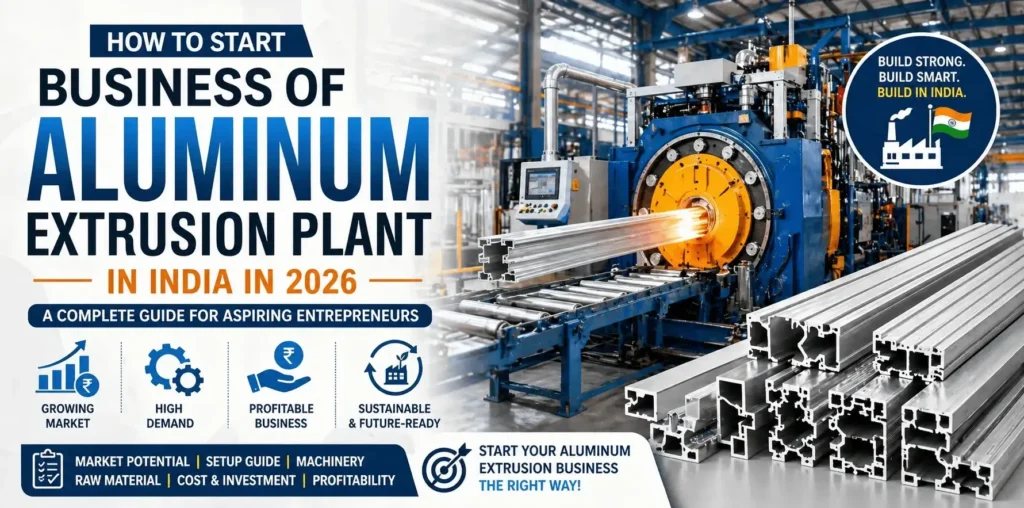
Aluminum is one of the most versatile and widely used non-ferrous metals in the world. Its lightweight, corrosion-resistant, and high-strength properties make it an ideal material for construction, transportation, consumer goods, solar panel frames, electronics, and more. One of the most important processes in the aluminum industry is extrusion, which allows the metal to be shaped into complex profiles for countless applications. With rapid urbanization, infrastructure growth, and the electric vehicle boom, the business of aluminum extrusion plant is becoming an increasingly attractive opportunity for entrepreneurs and MSMEs in India. Aluminum extrusion involves heating aluminum billets and forcing them through a die to create long, uniform profiles like channels, angles, rods, tubes, and custom designs. With growing demand from industries like real estate, automotive, railways, and electronics, starting a business of aluminum extrusion plant offers excellent growth and revenue potential. In this blog, we’ll explain the setup process, machinery, investment, market trends, and profitability of entering this sector. Visit this Page for More Information: Start a Business in Aluminium Downstream Sector Scope of the Business of Aluminum Extrusion Plant The global aluminum extrusion market is expected to reach USD 130 billion by 2030, growing at a CAGR of over 6%. In India alone, aluminum consumption is projected to reach 10 million tonnes by 2030, with extrusions making up 25–30% of this usage. Key Application Sectors: Construction and infrastructure Renewable energy (solar and wind) Automobiles and electric vehicles Electrical and electronics Consumer products and modular furniture Starting the business of aluminum extrusion plant gives you access to both B2B and B2C markets with high customization flexibility and growing demand. Read our Books Here: The Complete Technology Book on Aluminium and Aluminium Products