
Paint Thinner Manufacturing Market Research Report 2026: Size, Growth, Demand-Supply Structure and Business Opportunity for Startups in India
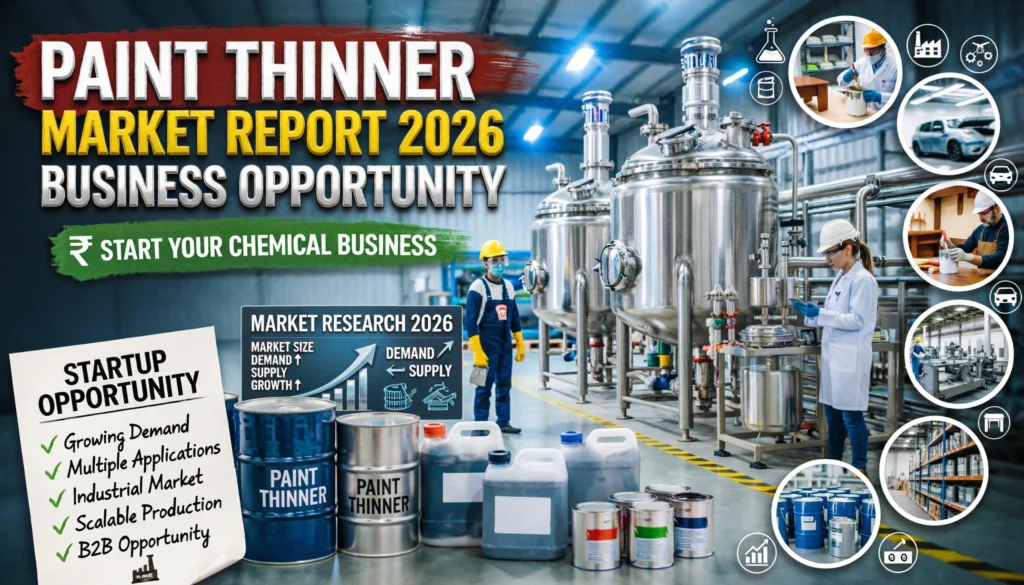
Paint Thinner Manufacturing Business in India All decorative, industrial, and automotive refinish paint sold in India will end up using a thinner at some point in its use. Unlike most segments in the report series, India’s thin industry does not have any big national brands dominating the market, but it is a highly fragmented market, where small and mid-sized regional manufacturers can be found in the wholesale directories but not listed companies. It’s the opportunity to be honest; it’s a platform with moderate capital investment, and really a good, low-brow entry point into the massively growing paints and coatings market in India, unlike many chemical categories in this series which are chemically exotic, and have the import reliance and exotic feedstock constraints. What Is Paint Thinner? Paint thinner – any volatile solvent or solvent mixture that is used to lower paint viscosity (increase flow, levelling and application properties) and to clean equipment and surfaces after paint use. From a commercial perspective, thinner formulations are classified according to chemical base and application: Mineral spirits, toluene, xylene, methyl ethyl ketone (MEK), acetone, glycol ethers and, more recently, bio-based and low-VOC alternatives are some of the key solvent components found in these formulations, as environmental regulations increasingly bite into the formula. Get Detailed Insights from This Book: Manufacture of Paint, Varnish & Allied Products Global and India Paint Thinner Market Size and Growth Recent studies (2026 base year) estimate global demand for paint thinner to be approximately USD 8.7 billion to USD 12.3 billion, with projections of moderate to mature-market growth (between 3.1% and 4.2%) in the market, which closely align with the growth of global industrial production and construction activity, and is expected to reach approximately USD 12.6 billion to USD 17 billion by 2034-2036. With its growing industry of paints and coatings, India is one of the fastest-growth national markets in the region, accounting for about 34% of the global market (USD 2.66 billion) in 2026, as infrastructure development, industrialisation, and increasing demand in the automotive sector are contributing towards the growth of the paint thinner market. Note on figures: Market studies of paint thinners often group various types of solvent-based paints (NC, PU, epoxy, general purpose) into the same category or list them separately by the different agencies. NPCS can create an investor grade techno-economic feasibility study that is customized to your particular thinner type (NC, PU, epoxy, or general purpose), and your target end-use segment. A Structurally Fragmented, MSME-Driven Market India’s paint thinner market is segmented into many small-scale paint thinner producers which are unlike large-scale petrochemicals or fertilizer categories. The industry directories indicate hundreds of small and medium manufacturing companies — most of them have a single production facility in clusters such as Ahmedabad, Mumbai, Kundli/Delhi, Pune and Chennai — and not a handful of leading national manufacturers. This is attributed to its relatively simple manufacturing process which is based on blending, and the high local demand associated with local paint production and application activity. This fragmentation is also informative to a new player: the barrier to entry isn’t limited raw material or complex chemistry, but capital and formulation know-how, and this is a distinct risk profile from most categories in this series, and why so many regional players have made it to the market without major investment. Policy Tailwinds 1. India’s fast-growing paint and coatings industry: The downstream demand for paint is also increasing rapidly with India’s automotive sector alone accounting for around USD 30.0 billion or about 7.1% of the GDP and the construction industry is booming with the national infrastructure programmes. 2. Inward trend of Index of Industrial Production (IIP) and manufacturing activity: With growth in industrial machinery and equipment, and general manufacturing, the demand for industrial grade thinners for equipment maintenance, cleaning and finishing also increases. 3. Environmental regulation favouring lower VOC formulations: As India faces growing environmental media attention, similar to the rest of the world under international schemes such as EU’s REACH regulation and US EPA standards, the Indian formulators have to use less VOC, more sustainable thinner formulations as per the emission guidelines by CPCB, a differentiation opportunity for manufacturers who invest in reformulation before the tighter regulations. 4. MSME manufacturing incentives: Given the sector’s already-established MSME-dominated structure, thinner manufacturing units are well-positioned to access MSME capital subsidy schemes and state industrial incentives. 5. Growing automotive refinishing and collision repair sector: As India’s vehicle parc expands, the automotive refinish and body shop segment sustains a distinct, steady demand stream for specialty automotive-grade thinners. View Full Project Details: Complete Guide to Paints, Pigments & Coatings India Market Structure: Paint Thinner Parameter Current Position Market structure Highly fragmented — hundreds of small-to-mid-scale regional manufacturers rather than a small number of dominant national brands Manufacturing complexity Relatively low barrier — primarily a solvent blending operation rather than complex primary chemical synthesis, making it accessible to a broader range of entrepreneurs Regional concentration Strong clusters in Gujarat (Ahmedabad), Maharashtra (Mumbai, Pune), Delhi/Haryana (Kundli), and Tamil Nadu (Chennai), tracking India’s major paint manufacturing and industrial hubs Feedstock dependency Raw materials (mineral spirits, toluene, xylene, MEK, acetone) are largely refinery/petrochemical byproducts, with pricing exposed to crude oil and domestic refinery output rather than a scarce, imported specialty feedstock Nature of the opportunity Not an import-substitution gap in the traditional sense, but a fragmented-market consolidation and quality-differentiation opportunity — genuine room exists for a well-run, quality-consistent regional manufacturer to build share against a very long tail of smaller competitors Price volatility exposure Directly tied to crude oil and petrochemical feedstock costs — recent tracking shows paint and solvent prices rising sharply (Asian Paints raised prices 12% in mid-2026) amid crude-linked feedstock cost pressure Reading the market: This category doesn’t present the kind of clean, quantified demand-supply gap seen in categories like carbon fibre or PCBs — India already manufactures the bulk of its thinner domestically, across a large number of small producers. The opportunity here is different: a genuinely large, growing, moderate-capital-entry market where quality consistency, formulation
Sodium Hydrosulphite Market Research Report 2026: Size, Growth, Demand-Supply Gap and Business Opportunity for Startups in India
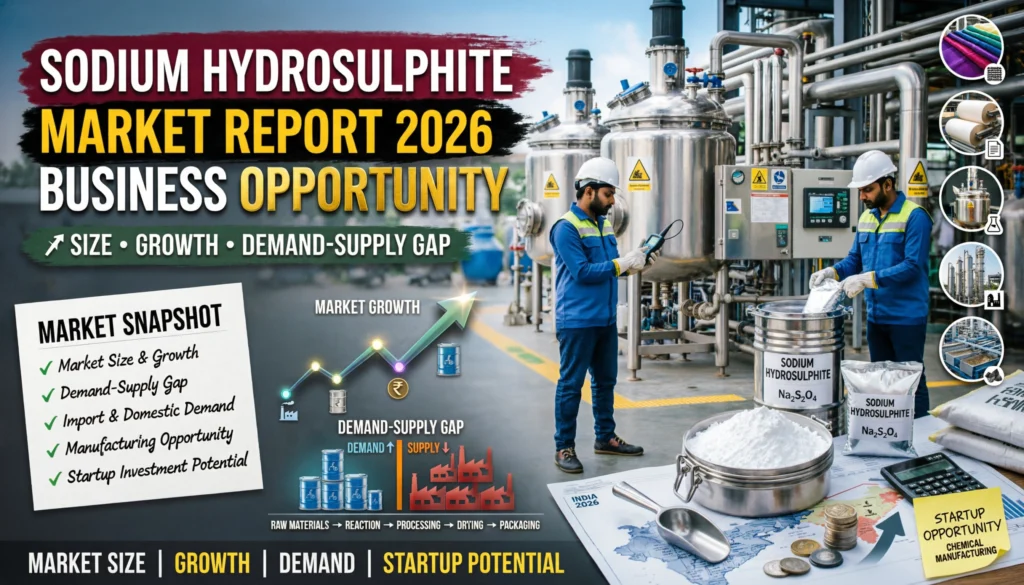
Sodium Hydrosulphite Manufacturing Business The vast textile and apparel manufacturing infrastructure in India is the largest in the world, and almost every metre of cotton, viscose or denim fabric that comes off the mill floor in India has been treated with sodium hydrosulphite, at some point in its life. It’s a non-glamorous reducing agent, but it’s also a chemical India still imports the majority of its requirements to meet: a simple opportunity with no seasonality, and the demand is assured. What Is Sodium Hydrosulphite? Sodium hydrosulphite is a white crystalline powder, and one of the strongest commercially available reducing agents, commonly called sodium dithionite or “hydros” in industry. It is produced by three major industrial processes: However, its essential characteristic, strong reducing power which easily breaks down in acidic or hot aqueous conditions, makes it indispensable in several industries: Get Detailed Project Report (DPR): Sodium Hydrosulphite Manufacturing Project Report Global and India Sodium Hydrosulphite Market Size and Growth Global market-size estimates for sodium hydrosulphite (sodium dithionite) in the most recent of the estimated base years (2022–2025) span from about USD 1.0 billion to USD 1.6 billion, and forecasts range from USD 1.46 billion to USD 1.7 billion by 2030–2034, at CAGRs that tend to cluster between 2.2% and 5.2% depending on study, a moderate, mature-market growth profile due to steady demand and emerging substitution threat from alternative reducing chemistries. The domestic market is projected to grow at a significantly higher CAGR of around 5.0% with rising demand in various applications, such as textile dyeing, paper bleaching and water treatment during 2020-2024, and forecast to reach a size of 200 MT by 2035 with the growth of environmentally friendly and high efficiency hydrosulphite products. Note on figures: Sodium hydrosulphite is also known by various names in market studies (sodium dithionite, “hydros” or hydrosulfite) and the amount in some studies may be stated as part of the liquid/stabilised formulations, as reported in the powder column. NPCS can provide an investor-grade TEFS that can be customized for your selected process route (sodium formate vs zinc dust) and application segment. India’s Import Dependence Industry sources say India’s domestic sodium hydrosulphite market is import-dependent with the product not just a niche specialty chemical but a base industrial input for the huge Indian textile industry, and that domestic capacity has not matched the demand. This translates into an “immediate opportunity for domestic manufacturers” – that is, demand that is not seasonal, not dependent on a single industry’s cycle and that is already partly being satisfied by imports. Policy Tailwinds Read the Complete Book Here: Modern Technology of Industrial Chemicals India Demand-Supply Gap: Sodium Hydrosulphite Parameter Current Position Demand base Broad and non-seasonal — spread across textile dyeing/bleaching (largest), paper bleaching, water treatment, mineral processing, and food preservation Domestic production base Limited number of established producers, most notably TCP Limited (the only Indian plant using the sodium formate process, one of only five such plants worldwide) and Gulshan Chemical Ltd. Import dependence Documented by industry sources as an ongoing structural gap — India imports a share of its sodium hydrosulphite requirement despite having a substantial textile-driven demand base that could support more domestic capacity Textile sector linkage India’s textile industry is one of the largest in the world by volume; as polyester and blended fabric usage grows alongside cotton and viscose, reducing-agent demand grows correspondingly Nature of the gap An import-substitution opportunity tied directly to India’s textile manufacturing scale — demand growth is assured by the underlying textile sector; the gap is in domestic reducing-agent production capacity, particularly using the cleaner, more compliant sodium formate process Opportunity for new entrants Strong for regional manufacturers positioned near textile clusters (Gujarat, Maharashtra, Tamil Nadu), particularly those adopting the sodium formate process for lower environmental compliance cost Reading the gap: This is a straightforward, demand-secure opportunity: India makes more textiles than almost anywhere else in the world, and sodium hydrosulphite is a non-substitutable input for a large share of that dyeing and bleaching process. The gap isn’t about proving demand exists — it’s about India’s current domestic manufacturing base (concentrated in a small number of established players) not yet matching the country’s textile-sector scale, leaving room for regional capacity closer to specific textile clusters. Major Indian Sodium Hydrosulphite Manufacturers Company Base/Region Process Notes TCP Limited India (with Mitsubishi Corporation, Japan technology collaboration) Sodium formate process India’s only plant using this cleaner process — one of only five such plants in the world; produces “Hydros” free of zinc, iron, or mercury traces Gulshan Chemical Ltd. Bhiwadi, Rajasthan Established process Recognised registered synthesizer supplying premium-grade sodium hydrosulphite to the textile trade across Mumbai and other markets Veeraj Chemtech Pvt. Ltd. India Established manufacturer Recognised Indian sodium hydrosulphite producer S.D. Dyes & Chemicals India Established manufacturer Recognised regional producer serving textile dyeing and paper industry customers Regional Gujarat/Rajasthan-based manufacturers (Ahmedabad, Vapi, Bhiwadi clusters) Gujarat, Rajasthan Various The MSME-scale entry tier — smaller regional producers serving local textile mill demand Major International Sodium Hydrosulphite Players Company Country Notes BASF (BASF Canada) Germany/Canada Major global chemicals company among the top players by market share in the sodium hydrosulphite/dithionite market Guangdong Zhongcheng (Zhongcheng Chemical) China Major Chinese producer; China holds an estimated 60% share of global sodium hydrosulphite production, driven by its massive textile manufacturing sector Yantai Jinhe China Recognised major Chinese sodium dithionite manufacturer Hubei Yihua China Recognised major Chinese chemicals producer with sodium dithionite capacity Huidelong China Recognised Chinese sodium dithionite manufacturer Transpek-Silox (India-linked international operations) India/international Cited among the top global players in some market studies, reflecting India’s growing manufacturing relevance in this category Market Segmentation By Process By Form By Application By End-Use Industry Key Growth Drivers 1. The size of India as a global textile producer. India has one of the largest textile industry bases in the world and the production of polyester and mixed fabrics continues to rise, so the base demand for reducing agents, such as sodium hydrosulphite continues to grow in India. 2. Move towards sodium formate
Citric Acid Market Research Report 2026: Size, Growth, Demand-Supply Gap and New Business Opportunity for Startups in India
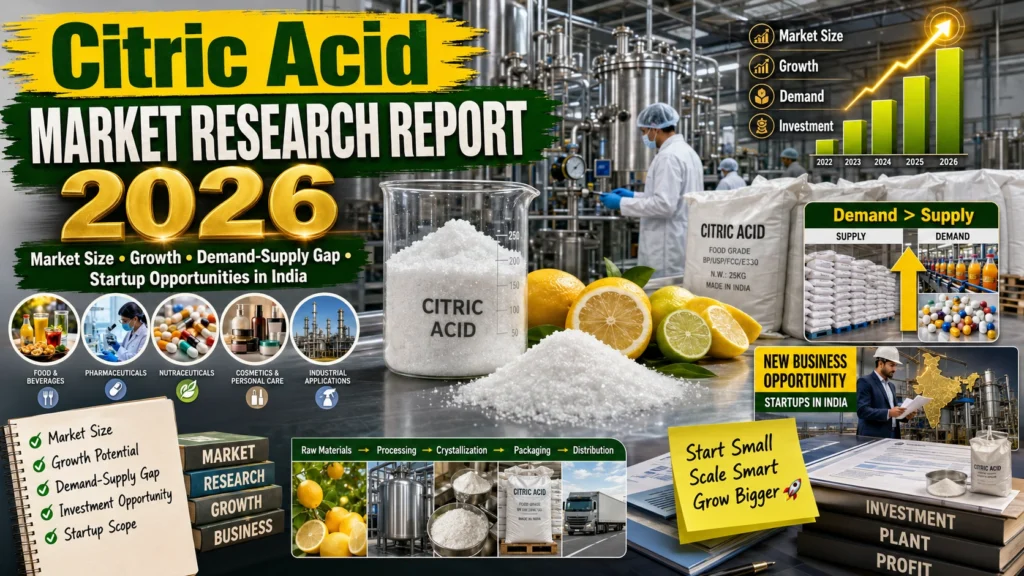
Citric Acid Manufacturing in India India is the second highest consumer of citric acid and second highest producer of citric acid in the world but it still imports almost the entire quantity of citric acid required to meet the domestic demand by the Chinese industry which produces nine times more citric acid than India. China’s export market is tightening through 2026 and India’s food, beverage and pharmaceuticals industry is still booming, while the fermentation process is one that India is familiar with. View Full Project Details: Citric Acid Manufacturing Plant – Detailed Project Report & Business Plan What Is Citric Acid? Citric acid is a weak organic tricarboxylic acid, which is commercially produced almost exclusively by microbial fermentation; Aspergillus niger mould fermented on sucrose, molasses or corn-steep liquor that can yield over 90% (on substrate basis). The metabolic product of the mould is filtered out and citric acid is precipitated as calcium citrate with lime (calcium hydroxide) and re-dissolved in sulphuric acid (or can be separated by liquid-liquid extraction). Citric acid is available in two main forms: It is widely used in the following applications: Related Article: How to Start a Citric Acid Manufacturing Business from Lemon Global and India Citric Acid Market Size and Growth The global citric acid market in 2025-26 was valued at an estimated range of USD 3.77–4.21 billion, and is expected to reach between USD 4.81–5.54 billion by 2031-2033, with the average rate of growth being in the range of 3.7% to 4.12%. China leads the world in production by volume, with an estimated 65-70% of global capacity, fueled by an integrated fermentation facility and a large supply of corn-based feedstock. India has a truly noteworthy but structurally weak stake in this situation: It is the 2nd largest consumer of citric acid with an estimated consumption of 420,000 tonnes per year, behind only China (1.1 million tonnes), and the 2nd largest producer with domestic production of around 296,000 tonnes per year. China produces about 2.6 million tonnes, compared to India’s nine times less ability. Note on figures: Citric acid market studies can be different in considering the acid alone or including its salts or esters (sodium citrate, potassium citrate, etc.). NPCS can provide a customised techno-economic feasibility study, tailored to your target product form (anhydrous vs. monohydrate) and your target grade (food versus pharmaceutical), for numbers for the investor. India’s Quantified Supply-Demand Deficit The consumption of about 420,000 tonnes, and domestic production of about 296,000 tonnes annually indicate that India has a structural deficit of about 124,000 tonnes per annum, which is met almost entirely by imports, with China being the predominant supplier. This gap is there while at the same time India maintains a significant market presence through valuable exports including to the United States, indicating a market where domestic supply is lacking, in terms of both volume and quality/grade mix, compared to market demand. The dependence is real and near term: Chinese export monitoring has ratcheted up and freight risk has risen since 2026, with almost 70% of all citric acid imports from just one country, which is just the type of geopolitical and logistics risk that has spurred new domestic investment in import-dependent markets. Policy Tailwinds 1. Capacity protection and incentives for domestic capacity: Thailand used anti-dumping duties on imports from China to protect and incentivise domestic supply of citric acid, a policy that India can use, as capacity is documented and significant and import dependency is high in the country as of January 2025 (in 57.79%). 2. Growing domestic food processing and beverage industry: India’s ready to drink (RTD) beverage, processed food and packaged food industry is a direct growth driver for citric acid, further supporting citric acid backward integration in the domestic market. 3. Clean label, natural preservative demand: Citric acid is GRAS/FSSAI approved as a natural preservative and acidulant, which is correlated with the demand of natural preservatives/synthetic preservative substitutes by the Indian consumer and regulatory preference. 4. Incentives for circular economy and waste valorisation: Indian citric acid producers have increasingly been looking into waste valorisation as a strategy, e.g., use of spent fermentation biomass for animal feed, biogas or compost, and it is being integrated into the overall value-addition and sustainability agenda of the government. 5. Domestic sugar production base: India has a large domestic sugar and molasses base, which gives an authentic raw material advantage for new capacity as a molasses and sugar-based fermentation process. India Demand-Supply Gap: Citric Acid Parameter Current Position India’s annual demand ~420,000 tonnes — the world’s second-largest national consumption India’s annual production ~296,000 tonnes — the world’s second-largest national production base Annual supply deficit ~124,000 tonnes, met almost entirely through imports Comparison to China China’s production capacity (2.6 million tonnes) is roughly 9x India’s output, despite India being a similarly large consumer Import value (2024) India imported approximately USD 105.2 million worth of citric acid ingredient streams in 2024 Market structure A few large players dominate domestic capacity, while many small and mid-sized units rely on imports or toll production, leaving the supply chain exposed to input shocks and logistics delays Nature of the gap A clearly quantified, persistent import-substitution gap — roughly 30% of India’s total demand is currently unmet by domestic production, a structural rather than cyclical shortfall Opportunity for new entrants Strong — greenfield fermentation capacity investment is already being actively evaluated in India, with feasibility studies indicating attractive project economics at meaningful scale Reading the gap: With India already the world’s second-largest producer, this is not a technology or process-knowledge gap — India’s fermentation industry (used similarly for enzymes, antibiotics, amino acids, and other bio-based chemicals) already has the relevant expertise. The gap is one of installed capacity relative to a demand base that continues to grow with India’s expanding food, beverage, and pharmaceutical sectors — and one that a documented feasibility study for a 30,000-tonne-per-annum greenfield plant estimates could achieve a 47% rate of return with break-even at just 45% capacity utilisation, indicating genuinely attractive project economics
Construction Chemicals Market Research Report 2026: Size, Growth, Demand-Supply Gap and Business Opportunity for Startups in India
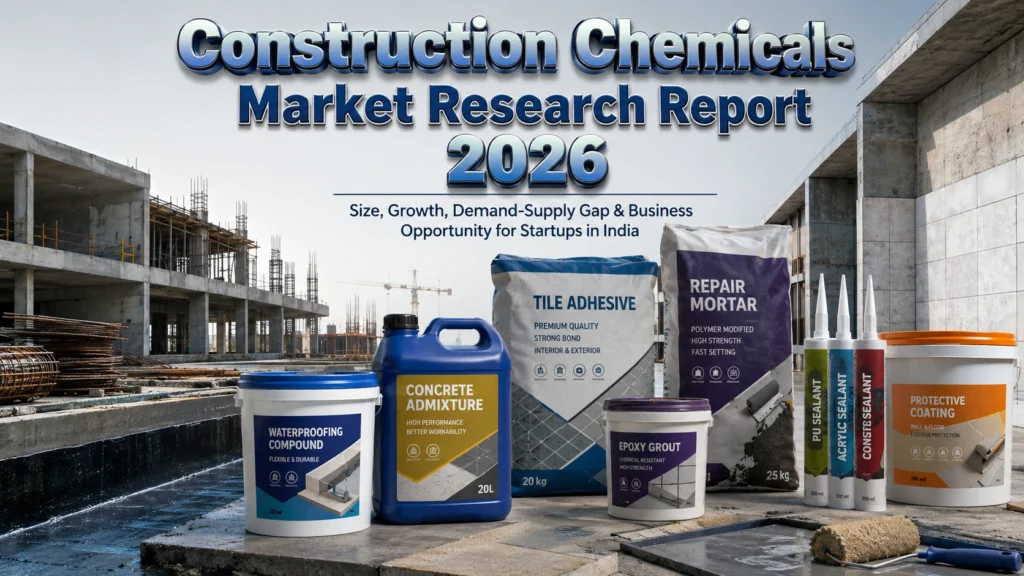
Construction Chemicals Market in India India’s construction industry is in the midst of its biggest capital expenditure cycle in decades – metros, highways, smart cities and a housing boom in Tier-2 and Tier-3 cities. Each of those projects requires the use of construction chemicals: admixtures to create workable and durable concrete; waterproofing systems; tile adhesives, grouts, sealants and repair compounds. But it’s a category that’s expanding even faster than the construction industry, as the intensity of the use of chemicals relative to square feet is increasing even as construction volume is increasing. The entrepreneurs find that sweet soup of volume growth and growing penetration a rare double whammy. What Are Construction Chemicals? Construction chemicals are sold on performance specification, as opposed to commodity pricing, are generally higher-margin, technically differentiated products, in contrast to bulk construction materials (cement, steel, aggregates). View Full Project Details: Construction Chemicals Projects India Construction Chemicals Market Size and Growth Market sizes published by different research firms have significant variations both due to the extent of the product scope (some include paints and coatings while others exclude these) and the base year methodology (some use a different base year than others) but all major studies indicate double-digit growth in India. The India market is estimated to be between USD 2.25 billion to USD 4.64 billion in 2025-26, and is expected to grow at a CAGR of around 10% to 14% in the near future, significantly higher than the global market, which is expected to grow at an average CAGR of ~3.5% over the same period. Note on figures: The wide range is because there is a genuine variation in scope of product activity between different research agencies (including paints, coatings and adhesives which are not used in non-construction applications). Consider the numbers above as directional. NPCS can put together a personalized techno-economic feasibility study tailored to your particular product line (admixtures, waterproofing, tile adhesives etc.) for investors grade numbers. What’s Driving the Faster-Than-Construction Growth The reason for this is that the construction chemicals market is expanding at a meaningful rate faster than the construction market – the number of square metres of ready-mix concrete (which relies heavily on admixtures) has increased, the number of buildings being constructed using advanced waterproofing, instead of traditional, has increased, and the number of developers using tile adhesives and epoxy grouts, as opposed to sand-cement mortar, has increased. The double-digit growth rates come from this progression from “no chemical” to “basic chemical” and then “advanced chemical”” specification, added to the increased construction volumes. Policy Tailwinds 1. National Infrastructure Pipeline (NIP): An investment plan for roads, railways, urban infrastructure and housing, with the total planned capital investment of approximately INR 111 lakh crore (₹11.1 trillion+). 2. Smart Cities Mission and metro rail expansion: This requires high-performance construction chemicals for tunnels, bridges, elevated structures, which are higher than the specification for residential building. 3. Pradhan Mantri Awas Yojana (PMAY) and affordable housing push: Mass housing construction drives volume demand for tile adhesives, waterproofing, and basic admixtures even in cost-sensitive segments. 4. BIS standards for construction materials: Increasing enforcement of Bureau of Indian Standards specifications for concrete and building materials is pushing informal/unorganised segments of the market toward branded, tested construction chemical products. 5. MSME and Make in India manufacturing incentives: Domestic manufacturing of construction chemicals — as opposed to imported formulations — is supported by manufacturing-linked incentive frameworks and MSME capital subsidy schemes. Check Out This Recommended Book: The Complete Book on Construction Materials India Demand-Supply Gap: Construction Chemicals Parameter Current Position Market structure Fragmented — the top five companies together hold only an estimated ~19% of the India construction chemicals market by some industry analyses Organized vs. unorganized share Several sub-segments (sealants, grouting) see meaningful unorganised/local competition; segments requiring stricter quality compliance (protective coatings, repair chemicals) are more organized-player dominated Domestic manufacturing base A mix of large MNC-linked players (Sika India, BASF/MBCC, Fosroc, Mapei, Saint-Gobain Weber) and strong domestic majors (Pidilite, Asian Paints, STP Ltd., Chembond Chemicals) manufacturing within India Nature of the gap Primarily a regional and category-specific capacity gap rather than an import-dependency gap — India largely manufactures domestically, but Tier-2/Tier-3 city demand and specific sub-categories (advanced repair systems, specialty flooring) remain underserved by regional-scale manufacturing Opportunity for new entrants Regional manufacturing closer to Tier-2/3 construction clusters, MSME-scale entry into specific product categories (tile adhesives, waterproofing coatings, admixtures), and contract manufacturing for established brands Reading the gap: Unlike categories where India depends heavily on imports, construction chemicals in India are largely manufactured domestically — the gap here is about market fragmentation and regional reach rather than a supply shortfall. With the top players collectively holding under a fifth of the market, and demand growing fastest in Tier-2/Tier-3 cities where large national brands often have thinner distribution, there is genuine room for a well-positioned regional manufacturer to build a defensible niche. Major Indian Construction Chemicals Manufacturers Company Base Focus Area Notes Pidilite Industries Ltd. Mumbai, Maharashtra Adhesives, waterproofing, sealants, tile fix systems India’s largest adhesives and construction chemicals company; brands include Dr. Fixit and Roff; revenue of ~₹13,094 crore (2025) Asian Paints Ltd. Mumbai, Maharashtra Waterproofing, protective coatings India’s largest paint company, with an expanding construction chemicals and waterproofing portfolio STP Limited Kolkata, West Bengal Protective coatings, waterproofing, repair chemicals Long-established Indian construction chemicals manufacturer (STP Berger) Chembond Chemicals Ltd. Mumbai, Maharashtra Protective coatings, admixtures, industrial flooring Established Indian specialty chemicals manufacturer with a construction chemicals division Bigbloc Construction Ltd. Gujarat Adhesives, putty, waterproofing (new entrant) Diversified into construction chemicals in 2024–26 under the Nxtfix/Nxtplast/Nxtgrip brands; representative of new domestic entrants Sunanda Specialty Coatings Pvt. Ltd. India Flooring, protective coatings Recognised Indian specialty coatings and flooring systems manufacturer Ramco Cements (Hard Worker brand) Chennai, Tamil Nadu Construction chemicals (new brand, 2025) Major cement company’s new construction chemicals brand, targeting ₹2,000 crore revenue within 4–5 years Sakshi Chem Sciences India Waterproofing agents, concrete admixtures, polymer additives R&D-focused domestic manufacturer Cera Chemicals / Cera-Chem Pvt. Ltd. India Waterproofing, admixtures Established regional Indian manufacturer Major International/MNC
Acetic Anhydride Market Research Report 2026: Size, Growth, Demand-Supply Gap and Business Opportunity for Startups in India
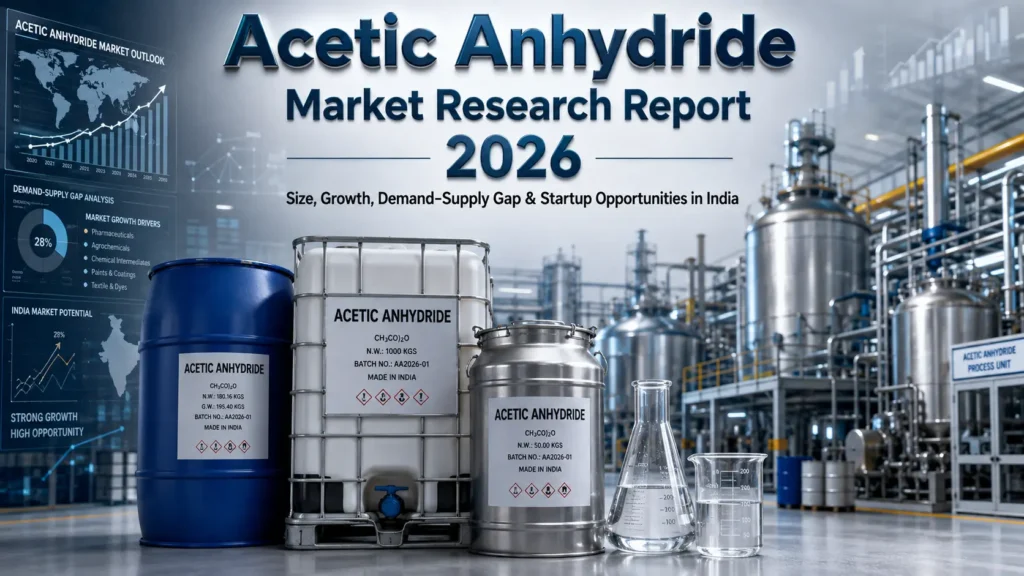
Acetic Anhydride Manufacturing in India India’s pharma sector is estimated to expand from USD 65 billion in 2024 to USD 130 billion by 2030 and acetic anhydride plays a central role in the synthesis process of some of the most widely consumed drugs produced by the industry, such as aspirin and paracetamol. However, the higher molecular weight acetyl chemical chain to which acetic anhydride belongs is one of the most import dependent industries in India as India imports over 85% of its need for upstream acetic acid. This opportunity is embedded in that dynamic: a growing demand for the pharma products downstream coupled with a highly import-dependent feedstock supply chain. What Is Acetic Anhydride? Acetic anhydride or ethanoic anhydride is a clear colourless liquid carboxylic acid anhydride produced mainly by the ketene process using glacial acetic acid as the raw material. It acts as a powerful acetylating agent (reacts with an alcohol or amine to add an acetyl group), which is useful in a number of key industrial value chains: Get Detailed Project Report (DPR): Acetic Anhydride Global and India Acetic Anhydride Market Size and Growth Global estimates for market value vary widely, depending on scope, from approximately USD 3.36 billion to USD 6.98 billion in 2025-26, rising to between USD 5.42 billion and USD 9.12 billion by the early-to-mid 2030s, with the CAGRs in the middle band. The size of India’s domestic market is estimated to be around USD 87–400 million (2024), with volume estimates ranging from approximately 76,000 metric tonnes (MT) in 2023, and most estimates of the Indian portion of the market CAGRs are significantly higher than the global average — ranging from 2.1% to as high as 7.8% across different studies — reflecting the country’s skewed higher growth pharmaceutical and agrochemical demand base compared to more mature global markets. Note on figures: Market studies of the acetic anhydride market differ in scope, some covering only the volume of the merchant market, others including the captive/integrated market. NPCS can develop an investor-grade numbers-based techno-economic feasibility study to suit your target application (pharma-grade vs. industrial-grade) and capacity. The Upstream Acetyl Chain Import Dependency The Indian supply position of acetic anhydride cannot be viewed in isolation as it is downstream of acetic acid and India’s acetic acid supply chain is extremely import dependent. India is the biggest consumer of acetic acid (around 1.2 million tonnes of acetic acid was consumed in 2024 ahead of China and the United States) but also imports over 85% of its acetic acid consumption, making the whole acetyl chain (including acetic anhydride, ethyl acetate and other derivatives) one of the most import dependent chemical sectors in India. The Indian acetyl chain market is estimated to be about USD 567 million, and could be significantly bigger by 2032 with the expansion of the downstream pharmaceutical and industrial market. This gives a unique strategic situation: domestic acetic anhydride capacity is growing (and recently has grown from established producers) – but even with this additional capacity, the production process still generally relies on the import of upstream acetic acid as feedstock – not just at the conversion stage of the process, but that stage is upstream. Explore This Book: Handbook On Chemical Industries (Alcohol Based) Policy Tailwinds 1. Pharmaceutical self-sufficiency push: India’s government emphasis on domestic API (Active Pharmaceutical Ingredient) production, aimed at reducing reliance on imports for critical drug intermediates, directly strengthens demand for domestically-manufactured, traceable, consistent-quality acetic anhydride. 2. PLI scheme of bulk drugs and key starting materials: Supporting the business case for backward integration investments for Acetyl chain – including Acetic anhydride – in indirect terms through PLI scheme for bulk drugs and key starting materials. 3. Expanding agrochemical export industry: India exports about 50% of its agrochemicals and the demand for acetic anhydride is closely linked to this export-intensive growth industry as it is used as a key raw material in the manufacture of organophosphate pesticides such as acephate. 4. Manufacturing relocation from stricter-regulation markets: Increasing environmental restrictions on pesticide manufacturing in the US and Europe are shifting agrochemical production toward India, further increasing domestic acetic anhydride demand. 5. Resurgent interest in cellulose acetate/bio-based materials: Revival of global interest in the use of cellulose acetate in the field of biodegradable plastics and sustainable textile products has generated new market opportunities for acetic anhydride in addition to the traditional cigarette filter tow market. India Demand-Supply Gap: Acetic Anhydride and the Broader Acetyl Chain Parameter Current Position India’s acetic acid position World’s largest consumption market (~1.2 million tonnes, 2024), yet imports over 85% of this requirement Broader acetyl chain market size ~USD 567 million (encompassing acetic acid, ethyl acetate, acetic anhydride, and related derivatives) India acetic anhydride market (2023) ~76,000 metric tonnes, growing at a CAGR estimated between 2.1% and 7.8% depending on the study Recent domestic capacity expansion IOL Chemicals & Pharmaceuticals expanded acetic anhydride capacity from 25,000 to 32,000 MTPA (March 2026); Laxmi Organic Limited has proposed further expansion at its Raigad, Maharashtra facility Nature of the gap A compound, two-tier import dependency — India’s acetic anhydride production capacity is growing, but much of it still relies on imported upstream acetic acid, meaning the more structural opportunity sits in backward integration across the full acetyl chain, not acetic anhydride conversion alone Downstream demand driver India’s pharmaceutical industry, projected to grow from ~$65 billion (2024) to ~$130 billion (2030), directly and substantially grows the addressable acetic anhydride market as a critical drug synthesis intermediate Opportunity for new entrants Strongest for integrated players capable of backward integration from acetic acid production through to acetic anhydride and downstream cellulose acetate/pharma intermediate manufacturing Reading in the gap: This is a multi-layered opportunity, not a one-and-done opportunity. India’s own government recognised acetyl-chain research explicitly states that the country is “one of the most import dependent chemical industries in India” since 85%+ dependence on Acetic Acid, and in turn, this is a constraint on realising self-sufficiency at the level of Acetic Anhydride with an increase in conversion capacity.
5 Hypochlorous Acid Spray Manufacturing Business Ideas That Can Transform Your Entrepreneurial Journey
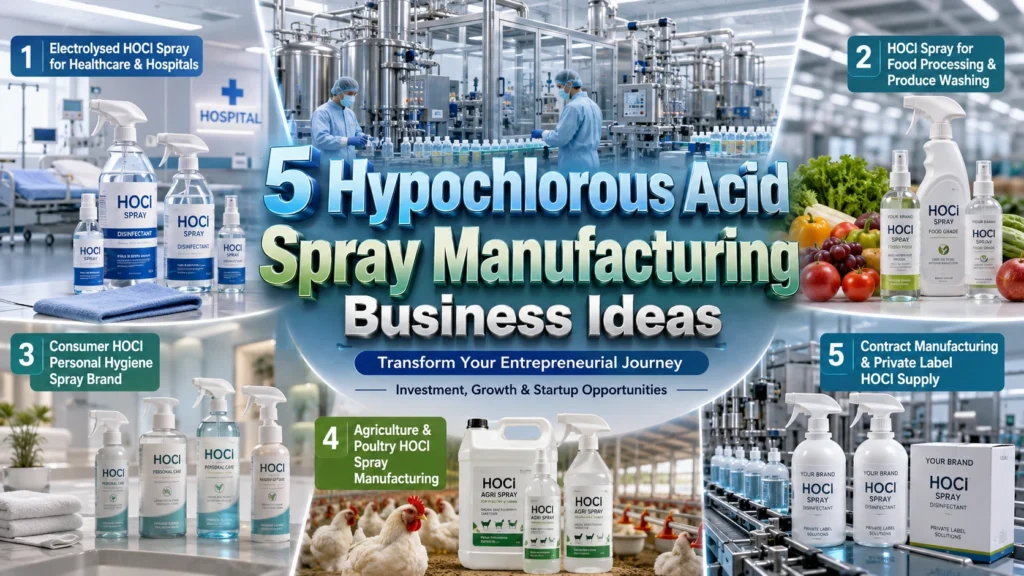
Hypochlorous Acid Spray Manufacturing Business The Indian disinfectant and antimicrobial market is undergoing a dramatic change. In the Chemical Processing business, one of the most promising ideas for entrepreneurs and MSME investors is hypochlorous acid (HOCl) spray manufacturing. Hypochlorous acid (HOCl) spray manufacturing is one of the most promising business ideas for entrepreneurs and MSME investors in the chemical processing industry. To gauge the manufacturing potential, Government support framework, trade dynamics and actionable business ideas in hypochlorous acid spray segment, this article delves into the matter in a detailed manner before the first-generation founders can invest. Hypochlorous acid spray is no longer a “scientific curiosity”. It has infiltrated the mainstream of health care, food processing, agriculture and consumer hygiene. It is a good opportunity for Indian entrepreneurs who are realizing its importance and the regulatory acceptance is growing. Why the Hypochlorous Acid Spray Industry Is Growing So Fast The need for non-toxic, broad-spectrum antimicrobial solutions has been rapidly growing worldwide over the last few years. Created by the electrolysis of salt and water, hypochlorous acid is a strong disinfectant with none of the corrosive or toxic properties associated with traditional chlorine-based disinfectants. This places it in an ideal position in several high growth verticals. Healthcare, food safety and agriculture sectors are all stepping up their hygiene measures in India. Increased demand is being placed on hospitals, food processing plants, poultry farms, and schools to use disinfectants that can be used safely for human exposure; that are biodegradable and that can kill bacteria, viruses and fungi. HOCl spray meets all these specifications. Market Drivers Supporting Rapid Growth The HOCl spray market is gaining momentum due to several strong market forces. The first is that more and more evidence is surfacing about growing microbe resistance to quaternary ammonium compound disinfectants, prompting institutional buyers – such as hospitals, hotel chains, airport authorities and others – to move away from these products. HOCl spray is a viable and scientifically proven alternative. Second, the food processing industry in India, as one of the world’s largest, requires multiple stages of disinfection in the surfaces and produce during the process of food manufacturing. The food-safe profile of HOCl spray and its approval by international food contact material norms are making it quickly popular in this segment. Third, the market of domestic animal care and veterinary hygiene is growing swiftly. In veterinary clinics in metros of Indian, HOCl spray has emerged as the preferred woundcare and sanitisation solution. Besides, there is a tremendous export potential as countries in the Middle East, Southeast Asia and Africa are actively importing the antimicrobial products from India. These export corridors are a good revenue diversification avenue for GMP and WHO-GMP manufacturers. Government Policies and Incentives Favouring HOCl Manufacturing The policy landscape in India is actively geared towards establishing chemical processing and disinfectant manufacturing MSMEs. There are several schemes providing direct monetary and operational benefits to start-up entrepreneurs in this space. MSME Udyam Registration and Credit Linked Capital Subsidy The Ministry of MSME launched the Credit Linked Capital Subsidy Scheme (CLCSS) to offer a capital subsidy of 15% in the initial stage for technology upgradation in small-scale manufacturing units, on the institutional credit. Electrochemical activation (ECA) manufacturing units are eligible for this scheme. This support is provided via MSME CLCSS portal (L1) for entrepreneurs. PLI and Chemical Sector Incentives via DPIIT The Department for Promotion of Industry and Internal Trade (DPIIT) has been working on strategies for the various sectors for chemical and pharmaceutical adjacent manufacturing. The Make in India promotion of manufacturing will help MSMEs in the disinfectant manufacturing segment. Make in India Chemicals Sector page (L2) contains relevant policy briefs. Startup India Recognition and Tax Benefits Private limited company/LLP based spray manufacturing startup can apply for Startup India recognition benefits such as exemption from income tax for 3 years, self-certification for labour and environmental laws and tenders eligibility to prioritise government tenders. The Startup India Government Schemes portal (L3) provides a single window access to programmes available. Further, the Production Linked Incentive (PLI) Scheme for bulk drugs and chemicals also indirectly benefits the disinfectant producers. Additionally, most state governments now have some sort of single window clearance system for chemical manufacturing enterprises; entrepreneurs should investigate this. 5 High-Potential Business Ideas in Hypochlorous Acid Spray Manufacturing Business Idea 1 — Electrolysed HOCl Spray for Healthcare and Hospital Supply A potential, highly profitable entry into the HOCl spray market is to product a concentrated or ready-to-use hypochlorous acid disinfectant spray specifically designed and packaged for use in a hospital, clinic or diagnostic center setting. Both private hospital chains and government hospitals in India are actively working on improving their surface disinfection practices in line with the guidelines laid down by National Accreditation Board for Hospitals (NABH) and Joint Commission International (JCI). A small scale ECA-based HOCl manufacturing unit can be set up by an entrepreneur to manufacture disinfectants in the spray format as per IS/ISO standards and can be sold to the institutional procurement departments. The business model is based on repeat orders, large supply contracts and somewhat inelastic demand: Hospitals disinfect every day, irrespective of the economy. Distribution can be done via pharmaceutical distributors, medical consumables suppliers or through their own sales team at the institution. This is a good manufacturing opportunity that has a defined and organized buyer population, and an attractive value proposition with respect to non-toxicity and surface safety. View Full Project Details: Healthcare and Medical Businesses Business Idea 2 — HOCl Spray for Food Processing and FSSAI-Compliant Produce Washing India’s food processing industry processes millions of tonnes of fresh produce, meat, seafood and dairy products annually. It’s essential to get validated disinfection of the surfaces and produce for all processing units to adhere with FSSAI guidelines. Spraying with hypochlorous acid, especially at concentration levels in between 50 ppm and 200 ppm, has been recognised worldwide as a food-contact safe sanitiser. This presents a tremendous under-served manufacturing opportunity. A start-up company might be able to manufacture food grade
How to Start a Water-Soluble NPK Fertilizer Business

This book will provide a practical and consultant style approach of making the Water Soluble NPK Fertilizer Manufacturing in India, market logic, government support, business ideas and practical feasibility steps. Currently, water soluble NPK fertilizer has become one of the most attractive manufacturing opportunities in India in a stealth manner. Farmers today are expecting rapid nutrient uptake and drip irrigation is gaining a sudden momentum in Maharashtra, Gujarat, Karnataka etc. This change is creating solid business opportunities for somebody with chemistry, timing and knowledge of government support in mind. It isn’t simply a matter of mixing together the correct proportions of NPK solution. It’s all about getting the demand signals right and creating a business that will evolve with the changing Indian farm economy. In this article, you’ll follow the logic of the market, the schemes you know of, some real business ideas, and some foundational work you should do before putting money into any business. Get Detailed Project Report (DPR): Fertilizers & NPK Manufacturing Why This Sector Is Growing Fast The water-soluble fertilizer market in India is estimated to be USD 425 million recently, and will hit the mark of USD 650 million within a couple of years. This translates to a growth rate in excess of 7 percent per year. However, the Indian NPK fertilizer market is already in the USD 12 billion mark and continues to rise. That isn’t an educated guess. They truly represent a ground-level change. The Shift From Bulk Urea to Specialty Nutrition The Indian agriculture has been functioning on bulk urea and subsidized granular urea for decades. But now horticulture has reached a level of production of over 3.5 crores tonnes per year, and high value crops like grapes, pomegranates and vegetables require accurate and quick nutrition. As a result, farmers cultivating these crops are shifting to fertigation and foliar feeding, for which 100% water soluble grades are essential. As a result of the government-sponsored schemes, there has been a further expansion of micro-irrigation, and of course this is attracting more farmers to soluble fertilizers as drip systems will not work with granular material. Profitability Logic Behind Water-Soluble Grades The prices of water-soluble NPK fertilizers are generally not subject to the statutory price control regime in place for bulk urea. This has allowed manufacturers to price their products according to quality and formulation instead of a specific subsidy slab. This one thing completely alters the new competitor’s profitability equation. Margins on water-soluble grades with branding, fortification or micronutrients generally are much higher than margins on standard granular grades. In this way, a well-managed small unit can offer competitors quality and service, as well as price, and thus compete on more than just price. Government Policies Supporting New Businesses A new entrepreneur is not required to use his own capital to finance all activities. The policy landscape for MSMEs in India has come a long way and there are various schemes that are applicable to a fertilizer manufacturing start-up. MSME Registration and Credit Support The first step for every founder should be Udyam Registration, an online platform set up by the Ministry of MSME which is free of cost for the founders. After registration, a unit can avail of loans up to ₹1 crore without any collateral under the Credit Guarantee Fund Trust for Micro and Small Enterprises or CGTMSE. Besides, the Credit Linked Capital Subsidy Scheme (CLCSS) provides subsidy for the machinery upgrade and the Prime Minister’s Employment Generation Programme (PMEGP) provides margin money subsidy ranging from 15% to 35% as per the scheme category and area. These schemes, together, can significantly reduce the initial investment for a new fertilizer plant. Fertilizer-Specific Regulatory and Support Framework Each fertilizer company has to register under the Fertilizer Control Order (FCO) with the Department of Fertilizers that prescribes quality criteria for NPK grades. On the demand side, the Pradhan Mantri Krishi Sinchayee Yojana continues to expand the scope of micro-irrigation, directly expanding the addressable market for soluble fertilizers. In addition, state governments in Maharashtra and Gujarat provide major subsidy on drip irrigation capital cost for the smallholder farmers, thereby indirectly encouraging the demand for fertigation friendly nutrients. Entrepreneurs can also avail Make in India resources on export facilitation and manufacturing incentives available to them in the agri-input segment. Get Detailed Insights from This Book: Fertilizers Manufacturing Handbook Profitable Business Ideas in This Water-Soluble Fertilizer Sector Here are some business ideas that can be implemented in this space. They are geared toward different customer segments and should be chosen based on the founders’ capital, location, and market access. 1. Fully Water-Soluble NPK Powder for Fertigation This is the big opportunity, the one that provides a lot of value. A unit manufactures crystalline or powder pellets (NPK) that will dissolve in the irrigation water, such as 19:19:19 or 13:40:13. Quality consistency is of huge importance, as these grades are directly connected to the drip system, and any insoluble residue can ruin a farmer’s trust by clogging emitters. Sizing and purifying the particles are critical for repeat orders and require investment at an early stage in the manufacturing process for a founder entering this segment. This model has a quick path to actual revenue, as the farmers obtain it through agri-input dealers in horticulture belts, especially in Maharashtra, Karnataka and Andhra Pradesh. 2. Foliar Spray Grade Fertilizer for Export Crops Foliar sprays are used on crops intended for export including grapes, pomegranates and cut flowers where there are requirements for buyers to see good quality and compliance with residues. A mini unit focused on foliar grade formulations can command a higher price because these products address a specific issue – correction of nutrient deficiencies during a critical growth phase. Relationships with the export market are best established with the farmer producer organisation (FPOs), rather than with general retailers, as the latter prefer consistency and technical support over the lowest price. 3. Micronutrient-Fortified NPK Blends For high value horticulture, plain NPK may not be sufficient. Therefore, the fortified blends
BHAVYA-Rasayan Scheme: 3 Chemical Parks, 10 chemical manufacturing Business Ideas for MSMEs
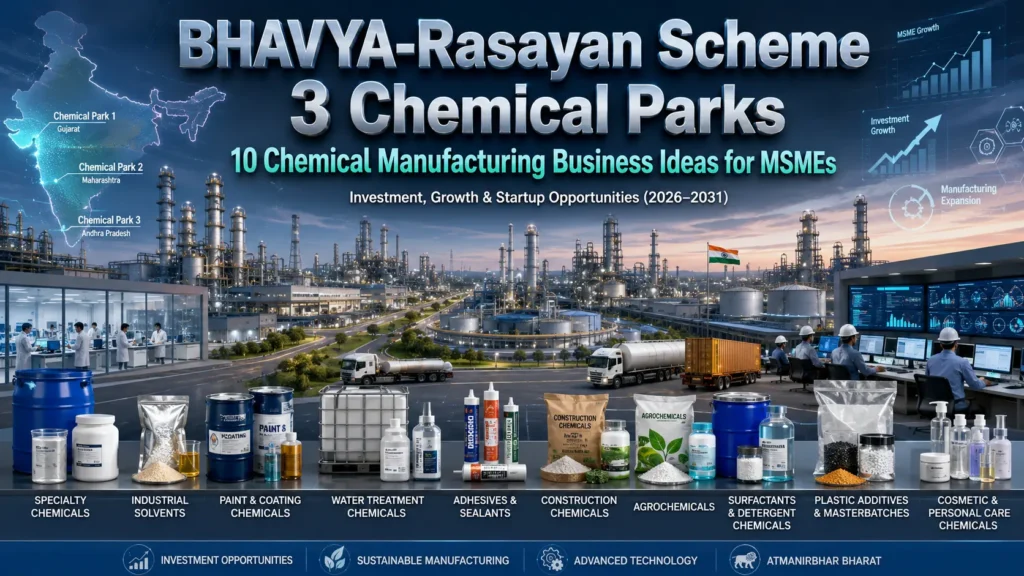
BHAVYA Rasayan Scheme Ten first-time promoters will say: What does it take to manufacture chemicals? Nine will say: What does it take to manufacture chemicals? How many dollars does it cost? That’s a good question, but it’s masking a better one. The question is what is the interest earned on each rupee and what is the time period. This article has both answers. It classifies practical business ideas based on the amount you can invest; so that you will not waste your time on the projects that you can’t afford. The timing is also a factor. Three dedicated chemical parks are a part of the BHAVYA-Rasayan scheme and the Union Cabinet has approved funding of ₹3030 crore for the same. Concentrated utilities within those parks will reduce the capital cost for all units within those parks. As a result, a number of projects that were considered to be too expensive just a year ago are now at the reach of a mid-size promoter. Why Founders Ask the Wrong Question First Capital Is Rarely the Real Constraint Good chemical projects are bank financed. They have been doing so for decades. The money is the least thing that prevents most promoters from succeeding. Far more projects fail due to weak product selection, missing approvals, and unrealistic demand estimates than due to tight budgets. Thus, capital is a result of good planning and not the beginning. What Actually Decides Your Return The profitability of this sector is determined by three factors. The first is the level of narrowness and defensibility of your product. Second, the efficiency with which you are using utilities like steam, power, water etc. Thirdly, your rate of filling capacity. The plant is not the same at 40 per cent as it is at 80 per cent. In most years, in fact, utilisation is more than the price. Margins Rise as Products Get Harder to Copy Simple blending businesses have regular, but modest margins. Product with the need of process know-how, catalysts or tight product purity fetches much more. They also require improved chemists and extended customer approval processes, though. So it does not actually make any sense to say it is a choice of ladders anymore. Select the rung that suits your team, not your bank account. How to Read a Chemical Project Cost Sheet The Five Blocks Every Project Contains When you’re judging a project, divide it up into 5 parts: Land and site development, which is eliminated by a park location. This is typically 15 to 20 per cent of the building or civil work cost. Plant, machinery and instrumentation (usually the largest block). Utilities and pollution control, typically 20 – 30 per cent, in standalone units. Working capital in the form of preliminary expenses, contingency and margin money. Be aware of the significant contribution of utilities and pollution control to the total. This one sentence is the answer as to why shared park infrastructure is such an important issue to smaller promoters. Related Article: 15 Profitable Chemical Business Ideas in India (Low Investment Manufacturing Guide) The Working Capital Trap This is where new founders are most likely to get hurt. Raw material must be paid for within a short period of time, and customer payment takes 60 to 90 days. Export buyers pull it even more. In the meantime, there is never an idle hour for salaries or power bills. Thus, even if a profitable plant is developed, it may still be cash-flowed in the first year. For at least 3-4 months operating cost, budget the operating cost as working capital; arrange the limit before commissioning; don’t wait after commissioning to arrange the operating cost limit. Business Ideas Under ₹2 Crore Don’t let small capital fool you, this is a big opportunity. The ideas below require small investments since they do not demand a lot of synthesis and pollution load. Chemical Testing and Calibration Laboratory All chemical units are required to test raw materials, finished products, effluent and emissions. Small units don’t have the resources for their own full analytical lab; therefore, they outsource. Thus, there is a demand for a NABL accredited third party laboratory from its first year. Services smoothly widen into instrument calibration, safety data sheet preparation and export support. Investment is in the instruments and qualified analysts, not land and reactors. Margins remain high because the key factor is skill. Fortunately, tougher environmental standards continue to grow the market without needing to be pushed. This still stands as one of the best opportunities for a technically savvy entrepreneur with little money to invest, anywhere in the industry. Drum Reconditioning and Chemical Packaging Chemicals are transported in drums, carboys, IBCs and each and every one of these requires cleaning, testing and certification before reusing. A reconditioning unit removes the used containers, conditions them to be standard and puts them back into circulation. The demand gradually increases with the increasing capacity of chemicals, which is close to the demand. Discipline in the areas of safety and traceability is more important for the business than extensive knowledge of deep chemistry. Therefore, it is appropriate for promoters coming from an engineering or logistics background looking for a presence in the sector without taking on process risk. The cash cycles are short, as buyers are not distant distributors but some industrial units. Subsequent operators go on to expand into bulk liquid transport, using the same customers. Institutional Cleaning and Sanitation Chemicals Consumables such as floor cleaners, disinfectants, degreasers and hand hygiene products are purchased on a regular basis by hospitals, hotels, food plants, and large offices. These are blending operations, not synthesis, which means that capital remains low and approvals remain easy. The real business is in the quality of the formulations and institutional selling. The majority of volume is generated by tenders and annual rate contracts which means income is predictable after empanellation. Another thing that you should know about contract manufacturing for bigger brands is that you will get your cash flow early and
7 Industrial Business Ideas Near HPCL Pachpadra Refinery That Can Earn ₹1 Crore/Year
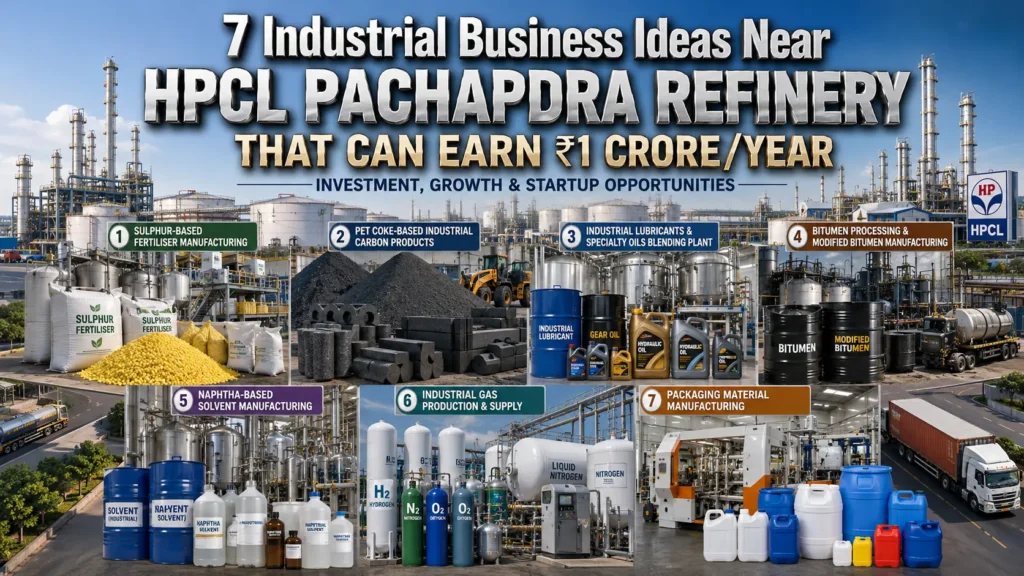
Business Ideas Near Pachpadra Refinery A Refinery That Changes the Map One of the biggest industrial events in the remote memory of western India is the commissioning of HPCL (Rajasthan) Refinery at Pachpadra, Balotra-Barmer belt. A greenfield crude oil refinery of this magnitude isn’t just a manufacturing plant for fuel; it’s a whole new environment of entrepreneurial concepts that savvy business people can exploit today. The supply chains, workforce and infrastructure that a mega-refinery attracts benefits all of the above. The Pachpadra corridor is undoubtedly the most enticing industrial opportunity in the country right now if you are a startup founder, MSME investor or first-generation entrepreneur seeking an opportune industrial entry into the nation. This article takes a detailed look at this opportunity – the sector logic, where the government support is available, some ideas for projects, trade dynamics and models of success to learn from. Understanding the HPCL Pachpadra Refinery and Its Industrial Significance The project for the HPCL Refinery Limited (HRRL) is a joint venture between Hindustan Petroleum Corporation Limited (HPCL) and the Government of Rajasthan at Pachpadra. It is meant to process locally available crude oil from Rajasthan, which is mainly from Barmer oil fields, with a capacity of 9 million metric tonnes per annum (MMTPA). Thus, it is one of the bigger greenfield refinery projects being undertaken during India’s recent industrial history. But it is not just the refinery that is significant for entrepreneurs. It’s the industry that develops around the refinery, and what it makes. Modern crude oil refinery produces more than petrol and diesel. They include naptha, liquefied petroleum gas (LPG), aviation turbine fuel (ATF), sulphur, petroleum coke (pet coke), bitumen, propylene, and other hydrocarbon streams, which are generated as by-products or co-products. These are each a separate “downstream” manufacturing value chain. Plus, because it’s such a large refinery, it requires massive amounts of support infrastructure: industrial gases and packaging materials, logistics, maintenance services, chemical intermediates, and so on. Thus, the business opportunity is direct (in the processing of the refinery outputs) and indirect (in provision of services and materials required by the refinery and its employees). Information about the refinery project can be obtained from HPCL official corporate website. Why the Petrochemical and Ancillary Manufacturing Sector Is a Strong Bet Right Now The Indian Petrochemical industry is in structural growth mode. Demand of polymers, plastics, synthetic fibres and specialty chemicals have been on the ascent in the domestic market. This demand is sustained by rising activity in the construction, food and drinks packaging, automotive and agriculture industries. India is currently importing considerable quantity of petrochemical intermediates which presents an opportunity for domestic manufacturers to meet the demand through import substitution. In addition, the state of Rajasthan is relatively underpenetrated industrially in terms of its resource base and size. The state government has made a conscious effort to make it an attractive industrial location through the Rajasthan Investment Promotion Scheme (RIPS) and dedicated industrial areas. The process of the Pachpadra refinery coming to life is also an anchor investment, which normally leads to an ancillary unit, workforce settlement and service industries coming into the area. One of the biggest costs benefits a manufacturer can have is its proximity to the raw material source, from a profitability perspective. Companies set up near Pachpadra refinery will benefit from reduced logistics costs for feedstocks, quicker response of supply chain and possible preferential access to by-product streams. The benefits directly impact on operating margins. The Ministry of Chemicals and Petrochemicals, Government of India is an authoritative source for industry level data and statistics for the petrochemical industry. Export Potential from the Pachpadra Industrial Belt The Indian petrochemical exports have been on the rise, and major markets in Southeast Asia, Africa and Middle East are actively looking for competitively priced petrochemical intermediates as well as finished products from India. The geo-location factor also proves to be advantageous for Rajasthan. The manufacturing sector has easy access to the sea through proximity of Mundra and Kandla ports located in Gujarat, which is essential for export-oriented industries. It is possible for an entrepreneur to start a petrochemical/ specialty chemical unit which can be export oriented from day one near Pachpadra, provided the product is in line with the global demand patterns such as agrochemicals, packaging polymers, industrial lubricants etc. Government Policies and Incentives Supporting New Manufacturing Businesses The policy landscape for new manufacturing enterprises that are located in the vicinity of an anchor industrial project, such as HRRL Pachpadra, is truly conducive at the moment. There are a few schemes at both central and state levels that offer capital subsidy, tax exemption, institutional support and thereby mitigate the financial risk for the first time investors. Central Government Schemes Production Linked Incentive (PLI) Scheme has been introduced by the Ministry of Chemicals and Petrochemicals for certain chemicals and petrochemicals. It provides incentives based on incremental production, which is especially appealing for manufacturers expanding production. The MSME Credit Guarantee Fund Trust (CGTMSE) scheme provides credit support of up to ₹2 crore to eligible MSMEs without the need for collateral.The MSME Credit Guarantee Fund Trust (CGTMSE) scheme is an important facilitator for the small manufacturing setups for providing credit support without collaterals to MSMEs. Besides, the Ministry of MSME also operates PMEGP (Prime Minister’s Employment Generation Programme) that offers capital subsidy of up to 35% for manufacturing industries in rural and semi-urban areas. Pachpadra is considered as semi-urban area, which is very relevant for small manufacturing entrepreneurs for the implementation of PMEGP. Likewise, the Technology Upgradation Fund Scheme (TUFS) is applicable in the case of investment by business in modern and efficient manufacturing equipment. Rajasthan State Incentives Rajasthan Investment Promotion Scheme (RIPS) is the state’s key industrial incentive scheme. Provides subsidies on investments, exemption from electricity duty, rebate on conversion of land charges, and waiver of stamp duty for qualified industries. Typically, the sectors including units for Petrochemicals and Chemicals are considered as priority sectors for RIPS incentives. Further, the Rajasthan MSME Act provides
Manufacturing and Business Ideas in the Chemical Sector: Gallic Acid, Potassium Nitrate, Chlorinated Paraffin Wax and Zinc Sulphate
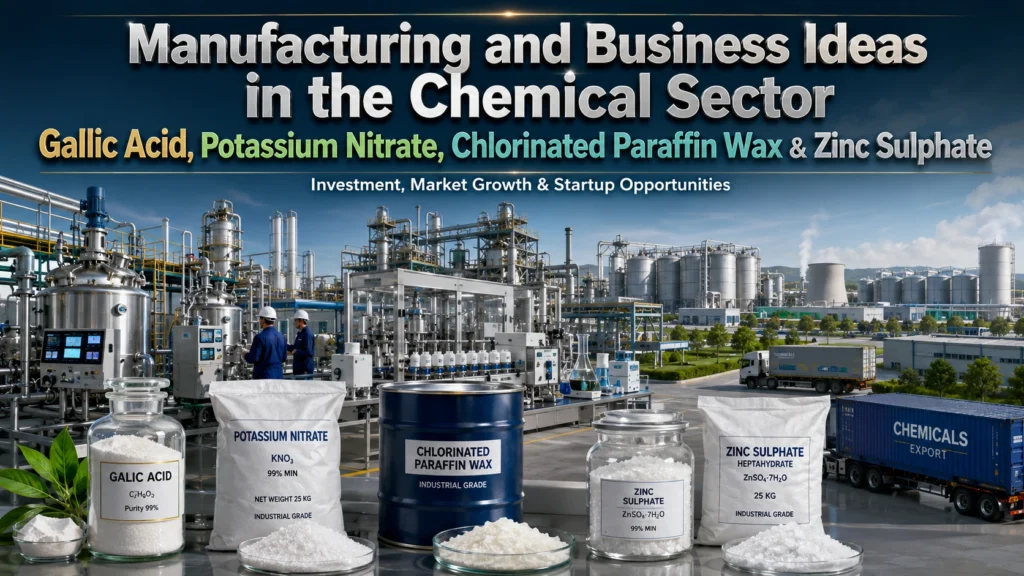
Chemical Manufacturing Business Ideas India The Indian chemical economy has morphed itself into one of the most promising business incubators for 1st generation entrepreneurs to execute without resorting to a multinational balance sheet. Over the years, I have seen hundreds of feasibility reports on small and mid-sized chemical companies and am always coming back to a few products that meet the criteria of reasonable capital investment, reasonable demand and a true import substitution rationale. There are four such opportunities that include gallic acid, potassium nitrate from tobacco waste, chlorinated paraffin wax, and a combined zinc sulphate heptahydrate–monohydrate unit. There is no glamour about them as there is about a battery gigafactory, and each are part of a supply chain that Indian industry relies on every day, be it from pharmaceuticals to leather, fertilisers to plastics to textiles. Why This Sector, Why Now Speciality and fine chemicals are in a strange situation in the Indian manufacturing industry because, although the local market is large and expanding, there has never been a significant expansion of the local production of meaningful intermediates, and so they have remained imports from China and Europe. It is here that the right kind of an MSME can fill that void. Process chemistry rewards consistency and quality control and reliable sourcing more than R&D expenditure, and that’s what the tannin derivatives, nitrate salts, chlorinated wax and zinc-based micronutrients are. The rationale for profitability is further complicated by export potential: buyers in SE Asia, the Middle East and Africa are actively seeking to de-risk their China-dependent supply chain and Indian producers offering consistent purity specifications are taking their business. The margins in this space are decent, not brilliant, and typically in the 15-25% operating range, when a plant operates at reasonable capacity utilisation, but the demand base is sticky because these are input chemicals that are used continuously by the downstream industries as opposed to discretionary purchases. Explore This Book: Handbook On Chemical Industries (Alcohol Based) Government Policies and Incentives Supporting New Entrants Business owners who move into this area do not need to give money their own way. The Ministry of MSME’s Credit Guarantee Fund Scheme and the Prime Minister’s Employment Generation Programme are loan support schemes which provide collateral-free loans for new manufacturing units, especially for chemical projects which also involve high investments in machinery. The PLI scheme for specialty chemicals, which is now being administered by the Department of Chemicals and Petrochemicals, has also created space for downstream players even if the main beneficiary of the PLI scheme is a larger integrated producer, because the demand pull from the PLI generates for ancillary/in-between suppliers. Gujarat, Rajasthan and Tamil Nadu have established industrial policies, especially for industrial clusters in these states to provide power tariff concessions and stamp duty exemption along with capital subsidy to new small-scale chemical / MSME units. Besides, time for environmental and factory licences, the biggest bottleneck for chemical start-ups, has been reduced significantly thanks to the Stand-Up India scheme and a number of state-level single-window clearance portals. A business man can check out the existing scheme information straight on the. The entrepreneurs can check the details of the schemes available at the portal of the Ministry of MSME. Multiple Business Ideas Within This Chemical Cluster 1. Gallic Acid Production from Tannic Acid Gallic acid is at an interesting crossroads of pharmaceuticals, ink making and the leather and dyeing industries and is the kind of product that demands a consultant’s eye rather than just an academic one. The major consumers of gallic acid are pharmaceutical intermediate manufacturers for trimethoprim and propyl gallate and the food industry for its use as an antioxidant preservative, which is synthesized by the acid or enzymatic hydrolysis of tannic acid (which is derived from natural material, such as tara pods, myrobalan or gallnuts). The key to the attractiveness to a new entrust for this business concept is that the basic hydrolysis work does not require any special equipment – a reasonably sized hydrolysis reactor, crystallisation and drying plant can be set up with moderate investment; the raw material – tannic acid – can be obtained locally from a number of well-established suppliers, and therefore the risk of dependence on imported raw materials is low. The realistic challenge is quality consistency: pharma-grade buyers are not only looking for production capacity but also for capability in analytical testing, for which the initial investment is the key to success for a new unit. Indian pharma intermediate manufacturers have been increasingly acquiring the necessary intermediate gamma in order to shift away from a dependence on Chinese imports and that opportunity is enough to keep a well-run plant busy. Discover business ideas that actually make money 2. Potassium Nitrate from Tobacco Waste This one’s a business concept that seems like a crazy idea until you plow through the economic math and realize that it only makes sense for there to be several well-established businesses out there making money around this concept. Tobacco waste, which is made up of stems, dust and rejected tobacco leaves from bulk tobaccos processors, contains high concentrations of potassium and nitrate, which can be extracted using a leaching/crystallisation process to create potassium nitrate, a high-value nitrate compound employed in a variety of industrial applications including fertilizer formulations, fireworks production, glass and ceramics manufacturing, and food preservation. The investment thesis here is that the raw material cost advantage: tobacco waste is usually at low or even negative cost, as the processor has to pay someone to dispose of it. The processing itself includes aqueous extraction, purification and controlled crystallisation, which is readily handled by a medium scale MSME chemical plant. For this business, location is a critical factor – the nearer they are to tobacco processing centres in Andhra Pradesh, Karnataka, Gujarat, the lower will be the cost of feedstock logistics, and so any entrepreneur looking at this opportunity should establish the location of the plant based on the availability of waste first and market access second. 3. Chlorinated