
Herbal Cosmetics Manufacturing for MSMEs: High-Profit Business Ideas

Herbal Cosmetics Manufacturing Business India’s manufacturing sector is in a new era of growth where small and medium industries are discovering opportunities outside traditional industries. One of the fastest growing areas of this transformation is that of herbal cosmetics manufacturing. Products made from natural ingredients are becoming increasingly popular due to consumer awareness of health, sustainability, and products safety. As a result, herbal personal care products such as a cleanser, moisturizer, shampoo, and conditioner are now widely used in households, salons, hospitals and in hospitality businesses. For entrepreneurs and investors, this shift is a good business opportunity. Herbal cosmetics manufacturing requires manufacturers to use agricultural raw materials together with their light industrial operations. The industry provides steady demand which requires minimal production expenses and allows businesses to increase their output. Get Detailed Insights from This Book : Herbal Cosmetics & Ayurvedic Medicines (EOU) (3rd Revised Edition) Why Herbal Personal Care Manufacturing is Good Business The herbal cosmetics industry has gained momentum because of a number of structural advantages in the Indian economy. India is one of the most prolific producers of medicinal and aromatic plants and the availability of these raw materials helps in providing growth to the manufacturing industry in the long run. The complete conversion of natural materials into final products results in major value increases. This process enables manufacturers to boost their financial returns. Some of the main reasons that entrepreneurs are venturing into this sector are: Moderate investment requirement as compared to heavy industries Strong domestic and export demand for herbal products Availability of raw materials throughout India Rising consumer demand for natural and chemical free products Friendly government policies towards MSMEs and traditional industries The current market conditions of herbal cosmetics manufacturing give businesses their best chance to expand and develop their operations through this industry. 1. Manufacturing Business Of Herbal Cleanser Herbal cleansers are fundamental personal care items used every day for cleaning up and hygiene purposes for the skin. Unlike traditional soaps which may contain harsh chemicals, herbal cleansers are made with natural extracts which help to keep your skin healthy while cleansing it gently. Because they are used on a regular basis, they create repeat sales and predictable revenue streams for manufacturers. The process of producing herbal cleansers is relatively simple and can be handled with semi-automatic machinery. Manufacturers usually prepare herbal extracts, blend them into mild surfactants, correct the pH level, and then package the finished item. With proper quality control, small manufacturing units can make consistent batches that meet consumer expectations. Common Raw Materials Used Neem extract Aloe vera gel Tea tree oil Vegetable oils Natural surfactants Preservatives and Fragrances The demand for herbal cleansers has been on rising as consumers have become more aware of their skin sensitivity and hygiene standards. Hotels, clinics and wellness centers are also using more and more herbal cleaning products which creates a larger market for the manufacturers. Estimated operating margin: 18% to 25% Get Detailed Project Report (DPR): Herbal Cosmetics 2. Herbal Moisturizer Manufacturing Business Herbal moisturizers are popular for providing hydration and protection of the skin. They are especially popular in urban markets where there are regular skincare routines by consumers. Moisturizers are also frequently bought by businesses such as hospitals, spas, and corporate organizations for the purpose of employee wellness and promotional programs. From the business point of view, moisturizers command better selling prices than the basic cleansing products. This enables manufacturers to produce greater profit margins even with medium production levels. The process of manufacturing includes the preparation of oil and water phases, heating and homogenization of two phases, and cooling of the product with subsequent packaging. Factors That Affect the Quality of Products Proper temperature control in mixing Emulsifier stabilized selection Concentrated quality of herbal extracts Suitable packaging design Packaging is an important factor in this category since consumers typically equate quality packaging with quality products. Investing in attractive packaging can enhance the perception of a brand and boost sales. Estimated operating margin: 20% to 28% 3. Manufacture of Herbal Shampoo and Conditioner Business Herbal shampoos and conditioners are among the hottest commodities on the personal care market. They deal with common hair problems like hair fall, dandruff, and dry scalp. Since hair care products are used so often, they are good sources of recurring income for manufacturers. The manufacturing process includes mixing surfactants with the herbal extracts, adjusting the viscosity of the mixture and adding fragrance and then filling the product into bottles. Conditioners need extra emulsification so that they provide a smooth texture with good conditioning performance. Major Demand Drivers Rising concerns of hair damage through chemical products Megatrends in the global beauty market and personal care products market Increasing use of herbal products for salons Increasing demand for exports from developing countries This category is especially appealing for long-term growth in business as it has one of the highest rates of repeat purchase in the consumer goods business. Estimated operating margin: 20% to 30% Related Article: How to Start a Successful Herbal and Organic Cosmetics Brand? Investment and Cost Structure Herbal Cosmetics Manufacturing Understanding the cost structure is the key before launching a manufacturing business. In most herbal cosmetics units, the cost of raw materials is the biggest expense followed by the cost of packaging and marketing. Labor and utility costs are normally manageable, especially in semi-urban areas where operating costs are lower. Typical Cost Distribution Raw materials: 35% to 40% Packaging: 20% to 25% Labor and utilities: 12% to 15% Marketing and distribution: 15% to 20% Most small-scale herbal manufacturing units achieve break-even point in two to three years, depending upon the capacity of production and demand from the market. Government Support for Herbal Manufacture Businesses The Indian government provides support to both small-scale manufacturing operations and traditional industrial sectors. Manufacturing entrepreneurs can access multiple programs which provide them with both financial assistance and training and technical support. These initiatives help in reducing the startup risks and boosts innovation in product development. Examples of
Top 6 High Profit Manufacturing Business Ideas in India (2026)
High profit manufacturing business The manufacturing sector of India is currently experiencing strong growth because domestic demand is rising and international supply chains are changing and government support programs are being implemented. The Make in India initiative and the Ministry of MSME policies enable entrepreneurs to develop export-focused businesses that can grow beyond their initial capacities. For the aspiring entrepreneur and investor, this is a unique opportunity to enter industries where the demand already exists and is continually growing. The manufacturing industry contains multiple segments that generate high profits through their operational activities, which demonstrate sustainable growth potential in the market for many years. The article presents six manufacturing business concepts, which will exist in India during 2026, along with their advantages and difficulties and their future business prospects. 1. Silica from Rice Husk Ash: Converting Waste into Value Rice husk ash (RHA) serves as a by-product of rice milling operations which people usually consider to be waste material. However, it has a high percentage of silica which is extractable and can be processed into a valuable industrial material. Silica obtained from RHA finds a wide range of applications in industries such as rubber, paints, coatings, adhesives and cosmetics. With India being one of the largest producers of rice in the world, the availability of raw material is ample and cheaply available. Key Advantages Cheap and readily available raw material High demand of tyre and chemical industries Opportunity to substitute imported silica Challenges Requires controlled processing conditions Consistent quality is extremely important to industrial buyers Business Potential This is a classic example of a waste to wealth model. Entrepreneurs who establish dedicated quality control systems together with streamlined operational procedures will achieve superior profit margins while accessing global markets. Get Detailed Insights from This Book: Rice Husk & RHA Value-Added Products (3rd Edition) 2. Pea Protein Isolate: Taking Advantage of the Plant-Based Trend The worldwide movement to increase plant-based nutrition has opened up a booming industry for alternative protein sources. Pea protein isolate is becoming more popular because of its high protein content, ability to be allergen free and compatible with vegan diets. It is commonly used in protein powders, health supplements, plant-based meat alternatives, and functional foods. Why This Business Stands Out Rapidly increasing health and fitness market Strong export demand Premium pricing over traditional protein sources Challenges Major factors of success include: – Taste and solubility Requires advanced processing technology Market Outlook With the growing awareness in the fitness and sustainability spaces, pea protein is predicted to be a high-growth segment worldwide. Entrepreneurs who invest in product quality and branding can establish a good competitive advantage. Get Detailed Project Report (DPR): Setup Plant Of Pea Protein Isolate/Concentrate 3. Gau Mutra Ark: Traditional Product with a Modern Need Gau Mutra Ark is a distilled product of cow urine and is generally used in Ayurveda and organic farming. While it has classical roots, its business potential is growing thanks to the growing demand for natural and chemical-free products. It is used in herbal medicines, agricultural products and wellness products. Best Suited For Rural entrepreneurs Small-scale manufacturing units Regions having access of gaushalas Advantages Low investment requirement Simplest of manufacturing processes Increasing demand in organic agriculture Key Considerations Hygiene and quality standards are to be maintained Adherence to AYUSH regulations is critical Business Insight This segment is perfect for entrepreneurs who are seeking low investment, stable demand opportunities, especially in the rural areas. 4. Solar PV Module Manufacturing: The Future of Energy The Indian renewable energy industry experiences rapid expansion because solar energy serves as its primary development driver. Solar PV (photovoltaic) modules are important constituents used to produce electricity from sunlight. The combination of government incentives and high electricity prices and sustainability requirements has resulted in widespread adoption across residential and industrial and agricultural sectors. Growth Drivers “Policy support and subsidies” Increasing energy demand Corporate commitments on sustainability Advantages High scalability Strong long-term demand Export opportunities Challenges High initial investment Requires technical expertise and compliance Future Outlook The solar manufacturing sector represents one of the fastest expanding business areas in India. The sector provides opportunities for entrepreneurs who possess adequate capital and a vision to build substantial and profitable businesses. Related Article: How to Start a Solar Manufacturing Business in India: Profitable Segments & Insights 5. Steel Fabrication and Galvanizing: Supporting Infrastructure Expansion Steel fabrication serves as an essential component for building infrastructure through its use in creating structures like construction sites and industrial buildings and transmission towers and renewable energy facilities. The product gains additional worth through the combination of galvanizing, which applies a zinc protective coating, since this process increases product durability and protects against corrosion. Business Strengths Increasing demand for infrastructure projects, which are: Solar and industrial sectors – “Solar has more potential,” 656 withdrawal of plants Opportunities in solar and industrial sectors Better margins with integrated operations Why It Works The infrastructure push in India through its development of roads and railways plus energy systems and urban areas will create continuous need for fabricated steel products. Pro Tip Entrepreneurs that merge fabrication and galvanizing processes can simultaneously increase efficiency and profitability in a big way. 6. Magnesium Sulphate Heptahydrate: A Stable Chemical Business Magnesium sulphate or Epsom salt is a widely used micronutrient in agriculture. The compound has additional applications in the pharmaceutical industry and the textile sector and the production of personal care items. Key Benefits Stable and constant demand Simple manufacturing process Wide range of applications Market Demand Magnesium sulphate functions as an agricultural resource that improves soil fertility and enables constant crop production throughout all seasonal periods. Business Insight Although margins can be moderate, this business is one of the most reliable and long-term, making it perfect for risk-averse business entrepreneurs. Choose the right startup backed by real market demand How to Select the Right Manufacturing Business Choosing the right manufacturing venture relies on a variety of factors. The entrepreneurs should analyse the market as well as their capacity before taking a
Profitable Manufacturing Ideas in India: Packaging, Auto Parts, and Rice Husk Ash
Profitable Manufacturing Business Ideas The manufacturing scene in India is undergoing a rapid set of changes, and the lucrative opportunities are becoming available for entrepreneurs, MSMEs and first-generation industrialists. The metal packaging industry for plant-based beverages and three-wheeler auto body parts and rice husk ash production have developed into profitable business sectors which exist outside traditional industrial operations. The industries provide products which maintain constant demand patterns together with investment requirements which business owners can manage and the potential for expansion which exists in both domestic markets and international markets. For anyone looking into manufacturing businesses in India these three opportunities provide solid paths for success. Get Detailed Project Report (DPR): White Cement Paper Bag Manufacturing Plant Tin Cans Almond Drink Packaging The plant-based beverage market in India has been growing at a steady pace. Increasing consumer interest in vegan diets and lactose-free alternatives as well as health-conscious options have fueled the demand for almond drink. To maintain the quality of the product and its shelf life, tin cans are the ideal packaging solution. Tin cans protect contents from light and oxygen while extending product shelf life and enabling recyclability. While they are used to serve mainly almond drinks, they are also extensively used for cold coffee, protein shakes, energy drinks, and functional beverages. Beverage companies use tin-plated steel cans or aluminum cans for their consistency in quality and branding. Why invest in the tin can industry? High demand by plant-based beverage brands Long term supply contracts and recurring orders Potential for Export to International Beverage Markets The manufacturing process involves multiple stages which begin with sheet preparation and proceed to cup formation and continue through shaping and coating and printing and sealing. Modern Plants incorporate automated two-piece or three piece can production technologies. Key materials are tin-coated steel or aluminum sheets, food-grade lacquers, inks, adhesives and sealing compounds. Strict adherence to food safety standards is a must. The Indian plant-based beverage market is expected to grow at more than 12% every year, so tin can manufacturing is one venture that is a good investment opportunity for any entrepreneur looking to scale up. Auto Body Parts: Three-Wheeler Three-wheelers are an integral part of India’s transport system. They are necessary for urban transportation, goods haulage and last mile delivery and for the widening e-commerce industry. With the emergence of electric three-wheelers, the need for a reworked body is on the rise. Manufacturing auto body parts includes sheet metal cutting, pressing, welding, and surface finishing. MSMEs are often tier-2 or tier-3 suppliers of the larger vehicle manufacturers, and produce items such as driver cabins, roof panels, passenger compartments, doors, metal frames, and chassis covers. Reasons that are responsible for this sector being attractive: Large domestic market- hundreds of thousands of vehicles sold annually Recurring demand of aftermarket replacement parts Opportunities to provide OEMs and e-mobility startups Success requires good vendor networks, uniform product quality and supply chain reliability. Moderate investment and being part of India’s vast automotive ecosystem make this a sustainable manufacturing venture. Get Detailed Insights from This Book: Manufacture of Value Added Products from Rice Husk (Hull) and Rice Husk Ash (RHA) (3rd Edition) Rice Husk Ash Production India is one of the biggest producers of rice worldwide producing millions of tons of rice husks every year. These husks, which are often considered agricultural waste, can be transformed into rice husk ash (RHA), and are very rich in amorphous silica. RHA has several industrial uses such as in cement and concrete production, refractory materials, rubber and plastics, and soil stabilization. The production process is relatively simple but must be precisely controlled because rice husks are collected, dried and burned in specially designed furnaces to create ash with a high silica content. The ash is then ground, classified and packaged. Low raw material cost makes this venture very profitable. Choose the right startup backed by real market demand Main benefits of RHA manufacturing: Low investment with high-profit margins Steady domestic industrial demand Export opportunities to cement industry, silica industry, and refractory industry Government initiatives supporting waste-to-wealth and circular economy programs provide further support to its market potential. This makes RHA production a very attractive choice for small and medium enterprises. Comparing Opportunities While all three sectors are promising they differ in terms of investment, stability of demand and potential for export: Sector Investment Demand Stability Export Potential Tin Beverage Cans High Very High High Three-Wheeler Body Parts Medium High Medium Rice Husk Ash Low-Medium High High A number of factors should be considered by entrepreneurs in selecting a venture, including the availability of raw materials, production technology, market demand, and long-term scalability. Detailed feasibility studies can help to mitigate risk and guarantee profitability Related Article: Rice Husk Ash Silica Manufacturing in India: Market Demand, Plant Cost & Profit Outlook (2026–2032) https://youtu.be/NoAliG5d2vw Conclusion The industrial growth in India creates new business prospects which manufacturers can exploit. The health-conscious drinking market is growing because it increases demand for plant-based beverages packaged in tin cans. The three-wheeler auto body industry in India derives advantages from the country’s extensive transportation system. Rice husk ash production transforms agricultural waste into a valuable resource which industrial facilities can use. The three sectors require efficient production systems together with reliable supply chains and strong buyer partnerships to achieve their objectives. The Indian manufacturing sector will develop sustainable businesses through proper planning and market research and a strong focus on quality. Frequently Asked Questions (FAQ) Which venture is most profitable for small scale startups? Rice husk ash production often provides the quickest return on investment because of the low cost of raw material and the steady industrial demand. Is auto component manufacturing conducive to MSMEs? Yes. Many large automotive companies depend upon MSME for sheet metal components. What are the Beverage Can Making Certifications? Manufacturers have to meet strict food safety and packaging standards. Can rice husk ash be exported? High-quality RHA is in demand abroad especially in the cement industry and the silica industry according to Yes.
Particle Board Manufacturing Business in India: Cost, Profit, Market Size & Startup Guide (2026 – 2031)
Particle Board Manufacturing Business India’s engineered wood industry is growing well and particle board production is one of the most promising areas of the building materials ecosystem. Rapid urbanization, rise in the demand for modular furniture and growth in real estate construction are driving the consumption of particle boards in the country. Particle boards are very commonly used in modern interior because they are cheap and easy to process, used for mass furniture production. As consumer tastes lean towards modular kitchens, wardrobes and ready-to-assemble furniture, the manufacturers have turned to the engineered wood panel in place of the traditional solid timber. Another important development that helps shape the industry is the more stringent quality regulations that have been introduced by the Bureau of Indian Standards. These regulations mandate particle board manufacturers to seek BIS compliance licenses. There are many small and antiquated mills that are unable to meet these standards and are gradually being removed from the market. The current transition cycle creates a new requirement gap which modern production facilities can address. For entrepreneurs and MSMEs intending to move to manufacturing business, there is an enormous opportunity to invest in particle board production between 2026 and 2031. Read More: Products From Waste (Industrial & Agro Waste) 2nd Edition Market Size and Growth of Particle Board Industry India’s particle board market has witnessed steady growth in the last decade. The industry reports show that the market value will reach between USD 720 million and USD 780 million during the 2024-25 period while the market will expand to USD 1.16 billion by 2030. Several factors are contributing to this growth, such as the growth of furniture manufacturing, more and more housing construction, and the growing demand for organized solutions for the interior. Some of the key market indicators are: The furniture and cabinetry sector is responsible for over 60% of particle board consumption. The overall market is expected to grow at CAGR of around 10% between 2025 and 2030. Urban housing projects and commercial office spaces are the large consumers of engineered wood panels. These numbers demonstrate the strong potential of growth in the industry going forward in the next several years. Why Is Demand for Particle Boards Growing The growing demand for particle boards is closely related to the changes in the furniture and construction industries. Modern furniture manufacturers prefer particle boards due to the consistency of the product and the suitability of the boards for mass production. There are several major trends driving this demand. Growth of Modular Furniture Modern homes have increasingly switched to modular kitchen, wardrobe and storage systems. Particle boards are very popular for these applications due to their light weight, low cost and ease of laminating. Global furniture brands like IKEA make use of particle boards widely in the design of ready-to-assemble furniture. Growth of Real Estate Development Large infrastructure projects like Delhi-Mumbai Industrial Corridor and new smart cities like Dholera Smart City are boosting construction all over India. Residential and commercial buildings use interior furniture, partition, cabinets and decorative panels all of which make heavy use of particle boards. Growth of Office Spaces and Co-Working Spaces The emergence of flexible working spaces has led to a growing demand for standard office furniture. Companies like WeWork, Awfis are growing rapidly in the big Indian cities and this brings in a steady demand for office interiors and modular furniture components. Read More: Particle Board – Manufacturing Plant, Detailed Project Report, Profile, Business Plan, Industry Trends, Market Research, Survey, Manufacturing Process, Machinery, Raw Materials, Feasibility Study, Investment Opportunities, Cost and Revenue, Plant Layout Demand – Supply Gap in Indian Market Despite the growing demand, the particle board manufacturing capacity of India is limited. The organized sector is dominated by a handful of large manufacturers, but many smaller mills have been forced to shut down because of more stringent standards of compliance. Some of the top companies that work in this sector include: Century Plyboards (India) Ltd. Action TESA Greenply Industries Ltd. Associate Decor Ltd. Shirdi Industries Even with these manufacturers, the amount of particle boards supplied has not been able to catch up with the ever growing demand. Imports are resorted to fill the gap still and the cost of imports has been on the rise in recent years. Another important issue is geographic concentration. Most of the manufacturing plants are found in western and southern India, mostly in the state of Gujarat, Maharashtra and Tamil Nadu. However, there is a fast-growing demand in the north and east which rely on long distance transportation of particle boards from existing manufacturing hubs. This kind of geographic imbalance leaves big opportunities for the setting-up of new factories in areas such as Uttar Pradesh, Rajasthan, Madhya Pradesh and Bihar. Read More: Rice Husk, Rice Hull, Rice Husk Ash (Agricultural Waste) based Projects, (Precipitated Silica, Activated Carbon, Cement, Electricity, Ethanol, Hardboard, Oxalic Acid, Paper, Particle Board, Rice Husk Briquettes, Rice Husk Pellet, Silicon, Sodium Silicate) Raw Materials used in Making Particle Board The manufacturing of particle boards involves the compression of wood particles using adhesives and high temperature and pressure. Traditionally, the feedstock for this process was wood-based materials. Common raw materials used in the production include: Wood chips and sawdust from sawmills Shavings of wood from furniture factories Sugar can bagasse from sugar mills Agricultural residues such as rice husk and wheat straw Bagasse has emerged as a key material because it exists in abundant supply throughout India and delivers sustainable environmental advantages. By turning agricultural waste into industrial products, manufacturers can save money while adopting environmentally friendly production practices. Read More: Startup Selector Investment Needed to Establish a Particle Board Plant The setting up of a particle board manufacturing facility requires a huge investment in machinery and infrastructure. However, the industry does provide great long-term returns when the planning of projects is done efficiently. For MSME entrepreneurs, the investment in a small to medium scale plant ranges between a mere Rs. 15 crores to Rs. 40 crores depending
10 Best Manufacturing Business Ideas in India for 2026 (Low Investment & High Profit)
Introduction: Best Manufacturing Business Ideas India is fast emerging as one of the most attractive destinations of the Manufacturing Business Ideas. With vigorous economic growth, increasing domestic consumption and positive government policies, the manufacturing sector is in a new phase of growth. Entrepreneurs, Start-ups and Small Business owners have more opportunities now than ever before to set up profitable manufacturing units. Government initiatives like Make in India by Government of India have given huge boost to the manufacturing activity in the country. In addition, various Production Linked Incentive (PLI) schemes are reviving domestic production and de-dependence on imports. Another important driving force of growth is the global “China +1” strategy. International companies are expanding their supply chains by selecting India as their secondary manufacturing base. The shift brings new business openings to local manufacturers who operate in electronics, packaging and healthcare product manufacturing. business owners who want to establish a manufacturing company in 2026 should consider the many industries which show strong demand and potential for future expansion. Some of the most profitable manufacturing business ideas in India are mentioned below. Read More: Production of Paper Cups, Plates and Boxes 1. Manufacturing of Corrugated Packaging Box The booming popularity of e-Commerce and logistic companies have led to huge need of packaging materials. Corrugated boxes are widely used for sending products, and storing goods, and protecting sensitive goods during the shipping process. Major online platforms such as Amazon, Flipkart, etc., are highly dependent on the corrugated packaging in their day-to-day functioning. As online shopping continues to grow, the need for packaging solutions is expected to grow significantly. Why This Business is Profitable Constant demand from e-commerce and logistics companies Order in bulk from businesses often Moderate investment as compared to heavy manufacturing industries Fast scalability with the right machineries 2. Non-Woven Fabric Bag Manufacture With a rise in awareness of environmental problems and the government limitation on the use of single-use plastic bags, non-woven fabric bags have become popular. Such bags are reusable, durable and are also eco-friendly. Retail stores, supermarkets and promotional campaigns frequently use non-woven bags for packaging and branding. Products that you can manufacture Shopping carry bags Promotional bags Agricultural covers Medical disposable fabrics This business can be started with moderate investment and it has good demand both in the urban and rural markets. Read More: Handbook on Biodegradable Plastics (Eco Friendly Plastics) 3. Biodegradable Packaging Products Sustainable packaging is booming across the world. Businesses are taking serious steps to switch from plastic packaging to biodegradable packaging to comply with environmental regulations as well as meet consumer expectations. A few examples of biodegradable products are: Paper cups and plates Food containers Compositable packaging materials; Eco-friendly takeaway boxes Restaurants, cloud kitchen, airlines, food delivery companies are some of the biggest buyers of such products. With the elevation on the sustainable plan, this sector has a huge scope for growth. 4. CNC- Produced Auto Components India has one of the largest automobile markets in the world. Vehicle manufacturing requires thousands of precision-engineered parts, many of which are the products of CNC machining technology. Leading automobile manufacturers such as Tata Motors and Mahindra & Mahindra have large number of component suppliers. Opportunities for this Industry Engine components Transmission parts Brake assemblies Precision metal parts Although the investment is higher than small manufacturing businesses but the long term Contracts and the export opportunities make this sector very profitable. Read More: E- Vehicle, E-Rickshaw, Hybrid Electric Scooter, Battery Operated Vehicle, Electric Vehicles, Battery Operated Electric Rickshaw 5. Production of Electric Vehicle Components Electric vehicles are transforming the face of the car industry all over the globe. India is also fast moving to the path of electric mobility with support of Ministry of Heavy Industries through various EV promotion programs. Despite the fact that the adoption rate of an EV increases rapidly, the majority of the components of EVs are imported. This is leaving a great opportunity for domestic manufacturers. High-demand EV components Battery management systems Charging connectors Wiring harnesses Thermal management components Entrepreneurs who get a leg up in this market early enough may be able to capitalize on the explosive growth of the electric vehicle market in the coming decade or so. Read More: Top 20 Medical Plastics and Disposable Business Ideas 6. Medical Disposable Manufacturers The healthcare industry requires a continuous supply of medical wastes for disposal that is used in hospitals and clinics. These things are necessary to be on hygienic and to be prevented from infections. Some of the common medical consumables are: Syringes Surgical gloves IV sets Disposable surgical kits Healthcare expansion programs led by organizations such as World Health Organization and national healthcare initiatives are driving up the demand for reliable medical supplies. Manufacturers if maintain good quality also have the option of exporting these products in the international market. 7. Nutraceutical/Ayurvedic Product Manufacture The health and wellness industry is exploding in recent years. Nutraceuticals, herbal supplements and Ayurvedic medicines are used in large scale nowadays for preventive healthcare and supporting the immunity. India has a major edge in traditional herbal medical with the help of institutions like ministry of AYush. Manufacturing opportunities include Herbal capsules and tablets Ayurvedic syrups and tonics Nutrition supplements Protein powders Contract manufacturing for known health brands are other lucrative business models in this sector as well. 8. Spice Processing and Packaging India is the biggest producer of spices in the world. However, many farmers sell raw spices without processing which impedes profitability. Processing and packaging of spices can add enormously to their market value. The processing of spices includes in most cases: Cleaning and sorting Grinding and blending Packaging and branding Branded spice companies such as MDH and Everest have established big businesses from packaged spice items. Entrepreneurs, who have a location near the production areas of spices, can save on raw material and can increase the profit margin. Read More: Top 3 Profitable Manufacturing Businesses in India (Silicon, ABS & Bentonite) 9. Cold pressed oil manufacturing Health conscious consumers
India’s Rising Steel Imports: 10 High-Profit Steel Manufacturing Business Ideas for Startup Entrepreneurs
Introduction: Steel manufacturing startup India The steel industry in India is currently expanding because three factors are driving the growth of infrastructure and manufacturing capacity and domestic demand for steel. According to information by the Ministry of Steel, between April and December 2024, India has imported more than 7.4 million tonnes of finished steel, indicating a robust demand and the current production gaps. While the shortage of supplies is evident from imports, there are also tremendous opportunities for entrepreneurs to build profitable manufacturing enterprises as well. Startups are able to enter high-demand segments once again-primarily specialty steel, fabrication, recycling and value-added components, which can capture markets currently dependent on imports. This SEO optimised guide looks at 10 high potential steel manufacturing business ideas that combine with current industry demand, policy incentives and future infrastructure projects.(Steel manufacturing startup India) Read More: The Complete Technology Book on Hot Rolling of Steel (2nd Edition) 1. Specialty Steel Production Specialty steel is one of the largest import dependent segments in India. High-performance grades such as electrical steel, automotive steel and corrosion-resistant alloys are still sourced from overseas suppliers. Why it’s a strong opportunity: Government incentives in Production Linked Incentive (PLI) schemes High demand from EVs, renewables and advanced manufacturing Production of transformers and motors increasing Startup Ideas: Electrical steel for power transformers and motors High strength automotive steel components Manufacturing units of tool steel and alloy steel Entrepreneurs who have expertise in quality standards and advanced metallurgy can compete directly with imported items.(Steel manufacturing startup India) 2. Cold Rolled Steel Products, Coated Steel Products Cold-rolled sheet and coated steel are used extensively in appliances, automobiles, construction and industrial machinery. Demand is still increasing with the rising infrastructure sector in India. Business Opportunities: Colour-coated roofing sheets Galvanized steel panels Industrial production of cold rolled sheet Small and medium manufactures can begin with downstream processing units instead of the full steelmaking operations, which reduces the risk of investment.(Steel manufacturing startup India) Read More: Steel Rolling Technology Handbook (2nd Revised Edition) 3. Steel Scrap Processing and Recycling (Green Steel Opportunity) Sustainability is changing the steel industry. Recycling helps lower emissions as well as aligns India’s green steel roadmap. High-Demand Areas: Scrap shredding and segregation plants End-of-life vehicle dismantling centres Ferrous scraps supply to induction furnace operators Recycling businesses have lower capital requirements than primary steelmaking and have the advantage of increasing environmental regulations.(Steel manufacturing startup India) 4. Pellet Production from Low-Grade Iron Ore India produces large volumes of iron ore but a significant part of this is low grade. This is then pelleted into an efficient raw material for steel plants. Startup Advantages: Strong demand by sponge iron and integrated steel producers Possibility to operate in the vicinity of mining clusters Reduced transportation costs if it is strategically located Pellet plant can become essential suppliers as steel plant focus on efficiency and cost reduction. Read More: Steel Re-rolling Mill – Manufacturing Plant, Detailed Project Report, Profile, Business Plan, Industry Trends, Market Research, Survey, Manufacturing Process, Machinery, Raw Materials, Feasibility Study, Investment Opportunities, Cost and Revenue 5. Fabricated Steel Structures and Pre Engineered buildings (PEB) India’s infrastructure expansion including high ways, logistics parks, metro rail, and renewable energy projects has led to a demand for fabricated steel structures. Segments of Products That Generate Profit: Pre-engineered building components Transmission towers – Telecommunication structures Solar mounting systems Industrial Warehouses and Modular Buildings Fabrication companies stand to gain rapid growth by partnering with EPC contractors and infrastructure development companies.(Steel manufacturing startup India) 6. Steel Wire and Fastener Production High-precision steel wire products can be imported on a large scale in light of strict quality requirements. Manufacturing Opportunities: Wire drawing And Heat Treating Units Galvanized agricultural fencing wire Industrial springs and fasteners Power transmission cables and reinforcement mesh Precision engineering and quality control can also aid in new manufacturers moving into export markets. Read More: Steel and Iron Handbook 7. Consumer and Industrial Products of Stainless Steel Increasing urbanization and lifestyle changes are driving the increase in demand for stainless steel products in the construction and consumer market. Business Opportunities: Stainless steel pipe and tubes Kitchenware and utensils Architectural fittings and railings Modular kitchen components High grade stainless steel manufacturing helps in reducing the dependence on imports while catering to the domestic demand.(Steel manufacturing startup India) 8. Foundry Products Made From Pig Iron Foundry products such as cast iron products are needed in automotive, machinery and pump manufacturing. Potential Business Areas: Cast iron automotive parts Industrial valves and pump housings Agricultural Machinery Components Foundries may serve both the domestic industries as well as to export markets in Asia and the Middle East markets.(Steel manufacturing startup India) 9. Long Products Investment: MSME Driven Induction Furnace Units Induction furnace technology enables smaller manufactures to produce structural steel products with relatively low capital investment. High-Demand Products: TMT bars for construction Angles, beams, and channels Rural and semi-urban construction Steel Faster growing towns have local markets to be serviced by a regional mini-mill. Read More: Top 20 Steel Products Manufacturing Business Ideas 10. Industrial Machinery and Equipment used in Steel Plants As the steel capacity increases, so does the demand for localised machinery and automation systems. Business Ideas: Material handling systems, conveyors. Pollution control equipment Plant automation and robotics Engineering and EPC support services Supplying equipment to steel manufacturers presents recurring revenue opportunities. Inspiration from the Steel Industry Leaders of India Entrepreneurs who are looking to get into the steel industry can learn from iconic steel industry leaders: Ratan Tata turned Tata Steel into a globally focused technology company. Sajjan Jindal grew JSW Steel by innovation and strategic expansion Lakshmi Mittal built ArcelorMittal to one of the largest producers of steel in the world. Their journeys show that innovation, efficiency and global thinking are the keys to being successful in the steel business. Read More: India’s Steel Scrap Recycling Policy: 15 Growing Avenues in Auto-Scrapping, Metal Recovery, and Urban Mining How Consulting & Feasibility Planning Can Help Before setting up a manufacturing business, entrepreneurs
Top 3 Profitable Manufacturing Business Ideas in India: (Tapioca Glue, Coconut Milk, and Iodophor Solution)
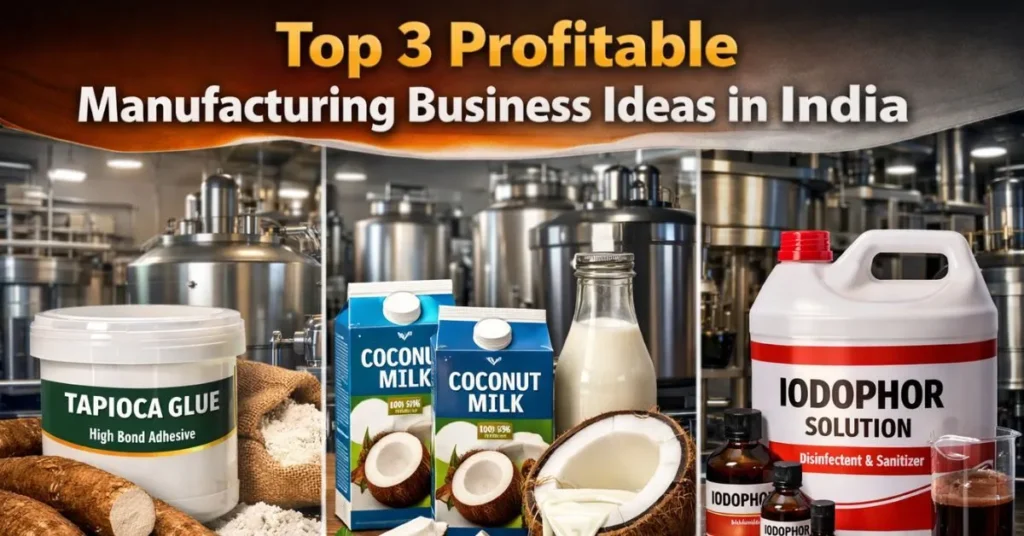
Introduction: Profitable Manufacturing Business Ideas in India India’s manufacturing sector is in powerful growth stage driven by growth in domestic demand, import substitution, sustainability trends and excellent policy support for MSMEs. For entrepreneurs and 1st generation manufacturers, opportunities today are not necessarily big industrial plants but demand-driven products that address everyday business and consumer problems. Three manufacturing segments are highlighted for their scalability and fairly manageable investment levels: tapioca starch-based glue, coconut milk processing, and iodophor disinfectant solution. The products represent different industrial clusters which currently experience fast growth because they create eco-friendly adhesives and plant-based food processing products and institutional hygiene chemicals. The article examines three manufacturing opportunities through its analysis of market potential and manufacturing process and demand drivers and profitability outlook to assist entrepreneurs in making investment decisions.(Profitable Manufacturing Business Ideas in India) Read More: The Complete Book on Coconut & Coconut Products (Cultivation and Processing) 1. Tapioca Starch Glue Manufacturing: A Sustainable Industrial Adhesive Enterprise Product Overview Tapioca starch glue is a bio-based glue made from cassava starch. It is used extensively in the manufacture of corrugated boxes, paper bonding, bookbinding, textile sizing and plywood lamination. With the industries moving away from petroleum based chemicals, starch adhesives are gaining good acceptance. The product is valued for its non-toxicity, biodegradability, fast bonding properties and cost advantage over synthetic alternatives. Growing e-Commerce and FMCG packaging demand has seen a big rise in consumption of corrugated boxes – indirectly leading to growth in adhesive demand.(Profitable Manufacturing Business Ideas in India) Manufacturing Process The production process is relatively simple and can be done in MSME scale units: Gelatinisation of tapioca starch by controlled heating Mixing with water and chemical additives Addition of preservatives to ensure shelf stability Viscosity control & packaging Typical plant capacity is between 1 and 5 tonnes per day, which enables gradual expansion. Capital investment is medium and energy consumption is not prohibitive. Raw Materials and Supply Chain Primary raw material: Tapioca starch (mostly sourced from Tamil Nadu and Andhra Pradesh). Secondary inputs include borax, caustic soda and stabilizers. Maintaining a consistent starch quality is the key to product reliability.(Profitable Manufacturing Business Ideas in India) Market Demand and profitability Industries that drive demand are: Manufacturers of corrugated packaging Notebook and stationery manufacturers Textile processing units Veins and plywood industries Bio-based adhesives market is expanding faster than the traditional adhesives and small units often get healthy operating margins due to steady repeat orders. Read More: White Phenyl – Manufacturing Plant, Detailed Project Report, Profile, Business Plan, Industry Trends, Market Research, Survey, Manufacturing Process, Machinery, Raw Materials, Feasibility Study, Investment Opportunities, Cost and Revenue, Plant Economics 2. Coconut milk processing: A High Growth Food Manufacturing Opportunity Product Overview Coconut milk has gone from being a regional item to an international food item. It is extensively used in ready-to-eat meals, vegan beverages, desserts, sauces and bakery applications. Increasing awareness among people about health and a growing demand for dairy alternatives have fueled great growth in this segment.(Profitable Manufacturing Business Ideas in India) In India rising urbanization and plant-based dietary trends are increasing the domestic market, whereas export demand is high in Europe, the Middle East and Southeast Asia. Manufacturing Process Coconut milk production consists of: Dehusking and shell removal Extracting and grinding kernel Pressing and filtration Thermal processing and homogenisation Packaging (pasteurised or aseptically) Units can start small – processing 5,000 to 10,000 coconuts per day – and work up to export grade production. Raw Material Sourcing Mature coconuts are largely coming from Kerala, Karnataka and Tamil Nadu. Price fluctuation is a significant issue, dealt with often by forming long-term supplier agreements or partnership with farmers. Standards of cleanliness, fat content and shelf stability are important, particularly for institutional buyers and the international market.(Profitable Manufacturing Business Ideas in India) Read More: The Complete Book on Coconut & Coconut Products (2nd Edition) Market Demand, Profitability Demand segments include: FMCG companies operating in curries and ready meals Hotels, restaurants, cloud kitchens Vegan and health food brands Export distributors In order to increase profitability, manufacturers can use by-products such as coconut oil and coconut residue. 3. Iodophor Solution Making: A High Trust Chemical Company Product Overview Iodophor solution is an iodine-based disinfectant that is widely used in dairy farms, food processing plants, breweries, pharmaceutical manufacturing and hospitals. The product delivers comprehensive antibacterial defines while releasing iodine at controlled rates which makes it appropriate for areas that require strict hygiene standards.(Profitable Manufacturing Business Ideas in India) The food sector and healthcare sector both experience rising demand for institutional disinfectants because sanitation regulations become more stringent. Manufacturing Process The process of production involves: Dissolving iodine using non-ionic surfactants Controlled mixing and stabilisation, Dilution with purified water Quality Testing and Packaging The project needs moderate funding yet it requires organizations to follow strict safety measures and complete regulatory obligations.(Profitable Manufacturing Business Ideas in India) Read More: Unlock Huge Profits With These Coconut Business Opportunities Raw Materials and Operational Factors The manufacturing process depends on iodine and surfactants and acids and purified water as its main components. The business needs reliable sources of iodine and secure chemical storage facilities to ensure its daily activities run smoothly. Market Demand and Profitability Primary demand comes from: Dairy and poultry farms Food processing industries Pharmaceutical manufacturers sani pairs to institutional sanitation services The organization establishes long-term relationships with customers through its continuous institutional order process which generates predictable revenue streams. Key Lessons of Indian Manufacturing Success Stories Successful Indian industrialists prove that it is more important to execute with discipline than to expand fast. Entrepreneurs who pay attention to the stability of supply chains, quality control and targeted markets tend to build more resilient businesses.(Profitable Manufacturing Business Ideas in India) Backward integration into raw materials helps in reducing cost volatility. Export orientation, good compliance systems and consistent product quality create customer trust for the long term – especially within chemical and food manufacturing industries. Read More: The Role of Tapioca Starch Glue in Sustainable Manufacturing Policy Support for
Top 3 Profitable Manufacturing Businesses in India (Silicon, ABS & Bentonite)
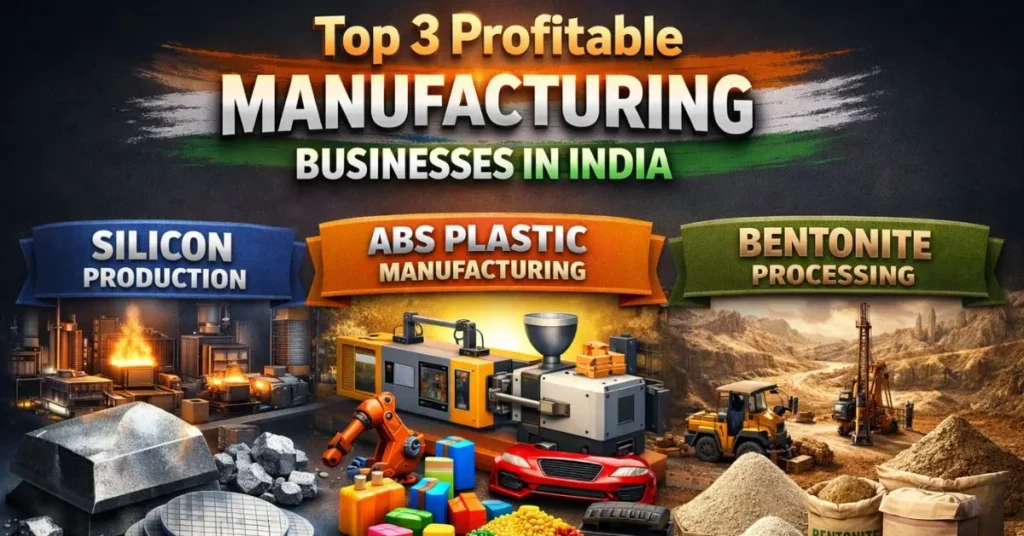
Introduction: Profitable manufacturing businesses in India India’s manufacturing sector is in a powerful phase of growth based on domestic demand, the modification of global supply chains, and government initiatives in support of industrial production. Many entrepreneurs are chasing digital trends, but manufacturing is one of the surest paths to building long-term wealth with tangible assets, repeat demand and scalable operations. Material-based manufacturing businesses are also attractive because they cater to many industries at the same time. From electronics to renewable energy resources, consumer goods to pet care products, raw material processing remains in constant and strong demand. This article discusses three promising manufacturing opportunities in India – Silicon Crystals, Acrylonitrile Butadiene Styrene (ABS) engineering plastic and Bentonite-based Cat Litter. Each of them represents a different level of investment and business model, and hence is suitable for large industrial investors as well as emerging MSME entrepreneurs.(Profitable manufacturing businesses in India) Read More: The Complete Book on Resins (Alkyd, Amino, Phenolic, Polyurethane, Epoxy, Silicone, Acrylic), Paints, Varnishes, Pigments & Additives (Surface Coating Products with Formulae)(3rd Revised Edition) 1. Silicon Crystals Manufacturing – Powering Electronics and Renewable Energy What Are Silicon Crystals? Silicon crystals are highly purified materials that are used in semiconductor wafers, solar panels, power electronics, and industrial sensors. Although they are not the products that consumers see, they are the backbone of modern technology. Every single smartphone, solar installation and industrial automation system is based on silicon-based parts.(Profitable manufacturing businesses in India) India’s dedication to electronics production together with its commitment to renewable energy has created an increased need for domestically produced silicon materials. Government incentives to solar energy and semiconductor manufacturing also strengthen the long-term growth potential. Overview of the Manufacturing Process The road of manufacturing starts with quality quartz or silica sand. Through carbothermic reduction in electric arc furnaces, silicon in metallurgical grade is produced. The process begins with material transformation into polysilicon through purification which uses Czochralski as a specialized crystallization method. Silicon manufacturing plants need: High capital investment Reliable energy supply Strict quality control Controlled production environments The existing plants need high capital investment yet they maintain their operation through extended supply agreements which secure steady income for extended periods. Read More: BENTONITE PROCESSING & PULVERISING – Manufacturing Plant, Detailed Project Report, Profile, Business Plan, Industry Trends, Market Research, Survey, Manufacturing Process, Machinery, Raw Materials, Feasibility Study, Investment Opportunities, Plant Layout Demand Factors and Market Potential The major industries which need silicon crystals for their operations include the following sectors: Solar panel manufacturing Semiconductor fabrication Electric vehicle power electronics Industrial automation systems The growth of domestic Electronics production in India creates new opportunities for businesses to replace imported products. Businesses that have the financial resources and engineering knowhow to operate in silicon production will achieve sustainable profits throughout their business lifecycle.(Profitable manufacturing businesses in India) 2. ABS Plastic Manufacturing: Engineering Thermoplastic of High Demand Understanding ABS Plastic Acrylonitrile Butadiene Styrene (ABS) is an engineering-grade thermoplastic that is known for its impact resistance, durability, and great molding properties. The material finds extensive application across various sectors including automotive interior construction and electrical equipment production and medical device manufacturing and toy creation and luggage design.(Profitable manufacturing businesses in India) As opposed to basic commodity plastics, ABS commands a better price based on its performance characteristics, and thus is profitable for manufacturers. Read More: Bentonite Processing – Manufacturing Plant, Detailed Project Report, Profile, Business Plan, Industry Trends, Market Research, Survey, Manufacturing Process, Machinery, Raw Materials, Feasibility Study, Investment Opportunities, Cost and Revenue Production and Manufacturing Process ABS, made by the polymerization of acrylonitrile and styrene in the presence of polybutadiene. This process requires controlled temperature and chemical handling systems. Commonly, manufacturers will produce ABS granules which are supplied to the injection molding companies and OEM manufacturers. A typical ABS plant is concerned with: Consistent formulation High-quality polymerization processes Efficient supply chain managemen Demand and Growth Prospects for the Market India’s burgeoning automobile industry and growing appliances manufacturing industry is a key growth driver for ABS. Increasing consumer expenditures on longer lasting goods like refrigerators, washing machines and electronics also contributes to rising demand. Major industries using ABS are: Automotive manufacturing Consumer electronics Medical equipment Household appliances The MSME sector offers business opportunities through three different paths which include niche development of ABS grades and compounding activities and partnerships with molded product manufacturers.(Profitable manufacturing businesses in India) 3. Bentonite Cat Litter Making Business: Low Investment, High Growth Product Overview Bentonite cat litter is a clumping absorbent litter that is made from natural clay. While it doesn’t come across as a very popular industry, India’s pet care market is rapidly growing and there’s a good demand for high-quality litter products. Additionally, bentonite has industrial applications in foundries, drilling fluids, and absorbents to provide diversified revenue streams.(Profitable manufacturing businesses in India) Read More: High-Capital Manufacturing Business Opportunities in India: Silicon Metal, Iron Ore Crushing, and MIBK Manufacturing Manufacturing Process Compared to the manufacture of chemicals or semiconductors, bentonite manufacturing is relatively easy and inexpensive. The process of production is as follows: Mining or sourcing of bentonite clay Drying and crushing Granulation and screening Optional fragrance or additives blending Packaging and branding Due to the moderate technology requirements, the segment is particularly suitable for first generation entrepreneurs and MSMEs.(Profitable manufacturing businesses in India) Market Opportunities and Profitability Urban pet ownership in India is rapidly growing, and there is a high demand for high-end pet products in the country. Retail expansion and e-commerce channels further enhance access in the market for new brands. Benefits of bentonite cat litters manufacturing include: Low capital investment Faster break-even period Branding opportunities Dual (industrial and consumer) markets This business segment provides entrepreneurs who want to start a manufacturing company with a production method which allows them to expand their operations.(Profitable manufacturing businesses in India) Key Lessons of Effective Indian Manufacturing Leaders Industrial leaders in India stress on process discipline, integration and long-term thinking. Companies that control both the source of raw materials and downstream products often have
Container, Trailer & Flatbed Manufacturing Business in India: High-Profit MSME Opportunity
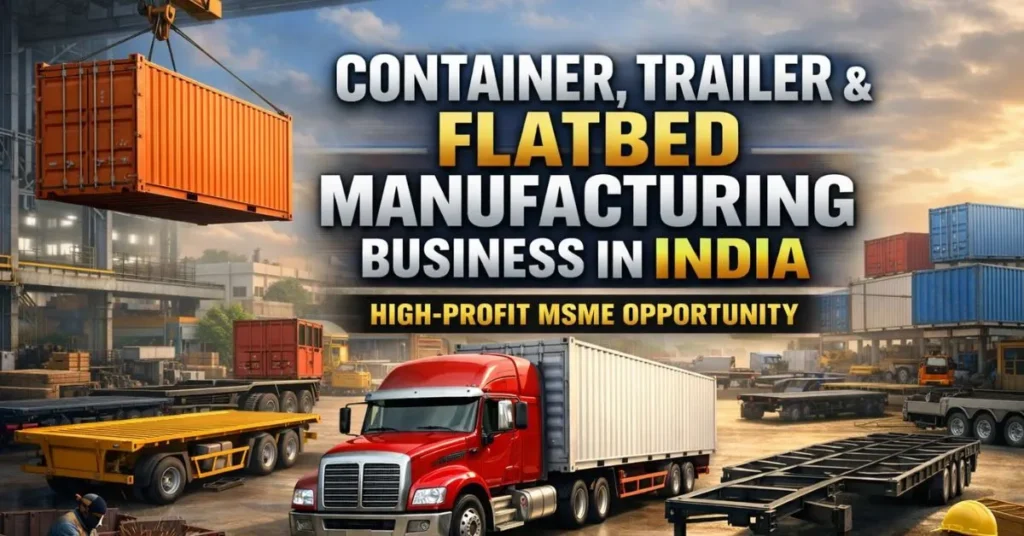
Introduction: Container manufacturing business in India In the logistics industry, profits are rarely made during the actual transportation process – they are made in the interface between goods being transported from road to rail, from rail to port, and from inland waterways to port. Containers, trailers and flatbeds are the backbone of these transitions as they allow for seamless cargo movement whilst reducing delays and handling costs. For MSME entrepreneurs and industrial investors, intermodal equipment manufacturing is a rare combination of stability and scalability. The advanced transportation equipment requirements of India increase as the country develops new freight corridors and multimodal logistics parks and export facilities. The industry functions according to permanent structural requirements because goods movement will always exist and organizations will continuously need equipment for their operations. This article delves into manufacturing opportunities, market potential, investment logic, processes and risks – to help entrepreneurs understand why containers, trailers and flatbeds are becoming strategic industrial investments.(Container manufacturing business in India) Read More: Our Books Market Demand Drivers: Infrastructure Supports Manufacturing India’s logistics ecosystem is in a process of structural transformation. Government initiatives like dedicated freight corridors, port modernization, inland waterways development and industrial corridors are adding a lot of capacity to the freight.(Container manufacturing business in India) For every kilometer of new freight infrastructure there is demand for transport equipment. As freight volume increases, logistics operators enlarge fleets, upgrade aging assets and invest in specialized equipment. This produces a strong feedback loop: Infrastructure investment helps to increase freight movement Higher freight volumes mean higher utilization of equipment Utilization increases the rate of replacement Manufacturing demand increases steadily For the MSME manufacturers, this translates to long-term institutional demand as opposed to fragmented retail buyers. The logistics companies together with EPC contractors and exporters and industrial fleet operators establish themselves as returning clients who generate steady income for the business. Understanding the Product Segments 1. Containers: Standardized Worldwide Assets Containers are the basis of modern intermodal logistics. ISO containers, high-cube containers, refrigerants, and specialized cargo boxes exist as worldwide standards which allow for simple international trade operations. Container manufacturing demands financial resources for steel production and stringent quality assessment procedures, yet standardization enables manufacturing at scale and international trade capabilities. With global supply chains looking for diversification in sourcing outside of traditional hubs, Indian manufacturers are having a growing export potential.(Container manufacturing business in India) 2. Trailers: Volume Domestic Opportunity Trailers are the link between the infrastructure and flexible road transportation. Skeletal trailers, container carriers & multi-axle logistics trailers are experiencing a high demand with the increasing e-commerce and industrial production and freight mobility. For MSMEs, trailer manufacturing is often the easiest gateway to get into the market because it can have relatively lower CAPEX and can offer faster order cycles. Fleet operators often expand and upgrade trailers, which assures repeat business. Read More: Business Plans / Project Profiles 3. Flatbeds: Customisation with Increased Margins Flatbeds function as transportation platforms which carry oversized goods that include machinery and steel structures and infrastructure components. The production of flatbeds results in fewer total units compared to trailers yet flatbeds generate higher profits because of their requirement for custom engineering work and their specific load handling methods.(Container manufacturing business in India) Together, these products constitute an interrelated manufacturing ecosystem that shares manufacturing infrastructure and engineering capabilities. Manufacturing Process: Engineering Discipline Over Complication Intermodal equipment manufacturing is not as much about innovation, but more about precision and process discipline. The manufacturing workflow usually consists of: Cutting steel plates and profiles on CNC plasma or laser machines Forming structural elements using hydraulic presses and roll forming Welding using Heavy Fabrication Techniques with Fixtures and Manulators Structural assembly using jigs to ensure dimensional accuracy Surface treatment – shot blasting and Corrosion resistant coating Final assembly and quality testing Success relies greatly on the quality of the weld, the load distribution, the alignment of the axles and the durability of the coating. Plants focusing on process consistency are beating those investing heavily in unnecessary automation. Read More: Project Reports & Profiles Machinery Needed in MSME Manufacturing Units Typical key equipment includes: CNC plasma or laser cutting machine for steel processing Hydraulic presses and roll forming machines Heavy welding set and fabrication fixtures Shot blasting lines, industrial painting lines Overheads and material handling equipment Instead of investing in cosmetic automation, MSMEs should prioritize machines that provide a better tolerance accuracy, throughput and production efficiency.(Container manufacturing business in India) Investment Logic and Profitability Factors Consultants are assessing intermodal manufacturing projects based on asset productivity and not simply profit margin. Important metrics include: Output per fabrication bay Equipment utilization rates Steel yield & scrap management Working capital cycle with logistics buyers After-sales services e.g. repair and refurbishment Manufacturers who integrate production with lifecycle services are often able to have better long-term cash flows. Refurbishment and retrofit services create recurring revenue and better customer retention.(Container manufacturing business in India) Read More: Steel Containers: Key Role of Cargo Containers in Global Trade Export Opportunities, Global Demand Transport equipment is internationally traded with a good export potential. The Indian manufacturers can target: International logistics fleet Coastal shipping operators EPC Contractors carrying out overseas infrastructure projects Markets in Africa, South East Asia and the Middle East Export participation does not always entail shipping full vehicles. Components, sub-assemblies and knock-down kits are possible entry strategies that minimize the complexity of logistics and open up global revenue streams. Strategic Lessons of Indian Industrial Leaders The transport manufacturers in India offer valuable insights: Tata Motors, put a focus to design the products not on technical specification, but to the operational use of the vehicle. Ashok Leyland developed robust fleet-centric service networks, which demonstrated that lifecycle value is more important than upfront pricing. Larsen & Toubro combined heavy engineering and infrastructure projects, proving the concept of how manufacturing increase relates to the growth of the nation. Intermodal equipment manufacturing employs similar strategic principles — durability, scalability and customer-focused engineering.(Container manufacturing business in India) Emerging MSME Project Opportunities Multiple
Port-Based Steel Manufacturing in India: Business Opportunity, Cost Advantages & Growth Potential
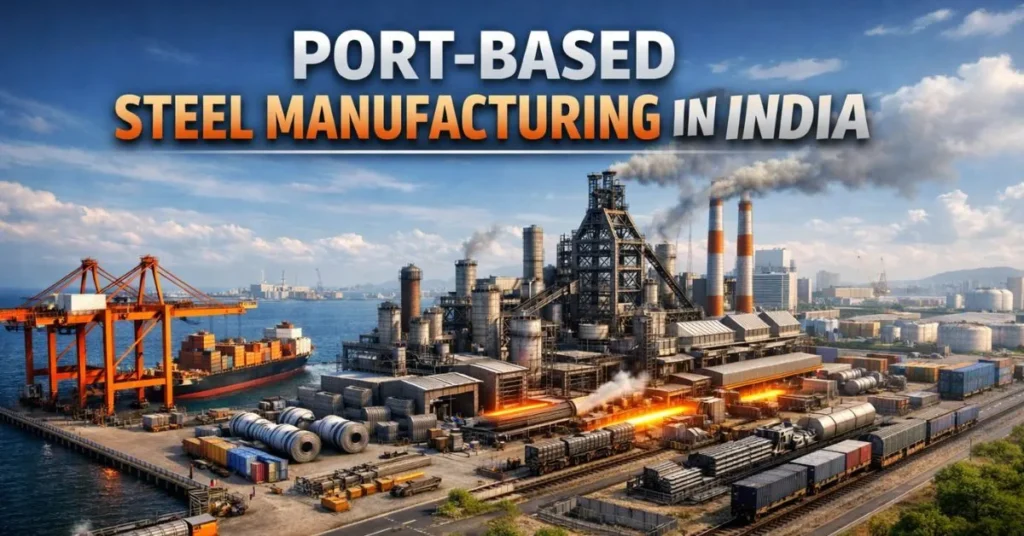
Introduction:Port-Based Steel Manufacturing in India Port-Based Steel Manufacturing in India is transforming the manufacturing sector through improved infrastructure, stronger global trade connections, and advanced logistics systems. The establishment of port-based manufacturing clusters has created integrated industrial ecosystems around major seaports, enabling businesses to enhance production efficiency, streamline transportation operations, and significantly boost export performance. In industries like steel and heavy fabrication, geography is increasingly becoming a strategic advantage, as opposed to just a logistical consideration. Port-based locations provide businesses with efficient access to both essential raw materials and international markets and institutional buyers which improves their ability to operate efficiently. For entrepreneurs, investors, and MSMEs looking for long term sustainability, steel manufacturing nearby ports is an attractive opportunity. The implementation of port-centric manufacturing models enables businesses to enhance their operational efficiency through two main methods which include reducing supply chain complexity and fulfilling their regular production needs. Read More: The Complete Technology Book on Hot Rolling of Steel (2nd Edition) The Concept of Ports Based Manufacturing Clusters Port-based manufacturing clusters are integrated industrial zones where production facilities are working in the close proximity to maritime infrastructure. These clusters create a complete system which combines all essential elements for manufacturing and logistics operations because they include facilities for production and storage and customs processing and distribution to international markets.(Port-Based Steel Manufacturing in India) The system creates an efficient value chain which enables direct port access to raw materials and requires minimal handling time to deliver finished products worldwide. Manufacturers benefit from reduced logistics expenses and faster delivery times and improved supply chain reliability. India’s increasing focus on the economic zones along its coast, port modernization and dedicated freight corridors has spurred the growth of such clusters. Ports are also evolving from transit points into more full-fledged industrial locations which facilitate long-term growth of manufacturing. Why Steel Manufacturing is the Perfect fit for Port Locations Steel production and fabrication are inherently logistics heavy activities. The industry depends on large raw materials such as iron ore, scrap metal and coal, while final products – everything from its structural components to its heavy equipment – also need efficient transportation. Port-based manufacturing solves these challenges by compressing the supply chain: raw materials may be acquired from anywhere in the world and transported directly to production facilities.” Finished steel products can be exported without the costly inland trucking requirement. Inventory storage requirements are reduced because of accelerated shipping cycles. Goods handling and material transfer costs are reduced to a great extent. For manufacturers, these advantages mean better margins and more constant operating expenses. In competitive markets where freight costs are often a major element in profitability, close proximity to ports can be a winning advantage.(Port-Based Steel Manufacturing in India) Read More: Steel Rolling Technology Handbook (2nd Revised Edition) Demand Stability through Institutional Buyers A high strength of the port-based manufacturing is found in its access to institutional and industrial buyers. Ports are complex environments of operation that need constant upkeep, infrastructure upgrade and equipment replacement. The primary factors which drive demand for this service include: Shipping lines & container operators Mariner Engineering and EPC Contractors Logistics and transportation companies Export-oriented manufacturers Infrastructure and maintenance agencies The institutional procurement process uses contract-based operations which operate differently from consumer markets that experience changes based on trends and economic fluctuations. The manufacturing process can create stable production schedules because the system produces consistent demand patterns which help manufacturers achieve constant machine operation throughout their production period. The current business environment assists MSMEs and mid-sized fabrication businesses to decrease their sales risk while they enhance their ability to predict their financial results.(Port-Based Steel Manufacturing in India) Steel Product Segments Most Suitable for Port Clusters Not all steel products have equal benefits from the proximity to the coast. The most successful categories have the following characteristics in common: they have high weight, they have an export orientation, and there is a continuous institutional demand.(Port-Based Steel Manufacturing in India) Read More: Steel Fabrication Industry Container and Container Component Production Shipping containers, corrugated panels and structural frames are directly related to port operations. Manufacturing these components in the vicinity of deployment areas curtails the turnaround time and allows for quicker servicing.(Port-Based Steel Manufacturing in India) Marine and Port Infrastructure Fabrication Ports require constant maintenance of safety and structural equipment such as bollards, fenders, access platforms, railings, crash barriers, etc. Replacement cycles create constant recurring demand. Structural Steel for Export Projects Prefabricated steel structures, which are used in international infrastructure projects, have the advantage of immediate access to the ports. Reduced shipping delay and logistics cost gives coastal fabrication units a strong competitive edge.(Port-Based Steel Manufacturing in India) Manufacturing of Logistics Equipment Trailers, skeletal carriers and cargo handling structures suffer intensive use within port ecosystems. Local manufacturing enables fast maintenance support and customer relationship building in the long run.(Port-Based Steel Manufacturing in India) Read More: Top 20 Steel Manufacturing Business Ideas Economic Benefits and Profitability Apricots, Avocados and Apples Port-based steel manufacturing has some structural advantages that lead to long-term financial soundness: Predictable Logistics Costs: With shorter transportation distances, there is less exposure to volatility and fuel price risk in freight. Improved Payment Discipline: Institutional clients tend to adhere to structured procurement cycles and contracts, resulting in more predictable payment schedules. Export Pricing Opportunities: Manufacturers who access international markets can use international pricing standards as their benchmark instead of competing only within their local markets through price wars. Consistent Production Utilization: A constant demand from industrial activities in setback offers better asset performance at low idle time. Instead of being at the mercy of volatile market spikers, manufacturers within port clusters tend to enjoy steady margin of EBITDA supported by operation efficiency. Infrastructure Development Building a Demand Flywheel The extensive Indian investments in logistics and coastal infrastructure development create more attractive opportunities for port-based manufacturing operations. Key developments include: Expansion of Coastal Shipping Networks Dedicated freight corridors between industrial regions Inland Waterway Connectivity projects Modernized systems of cargo handling and containerization The