
Paper and Packaging Business Ideas: 5 Profitable Units to Start in India
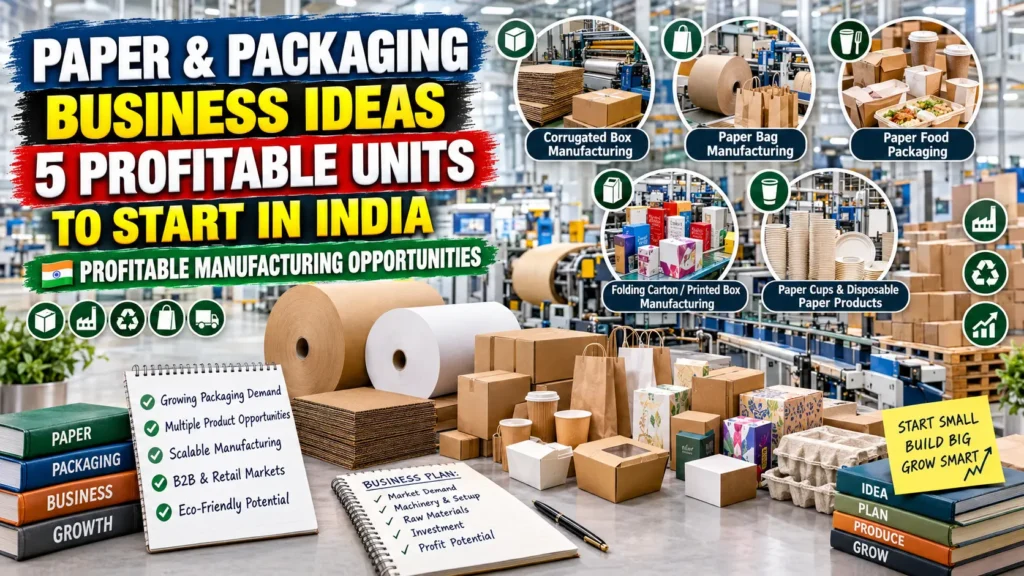
Feasibility based analysis of where the demand from e-commerce intersects with sustainability in Indian packaging. All products in any online delivery, on the shelves and in transportation need packaging and thus make any idea of business related to paper and packaging always relevant. With the growth of e-commerce and growing pressures on plastic, there is increasing demand for eco-friendly packaging solutions. This is very unique opportunity for a new entrepreneur since it combines both high demand and favorable legislation. The article will analyze the industry based on the project consultant viewpoint, looking at demand factors, feasible options and 5 potential manufacturing paths. Why Paper and Packaging Demand Keeps Rising E-Commerce and Retail Fuel Growth Packaging needs come with economic activity, and since retail and online purchases are increasing, the orders are regular, providing a reliable and repeating source of income for an efficient unit instead of a one-time deal. The efforts to fight the usage of single-use plastics create another reason why there is a demand for packaging based on paper products. The entrepreneur who produces such packaging products takes advantage of the development of e-commerce and the change in trends. Sustainability Opens Premium Niches People want more packages that are recyclable and biodegradable. Hence, there is scope for value added products. Therefore, a company making environmental friendly packages can benefit from improved margins as well as loyal customers. The industry can be regulated by Ministry of MSME & Central Pollution Control Board. Government Policies and Incentives The support available is mainly via MSME and cluster initiatives. The Ministry of MSME supports the small manufacturer by fostering lending and clustering. Also, “Make in India” supports domestic manufacturing by removing entry barriers to new units. It is recommended that founders enroll at Udyam for interest-free loans and favorable lending terms. Regulations pertaining to waste plastics set up by Central Pollution Control Board help paper alternatives. There is state support as well; such as the MSME and export promotion portal in Uttar Pradesh. 5 Paper and Packaging Business Ideas for Startups Idea 1 — Corrugated Boxes Unit Corrugated Boxes are vital in shipment, and demand increases with every e-commerce transaction. This particular unit can take advantage of the consistent reorders made by manufacturers and internet marketers. The owner starts out with regular-sized boxes and adds printing to the package. It is very important to maintain quality control because consistency of the product will ensure buyer trust. In addition, having local sourcing means lower delivery and freight expenses, providing an advantage for a new unit. Lastly, printed boxes always have higher margins. Idea 2 — Paper Bags and Eco-Friendly Packaging There is an increasing requirement for paper bags and biodegradable packages due to bans on plastic products. This will prove helpful for the owner as he has a good source of making quality paper bags. Making common sizes will increase volumes while making printed packages will improve margins. Furthermore, there is a possibility of entering high value-added packaging segment like food grade and superior packaging. Local production will help by competing on price and logistics basis. Idea 3 — Paper Cups and Disposable Tableware Disposable paper cups, plates, and tableware meet the needs of a large food service industry. With increased regulations against plastic disposable items, paper-based disposables enjoy huge demand from policy drivers. A startup that makes such products will enjoy repeated orders from caterers, coffee shops, and other event organizations. Consistency in quality and supply is what wins orders. It begins by selling the common products, but making the product unique brings in more profits. Moreover, institutional and event requirements offer constant bulk orders. Local production cuts down costs and time. The disposable tableware company that can meet the food safety requirements and supply is bound to prosper. Idea 4 — Recycled Paper and Board The recycling of waste into boards and packaging materials would be beneficial for manufacturers looking to use environmentally friendly inputs. This ensures there is plenty of cheap raw material hence predictable margins. Policies favoring recycling ensure the demand remains high. A founder may have both an advantage in cost and environment. This raw material can be sold to manufacturers of boxes and packages for use. This would result in a huge customer base. Institutions also insist on buying recycled feedstock, hence ensuring steady orders. Idea 5 — Flexible and Food Packaging There is a need for packaging of food products and consumer brands in the form of pouches, wraps, and cartons. With many brands and products being launched continually, there is a greater demand for the same. The founding member needs to concentrate on quality print and food-safe packaging because they are key to winning the contracts. A market segment will enable the company to grow through volume, while premium packaging increases the profit margins. There is also the opportunity for sustainable packaging for the premium customer. Import–Export Opportunity Analysis Trading behavior is in favor of skilled producers. The specialty packaging materials used by India are sourced from imports, which means that a dependable producer can replace the import in the country. On the other hand, India’s packaging products have markets outside the country, and thus the founders get a double opportunity. Exporting depends on consistency in quality and compliance. DGFT provides guidance on this to the founders, which means that the unit is able to cope with any challenges. When the local market falters, the external market steps in. Indian MSME Success Stories Worth Studying A number of suppliers in regional markets turned into significant vendors due to reliable services offered to e-commerce customers and FMCGs. The ability to develop an enterprise on the back of consistent demand proves the power of the latter in growing a business. A number of environmental packaging MSMEs managed to quickly scale up due to their ability to understand the change in the policy environment and provide solutions in compliance with the ban on plastics. Recycled board packaging MSMEs established themselves through a cost advantage and sustainability. About
प्लास्टिक बैन के बाद कौन से नए उद्योग उभरे — और कैसे करें शुरुआत
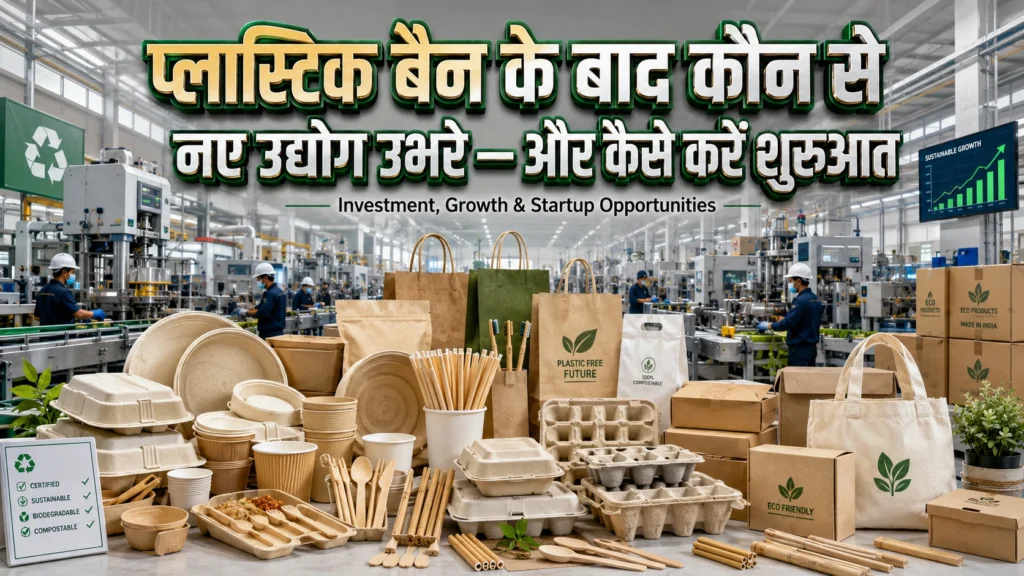
प्लास्टिक बैन के बाद बिजनेस आइडियाज Single-use plastic पर ban एक ऐसा decision था जिसने एक साथ एक industry को बंद किया और कई नई manufacturing industries के दरवाज़े खोल दिए। जो लोग इस shift को समझ गए, उन्होंने नए business ideas में जल्दी कदम रखा। और अब वे अच्छा कमा रहे हैं। इस आर्टिकल में हम देखेंगे — plastic ban के बाद कौन से नए उद्योग उभरे हैं, किसमें सबसे ज़्यादा demand है, और कैसे आप इस बड़े market opportunity का फायदा उठा सकते हैं। Related Article: The Green Manufacturing Revolution: Paper Water Bottles, Bioplastics & Biodegradable Products भारत में प्लास्टिक बैन — क्या बंद हुआ? जुलाई 2022 से भारत सरकार ने single-use plastic के 19 items पर complete ban लगा दिया। Ministry of Environment, Forest and Climate Change के इस फैसले ने plastic alternatives की demand एकदम बढ़ा दी। Plastic bags (75 micron से कम), straws, cutlery, thermocol cups — सब बंद हो गए। 1. पेपर बैग मैन्युफैक्चरिंग यह plastic bag का सबसे सीधा और popular alternative है। Shopping malls, grocery stores, restaurants, और pharmaceutical companies — सभी को paper bags चाहिए। Demand इतनी है कि छोटी paper bag units भी महीनों के orders advance में बुक हैं। इस business की शुरुआत ₹5-15 लाख में हो सकती है। एक small machine से रोज़ 10,000-20,000 bags बन सकते हैं। और profit margin 25-35% तक होता है। Access Complete Business Plan: Paper & Paper Products Manufacturing 2. जूट बैग और जूट प्रोडक्ट्स Jute एक eco-friendly, biodegradable material है। National Jute Board कई support schemes चलाता है। Jute bags, rugs, और packaging India और export दोनों markets में खूब बिकते हैं। Jute manufacturing units को raw material आसानी से मिलता है, खासकर पश्चिम बंगाल, असम, और बिहार में। Read the Complete Book Here: The Complete Book on Jute & Coir Products 3. बायोडिग्रेडेबल प्लेट और कप Areca palm leaf, sugarcane bagasse, और bamboo से बनी plates और cups का market बहुत तेज़ी से बढ़ रहा है। Hotels, caterers, और food delivery companies इन्हें prefer करते हैं। यह एक ऐसा business है जो rural areas में भी शुरू हो सकता है। Raw material local farms से मिलता है और machines की cost ₹3-10 लाख के बीच है। 4. कपड़े के थैले (Cloth Bag Manufacturing) Cotton, canvas, और non-woven fabric से बने bags की demand retailers, FMCG companies, और government schemes में है। ये bags reusable हैं और premium segment में भी अच्छी कमाई है। 5. कागज़ के स्ट्रॉ और बर्तन Paper straws, paper cups, और paper plates की demand cafes, QSR chains, और airlines में तेज़ी से बढ़ी है। एक small paper straw manufacturing unit ₹8-20 लाख में लग जाती है। 6. बांस के प्रोडक्ट्स Bamboo toothbrushes, bamboo straws, bamboo cutlery — ये सब premium eco-friendly products की category में आते हैं। Export potential भी बहुत अच्छा है। Identify high-growth industries before others do बैन के बाद उभरे उद्योग — तुलनात्मक जानकारी उद्योग शुरुआती लागत (₹) मुख्य बाज़ार Profit Margin Paper Bags 5–15 लाख Retail, Pharma 25–35% Jute Products 8–25 लाख Retail, Export 20–30% Areca/Bagasse Plates 3–12 लाख Hotels, Catering 30–40% Cloth Bags 2–8 लाख FMCG, Retail 25–35% Paper Straws/Cups 8–20 लाख Cafes, QSR 20–30% Bamboo Products 5–18 लाख Premium, Export 35–50% शुरुआत कैसे करें — प्रैक्टिकल गाइड सबसे पहले अपना product decide करें। फिर local market में demand check करें — nearby shops, hotels, restaurants से बात करें। Raw material suppliers identify करें और एक छोटे scale पर trial production करें। Udyam registration और GST के बाद अपना product B2B channels पर list करें। IndiaMART और TradeIndia पर profile बनाना एक अच्छी शुरुआत है। अक्सर पूछे जाने वाले सवाल (FAQ) Q1. क्या plastic alternatives का business profitable है? हां, यह highly profitable है। Demand बढ़ रही है और competition अभी उतना ज़्यादा नहीं है। Profit margin 25-50% तक होता है। Q2. Biodegradable products के लिए कोई certification चाहिए? BIS और CPCB certification आपके product को premium market में मदद करती है। हालांकि शुरुआत में FSSAI (अगर food packaging है) ज़रूरी है। निष्कर्ष Plastic ban ने एक नई manufacturing economy को जन्म दिया है। जो उद्यमी आज इन business ideas में निवेश कर रहे हैं, वे कल के market leaders बन सकते हैं। Environment-friendly होना अब सिर्फ नैतिकता नहीं, बल्कि एक smart business strategy भी है।
India Paper-Based Products Market 2026–2033: SWOT, Demand-Supply Analysis, Regional Insights & Startup Opportunities
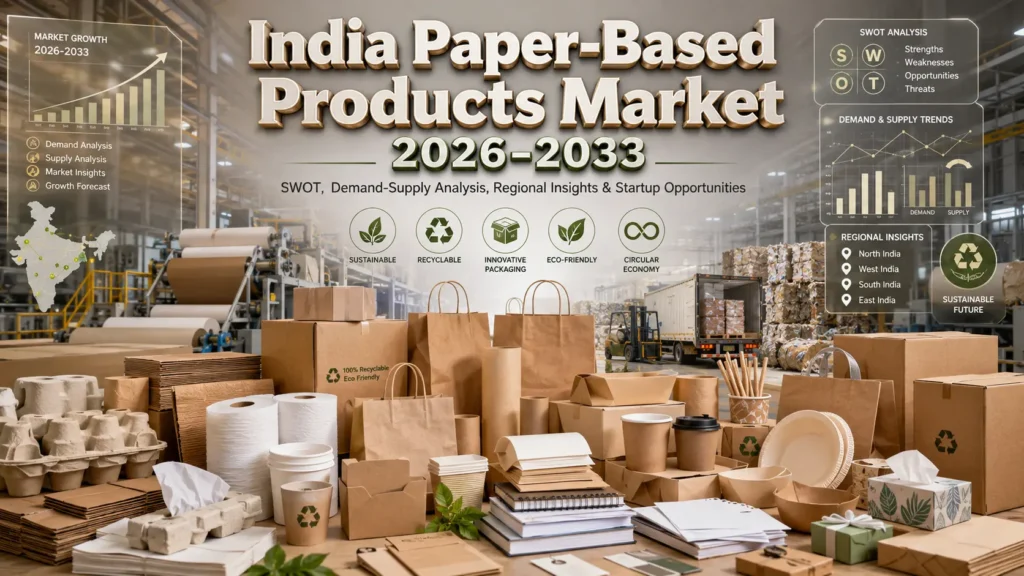
India Paper Based Products Market Market Insight The paper-based products sector in India is at a juncture – where policy support initiatives, increasing e-commerce volumes and a significant change in consumer mindset from single-use plastics are shaping the entire demand curve. Indian paper and paper products market is estimated at USD 9.25 billion and will reach a value of USD 11.91 billion by 2030 with steady growth of approximately 4.37% during the forecast period. The packaged paper market, meanwhile, is growing at much higher rates, and India’s paper packaging market alone was worth about USD 18.6 billion, which by 2033 should be worth USD 28.3 billion, according to data tracked by the India Brand Equity Foundation (IBEF). The headline growth rate is not the most compelling part of this opportunity. It is the increasing disconnect between the demand and supply of domestic consumption, which must be clearly analyzed by policy makers, investors and manufacturing entrepreneurs. India Paper-Based Products: Market Overview and Growth Trajectory India is now among the fastest growing paper markets of the world and the total paper and paperboard consumption have reached 23-24 million tonnes per annum. The production capacity of the operating mills is in the range of 22-24 million tonnes, whereas installed capacity of mills is in the range of 30-32 million tonnes, which is a contradiction and highlights under-usage of production capacity as well as structural deficiency of supply. According to the data given by the Central Pulp & Paper Research Institute (CPPRI), which is an autonomous body under Ministry of Commerce & Industry in the Government of India, the manufacturing of paper in the country is around 900 with only 550-560 being operational. This figure alone represents the level of investment and consolidation needed in the sector. Generally, there are four application segments of the paper market in India – packaging paper and paperboard, writing and printing paper, newsprint, and specialty papers. The packaging is the largest growth driver of these, representing almost 65% of paper usage, with an annual increase of more than 8%, and is fueled by growth from FMCG, organized retail, pharmaceutical packaging and the structural development of e-commerce logistics. India shipped more than 5.2 billion online shipments in one recent year alone, and that figure is still rising — all of these shipments need corrugated packaging, paper bags, labels, or protective paper inserts. Writing and printing paper is the second-largest segment and is expected to see a fairly consistent demand from education institutions, publishing houses, government documentation and stationery from the value chain, as they consume paper at the rate of about 35%. India, despite the digital disruption, has more than 105000 registered newspapers published in various languages of which more than 100000 are daily newspapers in India, according to the Registrar of Newspapers in India, which is the highest in the world in terms of newspaper and writing paper demand. The turnover of Indian paper industry is about Rs. It is estimated to be about Rs. 70,000 crores for the national exchequer. 8,000 crores. Not only is it an industry sector, but it directly and indirectly employs more than five lakh people and helps thousands of agro-forestry farmers all over the country, too. Get Detailed Insights from This Book: Modern Technology of Pulp, Paper and Paper Conversion Industries Per Capita Consumption Gap: The Single Biggest Market Opportunity The one figure that sums up the investment case of the paper-based products industry in India is this: India consumes about 15-17 kilograms of paper per capita annually. The average for the world is 57 kilograms. In developed countries such as the USA, it is over 200 kg per person/year. This is an abysmal consumption deficit and it is not just a number — it is an economic deficit. Increase in India’s per capita paper consumption by 1kg is approximately equivalent to one million additional tonnes of paper consumption per year. In India, the economy is rapidly formalizing, urbanization is increasing rapidly and literacy is on the rise, which will lead to a per capita consumption of 28 to 30 kilograms of paper in 2030. It does not take much imagination to realize that this alone would mean the need for adding up to 15–16 Mt of consumption capacity in this decade—an extraordinary manufacturing opportunity. The Indian Paper Manufacturers Association (IPMA) data shows domestic use of packaging paper is more than 8% a year now, and the total paper market is expanding at 6-7% a year. But a lot of this incremental demand growth is being satisfied right now not by domestic manufacturers but by imports, and especially from China, the ASEAN countries and South Korea. Demand–Supply Gap: Where the Real Opportunity Lies The Indian paper-products industry has a real, measurable and commercially important demand-supply gap. On the other, the domestic consumption is expected to increase to 23.5 million tonnes per annum while the domestic production capacity (with only the operational mills considered) is around 22 MT per annum. This is being addressed mainly by new imports, which have increased dramatically, of around 1.5 to 2 million tonnes per year. IPMA data shows that at certain junctures, imports of paper and paperboard have demanded over 15% of the total Paper Market in India — almost 2.8 to 3 million tonnes of paper per year. Imports from China have increased by more than 13% on an annual basis in value terms and imports from ASEAN have soared by more than 78% in certain quarterly periods. Most of the paper which India imports are coated papers, specialty papers, tissue, kraft paper and newsprint which can be produced locally in India, with the exception of coated papers, which are imported from the Far East. The import surge is structural, not cyclical, according to information from the Directorate General of Commercial Intelligence and Statistics (DGCI&S). Nearly Rs. 14 billion worth of paper and paperboard were imported. This amounts to 10,000 crores in a single nine-month period and is a straight-line impact on the viability of
The Green Manufacturing Revolution: Paper Water Bottles, Bioplastics & Biodegradable Products
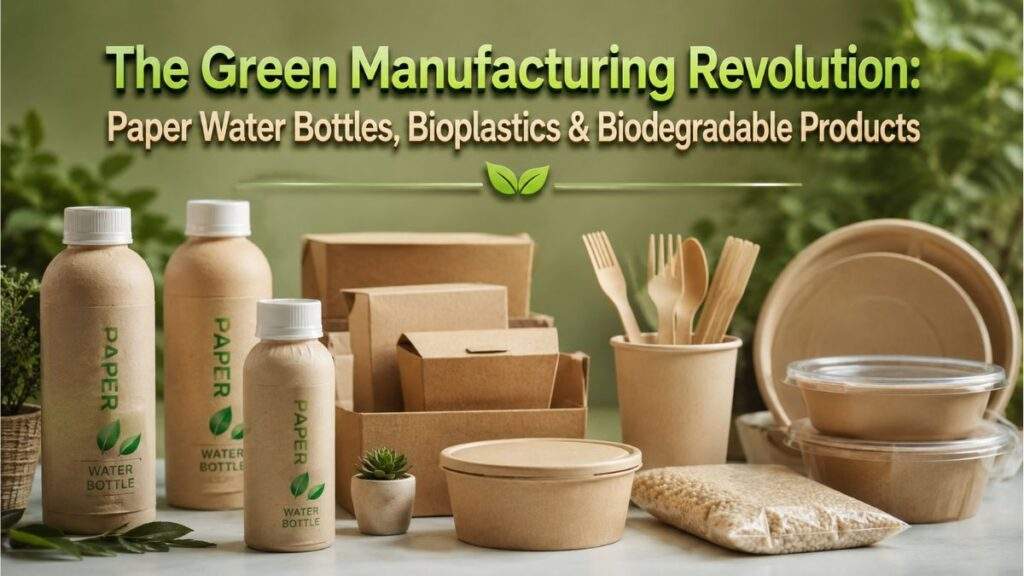
Biodegradable products manufacturing in India Plastic pollution is no longer just an environmental problem; it’s one of today’s greatest business opportunities. Governments, consumers and big companies around the globe are phasing out conventional plastics and adopting more eco-friendly alternatives like biodegradable plastic. The green manufacturing revolution is generating a whole new industrial economy, ranging from paper water bottles to compostable food packaging. Sustainability was a somewhat esoteric idea a couple of years ago. Today it shapes the way that companies produce their goods, how restaurants package their food and even how consumers choose which brands to support. This shift is occurring at an accelerated pace, due to increased global awareness of the long-term environmental effects of plastic waste, especially on oceans, soil, and human health. India produces millions of tones of plastic waste in a year. Much of this waste is hard to recycle and will eventually be dumped in landfills, rivers and oceans. To mitigate the issue, the Government of India has banned a large number of single-use plastic items from July 2022. This policy sparked immediate need for biodegradable alternatives and offered tremendous opportunity for manufacturers. As a result, industries are now actively searching for sustainable packaging solutions such as: Biodegradable carry bags Compostable food containers Paper straws Sugarcane bagasse plates Starch-based bioplastics Paper water bottles These products are not anymore experimental products. They are being produced commercially and sold all over the world. The global bioplastics market is already larger than $1 billion and is projected to rise sharply during the next 10 years. Get Detailed Insights from This Book: Paper Water Bottles and Bioplastics Manufacturing Handbook Why India Has a Huge Advantage India is placed in a very good position in order to be a global name in manufacturing biodegradable products. There are plenty of raw materials of agriculture in the country that can be processed into environmentally friendly raw material. In India some of the most important raw materials are: Sugarcane bagasse Rice husk Corn starch Cassava starch Potato starch Wheat bran Agricultural residues can be utilized in the production of sustainable packaging and biodegradable products, rather than as waste. This not only helps to minimize environmental impacts but also generates new livelihood and business opportunities for farmers and rural industries. The other great benefit is the low-cost manufacturing setup in India. Indian biodegradable products are very competitive in the global markets as compared to that of Europe or North America as production costs are much low in India as compared to them. Paper Water Bottles: The Next Big Packaging Innovation Paper water bottles are receiving vast attention worldwide among all eco-friendly packaging products. As consumers become more environmentally conscious of packaging, large beverage companies are already investing in the technology for paper bottles. Paper water bottles are designed with: A paper shell outer shell The inside lining is biodegradable or recyclable. Eco-friendly barrier coatings The idea is simple: reduce plastic usage while maintaining the convenience of bottled beverages. The combination of relatively low competition and increased demand makes paper water bottles particularly appealing to Indian entrepreneurs. Environmentally friendly packaging is a quick way for consumers to make sense of environmentally friendly brands and companies, helping to establish trust and a good reputation. Over the next couple of years, the hospitality sector, airports, luxury retailers and eco-conscious beverage brands will be significant purchasers of paper bottle packaging. The Rising Demand for Biodegradable Packaging The biggest business opportunity is to replace common plastic products with alternatives that are more environmentally friendly. The following industries are contributing to this demand: Restaurants and cafés Food delivery companies Cloud kitchens Hotels and resorts Hospitals Retail stores FMCG companies Airline catering services Consumers and government regulations are forcing many businesses to decrease their use of plastic. Consequently, plates, bowls, trays and carry bags that biodegrade are becoming more popular. Other biodegradable plastics, such as PLA (Polylactic Acid) and PHA (Polyhydroxyalkanoate), are also becoming popular due to their durability and biodegradability. Access Complete Business Plan: Biodegradable & Eco-Friendly Plastics and Packaging Challenges in the Industry The market for biodegradable products is huge, but entrepreneurs need to know the difficulties of entering the market. The greatest problem is the production cost. The prices of biodegradable products are generally higher than those of conventional plastic products. In markets where price is a major consideration, consumers could be reluctant unless sustainable alternatives are mandated by regulations. An additional challenge is certification. Biodegradable or compostable products are those that comply with the following recognized standards: EN 13432 ASTM D6400 BIS certification in India Manufacturers might encounter challenges in exports and in commercial sales on a large scale without proper certification. Another factor is the supply of raw materials is not consistent. The key to sustaining product quality and price stability is the dependable sourcing network a business can have. Opportunities for Entrepreneurs and Startups With all of the difficulties, the future of this industry is looking bright. There are various levels of investment that entrepreneurs can make within the sector, depending on their resources and expertise. Small-scale opportunities include: Compostable cups Sugarcane bagasse plates Paper straws Biodegradable carry bags Medium & large opportunities: PLA manufacturing Paper water bottle production Bio-based packaging films Industrial compostable packaging units The expanding start-up ecosystem and support from the government on green industries are helping new entrepreneurs to enter the market. Identify high-growth industries before others do NPCS: Trusted Industrial Guidance for Entrepreneurs If a businessman wants to open a business for manufacturing biodegradable products, he will have to take proper industrial instructions. This is where NPCS (Niir Project Consultancy Services) comes into play. National Institute for Industrial Research is one of the premier industrial consultancy and project report organizations in India. NPCS has been assisting startups, MSMEs, Manufacturers and investors for decades in understanding profitable manufacturing opportunities. Their website called Entrepreneur India offers useful business-related information on: Manufacturing project reports Market research studies Machinery details Techno-economic feasibility reports Startup business ideas Industrial investment guidance These resources can help
How to Start a Profitable A4 Size Paper Manufacturing Business
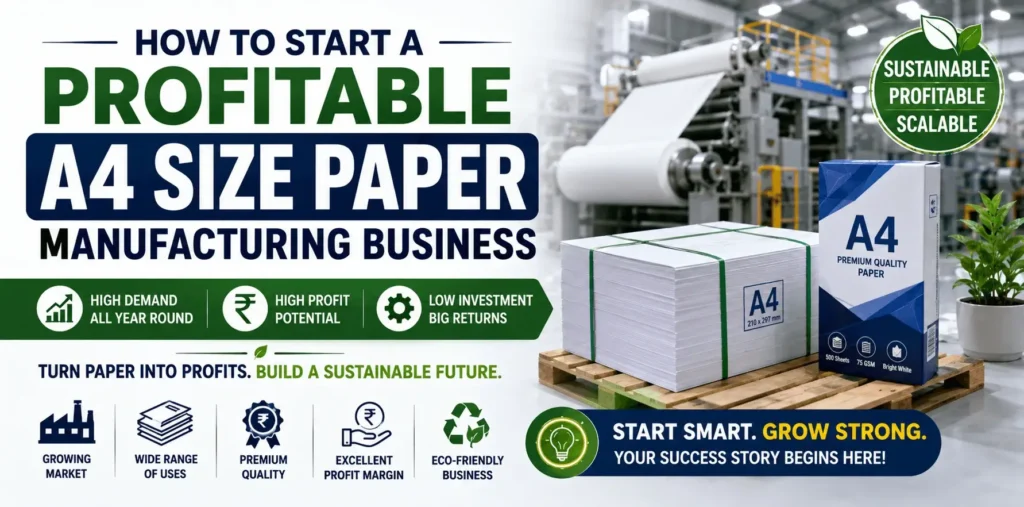
The A4 Size Paper Business is one of the most profitable and fast-moving opportunities in the paper and stationery industry due to continuous demand from schools, offices, government departments, photocopy centers, printing businesses, and corporate organizations. Despite increasing digitalization, the consumption of copier and photocopy paper continues to grow steadily across educational, commercial, and administrative sectors. With relatively low investment, simple machinery setup, and strong year-round market demand, many entrepreneurs are now exploring A4 size paper manufacturing business opportunities in India. Businesses involved in copier paper cutting, packaging, branding, and distribution can generate consistent recurring income through wholesale and institutional supply networks. What is an A4 Size Paper Business? An A4 size paper business involves cutting, packaging, branding, and distributing copier paper sheets commonly used for office printing, photocopying, educational work, and commercial documentation. This guide explains the complete A4 size paper business setup process including machinery, raw materials, manufacturing process, packaging methods, market opportunities, and profitability analysis. Why Starting an A4 Size Paper Manufacturing Unit is a Smart Investment The A4 size paper business has shown remarkable resilience over the years. Even as businesses shift toward digital, paper usage persists across multiple domains such as academic institutions, government sectors, corporate houses, and publishing industries. This specific paper size is considered the global standard for office documents, assignments, reports, photocopies, and formal communications. Why A4 Size Paper Business is Profitable Include: recurring office demand educational demand government supply demand low entry barrier scalable distribution B2B wholesale opportunities institutional contracts Understanding the A4 Size Paper Market Potential The A4 paper market is part of the global printing and writing paper industry, which has seen consistent demand due to its utility in formal documentation. In India alone, paper consumption is expected to reach over 30 million tonnes annually by 2030, and a substantial portion of this includes A4 sheets. This growth presents a golden opportunity for small and medium enterprises (SMEs) to establish localized units for manufacturing and supplying A4 size paper. The relatively low entry barrier in terms of capital investment and land requirement makes this a feasible venture for new entrepreneurs. Moreover, increasing awareness regarding eco-friendly practices has led to a rise in the demand for recycled A4 size paper, creating new niches within the sector. Machinery and Raw Materials Needed for A4 Paper Manufacturing Setting up an A4 size paper manufacturing unit requires some basic yet critical machinery and raw materials. The core components include: Slitting Machine: To cut large paper rolls into A4 dimensions. Ream Cutter Machine: For cutting and trimming the paper sheets accurately. Packaging Machine: To wrap and bundle paper sheets efficiently. Moisture Meter & Calibration Tools: To ensure quality and precision. The main raw materials required are: Jumbo paper rolls (Reel Form) Adhesive and ink (for branding and packaging) Packaging materials (boxes, shrink wraps) Sourcing raw materials from paper mills or wholesalers can reduce costs substantially, especially when purchased in bulk. Manufacturing Process of A4 Size Paper The production process involves several streamlined steps: Loading the jumbo rolls into the slitting machine. Cutting and trimming the paper to A4 dimensions. Counting and bundling the paper into standard reams (usually 500 sheets). Branding and packaging each ream with required labels. Packing the reams into cartons for distribution. Quality checks are performed during each stage to ensure consistency in thickness, brightness, and GSM (grams per square meter), which is a key indicator of paper quality. Legal Requirements and Licensing To establish a compliant unit, the following registrations and certifications are typically required: Udyog Aadhaar/MSME Registration GST Registration Factory License Pollution Control Board Clearance (if applicable) Trademark Registration (for branding) Adhering to these legal protocols ensures smooth operations and boosts the credibility of your business. Investment and Profit Margin in A4 Paper Business Starting a small-scale A4 paper cutting and packaging unit may require an initial investment of INR 10–25 lakhs, depending on the scale and automation of operations. A medium-sized unit can produce approximately 2,00,000 to 3,00,000 sheets per month. Profit margins range between 10% to 25%, depending on sourcing efficiency, operational costs, and distribution reach. With consistent orders and local dealership tie-ups, entrepreneurs can expect a return on investment (ROI) within 12–18 months. Target Customers and Market Strategies Target markets for A4 size paper include: Educational institutions Government offices Corporate houses Stationery wholesalers and retailers Photocopy and printing shops Effective strategies to penetrate the market: Offering bulk discounts to wholesalers and dealers. Establishing partnerships with schools and colleges. Participating in trade fairs to build visibility. Online B2B selling via platforms like IndiaMART, TradeIndia, and Amazon Business. Brand differentiation through eco-friendly or premium-quality paper offerings. Branding and Packaging Tips The look and feel of your paper packaging significantly affect the buying decision, especially in a saturated market. A well-branded ream of A4 size paper instills trust and signals quality. Key tips: Use eco-friendly packaging to attract sustainability-conscious customers. Include certifications or quality standards (like ISO, FSC) on the packaging. Highlight key features such as GSM rating, brightness, and suitability for inkjet/laser printing. Offer customized packaging for bulk corporate clients. Automation and Scaling Up Once the business reaches stability, investing in automated machines for stacking, cutting, and wrapping can enhance productivity. Automation reduces manpower dependency, improves accuracy, and enables higher output with lower operational costs. Scaling up can include: Expanding into A3 and legal size papers Manufacturing colored or recycled A4 sheets Launching a private-label brand and selling through e-commerce Exporting to nearby countries with paper demand Challenges and How to Overcome Them While the A4 size paper business offers lucrative returns, it is not without its set of challenges: Raw material price fluctuation High competition from established brands Logistics and distribution issues Solutions include: Entering into long-term supplier contracts to stabilize costs. Building a niche (such as recycled, sustainable paper). Developing a local distribution network to reduce transport costs. Sustainability and Future Trends The growing awareness of environmental impact is pushing manufacturers toward sustainable paper production. This includes: Using recycled pulp instead of virgin wood fiber.
Paper Core Manufacturing Industry. Business Ideas in Paper Packaging Industry
The industrial world has witnessed a shift toward eco-friendly and cost-effective materials in packaging and manufacturing. Among these, Paper Core Manufacturing has emerged as a highly profitable and sustainable business avenue. Paper cores are cylindrical products made from recycled paper and are widely used in textiles, plastic film, paper rolls, tapes, and construction materials. With increased awareness of sustainability and the rise of eco-packaging solutions, the demand for paper cores is on a significant upward trend. If you are an aspiring entrepreneur or investor looking to start a green and profitable business, Paper Core Manufacturing in 2025 is worth serious consideration. Why Paper Core Manufacturing Is a Smart Business Choice in 2025 The growing push for environmentally conscious practices and recyclable packaging materials makes Paper Core Manufacturing a strategic investment for the future. Governments around the world are encouraging the use of biodegradable and recyclable products to reduce plastic pollution. This has opened up vast opportunities for paper-based solutions. Moreover, the increasing need for industrial packaging in sectors like textiles, film, and paper mills has expanded the market for paper cores. These industries use cores as essential components for rolling and storing materials. The low raw material cost, scalable production models, and a wide range of application areas make this business both accessible and profitable. Market Potential of Paper Core Manufacturing The global paper core market has been growing steadily and is projected to continue its rise through 2025 and beyond. Several factors contribute to this growth: Rapid expansion of the packaging industry Increased textile and fabric production Greater demand in the construction and adhesive tape industries Environmental regulations favoring paper-based alternatives India, in particular, is a thriving market for Paper Core Manufacturing due to the growth of its textile, packaging, and FMCG industries. With the “Make in India” initiative and support for MSMEs, setting up a manufacturing unit is becoming more viable for small and medium entrepreneurs. Types of Paper Cores Depending on the usage and specifications, paper cores can be categorized into: Textile Cores – Used for winding yarn and fabrics. Industrial Cores – Utilized in plastic film, foil, and other sheet materials. Printing & Converting Cores – For paper, label stock, and adhesive tapes. Construction Cores – Used for formwork in construction. Custom Cores – Made for specialized applications with specific diameters and strengths. Understanding these categories allows manufacturers to target different industries with tailored product offerings. Key Raw Materials Required The most important raw material in Paper Core Manufacturing is recycled kraft paper. Other materials and components include: Adhesives and glues (water-based or synthetic) Cardboard sheets Resin or varnish for coating (optional) Machinery for winding, cutting, and shaping By sourcing raw materials from recycling plants and local vendors, manufacturers can keep costs low while maintaining product quality. Machinery and Equipment Needed Setting up a paper core manufacturing unit requires several machines, which may include: Paper slitting machine Core winding machine Core cutting machine Dryer (optional, for high-speed production) Printing and labeling unit (if customization is offered) Quality testing equipment The capital investment for a small-scale unit can start from INR 15–20 lakhs, with scope to expand based on demand and scale. Step-by-Step Manufacturing Process The Paper Core Manufacturing process involves a series of precise steps to ensure strength and dimensional accuracy. Here’s a simplified process outline: Slitting the Kraft Paper – Large rolls of kraft paper are slit into smaller strips suitable for core winding. Core Winding – The slit kraft paper strips are spirally or parallelly wound using an adhesive to form a core of desired thickness and diameter. Drying – The wound cores are dried to solidify the glue and provide shape retention. Cutting to Size – The dried cores are cut into required lengths using an automatic cutter. Finishing – The final product may be surface-coated, labeled, or polished depending on client requirements. Packaging – The finished cores are packed and sent for dispatch. Business Setup and Legal Requirements Before you start your Paper Core Manufacturing unit, you need to take care of some basic formalities and registrations: Company registration (as a proprietorship, partnership, LLP or Pvt Ltd) Udyam Registration for MSME benefits GST registration NOC from the Pollution Control Board Factory license Trade license from the local municipal authority Ensuring compliance with these regulations helps you avoid legal issues and gives access to government subsidies and schemes. Marketing and Sales Strategies Effective marketing is crucial to establish your presence in the competitive Paper Core Manufacturing industry. Here are some useful strategies: B2B Networking – Connect with textile mills, packaging units, and tape manufacturers. Online Listings – Use B2B platforms like IndiaMART, TradeIndia, and Alibaba. Exhibitions & Trade Fairs – Participate in industrial expos to showcase your products. Website & SEO – Build a professional website and optimize it with keywords like “custom paper cores,” “industrial paper cores,” etc. Samples & Discounts – Offer free samples or introductory discounts to bulk buyers. Good customer service and timely delivery can build long-term relationships with clients. Challenges in the Industry While Paper Core Manufacturing is lucrative, it does come with some challenges: Raw Material Fluctuations – Prices of kraft paper and adhesives may fluctuate. Machinery Maintenance – Equipment requires regular maintenance and skilled operators. Competition – Local and regional competitors can affect pricing and margins. Waste Management – Managing scrap and glue waste requires proper systems. A well-thought-out business plan and risk assessment can mitigate these issues efficiently. Profitability and ROI A well-managed small-scale Paper Core Manufacturing unit can achieve break-even within 12–18 months. Profit margins generally range between 15–25% depending on production scale and market strategy. For example, a unit producing 1,000 cores per day can generate monthly revenue between INR 6–8 lakhs with a net profit of INR 1–1.5 lakhs after expenses. Scaling up production and automating processes can further improve profit margins. Future Trends in Paper Core Manufacturing By 2025 and beyond, the Paper Core Manufacturing industry is likely to experience innovations and shifts, such as: Eco-friendly Adhesives – New biodegradable
Paper Manufacturing Industry
The Paper Manufacturing Industry plays a critical role in supporting global communication, packaging, education, and sanitation needs. Despite the rise of digital alternatives, the demand for paper products remains significant across sectors such as printing, tissue, packaging, and industrial processing. With environmental concerns growing, the shift toward recycled paper and eco-friendly production practices has also revitalized the sector. The Paper Manufacturing Industry continues to innovate in material sourcing, production efficiency, and sustainability, making it an excellent avenue for long-term investment and business development. Types of Paper Produced The Paper Manufacturing Industry produces a wide variety of paper types, each tailored to specific market segments: Printing and Writing Paper: Used in offices, books, newspapers, and education Tissue Paper: Includes toilet paper, napkins, and facial tissues Packaging Paper: Kraft paper, corrugated board, and paper bags Industrial Paper: Filter paper, insulation board, and specialty coatings Recycled Paper: Made from post-consumer or industrial waste for eco-conscious buyers This wide range of end products ensures a diversified market and stable revenue streams for manufacturers. Key Raw Materials Used The essential raw materials in the Paper Manufacturing Industry include: Wood Pulp: Derived from softwood or hardwood trees Recycled Paper: Used in producing newsprint and packaging paper Chemicals: Bleaching agents, fillers (such as clay and calcium carbonate), sizing agents Water: Heavily used throughout the pulping and papermaking process Energy: Both electricity and steam are required for drying and processing Due to high consumption of natural resources, many units now integrate closed-loop systems for water recycling and energy optimization. Manufacturing Process Overview The standard paper production process in the Paper Manufacturing Industry follows these core steps: Raw Material PreparationWood chips or recycled paper are treated to extract cellulose fibers. Debarking, chipping, and pulping are involved. PulpingMechanical or chemical pulping breaks down raw materials into pulp. For higher-quality paper, chemical pulping is preferred. Bleaching and CleaningThe pulp is washed and bleached to achieve desired whiteness and remove impurities. Sheet FormationThe pulp is diluted and fed onto a moving wire screen where water drains away, leaving a wet paper mat. Pressing and DryingThe paper mat passes through rollers to remove moisture, then dried with steam-heated rollers. FinishingCoating, calendaring (smoothing), cutting, and packaging are performed to produce the final paper product. The choice of method (chemical, mechanical, or recycled) depends on the desired paper grade and end use. Required Machinery and Equipment To set up a facility in the Paper Manufacturing Industry, the key machinery includes: Pulping equipment (hydrapulper, refiners, screens) Paper machines (Fourdrinier or twin-wire former) Press section and dryer section Calendaring and coating machines Slitters and rewinders Boilers and water treatment systems Pollution control equipment (scrubbers, effluent treatment plants) Advanced automation and SCADA systems are also being adopted to improve efficiency and reduce manpower dependency. Infrastructure and Space Needed Setting up a medium-scale paper plant in the Paper Manufacturing Industry typically requires 15,000 to 50,000 sq. ft., depending on capacity and integration level. You will need: Raw material storage yards Pulping and paper production halls Chemical storage and handling rooms Drying and finishing section Water and effluent treatment plant Warehouse and administrative office Proximity to raw material sources like forests, urban waste paper suppliers, or agro-waste producers can significantly reduce logistics costs. Investment and Profitability The investment required in the Paper Manufacturing Industry depends on the scale of operations: Small-scale plant (recycled paper-based): ?75 lakhs – ?1.5 crores Medium-scale plant: ?3 – ?7 crores Large-scale integrated unit: ?10 – ?50 crores+ Paper sells at ?30 to ?120 per kg depending on type (tissue, printing, or kraft). With optimized operations and strong distribution, manufacturers can expect profit margins of 15–25%, and the return on investment usually materializes within 2–4 years. Licensing and Regulatory Requirements To establish a unit in the Paper Manufacturing Industry, the following licenses and certifications are essential: MSME/Udyam Registration Factory License GST Registration Consent to Establish and Operate (from State Pollution Control Board) Fire and safety compliance certificates ISO 9001, ISO 14001, and FSC certification (for quality, environment, and sustainability) Water usage permissions and effluent management plan Given the high water and energy usage, sustainability compliance is becoming critical for long-term operational approval. Market Demand and Customer Segments The Paper Manufacturing Industry caters to a wide range of customers: Schools, colleges, and publishing houses E-commerce and retail packaging firms FMCG brands for wrapping and labeling Restaurants and hotels for tissue and napkin supplies Government departments and stationery suppliers Exporters of specialty and recycled paper products There’s increasing demand for biodegradable paper packaging as a replacement for plastic, especially in FMCG and retail sectors. Opportunities for Expansion and Diversification Growth in the Paper Manufacturing Industry can be achieved through: Recycled Paper Plants: For eco-friendly brands and export Tissue Paper and Napkins: High-margin consumer products Value-Added Coated Paper: For premium printing and packaging Corrugated Board and Kraft Paper: For the booming e-commerce market Biodegradable Tableware or Packaging: Using paper pulp as raw material Joint ventures with FMCG brands or investments in in-house recycling units can further enhance margins and market access. Conclusion The Paper Manufacturing Industry is not only thriving but also transforming into a more sustainable and tech-driven sector. From office stationery and education to green packaging and hygiene products, paper continues to be a fundamental material in the global economy. With the right mix of technology, resource planning, and environmental compliance, setting up a paper manufacturing business can lead to high profitability, long-term stability, and strong export potential. Niir Project Consultancy Services An ISO 9001:2015 Company 106-E, Kamla Nagar, Opp. Spark Mall, New Delhi-110007, India. Email: npcs.ei@gmail.com , info@entrepreneurindia.co Tel: +91-11-23843955, 23845654, 23845886, 8800733955 Mobile: +91-9811043595 Website: www.entrepreneurindia.co , www.niir.org Contact Us
Production of Tissue Paper from Recycled Paper. Recycling of Waste Paper to Tissue Paper
sTissue paper is an essential product used in homes, offices, hospitals, restaurants, and countless other places around the world. Its popularity has steadily increased thanks to its convenience, softness, and hygienic qualities. However, the large-scale manufacturing of tissue paper using virgin pulp contributes to deforestation and environmental degradation. As a result, many eco-conscious entrepreneurs and small-scale manufacturers are exploring how to make tissue paper from recycled paper as a sustainable alternative. Recycling paper to make tissue paper not only conserves natural resources but also helps reduce waste and promotes a circular economy. The Sustainable Process of Making Tissue Paper from Recycled Paper In this comprehensive article, we will explore in detail how to make tissue paper from recycled paper, highlighting each crucial step in the production process, the equipment needed, and the environmental benefits. Whether you are an aspiring entrepreneur, an eco-friendly craft enthusiast, or a sustainability advocate, understanding how to make tissue paper from recycled paper will empower you to make a positive environmental impact. Understanding Tissue Paper and Its Uses Tissue paper is a lightweight, soft, and absorbent paper product that can be used for a variety of purposes including hygiene (toilet paper, facial tissues, paper towels), wrapping, packaging, and crafts. Its demand has grown exponentially with urbanization and rising living standards. Traditionally, tissue paper was produced from virgin wood pulp, but with increased environmental awareness, recycled paper has emerged as a preferred raw material. By repurposing discarded office paper, newspaper, or other post-consumer waste, manufacturers can significantly reduce their environmental footprint while satisfying the growing need for tissue products. Collecting and Sorting Waste Paper The first step in learning how to make tissue paper from recycled paper is collecting appropriate raw materials. Generally, waste paper is collected from households, offices, schools, and commercial establishments. However, not all waste paper is suitable for tissue paper manufacturing. It is crucial to sort the waste paper to remove materials coated with plastic, heavy ink, or adhesives, as these can negatively affect the softness and absorbency of the final product. High-quality white waste paper, like old office printing sheets, is ideal for making tissue paper. Once collected, the waste paper is manually or mechanically sorted to eliminate contaminants such as staples, pins, or plastic bindings. Proper sorting ensures that the recycled pulp will be of high enough quality for hygienic and soft tissue paper production. Pulping the Waste Paper After sorting, the next step in how to make tissue paper from recycled paper is pulping. The sorted waste paper is fed into a pulper, which is a large machine equipped with water and mechanical agitation to break down the paper fibers. During this process, water is added to the waste paper, and the mixture is vigorously agitated to break down the paper into a fibrous slurry called pulp. At this stage, various chemicals may be added to the pulper to help de-ink the fibers, brighten the pulp, and improve fiber separation. Enzymes or eco-friendly de-inking agents can be used instead of harsh chemicals to make the process more environmentally friendly. The pulping process usually takes a few hours, depending on the quality of the waste paper and the desired softness of the tissue paper. Cleaning and Refining the Pulp Once the pulp is formed, it is transferred to a cleaning and refining stage. Here, screens and centrifugal cleaners remove any remaining large contaminants such as bits of plastic, metal, or sand. Additionally, flotation tanks or washing systems are used to remove ink particles and other fine impurities. For tissue paper production, the pulp often undergoes a bleaching stage to improve its whiteness. If you want a more eco-friendly tissue paper, you can opt for Totally Chlorine Free (TCF) or Process Chlorine Free (PCF) bleaching methods, which are safer for the environment and human health. The refined pulp is then adjusted for consistency, with water content regulated to create the right slurry for paper formation. Forming the Tissue Paper Sheet After cleaning, the pulp is pumped onto a paper machine’s forming section, which includes a moving wire mesh belt. The thin pulp slurry is evenly spread onto this belt, where water is rapidly drained by gravity and suction, forming a continuous wet sheet. This sheet passes through a press section to remove excess water and then moves to the drying section, where heated cylinders or air hoods dry it further. To achieve the desired softness and lightweight feel, the tissue sheet is usually creped. Creping involves scraping the semi-dry tissue sheet off a drying cylinder with a doctor blade, which causes the paper to wrinkle slightly and increases its bulk and flexibility. This is a signature property of high-quality tissue paper. Converting and Finishing Once the tissue sheet is formed, it is wound into large jumbo rolls. These rolls are then transferred to converting machines, which cut, fold, emboss, and package the tissue paper into the final product—whether facial tissues, toilet rolls, or napkins. Embossing is often done to improve the product’s softness and strength while also giving it an attractive look. For instance, many branded tissue papers feature decorative embossing patterns that make them visually appealing and more absorbent. Finally, the finished tissue paper products are packed, labeled, and prepared for distribution. Environmental Benefits of Recycling Paper into Tissue One of the most important reasons to learn how to make tissue paper from recycled paper is the positive environmental impact. Conventional virgin pulp production contributes to deforestation, uses large amounts of energy and water, and creates chemical pollutants. In contrast, recycled paper tissue manufacturing: Reduces demand for virgin wood pulp, conserving forests Uses less energy and water than virgin pulp processes Diverts waste paper from landfills Lowers greenhouse gas emissions Promotes a circular economy By embracing recycled tissue paper production, you are contributing to a more sustainable and responsible manufacturing process. Setting Up a Tissue Paper Production Unit Entrepreneurs must carefully plan their tissue paper production unit using recycled paper for commercial-scale manufacturing. A typical recycled tissue paper manufacturing unit
List of Profitable Projects on Paper and Paper Products Manufacturing Industry Production of Paper
Starting a business in the paper products manufacturing sector can be a highly rewarding venture, especially in a world that increasingly favors eco-friendly and biodegradable alternatives over plastic. The demand for paper-based products such as tissue paper, paper bags, napkins, cups, notebooks, and packaging materials is surging due to growing environmental awareness, government regulations against single-use plastics, and rising urbanization. With a reasonable investment, sound planning, and an efficient production setup, entrepreneurs can establish a successful business in this thriving industry. Why Start a Paper Products Manufacturing Business? The paper products manufacturing business offers a wide range of opportunities for new entrepreneurs. One of the major advantages is the variety of items that can be produced – from household essentials like tissue papers and kitchen rolls to industrial products like corrugated boxes and paper tubes. This diversity allows manufacturers to tap into different markets and diversify revenue streams. Additionally, paper is recyclable and biodegradable, making it a preferred choice for packaging, which adds to the market’s long-term potential. Market Potential and Demand The demand for paper products has shown consistent growth over the years. With the rise in e-commerce, there’s an increasing need for sustainable packaging solutions. Educational institutions, offices, hotels, restaurants, and households also contribute to the high consumption of paper goods. According to recent market reports, the global paper products market is projected to grow steadily, driven by a shift from plastic to eco-friendly materials. The Indian market specifically has seen growth due to urban expansion, lifestyle changes, and the digital commerce boom. Types of Paper Products You Can Manufacture When entering the paper products manufacturing space, it’s essential to identify your niche. Some common and profitable options include: Tissue paper and napkins – Widely used in households and the hospitality sector. Toilet paper and kitchen rolls – Everyday household items with consistent demand. Paper bags – Replacing plastic bags due to environmental regulations. Disposable paper cups and plates – Especially popular in food delivery and catering. Notebooks, diaries, and office stationery – Continues to have strong demand from the education sector. Corrugated cardboard and boxes – Essential for shipping and logistics industries. You can start with one or two products and expand gradually based on market demand and business capacity. Required Licenses and Registrations To start a paper products manufacturing business in India, certain licenses and regulatory approvals are necessary. These include: Business registration – Register your firm as a sole proprietorship, partnership, LLP, or private limited company. Factory license – Mandatory if the unit uses power and employs workers. GST registration – Required for tax purposes. Trade license – Issued by local municipal authorities. Pollution control certificate – From the State Pollution Control Board (especially if chemical processing is involved). Udyam Registration (MSME) – Helps avail government schemes and subsidies. Ensure you comply with all the legal norms to operate smoothly and avoid penalties. Machinery and Equipment The machinery required depends on the type of product you intend to manufacture. For example: Tissue paper making machine – Used for converting jumbo reels into facial tissues or toilet paper. Bag making machine – For manufacturing paper carry bags. Notebook manufacturing machine – To cut, stitch, and bind papers into notebooks. Printing and cutting machines – For labeling, branding, and shaping the paper. Packaging machines – For packing the finished products. Automated and semi-automatic machines are available depending on your budget and production scale. Investing in quality machinery improves productivity and minimizes wastage. Raw Materials Required The primary raw material in paper products manufacturing is paper. Depending on your niche, the type of paper you use will vary. For example: Virgin paper or recycled paper – For tissue and napkins. Kraft paper – For paper bags and packaging boxes. Cardboard sheets – For diary and notebook production. Adhesives, printing inks, stitching wire – Based on your product specifications. You can source paper locally or from wholesale paper mills. Opting for recycled paper also aligns with sustainable manufacturing practices. Manufacturing Process Here is a general overview of the steps involved in paper products manufacturing: Material Preparation – Procure and inspect raw materials for quality. Cutting and Shaping – Raw paper is cut and shaped using specific machines. Printing (if applicable) – Logos or designs are printed onto the paper products. Binding or Stitching – For notebooks and diaries, pages are stitched and bound. Folding and Packaging – Tissue paper, napkins, and similar items are folded and packed. Quality Control – Each batch is checked to ensure it meets quality standards. Storage and Dispatch – Finished products are stored in hygienic conditions and dispatched to distributors or retailers. Cost of Starting the Business The initial investment required for setting up a paper products manufacturing unit can vary depending on scale, product type, and automation. Here’s a rough estimate: Small scale unit: ?5 to ?15 lakhs Medium scale unit: ?20 to ?50 lakhs Large scale unit: ?50 lakhs and above Expenses typically include: Machinery purchase or lease Factory setup and infrastructure Raw material procurement Labor costs Marketing and distribution Utility bills and contingency fund Availing MSME loans or government subsidies can reduce your financial burden. Marketing and Sales Strategy An effective marketing plan is crucial for establishing a foothold in the competitive paper products manufacturing market. Here are some strategies: Online presence – Create a website, list products on e-commerce platforms, and run ads on Google and social media. B2B tie-ups – Approach supermarkets, wholesalers, stationery shops, schools, hotels, and packaging firms. Product branding – Offer eco-friendly, hygienic, and attractively packaged products. Attend trade fairs and exhibitions – A great way to network and showcase your product range. Offer samples and discounts – Especially in the initial phase to gain customer trust. Word-of-mouth marketing and consistent product quality will further enhance your brand image. Profit Margin and Growth Scope The profit margin in paper products manufacturing ranges between 10% to 25%, depending on the product type, quality, and distribution channels. For instance, luxury or custom-printed products fetch better prices compared
Production of Paper Cups, Plates and Boxes Manufacturing Plant, Detailed Project Report, Profile, Business Plan, Industry Trends, Market Research, Survey, Manufacturing Process, Machinery, Raw Materials, Feasibility Study, Investment Opportunities, Cost and Revenue, Plant Economics, Production Schedule, Working Capital Requirement, Plant Layout, Process Flow Sheet, Cost of Project, Projected Balance Sheets, Profitability Ratios, Break Even Analysis
As the world becomes increasingly conscious of plastic pollution and environmental impact, the demand for sustainable alternatives continues to rise. One fast-growing segment is Eco Paper Products Manufacturing—an industry focused on producing biodegradable and compostable cups, plates, trays, and food boxes. These items are now used not only by eco-conscious consumers but also by food service chains, restaurants, and packaging companies seeking green solutions. With government regulations discouraging single-use plastics and promoting alternatives, eco paper products offer a timely and profitable opportunity for manufacturers and entrepreneurs. Eco Paper Products Manufacturing | Cups, Plates & Boxes Starting an eco-friendly paper product manufacturing unit involves understanding the raw materials, machinery, production process, and compliance requirements. Whether you’re producing paper cups, disposable plates, or takeaway boxes, the steps remain largely similar but require careful planning to maintain both quality and sustainability. Read Also :Want to Start Business in Kerala Why Eco Paper Products Are in Demand The shift away from plastics is driven by multiple factors: Government bans on single-use plastic in various Indian states and globally Rising consumer awareness about waste reduction and biodegradable alternatives Increased demand from the food delivery, catering, and QSR (Quick Service Restaurant) industries Sustainable branding efforts by large corporations As a result, Eco Paper Products Manufacturing has become an attractive and scalable business model for new entrepreneurs. Types of Products You Can Manufacture A single unit can produce multiple items based on demand, machine capability, and raw material selection: Paper Cups (single or double-walled, hot or cold beverage use) Paper Plates (round, compartment-style) Food Trays and Lunch Boxes Burger Wrap Boxes, Sandwich Boxes, and Noodle Containers Paper Bowls, Ripple Containers, and Popcorn Buckets Moreover, product customization—such as printing logos or creating custom sizes—offers added value and branding appeal. Raw Materials Required The primary material used in this industry is food-grade paper board, often laminated with a biodegradable inner lining (such as PLA or water-based coatings). Supporting materials include: PE-coated or PLA-coated paper reels Corrugated sheets or kraft paper (for boxes and trays) Adhesives (water-based, food safe) Printing inks (eco-friendly, non-toxic) Packing films or paper sleeves Moreover, sourcing FSC-certified and recyclable paper materials strengthens your sustainability credentials and helps meet export standards. Machinery and Plant Setup The type of machinery you require depends on the range of products you want to produce. Core machines include: Paper cup forming machine Die-cutting machine (for shaping plates and lids) Hydraulic paper plate making machine Automatic food box forming machine Printing unit (optional for custom branding) Sheet laminator (for coating paper sheets) Drying system (for lamination or glue setting) A medium-scale Eco Paper Products Manufacturing unit should have sufficient space for production, raw material storage, finished goods, and utility equipment (like compressors and chillers). Moreover, proper ventilation and waste disposal systems ensure compliance with environmental norms. Production Process Overview Raw Material PreparationFood-grade paper rolls are loaded into the machine, optionally pre-printed and pre-laminated with PLA or PE. Die-Cutting / ShapingSheets are cut and shaped into cups, plates, or boxes using hydraulic pressure or rotary molds, depending on the item. Heating and BondingHeat is applied to fold and bond edges, ensuring leak-proof sealing (especially in paper cups and boxes). Finishing and TrimmingExtra paper is trimmed, and sharp edges are smoothened for consumer safety. Drying and CoolingProducts are dried (if glue or lamination is involved) before stacking or packing. PackagingFinished goods are packed in corrugated boxes or shrink-wrapped, depending on the buyer’s requirements. Moreover, following a batch-wise quality check at each step ensures consistent product standards. Licensing and Compliance While Eco Paper Products Manufacturing is not heavily regulated like pharmaceuticals or food, certain licenses are essential: Factory Registration and Udyam/MSME Registration GST Registration for business transactions Pollution Control NOC from the local board Trade License from municipal authority BIS Certification (optional but useful for government tenders or bulk buyers) Moreover, use of food-grade materials and hygiene-compliant packaging ensures eligibility for working with restaurant chains, exports, and ecommerce brands. Sustainability and Certifications Sustainability is a strong selling point. To enhance credibility and market access: Use biodegradable or compostable coatings instead of PE Offer FSC-certified or recycled paper-based options Avoid plastic lamination unless specifically requested Opt for soy-based inks and water-soluble adhesives Moreover, pursuing certifications like ISO 14001 (Environmental Management) or BRC for food-safe packaging can help win large B2B clients and retailers. Marketing and Sales Channels Your marketing strategy should target both retail and institutional buyers. Key sales channels include: Restaurants and Cafes Food delivery kitchens Catering services and event managers Wholesale distributors and retail chains Online platforms like IndiaMART, TradeIndia, Amazon B2B Direct ecommerce with branded or private-label options Participating in trade fairs, expos, and sustainability summits also boosts visibility. Moreover, offering samples with eco-branding and compostable certification logos builds client trust. Business Expansion Opportunities Once your unit is stable, you can diversify your product line or add value-added services such as: Printed branding for events or corporate clients Designing custom molds for unique packaging styles Exporting to eco-conscious markets in Europe, North America, and the Middle East Collaborating with sustainable brands for private-label manufacturing Moreover, aligning with government initiatives like Startup India or Make in India can help access incentives, incubation support, and financial assistance. See Also :Want to Start a Business in Karnataka Conclusion Eco Paper Products Manufacturing is more than just a business—it’s a contribution to a cleaner planet. With growing environmental awareness, government support, and consumer preference for green alternatives, the demand for biodegradable cups, plates, and boxes will only increase. By investing in quality machinery, sustainable materials, and hygienic production practices, entrepreneurs can build a profitable, responsible, and future-ready business. Moreover, consistent branding, customization, and certification can position your brand as a leader in India’s booming eco packaging industry. Contact Us