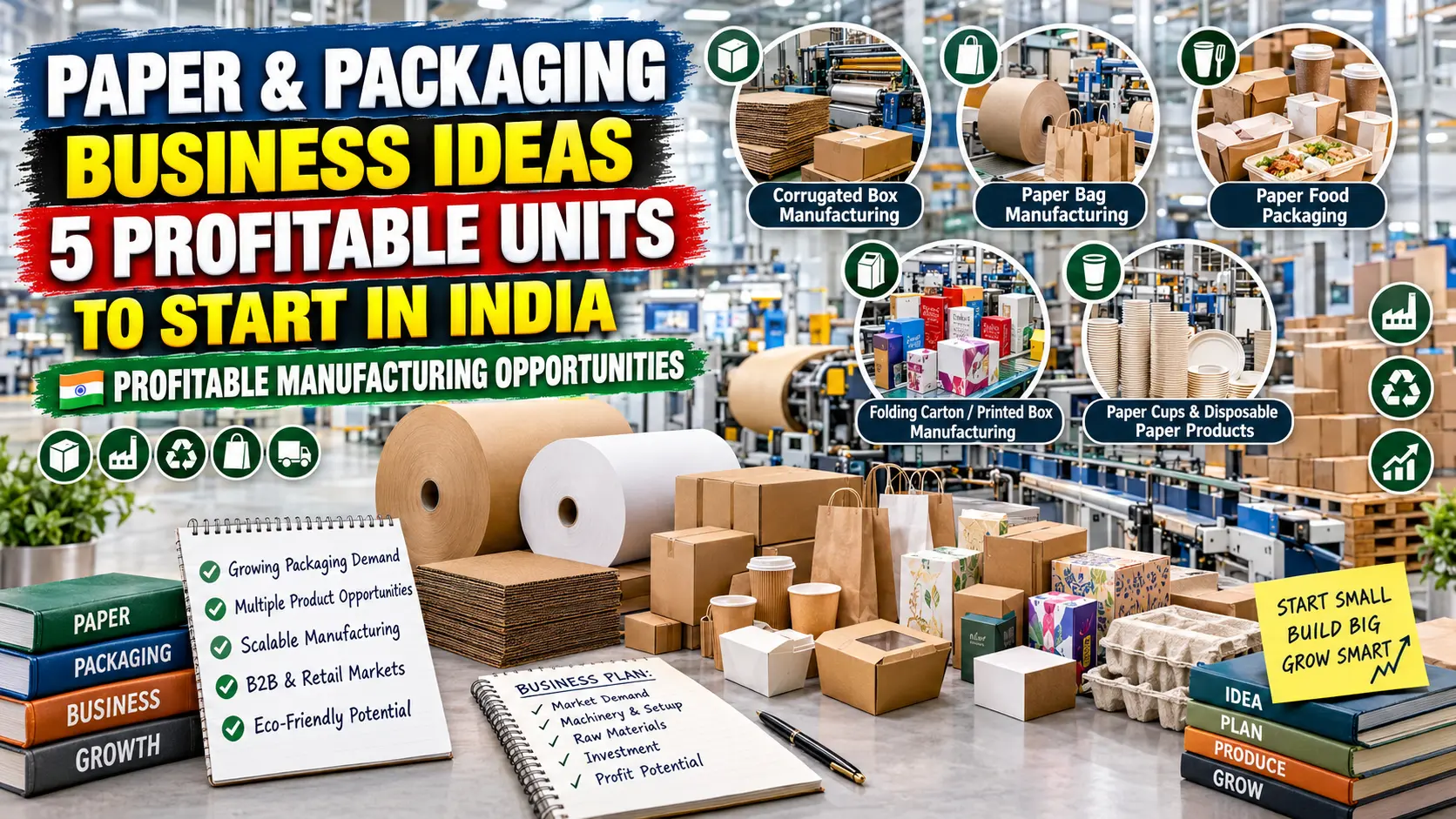
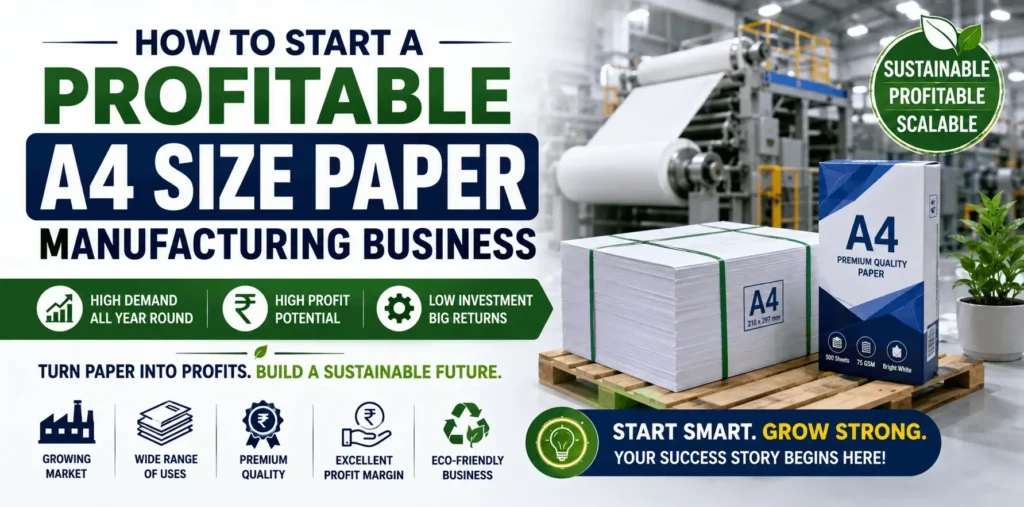

The A4 Size Paper Business is one of the most profitable and fast-moving opportunities in the paper and stationery industry due to continuous demand from schools, offices, government departments, photocopy centers, printing businesses, and corporate organizations. Despite increasing digitalization, the consumption of copier and photocopy paper continues to grow steadily across educational, commercial, and administrative sectors.
With relatively low investment, simple machinery setup, and strong year-round market demand, many entrepreneurs are now exploring A4 size paper manufacturing business opportunities in India. Businesses involved in copier paper cutting, packaging, branding, and distribution can generate consistent recurring income through wholesale and institutional supply networks.
Contents
- 1. What is an A4 Size Paper Business?
- 2. Why Starting an A4 Size Paper Manufacturing Unit is a Smart Investment
- 3. Why A4 Size Paper Business is Profitable
- 3.1. Understanding the A4 Size Paper Market Potential
- 3.2. Machinery and Raw Materials Needed for A4 Paper Manufacturing
- 3.3. Manufacturing Process of A4 Size Paper
- 3.4. Legal Requirements and Licensing
- 3.5. Investment and Profit Margin in A4 Paper Business
- 3.6. Target Customers and Market Strategies
- 3.7. Branding and Packaging Tips
- 3.8. Automation and Scaling Up
- 3.9. Challenges and How to Overcome Them
- 3.10. Sustainability and Future Trends
- 3.11. Conclusion
- 4. Frequently Asked Questions
- 5. What machinery is required for A4 paper manufacturing?
What is an A4 Size Paper Business?
An A4 size paper business involves cutting, packaging, branding, and distributing copier paper sheets commonly used for office printing, photocopying, educational work, and commercial documentation.
This guide explains the complete A4 size paper business setup process including machinery, raw materials, manufacturing process, packaging methods, market opportunities, and profitability analysis.
Why Starting an A4 Size Paper Manufacturing Unit is a Smart Investment
The A4 size paper business has shown remarkable resilience over the years. Even as businesses shift toward digital, paper usage persists across multiple domains such as academic institutions, government sectors, corporate houses, and publishing industries. This specific paper size is considered the global standard for office documents, assignments, reports, photocopies, and formal communications.
Why A4 Size Paper Business is Profitable
Include:
- recurring office demand
- educational demand
- government supply demand
- low entry barrier
- scalable distribution
- B2B wholesale opportunities
- institutional contracts
Understanding the A4 Size Paper Market Potential
The A4 paper market is part of the global printing and writing paper industry, which has seen consistent demand due to its utility in formal documentation. In India alone, paper consumption is expected to reach over 30 million tonnes annually by 2030, and a substantial portion of this includes A4 sheets. This growth presents a golden opportunity for small and medium enterprises (SMEs) to establish localized units for manufacturing and supplying A4 size paper.
The relatively low entry barrier in terms of capital investment and land requirement makes this a feasible venture for new entrepreneurs. Moreover, increasing awareness regarding eco-friendly practices has led to a rise in the demand for recycled A4 size paper, creating new niches within the sector.
Machinery and Raw Materials Needed for A4 Paper Manufacturing
Setting up an A4 size paper manufacturing unit requires some basic yet critical machinery and raw materials. The core components include:
- Slitting Machine: To cut large paper rolls into A4 dimensions.
- Ream Cutter Machine: For cutting and trimming the paper sheets accurately.
- Packaging Machine: To wrap and bundle paper sheets efficiently.
- Moisture Meter & Calibration Tools: To ensure quality and precision.
The main raw materials required are:
- Jumbo paper rolls (Reel Form)
- Adhesive and ink (for branding and packaging)
- Packaging materials (boxes, shrink wraps)
Sourcing raw materials from paper mills or wholesalers can reduce costs substantially, especially when purchased in bulk.
Manufacturing Process of A4 Size Paper
The production process involves several streamlined steps:
- Loading the jumbo rolls into the slitting machine.
- Cutting and trimming the paper to A4 dimensions.
- Counting and bundling the paper into standard reams (usually 500 sheets).
- Branding and packaging each ream with required labels.
- Packing the reams into cartons for distribution.
Quality checks are performed during each stage to ensure consistency in thickness, brightness, and GSM (grams per square meter), which is a key indicator of paper quality.
Legal Requirements and Licensing
To establish a compliant unit, the following registrations and certifications are typically required:
- Udyog Aadhaar/MSME Registration
- GST Registration
- Factory License
- Pollution Control Board Clearance (if applicable)
- Trademark Registration (for branding)
Adhering to these legal protocols ensures smooth operations and boosts the credibility of your business.
Investment and Profit Margin in A4 Paper Business
Starting a small-scale A4 paper cutting and packaging unit may require an initial investment of INR 10–25 lakhs, depending on the scale and automation of operations. A medium-sized unit can produce approximately 2,00,000 to 3,00,000 sheets per month.
Profit margins range between 10% to 25%, depending on sourcing efficiency, operational costs, and distribution reach. With consistent orders and local dealership tie-ups, entrepreneurs can expect a return on investment (ROI) within 12–18 months.
Target Customers and Market Strategies
Target markets for A4 size paper include:
- Educational institutions
- Government offices
- Corporate houses
- Stationery wholesalers and retailers
- Photocopy and printing shops
Effective strategies to penetrate the market:
- Offering bulk discounts to wholesalers and dealers.
- Establishing partnerships with schools and colleges.
- Participating in trade fairs to build visibility.
- Online B2B selling via platforms like IndiaMART, TradeIndia, and Amazon Business.
- Brand differentiation through eco-friendly or premium-quality paper offerings.
Branding and Packaging Tips
The look and feel of your paper packaging significantly affect the buying decision, especially in a saturated market. A well-branded ream of A4 size paper instills trust and signals quality.
Key tips:
- Use eco-friendly packaging to attract sustainability-conscious customers.
- Include certifications or quality standards (like ISO, FSC) on the packaging.
- Highlight key features such as GSM rating, brightness, and suitability for inkjet/laser printing.
- Offer customized packaging for bulk corporate clients.
Automation and Scaling Up
Once the business reaches stability, investing in automated machines for stacking, cutting, and wrapping can enhance productivity. Automation reduces manpower dependency, improves accuracy, and enables higher output with lower operational costs.
Scaling up can include:
- Expanding into A3 and legal size papers
- Manufacturing colored or recycled A4 sheets
- Launching a private-label brand and selling through e-commerce
- Exporting to nearby countries with paper demand
Challenges and How to Overcome Them
While the A4 size paper business offers lucrative returns, it is not without its set of challenges:
- Raw material price fluctuation
- High competition from established brands
- Logistics and distribution issues
Solutions include:
- Entering into long-term supplier contracts to stabilize costs.
- Building a niche (such as recycled, sustainable paper).
- Developing a local distribution network to reduce transport costs.
Sustainability and Future Trends
The growing awareness of environmental impact is pushing manufacturers toward sustainable paper production. This includes:
- Using recycled pulp instead of virgin wood fiber.
- Installing wastewater treatment plants in the manufacturing unit.
- Promoting double-sided printing and minimal packaging.
These practices not only improve your brand image but can also help in gaining subsidies and incentives from government programs promoting green initiatives.
Conclusion
The A4 Size Paper Business offers excellent opportunities for entrepreneurs looking to enter the manufacturing and stationery sector with moderate investment and scalable growth potential. Due to increasing demand from offices, educational institutions, government departments, and printing businesses, the copier paper market continues to remain highly active and profitable.
By investing in quality machinery, strong branding, efficient packaging, and a reliable distribution network, entrepreneurs can establish a sustainable and profitable A4 size paper manufacturing business in India.
Frequently Asked Questions
What is the size of A4 paper?
The standard A4 paper size is 210 mm × 297 mm or 21 cm × 29.7 cm.
How to start an A4 size paper business?
You can start an A4 size paper business by setting up paper cutting, packaging, and branding machinery, sourcing jumbo paper rolls, obtaining registrations, and developing a distribution network.
Is A4 size paper business profitable?
Yes, the A4 size paper business can be profitable due to steady demand from offices, schools, printing shops, and institutions.
What machinery is required for A4 paper manufacturing?
Key machines include paper cutting machines, slitting machines, ream wrapping machines, and packaging equipment.
ith:
- Detailed Project Reports (DPR)
- Machinery selection
- Plant setup planning
- Market research
- Packaging solutions
- Distribution strategy
- Financial feasibility analysis
- Branding consultation
Contact our expert team today to explore profitable A4 size paper business opportunities in India.