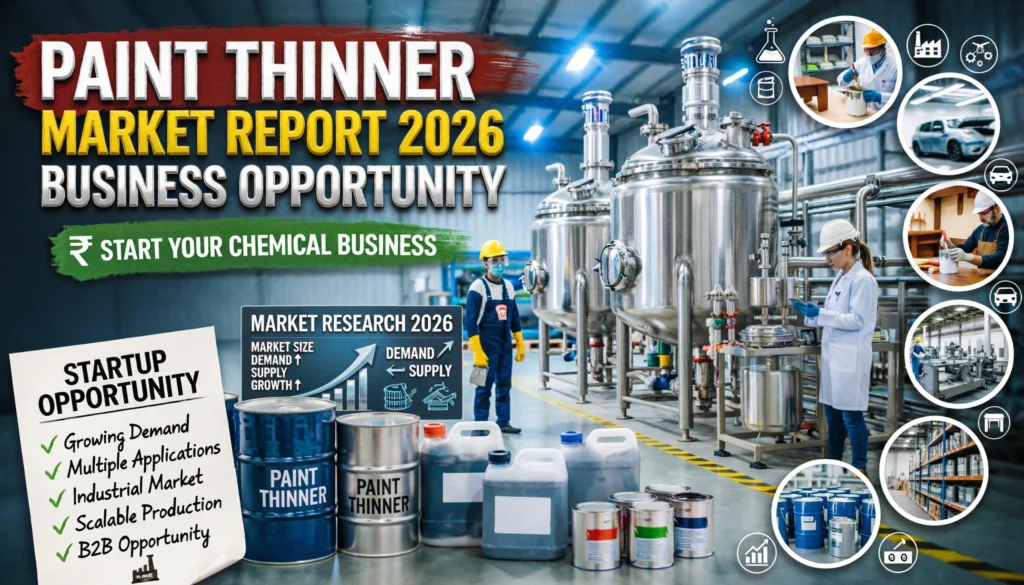

Paint Thinner Manufacturing Business in India
All decorative, industrial, and automotive refinish paint sold in India will end up using a thinner at some point in its use. Unlike most segments in the report series, India’s thin industry does not have any big national brands dominating the market, but it is a highly fragmented market, where small and mid-sized regional manufacturers can be found in the wholesale directories but not listed companies. It’s the opportunity to be honest; it’s a platform with moderate capital investment, and really a good, low-brow entry point into the massively growing paints and coatings market in India, unlike many chemical categories in this series which are chemically exotic, and have the import reliance and exotic feedstock constraints.
What Is Paint Thinner?
Paint thinner – any volatile solvent or solvent mixture that is used to lower paint viscosity (increase flow, levelling and application properties) and to clean equipment and surfaces after paint use. From a commercial perspective, thinner formulations are classified according to chemical base and application:
- Mineral spirits/white spirits-based paint strippers – most frequently used for removing oil-based paint and cleaning brushes/equipment
- The thiners used for nitrocellulose lacquers and enamels are special blends of esters, glycols, alcohols, aromatic solvents, and ketones, which are formulated to thin nitrocellulose-based lacquers and enamels commonly employed in furniture refinishing and auto refinishing.
- Solvent-based – used for solvents such as lacquers and varnishes that are solvent-based, typical in the furniture and flooring industries, and in industrial finishing applications
- Epoxy thinner – dilutes the epoxy resins and hardeners and cleans epoxy-based primers and coatings
- Synthetic/melamine/stoving thinner – specialty coatings for synthetic and stoving (baked) enamels, often used in automotive OEM and appliance coatings applications.
- Mineral Turpentine Oil (MTO) is a traditional widely used general purpose thinner and solvent.
Mineral spirits, toluene, xylene, methyl ethyl ketone (MEK), acetone, glycol ethers and, more recently, bio-based and low-VOC alternatives are some of the key solvent components found in these formulations, as environmental regulations increasingly bite into the formula.
Get Detailed Insights from This Book: Manufacture of Paint, Varnish & Allied Products
Global and India Paint Thinner Market Size and Growth
Recent studies (2026 base year) estimate global demand for paint thinner to be approximately USD 8.7 billion to USD 12.3 billion, with projections of moderate to mature-market growth (between 3.1% and 4.2%) in the market, which closely align with the growth of global industrial production and construction activity, and is expected to reach approximately USD 12.6 billion to USD 17 billion by 2034-2036.
With its growing industry of paints and coatings, India is one of the fastest-growth national markets in the region, accounting for about 34% of the global market (USD 2.66 billion) in 2026, as infrastructure development, industrialisation, and increasing demand in the automotive sector are contributing towards the growth of the paint thinner market.
Note on figures: Market studies of paint thinners often group various types of solvent-based paints (NC, PU, epoxy, general purpose) into the same category or list them separately by the different agencies. NPCS can create an investor grade techno-economic feasibility study that is customized to your particular thinner type (NC, PU, epoxy, or general purpose), and your target end-use segment.
A Structurally Fragmented, MSME-Driven Market
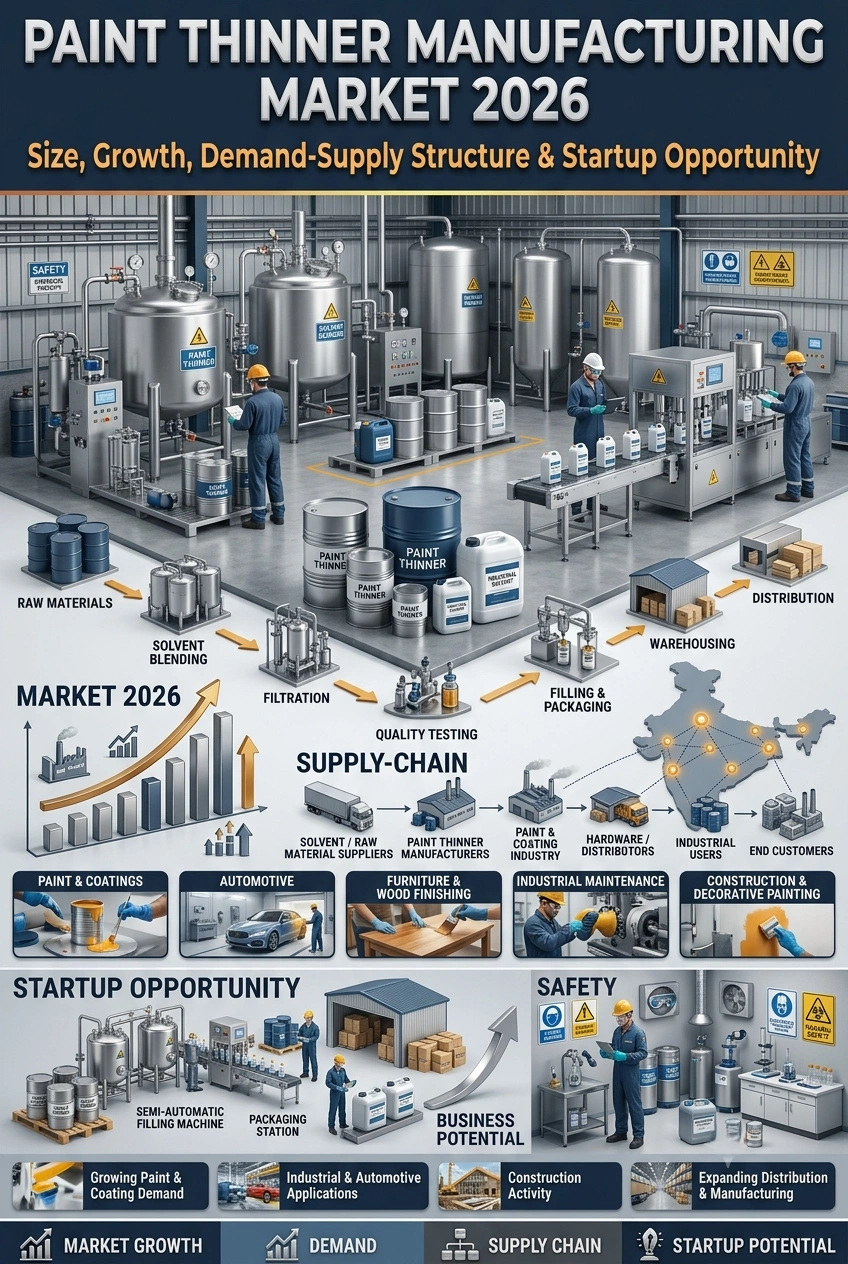
India’s paint thinner market is segmented into many small-scale paint thinner producers which are unlike large-scale petrochemicals or fertilizer categories. The industry directories indicate hundreds of small and medium manufacturing companies — most of them have a single production facility in clusters such as Ahmedabad, Mumbai, Kundli/Delhi, Pune and Chennai — and not a handful of leading national manufacturers. This is attributed to its relatively simple manufacturing process which is based on blending, and the high local demand associated with local paint production and application activity.
This fragmentation is also informative to a new player: the barrier to entry isn’t limited raw material or complex chemistry, but capital and formulation know-how, and this is a distinct risk profile from most categories in this series, and why so many regional players have made it to the market without major investment.
Policy Tailwinds
1. India’s fast-growing paint and coatings industry: The downstream demand for paint is also increasing rapidly with India’s automotive sector alone accounting for around USD 30.0 billion or about 7.1% of the GDP and the construction industry is booming with the national infrastructure programmes.
2. Inward trend of Index of Industrial Production (IIP) and manufacturing activity: With growth in industrial machinery and equipment, and general manufacturing, the demand for industrial grade thinners for equipment maintenance, cleaning and finishing also increases.
3. Environmental regulation favouring lower VOC formulations: As India faces growing environmental media attention, similar to the rest of the world under international schemes such as EU’s REACH regulation and US EPA standards, the Indian formulators have to use less VOC, more sustainable thinner formulations as per the emission guidelines by CPCB, a differentiation opportunity for manufacturers who invest in reformulation before the tighter regulations.
4. MSME manufacturing incentives: Given the sector’s already-established MSME-dominated structure, thinner manufacturing units are well-positioned to access MSME capital subsidy schemes and state industrial incentives.
5. Growing automotive refinishing and collision repair sector: As India’s vehicle parc expands, the automotive refinish and body shop segment sustains a distinct, steady demand stream for specialty automotive-grade thinners.
View Full Project Details: Complete Guide to Paints, Pigments & Coatings
India Market Structure: Paint Thinner
| Parameter | Current Position |
| Market structure | Highly fragmented — hundreds of small-to-mid-scale regional manufacturers rather than a small number of dominant national brands |
| Manufacturing complexity | Relatively low barrier — primarily a solvent blending operation rather than complex primary chemical synthesis, making it accessible to a broader range of entrepreneurs |
| Regional concentration | Strong clusters in Gujarat (Ahmedabad), Maharashtra (Mumbai, Pune), Delhi/Haryana (Kundli), and Tamil Nadu (Chennai), tracking India’s major paint manufacturing and industrial hubs |
| Feedstock dependency | Raw materials (mineral spirits, toluene, xylene, MEK, acetone) are largely refinery/petrochemical byproducts, with pricing exposed to crude oil and domestic refinery output rather than a scarce, imported specialty feedstock |
| Nature of the opportunity | Not an import-substitution gap in the traditional sense, but a fragmented-market consolidation and quality-differentiation opportunity — genuine room exists for a well-run, quality-consistent regional manufacturer to build share against a very long tail of smaller competitors |
| Price volatility exposure | Directly tied to crude oil and petrochemical feedstock costs — recent tracking shows paint and solvent prices rising sharply (Asian Paints raised prices 12% in mid-2026) amid crude-linked feedstock cost pressure |
Reading the market: This category doesn’t present the kind of clean, quantified demand-supply gap seen in categories like carbon fibre or PCBs — India already manufactures the bulk of its thinner domestically, across a large number of small producers. The opportunity here is different: a genuinely large, growing, moderate-capital-entry market where quality consistency, formulation expertise (particularly around low-VOC and specialty grades), and regional distribution relationships — not overcoming an import gap — are what separate a successful entrant from the long tail of undifferentiated regional suppliers.
Notable Indian Paint Thinner Manufacturers
| Company | Base/Region | Notes |
| A. B. Enterprises | India | Recognised among India’s leading industrial thinner manufacturers, offering a comprehensive range of powder and solvent chemicals |
| Avudai Surface Treatments Pvt. Ltd. | India | Recognised among India’s top industrial thinner-making companies |
| Jay Chemicals | Pune, Maharashtra | Established manufacturer (since 1996) of industrial thinners, mineral turpentine oil, foundry chemicals, and paint removers |
| Rajhans Agro Chemical Industries Pvt. Ltd. | India | Recognised Indian thinner manufacturer serving paint and coatings industry customers |
| Colorchem Industries Ltd. | India | Recognised Indian industrial thinner manufacturer and supplier |
| Four-P International Pvt. Ltd. | India | Recognised Indian paint thinner manufacturer |
| Ree Atharva Lifescience Pvt. Ltd. | India | Recognised Indian paint thinner manufacturer |
| Rhythm Chemicals Pvt. Ltd. | India | Recognised Indian paint thinner manufacturer |
| Nav Durga Chromatics Pvt. Ltd. | India | Recognised Indian paint thinner manufacturer |
| Super Paints and Chemicals | Kundli, Haryana/Delhi | Established manufacturer of synthetic, polish, epoxy, PU, melamine, and stoving thinners serving paint, rubber, and cosmetics industries |
| RXSOL (regional distributors, Mumbai-manufactured) | Mumbai, Maharashtra (with distribution across Bihar, West Bengal, Odisha) | Established Indian thinner brand with export presence to the Middle East |
| A very long tail of regional manufacturers | Ahmedabad, Mumbai, Delhi, Chennai, Kolkata, Hyderabad, Pune, Vadodara | Hundreds of smaller manufacturers, most visible through B2B marketplaces (IndiaMART, TradeIndia), representing the dominant structural feature of this industry |
Global Paint Thinner Industry Context
Given the fragmented, largely domestic-blending nature of thinner manufacturing, the “international players” framing is less relevant here than in globally-traded specialty chemical categories — thinner is predominantly manufactured close to where it’s consumed. The relevant global context is instead regional demand structure and regulatory direction:
| Region | Notes |
| North America | Roughly 26% global share (~USD 2.03 billion, 2026); growth driven by renovation activity and automotive refinishing; increasingly shaped by EPA NESHAP volatile organic compound restrictions pushing waterborne substitution |
| Europe | Roughly 24% global share; strict environmental standards (REACH) are driving the fastest shift toward eco-friendly, low-VOC solvent solutions among any region, with an estimated 41% of regional manufacturers actively reformulating |
| Asia-Pacific (including India) | Largest global share (~34%, ~USD 2.66 billion 2026); growth linked to infrastructure expansion and industrialisation, with roughly 52% of regional demand tied to construction and infrastructure projects |
| Middle East & Africa | ~16% global share; growth linked to construction and infrastructure project activity |
Market Segmentation
By Solvent Type
- Mineral spirits/white spirits — most common, general-purpose
- Toluene and xylene-based
- Methyl ethyl ketone (MEK) — fastest global CAGR among solvent types (~4.6%)
- Nitrocellulose (NC) thinner blends
- Turpentine — traditional, general-purpose
- Low-VOC/bio-based formulations — smallest but fastest-growing, regulation-driven segment
By Application
- Architectural/decorative paint dilution and cleanup — largest volume segment
- Automotive refinishing and collision repair
- Industrial coatings and equipment finishing
- Furniture and wood finishing (lacquers, varnishes)
- Marine and metal-working applications
By End User
- Professional painters and contractors
- Automotive body shops and OEM finishing lines
- Furniture and wood products manufacturers
- Individual/DIY consumers (growing segment, supported by e-commerce access)
- Industrial equipment maintenance
Related Article: How to Choose the Right Paint Colour for Your Home
Key Growth Drivers
1. The growing paints & coatings market in India. As the volume of decorative and industrial paint applications increases, so does the demand for its near universal companion, thinner.
2. Power generation. India’s automotive market is poised to grow to USD 300 billion, accompanied by a large vehicle parc that will demand continuous refinishing and collision repair work, thus assuring the demand for specialty automotive-grade thinner.
3. An increasing production of industries. Growth in the Index of Industrial Production goes hand in hand with the activity in industrial equipment maintenance and finishing, which is a regular supplier of industrial thinners.
4. Access to DIY culture, e-commerce. Individual consumer painting activity has increased, driven by consumer interest in tutorials online and e-commerce sites with smaller pack sizes of retail thinners, which is widening the consumer base that is not traditionally part of the trade.
5. Regulatory-driven reformulation opportunity. Environmental regulations for VOC content are tightening continuously around the world and slowly in India, thus, manufacturers that proactively invest in low-VOC and bio-based formulations are ahead of the curve on the predicted change in VOC regulations.
Challenges and Restraints
- Intense fragmentation and price competition. With hundreds of small manufacturers competing largely on price (retail prices as low as ₹30-38/litre on B2B platforms), differentiation and margin protection require genuine quality consistency or specialty formulation focus.
- Crude oil and feedstock price volatility. As a petrochemical-derived product, thinner production costs are directly exposed to crude oil price swings and refinery margin dynamics — recent tracking shows sharp cost-driven price increases across the paint and solvent value chain in 2026.
- Flammability and hazardous material handling. Thinner’s volatile, flammable nature requires proper safety infrastructure, storage, and transport compliance, adding a baseline compliance cost for any manufacturer.
- Environmental and VOC regulation tightening. While creating a reformulation opportunity, tightening VOC restrictions also raise compliance costs and require formulation R&D investment for manufacturers currently reliant on traditional solvent-heavy formulations.
- Brand and quality trust building in a crowded market. With minimal brand differentiation currently visible in the market, building genuine customer trust and repeat business requires consistent quality and reliable supply — not a given in a market with many undifferentiated suppliers.
Competitive Landscape
The absence of dominant national players and a large number of small/medium scale regional players is the hallmark of India’s paint thinner industry, and it is easy to spot these players in the B2B marketplaces such as IndiaMART and TradeIndia, but difficult to find them on corporate websites or stock exchanges. A very different competitive landscape than most other categories in this series of reports: a more true-to-market, low barrier to entry than a high concentration industry with established incumbents. This is where the competition is not so much against an existing competitor and more about developing real quality consistency and consistent regional distribution, in a market where most of the other players are now playing on price.
Paint Thinner Manufacturing: Business Opportunity for Startups and MSMEs
1. Manufacturing general purpose thinner in the region. As the market is fragmented and the capital requirement is not high (blending is not the primary route for synthesis of paints), a regional manufacturing facility for paint retailers, hardware stores and contractors is one of the more accessible entry points in this report series.
2. Specialty formulation focus (NC, PU, epoxy). This is because specialising in a certain formulation type (automotive grade NC thinner, furniture industry PU thinner, industrial epoxy thinner etc) provides a way to differentiate from the commodity, general purpose product, and can give improved margins.
3. Low-VOC/eco-friendly formulation development. Earlier adoption of low-VOC, bio-based, or other environmentally differentiated formulations puts a manufacturer ahead of the curve of future regulations and makes a good impression on commercial and DIY buyers who are increasingly looking for “green” products.
4. Automotive refinish and collision repair-focused supply. Building direct relationships with automotive body shops and refinishing centres offers a distinct, steady B2B demand channel less exposed to general retail price competition.
5. Export-oriented manufacturing. Well-documented and consistent manufacturing companies like established importers from Middle East countries can take advantage of the neighbouring countries outside of India’s domestic market.
Find the most profitable startup for your investment range
Assumption flag: This is a fragmentated category with moderate capital investment needs, but the actual capital needs vary based on target formulation type, capacity, and if captive raw material blending or purchased-intermediate blending is employed. Formulation specific machinery list, Raw material sourcing strategy, regional market assessment and detailed Project Report with machinery cost, raw material cost, labour cost is prepared by NPCS for your proposed capacity and product mix to make your Project report bankable.
How NPCS Supports Entrepreneurs Entering This Space
The first step every entrepreneur takes in evaluating a paint thinner manufacturing business is to prepare a Detailed Project Report (DPR) that covers the plant capacity, type of paint thinners (general purpose and specialty grades), procurement of raw materials, safety and regulatory issues, manpower estimates, project cost estimate and financial viability for the selected product mix and target market.
About NPCS (Niir Project Consultancy Services)
Founded in 1994, NPCS is an ISO 9001:2015 certified Industrial Consultancy based in Delhi, India, with more than 30 years of experience in Techno-economic and Project Consultancy. In the span of 30 plus years, NPCS has supplied over 150,000 project reports and profiles to 85 different countries, and has published reports on almost every manufacturing and process industry, including paints and coatings, solvents and industrial chemical formulations.
The primary outputs that are important for a paint thinner venture are:
- Detailed Project Reports (DPRs) with plant capacity and machinery specification and layout
- Techno-economic feasibility studies, formulation and safety compliance guidance
- Financial modelling – project cost, profitability analysis, ROI and break-even analysis
- Raw material and market analysis for Indian regional paint and coatings clusters
- Support documents for MSME loan applications, subsidy schemes and bank funding requirements.
Government and Institutional Reference Links
Entrepreneurs can also connect with the FICCI Chemicals & Petrochemicals Committee and the Confederation of Indian Industry (CII) for industry networking, policy advocacy, and market access support specific to India’s paints, coatings, and solvent manufacturing sector.
- Ministry of Micro, Small and Medium Enterprises (MSME)
- Development Commissioner, MSME (DCMSME)
- Petroleum and Explosives Safety Organisation (PESO)
- Central Pollution Control Board (CPCB)
- Bureau of Indian Standards (BIS)
- Directorate General of Foreign Trade (DGFT)
- Press Information Bureau (PIB), Government of India
- Startup India
- Invest India (National Investment Promotion and Facilitation Agency)
Entrepreneurs are advised to verify the latest PESO hazardous chemical handling requirements, CPCB VOC/emissions norms, and MSME subsidy guidelines directly on these portals, as regulatory provisions are periodically revised.
Conclusion
Paint thinner manufacturing is an opportunity that is different from most in this report series, in that there is no large quantified import substitution gap; there is a really good, low capital entry point into a large, steadily growing market served by a very long tail of undifferentiated regional manufacturers. This is one of the more accessible manufacturing options in the Indian paints and coatings segment for an entrepreneur who is ready to prioritize building quality consistency and, in the process, invest in specialty products or low-VOC products ahead of the regulatory curve.
Paint thinner manufacturing is a moderately capital-intensive business that is closely linked to the booming paint, auto, and construction industries in India and is a low barrier of entry for entrepreneurs and MSMEs looking to venture into chemical formulation and blending businesses.