
How to Setup Private Education University
In the competitive world of education, various institutions have come up with unique strategies to attract prospective students. Private education universities are one such option that is gaining traction among young people and working professionals. Private education universities are often stand-alone institutions that offer courses and degrees on a part-time basis. They help working professionals who cannot take up full-time courses due to their busy schedules or those who want to switch from one career to another by taking up short courses. Private education universities can be set up either as for-profit or non-profit organizations. To begin with your venture, you need to understand the legal framework, plan your strategy, draft business documents, find suitable partners, and meet all regulatory requirements. This blog post will answer your queries and help you get started with setting up your private education university. Check the Legal and Regulatory Framework The Ministry of Human Resource Development (MHRD) plays a crucial role in regulating the private education sector. It is the regulatory body that monitors the standards of private education providers, the fee charged by them, and their eligibility criteria. It is always better to get clarity on the regulatory framework governing the private education sector. You can also check with your state government to know the requirements that are specific to your location. You should also take a look at the regulations governing the Higher Education sector. The regulatory framework for the private education sector and that of Higher Education are very different. Know Your Audience Identifying your target audience is essential for the success of your private education university. You need to understand the needs and aspirations of your prospective students to offer them a suitable platform for enhancing their education. This will help you in framing a suitable course curriculum and in attracting more people to your institution. You can carry out a SWOT analysis to understand your strengths and weaknesses, as well as those of your potential competitors. You can also conduct market research to get an idea of the profit potential in this sector. The Importance of Being an Accredited Institution When you are setting up a private education university, you will have to submit an application to the MHRD for getting a notice of recognition. This is a mandatory requirement for anyone who wants to establish a new higher education institution. You will have to complete this process before starting your operations. Apart from the fee, you will also have to submit several documents to the regulatory body. It will help you in getting recognition from the regulatory body, and your course credits will be transferable to other institutions. This will give your institution a boost in the market as more people will know about its existence. Determining the Type of Institution You’ll Be The regulatory framework governing the private education sector in India allows universities to offer both degree and non-degree courses. You need to decide whether you want to offer a degree or a non-degree course. You should also decide the field of study for which you will offer courses. This will help you in formulating a suitable curriculum and in attracting students to your institution. You also have to decide whether you want to start a stand-alone institution or join an existing private university in the area. While starting a stand-alone institution will help you in branding your institution, joining an existing university will help you in expediting the process of getting regulatory approval. You can also consider joining a public-private partnership to expand the outreach of your institution. Select a Location for your University The location of your private education university will have a significant impact on its success. You need to choose a location for your university that will help you in meeting the requirements of your target audience. It should also be easily accessible to a sizable population to attract more students to your institution. Before setting up your institution, assess the availability of real estate in your desired location. It’s important to understand the local employment landscape and evaluate the commercial potential of nearby areas. Additionally, having a clear insight into the demographic profile of the region will help you make well-informed and strategic decisions. Hiring Quality Staff is Important To ensure your institution runs smoothly, it’s essential to hire qualified, competent, and skilled professionals in their respective fields. Look for individuals who not only have the necessary expertise but also align with your institution’s values and are adaptable to its environment. Hiring staff who embrace a culture of excellence and innovation will contribute significantly to the growth and success of your institution. You can build a diverse and innovative team by hiring employees from various backgrounds and encouraging collaboration to solve existing problems creatively. To attract experienced professionals, advertise job openings on professional platforms and social media networks. Consider offering part-time roles or internships to university students seeking work experience. Additionally, be open to candidates looking to make a career change, as they can bring fresh perspectives and a strong drive to grow within your organization. This will help you in inculcating a culture of excellence among your employees. Coming up with a Marketing Strategy The marketing strategy that you put into action while setting up your private education university will have a major impact on its success. You should come up with effective marketing techniques that will help you in attracting a huge number of prospective students. You can use traditional as well as online channels for marketing your institution. Conclusion The business model of a private education university is to provide training programs and courses that are not available in government or regular universities. When you are setting up your private education university, you should check the legal and regulatory framework that governs the sector, know your audience, the importance of being an accredited institution, and the type of institution you’ll be. You should also select a location for your university, hire quality staff, and come up with
Establishment of new Pharmacy college | B.Pharma and D.Pharma College Setup Success Guide 2026
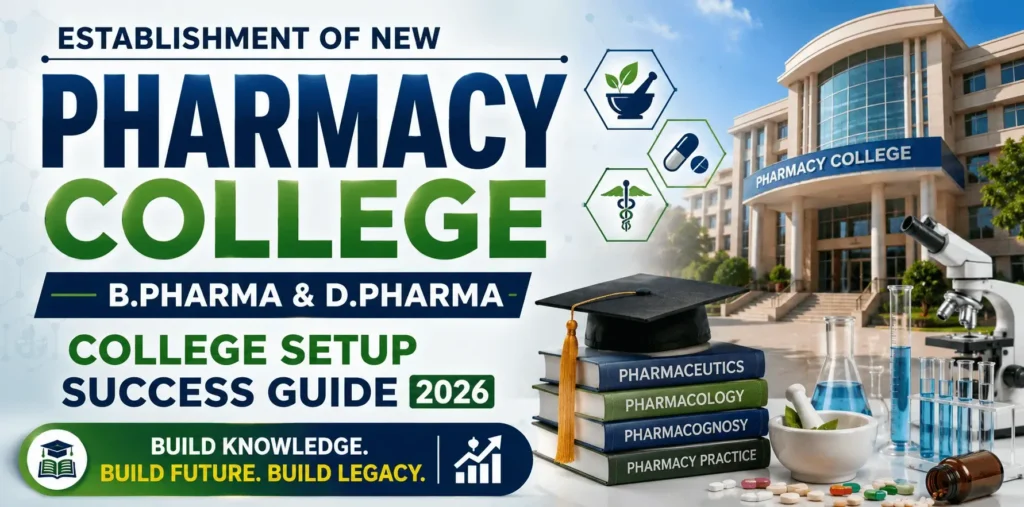
Establishing a B.Pharma and D.Pharma college in India is one of the most lucrative opportunities in the healthcare education sector. With the growing demand for qualified pharmacists, setting up a B.Pharma and D.Pharma institution offers immense potential. B.Pharma and D.Pharma colleges are witnessing unprecedented student interest, backed by regulatory reforms and industry demand. Whether you’re an investor, educationist, or healthcare entrepreneur, this comprehensive guide will walk you through every critical aspect of launching a successful B.Pharma and D.Pharma institution in 2026. Comprehensive Overview of Pharmacy College Set Up for a B.Pharma & D.Pharma To establish a pharmaceutical institution offering both Bachelor of Pharmacy (B.Pharma) and Diploma in Pharmacy (D.Pharma) courses, a well-structured approach involving regulatory approvals, infrastructural development, curriculum design, and skilled faculty recruitment is essential. 1. Regulatory Approvals and Affiliations To start a B.Pharma & D.Pharma college in India, institutions must secure approvals from: Pharmacy Council of India (PCI) – Mandatory for both B.Pharma and D.Pharma. All India Council for Technical Education (AICTE) – Required for B.Pharma course. State Government Approval – Necessary to operate any professional institution. Affiliation to a Recognized University – Typically for B.Pharma programs. State Pharmacy Council Registration – Allows for recognized practice licenses post-graduation. All applications must be submitted online via the PCI portal by the prescribed dates, usually by early March every academic year. 2. Ideal Land and Infrastructure Requirements Setting up a B.Pharma & D.Pharma college requires significant land investment and modern infrastructure as per PCI norms. Land Area: Minimum 2 acres in metropolitan areas; 3 acres in non-metro regions. Built-up Area: Approx. 45,000–50,000 sq. ft. for combined B.Pharma & D.Pharma programs. Classrooms: Well-ventilated smart classrooms with audio-visual aids. Laboratories: At least 12 fully-equipped labs, including: Pharmaceutics Lab Pharmacology Lab Pharmaceutical Chemistry Lab Pharmacognosy Lab Library: Minimum 2000 reference books with subscriptions to pharmaceutical journals. Computer Lab: 1:5 student-computer ratio with internet connectivity. Additional Facilities: Auditorium, girls’ and boys’ common rooms, administrative offices, placement cell, hostel accommodation. 3. Faculty Recruitment and HR Planning The PCI mandates stringent faculty-to-student ratios. A standard requirement for B.Pharma is 1:15. Each department should have a Head (Ph.D. preferred), associate professors, and assistant professors. Principal: Qualified with Ph.D. and minimum 15 years of experience. Professor/Associate Professors: Minimum 5–10 years experience. Supporting Staff: Lab technicians, non-teaching administrative staff, peons, and IT support. Hiring experienced faculty boosts institutional credibility and attracts student admissions. 4. Investment Requirements and Financial Planning Launching a B.Pharma & D.Pharma college typically involves an initial capital expenditure of ?6 to ?15 crore depending on location and infrastructure scale. Land & Building: ?3–7 crore Equipment & Lab Setup: ?1.5–3 crore Library & Digital Infrastructure: ?50–80 lakhs Faculty Salaries (Annual): ?1–2 crore Marketing & Branding: ?20–50 lakhs annually Institutions can explore financial assistance from education loan schemes, private investors, or PPP (Public-Private Partnership) models. ROI is usually visible within 4–6 years with strategic student intake and efficient management. 5. Curriculum Design and Program Structure Curriculum must strictly follow the syllabus prescribed by PCI. The B.Pharma course is of 4 years (8 semesters), while D.Pharma is a 2-year program (4 semesters). Key subjects include: Human Anatomy & Physiology Pharmaceutical Organic Chemistry Pharmacognosy & Phytochemistry Pharmacology & Toxicology Biopharmaceutics & Pharmacokinetics Hospital & Clinical Pharmacy Pharmaceutical Jurisprudence Focus should be laid on hands-on training, research projects, and industry exposure through MoUs with pharma companies and hospitals. 6. Marketing, Admission Strategy, and Branding To attract quality students in a competitive environment, strategic marketing is essential. This includes: Offline Promotions: Seminars in schools, education fairs, newspaper ads. Online Campaigns: SEO-optimized website, social media ads, lead generation via Google Ads. Admission Helplines: 24/7 query support, virtual counseling sessions. Alumni Engagement: Build credibility through successful alumni case studies. Admissions can be through entrance exams like GPAT, state-level pharmacy CETs, or direct management quotas as per norms. 7. Technology Integration and Smart Campus Initiatives In 2026, the use of technology is vital in education. Your B.Pharma & D.Pharma college should integrate: Learning Management Systems (LMS): Moodle, Google Classroom, etc. Virtual Labs & Simulation Software: For pharmacology and chemistry. Biometric Attendance: For staff and students. ERP Solutions: For administration, academics, HR, and finance. AI Chatbots: For student support and automated query handling. A tech-savvy campus improves operational efficiency and enhances student experience. 8. Placement Cell and Industry Tie-ups An active placement cell is a major value addition. Partner with pharmaceutical companies, hospitals, and research firms for: Internships and industrial training Campus recruitment drives Guest lectures and workshops Industry-sponsored labs and research funding Top recruiters include Cipla, Dr. Reddy’s, Sun Pharma, Apollo Hospitals, and Aurobindo Pharma. 9. Quality Assurance and Accreditation Obtaining accreditations elevates institutional standards: NAAC Accreditation – Ensures overall academic excellence. NBA Accreditation – Specific to the B.Pharma program. ISO Certification – For administrative and service quality. Regular audits, academic reviews, and feedback systems help maintain excellence and compliance. 10. Sustainability and Future Roadmap A successful B.Pharma & D.Pharma institution should plan for: Postgraduate Courses (M.Pharm) in areas like Pharmaceutics, Pharmacology, and Quality Assurance. Research Centers for clinical trials, herbal medicine, and formulation studies. Skill Development Programs in medical coding, regulatory affairs, and pharmaceutical marketing. International Collaborations with pharma colleges abroad for faculty exchange and global exposure. With the Indian pharma sector projected to touch $130 billion by 2030, such expansions will future-proof the institution. Conclusion The opportunity to establish a B.Pharma & D.Pharma college in 2026 is not just about infrastructure and curriculum—it’s about building a trusted academic brand. With regulatory compliance, excellent faculty, modern labs, and strategic outreach, your institution can become a benchmark in pharmaceutical education. Timely execution, proper funding, and quality focus will lead to a profitable and impactful venture in the healthcare education domain. Frequently Asked Questions (FAQ) Q 1: What are the regulatory approvals needed to start a B.Pharma and D.Pharma college? To establish a B.Pharma and D.Pharma college, you need approvals from the Pharmacy Council of India (PCI) for both programs, AICTE approval specifically for B.Pharma, state government permission, affiliation to a recognized university for B.Pharma, and State Pharmacy Council registration. All applications must be submitted through
List of Profitable Business Ideas in Education Sector.
The education sector has witnessed a rapid transformation in recent years, fueled by advancements in technology, changing societal needs, and a growing demand for quality and personalized learning experiences. As more students, parents, professionals, and institutions turn to innovative learning models, entrepreneurs have found fertile ground to build impactful and highly profitable businesses. Whether online or offline, tech-driven or service-oriented, the education sector offers a multitude of opportunities for those willing to tap into its potential. Top Profitable Business Ideas in the Education Sector 1. Online Tutoring Platforms Online tutoring is a booming market, thanks to the increasing penetration of the internet and smartphones. Students from all grades and streams now prefer the flexibility of learning from home. Creating a subject-specific or all-in-one tutoring platform can yield substantial revenue through subscriptions, hourly charges, or package-based models. Entrepreneurs can start small with freelance tutors and scale by onboarding qualified educators and developing custom content. Niche platforms that focus on competitive exams like IIT-JEE, NEET, UPSC, GMAT, or language proficiency tests like IELTS and TOEFL are especially profitable. 2. EdTech App Development App-based learning is the future of the education sector. Whether it’s interactive learning for kids, coding platforms for teenagers, or skill-building tools for adults, EdTech apps are in high demand. These apps often include gamified lessons, adaptive quizzes, progress tracking, and AI-based personalization, which enhance user engagement. If you have technical expertise or can partner with a developer, launching a specialized learning app can be both impactful and profitable. 3. Skill Development & Vocational Training Centers The gap between academic learning and job readiness is a long-standing issue. Setting up a vocational training center or a skill development institute that focuses on job-specific skills such as digital marketing, graphic design, data analytics, plumbing, welding, or retail management can attract a large customer base, particularly in semi-urban and rural areas. With government initiatives like Skill India and National Skill Development Mission, these ventures in the education sector can also receive support in the form of grants and recognition. 4. Franchise Model Coaching Institutes If starting from scratch sounds too daunting, entering the education sector through a coaching institute franchise can be a safer bet. Renowned coaching brands in India and globally offer franchise opportunities with established curriculums, training support, and brand value. Popular franchises operate in areas like engineering and medical entrance coaching, commerce and CA training, Olympiad prep, or early childhood education. The initial investment varies depending on the brand, location, and scale but the returns are stable and often quick. 5. K–12 Content Development Services The rise in digital education and the NEP (National Education Policy) overhaul in India have increased the demand for fresh curriculum-aligned content. Entrepreneurs with a background in teaching, publishing, or instructional design can build a business offering K–12 curriculum development services to schools, EdTech companies, and NGOs. This includes textbooks, digital modules, worksheets, animations, and assessments. Creating regional language content is a relatively untapped yet promising niche in the education sector. 6. Early Childhood Education (ECE) Centers Parents are increasingly recognizing the importance of early childhood education in shaping their children’s cognitive and emotional development. Starting a preschool, Montessori center, or kindergarten with a structured curriculum can yield impressive returns. If you follow a global model like Montessori, Reggio Emilia, or Waldorf, or create your own value-based learning structure, there’s scope to scale rapidly. These centers can also expand into daycare services, offering additional revenue streams. 7. Educational YouTube Channels & Content Creation Educational content creators on YouTube, Instagram, and other platforms are building profitable brands around niche subjects—from mathematics tutorials and science experiments to soft skills and career guidance. Monetization options include YouTube ads, brand partnerships, merchandise, paid courses, and membership tiers. The barrier to entry is low, requiring just a phone or laptop to start, but the impact can be immense with consistent, high-quality content. In this new age, content creators are becoming micro-educators within the education sector. 8. Corporate Training & Upskilling Solutions As industries evolve, companies seek ways to keep their employees up to date. Starting a business that offers corporate training, whether in-person or via Learning Management Systems (LMS), is a profitable route. Courses may range from technical upskilling (like coding, analytics, AI/ML) to soft skills (like leadership, communication, teamwork). Custom B2B solutions and subscription models can make this a recurring revenue business. Partnering with HR teams and offering certification adds more value. 9. Study Abroad Consultancy Services With increasing interest in global education, students and parents seek expert guidance on applications, visas, SOPs, and exam prep. A well-structured study abroad consultancy business can earn revenue through application assistance fees, partnerships with foreign universities, and visa services. Offering English test preparation (IELTS/TOEFL), scholarship assistance, and travel planning services can further enhance profitability. The education sector is expected to see continued growth in international mobility in the coming years, making this a resilient opportunity. 10. Learning Management Systems (LMS) for Institutions Developing or reselling LMS solutions that help educational institutions digitize their operations is a B2B idea with immense potential. Schools, colleges, and training centers need platforms to manage attendance, fees, content delivery, exams, and feedback. LMS platforms can be offered as Software-as-a-Service (SaaS) products, with monthly or annual subscription models. There’s also scope to build custom solutions for niche sectors like religious education, music schools, or corporate training. 11. E-Library & Digital Book Subscription Services Creating an online library or digital subscription platform for academic books, research materials, or children’s literature is an untapped business opportunity. With rising textbook costs and paper shortages, many institutions and students prefer digital formats. By collaborating with publishers or licensing open-source content, entrepreneurs can create platforms where students pay a subscription fee to access books and notes. Integrating features like bookmarks, notes, and audio versions can improve user experience. 12. Online Test Preparation & Mock Exam Portals Test prep is one of the largest and most stable verticals in the education sector. Whether it’s for college admissions, government jobs, or certification programs,
Industrial Training Institute (I.T.I.), Industrial Training Centers
Introduction Industrial-training-institute-i-t-i-industrial-training-centers have become vital institutions in skill development and vocational education worldwide. These centers provide specialized training programs designed to equip students with practical knowledge and technical expertise in various trades. Moreover, ITIs bridge the gap between formal education and industrial requirements by preparing a skilled workforce ready to meet the demands of diverse industries. As a result, ITIs play a pivotal role in enhancing employability, reducing unemployment, and supporting economic growth. With increasing emphasis on skill-based education and government initiatives promoting vocational training, enrolling in an ITI can open doors to promising career opportunities. What are Industrial Training Institutes (ITIs)? Industrial Training Institutes (ITIs) are government-recognized vocational training centers established to impart technical skills and knowledge in various trades. These institutes aim to produce skilled technicians and artisans who can support industrial and infrastructural growth. See Also – Rosin Derivatives Types of ITI Courses Offered ITIs provide training in a wide array of trades based on industry demand. Some common courses include: Electrician Fitter Welder Mechanic (Automobile, Diesel, Machine Tools) Plumber Carpenter Computer Operator and Programming Assistant (COPA) Surveyor Tool & Die Maker Course durations vary from six months to two years, combining theoretical lessons with practical workshops to ensure comprehensive skill development. Admission Process and Eligibility Criteria Admission to ITIs usually requires candidates to have completed secondary education (10th grade) or higher, depending on the trade. Many ITIs conduct entrance exams or merit-based selection. Reserved seats and scholarships are often available for marginalized communities. Some courses may require a minimum age or prior qualification. Additionally, apprenticeship programs linked to ITIs provide on-the-job training in partnership with industries. Facilities and Infrastructure at Industrial Training Centers Quality infrastructure and modern facilities enhance learning experiences and skill acquisition in ITIs. Workshops and Laboratories ITIs are equipped with well-furnished workshops and laboratories tailored to each trade. These facilities include: Electrical wiring and circuitry labs for electrician courses. Machine tool workshops with lathes, milling machines, and grinders for mechanical trades. Welding bays with safety equipment and welding machines. Computer labs with updated software for IT-related courses. Hands-on training in these practical environments builds confidence and competence among students. Experienced Faculty and Trainers Certified instructors with Industrial Training ??????????? experience guide students throughout their training. Continuous faculty development programs ensure trainers stay updated on new technologies and industry standards. Safety Measures and Student Amenities Maintaining safety standards in workshops is paramount, including fire safety, protective gear, and first aid. Additionally, many ITIs provide amenities like hostels, libraries, and counseling services to support student welfare. Role of ITI in Employment and Industrial Development ITIs significantly contribute to workforce development by aligning training programs with industry needs. Job Placement and Career Opportunities Graduates of ITIs find employment in various sectors such as manufacturing, automotive, construction, electronics, and maintenance. Many ITIs organize placement drives and have tie-ups with industries for direct recruitment. Some graduates pursue entrepreneurship by starting small workshops or service centers. Apprenticeships provide valuable work experience and enhance employability. Moreover, government skill development missions integrate ITIs into broader employment generation schemes. Government Initiatives Supporting ITIs Several government programs aim to strengthen ITIs and promote vocational education: Skill India Mission: Enhances training infrastructure and increases enrollment. National Apprenticeship Promotion Scheme (NAPS): Encourages apprenticeship training in industries. Pradhan Mantri Kaushal Vikas Yojana (PMKVY): Provides short-term skill training linked with ITI courses. These initiatives support upskilling, reskilling, and youth empowerment. Challenges and Opportunities for ITIs Despite their importance, ITIs face challenges such as outdated curricula, infrastructure gaps, and limited industry linkage. However, growing demand for skilled labor and government focus on vocational training create ample opportunities for ITI modernization and expansion. Addressing Skill Gaps with Industry Collaboration Partnerships between ITIs and industries help update course content, introduce new technologies, and provide real-world exposure to students. Enhancing Digital and Soft Skills Incorporating digital literacy, communication, and entrepreneurial skills alongside technical training can improve overall student outcomes. Promoting Inclusivity and Accessibility Efforts to increase participation from women, differently-abled individuals, and underprivileged communities improve social equity. See Also –Electrochemical Manufacturing Conclusion Industrial-training-institute-i-t-i-industrial-training-centers remain critical pillars for developing a competent and job-ready workforce. By providing hands-on training in diverse trades, ITIs equip students with the skills needed to thrive in today’s industrial landscape. Moreover, ongoing government initiatives and industry partnerships are enhancing the quality and reach of ITI programs. As a result, these centers not only contribute to individual career growth but also support national economic progress through skilled manpower development. For students seeking practical education and promising career pathways, enrolling in an ITI offers a valuable opportunity to build a sustainable future. Contact Us
Indian Colleges, Universities & Educational Institutions, Directory Database List
India’s vast education sector is both diverse and expansive, spanning from elite institutions to grassroots community colleges. With thousands of institutions offering varied disciplines, finding accurate and consolidated information becomes critical for students, educators, and policy makers. The indian colleges universities educational institutions directory database list serves this essential need by compiling a centralized, verified, and structured repository of academic institutions across the country. This comprehensive list not only aids in admissions and research but also supports institutional benchmarking, collaborations, and policy development. As India’s education ecosystem grows more competitive and globalized, having such a curated reference tool becomes indispensable. Overview of Indian Colleges Universities Educational Institutions Directory Database List The indian colleges universities educational institutions directory database list provides a consolidated source of information about the academic infrastructure across India. This resource offers in-depth profiles, contact information, accreditation status, and program details, making it a valuable asset for multiple stakeholders. See Also : Aluminium Fabrication Scope and Coverage of the Directory The indian colleges universities educational institutions directory database list spans across multiple categories of institutions. It includes: Central and state universities Deemed universities Private and autonomous colleges Engineering, medical, law, management, and polytechnic institutes Distance education and open universities Technical and vocational education centers Each entry offers structured data points such as founding year, university affiliation, approval bodies like AICTE or UGC, available courses, location, and website links. By covering rural and urban centers equally, the database reflects the true scope of India’s educational infrastructure. Moreover, this directory serves as a transparent knowledge base for domestic and international researchers seeking insights into India’s academic landscape. Benefits for Students and Parents For students navigating the maze of higher education options, the indian colleges universities educational institutions directory database list proves invaluable. It allows prospective applicants to: Compare institutions based on rankings, course offerings, and location Verify accreditations and affiliations Discover emerging institutions in specialized disciplines Access up-to-date contact information for admission-related queries Parents, too, find this resource useful for assessing institutions based on faculty strength, infrastructure, and student outcomes. This improves decision-making and ensures students are directed toward credible and recognized colleges and universities. As a result, the directory serves as a trusted decision-making guide for academic planning. Research and Institutional Collaboration Academic researchers, education consultants, and think tanks also rely on the indian colleges universities educational institutions directory database list for macro and micro-level studies. It enables: Trend analysis of institution growth across different states Tracking regional disparities in educational access Facilitating collaborative programs between domestic and foreign institutions Identifying emerging centers of excellence in specific fields Furthermore, policy makers use this database to study enrollment trends, faculty availability, and regional saturation of particular institutions. This insight plays a role in educational policy formulation and grants allocation. Thus, the directory bridges knowledge gaps for data-driven decision-making. Role in Education Marketing and Outreach In the competitive higher education space, institutions benefit from being listed in the indian colleges universities educational institutions directory database list. It enhances their visibility among students, agents, and corporate recruiters. Being part of this comprehensive list allows institutions to: Attract applicants from different regions Engage in national and global rankings Promote new programs and academic initiatives Build partnerships with research institutions and industry This visibility also benefits coaching centers, ed-tech platforms, and education fairs looking to target the right institutions for engagement. In contrast to fragmented online data, this verified list ensures institutions present accurate information in one credible location. Digitization and Accessibility Features The indian colleges universities educational institutions directory database list has evolved with the digital transformation of the education sector. Today, it is accessible through multiple formats: Print directories for libraries, research offices, and institutional records Digital databases available on subscription or license basis Online searchable platforms with real-time updates APIs for integration with ed-tech solutions and research tools Such flexibility ensures that users can access the data based on their specific requirements. Enhanced features like filtering by region, stream, course level, and affiliation status make it user-friendly and highly navigable. Moreover, regular updates ensure the directory remains current and accurate, increasing its trustworthiness. Government and Regulatory Use Cases Various government bodies utilize the indian colleges universities educational institutions directory database list to ensure regulatory compliance, monitor educational standards, and plan expansion. For example: The University Grants Commission (UGC) uses it to identify and accredit institutions AICTE leverages it for technical education governance Ministry of Education uses it to assess state-level disparities in education access By aligning this database with Aadhaar-based student registration and faculty databases, it contributes to a unified national education registry. This enhances transparency and ensures better monitoring and evaluation of institutional performance. Such centralized data architecture supports India’s broader goals under the National Education Policy. Utility for International Education Stakeholders Foreign universities and education agents seeking collaboration opportunities in India often rely on the indian colleges universities educational institutions directory database list to identify reputable institutions. It supports: Exchange programs and faculty mobility Joint research initiatives and MoUs Student recruitment for higher studies abroad Academic benchmarking and curriculum exchange Additionally, international ranking bodies and accreditation councils use this verified list to include Indian institutions in their evaluation metrics. This global usability amplifies India’s educational diplomacy and contributes to the internationalization of its academic offerings. Support for Career Counselors and Ed-Tech Startups Career counselors, educational consultants, and guidance professionals frequently use the indian colleges universities educational institutions directory database list to advise students. It enables them to: Create custom college recommendations Identify niche programs for student goals Provide verified information about seat intake, placements, and facilities Similarly, ed-tech platforms that offer college discovery services, scholarship assistance, or career guidance rely on this database for back-end integration. APIs and machine-readable formats allow seamless automation of institution data into websites and mobile apps. This cross-platform utility increases the relevance of the directory in modern education services. Boosting Access to Emerging Institutions A unique benefit of the indian colleges universities educational institutions directory database list is its ability to highlight emerging
Complete Indian Schools Directory Database in India
The Indian Schools Directory Database is an essential resource for parents, education consultants, researchers, edtech companies, publishers, and educational service providers seeking verified information about schools across India. With over 1.5 million schools operating under various educational boards including CBSE, ICSE, IB, IGCSE, and state boards, accessing organized and accurate school data is increasingly important for admissions, outreach, research, and academic planning. A well-structured Indian schools directory database provides detailed information such as school names, addresses, board affiliations, contact details, facilities, medium of instruction, and regional categorization. This centralized database helps users compare institutions, identify opportunities, conduct educational research, and streamline communication with schools nationwide. This guide explores the importance, structure, applications, and benefits of a comprehensive Indian schools directory database for education stakeholders across India. What is an Indian Schools Directory Database? An Indian schools directory database is a structured collection of school information across India including school names, board affiliations, addresses, contact details, academic categories, and regional classifications. Types of Schools Included in Indian Schools Directory Database Include: CBSE schools ICSE schools State board schools IB schools IGCSE schools government schools private schools international schools Why Verified School Data Matters Include: admission planning accreditation verification outreach accuracy education research school comparison regional analysis Importance of a Comprehensive List of Indian Schools Directory Database The list of Indian schools directory database acts as a centralized resource that provides detailed profiles of schools across different states and education boards. This includes government schools, private institutions, missionary schools, international schools, and alternative education centers. See Also : Ferrous & Non-Ferrous Metals Key Features and Coverage The list of Indian schools directory database covers schools affiliated with various education boards such as: Central Board of Secondary Education (CBSE) Indian Certificate of Secondary Education (ICSE) State Education Boards International Baccalaureate (IB) Cambridge International (IGCSE) Each listing provides critical information like school name, address, board affiliation, contact numbers, website, student strength, medium of instruction, and facilities offered. Moreover, the directory categorizes schools by region, district, city, and pin code, ensuring users can easily find localized results. Such comprehensive coverage aids parents, education consultants, and government bodies in accessing and comparing data across the country. As a result, the database supports better planning and outreach. Benefits for Parents and Students For families moving cities or evaluating the best options for their children’s education, the list of Indian schools directory database proves invaluable. It helps them: Identify the best schools in a specific locality Compare facilities, curricula, and extracurricular offerings Contact schools directly for admission or counselling Verify school accreditations and board affiliations In contrast to scattered online information or outdated records, this organized directory ensures that parents access reliable, up-to-date data. It saves time, reduces confusion, and improves decision-making for a child’s academic journey. Moreover, the database highlights not just well-known institutions but also emerging schools with unique offerings in smaller towns. Role in Educational Research and Analysis The list of Indian schools directory database serves as a foundational dataset for researchers, education planners, and think tanks. It allows them to: Track growth patterns in school infrastructure across regions Analyze enrollment trends and gender ratios Identify underserved districts or high-density areas Evaluate school-to-student ratios and teacher availability Policymakers rely on this data to develop targeted interventions, design mid-day meal schemes, allocate funds, and implement policies under programs like Samagra Shiksha Abhiyan. Furthermore, researchers studying the impact of socio-economic factors on education outcomes find the directory highly useful for cross-sectional and longitudinal studies. Support for School Outreach and Marketing In an increasingly competitive educational landscape, private and public schools use the list of Indian schools directory database as a channel for enhancing visibility. By being part of a verified and widely-used platform, schools can: Attract prospective students from various regions Promote new programs or facility upgrades Showcase affiliations, awards, and academic excellence Engage with teachers, vendors, and service providers For education fairs, scholarship programs, and book publishers, this directory becomes a go-to resource for outreach planning. It allows stakeholders to target the right audience and establish meaningful collaborations. Such visibility strengthens brand recognition and trust among parents and students. Utility for Education Startups and Service Providers The list of Indian schools directory database offers a valuable business resource for ed-tech platforms, coaching centers, and educational product companies. With access to this comprehensive list, these stakeholders can: Develop targeted marketing strategies for specific regions Offer customized school-specific solutions or apps Build CRM tools integrated with real school data Identify regions with low digital penetration for strategic expansion Moreover, vendors supplying uniforms, books, school furniture, and smart classroom technologies use this directory to identify potential clients. As a result, the directory becomes an ecosystem enabler, connecting service providers with schools efficiently. Enhancing Government Planning and Governance Government agencies responsible for school education use the list of Indian schools directory database to manage: School inspections and audits Teacher training and allocation Infrastructure development Digital education rollouts Accurate school listings ensure the success of centralized initiatives like the DIKSHA platform, PM-POSHAN, and digital attendance tracking. State education departments use the directory to identify unregistered schools, ensure regulation compliance, and avoid duplication of efforts. This centralized data framework supports India’s goal of delivering quality education to every child, as outlined in the National Education Policy. Digitization and Smart Access Modern versions of the list of Indian schools directory database are available in both digital and print formats. They offer features like: Search by region, board, grade level, or co-ed status Filtering by medium of instruction or facilities like hostels or transport Downloadable reports and CSV files for research or marketing API access for third-party applications These tools ensure the data is accessible to everyone—from parents using smartphones to researchers working with bulk datasets. Such digital adaptability increases the utility of the directory in today’s tech-driven educational environment. International Use and Collaboration International education consultants and foreign schools seeking collaboration with Indian institutions benefit from the list of Indian schools directory database. It helps them: Identify reputed international or bilingual schools