
Top 10 Industrialists of Maharashtra: Success Stories, Business Ideas, and Future Vision
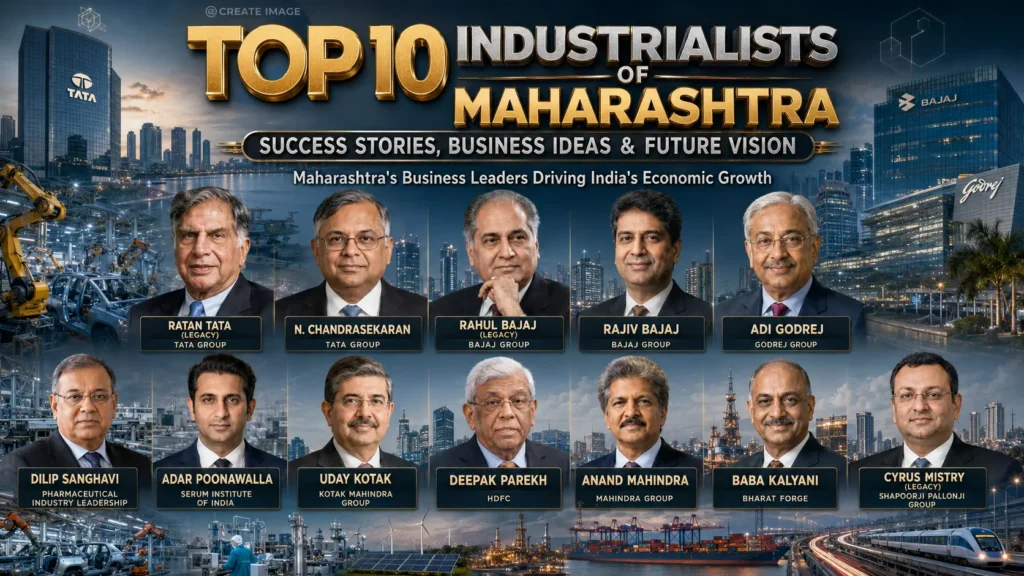
Industrialists of Maharashtra Maharashtra’s Industrial Identity as India’s Economic Capital Maharashtra is the financial capital of India, has the most important seaport (JNPT) and the most diversified industrial base, all of which influence business ideas in the area. Maharashtra generates the highest share of industrial gross value added in India (around Rs.) at 16% of total gross value added in the country. It is the biggest state economy in India with 42.67 trillion. The state’s industrial landscape includes the presence of the auto industry (Pune, Nashik, Aurangabad), pharmaceutical industry, IT industry (Pune), financial industry (Mumbai), petrochemical industry (Raigad) and food processing industry. The industrial ethos is tied to the industrial families, some of whom came up with industries that became the national and international leaders in their respective fields, such as the Godrejs in consumer durables, the Bajajs in two-wheelers, and financial services, the Tamils from Mumbai in Tata and the Ambanis in textiles in the early days. New era industrialists in Electric Vehicles, Fintech and Deep-tech are shaping the next generation of the industrial narrative in Maharashtra from the engineering hub of Pune to the capital markets of Mumbai. IBEF Maharashtra Report offers information on the state of investment in the sector. View Full Project Details: Best Business Opportunities in Maharashtra Why Maharashtra Dominates India’s Industrial Economy Maharashtra has three structural strengths that strengthen and support the dominance of the industrial sector. First, the access to capital: Mumbai is home base of BSE, NSE and the leading banks, insurance companies and mutual funds in India, providing unparalleled access to equity and debt capital for industrial expansion in Maharashtra. Secondly, the connectivity of the ports: Jawaharlal Nehru Port (JNPT) is the largest port in India with more than 50% of the country’s traffic through containers, and is the main export hub for manufacturers in Maharashtra and Central India. Third, human capital: hundreds of thousands of engineering, management and finance graduates are produced by Mumbai, Pune and Nagpur every year, which goes to feed manufacturing and technology businesses. The Pune-Mumbai industrial corridor is one of the most productive manufacturing corridors in India where Bajaj Auto, Tata Motors, Volkswagen, Mercedes-Benz, Force Motors, Thermax, and hundreds of tiers-1 and tier-2 auto component makers are spread out. Nashik’s contribution is wine production (which is an unusual success story in the Indian industrial sector), engineering and auto components. Aurangabad is regarded as one of the fastest growing auto manufacturing cities of India. Government Policies Supporting Maharashtra’s Industries More than 280 industrial areas are managed by Maharashtra Industrial Development Corporation (MIDC). Capital subsidy, power tariff benefit and stamp duty benefit are provided for fresh investments in manufacturing under Package Scheme of Incentives (PSI) in Maharashtra. The state EV Policy 2021 aims to achieve 10% EV penetration by 2025 and offers more incentives to purchase and manufacture EVs. The state of Maharashtra has seen investments in the semiconductor design, EV manufacturing and Data centre sectors under Make in India. The Ministry of MSME actively promotes the MSME clusters of Maharashtra in Auto-component, Pharmaceutical, Textile and Food processing Technology. Top 10 Industrialists of Maharashtra: Profiles and Future Vision 1. Ratan Tata (Legacy) / N. Chandrasekaran – Tata Group (Mumbai HQ) The Tata Group is the most trusted and internationally known conglomerate in India with its headquarters in Mumbai, Maharashtra. N. Chandrasekaran (since 2017) has spearheaded the group’s transition to digital services, EV, semiconductors, and clean energy, while retaining its leadership in steel, auto, IT, consumer goods, and hospitality. Long term capital investment, ethical governance, and community development is the Tata model, which has led to the formation of brands (Tata Salt, Tanishq, Titan, TCS, Jaguar Land Rover) which consumers believe in unconditionally. The future plans involve in the development of India’s first indigenous semiconductor chip and creating India’s most valuable EV brand through the Tata Motors. 2. Rahul Bajaj (Legacy) / Rajiv Bajaj – Bajaj Group The Bajaj Group is based in Pune, in Maharashtra and established two of the most prominent enterprise clusters in India: Bajaj Auto (two wheeled vehicles) and Bajaj Finserv (financial services). Rajiv Bajaj’s bold product strategy move of exiting scooters and concentrating on motorcycles and thus creating India’s first true performance-oriented mass motorcycle is one of the boldest product strategy moves in India. His father Rahul Bajaj made the name Bajaj synonymous with the aspirations of the common people in the country over decades. The future plans involve further expansion of Bajaj’s Chetak EV brand and increased digital lending market share for Bajaj Finserv. Explore This Book: Just For Starters: How To Become A Successful Businessman? 3. Adi Godrej – Godrej Group Adi Godrej is the Chairman of Godrej Group, one of the oldest and the most diversified industrial families in India. Godrej’s business portfolio includes aerospace components, real estate, agri-inputs, FMCG (Good Knight, Hit, Cinthol) and consumer durables (refrigerators, washing machines). Their Vikhroli township on Mumbai is a landmark of the industrial heritage of Maharashtra, which is an entire industrial and residential township. The Godrej way to build trust in the trustworthiness of the product and the long-term investments of brands has established the brand as a household name in the Indian consumers’ minds and has been passed on through four generations. 4. Dilip Sanghavi / Pharma MNC Leaders – Pune Pharma Belt Pune and Nashik is one of the most prominent pharmaceutical manufacturing hubs in India, where the companies manufacture APIs, formulations, and clinical research services for the global markets. The world’s largest vaccine maker in terms of volume is the Cyrus Poonawalla group’s Serum Institute of India (Pune) which is now headed by Adar Poonawalla. Adar Poonalla is looking forward to Serum’s future growth as they extend their vaccine pipeline to additional disease segments, and from vaccines, into biologics globally. 5. Adar Poonawalla – Serum Institute of India (Pune) Adar Poonawalla is the CEO of the world’s largest vaccine maker by volume, Serum Institute of India. During the pandemic, Maharashtra’s pharmaceutical industry capability was put to the test as
Gautam Adani Success Story: From Diamond Sorter to Business Empire | Business Lessons and Profitable Industry Ideas
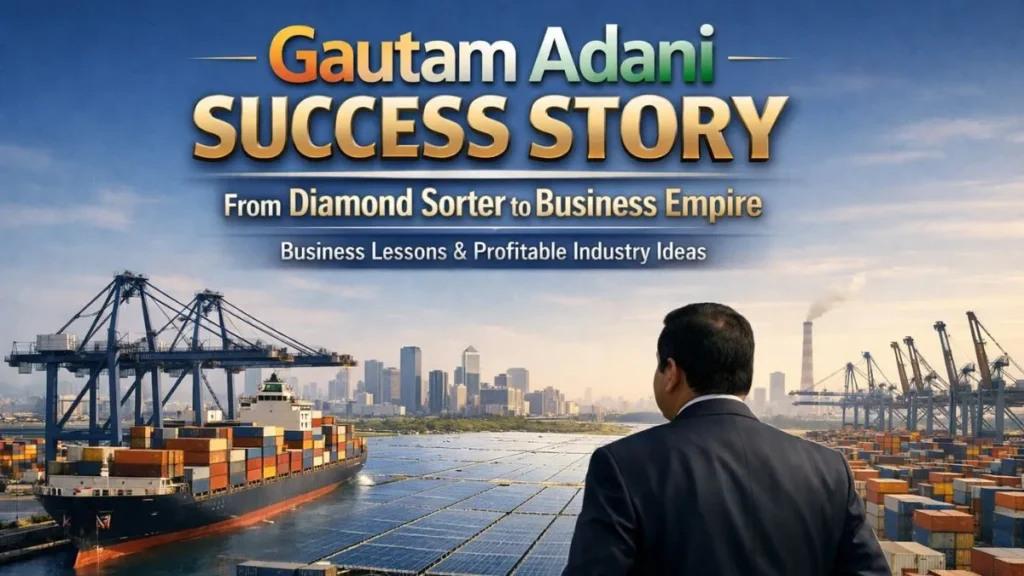
Gautam Adani success story Gautam Adani’s is one of the most powerful inspirational stories of entrepreneurship in the modern India. He was born in a simple family in Ahmedabad and did not receive a big industrial empire. Rather, he created success, based on a measured risk-taking, long-term vision and ability to recognize the opportunities in expanding industries. The Adani Group is one of the most powerful business groups in the country today as it operates in ports, logistics, power generation, airports, cement, and renewable energy. His story is not only inspirational, but also practical to those who aspire to be entrepreneurs. It demonstrates that the smallest of things can result in huge developments in case of planning, persistence, and strategic decision-making. It also emphasizes the need to do a professional feasibility analysis prior to investing in any industry and this is where professional services providers such as Niir Project Consultancy Services (NPCS) come in. Get Detailed Insights from This Book: Our Books Early Life and the Beginning of His Business Journey Gautam Adani was born in 1962 in a middle-class Jain family. His father was a small textile businessman and the family was leading a simple life. Adani however had other ambitions besides trading. He joined a commerce course at Gujarat University, but dropped out of school before graduating since he thought that the true business knowledge is gained through experience. He immigrated to Mumbai at a tender age to see what was available. His initial employment as a diamond sorter, made him learn the working mechanisms of the markets and the quality of a product. Several years later, he found himself venturing into business of his own, having gained confidence and experience in the running of a business. The skills that were acquired in this initial stage of his professional life were to be vital to his success in the future such as negotiation, market knowledge and risk management. The Turning Point: Entry into Commodity Trading The actual breakthrough to the career of Adani came when he came back to Ahmedabad to run a PVC manufacturing plant owned by his brother. India was rapidly growing its plastic business, and raw material demand was growing at that time. Adani saw this opportunity and he started importing PVC which enabled him to venture into the international trade market. In 1988, he founded Adani Exports Limited, which became: Adani Enterprises Limited This company was the base of the Adani business empire and the start of big business. Mundra Port: The Strategic Choice that created the Empire The development of: was one of the biggest milestones of Adani. Mundra Port In the 1990s, there was significant challenge of port infrastructure in India such as congestion and slow cargo handling. Adani saw this loophole and invested in the construction of a state-of-the-art private port which could accommodate high volumes effectively. Gradually, Mundra Port grew to be the biggest trade port in India and a main contributor of the development of the Adani Group. The choice proves the strength of seeing the long-term prospects rather than temporary returns. Access Complete Business Plan: Project Reports & Profiles Expansion into Major Industries Following the success of Mundra Port, the Adani Group diversified to various industries which contribute to the economic development. These industries developed a robust business ecosystem, which is still expanding today. Some of the major industries include: Generation of power by Adani Power. Adani Green Energy through renewable energy. Airport through Adani Airport Holdings. Cement production with the help of Ambuja Cements and ACC Limited. This diversification plan enabled the company to develop long-term stability and sustained growth. Key Business Lessons Entrepreneurs Can Learn from Gautam Adani The experience of Adani can teach some valuable lessons to those entrepreneurs who would like to establish sustainable business. These are applicable in startups, MSMEs, and industrial investors. The greatest lessons are: Concentrate on the industries that are increasing in demand. Gets to thinking long term, not quick profits. Build systems and infrastructure, not only products. Making calculated risks on the basis of market research. Keep on expanding into related areas. The principles can be applied to any business owner who intends to establish a manufacturing or infrastructure-based company in India. Emerging Business Opportunities Inspired by the Adani Model India is now rapidly growing in terms of infrastructure and production. The investment in transportation, energy, and industrial development by the government, has provided a great demand of new businesses. When entrepreneurs venture in these areas and do it well by planning, then they are able to enjoy growth that is stable and profitable. Among the best opportunities there are: Solar component manufacturing Cold storage and warehousing. Pre-engineered building structures Specialty chemical production Waste-to-energy and compressed biogas projects. The industry policies, rising domestic demand, and export potential favor these industries, and therefore, these industries are appealing to new entrepreneurs. Identify high-growth industries before others do Why Professional Project Planning Is Essential Before Starting a Business One of the most frequent causes of failure is to start a business that is not planned properly. A good idea may not work out even when there is underestimation of costs or wrong assessment of demand. Professional project planning helps entrepreneurs to avoid risks while making educated choices. The Detailed Project Report (DPR) serves as the main document which every industrial project needs to complete its requirements. The document provides a complete understanding of the business operations which helps investors and banks assess the business’s financial viability. A standard DPR has: Market demand analysis Costs of investment and operating costs. Machinery and raw material needs. Production capacity planning Profit and loss projections. This is a systematic way of improving the likelihood of business success, and minimizing financial risk. Related Article: Top 15 Manufacturing Businesses in India with High Demand and Profit (China+1 Opportunity) About NPCS and How It Helps Entrepreneurs Niir Project Consultancy Services is one of the most popular consultancy firms in India, which deals with the industrial project planning and
Best Franchise Business in India Under 10 Lakh – Low Investment & High Profit

Franchise business in India under 10 lakh Starting a business in India has never been easier than it is today. With increasing demand from consumers, better digital infrastructure and government policies, entrepreneurship is burgeoning in both urban and rural areas. However, one of the great challenges that new entrepreneurs face is determining the right business model. Building a brand from the ground up takes time, money, and know-how that may be risky for beginners. This is where the franchise business model provides a practical solution. A franchise is a way for people to run a business under an existing brand name using an established system. Franchise owners can benefit from established brand presence and operational assistance and supplier connections and advertising help instead of pursuing uncertain business activities. For first-time business owners, professionals making a career shift from a job, and investors looking for a more stable income, franchising is a tried and tested pathway to a new business ownership. The guide examines the most lucrative franchise business opportunities present in India for 2026 together with the industry sectors which generate the highest demand and investment and the associated advantages and dangers and expansion prospects. Read the Complete Book Here: Our Books Why Franchise Businesses are Growing At A Rapid Rate in India India’s franchise industry has seen considerable growth in the penultimate decade. Changing consumer behaviour, increasing disposable incomes and the growing inclination towards branded services in general have paved a positive path for expansion of franchises. Modern consumers demand high quality products which maintain consistent performance and dependable results which established brands provide Franchise business development in India occurs because of multiple important factors: Increasing Trusted Brands Rapid urbanization and growth of Tier 2 and Tier 3 cities Online shopping and delivery services – growth Easier access to small business loans and government schemes Increasing number of first-time entrepreneurs Evolution of digital payments and e-commerce The current trends indicate that franchising will remain a dependable business opportunity which will sustain its presence in India for multiple future decades. Franchise vs Independent Business: What’s the Difference? Before beginning a business, entrepreneurs often have a choice between opening an independent business and investing in a franchise. Both options have their advantages and disadvantages, but the level of risk and level of support is quite different. A business starts as an independent entity. The owner makes all decisions related to branding, pricing, marketing and operations. However, the business demands all its components to be developed from the ground up, which includes building both brand identity and customer loyalty, thus presenting elevated dangers for the owner. A franchise business on the other hand, offers a system that is already set. The brand has the benefit of market recognition, as well as established processes and tested products or services. This helps to reduce uncertainty and enables entrepreneurs to concentrate on running the business and on customer service. For beginners and small investors, the model of franchising is often the safer and more predictable choice. Access Complete Business Plan: Manufacture of Food & Beverages with Project Profiles (3rd Edn.) High-Demand Franchise Industries in India The success of a franchise business depends much on what industry you chose. Some sectors have steady demand and steady income, which make them good for investment over the long term. Following are the best franchise industries in India for the year 2026. 1. Food Franchise Business The food industry is the biggest and most active segment of franchise in India. People spend money on food every day so there will always be customer demand. The market shows strong demand for quick service restaurants and snack outlets and takeaway counters because these businesses need only moderate investment while providing constant revenue. Food franchises operate successfully in locations with high pedestrian traffic such as markets and shopping malls and railway stations and residential neighbourhoods. Typical Investment Amount: Rs.8 lakhs to Rs.50 lakhs Expected Monthly Profit: ₹60,000 to ₹2,50,000 Payback Period: 18 to 36 months Advantages of food franchise businesses: High daily customer demand Strong brand recognition Repeat customers Flexible menu options Potential for rapid business growth Franchising food businesses represents a safe investment because of the continuous consumer need for food products. 2. Education Franchise Business Education is one of the most stable industries in India because parents invariably invest money on the education of their kids. This makes education franchises recession-resistant and financially reliable. Preschool centers, coaching institutes, skill training programs are especially popular in developing residential areas. Education franchises are perfect for those who want to create a community-oriented business that will make them steady money. Typical Range of Investment: Rs 5 Lacs to Rs 20 Lacs Expected Monthly Profit: ₹50,000 to ₹1,50,000 Payback Period: 12 to 24 months Benefits of education franchise business: Regular annual fees from students At all times of the year, a stable demand Moderate investment at startup Strong long-term growth potential Positive social impact As India is continuing to concentrate on education and skill development, this sector is expected to grow significantly. 3. Healthcare & Diagnostic Franchise Healthcare services are needed no matter the economic conditions. The public needs medical tests and consultations and preventive health services which creates ongoing demand for these services. Increasing health awareness and a growing population are also furthering the growth of healthcare franchises. Diagnostic centers, medical laboratories, and specialized clinics are some of the fastest growing healthcare business in India. Typical Investment Range: Rs15 Lacs to Rs50 Lacs Expected Monthly Profit: ₹1,00,000 to ₹3,00,000 Payback Period: 24 to 36 months Key benefits of healthcare franchise business: High customer trust and brand loyalty Predictable long-term revenue Increasing need for medical services Stable and recession-resistant industry| Opportunities for expansion Healthcare franchises need an initial investment which exceeds other business models but they provide continuous revenue streams that remain stable over time. Related Article: Top 3 Profitable Healthcare Manufacturing Ideas for Startups in India 4. Logistics and Courier Franchising The e-commerce industry continues to grow and this expansion creates strong
June 2025 Entrepreneur India Monthly Magazine
Contact Us
May 2024 Entrepreneur India Monthly Magazine
Contact Us
April 2024 Entrepreneur India Monthly Magazine
Contact Us
March 2024 Entrepreneur India Monthly Magazine
Contact Us
February 2024 Entrepreneur India Monthly Magazine
Contact Us
January 2024 Entrepreneur India Monthly Magazine
Contact Us
December 2023 Entrepreneur India Monthly Magazine
Contact Us