
Best MSME Business Ideas in India for 2026: Top 50+ Profitable Projects
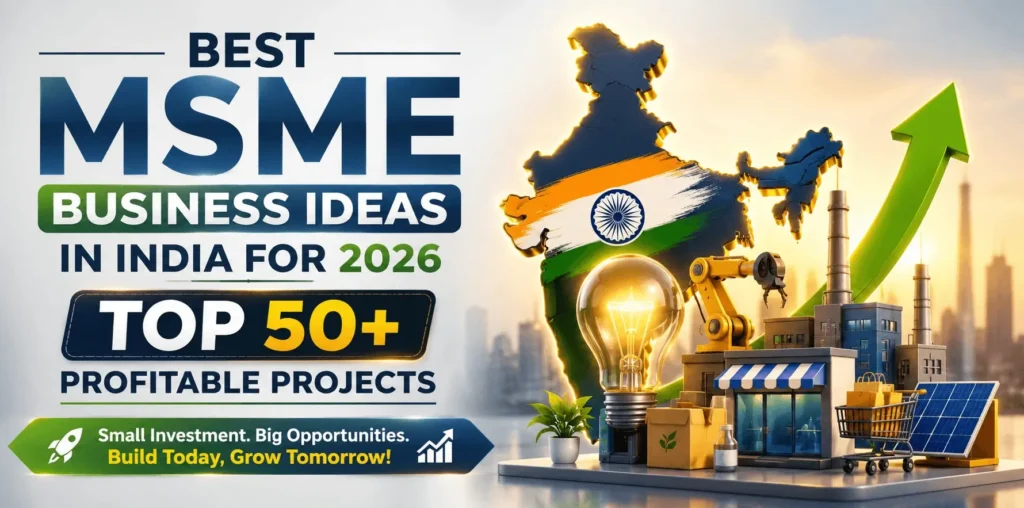
India’s economic backbone is powered by Micro, Small, and Medium Enterprises (MSMEs), contributing significantly 30% to GDP, employing over 110 million people, and 45% of manufacturing outputs. Over 63 million MSMEs across the country, the sector is poised for massive growth in 2026. The Indian government has rolled out significant MSME reforms in 2026, including revised classification norms (effective April 2025), expanded investment and turnover limits, and enhanced support through Udyam Registration, which now unlocks collateral-free loans up to ₹5 crore and 25% government procurement reservation. With the government providing strong support and the market showing increased demand for local, sustainable, and value-driven services, MSME business projects are proving to be highly lucrative. Whether you’re a first-time entrepreneur or looking to expand into new sectors, or an NRI seeking investment opportunities in India. This comprehensive list of 50+ profitable MSME business ideas covers low-investment, high-growth, and policy-backed opportunities across sectors. Top 50 Profitable MSME Business Projects to Start in 2026 Here’s a curated list of 50 profitable MSME business projects across different sectors to help you identify the right opportunity based on your skillset, investment level, and market demand: 1. Packaged Food Manufacturing With the rise in urban lifestyles, ready-to-eat meals, snacks, and organic packaged food are in demand. This MSME business project is ideal for food technologists or home cooks. 2. Mobile Phone Repair Services Low investment and high demand make this a reliable urban MSME opportunity. Adding doorstep service or franchising can scale it faster. 3. Customised -T-Shirt Printing Great for creative entrepreneurs. Use online platforms to accept orders and deliver custom-printed clothing. 4. Handmade Organic Soaps Consumers are moving toward chemical-free personal care. This MSME business project requires basic training and minimal equipment. 5. Digital Marketing Agency As businesses move online, they require SEO, social media, and content marketing support. This is a service-heavy business with low setup costs. 6. Solar Panel Installation Green energy is the future. Residential and commercial sectors are increasingly adopting solar panels, creating a booming MSME sector. 7. Paper Bag Manufacturing With plastic bans, eco-friendly alternatives like paper bags are in demand. This MSME project is both sustainable and scalable. 8. Spice Powder Packaging Traditional spices are essential in Indian kitchens. Value-added packaging and branding can help tap global markets too. 9. Online Tutoring Services From school subjects to music or coding, online tutoring is gaining traction. A simple platform and internet access are all you need. 10. Furniture Making & Restoration Custom and vintage furniture is in demand. This MSME business project can be pursued locally with skilled labor. 11. LED Light Manufacturing Energy-saving products like LEDs are now in every home and office, offering large-scale demand. 12. Cloud Kitchen Without a dine-in space, you save costs and cater to online food orders. This model thrives on low investment and high returns. 13. Herbal Beauty Products Herbal creams, oils, and face packs are sought-after in both Indian and international markets. 14. Dairy Products Processing Paneer, ghee, flavored milk, and curd are daily essentials. With quality control, this MSME project offers high profitability. 15. Toy Manufacturing India is promoting local toy production. Unique, safe, and educational toys have a growing market. 16. Electric Vehicle (EV) Charging Station A future-ready MSME business project, particularly in urban and tier-2 cities. 17. Agarbatti & Dhoop Stick Manufacturing A religious and cultural staple, these products see daily use and repeat purchases. 18. Cold Storage Facility Fruits, vegetables, dairy, and meat require refrigeration—ideal for rural or semi-urban setups. 19. Event Management Weddings, corporate events, and brand launches provide continuous business if executed professionally. 20. Eco-Friendly Disposable Tableware Plates, cups, and cutlery made from leaves or sugarcane are becoming mainstream in catering and restaurants. 21. Mobile Car Wash Service On-demand cleaning services are gaining popularity due to convenience. 22. Pet Grooming & Care Pet ownership is growing, and this niche market is underserved. 23. Digital Printing Press From visiting cards to product labels, businesses and individuals need quick-print solutions. 24. Custom Jewelry Making Ethnic and designer jewelry always has a fanbase. This MSME business project needs creativity and design tools. 25. Coir Products Manufacturing Eco-friendly mats, ropes, brushes, and bags made from coconut fiber are popular in domestic and export markets. 26. Vermicompost Production As organic farming grows, so does the need for organic fertilizers like vermicompost. 27. Stationery & School Supplies Selling notebooks, pens, and art material to students, schools, and coaching centers ensures steady business. 28. Bakery Products Pastries, cakes, bread, and cookies have timeless demand. Home bakers are turning into full-scale MSMEs. 29. Packaged Drinking Water Plant A must-have in urban and industrial zones. Brand positioning is key here. 30. Plant Nursery Business Urban gardening, landscaping, and indoor plants are trending. It requires limited space and high profit margins. 31. Detergent Powder & Liquid Manufacturing Household cleaners are basic necessities. You can supply to local kirana stores or create your own brand. 32. Mushroom Farming Quick growth and high protein content make mushrooms a popular food item with good export potential. 33. Mobile App Development Apps are essential for businesses, events, and personal services. You can even develop your own product and monetize it. 34. Car Rental Services Ride-hailing and self-drive services are ideal for tier-1 and tourist cities. 35. Ice Cream Manufacturing Start with a local setup and expand through retailers or parlors. 36. Millet-Based Food Products As health consciousness rises, millet snacks and mixes are growing in popularity. 37. Paper Cup & Plate Manufacturing Single-use eco-disposables are necessary for events, eateries, and stalls. 38. Ayurvedic Medicine Manufacturing Traditional medicine has a strong hold in India and abroad. Requires licenses and formulation knowledge. 39. E-waste Recycling A fast-growing MSME business project that focuses on sustainability and tech waste management. 40. Fabric Printing & Embroidery Unit Traditional prints and custom embroidery are always in demand, especially in ethnic wear. 41. Photocopy & Documentation Services Schools, offices, and students need easy access to print, scan, and document facilities. 42. Ice Cube Production Essential for restaurants, bars, and caterers.
Top B2B Manufacturing Business Ideas for Indian MSMEs
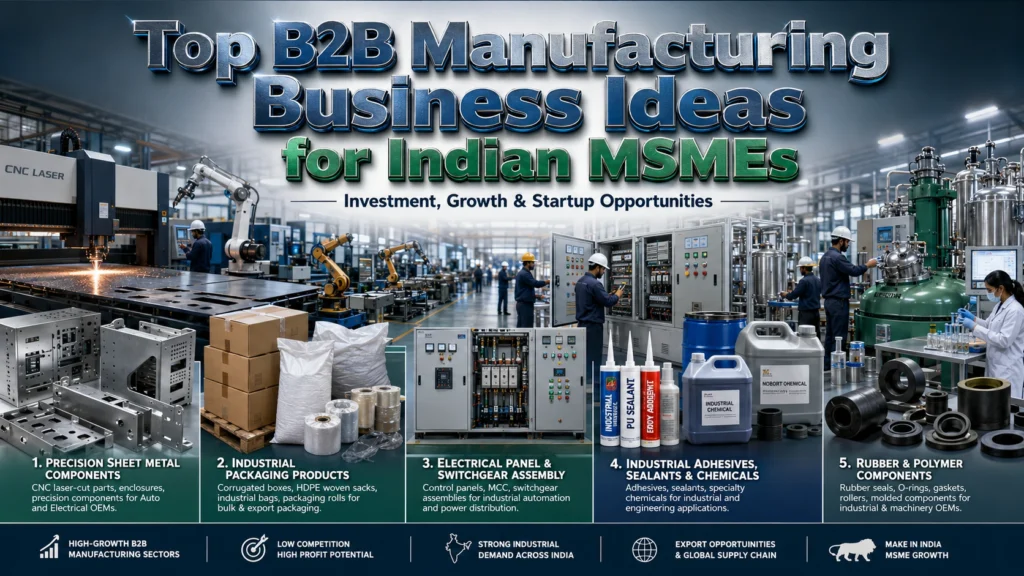
B2B Manufacturing Business Ideas for Indian MSMEs The factory floor of India is stealthily becoming the most potent engine of wealth creation and that is giving a huge opportunity to new B2B manufacturing business ideas. When compared to consumer startups that are looking to satisfy the short-lived desires of retail customers, B2B manufacturers are providing products and services to the demand side of the supply chain that has a deep appetite for reliable, quality consistent vendors. That makes this segment particularly good for the budding entrepreneur. Large OEMs in all automotive, electrical, construction and FMCG businesses are actively de-risking their suppliers. They would like to see more home vendors, rather than fewer. It is indeed one of the better windows to get into industrial production in India for a founder with a small capital and willing to get his hands dirty to master a manufacturing process. Why B2B Manufacturing Deserves Serious Attention Right Now Consumer manufacturing is on a growth trajectory and demand for components, packaging and industrial inputs is continuing to rise. Dozens of smaller vendors need to supply parts, packaging and sub-assemblies to every new appliance manufacturing plant, to every new EV assembly line, to every new FMCG manufacturing plant. Now, a new player can easily slot in into that vendor ecosystem. This is further complicated by export potential. There has been increasing trend in the global market towards diversification from one country-based purchase to a mix of countries, and India has emerged as a viable option. Therefore, a well-managed small manufacturing plant today can supply the local OEMs or convert into export orders as soon as the quality system is developed. It’s a similar scenario as B2B, where profitability means it’s better to sell to other businesses than to consumers. Business buyers can buy large quantities, pay over a well-defined credit cycle and are not in the business of spending as much as the consumer products spend on branding and marketing their products. When margins are steadier, it’s not because they’re slimmer, per se, but because volumes and repeat orders do the bulk of the work. Discover business ideas that actually make money Government Policies and Incentives Backing New Manufacturers The government’s involvement in manufacturing has come a long way beyond the subsidies. Credit Linked Capital Subsidy Scheme (CLSS) by the Ministry of Micro, Small and Medium Enterprises and the Credit Guarantee Fund Trust for Micro and Small Enterprises (CGTMSE) are initiatives that provide capital subsidy and remove the collateral barrier for many first-generation entrepreneurs from accessing credit. The PLI scheme will continue to offer financial incentives on the basis of scale and production to various manufacturing activities, and the MUDRA loan scheme is still the most convenient option for micro enterprises looking for working capital loans of less than a few lakh rupees. In addition, most state industrial policies include capital investment subsidies, waiver of stamp duty and power tariff concessions on the units established in designated industrial areas. In the meantime, the Make in India initiative is working on these new unit preferences by moving the public procurement agenda toward local manufacturers, albeit in a subtler fashion. Learn more via the DPIIT, and the Make in India portal. Multiple B2B Manufacturing Business Ideas Worth Exploring Precision Sheet Metal Components for Auto and Electrical OEMs Sheet metal fabrication is one of the most solid starts to B2B manufacturing because nearly every OEM, including automotive, electrical panel manufacturers, and more, outsources bracket, bezel, and enclosure work, rather than doing it in-house. A unit based on a CNC turret punch, press brake and simple powder coating line can begin to provide local OEMs in a matter of months—after commissioning. The investment in a small machine is usually in the range of ₹40 lakh to ₹80 lakh, depending on the tonnage of the machine, and the gross profit is in the range of 20 to 30 per cent after tooling cost is adjusted. Since OEMs are expecting the vendors to be consistent, a founder who succeeds in the first year in controlling tolerance and delivering on time is likely to secure repeat orders in no time. Explore This Book: Handbook on Steel Bars, Wires, Tubes, Pipes, S.S. Sheets Production with Ferrous Metal Casting & Processing Industrial Packaging: Corrugated Boxes and HDPE Woven Sacks One of the business ideas that is more recession-proof is corrugated board and HDPE woven sack manufacturing as every manufacturing plant, warehouse, and export unit requires a regular packaging supplier. Corrugation plants may begin with a semi-automatic flexo printer and slotter unit and expand to a fully automatic line. Woven sack units for HDPE (High Density Polyethylene), however, are used by cement, fertiliser and food-grain packers who require bulk and reliable capacity. Both segments are also supported by availability of raw material in most of the industrial clusters and the demand for packaging follows the overall demand of industries; demand for packaging is not cyclical and does not dry up easily. Electrical Panel and Switchgear Assembly Units The demand for low voltage distribution boards, motor control centres, switchgear panels has steadily increased with the proliferation of real estate, infrastructure and renewable energy projects. The critical components of assembling a panel are skilled wiring labour, a testing bay and good connections with the component suppliers such as circuit breaker and busbar manufacturers. In the case of panels, they are engineered products that pay off for design skill, not assembly speed, and margins here are better than pure fabrication work, at the 25 to 35 percent level. EPC contractors and builders also order more from the same vendor after they have a history of reliability with lead time. Related Article: India’s $235 Billion Electrical Equipment Boom: What Every Founder Must Know Industrial Adhesives, Sealants, and Specialty Chemicals Another type of opportunity exists in formulation-based manufacturing, including industrial adhesives, sealants, and specialty coatings, where an IP can be embedded into the product. A small batch manufacturing facility including reactors, mixers and quality testing equipment will provide construction, furniture,
Best Large-Scale Business Ideas in India: Multi-Crore Investment Opportunities
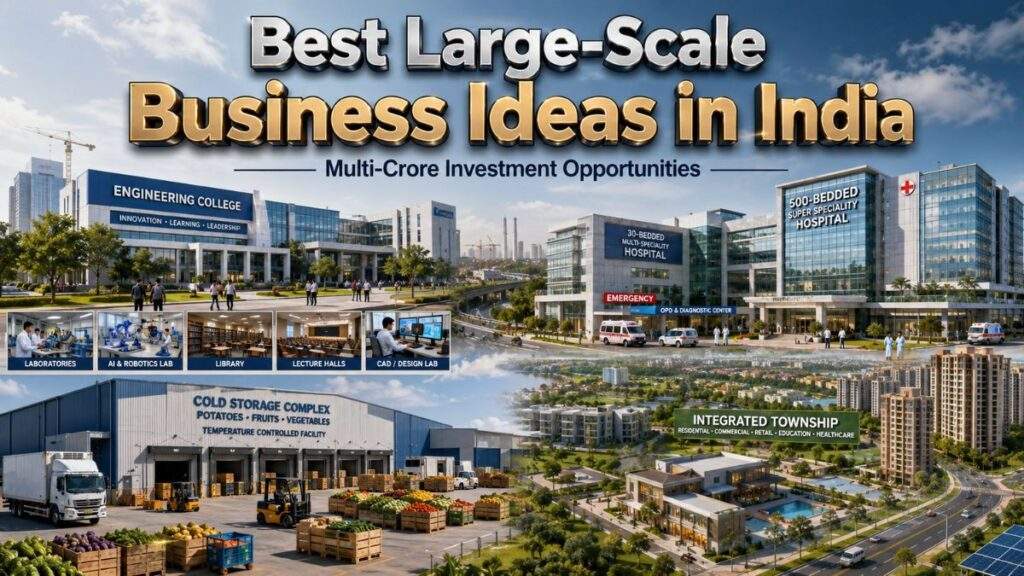
Best Large Scale Business Ideas in India Why Infrastructure Is India’s Smartest Business Canvas The story of India’s infrastructure has always revolved around steel tonnages, highway kilometres and power plant capacities. However, the more interesting narrative, one that matters to startup founders, institutional investors and first-generation entrepreneurs, is occurring at the intersection of services and built infrastructure. Engineering colleges, hospitals, cold storage places and integrated townships are not engineering play-rooms, but one of most durable businesses in today’s Indian market backed by demand, stickiness of essential services and has a scalable revenue architecture that is hard to beat in the manufacturing business. Look at the structural background: India has an over 900 million working population, governments are aggressively striving to gain access to healthcare and increase access to higher education, agricultural sector is troubled with issues of post-harvest loss, and urbanisation is happening at an incredible pace, requiring planned urban housing. All of these trends are ideal investments on their own. As a whole, they create a time in which infrastructure businesses based on true demand, not speculative capital cycles are more appealing than ever. If the entrepreneurs and investors are ready to turn away from the traditional trade and manufacturing, the four sectors analysed here are some of the most bankable, policy supported and future-proof segments of the domestic economy. Get Detailed Insights from This Book: Our Books Why Infrastructure and Services: The Investment Logic The demand visibility of infrastructure services is one of the few sectors in India that can show that kind of sustained demand visibility. Structural demand is the type of demand that does not go away during a recession, as it is with consumer products and manufacturing enterprises sensitive to input cost changes. For example, demand for healthcare in low-income countries is highly price inelastic. The demand for cold storage increases with food production and formalisation of food retailing. GDP and employment in engineering and technical education follow the curves of GDP and industrial employment with almost a perfect correlation. In recent years, it’s the financial structure of these investments that has evolved. The Government of India through various ministries from the Ministry of Education to the Ministry of Health and Family Welfare, the Ministry of Food Processing Industries and the Ministry of Housing and Urban Affairs have gradually made it easier to offer subsidies, viability gap funding, and access to institutional lending facilities. What you get is a risk adjusted return profile that performs well despite the volatility of commodity cycles and is competitive against the high growth manufacturing sector. These are some of the most defensible business architectures that exist, in the sense that they are suited to investors who have a 10-to-15-year time horizon and access to local institutional relationships and land. Government Policies and Incentive Architecture The policy context for infrastructure investments has come a long way. The Credit Guarantee Fund Trust for Micro and Small Enterprises (CGTMSE) under the Ministry of MSME offers collateral-free loans to enterprises for establishing cold storage and food processing support infrastructure facilities of up to ₹5 crore, thereby providing a strong de-risking facility to the first-generation entrepreneurs. Ayushman Bharat – Pradhan Mantri Jan Arogya Yojana (PM-JAY) et al creates a guaranteed payer base for empanelled hospitals, which would make even 30 bed secondary care hospitals in Tier-2 and Tier-3 towns have visibility of revenue! The National Cold Chain Fund (NCCF) under the Ministry of Food Processing Industries (MoFPI) provides capital subsidy of up to 35% of project cost for integrated cold chain projects with an emphasis on potato, horticulture and perishable supply chains, catering for the identified gaps in post-harvest infrastructure. In the meanwhile, the Pradhan Mantri Kisan SAMPADA Yojana (PMKSY) offers infrastructure grants for agri-logistics nodes with a critical component of cold storage. The Real Estate Regulatory Authority (RERA) framework on the whole is regulatory, but it has institutionalized the belief of the buyers, which in fact has furthered the speed at which the projects are completed and made them accessible for construction finance. The Smart Cities Mission and AMRUT schemes also provide urban local body co-financing for infrastructure in designated areas which lessen the burden on private developers. AICTE’s revised norms for approval of private engineering colleges and the National Education Policy (NEP) 2020 were also important in enhancing the commercial viability of private technical institutions, while there is a call for multidisciplinary education, which will benefit engineering education. Startups in infrastructure that are linked to MSME get tax exemption, ease of compliance, and access to government infrastructure procurement process on par with other startups, under the Startup Recognition benefits provided by the Department for Promotion of Industry and Internal Trade (DPIIT). Together these schemes take the risk “floor” for first time infrastructure entrepreneurs down considerably. Business Opportunities: Sector-by-Sector Analysis 1 Engineering College The engineering and technical education space in India has one of the lowest investments to demand (I/D) ratios among all sectors in the country. While the perception of a lack of seats exists in some of the metros, a ground level assessment of the country has revealed that there is a huge gap in the emerging corridors, especially in states such as Rajasthan, Odisha, Chhattisgarh, Uttar Pradesh and the Northeast region, where the ratio of engineering colleges to the population of 18-22 year old population is significantly lower than the national average. If a land owner with local stakeholder base wants to make an engineering college, the capital expenditure is high but it is also a business that can be banked easily due to the presence of AICTE. The capital cost of a normal College with four departments (Computer Science, Mechanical, Civil, Electronics) of 300 seats is around 15-25 crores when taking into account the land cost and construction specification. Diversification of revenue streams: tuition fees, hostel, mess operations, consultancy and training, industry sponsored labs and more and more, skill development centres under PM Kaushal Vikas Yojana (PMKVY). A good and well-managed private engineering college evolves from a capital
Entrepreneur India May 2026 Is Here — Download Free & Explore India’s Most Profitable Manufacturing Business Ideas
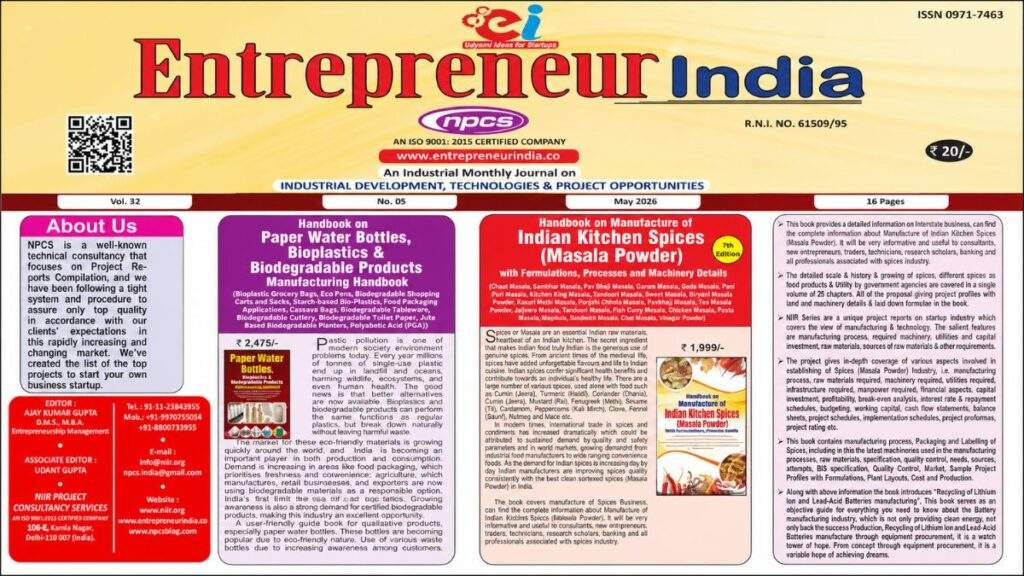
India is going through a strong period of industrialization. Rapid infrastructure development, government support, growing domestic demand and boosted exports are generating huge opportunities for manufacturing startups. Economists nationwide are now focusing on new, high-growth, manufacturable industries that have long-term potential, as opposed to the traditional jobs. NIIR Project Consultancy Services (NPCS) publishes the latest issue of Entrepreneur India May 2026 which is one of the best resources to find these opportunities. This issue contains a lot of detailed manufacturing business ideas, market analysis, project cost estimates and future trends of industry which can help the entrepreneurs to make better business decisions. As a startup founder, investor, MSME owner, or a first-time entrepreneur, this issue offers you valuable insights into some of the fastest-growing industries in India. Get Detailed Insights from This Book: Just For Starters: How To Start Your Own Export Business What is Entrepreneur India Magazine? Entrepreneur India is one of India’s most prominent industrial magazines covering manufacturing, new technologies and project opportunities. The magazine has been the navigational guide of entrepreneurs and industrial investors for over 30 years now published by NIIR Project Consultancy Services (NPCS). Entrepreneur India is not a regular business blog that just gives general information, it provides detailed industrial information, which is backed by research and actual project data. The magazine includes: Manufacturing business ideas Plant and machinery cost estimates Market demand analysis The rate of return and break-even information. Industrial technology insights Future growth opportunities This is very useful for business owners who are going to venture into manufacturing. Related Article: India’s Healthcare Manufacturing Sector Is Booming —5 High-Return Businesses. Entrepreneur India May 2026 Free Download of Entrepreneur India May 2026 The Entrepreneur India May 2026 issue is available for free download online through the official website. Download Here: Entrepreneur India May 2026 PDF Official Website: Entrepreneur India Top Manufacturing Business Ideas Featured in Entrepreneur India May 2026 Bioplastics and Paper Bottle Manufacturing One of the most standout features of the May 2026 edition is sustainable packaging and eco-friendly production methods. Governments across the globe have curbed the use of plastic; and organizations are moving quickly towards adopting environmentally friendly alternatives. The magazine delves into the opportunities in: Bioplastic carry bags Compostable products PLA-based materials Paper water bottles Eco-friendly packaging solutions The world’s largest beverage manufacturers are testing sustainable packaging systems, making paper bottle production one of the hottest start-up areas. This business holds a great potential, because of the following: Growing environmental awareness Government assistance to green industries Rising export opportunities The growth of demand from FMCG companies. This is a business sector that is future ready with the increased demand for biodegradable products in the coming decade. Explore This Book: Paper Water Bottles and Bioplastics Manufacturing Handbook Moringa Powder Manufacturing Business Due to its nutritional content and health benefits, Moringa is sometimes referred to as the “Miracle Tree”. India is the biggest producer of moringa and the demand for moringa powder has been rising in the world. Moringa powder will be utilized for: Health supplements Herbal products Nutritional foods Health and beauty products The Entrepreneur India May 2026 issue includes comprehensive details on project cost estimates for establishing a moringa powder manufacturing unit. Project Cost Estimate Capacity: 907 Kg per day Plant & Machinery: Rs. 134 Lakhs Total Project Cost: Rs. 466 Lakhs Rate of Return: 25% Break Even Point: 80% Since the consumers with interest on health is increasingly looking for natural products, the moringa business is expected to have considerable growth in international market. WPC Boards from Rice Husk The magazine also emphasizes on the increasing need for Wood Plastic Composite (WPC) boards using rice husk. India produces a huge amount of rice husk annually, and the modern technologies are available to use the agricultural waste product for useful industrial products. WPC products are used extensively in: Furniture manufacturing Modular kitchens Wall cladding Outdoor construction Interior decoration These boards are used extensively due to their: Waterproof Termite-resistant Eco-friendly Durable and long-lasting With the adoption of sustainable construction products, the WPC manufacturing has become a lucrative industrial opportunity in India. Blood Bag Manufacturing Business Healthcare manufacturing is one of the most secure and stable of all manufacturing industries. Blood bags and medical disposable products market is growing in the market, which is talked about in Entrepreneur India May 2026. The increase in hospitals, blood banks, and healthcare facilities is driving the demand for blood storage systems market. Growing number of hospitals, blood banks, and healthcare facilities is fueling the blood storage systems market. This kind of business offers the following benefits: Stable long-term demand Growing healthcare infrastructure High-value medical products Export opportunities Healthcare products are a critical business in any economic climate, so it’s generally regarded as somewhat recession-proof. Access Complete Business Plan: Blood Bags Manufacturing Plant Report Gas Atomized Aluminum Powder Manufacturing Gas atomized aluminum powder manufacturing is another high potential opportunity mentioned in the issue. It is an advanced industrial material with applications in the field of aviation, electric vehicles, military and 3D printing. Applications include: Aerospace components Electric vehicle manufacturing Defense equipment Advanced metallurgy Industrial 3D printing The rising interest in EV and industrialization in India is driving the demand for quality aluminum powder. This is a business that demands technical skills and of course a higher investment, but has a high level of profit, and a relatively low level of competition. About NIIR Project Consultancy Services (NPCS) NIIR Project Consultancy Services (NPCS) is one of the most trusted industrial consultancy firms in India. Over the past 30 plus years, NPCS has assisted entrepreneurs in business opportunities that are economically viable via industrial research, market analysis, and project consultancy. NPCS specializes in: Detailed Project Reports (DPR) Techno-economic feasibility studies Manufacturing startup guidance Market survey reports Industrial project identification Business investment analysis They are reported by and used by: Entrepreneurs MSMEs Industrial investors Manufacturing companies Banks and financial institutions NPCS is being used by thousands of businesses throughout India for hands-on guidance for industry and project
Emerging Business of Medical Disposables
The emerging business of medical disposables has become one of the most lucrative and high-potential sectors in the global healthcare industry. With growing awareness of infection control, hygiene, and patient safety—especially after the COVID-19 pandemic—demand for single-use medical products has skyrocketed. From gloves and syringes to gowns, IV sets, and surgical masks, disposable medical items are now indispensable in hospitals, clinics, and home healthcare settings. Market Research: – Market Research Report Major Key Players: Contact Us
How to Start a Manufacturing Business of Seaworthy Containers?
The shipping and logistics industry is growing rapidly with the expansion of global trade. In this scenario, the manufacturing of seaworthy containers has emerged as a highly profitable and sustainable business opportunity. These containers are specially designed to withstand harsh marine environments, protect cargo during long-distance ocean transport, and comply with international safety standards. With India becoming a logistics hub and exports rising steadily, entering the seaworthy container manufacturing sector can be a smart investment choice. If you’re looking for a business opportunity in manufacturing Business of seaworthy Containers, get in touch with NIIR Project Consultancy Services. In the world of business, NPCS has established a reputation as a trustworthy provider of comprehensive technical consulting services. Click here to send your queries/Contact Us See More Links:
Highway Guard Crash Barrier Manufacturing: Investment Opportunities in Highway Guard Crash Barrier Production
Highway guard crash barrier manufacturing is a crucial segment in the road safety and infrastructure industry. With the rapid expansion of highways, expressways, and urban road networks, the demand for effective crash protection systems has grown significantly. Crash barriers are engineered metal or concrete systems installed along roadsides, medians, and flyovers to prevent vehicles from veering off the road or colliding with hazardous obstacles. This booming sector not only ensures safety for commuters but also presents a lucrative business opportunity for manufacturers and entrepreneurs looking to invest in infrastructure-related industries. From public tenders to private highway projects, the market scope for highway crash barrier systems is robust and expanding. Visit this Page for More Information: Start a Business in Industrial & Engineering Products Industry Market Overview and Scope The highway infrastructure sector in India and globally is witnessing exponential growth, with increasing budget allocations for road safety measures. The installation of crash barriers has become mandatory in many regions, especially in accident-prone zones, ghat sections, highways, and bridges. Read Similar Articles: ENGINEERING GOODS PROJECTS Key market drivers: Government mandates and road safety norms Rapid infrastructure development (Smart Cities, Bharatmala Project, etc.) Growing awareness of road accident prevention Highway modernization and upgradation projects India alone is expected to invest trillions of rupees in highway development by 2030, creating consistent demand for guardrail systems and safety components. Types of Crash Barriers in Manufacturing Manufacturing crash barriers involves producing a variety of structures designed to absorb the impact and redirect vehicles safely. 1. W-Beam Crash Barriers These are the most commonly used guardrails made from hot-dip galvanized steel. Their W-shaped design provides excellent tensile strength and flexibility upon impact. 2. Thrie-Beam Crash Barriers Thrie-beam barriers have an extra corrugation compared to W-beams, making them suitable for areas requiring higher impact resistance such as flyovers and sharp curves. 3. Wire Rope Safety Barriers These use high-tension steel cables mounted on posts and are widely used on medians to prevent cross-over crashes. 4. Concrete Barriers Though not always manufactured in the same facilities, some companies also produce reinforced concrete crash barriers for rigid protection in urban zones. Each type has its specific application, depending on road geometry, speed limits, and expected impact loads. Raw Materials and Machinery Used To set up a highway guard crash barrier manufacturing unit, the following materials and equipment are generally required: Raw Materials: Hot-rolled or cold-rolled steel sheets Galvanized steel coils Zinc for galvanization Bolts, nuts, washers Paints and primers (for anti-corrosion coating) Machinery: Roll forming machines (for shaping W and Thrie beams) Hydraulic press Punching and cutting units Hot-dip galvanizing plant Shot blasting machine Material handling equipment Advanced units may also include CNC punching, robotic welding, and testing equipment for crash simulation and tensile strength checks. Manufacturing Process The manufacturing process is a mix of mechanical, chemical, and thermal operations to ensure strength and durability. Here’s a step-by-step overview: Steel Sourcing – High-quality steel coils are procured and quality-checked. Roll Forming – The steel is passed through roll-forming machines to shape into W-beam or Thrie-beam profiles. Punching & Cutting – Holes are punched, and the formed sections are cut to standard lengths. Hot-Dip Galvanizing – Components are dipped in molten zinc to prevent corrosion. Quality Inspection – Final inspection of dimensions, galvanizing thickness, and tensile strength. Packing & Dispatch – Components are bundled and shipped to installation sites. Licensing and Compliance For manufacturing crash barriers, it’s essential to comply with national and international standards to ensure product reliability and eligibility for government contracts. Mandatory Certifications: IS 2062 / IS 5986 / IS 10748 (for steel grades) MORTH Specifications (Ministry of Road Transport & Highways, India) EN 1317 / AASHTO M180 (for export markets) BIS Certification and ISO 9001 (for quality management) Approval from road safety authorities is also necessary for public infrastructure supply tenders. Business Opportunities and Profitability With increasing road construction activity and public-private partnerships (PPPs) in infrastructure, highway crash barrier manufacturing is a capital-intensive but highly profitable business. Revenue Sources: Direct supply to NHAI, PWD, and Road Development Authorities Private contractors in Smart City and township projects Industrial safety zones, toll plazas, and flyovers Export to developing countries needing safety solutions Profit Margins: Average margins range from 15–25% depending on production scale, automation, and contracts. The demand for repair, replacement, and maintenance of old barriers adds a recurring revenue stream. Investment and Setup Cost A medium-scale manufacturing unit with a galvanizing plant can be set up with an initial investment of ?2–5 crore (USD $250K–600K), depending on land, machinery, automation level, and production capacity. Cost Components: Land and Building Roll-forming machinery setup Galvanizing plant (optional but recommended) Labour and Utilities Testing Lab & Quality Control Marketing and Government liaison ROI (Return on Investment) is generally observed within 2–3 years in high-demand regions. Challenges in the Industry Like any business, highway guard crash barrier manufacturing has its share of challenges: Steel price volatility impacting raw material cost Stringent quality requirements and tender eligibility High capital investment for machinery and certification Logistics challenges for bulky product transportation Need for regular compliance and audits However, these challenges can be mitigated with proper planning, technical consultants, and efficient vendor management. Future Outlook The future of the crash barrier manufacturing business is highly promising with increased focus on: Road safety automation and smart highway systems Demand from developing countries and export potential Innovations in eco-friendly, recyclable steel designs Integration of sensors and IoT in crash barrier technology Greenfield and brownfield infrastructure projects will continue to fuel demand for crash barriers in India and across the globe. Conclusion Highway guard crash barrier manufacturing is more than just a business—it’s a contribution to public safety and national infrastructure development. With rising traffic, expanding highways, and growing safety awareness, the need for high-quality crash barriers is at an all-time high. If you have the capital, resources, and technical know-how, setting up a manufacturing unit can be a highly profitable and sustainable venture in the long run. Partnering with government agencies and infrastructure developers ensures
A Complete Business Plan to Start a Profitable Business of Zinc Oxide from Zinc Dross

The business of Zinc Oxide from Zinc Dross is a profitable and sustainable opportunity in the field of metal recycling and chemical manufacturing. Zinc dross is a byproduct of the hot-dip galvanizing process, containing a significant amount of usable zinc. Through proper extraction and processing, this dross can be converted into high-purity zinc oxide—a valuable industrial compound used in rubber, ceramics, paints, fertilizers, cosmetics, and pharmaceuticals. With increasing demand for zinc oxide and rising interest in circular economy models, this business offers both environmental and commercial benefits to forward-thinking entrepreneurs. Understanding the Market Demand Zinc oxide is a versatile compound with high global demand due to its diverse industrial applications. It is used as a vulcanizing agent in the rubber industry, an additive in fertilizers, an opacifier in ceramics, and a whitening agent in paints and cosmetics. The Indian market alone imports a significant amount of zinc oxide each year, creating a clear opportunity for localized production through sustainable sources. Establishing a business of Zinc Oxide from Zinc Dross allows companies to capitalize on the ready availability of zinc dross from galvanizing plants while minimizing raw material costs. Moreover, this recycling process aligns well with environmental norms and waste management rules. Industries and government agencies are actively supporting ventures that turn industrial waste into usable products, further encouraging growth in this domain. Visit this Page for More Information: Start a Business in Chemical Industry Projects Raw Material: Zinc Dross and Its Source Zinc dross is the residue formed during hot-dip galvanization, which includes unutilized metallic zinc, iron particles, and impurities. Typically, it contains 80–95% metallic zinc, making it an ideal raw material for zinc oxide production. Galvanizing units, steel fabrication plants, and alloy manufacturers generate zinc dross in substantial quantities, offering a consistent and low-cost supply channel for manufacturers. In the business of Zinc Oxide from Zinc Dross, acquiring quality dross is the first step. The location of the plant should ideally be near galvanizing clusters or industrial hubs where zinc waste is regularly generated. This ensures reliable procurement, lower logistics costs, and improved overall margins. Read Similar Articles: Inorganic and organic Manufacturing Process and Equipment The process of extracting Zinc Oxide from Zinc Dross involves thermal treatment and oxidation in a controlled furnace environment. Here’s how the general workflow unfolds: Pre-cleaning and drying of dross: Removing excess oil, dust, and moisture for consistency Melting and vaporization: Heating dross in a specially designed furnace at 900–1100°C Oxidation in air: Zinc vapor reacts with oxygen to form zinc oxide Collection and cooling: The fine zinc oxide particles are collected in a bag filter system or chamber Sieving and packaging: The final product is refined, sieved, and packed for sale Key equipment includes rotary furnaces, bag filters, dust collectors, heat exchangers, pollution control units, and packaging systems. Modern zinc oxide units often incorporate energy recovery and emission control systems to enhance environmental compliance. Watch other Informative Videos: Chemicals (Organic, Inorganic, Industrial) Capital Investment and Costing To start the business of Zinc Oxide from Zinc Dross, an estimated capital investment of ?50 lakh to ?2 crore may be required depending on plant capacity, technology level, and location. The cost breakdown includes: Furnace and processing equipment: 40% Pollution control and filter systems: 20% Infrastructure, labor, and utilities: 20% Licensing and compliance: 5–10% Working capital for raw material and packaging: 10–15% Zinc dross costs around ?150–200 per kg depending on purity and source, while high-grade zinc oxide can fetch ?250–?300 per kg in the Indian market. With good process control and raw material procurement, the profit margin can range between 20% and 30%. The ROI is usually achievable within 1.5 to 2 years of operation. Read our Books Here: Chemical Technology (Organic, Inorganic, Industrial), Fine Chemicals Legal Permissions and Regulatory Compliance For setting up a business of Zinc Oxide from Zinc Dross, certain approvals and licenses are necessary: MSME/Udyam registration GST registration Factory license and safety clearance Environmental NOC from the Pollution Control Board Consent to establish and operate (CTE/CTO) Hazardous waste authorization (as zinc dross is an industrial waste) BIS certification (optional but helpful for certain buyers) Complying with environmental standards such as emission norms, air filtration, and proper waste disposal is critical for plant operations. Non-compliance may lead to penalties or operational shutdown, so investing in pollution control equipment and certified handling practices is essential.Read our Book Here: The Complete Technology Book on Chemical Industries Target Customers and Sales Channels The end market for zinc oxide includes rubber and tyre manufacturers, paint companies, fertilizer producers, ceramic tile makers, plastic compounders, cosmetic brands, and even pharmaceutical companies. Each of these sectors requires specific zinc oxide grades—active, white seal, or pharma-grade—depending on application. Your marketing strategy in the business of Zinc Oxide from Zinc Dross should focus on: Building B2B supply chains with direct manufacturers Supplying to government fertilizer tenders (if compliant with agro standards) Bulk supply to tyre and rubber processing units Listing products on industrial B2B marketplaces Participating in metal recycling and chemicals trade expos Packaging, branding, and consistent quality testing play a significant role in customer retention and scaling. Environmental and Economic Benefits Apart from being financially rewarding, the business of Zinc Oxide from Zinc Dross promotes circular manufacturing, reducing environmental damage caused by discarded metal waste. It minimizes the need for virgin zinc mining, which is energy-intensive and ecologically damaging. By converting industrial dross into a usable input, this business helps galvanizing units dispose of waste responsibly while contributing to zero-waste manufacturing goals. The by-products generated during the zinc oxide process (like slag or ash) can sometimes be sold to cement or construction companies, further improving overall material efficiency. Future Potential and Expansion As industrial activities grow and galvanization expands, the availability of zinc dross will increase—fueling the long-term potential of this business. With technological upgrades like automated furnaces, better filtration systems, and AI-based quality checks, producers can increase output while maintaining consistent quality. There is also export potential to countries with heavy rubber, paint, and glass manufacturing bases. Additionally,
Why one should Start a Business in Turkey, Middle East
Starting a business in Turkey has become an increasingly attractive opportunity for international entrepreneurs and investors looking to establish operations in a dynamic, rapidly developing economy. Strategically located at the crossroads of Europe and Asia, Turkey offers access to key global markets, a young and skilled workforce, favorable government incentives, and a growing infrastructure base. The Turkish economy is diversified, with strong sectors in manufacturing, tourism, agriculture, automotive, textiles, and information technology. With clear legal frameworks and simplified registration processes, starting a business in Turkey is no longer limited to large corporations—it’s a viable path for small businesses, startups, and multinational expansions alike. Start a Business in Turkey, Click Here Economic Overview and Investment Climate Turkey’s economy is one of the largest in the region, driven by domestic consumption, export-oriented manufacturing, and foreign investment. The government actively encourages entrepreneurship and foreign direct investment (FDI) through its investment office and various public-private partnership programs. Starting a business in Turkey benefits from several bilateral and multilateral trade agreements, including its customs union with the European Union. This provides Turkish-based businesses with seamless access to a market of over 700 million consumers. The country’s population of more than 85 million is predominantly young, with over half under the age of 32. This demographic advantage translates into a digitally aware, tech-savvy consumer base and workforce. Additionally, Turkey’s central location and well-developed logistics infrastructure—including airports, railways, and seaports—make it an ideal hub for regional distribution. Watch Video: Doing Business in Turkey, Middle East Business Structures and Company Registration When it comes to starting a business in Turkey, choosing the right legal structure is critical. The most common types of business entities are: Limited Liability Company (LTD ?T?) Joint Stock Company (A.?.) Branch Office Liaison Office Sole Proprietorship The Limited Liability Company is most preferred by foreign investors due to its simplicity and flexibility. It requires at least one shareholder and one director, with a minimum capital of 10,000 TRY. Company registration is managed through the Central Registry System (MERSIS), where all steps—from reserving a name to finalizing incorporation—are handled digitally. Read Similar Articles: Business Opportunity in Middle East Countries To complete the process, you must prepare articles of association, deposit capital, open a bank account, register with the tax office, and obtain a potential tax number. Foreign shareholders may need to obtain a Turkish tax identification number and notarize required documents, which can be handled by legal advisors or company formation agents. Overall, starting a business in Turkey can be completed within a few weeks with proper documentation. Taxation and Financial Regulations One of the key concerns while starting a business in Turkey is understanding its tax structure. The corporate income tax rate currently stands at 20% (subject to change based on government policy), and value-added tax (VAT) is generally 18%. There are also special consumption taxes and withholding taxes applicable in certain transactions. Turkey has signed double taxation treaties with over 80 countries, allowing foreign investors to optimize their tax planning. Additionally, the country is compliant with OECD’s Common Reporting Standard (CRS) and has strict anti-money laundering laws, ensuring financial transparency and global business credibility. All businesses must maintain accurate accounting records and submit regular tax returns. It’s advisable to partner with a licensed financial consultant or accountant who understands both Turkish regulations and international reporting standards. Read our Books Here: Startup Books for Entrepreneurs Incentives for Foreign Investors To encourage foreign direct investment, the Turkish government provides several incentives depending on the industry and region. These may include: Customs duty and VAT exemptions Income tax reductions Social security premium support Land allocation for industrial facilities Interest support for investment loans For example, technology development zones (Technoparks) and organized industrial zones offer tax holidays and infrastructure support to businesses operating in R&D, software development, and manufacturing. Foreign entrepreneurs starting a business in Turkey in these zones can enjoy up to 100% tax exemptions for several years, making the venture highly cost-effective in the initial stages. Banking, Currency, and Financial Transactions Turkey’s financial system is well-regulated and efficient. Once your business is registered, opening a corporate bank account is straightforward, though KYC (Know Your Customer) checks are stringent. Most banks offer services in English and support international transactions. The official currency is the Turkish Lira (TRY), and businesses can hold accounts in foreign currencies like USD or EUR. With access to SWIFT and international wire transfer systems, cross-border operations are streamlined. However, due to currency fluctuations, many businesses hedge their exposure or transact in multiple currencies. Digital payment systems, mobile banking, and fintech platforms are also widely used, offering additional convenience for online or e-commerce-based businesses. A well-planned banking strategy is a crucial step in starting a business in Turkey and managing operations smoothly. Hiring and Employment Regulations Turkey has a large pool of skilled labor at competitive wage levels. The Labor Law governs employment contracts, working hours, minimum wage, severance pay, and workplace safety. Foreign companies can hire Turkish citizens easily, but employing foreigners requires a valid work permit, which is typically grante once the company is operational and meets certain criteria. Standard working hours are 45 hours per week, and workers are entitled to paid annual leave, social security, and health benefits. The minimum wage is revised regularly and varies slightly depending on sector and region. Businesses must register employees with the Social Security Institution (SGK) and ensure timely contributions. For companies in sectors like IT, construction, and export services, starting a business in Turkey allows you to tap into a young, dynamic workforce willing to engage in innovative, tech-driven work environments. Opportunities Across Industries There are numerous sectors where starting a business in Turkey can yield high returns. These include: Tourism & Hospitality: Capitalize on Turkey’s status as a top global tourist destination Renewable Energy: Solar, wind, and hydro projects receive strong government backing Agribusiness & Food Processing: Huge domestic and export potential in organic and processed foods Real Estate & Construction: Urban development and housing projects are ongoing E-commerce &
Production Business of Liquid Epoxy Resin | Epoxy Resin Industry
The production business of liquid epoxy resin is gaining immense traction in the industrial chemical segment due to the widespread use of epoxy-based materials in adhesives, coatings, flooring, electrical systems, automotive, and composite manufacturing. Liquid epoxy resin, known for its exceptional strength, durability, chemical resistance, and bonding properties, has become a key ingredient in several high-growth industries. As global demand for lightweight materials and high-performance coatings increases, setting up a liquid epoxy resin production business can be a highly profitable venture for chemical manufacturers and new entrepreneurs with technical and industrial capabilities. Visit this Page for More Information: Start a Business in Epoxy Resin Industry Market Potential and Applications The demand for epoxy resins has surged across sectors such as electronics, construction, marine, aerospace, and renewable energy. A well-planned production business of liquid epoxy resin can supply high-quality resins to paint manufacturers, printed circuit board makers, automotive component producers, and flooring solution providers. The market is witnessing consistent growth due to the increased adoption of resin-based paints and corrosion-resistant coatings. Epoxy resins are also replacing traditional materials in wind turbine blades, electric vehicle (EV) batteries, and structural composites. Read our Book Here: Epoxy Resins Technology Handbook In construction, liquid epoxy resin is used in concrete bonding, waterproofing, and floor coatings. In electronics, it’s critical in encapsulating semiconductors and PCBs. This wide range of applications makes the production business of liquid epoxy resin resilient against market fluctuations, with scope for scaling and diversification. Read Similar Articles: Resins Industry Raw Materials and Chemistry The primary raw materials for the production business of liquid epoxy resin are epichlorohydrin (ECH) and bisphenol-A (BPA). These are reacted through a condensation reaction in the presence of a base like sodium hydroxide to produce bisphenol-A-based epoxy resins, which can be further modified for different viscosities and thermal properties. Some variants also use novolac or aliphatic modifiers for specific performance needs. Sourcing raw materials of consistent purity is critical to ensure product quality. Many manufacturers also add reactive diluents, flexibilizers, or hardeners depending on the target use. As the production involves exothermic reactions and precise temperature control, setting up proper safety and quality protocols is essential. Watch other Informative Videos: Profitable Projects on Paints Plant Setup and Machinery Requirements To start the production business of liquid epoxy resin, one requires a well-equipped chemical manufacturing plant with provisions for handling hazardous and flammable chemicals. Key machinery and equipment include: Stainless steel or glass-lined reactors with temperature and pressure control Condensers and reflux units Storage tanks for raw materials and finished resin Vacuum pumps, filters, and dosing systems Cooling and heating systems Automated packaging units (barrels, drums, or bulk tanks) Fume scrubbers and fire safety systems Depending on the production scale, a 500–1000 sq. m industrial unit may be needed with appropriate zoning and environmental clearance. Manufacturing Process Overview The production business of liquid epoxy resin typically follows a batch-wise or continuous manufacturing method. The general process includes: Charging the reactor with bisphenol-A and epichlorohydrin Initiating reaction with an alkaline catalyst (usually NaOH) Controlling temperature to manage the exothermic reaction Removing byproducts like water and salt Filtering and vacuum stripping of unreacted ECH Cooling, testing, and packing the resin into containers Each batch undergoes stringent QC tests for viscosity, epoxide equivalent weight (EEW), color index, and reactivity. Proper formulation adjustments are made to cater to different industrial requirements. Related Project: Epoxy Resin – Manufacturing Plant Licensing, Safety, and Compliance Since this is a chemical manufacturing unit, the production business of liquid epoxy resin must comply with local industrial, fire, and environmental laws. Key licenses and registrations include: Factory license under the Factories Act Consent to Establish and Consent to Operate from Pollution Control Board Hazardous waste handling approval MSME/Udyam Registration GST Registration and Excise documentation Worker safety and chemical handling training protocols The factory must be equipped with fire extinguishers, eyewash stations, personal protective equipment (PPE), and well-defined safety signage. Hazardous chemical storage protocols must be in place for raw materials like ECH. Branding and Packaging Strategy In the production business of liquid epoxy resin, packaging is usually done in: 30 kg to 220 kg plastic or metal drums Intermediate Bulk Containers (IBCs) Bulk tankers (for industrial supply) Branding plays a less visible role in B2B chemicals, but technical datasheets, product certifications (such as REACH or RoHS), and customer technical support become essential value additions. Having a dedicated sales and technical team helps build trust with industrial clients. Marketing and Distribution Channels The business is primarily B2B, so your production business of liquid epoxy resin should focus on: Bulk buyers like paint manufacturers, composite manufacturers, adhesive companies Distributors and chemical wholesalers Industrial procurement portals like IndiaMART or TradeIndia Direct sales through exhibitions, technical seminars, and online channels Export markets via merchant exporters or direct shipping to Southeast Asia, the Middle East, or Europe A technical brochure with TDS (technical data sheet) and MSDS (material safety data sheet) is crucial to gain industrial clients. Offering bulk discounts, credit terms, and custom formulations also boosts long-term partnerships. Read our Books Here: Synthetic Resins Cost Structure and Profit Margins An indicative cost breakdown for starting a production business of liquid epoxy resin: Plant setup and equipment: ?35–50 lakhs (for small to mid-scale plant) Licensing and pollution compliance: ?3–5 lakhs First batch raw material procurement: ?15–20 lakhs Working capital for 3 months: ?10–15 lakhs Packaging and logistics setup: ?5 lakhs The manufacturing cost per kg of epoxy resin ranges from ?160 to ?200, depending on purity and formulation. Selling prices range from ?220 to ?350 per kg. With bulk production and consistent quality, profit margins can reach 20–30%, and breakeven may occur within 1.5 to 2 years. Future Opportunities and Innovations As industries evolve, epoxy resin formulations are being optimized for sustainability, low VOC emissions, and bio-based feedstocks. The production business of liquid epoxy resin can expand into: Water-based epoxy systems Bio-based resins using plant oils High-temperature resins for aerospace Epoxy nanocomposites for electronics Custom adhesives for EV batteries and solar panels