
How to Choose Your Next Manufacturing Business
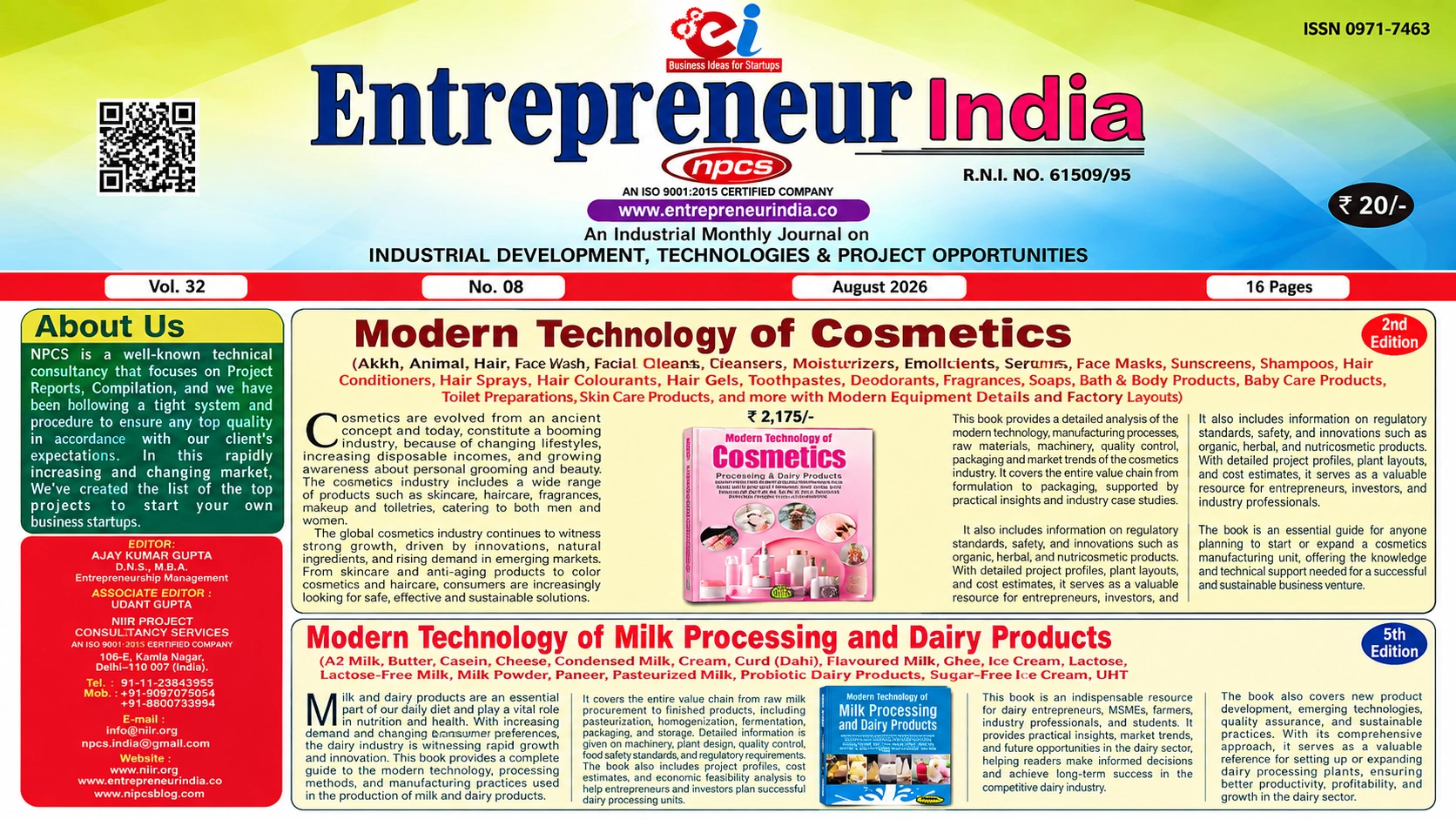
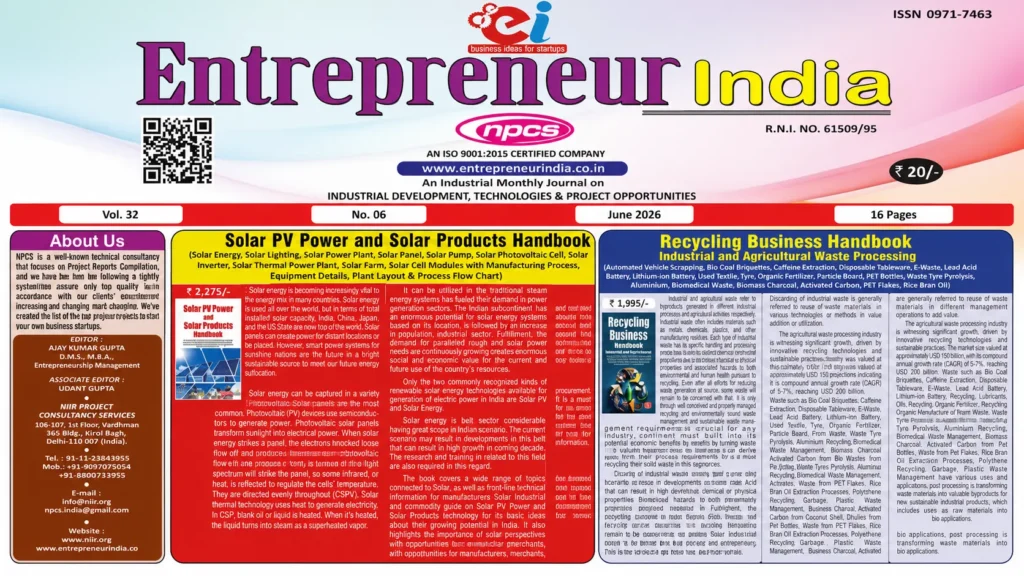
Hundreds of new business concepts are written about, shared and lost every month. For most first timers, the problem is not that they are not getting ideas, but rather, what idea is worth pursuing. This is where the Entrepreneur India June 2026 (Vol. 32 No. 06) article on it comes in handy! It doesn’t present opportunities as a list; it provides you with the data points to compare opportunities.
Each idea of manufacturing as well as service business given in this issue is accompanied by Project Cost Estimate which is prepared by NIIR Project Consultancy Services (NPCS), an ISO 9001:2015 certified consultancy firm with a rich experience of 30 years in the field of project research.
Rather than just summarising what is in there, this article takes the reader through the process of how to apply the information to help make a decision — and does so, with examples taken from this issue.
Step 1: Start With Capital, Not Excitement
It’s easy to choose a business that’s exciting or futuristic. The first “true” filter, however, is always capital availability. The selection of the June 2026 issue is quite broad.
The lowest project cost for Moringa Oleifera (Drumstick) Powder is ₹71 lakhs which includes the cost of Plant and Machinery of ₹31 lakhs. On the other hand, paper water bottles are priced at ₹286 lakhs, and Ready to Eat Food (Retort Packaging) is priced at ₹718 lakhs.
At the other end of the scale, the Viscose Filament Yarn Spinning by the Lyocell Process requires the investment of ₹480 crore and Mono Crystalline Silicon Wafers cost ₹91 crore — definitely not the level of competition for most new entrepreneurs, but certainly attractive to established manufacturers or well-financed start-ups aiming to move into a niche, high barrier sector.
The rule is: identify your investment level with the concept before. If you cannot raise the required capital of ₹480 crore to start the business, then it is of no use to a business having 44% rate of return.
View Full Project Details: Moringa Oleifera (Drumstick) Powder Manufacturing Plant Report
Step 2: Look at Rate of Return Alongside Break-Even Point
The discussion is mostly about the rate of return, but the break-even point is just as important because it lets you know how long you’ll be operating before the business starts to make money — and that’s just as critical in cash flow planning.
Choose two examples from this issue. Lithium-Ion Battery Assembly has been determined to have a 32% return on investment and break-even point of 39%. The 22% rate of return for Steel Containers is slightly lower with a 43% break-even point. Agro Industrial Park has a higher rate of return of 26% but a particularly low breakeven point of 18% as it generates a lot of income from leasing and service income, compared to the simple manufacturing activities.
A lower break-even is a more significant factor than a slightly higher ROI, if you’re self-funding or have restricted working capital. If you have investors who are willing to wait for a longer time period and are willing to accept a higher rate of return, you may be willing to wait.
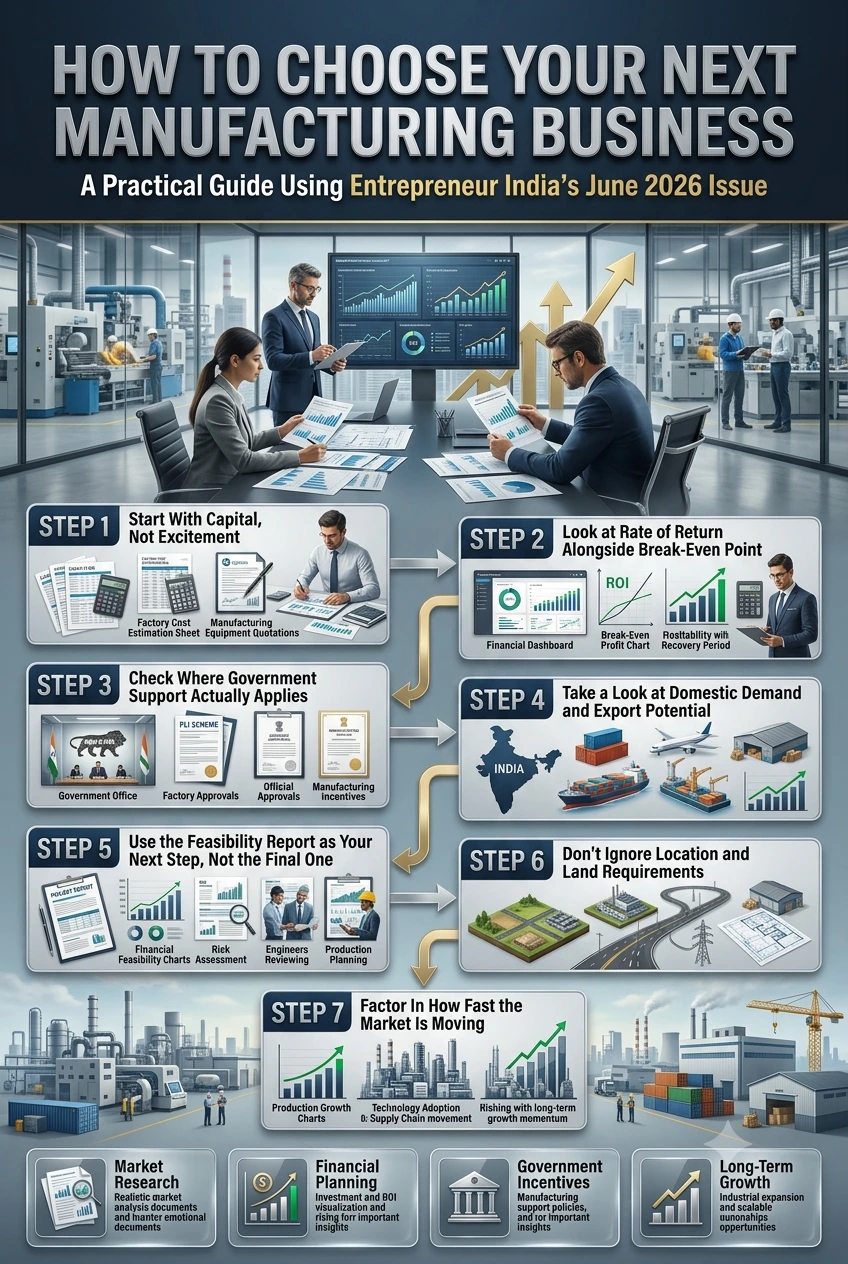
Step 3: Check Where Government Support Actually Applies
One positive aspect of this issue is that it refers to specific schemes, not to the vague term of “government support. It’s helpful to do this because it allows you to assess eligibility before falling in love with an idea.
For example:
- Lithium-Ion Battery Assembly is the name given to Advanced Chemistry Cell batteries under the PLI scheme, which has an outlay of ₹18,100 crore.
- Agro Industrial Park schemes can leverage PMKSY, Mega Food Parks, BHAVYA scheme and the ASPIRE scheme.
- Steel Container Manufacturing is eligible for CGTMSE, MUDRA (for ancillary unit) and PMEGP and State level industrial subsidies.
- The other construction-material companies indirectly profit from the spending on smart city infrastructure and affordable housing.
It is advisable to review the schemes listed to see if you or your business structure are eligible to apply for the shortlisted idea before you submit it. The business that has the potential to look great on paper may not look that great once you discover that your unit size or location is not eligible!
Step 4: Take a look at the domestic demand and export potential.
A few businesses in this issue are based on domestic demand, and a few others rely heavily on opportunity for export. The category you’re entering will impact your thinking on location, certification, and your go to market plan.
The rice husk ash silica, for example, has already found export markets in Bangladesh, Nepal, Sri Lanka, Myanmar, UAE and Africa, as well as domestic applications in tyre manufacturing and paint production. The diversification of the supply chain from China is a major driver of the importance of export markets for both Steel Containers and LRPC Steel Strand, with the United States, Europe and the Middle East being the key markets.
Businesses, on the other hand, such as Ready to Eat Food and Hydroponic Green House Farming, are more domestically based and are closely linked to the consumption pattern in India and urban food habits.
If exporting is a key part of your business plan, the extra compliance, certification and logistics costs should be taken into account early, as these are not included in the basic project cost estimates.
Read the Complete Book Here: Manufacture of Value Added Products from Rice Husk (Hull) and Rice Husk Ash (RHA)
Step 5: Use the Feasibility Report as Your Next Step, Not the Final One
It’s important to understand that what the magazine will provide you is a starting, not a final business plan. Each project profile in the June 2026 issue refers to NPCS’ detailed techno-economic feasibility reports including raw material sourcing, machinery suppliers, manufacturing process flow, personnel requirement, land and building requirement, multiyear financial details etc. which are suitable for further analysis.
Use the magazine for your shortlist tool. When you have reduced your ideas down to 2 or 3 based on capital, return profile, scheme eligibility and market orientation then it is time to have a good detailed feasibility study done before putting real capital in.
Putting It All Together
When you have several ideas from this issue to consider, it’s a straightforward way to compare them by lining up four numbers side by side: project cost, rate of return, break-even point, and applicable government scheme. A few compare here:
- Agro Industrial Park: > 26% return, 18% break-even, multiple scheme support, high capital
- In Lithium-Ion Battery Assembly, cost is ₹953 lakh, the return is 32% and breakeven is 39%, supported by PLI.
- Steel Containers: ₹22,357 lakh cost, 22% return, 43% break even, PLI and MUDRA eligible
- Paper Water Bottles: ₹286 lakh cost, 28% return, 58% break even, export oriented. Paper Water Bottles: ₹286 lakh cost, 28% return, 58% break even, export oriented.
- Gypsum Plaster Board: ₹1,743 lakh investment, 28% return, 51% break-even, construction-related
None of these is objectively “the best” idea — it will ultimately depend on your capital, risk taking appetite and time horizon. That’s what makes a resource like this issue, which is based on data, more useful than a list of trending business ideas.
Choose the right startup backed by real market demand
Step 6: Don’t Ignore Location and Land Requirements
Capital and returns are always on the agenda, but so are land and location requirements, and if it’s not feasible up front, nothing else matters. That’s evident from some examples that follow from this issue.
Agro Industrial Park projects, for example, are more likely to be concentrated in the semi-urban belts such as Phalodi, Rajasthan, Kalaburagi, Karnataka, Nellore, Andhra Pradesh and Rae Bareli, Uttar Pradesh which were selected for the availability of cheap land, availability of raw materials, and lower competition. In contrast, Steel Container Manufacturing requires 2–5 acres of industrial land, and access to port facilities for an exportable business.
When considering an idea from this issue, you should discuss early whether the location and land use that the design calls for are realistic in your area. A business idea that does really well near Sagarmala port infrastructure, could not be the same on the land without taking into account the logistics cost in business calculations.
Step 7: Factor In How Fast the Market Is Moving
There is not a uniform speed with which all opportunities in this issue move, and this impacts on the size of a “first-mover window.
Things such as Lithium-Ion Battery Assembly and Mono Crystalline Silicon Wafers are found in markets that are extremely dynamic and policy driven — where the early movers who have invested heavily in process control and customer qualification now have the ability to create a moat that will last as the market becomes crowded. Others, such as Ready to Eat Food or Paper Water Bottles, are on the rise but have lesser entry requirements, which means that even though they may be on the rise, they may see competition catching up soon.
There are no right or wrong opportunities, but there are strategies for each. High barrier and fast-moving categories are the ones who are paying out for investing early and sticking to their investment plan. Lower-barrier, slower moving categories recognize both good execution, branding and relationship building more than just early timing.
Related Article: EV Battery Manufacturing Business Opportunity for MSMEs in India
Get the Full Issue
The project profiles mentioned in this guide have been fully featured in the June 2026 issue of Entrepreneur India; in addition, there are several other new project profiles included, namely: Recycling Business, Solar PV Products and Animal Feed from Bagasse.
Download the full Entrepreneur India June 2026 issue here
FAQ
1. What size of business am I able to afford?
You should first eliminate ideas based on overall project expenses from your resources, and then discuss ROI and break-even analysis with the ones you are able to afford.
2. Is it always better to choose a higher rate of return?
Not necessarily. A higher rate of return is usually associated with a longer break-even period or a bigger investment, therefore, consider your cash flow and investment scenario.
3. Are all businesses in this issue eligible for Government subsidy?
No. All of the business ideas have special schemes and eligibility would vary based on size of the unit, location and business structure, so it is essential to review each business idea individually.
4. What should I do once I have selected a business idea from the magazine?
The next step recommended is to have a detailed techno-economic feasibility report prepared which can provide much more detail of raw materials, machinery, and multi-year projections than the summary offered in the magazine.
5. What is the risk level of export-oriented companies as compared to domestic companies?
Not necessarily riskier, but they will often need extra investment in the certification / compliance / logistics which is not always considered in the base project cost estimate.