
Citric Acid Market Research Report 2026: Size, Growth, Demand-Supply Gap and New Business Opportunity for Startups in India
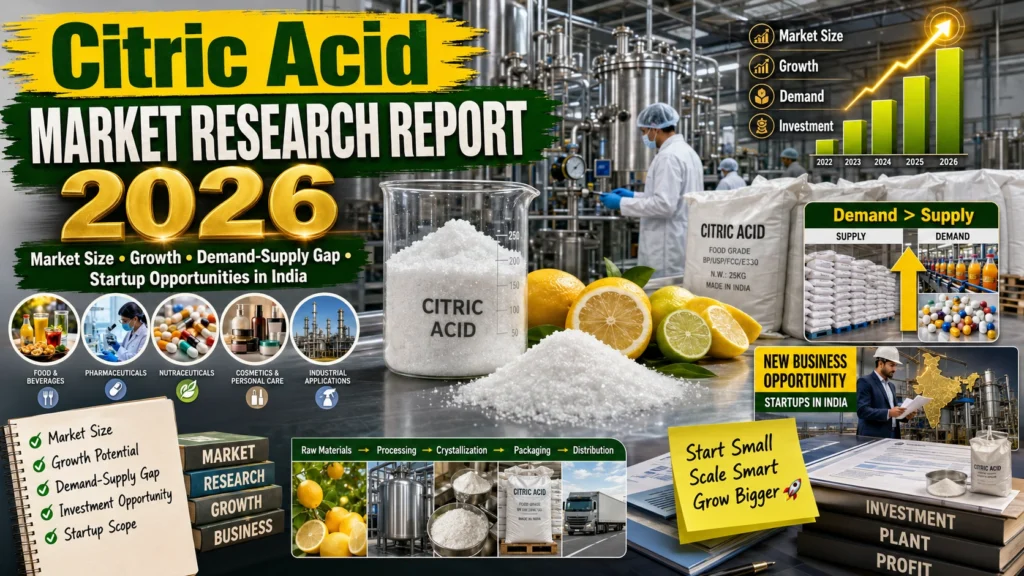
Citric Acid Manufacturing in India India is the second highest consumer of citric acid and second highest producer of citric acid in the world but it still imports almost the entire quantity of citric acid required to meet the domestic demand by the Chinese industry which produces nine times more citric acid than India. China’s export market is tightening through 2026 and India’s food, beverage and pharmaceuticals industry is still booming, while the fermentation process is one that India is familiar with. View Full Project Details: Citric Acid Manufacturing Plant – Detailed Project Report & Business Plan What Is Citric Acid? Citric acid is a weak organic tricarboxylic acid, which is commercially produced almost exclusively by microbial fermentation; Aspergillus niger mould fermented on sucrose, molasses or corn-steep liquor that can yield over 90% (on substrate basis). The metabolic product of the mould is filtered out and citric acid is precipitated as calcium citrate with lime (calcium hydroxide) and re-dissolved in sulphuric acid (or can be separated by liquid-liquid extraction). Citric acid is available in two main forms: It is widely used in the following applications: Related Article: How to Start a Citric Acid Manufacturing Business from Lemon Global and India Citric Acid Market Size and Growth The global citric acid market in 2025-26 was valued at an estimated range of USD 3.77–4.21 billion, and is expected to reach between USD 4.81–5.54 billion by 2031-2033, with the average rate of growth being in the range of 3.7% to 4.12%. China leads the world in production by volume, with an estimated 65-70% of global capacity, fueled by an integrated fermentation facility and a large supply of corn-based feedstock. India has a truly noteworthy but structurally weak stake in this situation: It is the 2nd largest consumer of citric acid with an estimated consumption of 420,000 tonnes per year, behind only China (1.1 million tonnes), and the 2nd largest producer with domestic production of around 296,000 tonnes per year. China produces about 2.6 million tonnes, compared to India’s nine times less ability. Note on figures: Citric acid market studies can be different in considering the acid alone or including its salts or esters (sodium citrate, potassium citrate, etc.). NPCS can provide a customised techno-economic feasibility study, tailored to your target product form (anhydrous vs. monohydrate) and your target grade (food versus pharmaceutical), for numbers for the investor. India’s Quantified Supply-Demand Deficit The consumption of about 420,000 tonnes, and domestic production of about 296,000 tonnes annually indicate that India has a structural deficit of about 124,000 tonnes per annum, which is met almost entirely by imports, with China being the predominant supplier. This gap is there while at the same time India maintains a significant market presence through valuable exports including to the United States, indicating a market where domestic supply is lacking, in terms of both volume and quality/grade mix, compared to market demand. The dependence is real and near term: Chinese export monitoring has ratcheted up and freight risk has risen since 2026, with almost 70% of all citric acid imports from just one country, which is just the type of geopolitical and logistics risk that has spurred new domestic investment in import-dependent markets. Policy Tailwinds 1. Capacity protection and incentives for domestic capacity: Thailand used anti-dumping duties on imports from China to protect and incentivise domestic supply of citric acid, a policy that India can use, as capacity is documented and significant and import dependency is high in the country as of January 2025 (in 57.79%). 2. Growing domestic food processing and beverage industry: India’s ready to drink (RTD) beverage, processed food and packaged food industry is a direct growth driver for citric acid, further supporting citric acid backward integration in the domestic market. 3. Clean label, natural preservative demand: Citric acid is GRAS/FSSAI approved as a natural preservative and acidulant, which is correlated with the demand of natural preservatives/synthetic preservative substitutes by the Indian consumer and regulatory preference. 4. Incentives for circular economy and waste valorisation: Indian citric acid producers have increasingly been looking into waste valorisation as a strategy, e.g., use of spent fermentation biomass for animal feed, biogas or compost, and it is being integrated into the overall value-addition and sustainability agenda of the government. 5. Domestic sugar production base: India has a large domestic sugar and molasses base, which gives an authentic raw material advantage for new capacity as a molasses and sugar-based fermentation process. India Demand-Supply Gap: Citric Acid Parameter Current Position India’s annual demand ~420,000 tonnes — the world’s second-largest national consumption India’s annual production ~296,000 tonnes — the world’s second-largest national production base Annual supply deficit ~124,000 tonnes, met almost entirely through imports Comparison to China China’s production capacity (2.6 million tonnes) is roughly 9x India’s output, despite India being a similarly large consumer Import value (2024) India imported approximately USD 105.2 million worth of citric acid ingredient streams in 2024 Market structure A few large players dominate domestic capacity, while many small and mid-sized units rely on imports or toll production, leaving the supply chain exposed to input shocks and logistics delays Nature of the gap A clearly quantified, persistent import-substitution gap — roughly 30% of India’s total demand is currently unmet by domestic production, a structural rather than cyclical shortfall Opportunity for new entrants Strong — greenfield fermentation capacity investment is already being actively evaluated in India, with feasibility studies indicating attractive project economics at meaningful scale Reading the gap: With India already the world’s second-largest producer, this is not a technology or process-knowledge gap — India’s fermentation industry (used similarly for enzymes, antibiotics, amino acids, and other bio-based chemicals) already has the relevant expertise. The gap is one of installed capacity relative to a demand base that continues to grow with India’s expanding food, beverage, and pharmaceutical sectors — and one that a documented feasibility study for a 30,000-tonne-per-annum greenfield plant estimates could achieve a 47% rate of return with break-even at just 45% capacity utilisation, indicating genuinely attractive project economics
Top 8 Products from Dairy Whey and Cheese Waste: Business Ideas & Manufacturing Guide
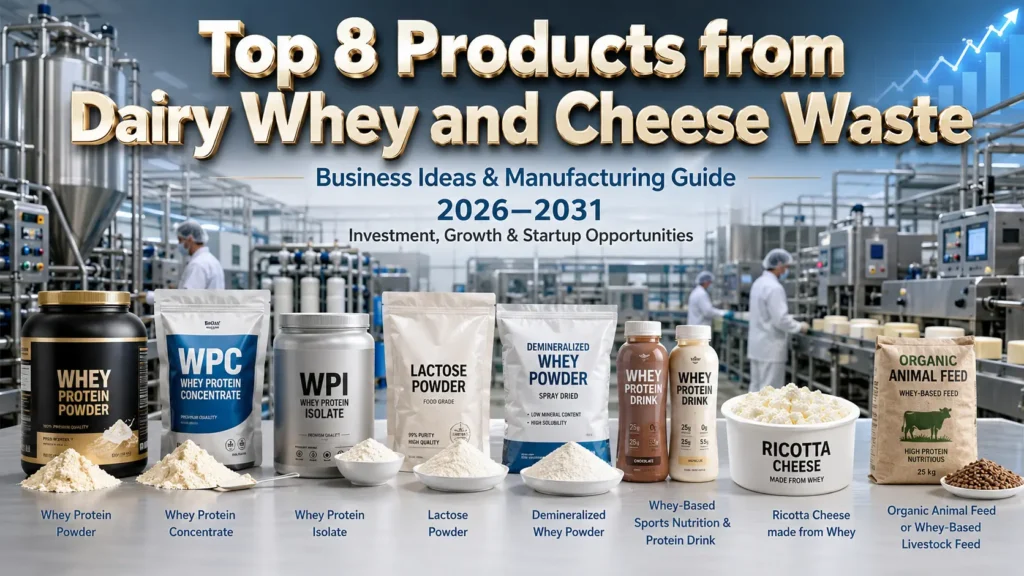
Dairy Whey Processing Business Whey — India’s Most Wasted High-Value Food Industry By-Product India is the world’s largest milk producer, with 220 million tonnes of milk being produced annually. The dairy processing industry generates huge quantities of Paneer, Cheese and Casein in the country and along with each of the above product comes a waste stream which is literally being dumped by most of the processors. The liquid end of cheese, paneer, and casein is called whey, which contains about 6.5 grams of protein (in the form of beta-lactoglobulin, alpha-lactalbumin, immunoglobulins and lactoferrin) that are among the most highly nutritious and most rapidly absorbed proteins in human nutrition. About 13-15 MT of whey is produced in India every year due to paneer, chhena and cheese production. If whey protein concentrate (WPC-80) prices are Rs. The protein content in India’s wasted whey is Rs. 400-600 per kg. 5,000 crore+ annual opportunity. The opportunity for specialised whey processing entrepreneurs who can collect, process and supply to the booming sports nutrition, infant formula and pharmaceutical market in India is created by most of the small and medium dairy processors lacking in capital and technology to recover this value. Get Detailed Insights from This Book: Milk Processing & Dairy Products in India Market Research Report The Whey Processing Chain and Entry Points The technological development of whey processing includes collection from the dairy processors (sweet whey or acid whey), pasteurisation, pre-treatment, ultrafiltration (UF) to concentrate protein, spray drying for whey protein concentrate (WPC-35, WPC-70, WPC-80) or further ion exchange chromatography for whey protein isolate (WPI-90). The protein content as well as market value increases significantly at each step. Lactose from the UF (permeate) will be a separate product stream, as lactose powder for pharmaceutical and food applications. This can be done by entrepreneurs at any stage of their business, whether they are interested in selling the semi-processed concentrate to existing driers or they would like to participate as fully-fledged companies and generate finished products for the consumer-market. Top 8 Products from Dairy Whey 1. Whey Protein Concentrate (WPC-80) WPC-80, which contains 80% protein, is the most popular sports nutrition ingredient on the world market, and the main raw ingredient in protein bars, shakes, meal replacement powders and functional foods. Currently, India sources most of its WPC-80 imports from New Zealand, Australian, Europe and the USA. Reprocessing Indian dairy whey domestically would be extremely cost competitive. The cost of a 5 MTPD WPC-80 plant (ultrafiltration + spray dryer) is around Rs. The revenue that the 5–15 crore earns is Rs. 400–600 per kg. 2. Whey Protein Isolate (WPI-90) The highest quality sports nutrition ingredient, WPI-90 is protein-rich, with 90% protein or higher and is faster digested than WPC, low in lactose, and virtually fat-free. An extra ion exchange chromatography/microfiltration step is needed for production in addition to the step required for WPC production. WPI sells at Rs. India’s sports nutrition market (estimated Rs. The value of the market (12,000crore by 2026) is expanding by 15-20 per cent per year, and it is highly import-dependent thereby offering significant opportunity for domestic manufacturing. Build a profitable business with the right idea 3. Whey Powder (Food Industry Grade) Sweet whey powder (12% protein, 70% lactose) is obtained by the simple spray drying of the concentrated whey without protein separation. It is used in bakery products, confectionery, infant formula, animal feed and processed cheese. At Rs. Whey powder is the cheapest product available but is the lowest value product with requirement of Rs. 80-150 per kg. Installing a spray dryer unit for Rs 80-200 lakh, which is an entry point for dairy processors producing whey. 4. Pharmaceutical Lactose Lactose concentration in the permeate from whey ultrafiltration is 4-5%. Crystallised and dried lactose is used in the manufacturing of pharmaceutical tablets as an excipient, in infant formula as well as confectionery and as a fermentation substrate. Lactose is sold at a price of Rs. per unit in Pharmaceutical Grade. The import prices of 150-250 per kg are high and India is importing a huge amount. The cost of a lactose crystallisation and drying unit is Rs. The market is large and import-substitutable, and they are at 2-5 crore. 5. Lactulose (Pharmaceutical Laxative) Lactulose is formed by alkaline isomerization of whey lactose. A pharmaceutical grade laxative and prebiotic for treating hepatic encephalopathy, selling more than USD 500 million world-wide each year. Currently, India depends on the imports of lactulose from Europe. A lactulose synthesis unit (Rs.) The market potential of 3-6 crore for converting lactose from whey into the pharmaceutical product is a very high margin specialty chemical opportunity with good import substitution potential. 6. Whey-Based Animal and Aquafeed Liquid whey can be spray dryed into whey-enriched animal feed pellets without protein concentration for poultry, swine and aquaculture. A fishmeal replacement ingredient which has been shown to improve fish growth. Due to the trend towards dairy and plant protein-based fishmeal alternatives, whey-based aquafeed is becoming an increasing share of the market. Investment: Rs. For blending and pelletising Rs 20-60 lakh. 7. Lactic Acid from Whey Permeate Whey permeates, containing abundant lactose, can be subsequently fermented by Lactobacillus species to yield lactic acid, which can be used in bioplastic (PLA) production, food acidulants, personal care products and pharmaceuticals. The price of lactic acid is Rs. 80–150 per kg. The price of a 100L whey fermentation and lactic acid recovery unit is Rs. 1-3 crore and is linking dairy waste processing to the rapidly expanding bioplastics value chain. 8. Biogas from Whey and Dairy Effluent Whey and wash water from dairy are good substrates for biogas digestion as they have very high BOD value (35,000-60,000mg/l). The effluent from dairy processing plants must be processed legally before discharge. The biogas digester helps in reducing electricity bill and energy cost in ETP compliance by using whey and dairy effluent as raw material to generate biogas as a fuel to provide energy for boilers. Dairy wastes produce biogas, which is also eligible for benefits under
India’s ₹5 Crore Food Processing Business: Gulf Export Opportunities for Manufacturers
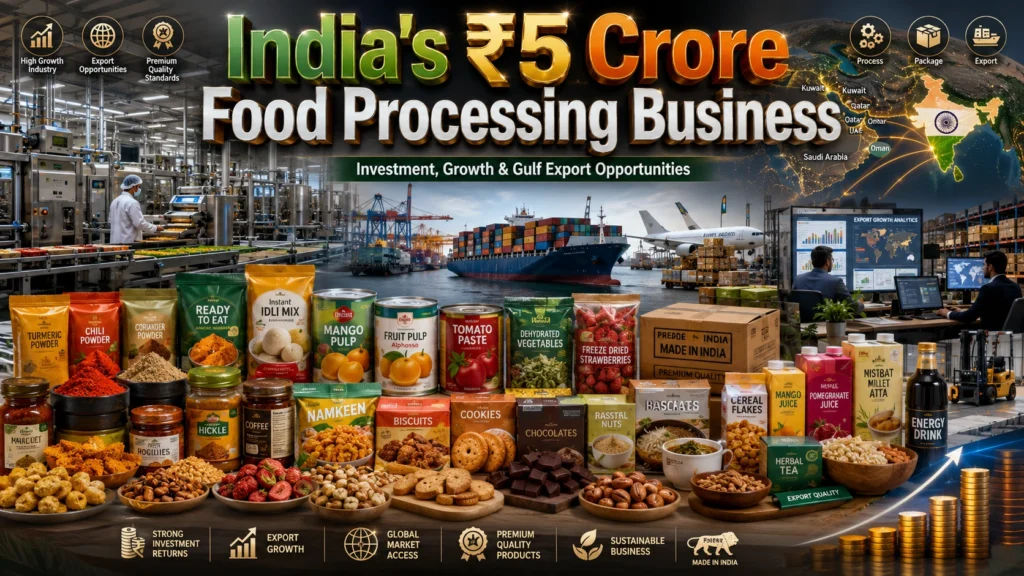
₹5 Crore Food Processing Business in India The food processing industry in India is at a turning point and for those who are thinking of entering into any serious business in manufacturing, the food processing unit with a capital investment of Rs.5 Crore for export to Gulf countries is one of the most commercially viable business ideas possible today. The Gulf Cooperation Council (GCC) countries – Saudi Arabia, UAE, Qatar, Kuwait, Oman and Bahrain – import billions of dollars in packaged and processed food each year. Geographic advantage of India along with huge population of NRIs in these countries leads to a natural demand pipeline. The Ministry of Food Processing Industries has always identified this as a priority for export and the availability of policy support in terms of capital subsidies and export promotion schemes is as easy as ever. Why the Food Processing Sector Is Booming in India India is the second largest producer of fruits and vegetables in the world but a large proportion of them is wasted because of lack of processing facility. The food processing industry is a significant contributor to manufacturing GDP of India and it is an industry which continues to attract investment from both the domestic and foreign sector. The food import needs of the Gulf countries, especially in Saudi Arabia and UAE, have increased substantially due to the huge rate of urbanization and development of the middle class. Indian processed food, including rice flour, spice blends, and ready to cook mixes, as well as frozen snacks, is always in demand in these markets. India’s agricultural exports have been continuously on the rise, with processed food playing a larger role, according to APEDA (Agricultural and Processed Food Products Export Development Authority). It’s an investment that’s also recession-proof — spending on food by consumers doesn’t slow down when the economy slows down, so consumer demand is always stable. Get Detailed Insights from This Book: Handbook on Fruits, Vegetables & Food Processing with Canning & Preservation Government Policies and Incentives for Food Processing Units Entrepreneurs are provided with several targeted schemes by the Ministry of Food Processing Industries (MoFPI). PMKSY offers capital subsidy to food processing units in clusters up to 35%. The innovative product category and organic product category are included in the Production Linked Incentive (PLI) scheme and are given incentives based on incremental sales. Further, the Credit Guarantee Trust Fund scheme of MSME Ministry has made it possible to avail collateral-free loan of Rs.2 Crore. APEDA is active in facilitating exports to the Gulf market in the following ways: Trade Fairs, Buyer-Seller Meetings, Export Certification. Food Safety and Standards Authority of India (FSSAI) has introduced fast-track licensing for export units, which can cut down the compliance timelines for the entrepreneurs. There are also electricity subsidy and provision of land in food parks by the State governments like Maharashtra, Gujarat, and Punjab. To get a detailed list of incentives available, please see the Startup India portal. Top Business Ideas in Food Processing for Gulf Exports Ready-to-Cook Indian Meal Kits and Spice Blends There are more than 8 million Indians living in the Gulf who are actively looking for real Indian flavours. Production of standardised spice mixtures, masala powder, ready to cook curry base, and meal kits can create a huge export brand with a simple investment. From Rs.5 Crore you can operate an automated blending, grinding and vacuum-packaging line, which complies with Gulf food safety certifications like GCC conformity marks and Halal certification. The two key factors in a supermarket’s success in retail shelf placement in the Gulf are consistency and packaging quality. Generally, gross margins for branded spice blends are between 35% and 50%, and hence this is one of the more profitable categories in the food processing industry. For direct buyer connect opportunities, APEDA’s export promotion programmes are for the benefit of entrepreneurs. Rice Flour, Semolina, and Milled Grain Products Domestic ag capacity is very low due to the arid conditions in the Gulf region which makes them very dependent on import of grains and milled products. This can be met by processing of rice and wheat in India which are available at competitive prices. A milling unit handling a capacity of Rs.5 Crore can mill the paddy or wheat to get refined flour, semolina, rice flour, beaten rice, and value-added grain products. Grain-based products are relatively easy to certify for the Halal markets in the Gulf (notably for the fact that this certification does not impose any extra compliance cost). Shelf life of 12 to 18 months can be obtained with good cold chain and moisture-controlled packaging, which meets the retail distribution cycles in the Gulf. Entrepreneurs should visit DGFT (Directorate General of Foreign Trade) for export documents and for IEC code registration. Your investment deserves the right opportunity Frozen Snacks and Traditional Indian Namkeen for the Gulf Retail Market One of the fastest-growing product line in the Gulf supermarkets is frozen food and packaged snacks. Indian namkeen, frozen samosa, frozen paratha and ethnic snack products have each a separate section in the Lulu Hypermarket, Carrefour and Spinneys in the Gulf. There is an investment requirement for the purchase of industrial fryers/ovens, individual quick-freezing equipment and cold storage packaging lines for setting up a frozen food processing unit at Rs.5 Crore. The unit should be HACCP standards and export-controlled temperatures. Many other Indian companies such as Haldirams, MTR Foods have proven this export model at large scale and enough opportunities are there for regional brands to establish niche positions. Import-Export Opportunity Analysis India has been steadily increasing its food and processed food exports to the Gulf region and bilateral agreements have ensured that most of the food categories have relatively low tariff. The APEDA data also reflects that rice, spices, processed vegetables and ready-to-eat products are the key commodities for India’s food export to the GCC. The UAE is also a re-exportation hub; if an Indian exporter sets up distribution in the UAE, then it is relatively easy to
How to Start a Spice Export Business in India: APEDA, Spices Board & Investment Guide
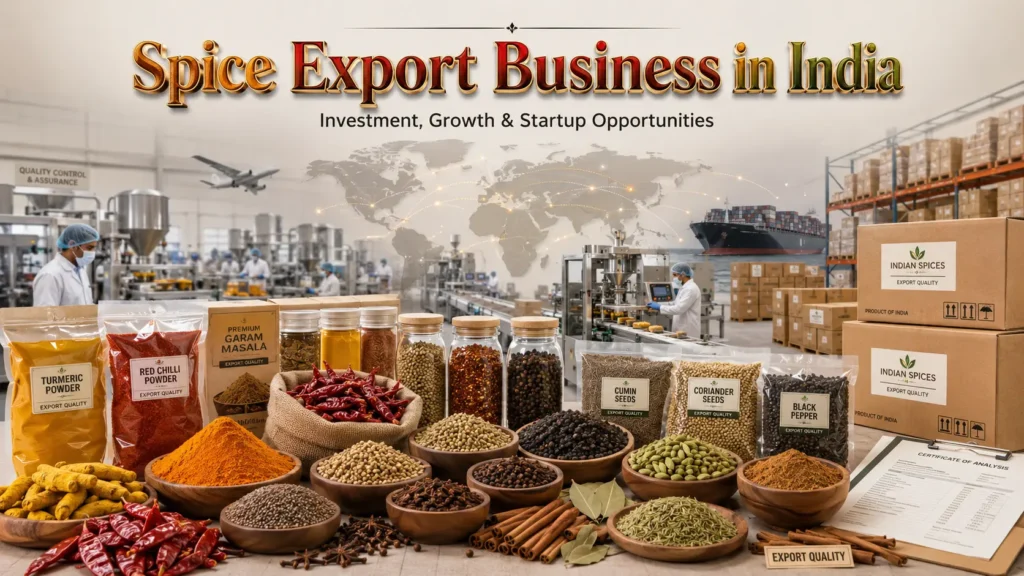
Spice Export Business in India The spice industry is a unique one in the Indian food culture and is an industry which, for the aspiring entrepreneurs with serious business ideas in the agricultural exports, has a significant opportunity both in terms of heritage and a present-day business opportunity of Rs.20 Crore Spice Exports Business. The Ministry of Commerce has established the Spices Board of India to oversee the entire spice export development ecosystem and provides subsidies on spice processing infrastructure, quality testing equipment and organic certification expenses. India is the world’s biggest producer, consumer and exporter of spices. However, the benefit that the Indian exporters are able to reap is limited to bulk commodity exports and not on premium branded exports, which can be tapped by organised entrepreneurs having appropriate processing and certification facilities. Why India’s Spice Export Sector Is a Global Opportunity The demand for genuine Indian spices has been rising worldwide, especially in North America, Europe and the Gulf, where ethnic cuisine has become increasingly popular — and so has the demand for authentic Indian spices in the organic, premium, and culinary specialty categories. Spices Board of India keeps a close watch on export statistics that have been showing positive double-digit growth in value added spices export. The European Union’s food safety standards have made buyers prefer certified Indian exporters who can certify pesticide residue compliance, creating a quality barrier in favour of organised Indian exporters as compared to unorganised traders. In the west, the functional food trend has made turmeric, ginger and black pepper superfood status, forming new food segments beyond traditional food buyers. Read the Complete Book Here: Handbook on Spices Government Schemes Supporting Spice Export The Spices Board of India (SBI) offers subsidies for the installation of spice processing infrastructure, quality testing equipment, and costs of organic certification. APEDA organises buyer-seller meets, export pavilions at international trade fairs and market intelligence reports of particular country requirements for the export of spices. Ministry of Commerce has given a framework for the export of value-added spice products under the name of Agriculture Export Policy with the identification of agri-export zones in the spice producing states. There is farm level support in the form of spice boards from Kerala, Karnataka and Andhra Pradesh states. DGFT’s RoDTEP scheme will help exporters get back domestic taxes which are hidden in export goods, making them more competitive in the international markets. Top Business Ideas in Spice Export at Rs.20 Crore Scale Certified Organic Spice Processing and Export Organic certified spices (such as turmeric, chilli, cumin, coriander, ginger and cardamom) sell at a premium of 50-200% in markets in Europe and North America. A Rs.20 Crore organic spice processing industry is using farmer network aggregation and advanced processing technologies such as steam sterilisation, colour sorting, grinding and blending along with certified organic cultivation. The organic promotion scheme by the Spices Board gives partial refund on the certification cost. NPOP and EU Organic certification are the main export certifications, apply through an APEDA accredited certification body. Steam Sterilised Spice Powder for Retail Export The technology investment for Indian spice exporters to comply with the European and American food safety standards on microbial limits is steam sterilisation (microbial elimination) of spice powders. A state-of-the-art Rs.20 Crore plant equipped with modern steam sterilisation technology and extensive quality testing, can deliver high quality spice powders that comply with the most rigorous import standards. FSSAI lays down the standards for spice quality and the Spices Board offers technical assistance to the processors aiming at upgrading to the steam sterilisation technology. Access Complete Business Plan: Curcumin Manufacturing, Extraction & Turmeric Processing Value-Added Spice Products: Cooking Pastes, Blends, and Extracts Moving beyond raw and powdered spice to value added products (oleoresins and essential oils) in flavour and fragrance industries captures much more value in the same raw materials. The price of spice oleoresins and essential oils is much higher than the price of food-grade spice powder in an industrial level. A solvent extraction/steam distillation technology is available to an entrepreneur for spice oils and oleoresins at Rs.20 Crore. The Spices Board has a list of oleoresin exporters, and it also supplies information on the world markets for spice extracts. Import-Export Opportunity Analysis India ships spices to more than 180 countries and the largest buyers are USA, China, Vietnam, Bangladesh and UAE. Export data is published by Spices Board of India on an annual basis, based on the product and country exported. The EU’s market need for organic spices, especially as part of the EU Farm to Fork Strategy, is a long-term positive trend for Indian exporters. In fact, regulatory environment is propping the quality-oriented Indian exporters as they are reducing the competition from the unorganised players in the market due to the updates of MRLs by EU. Early Registration with APEDA and Spices Board for export promotion benefits. Indian MSME Success Stories in Spice Export MDH Spices: Building India’s Most Recognised Spice Brand Established by Dharampal Gulati in Delhi, MDH (Mahashian Di Hatti) started as a small spice shop in Old Delhi and is one of the most popular spice brands in India today, both nationally and internationally. They had an international distribution network established in the UK, USA and Canada, with their own grocery stores from the Indian people, which provided an international income stream without an export setup. MDH illustrates how brand consistency – same taste, same packaging – every time is the key to a spice export business that stands the test of time. Related Article: MDH Masala Story: How Dharampal Gulati Built a Spice Empire Synthite Industrial Chemicals: Spice Extracts Export Pioneer Synthite Industrial Chemicals, Kerala, is one of the world’s biggest manufacturers of oleoresins and essential oils of spices and exports to the flavour houses of USA, Europe and Japan. The Company’s competitive edge was created through its perpetual investments in extraction technology and direct technical relationships with international flavour and fragrance firms, led by K.V. Jose. The success of Synthite has proven
Dairy Processing Business in India: Complete Investment & Profit Guide
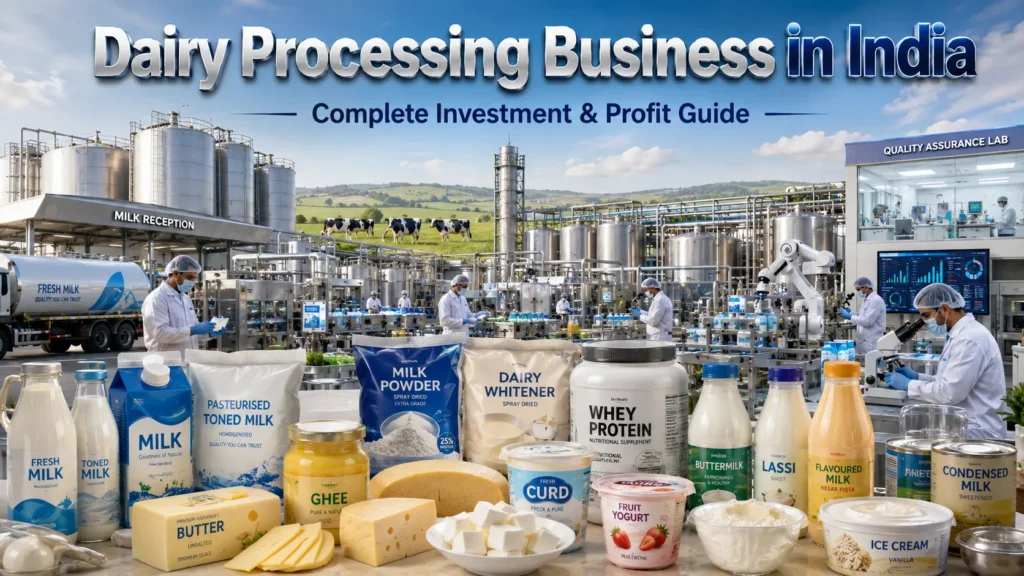
Dairy Processing Business in India The dairy sector is one of the most structurally sound sectors to invest entrepreneurial capital in India and the ideas for a dairy processing business at the investment level of Rs.10 Crore are some of the most interesting ones in the agricultural value chain. Despite being the biggest milk producer in the world as mentioned by the National Dairy Development Board (NDDB) the value addition chain from the farm gate to the end consumer is far from developed. The ideal location in this supply chain is a Rs.10 Crore raw milk processing plant, which maximizes the share of the consumer price, while simultaneously adding value to the raw milk producers. The Ministry of Animal Husbandry, Dairying and Fisheries (DAHD) has various subsidy and loan schemes in place for this investment category. Why Dairy Processing Is India’s Most Stable Agricultural Business Population growth, increasing income levels, and penetration of packaged dairy products in the urban markets are the major drivers of demand of dairy in India. The NDDB releases production and consumption statistics every year, which reveal that the organised dairy sector has been expanding at a much higher rate than production of raw milk, suggesting that value addition is the area that might offer the economy an additional economic opportunity. The rising middle-class in the city has resulted in a huge boom in paneer, yoghurt and cheese consumption. High margin product categories are created due to the premium ghee, especially the A2 ghee. All of these trend changes are driving demand for dairy process capacity which organised private entrepreneurs can cater to along with the cooperative giants like Amul and Mother Dairy. Read the Complete Book Here: Market Research Report on Milk Processing & Dairy Products in India Government Schemes for Dairy Processing Entrepreneurs Dairy Processing and Infrastructure Development Fund (DIDF) is a fund under the Ministry of Animal Husbandry, Dairying and Fisheries for provision of concessional loans at 6.5% per annum for the setting up of dairy processing infra. Private dairy entrepreneurs are eligible to avail capital subsidy up to 25% from NABARD under Dairy Entrepreneurship Development Scheme (DEDS). The Animal Husbandry Infrastructure Development Fund (AHIDF) provides a Rs.15,000 Crore loan at subsidised rates to dairy processors and cold chain investors. Units qualified as international Halal and cold chain standards are facilitated by APEDA for making dairy exports. To apply for FSSAI license for giving Dairy product for export markets, please refer to the FSSAI’s central licensing portal. Top Business Ideas in Dairy Processing at Rs.10 Crore Scale Paneer and Fresh Dairy Products for Organised Retail The fresh paneer has become one of the most popular consumables in India because of the number of vegetarians in urban households and the boom in Indian cuisine in restaurants. A modern paneer manufacturing unit at Rs.10 Crore with capacity of 20,000 to 40,000 litres of milk per day can provide the FMCG retailers such as D-Mart, Reliance Fresh, Spencer’s Retail etc. Defensible Differentiation is achieved by building a recognized regional brand, highlighting QR code traceability and natural ingredients. Exporters have to meet the standards laid down by the FSSAI for the labelling and quality of paneer. Ghee Manufacturing for Domestic Premium and Export Markets Premium ghee, which is made from desi cow breeds A2 variety, bilona-churned ghee and organic certified ghee, has increased by a huge fold with urban consumers willing to pay a steep premium for genuine production. Indian brand ghee is in good demand in the Gulf Indian diaspora market. A2 ghee fetches a premium in retail channels of Rs.1500 to Rs.3000 per kg. The main requirements for the ghee export to Gulf are its halal certification and APEDA registration. The technical assistance is offered to the small dairy processors to upgrade their quality management and processing system by the NDDB. Flavoured Milk and Probiotic Dairy Beverage Manufacturing Flavoured milk and probiotic dairy beverages are expanding at a rate of 20-25% per year. The volume of mango lassi, chocolate milk and probiotic yoghurt drinks that are sold in Tetra Pak or PET bottles is on the rise in today’s modern retail and vending outlets. Packaged dairy beverages are big volume purchases for institutional outlets such as schools and hospitals. In addition to the subsidies for the dairy manufacturers, the DAHD’s dairy development schemes also cover dairy beverage manufacturers who meet the criteria of the AHIDF. Get Detailed Project Report (DPR): Comprehensive Guide to Milk & Dairy Products Import-Export Opportunity Analysis Ghee, paneer and milk powder are exported to the markets of the Gulf countries, South East Asia, and the global diaspora. Indian Dairy market is well established in the Gulf. APEDA supports export of dairy products. For exports to the Gulf, it must be certified as Halal. Full compliance audit and listing of estates based on the EU standard for dairy products is required for export — handled via FSSAI’s export establishment certification programme. Indian MSME Success Stories in Dairy Processing Parag Milk Foods: Building a National Dairy Brand from Manchar The Bhosale family owner, at Manchar, Maharashtra, established one of the most innovative private dairy companies in India with the Pride of Cows premium milk brand and India’s first mozzarella cheese plant. The company’s commitment to product innovation, for instance, in the cheese category, where there was no Indian brand, meant that it had the opportunity to penetrate an emerging market before the category became competitive. Hatsun Agro Products: South India’s Dairy Champion South India’s biggest private sector dairy company was developed by RG Chandramogan of Hatsun Agro Products in TamilNadu. They have two ice cream brands, Arun, and two dairy brands, Hatsun, which have high recognition value among consumers thanks to the decades of investments made in both product quality and distribution. Hatsun proves that to be successful in dairy processing, one needs to invest heavily in milk procurement from the upstream and delivery capability from the downstream. How NPCS Can Help You Get Started At Niir Project Consultancy Services (NPCS), the
6 Profitable Food Processing Business Ideas in India with Low Investment (Complete Startup Guide)
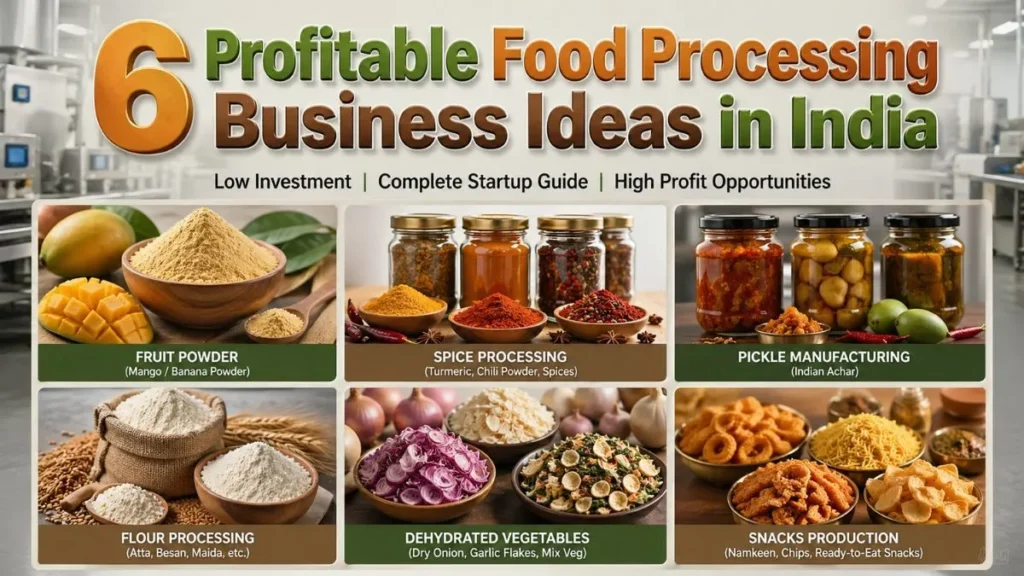
food processing business ideas in India India is a leading agricultural economy. It is home to vast production of fruits, vegetables, grains and dairy products. But much of it goes unprocessed or is wasted because of the lack of processing infrastructure. Indian entrepreneurs find their business opportunities at this location. People now prefer processed food products according to the recent market trend. Consumers want products that are convenient, have a longer shelf life and are pre-cooked. Urban areas experience increasing demand for processed food products because of growing urbanization and rising health-consciousness and food delivery application usage. As a result, the food processing industry is one of the fastest-growing industries in India. This is a secure, profitable and sustainable industry for both seasoned and aspirational entrepreneurs. Why Food Processing Is a Smart Business The food processing industry is seen as a safe investment because food is an essential commodity. Food processing exists as a continuous operation because demand for its products remains constant throughout the entire year. This makes it an ideal industry for investment. A key driver for growth is government policies. India’s government has launched a number of schemes to support small and medium enterprises. These schemes provide financial assistance through subsidies and loan services which help businesses reduce their initial financial burdens. The most beneficial schemes are: PMEGP Scheme (subsidy up to 35%) MUDRA Loan Scheme (up to ₹10 lakh loan) CGTMSE Credit Guarantee Scheme PMKSY Food Processing Scheme Startup India Program These schemes have allowed many small businesses to be established and flourish in India. Best Food Processing Business Ideas with High Profit Potential The first step while starting a manufacturing business is to select the right business idea. Here are some of the best profitable food processing business ideas for India. 1. Moringa Powder and Capsule Manufacturing Moringa qualifies as a superfood because it contains high amounts of nutrients and antioxidants. The health supplement market has expanded throughout recent years which creates a profitable business opportunity. The business requires no complicated processes to start because all necessary materials are easy to obtain. The final product also has a long shelf life, which results in decreased product loss. Investment: ₹5-10 lakh Profit Margin: 25% to 35% Access Complete Business Plan: Moringa Oleifera Powder. Formulation and Processing of Moringa Oleifera 2. Potato Chips and Namkeen Manufacturing Namkeen manufacturing is one of the most popular food businesses in India. Potato chips, banana chips and namkeens are consumed by people from all age groups every day. Local manufacturers can be successful against big players with better taste, quality and cost. This is a low-investment, high-demand and high-turnover business. Investment Required: ₹40 – 60 lakh Profit Margin: 18% to 25% 3. Honey Processing and Packaging Honey is used in homes, restaurants and health care products. There is growing interest in natural and organic products, which has led to a rise in demand for pure honey. An entrepreneur can get raw honey from beekeepers and pasteurise and bottle it for sale. The business can be scaled up from a small operation. Investment: ₹7-12 lakh Profit Margin: 20% to 30% 4. Dairy Processing Business Indians consider paneer (cottage cheese), ghee (clarified butter), butter, and flavoured milk to be essential dairy products. Urban residents show increasing interest in packaged dairy products because of the growing trend of urbanization. The industry must implement hygienic practices and quality control measures but it operates as a profitable business which maintains strong customer loyalty. Investment Required: ₹25 lakh to ₹1 crore Profit Margin: 18% to 24% Related Article: How to Start a Dairy Processing Plant in India | Investment, Costs & Profit Guide 5. Spice Processing and Packaging India ranks as the top spice producer while the demand for packaged spices keeps increasing both domestically and in international markets. The process includes purchasing raw spices and grinding them into finished products which will bear the company’s brand name. This business operates as a perfect fit for small and medium-sized enterprises because the company needs only basic materials and the production process is straightforward. Investment: ₹10 lakh to ₹20 lakh Profit Margin: 20% to 30% 6. Frozen Food Processing Business Frozen food is increasingly becoming more popular in cities due to its convenience and time-saving nature. Frozen vegetables, instant foods and frozen meat are currently in great demand. While the initial investment required for this business is higher than small-scale enterprises, it has great export potential and growth opportunities. Investment Required: ₹50 lakh to ₹2 crore Profit Margin: 20% to 28% Read the Complete Book Here: Handbook on Fruits, Vegetables & Food Processing with Canning & Preservation (3rd Edition) Steps to Start a Food Processing Business The establishment of a food processing enterprise requires proper execution of specific critical actions. The implementation of a structured methodology will enable organizations to decrease their operational hazards while achieving their desired business results. The process of starting a business usually requires execution of four essential components which include business planning, company registration, obtaining financial resources and establishing operational systems. Key steps to start: Choose a profitable product in demand Create a business plan Register and get licenses Secure finance from banks and various schemes Buy equipment and begin manufacturing Small-scale food processing operations achieve their first operational stage within two to four months after executing these particular tasks. Licenses Required for Food Processing Business in India The business owner must obtain necessary permits and official documents before starting the business operations. The licenses guarantee food safety, legality and consumer confidence. The most important licenses include: FSSAI License (required for all food businesses) GST Registration Udyam Registration (MSME registration) Trade License from local authority Some businesses require additional permits which include factory license and pollution control license and other licenses for their operations. Investment and Profit Potential in Food Processing The investment requirements of a business depend on its operational activities and the size of its operations. Businesses require minimum financial resources for establishment, while industrial facilities demand substantial capital investment
One District One Product (ODOP): New Startup Ideas Backed by Government Support
The One District One Product (ODOP) initiative is transforming India’s grassroots economy by advancing a product from each district with the aim of driving economic development, generating employment opportunities, and fostering local entrepreneurship. Under the Pradhan Mantri Formalization of Micro Food Processing Enterprises (PMFME) Scheme by the Ministry of Food Processing Industries (MoFPI), ODOP serves to further India’s goal of self-sufficiency articulated by “Atmanirbhar Bharat.” For many startups and entrepreneurs, ODOP functions as more than a scheme—it serves as a launchpad. It offers localized assistance, infrastructure opportunities, finances and economic incentives, and branding. This article delves into the entrepreneurial opportunities available within the ODOP framework and discusses future trends, government policies, and viable business models. Why ODOP is Ideal for New Startups Concentrated Product Development: Each district has a specific product they specialize in which greatly simplifies brand association as well as supply chain sourcing. Government Backing: The PMFME scheme offers grants for training, as well as credit linked subsidies. Entrepreneurship Clusters: ODOP promotes collaborative entrepreneurial engagement within agro-processing to excel above entry barriers. International Markets: Many ODOP products have GI tags or are in high demand overseas, giving startups international growth opportunities. Related: Why Now Is the Best Time to Launch a Food Startup in India ODOP Coverage and Reach According to the MoFPI Annual Report 2023–24, ODOP has: 713 districts 137 unique products identified 92,549 micro enterprises formalized under PMFME Over 1 lakh SHG members receiving support Examples of ODOP Products Mango – Malihabad, UP Turmeric – Erode, TN Walnut – Budgam, J&K Chilli – Guntur, AP Market Trends and Growth Potential India’s food processing sector is expected to grow from USD 407 billion in 2023 to USD 535 billion by 2027, at a CAGR of 6.5%. The growth of ODOP-linked spices, millets, fruits, and dairy products is expected to drive this growth. Segmented Growth Forecast Sector CAGR (2023–27) Key Driver Processed Fruits & Vegetables 7.2% Urban demand, ODOP clusters Spices & Turmeric 10%+ Export demand, wellness trend Frozen & RTE ODOP Foods 12.5% Convenience trend Dairy & Millet-based Products 9.1% Health awareness, ODOP linkage Related: Building A Successful Integrated Business MoFPI Statistics (2023–24) Contribution to GDP Year GVA – Food Processing (? Lakh Cr.) Share of Manufacturing (%) 2018-19 2.36 10.13% 2022-23 1.92 7.66% Employment Registered Units: 20.68 lakh workers Unregistered Units: 51.11 lakh workers Women Workers (Informal): Over 12 lakh Processed Food Exports Year Value (US$ Billion) Share in Agri Exports 2022-23 13.08 25.6% 2023-24 10.88 23.4% Government Schemes Fueling ODOP Startups PMFME Scheme – ?10,000 Cr allocation; 35% capital subsidy for individual entrepreneurs, self-help groups (SHGs), and farmer producer organizations (FPOs). PMKSY Scheme – Support for Mega Food Parks, Cold Chains, and Agro-processing clusters. PLI Scheme for Food Processing – ?10,900 Cr incentives to expand processing and global branding. Startup Opportunities Linked to ODOP Regional Processing Units – Establishment of micro-units for ODOP products such as mango pulp, turmeric powder, or chili flakes. Cold Chain Logistics – Development of storage and transportation for perishables such as litchis and fish. Organic/GI-tagged Products – Creation of brands focused on export markets for ODOP items registered under geographical indications (GI). Millet-Based Startups – Use the International Year of Millets and ODOP initiatives to create snacks, flour, and millet-based cereals. E-commerce Aggregators – Set up marketplaces that exclusively sell products branded under ODOP. For more information check our related videos on Food Processing Challenges for Entrepreneurs Challenge Mitigation Strategy Lack Awareness of Schemes Training under PMFME; NGO and SLTI-led outreach campaigns FSSAI and GST Compliance Center Subsidy for Incubation Facilities Inadequate Infrastructure Common use of facilities through Mega Food Parks or Self Help Groups While these challenges exist, with proper backing, there is an overall positive risk-to-reward balance for startups leveraging ODOP. Role of NPCS in ODOP-linked Business Development Niir Project Consultancy Services (NPCS) has a critical role to aid the ventures based on ODOP by providing: ODOP-based market survey cum detailed techno-economic feasibility studies Manufacturing processes and financials, raw materials, plant layout, and process documentation Comprehensive ODOP guidance and new business or industrial set-up feasibility appraisals NPCS supports food entrepreneurs to align their business models to the goals of ODOP ensuring they are scalable and profitable. Conclusion: Your District, Your Brand The ODOP initiative aims to foster an ecosystem where local entrepreneurs are empowered to establish global brands. With access to raw materials, government policies, training opportunities, and growing consumer interest, along with subsidized frameworks, increase the chances for startups to thrive. Startups that align with ODOP gain access to local level assets and recognition in the entire country. With the support of NPCS and MoFPI, a small food idea today can become a flagship business tomorrow. The time to act is now. And ODOP is the launchpad. Which business to start? How to choose a business idea?
Building A Successful Integrated Business: Soya Nuggets, Tea Packaging, Turmeric Grinding & Packaging, Jam | Starting A Multi-Product Processing Facility
The Integrated Unit, a versatile facility, combines the production and packaging processes for many different food items. It comprises the production of jam, tea packaging, turmeric storage and grinding, and soy nugget production. The unit aims to increase efficiency and streamline operations by bringing various functions under one roof. It ensures that these different food products are successfully produced, processed, and packaged while also satisfying a variety of consumer needs. The operation uses resources efficiently and handles logistics while producing and packaging soya nuggets, tea, turmeric, and jam. The unit promotes convenience and lowers costs by merging diverse processes. Applications and Uses Soy nuggets are a popular meat substitute in vegetarian and vegan diets because they are a flexible food element that is high in protein. They can be used in a range of cuisines, including salads, stir-fries, and curries, as a wholesome and nourishing replacement. Tea packaging is crucial for keeping tea leaves flavourful and fresh, giving customers a satisfying experience. By protecting the tea from moisture, light, and air, it helps to maintain the quality and aroma of the beverage. After being transformed from raw turmeric roots into a fine powder, turmeric is carefully packaged to maintain its vibrant colour and significant therapeutic properties. Turmeric is commonly used in cooking and as a natural food colouring due to its many health benefits. Jam is a sweet and fruity spread with a thick and gooey consistency made by boiling fruits with sugar and pectin. It gives bread, pastries, and desserts—which are frequently eaten—a delicious flavour explosion. Jams come in a range of fruit tastes, making them a versatile and enjoyable addition to breakfast and snacks. Production Process The integrated unit’s manufacturing process involves several steps and results in a variety of products. Soy nuggets are made by first cleaning and dehulling the soybeans, then grinding and heating the dehulled soybeans. The cooked soybean-extruded nuggets are then dried and packaged. Additionally, tea leaves are selected, dried, and prepared for packaging. The processed, sorted tea leaves are then put in tea bags or packets with loose-leaf tea. Similar steps are taken to gather, clean, and dry turmeric roots before they are powdered and packaged. After being ground into a fine powder, the dried turmeric roots are packaged. Finally, fruits are selected, prepped, and peeled for jam production. After the peeled fruits are blended with sugar and other ingredients, the cooked jam is then placed into jars or bottles. Quality control procedures make sure that every product meets the requirements before final packaging and shipping. Read Similar Article: FOOD PROCESSING The advantages of opening an integrated unit for the production of jam, soy nuggets, tea, and turmeric include: Starting an integrated business for the production of jam, soy nuggets, tea, and turmeric has a number of benefits. Resources are employed more efficiently, and the production process is streamlined, which lowers costs and increases profitability. Additionally, it provides a range of goods, attracting a wider clientele and optimising market potential. It is also simpler to cross-promote and upsell when different product lines are combined, which increases revenue and brand recognition. By maintaining uniform standards across the board, such a unit also makes it possible to control quality assurance more efficiently. Finally, it promotes sustainability by reducing waste generated while packaging and shipping, making the process more environmentally friendly and green. Market Prospects The outlook for the markets for soy nuggets, tea packaging, turmeric grinding and packaging, and jam is affected by broader socioeconomic trends. As people grow more conscious of the environmental effects of animal husbandry, which is in line with the surge in popularity of eco-friendly and sustainable food options, the demand for plant-based protein substitutes like Soya Nugget has increased. Due to the increasing demand for speciality teas and the cultural significance of drinking tea in various regions of the world, the market for tea packaging is steady and has room to expand. Additionally, the growing emphasis on natural treatments and holistic well-being is driving demand for turmeric grinding and packaging because of the spice’s well-known anti-inflammatory and antioxidant benefits. As customers seek products that improve general health and well-being, the demand for products containing turmeric is growing. Customers prefer real, handcrafted, local goods for their quality, freshness, and support of local producers. Furthermore, technological advancements and improvements in packaging methods have a substantial impact on these organisations market forecasts. Contact Us
Potato Chips and Snack Food Setup Manufacturing Business
The Snack Food Setup Manufacturing Business stands as a lucrative venture in the fast-evolving food industry. Snacks such as potato chips and extruded products like Kurkure have immense popularity across urban and rural markets. The rising demand for ready-to-eat, tasty, and convenient snacks fuels this industry’s growth. This article offers a comprehensive overview of product types, manufacturing processes, market outlook, investment benefits, costs, marketing strategies, risks, and practical advice for starting your own snack manufacturing unit. Understanding the Products Potato chips are thinly sliced potatoes, either fried or baked until they become crispy and crunchy. Consumers appreciate their texture and flavorful coatings, which make them a favorite snack worldwide. Extruded snacks, such as Kurkure, differ in manufacturing and ingredients. These snacks consist of a mix of starches—typically wheat, corn, rice, and gram flour. The dough is cooked under high temperatures using an extruder, which shapes it into unique forms. After frying, the snacks are coated with various seasonings to enhance flavor and appeal. Kurkure-style snacks stand out for their crunchiness, unique shapes, and spicy, savory flavors. These factors allow manufacturers to appeal to diverse consumer groups and expand their market base effectively. Visit this Page for More Information: Start a Business in Potato Processing Industry Manufacturing Process Starting production begins with sourcing high-quality raw materials. Fresh potatoes and premium edible oil form the basis for potato chips. For extruded snacks, procuring good-quality flours and spices is crucial. Next, you invest in machinery such as potato slicers, fryers, extruders, conveyors, seasoning equipment, and packaging machines. The production scale determines if cold storage facilities are necessary. The production process for potato chips involves uniform slicing of potatoes, followed by frying or baking until crisp. Seasonings get applied afterward to achieve the desired taste. For extruded snacks, the dough passes through the extruder, which cooks and shapes it simultaneously. The snacks are then fried and seasoned. Finally, the finished products undergo hygienic packaging, ready for market distribution. Quality Control Maintaining consistent quality ensures customer satisfaction and brand loyalty. Start by inspecting raw materials for freshness and quality before production. During manufacturing, monitor temperature, frying duration, and seasoning amounts precisely. After production, test samples for moisture content, oil levels, and microbial contamination regularly. Use moisture-proof, airtight packaging to preserve freshness and extend shelf life. This step prevents spoilage and helps your product stand out on store shelves. A rigorous quality control system reduces wastage, enhances product consistency, and builds trust with consumers. Related Business Plan: Start Production of Potato Chips And Extruded Snack Food (Kurkure Type) Market Outlook The snack food market, especially potato chips and extruded snacks like Kurkure, continues to grow strongly. Rising incomes, urbanization, and changing lifestyles increase consumer demand for quick, flavorful snacks. Both urban and rural populations enjoy these products, providing a broad consumer base. Smaller cities and towns offer underserved markets with less competition, presenting growth opportunities for new businesses. Additionally, consumer trends favor healthier options such as baked or low-fat snacks, encouraging manufacturers to innovate. Expanding distribution channels—from local grocery stores to large supermarkets and e-commerce platforms—helps manufacturers reach more customers and increase sales. Investment Benefits The Snack Food Setup Manufacturing Business requires a moderate initial investment, making it accessible for startups and small enterprises. Machinery costs typically range from $10,000 to $25,000, depending on capacity and automation levels. Production processes are straightforward and scalable. Entrepreneurs can start small and gradually increase output by adding shifts or equipment. The steady demand for snacks, combined with long shelf life, reduces the risk of spoilage and waste. These factors support sustained revenue generation. The business also benefits from low raw material costs, especially for potato chips, which use inexpensive ingredients like potatoes and oil. Moreover, digital marketing and e-commerce enable easy market entry and expansion into new regions or international markets. Cost Considerations Key costs include machinery, raw materials, labor, utilities, and packaging. Machinery such as fryers, extruders, and slicers represent the largest upfront expense. Raw material costs fluctuate with market supply and production volume. Potatoes, edible oil, flours, and spices form the main input expenses. Labor costs involve operators, quality control staff, and packaging personnel. Utility bills cover electricity, water, and fuel for cooking. Packaging materials must be durable, moisture-proof, and attractive to preserve product quality and entice buyers. Marketing and distribution expenses vary with strategy but are crucial for brand growth and market penetration. Careful financial management and cost control are essential to maintain profitability. Marketing and Sales Strategies Effective marketing can determine your success in this competitive sector. Develop eye-catching, branded packaging that highlights your product’s unique flavors and quality. Leverage social media platforms and digital ads to connect with younger consumers and create brand awareness. Collaborate with local retailers, supermarkets, and convenience stores to secure prominent shelf placement. Participate in food fairs, exhibitions, and trade shows to promote your brand and network with distributors. Consider listing your products on popular online marketplaces to reach customers nationwide or globally. Introducing new flavors, healthier options, or packaging sizes can attract new customers and keep existing ones interested. Read Similar Articles: POTATO CHIPS AND EXTRUDED SNACK FOOD (KURKURE TYPE) Challenges and Risk Management This business faces challenges such as raw material price fluctuations, machinery breakdowns, and shifting consumer preferences. Develop strong supplier relationships to ensure stable raw material supply and negotiate favorable prices. Schedule routine maintenance to avoid unexpected equipment failures and production delays. Stay updated with market trends and consumer feedback to adapt your products accordingly. Implement strict hygiene and quality standards to safeguard product safety and brand reputation. Building a diverse product portfolio can help spread risks and tap into emerging market segments. Read Our Book Here: Potato and Potato Products Cultivation Conclusion The Snack Food Setup Manufacturing Business offers promising growth potential and profitability. Understanding the products, investing in quality inputs and equipment, and executing strong marketing strategies are crucial for success. This business suits entrepreneurs seeking moderate startup costs, scalability, and access to a large consumer base. By focusing on innovation, consistent quality,
Food Colours, Flavours and Additives Technology Handbook (Second Edition)
Food colours, flavours and additives are substances that are used to enhance the appearance, taste, texture, and overall eating experience of food. They are commonly used in the food industry to improve shelf life, add colour and flavour, and increase safety. The book of Food Colours, Flavours and Additives Technology Handbook is particularly important in the technological world, as they can be used to create new products or improve existing ones. Food colours, flavours and additives can come from a variety of sources including plants, animals, and even synthetics. Food colours are additives that can be natural or artificial. Natural food colours come from fruits, vegetables, plants, and minerals. Manufacturers make artificial food colours from coal tar dyes or petroleum byproducts. Food flavours are another type of additive that can be natural or artificial. Natural flavours come from herbs, spices, and fruits, while chemists create artificial flavours from chemicals designed to replicate natural flavours. Finally, food processors use additives as substances added directly or indirectly to foods for preservation, processing, or to improve their flavour. These substances may include nutrients like vitamins and mineral salts; biological controls such as yeasts; preservatives such as sulfur dioxide; antioxidants; emulsifiers; acidulants; anticaking agents and thickeners like guar gum; carrier solvents such as propylene glycol alginate, a thickener derived from seaweed. Carriers also function as stabilizers, preventing oils from separating out and appearing on top of a product. – Substances that help other substances mix together smoothly -include carrier solvents such as propylene glycol alginate, a thickener derived from seaweed. Carriers also function as stabilizers, preventing oils from separating out and appearing on top of a product. The beverage segment is anticipated to be the largest in the food flavors market. Due to rising discretionary budgets among consumers, various synthetic flavors, including chocolate fruit and floral flavors, are growing in popularity in developing economies in Asia Pacific and the Middle East. The dairy, confectionery, and bread sectors are anticipated to increase significantly. The global market for food colours, flavours, and additives has been growing steadily over recent years. The food color industry has been booming for a while now as people are more conscious about what they put into their bodies. With so many flavors to choose from for different dishes, it’s just not enough anymore to make food taste good – it also has to look good. That’s where food color comes in. Not only does it make your food look more appetizing, but it also makes your cooking more fun! The book covers a wide range of topics connected to Food Colours, Flavours and Additives, as well as their manufacturing processes. It also includes contact information for machinery suppliers, as well as images of equipment and plant layout. A comprehensive reference to manufacturing and entrepreneurship in the Food Colours, Flavours and Additives products business. Food Colours, Flavours and Additives Technology Handbook is a one-stop shop for everything you need to know about the Food Colours, Flavours and Additives products manufacturing industry, which is ripe with potential for manufacturers, merchants, and entrepreneurs. This is the only comprehensive guide to commercial Food Colours, Flavours and Additives products manufacture. It provides a feast of how-to knowledge, from concept through equipment purchase. Also Read: 5 Reasons Why Market Research is Vital for Start-ups Contact Us