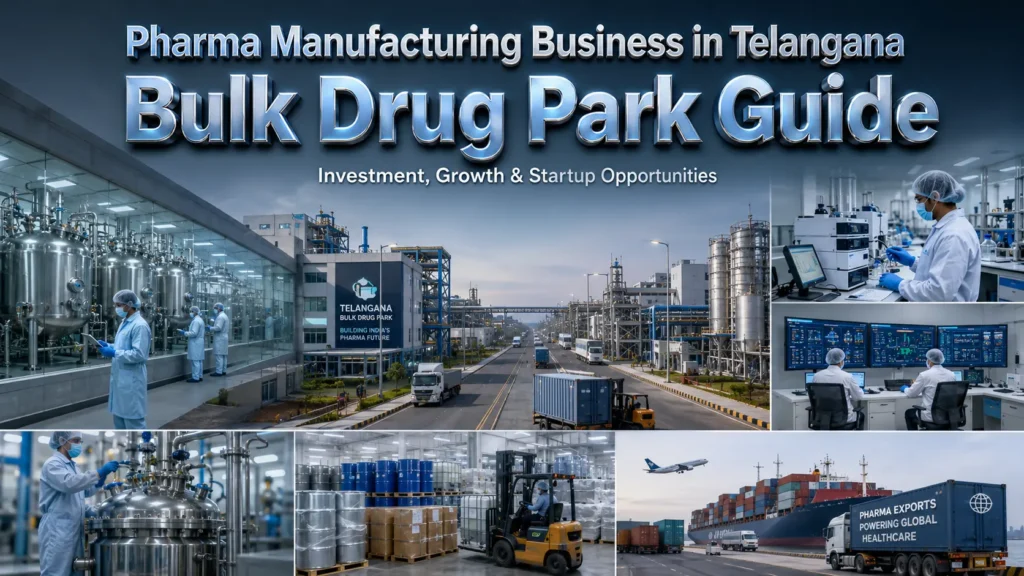

Pharma Manufacturing Business Telangana
The Hyderabad alone produces about one third of India’s output of bulk drugs and APIs, with the core of these activities being Genome Valley and a pharma manufacturing base, which has been created over 30 years. It’s actually this concentration that makes the pharma manufacturing business that the Telangana entrepreneurs think about today appear daunting from the exterior: Dr. Reddy’s, Divi’s Laboratories and Hetero already possess the cake.
But the state’s own Bulk Drug Park initiative, which has been aided by capital subsidy from the central government, has been created because the policy makers have realised that there is a room for new and specific players in the market, apart from the giants who are already working on a large scale. It is not an opportunity for a founder looking for a product for which every other unit in Hyderabad is doing business. It’s an invitation for one trouble-prone founder to focus on a single facet — one intermediate, one niche API, one contract manufacturing partnership — within a regulatory framework, a workforce, and a buyer base that other states take years to develop.
Read the Complete Book Here: Business Ideas for Startup in Drugs & Pharmaceutical Industry with Project Profiles
Why Telangana’s Pharma Cluster Is a Genuine Opening
Get started with talent density. An advantage for Hyderabad over the pharma companies that have not built their capacity with API and formulation manufacturing in the city, is that a new startup can easily find experienced process chemists, regulatory affairs personnel and quality control staff, without having to import them from across the country.
Add to this the government’s support. The special Bulk Drug Park developed with central PLI linked capital subsidy and allotted through Telangana State Industrial Infrastructure Corporation has plug and play infrastructure with shared effluent treatment specifically for API and intermediate manufacturing thereby reducing capex and approval time for the units to be located inside the park. The state’s own industrial policy with a focus on the pharmaceutical sector has another layer of capital and power tariff benefits that sit on top of central schemes implemented through the Ministry of Micro, Small and Medium Enterprises.
The basic intermediate manufacturing unit costs start around fifteen to two dozen crore rupees for two hundred to three hundred tonnes per year, while API manufacturing for regulated markets is thirty to fifty crore rupees based on stringent quality and validation regulations. It takes around 10-14 months for the Telangana State Pollution Control Board to approve licenses and the Central Drugs Standard Control Organisation for drug manufacturing to approve infrastructure, specifically Bulk Drug Park.
Business Selection Logic
The margin structure is as elsewhere in the bulk drug industry in India: commodity intermediates, which a handful of existing firms in Hyderabad produce, trade at 12 to 18% margins, while specialty intermediates or niche APIs that cater to a single innovator molecule trade at 25 to 35%.
The pharma cluster in Telangana is scalable because of the presence of well established buyers. A founder can launch with one multipurpose batch reactor, test one or two products with a local formulation company that doesn’t have to look far to find a qualified supplier, and then expand when repeat orders are received and the product has been proven to be in demand.
The same risks identified in bulk drug manufacture in the country, such as regulatory clearance timelines and buyer concentration, apply in Telangana, however, the buyer search risk that the founders of companies in less pharma-dense states face is significantly less in Telangana due to the high concentration of buyers of bulk drugs in the state.
Get Detailed Project Report (DPR): Business Opportunities in Telangana – Startup & Entrepreneurship Guide
Product and Project Opportunities Worth Evaluating
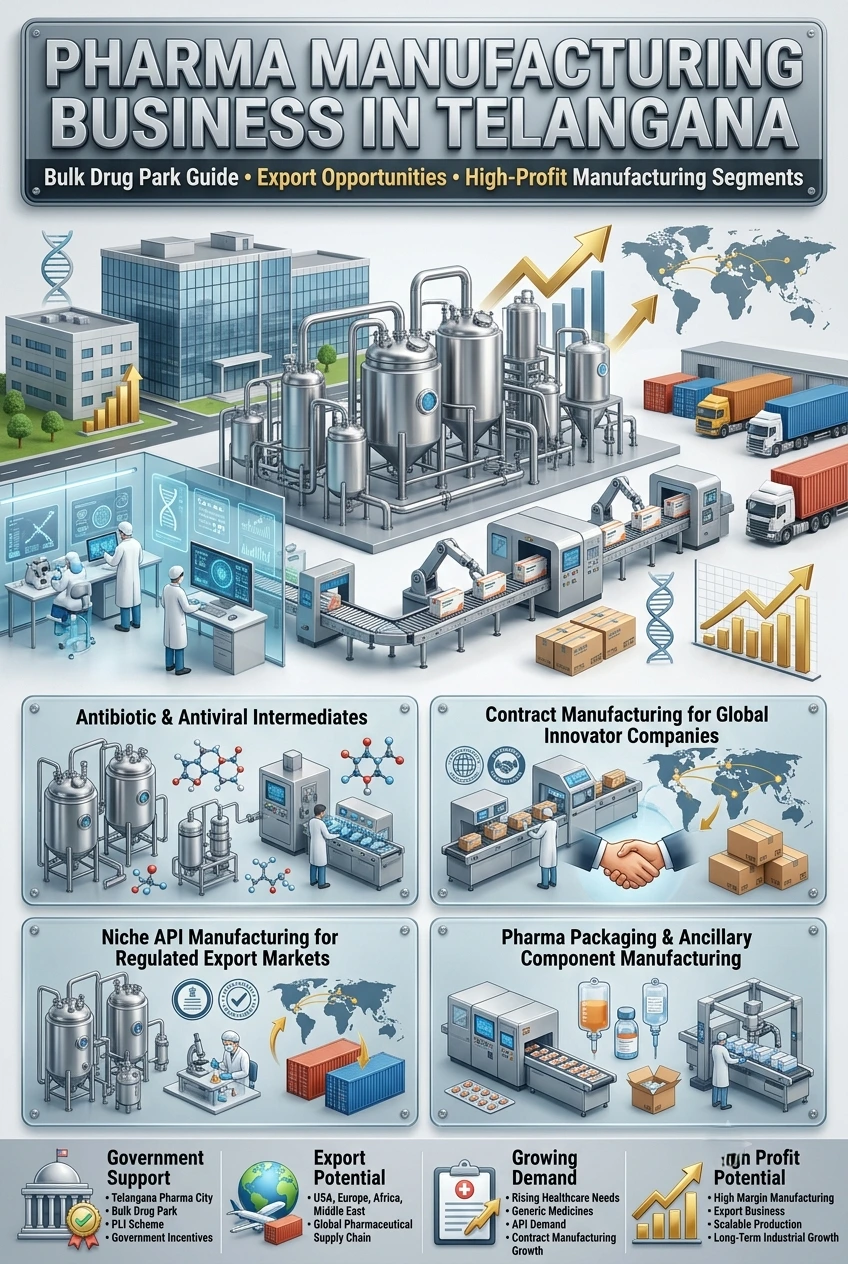
Antibacterial and antiviral intermediates are being used by Hyderabad’s formulation units all the time and also the volume of customers within the state is such that if a new intermediate manufacturer wants to find a customer, they have to look within 50 km of Hyderabad. The capex for a plant of 150-250 tonne per annum is 18-25 crore rupees. The margins range from eighteen to twenty-two percent after the quality certification process with a formulation buyer is completed, which is quicker in Telangana than states with lesser concentration of pharma buyers because of their prior understanding of the qualification of suppliers.
Contract Manufacturing for Global Innovator Companies
With its proven regulatory track record, Telangana is a logical base for the CRAMS approach of contract manufacturing, offering global innovator pharma companies to explore India as a production partner for complex intermediates. A separate unit – one with capex of 12 to 20 crore rupees – enters into multi-year supply contracts instead of looking for volumes in the spot market. The margins are 22-28 per cent and the existing standing that Hyderabad has with the regulatory authorities is a good advantage in terms of trust building for the buyer than if the founder was coming from a lesser- established pharma hub.
Niche API Manufacturing for Regulated Export Markets
The best chance for a founder to carve out a niche in the Telangana pharma market is niche APIs which are molecules with a small number of qualified global manufacturers. A dedicated facility, the capex is in the range of Rs. 30 to 40 crore, which takes into consideration quality and validation infrastructure requirements, directly targets export formulation buyers in regulated markets. Once a Drug Master File (DMF) is filed and approved, the margins are twenty-eight to thirty-five percent, but the filing of a DMF takes between twelve to twenty-four months.
Related Article: India’s ₹27,000 Crore API Import Problem Is Your Biggest Business Opportunity
Pharma Packaging and Ancillary Component Manufacturing
In addition to direct drug production, Telangana’s pharma density ensures a consistent demand for such special packaging and blister components, as well as ancillary manufacturing that every formulation and API unit in the state will need. The dedicated line requires capes expenditure of Rs 8-12 crore and has the entire Hyderabad pharma cluster as its captive buyer base. This class has margins ranging from eighteen to twenty-four percent and it’s a lower capex way for a founder to get in the pharma business with a good manufacturing and quality system know-how, even if a lack of background in chemistry.
Indian Entrepreneurs Who Built This
Murali K. Divi, working from Hyderabad, turned Divi’s Laboratories into one of India’s most valuable innovative pharmaceutical firms by targeting a small segment of the market with high purity, custom synthesized intermediates to global innovator companies, instead of commodity generic volumes. It is the ability to develop expertise in a specific process rather than a wide array of products that is the key lesson to learn for a new player in the same cluster.
Satish Reddy built Dr. Reddy’s Laboratories into a globally regulated formulation and API manufacturer by investing early in regulatory affairs capability and quality systems that met US FDA and European standards well before most Indian competitors treated that as a priority. K. Nityananda Reddy’s Hetero Drugs took a volume-focused approach instead, becoming one of the world’s largest generic API and formulation manufacturers by scaling aggressively once initial regulatory approvals were secured. The applicable lesson across all three: Telangana rewards founders who pick a clear strategic lane early, whether that is technical specialization, regulatory rigor, or scale, rather than attempting all three simultaneously.
Import-Export Opportunity Analysis
Telangana’s pharma sector already exports meaningfully to regulated markets in the United States and Europe, but India as a whole still imports a significant share of key starting materials from China, a gap that applies to Hyderabad-based manufacturers as much as anywhere else in the country.
A founder building intermediate or KSM manufacturing capacity within Telangana’s existing pharma ecosystem captures both the import-substitution opportunity domestically and export access through the state’s already-established regulatory credibility with global buyers. Export shipment and product registration for bulk drugs runs through the Directorate General of Foreign Trade, and formulation companies within the state increasingly prefer local intermediate suppliers to reduce dependency on Chinese pricing volatility, giving a new entrant a genuine domestic demand base before even considering export markets.
Government Reference and Feasibility Planning
Solvent and utility input economics for pharma manufacturing connect back to India’s broader refining and petrochemical base, a link worth tracing even within a pharma-dense state like Telangana. The Annual Report 2024-25 of Ministry of Petroleum and Natural Gas, Government of India — accessible at mopng.gov.in — documents the scale of domestic refining capacity supporting the solvent and processing chemical supply chain that every pharma manufacturing unit in Hyderabad depends on.
Founders serious about entering Telangana’s pharma cluster typically commission a Market Survey cum Detailed Techno-Economic Feasibility Report before finalizing product selection and Bulk Drug Park allocation. Niir Project Consultancy Services prepares these specifically for entrepreneurs entering pharmaceutical and industrial manufacturing, covering process flow, machinery and raw material specification, capacity planning, and full project financials — replacing assumption with a number a bank or investor can actually evaluate. The Federation of Indian Chambers of Commerce and Industry and Invest India both maintain pharma sector briefings worth cross-referencing before finalizing a Bulk Drug Park application.
Conclusion
A pharma manufacturing business Telangana entrepreneurs build today does not need to compete with Dr. Reddy’s or Divi’s directly. It needs to identify one narrow product category — an intermediate, a niche API, a packaging component — and build inside an ecosystem that already provides the workforce, regulatory infrastructure, and buyer density most other Indian states spend a decade trying to replicate.
The decision hierarchy is straightforward. Apply for Bulk Drug Park allocation early, since plug-and-play infrastructure meaningfully cuts both capex and approval timelines compared to standalone sites. Pick specialty intermediates or niche APIs over commodity products wherever technical capability allows, since the margin difference runs ten to fifteen percentage points. Budget ten to fourteen months for regulatory clearance as a fixed part of the timeline, treating it as parallel to construction rather than a delay after it.
Telangana’s pharma cluster will keep growing regardless of how crowded it looks from the outside, because global buyer diversification away from China keeps expanding the addressable market for every qualified Indian manufacturer. For a founder with genuine technical depth and the patience to clear regulatory qualification properly, a pharma manufacturing business Telangana offers one of India’s most complete, lowest-friction pharma manufacturing ecosystems today.
Discover business ideas that actually make money
Capex vs Margin Overview by Product
Source: Industry estimates; NPCS sector analysis
| Product | Capex Range | Gross Margin | Target Buyer |
| Antibiotic/Antiviral Intermediates | ₹18-25 Cr | 18-22% | Hyderabad formulation companies |
| CRAMS Contract Manufacturing | ₹12-20 Cr | 22-28% | Global innovator pharma companies |
| Niche API (Regulated Export) | ₹30-40 Cr | 28-35% | Export formulation buyers |
| Pharma Packaging/Ancillary Components | ₹8-12 Cr | 18-24% | Hyderabad pharma cluster (captive) |
Frequently Asked Questions
From a founder’s perspective — practical, decision-oriented questions:
What capex is needed for a pharma manufacturing business Telangana Bulk Drug Park allocation supports?
A basic intermediate unit can start near fifteen to twenty crore rupees, while niche API manufacturing for regulated export markets needs thirty crore rupees and above given quality and validation infrastructure requirements.
How does Bulk Drug Park allocation help a new entrant?
Plug-and-play infrastructure including shared effluent treatment cuts both capex and approval timelines meaningfully. Founders locating within the park typically clear licensing in ten to fourteen months versus longer timelines for standalone sites.
Is Telangana’s pharma sector too crowded for a new entrant?
The commodity generic layer is crowded; specialty intermediates, niche APIs, and CRAMS contract manufacturing remain genuinely open. Hyderabad’s buyer density actually reduces customer-search risk compared to less pharma-concentrated states.
How long does buyer qualification take within Telangana’s pharma cluster?
Six to nine months is typical, faster than in less pharma-dense states because local formulation buyers are already familiar with supplier qualification processes and audit requirements specific to the region.
What is the biggest advantage of building in Telangana versus another state?
Workforce depth. Three decades of pharma manufacturing history means experienced process chemists, regulatory affairs staff, and quality control personnel are available locally, removing a hiring challenge founders face in less established pharma locations.