
Bio-Based Hybrid Leather: Business Ideas, Market Opportunity, and the Green Manufacturing Revolution in India
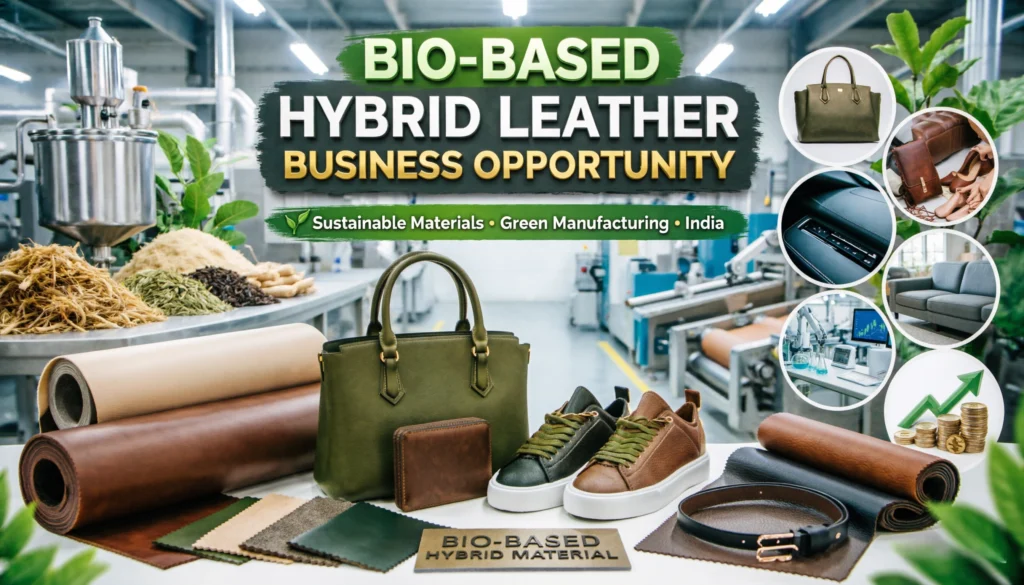
Bio based hybrid leather is one of the most promising material innovations of the last decade for a first-generation entrepreneur or MSME founder looking for business ideas that are equally sustainable and profitable. It is cruelty-free, biodegradable, and has become more cost effective to produce, all while being a demand of global brands who have pledged animal-free supply chains. India has a vast agro-waste base, a strong manufacturing base for textiles and a government that has taken an active stance to encourage green production, making it a perfect position to lead the way in this area globally. That’s an opportune moment. Bio-based hybrid leather isn’t just vegan leather. It is an advanced form of material with plant-derived fibres or bacterial cellulose or mycelium, which are mixed with bio-polymers or natural binders to create composites with mechanical characteristics and durability comparable — and in some cases superior — to animal hide. That’s the “hybrid” part that’s important: They are made using a combination of several biological sources and processing methods, which enable manufacturers to adjust the end product for different uses, such as fashion accessories, automotive interiors, and premium footwear. Check Out This Recommended Book: Leather Processing & Tanning Technology Handbook Why This Sector Is Growing Faster Than Expected The global bio-based leather market has come a long way from the experimental stage. According to several market intelligence reports, the market is growing at a CAGR of more than 13% owing to the paradigm shift in global brands’ way of thinking about material procurement. The EU Green Deal calls for the elimination of chromium tanned hides and the limiting of synthetic leathers made from high carbon.The EU Green Deal requires the removal of chromium tanned hides and the limitation of synthetic leathers made from high carbon. German, French, and Italian major fashion brands and carmakers are keen on sourcing mycelium and pineapple-fibre products. The total market of synthetic leather, which includes bio-based, PU and PVC varieties, would have reached India’s own size of approximately USD 3.3 billion in the coming decade. The Bio-based products is the highest growth segment. The brands already have some in the domestic market such as Allen Solly who has introduced PETA-approved vegan handbag collections made from bio-based apple and cactus leather, which are a strong indicator that Indian consumers are ready for this category on a large scale. Export-ready MSME leather units with bio-based leather EBITDA margins range from 18-25% after volumes are settled. That’s an interesting number for any entrepreneur who contrasts that with margins that are commonly in single digits with traditional textile production. Government Policies and Schemes Supporting This Business The overall policy framework for manufacturing bio-based hybrid leathers in India is very enabling, involving several ministries and schemes. Indian Footwear and Leather Development Programme (IFLDP) The IFLDP is a initiative of the Ministry of Commerce under DPIIT directly working on supporting the technology up-gradation in the leather ecosystem. Financial assistance in MSME units is provided at 30% of the cost of plant and machinery and for the units in Northeastern States it is available up to 40% of the cost of the plant and machinery. The Integrated Development of Leather Sector (IDLS) sub-scheme has an outlay of ₹500 crore. Start-ups using bio-polymer coating or fibre extraction equipment and investing in bio-based hybrid leather can directly benefit. All details are available on the National Single Window System portal: www.nsws.gov.in. BioE3 Policy and Make in India High-performance bio-based manufacturing is also explicitly supported under the BioE3 Policy, Department of Biotechnology. Bio-based hybrid leather (made by processing plant fibres or by growing mycelium or bacterial cellulose) is clearly within the scope of BioE3. Advanced materials are also recognized as priority sectors of manufacturing under the Make in India programme initiated by DPIIT. To avail the DPIIT recognition, founders should register on Startup India and avail income tax exemption for 3 years successive and fast track clearance from various regulatory authorities. MSME Credit and Subsidy Support The Ministry of MSME offers loans under the Prime Minister’s Employment Generation Programme (PMEGP) for the first-generation manufacturing entrepreneurs with subsidy. New founders’ main hurdle is eliminated when they can borrow through collateral-free lending by CGTMSE. The Council for Leather Exports is also a valuable source of export facilitation support and market intelligence on international buyer requirements for entrepreneurs. View Full Project Details: Leather, Leather Goods & Tanning Industry Handbook Manufacturing Business Ideas in Bio-Based Hybrid Leather 1. Agro-Waste Fibre Extraction and Bio-Leather Sheet Manufacturing The most basic manufacturing opportunity in this business is to obtain raw bio-leather sheets from agro-waste. Pioneer startups have transformed large amounts of banana stem waste, pineapple leaf fibre, coconut husk, and sugarcane bagasse into leather composites, all with tremendous potential to transform.The startups have turned a huge volume of banana stem waste, pineapple leaf fibre, coconut husk, and sugarcane bagasse into leather composites with great potential. The cost of agrowaste fibre extraction equipment, slurry preparation system and coating machine would be around ₹15–30 lakh for a founder starting an agro-waste fibre extraction unit. The extracted fibre slurry is used in mixing natural binders, bio-polymers and finishing agents to make fibres sheets which are being supplied to bag, footwear and automotive upholstery manufacturers. The costs of agro-waste are much less than that of petrochemical inputs and most Indian states have agricultural surplus at a nominal rate. This model is being supported by the cluster development programmes of the Ministry of MSME, which provide technical and financial support for agro industries. 2. Mycelium Leather (Mushroom Leather) Production Unit Mycelium-based leather — grown from the root structure of fungi — is one of the most exciting innovations in this space globally. In India, this remains a largely untapped production segment even though agricultural waste substrates are widely available. A mycelium leather production unit operates on a fermentation-and-harvest cycle: agricultural waste is inoculated with fungal spores, grown into a dense mat, harvested, heat-treated, and processed into leather-like sheets. Capital requirements are moderate — a small-batch unit can
The Government Will Pay 35% of Your Factory Setup Cost. Most People Don’t Know.
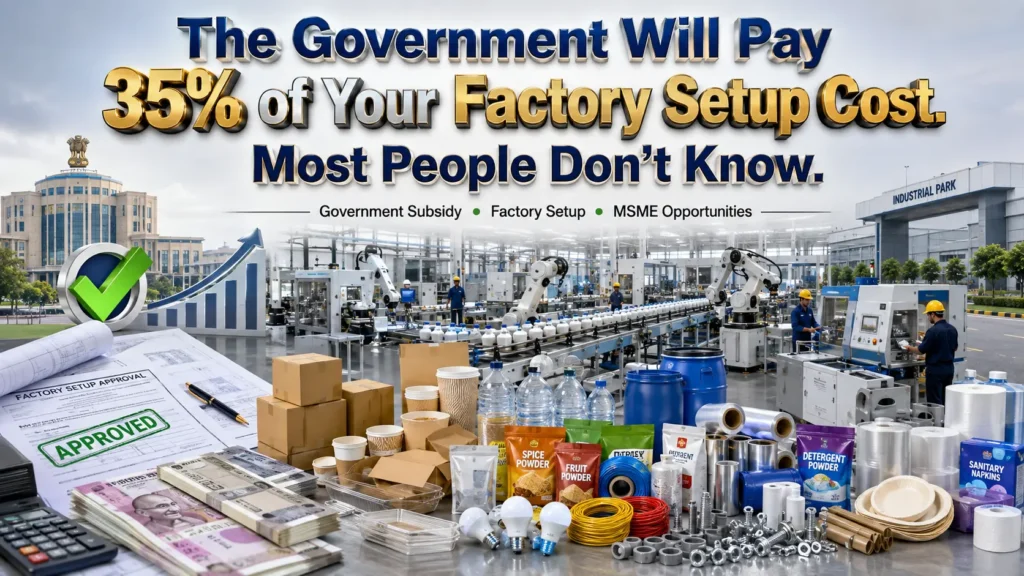
Government Pays 35% Factory Cost India has one of the world’s most untapped pool of manufacturing business ideas and startup capital, and a significant portion of it is from the Government. Thousands of entrepreneurs are investing their savings, borrowing from relatives or borrowing money on high interest rates to establish a factory and do not know that the Prime Minister’s Employment Generation Programme (PMEGP) provides up to 35% of the project costs as a direct capital subsidy. This works out to be a sum of ₹17.5 lakh of free government money for a manufacturing unit, valued at ₹50 lakh. However, many of the first-generation entrepreneurs have either never heard of it, or think they can’t be part of it. This article explains how the scheme works, who’s eligible to use it and which manufacturing business ideas have the greatest potential for success — with the government lining up on your side. Why Manufacturing Remains the Smartest Business Entry Point in India India is on the verge of witnessing the biggest change in decades for the manufacturing sector. The government has bitten off more than it can chew: it has set itself the ambitious target of increasing the contribution of manufacturing to GDP from 17% to 25%. All its policies, from tax breaks to investments in infrastructure, are geared toward this goal. This is an unusual confluence of circumstances: high demand, government support, export opportunity, and lower competition for the entrepreneur and investor. Additionally, the Make in India initiative has been successful in not only securing investments in Indian supply chains but also in creating and expanding premium procurement chains involving domestic component manufacturers. This means that the window of opportunity for a first-generation manufacturer has been greater than ever before. The initial cost of setup in the factory is still competitive. Availability of raw material is good. The domestic middle class keeps on consuming manufactured goods faster than any other economy in the world. Furthermore, with import substitution becoming a national priority, the government is actively encouraging local production under various overlapping schemes. If an entrepreneur really grasps this policy stack, he can significantly reduce his actual capital requirement by 35% to 50% prior to manufacturing even the first unit. Government Policies That Can Fund 35% of Your Manufacturing Business Setup PMEGP – The 35% Capital Subsidy You Are Missing The Prime Minister’s Employment Generation Programme (PMEGP) is the flagship programme for manufacturing start-ups in India. It is the direct capital subsidy offered by Khadi and Village Industries Commission (KVIC), Ministry of MSME, for 15% to 35% of the project cost. The general category entrepreneurs in urban areas get 15% and the special category entrepreneurs (women, SC/ST, minorities, ex-servicemen, differently abled) in rural areas get 35% of the subsidy. Manufacturing Businesses – The maximum eligible project cost is ₹50 lakh. Importantly, the funding from the applicant represents a small percentage (5-10%) of the total project cost. The remaining amount is financed by the bank. This translates to a capable businessman can establish a manufacturing business with ₹50 lakh with a mere investment of ₹2.5 lakh of his own funds. The bank finances ₹30 lakh and the government finances ₹17.5 lakh. That’s a capital efficiency ratio that hardly any private investment structure can beat. Production Linked Incentive (PLI) Scheme for Scale Businesses The Production Linked Incentive (PLI) Scheme provides performance-based financial incentives of up to 14 key sectors with 4% to 6% of incremental sales over a fixed base year for the entrepreneurs who are willing to scale up. PLI covers sectors like electronics, pharmaceuticals, food processing, textiles, automobiles and specialty steel. As of November, of the previous reported year, invested amount in committed PLI projects was ₹1.61 lakh crore which resulted in production and sales of around ₹14 lakh crore, and generated direct and indirect employment creation of 11.5 lakh. CLCSS and CGTMSE – Technology and Credit Support The Credit Linked Capital Subsidy Scheme (CLCSS) offers a capital subsidy of 15% on institutional finance received for technology upgradation in 51 specified sub-sectors with a maximum limit of ₹1 crore. At the same time, the Credit Guarantee Fund Trust for Micro and Small Enterprises (CGTMSE) has been introduced to provide collateral-free loans of up to ₹5 crore to MSMEs, which is a significant benefit for first-generation entrepreneurs who may not have an asset base. Manufacturing Business Ideas for Startups: High-Profit Units You Can Start With PMEGP 1. Food Processing and Packaging Unit Among all the business ideas in India, food processing is still one of the most resilient and least volatile businesses. The food processing industry has continued to grow in India, and the Ministry of Food Processing Industries is keen to encourage new food processing units by offering several capital and grant schemes. A start-up unit for grinding spices, milling pulses or manufacturing packaged snacks can be set-up in a project cost of Rs 30 lakh – Rs 50 lakh which falls within the project manufacturing limit of PMEGP. The operational economics are also favourable for the entrepreneur as there is a ready availability of raw materials, a developed distribution system and increasing demand for Indian food products in foreign markets. This is one of the financially most approachable avenues in manufacturing for the women entrepreneurs who start rural food processing units receiving the full subsidy of 35% under PMEGP. Get Detailed Project Report (DPR): Food & Beverage Packaging 2. Agarbatti (Incense Stick) and Dhoop Manufacturing The manufacture of agarbatti is one of those few business ideas, where the demand is huge in the country, export market is good and the government is encouraging production in the country. India is the world’s major importer as well as exporter of incense products. The SFURTI Scheme (Scheme of Fund for Regeneration of Traditional Industries) is particularly supporting the agarbatti clusters with infrastructure and technology support. The cost of setting up a basic mechanised agarbatti unit is in between ₹10 lakh to ₹20 lakh, which is perfect for first-time entrepreneurs to avail
Stop Waiting for the Perfect Business Idea. Start With This One
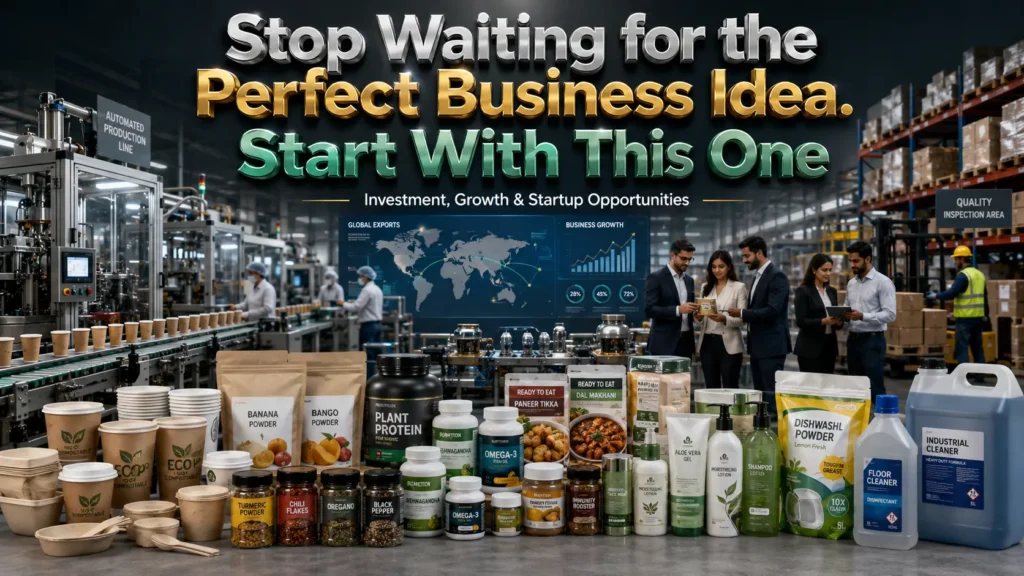
The first-time entrepreneurs start their own business, they wait years for the one “perfect” idea that’s risk-free, endlessly scalable and completely original. Meanwhile, thousands of smart manufacturing ideas quietly generate steady income, create jobs and build generational wealth for those who paused, and just took action. But the reality is, the Indian market does not honor the creative idea finder. It can pay off the one who can implement a successful concept with discipline and proper planning. The manufacturing industry is at a tipping point in India. The opportunity is not merely theoretical; it is structural and has an impact on nearly 30% of GDP and 45% of total exports through more than 7.5 crore MSMEs. The government policy, credit access and trade infrastructure is aligned to actually favour new manufacturers. The issue isn’t this time around whether to establish a manufacturing venture. The challenge now is to choose the idea and to do it smartly. Stop guessing—choose the right business with confidence Why Manufacturing Business Ideas Are Winning Right Now India’s expansion to become a viable option to the Chinese led supply chains has generated real demand deficits in a wide range of product categories. The MNCs are on the lookout for suppliers from India. The growth of domestic consumption is picking up pace in Tier 2 and Tier 3 cities. But e-commerce has created distribution channels that would have needed a lot of capital to reach before. In addition, India’s local manufacturing production is steadily increasing. Government data shows that the contribution of the MSME industry to overall manufacturing is 36%. In a recent reporting period, the credit growth in MSME sector has expanded by 19.6% YoY, which signifies the growing demand for new businesses as well as the rise of lender confidence. Today, 2/3rd of Indian MSMEs is digitally prepared and can manage procurement, sales and export documentation without having to hire a large support team for the new founder. The fact that it is a combination of rising domestic demand, export pull, government-backed credit, and robust digital infrastructure, makes manufacturing business ideas truly accessible for first-generation entrepreneurs rather than well capitalised conglomerates. Government Policies That Are Actually Helping New Manufacturers Manufacturing policy in India is now more pro-startup than ever. There are now multiple schemes layered on top of each other, thereby providing an actual capital advantage to new entrants. Production Linked Incentive (PLI) Scheme Under PLI Scheme, there are 14 priority sectors and cash incentive from 4% to 20% on increment sales over the base year. The actual investment made under PLI has surpassed ₹2.40 lakh crore, which has created more than 14 lakh direct and indirect employment. The secret to the PLI opportunity, for an MSME founder, is to be not only eligible to enter the fray but also be able to cater to the need of large manufacturers who are registered with PLI, a B2B play that most new entrepreneurs are not focusing on. PMEGP — The First-Generation Entrepreneur’s Launchpad The Ministry of MSME runs the Prime Minister’s Employment Generation Programme to provide credit linked subsidy for establishing micro manufacturing units. The subsidy for the general category applicants is 15% in urban areas and 25% in rural areas. For SC/ST and women entrepreneurs it is up to 35%. This will lead to a reduction in the breakeven risk for a new founder and the maximum government subsidy that could be availed will be between ₹6.25 lakh and ₹8.75 lakh for the manufacturing unit costing ₹25 lakh. CGTMSE and Collateral-Free Lending Credit Guarantee Fund Trust for Micro and Small Enterprises (CGTMSE) is a scheme between Ministry of MSME and SIDBI to provide banks with loans for micro and small manufacturers without requiring collateral. That’s very important for people who are first-generation entrepreneurs without property assets to put up as collateral. Having access to MUDRA loans for working capital, an MSME founder can easily start their business without needing to provide a single rupee of traditional collateral. Startup India and DPIIT Recognition Registered Startups under Startup India are offered with income tax exemption for three consecutive years, patent fee concessions and simplified exit norms. The Department for Promotion of Industry and Internal Trade (DPIIT) also eases the way for manufacturing startups by providing for fast-track regulatory clearances, thereby eliminating the typical delays that manufacturing entrepreneurs might face. Manufacturing Business Ideas for Startups: Where to Actually Begin The following business ideas are not dream concepts. They are current government policy priorities and categories of products that have proven to have market demand, viable startup economics, and documented. These are concepts that the market is talking about you, you just have to respond. 1. Food Processing and Value-Added Agricultural Products India is one of the world’s biggest producers of fruits, vegetables, dairy and spices; however, a considerable amount of the agricultural produce is wasted because of lack of processing infrastructure in the country. This vacuum is one of the lucrative and scalable manufacturing business ideas that aspiring entrepreneurs have these days. A food processing unit can commence with a specific product, such as dehydrated vegetables, spice blends, ready to eat snacks or packaged pulses and generate sales both from domestic retail markets and export markets. The investment cost starts from ₹10 lakh for micro processing unit to ₹40 lakh for mid-scale units. The Food Safety and Standards Authority of India (FSSAI) offers a clear regulatory roadmap and there are PLI incentives for several processed food categories. The average margin is 18-35% depending on the product and its value added. In addition, the Ministry of Food Processing Industries provides incentive for cold chain development to the sector. Explore This Book: Handbook on Fruits, Vegetables & Food Processing with Canning & Preservation 2. Herbal and Ayurvedic Product Manufacturing The Indian herbal and wellness product market is booming with increasing health awareness among Indians and people around the world. The cost of setting up a small-scale herbal manufacturing unit, where one produces hair oils, immunity supplement, skin care products,
Mega Food Park in India: Business Ideas, Government Schemes and Startup Opportunities
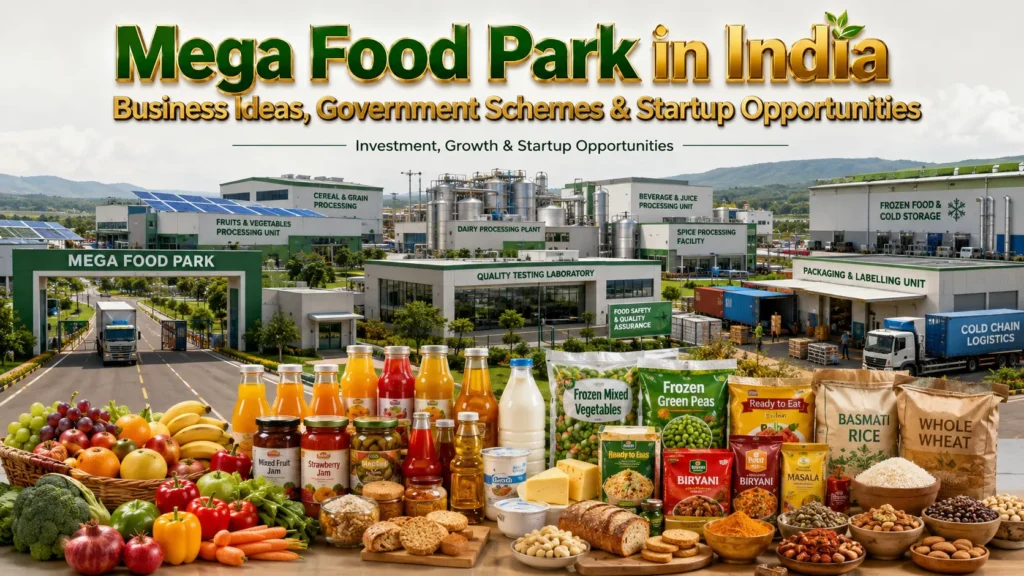
The fact that India wastes almost one-third of the food grown in its farms before it ends up on a plate is enough to make food entrepreneurs see potential in Mega Food Park business ideas. A Mega Food Park is not a factory. It is a collaborative industrial complex where cold storage, processing sheds, testing labs and logistics are available under the same roof and have been designed specifically for the ease of a small manufacturer. That’s a complete game change for a first-generation entrepreneur. A unit owner may lease an already developed plot within an existing unit and commence production within months, rather than spending crores building effluent treatment plants, power plants, and land. In this article, he explains why food processing is one of the most promising businesses for new entrants in India these days, what kind of government schemes are currently used to support a new player and what would be the most suitable business lines. Why Food Processing Is a Smart Sector to Enter Right Now India generates huge production of fruits, vegetables, milk, grain and marine products. But much of that production does not go into higher value, longer shelf-life products. That’s the space where profit is hiding! Tomatoes are sold at the farm gate at a decent price, a tonne of raw tomatoes. Transform it to packaged puree, ketchup, or dehydrated flakes, and the value realisation increases several-fold as the buyer is now paying for shelf life, convenience, and brand trust, instead of paying for the raw crop. The closed setting of Mega Food Parks allows the new player to leverage the infrastructure of other processors, such as processing units, cold chains and packaging plants, which would take years to construct on their own. A unit can simply be installed at operational parks with existing effluent treatment plants, weigh bridges, quality testing labs and warehousing facilities, which removes the need to invest large amounts of money into developing raw industrial land. There’s also a chance to export. Gulf, Southeast Asia, the U.S. and the European Union are all areas that have become hot markets for processed food, spices, marine products and organic products from India. A unit that can access export documentation services, has access to a cold chain, and is located within a food park would thus have the best chance of capturing these markets when compared to a standalone rural unit operating in isolation. Choose the right startup backed by real market demand Government Policies and Incentives Supporting New Entrants Here, a word of clarity is important before a founder’s business plan is created around it. The Ministry of Food Processing Industries has already withdrawn fresh sanctions under the original Mega Food Park Scheme, which means that there is no fresh sanction going down for any new park under the same window. Where there are already sanctioned parks, there will be no funding for unpaid liabilities. The real chance which a new entrepreneur has these days is two-fold—he can lease plots within the existing operational food processing parks formed under the scheme and he can look into the newer schemes which has replaced this scheme as the government’s staple food processing support measures. Pradhan Mantri Kisan Sampada Yojana (PMKSY) PMKSY continues to be the umbrella central sector scheme for food processing with infrastructure development, cold chain and agro-processing clusters. A new unit can join and plan its capital requirements in accordance with the components of infrastructure support under PMKSY within an existing food park ecosystem. Production Linked Incentive Scheme for Food Processing Industry (PLISFPI) This scheme offers incentives for eligible manufacturers based on the number of incremental sales of their processed food products, such as those in the branding and international marketing sectors. It is relevant to a food park-based manufacturing unit particularly because it is a focus on units that can increase the volume and create a brand that can compete in the export market. PM Formalisation of Micro Food Processing Enterprises (PMFME) PMFME can be a more appealing option for a truly small or new business owner. It provides credit linked capital subsidy, common infrastructure support, branding and skill training for micro and unorganized food processing units on a targeted basis to formalize and expand. MSME and State-Level Support In addition to the different schemes available in the different sectors, some food processing units are also classified as manufacturing MSMEs and can avail of the benefit of collateral-free credit guarantee cover, interest subvention on term loans and capital investment subsidy provided by a number of state industrial policies. Many state governments also exempt/reduce stamp duty for units established in notified food parks/in industrial estates. Read as a package, these documents indicate that the road to funding for the Mega Food Park, as conceived, has been closed, but the government’s support of food processing, in general, has been more complex and more favorable to those who are careful about planning. Multiple Business Ideas for Startups Inside a Mega Food Park Establishment of business idea around a food park must match a product line with the infrastructure already provided by the food park. Some of the most viable options for a first-time investor entering the market as a founder. Fruit and Vegetable Processing Unit One of the most natural places for a Mega Food Park is a fruit and vegetable processing line which converts local horticulture produce into pulp, puree, jam, pickle or dehydrated products, the cold storage and primary processing centres of a Mega Food Park are generally built around a particular agri-horticultural area. A founder can get raw material from the collection centers within the park, reducing losses during transportation and procurement expenses. Shelf-stable products such as jams, purees and ready-to-cook paste have healthy margins over fresh products and can be profitable within 2-3 years of fit-up even if only a few tonnes per day of capacity is installed, if quality and packaging is managed well from the beginning. Get Detailed Insights from This Book: Handbook on Fruits, Vegetables
Top 10 Industrialists of Bihar: Success Stories, Business Ideas, and Future Vision
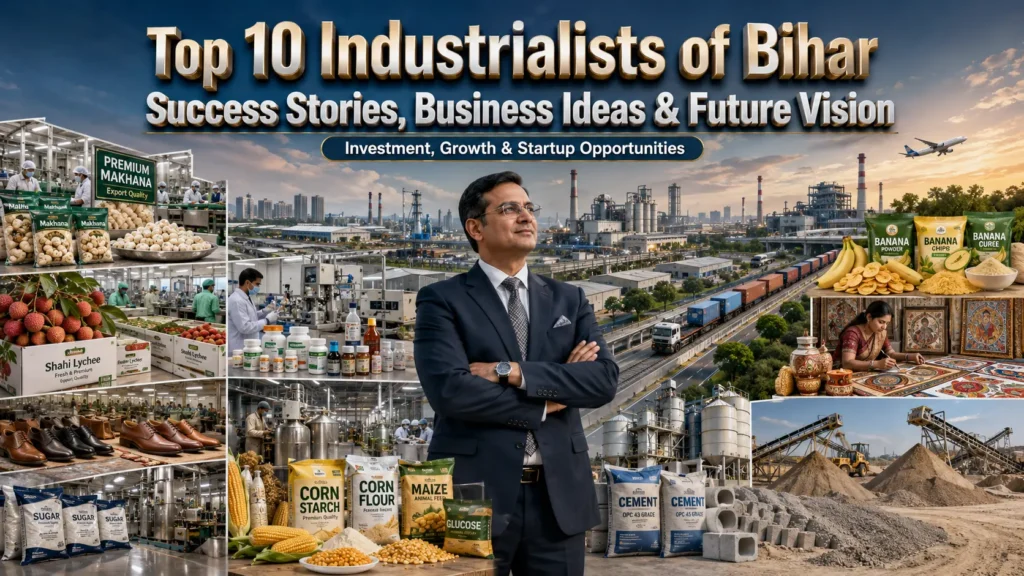
Industrialists of Bihar Awakening Bihar is going through its biggest economic metamorphosis in a century and a half, and a host of business concepts are taking shape. Bihar’s problems for decades have been: poverty, flood susceptibility, and not being industrialized. Presently, it is one of the fastest growing state economies and it is being promoted in a direction of food processing, agri-industrialisation, pharmaceuticals, light manufacturing, and construction of infrastructure. Bihar’s per capita income has seen a lot of improvement in the state due to sustained focus of the government and the commitment made by the Prime Minister for the development of the state’s infrastructure has been a huge boost to the increased interest in investment in the state. Bihar’s key strength lies in its scale – it is the third most populous state in India, and the population is young, both meaning a consumer market and a source of labour for manufacturing. The state is the top producer of vegetables in India, 2nd largest lychee producer in the country and a major contributor of maize, wheat and fish to national supply chains. These agricultural surpluses provide good feedstock for food processing industrial investments. This article talks about Bihar’s 10 industrialists, their contribution and future plans. IBEF Bihar Report offers an up-to-date sector analysis with respect to State data. Why Bihar Is an Emerging Industrial Opportunity There are a number of factors that are driving Bihar’s industrialization. Megaprojects are first of all, massive investments in infrastructure – a commitment by the Union government of over Rs. 58,900 crores of infrastructure investments for Bihar. The connectivity between inter-district and inter-state is drastically enhanced with the six national highway corridors, expressway projects like Patna-Purnia Expressway and Kosi River Bridge project. Second, the food processing opportunity: The vegetable, maize, makhana, lychee and fisheries surpluses in Bihar are almost entirely processed outside the state, providing an enormous opportunity for investment in the food processing sector within Bihar. Third, demographic dividend: Bihar’s youth population will have higher education levels, leading to skilled workforce which will be more preferred by labour-intensive manufacturing. The Ministry of MSME has a proactive approach to the development of the MSME sector and has been actively promoting the development of Bihar’s food processing, handloom, and light manufacturing sector. The Nalanda Agri-Business School has done research on the agricultural value chains in Bihar and found that the value of the chains is over Rs. The annual processing opportunity is 50,000 crore which is being exported to other states for value addition. The essence of Bihar’s future generation of industrial entrepreneurs is to capture a part of this opportunity. Access Complete Business Plan: Bihar Industry Startup & Entrepreneurship Guide Government Policies Supporting Bihar’s Industrial Growth Capital investment subsidy, concessional land and power tariff concession are provided in Bihar Industrial Investment Promotion Policy for new industrial investment. BIADA is the Industrial Estate Authority of Bihar that runs industrial estates in various districts. The Mega Food Park – under PM Sampada Yojana – for the food surplus districts of Bihar is a vital common infrastructure for food processing entrepreneurs. The export of makhana (fox nut), lychee and vegetables is promoted in Bihar by APEDA with the help of quality certification and market access programmes. Bihar has identified ‘food processing’, ‘Leather’, ‘Textile’ and ‘Manufacture of construction materials’ as priority sectors in ‘Make in India’. The central government has been investing in Bihar Special Package and the PMGSY (Pradhan Mantri Gram Sadak Yojana) for rural road connectivity which is helping to ease the last-mile logistics cost of agri-processing entrepreneurs in flood-prone districts. The state’s good land reform history offers a fairly good level of land security, which is one of the risks associated with industrial investment in Bihar. Top 10 Industrialists of Bihar: Profiles and Future Vision 1. Anil Agarwal (Bihar Origins) – Vedanta Resources Anil Agarwal, Founder of Vedanta Resources, was born at Patna, Bihar. From humble beginnings, trading in scrap metal in Mumbai, he was able to grow up into India’s largest diversified natural resource company with the help of a bank loan on the first cable company that he acquired. This is one of the great entrepreneurial origin stories in India, from Agarwal in Patna to London, via his days in the scrap yards in Mumbai. His industrial strategy, who would acquire resource assets and establish refining and processing facilities around them, established a zinc-copper-aluminium-iron ore-oil and gas conglomerate. Agarwal’s vision is to bring back substantial investments in the semiconductor and tech industry in India. 2. Food Processing Industry Leaders – Makhana and Lychee, Darbhanga Bihar is the leading state in the production of makhana (fox nut / water lily seed) which is in increasing demand in the country and abroad as a healthy snack food and accounts for 90% of the total production in the country. The benefit of these industrial entrepreneurs who have established organised businesses for the production of makhana, roasting and packing is that they are making a most unique product for export in Bihar. The government’s GI (Geographical Indication) tagging of Mithila Makhana and export promotion support from APEDA is opening up markets for health food retailers in the US, Europe and Middle East. The lychee processing from Muzaffarpur which has the largest lychee cultivation belt in India is also a potential opportunity in food processing. Get Detailed Insights from This Book: Handbook on Fruits, Vegetables & Food Processing with Canning & Preservation 3. Sitaram Jindal – Jindal Charitable Trust and Bihar Steel The Jindals’ industrial and philanthropic footprint in the Indian state of Bihar extends to steel manufacturing, construction materials, and substantial investments in the social sector through the Jindal Charitable Trust. Bihar is seeing capacity building by industrial leaders that have a link with steel and infrastructure sector, keeping in view the state focus on its huge capacity building plan. Bihar’s expressway, railway and bridge construction pipeline generates huge demand for rebar, structural steel, cement and construction equipment, where industrial entrepreneurs situated in the state enjoy
Manufacturing Business Under ₹1 Crore in India: Best Business Ideas for 2026
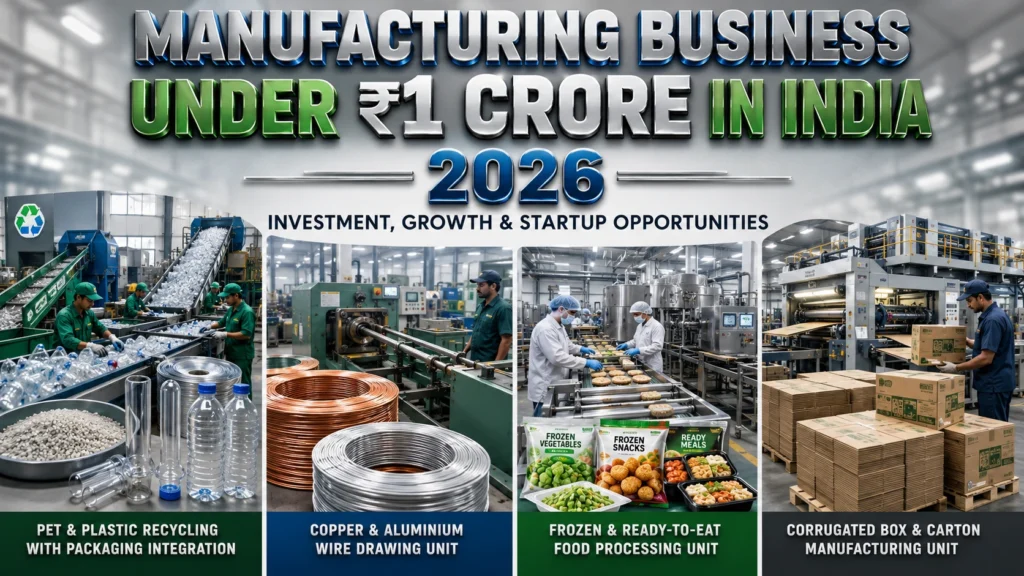
Manufacturing Business Under ₹1 Crore in India For each and every entrepreneur sitting with ₹1 crore, the question is: Where does this money work best? So, it’s no accident that manufacturing is the honest answer. It builds assets, it qualifies for government subsidy and it generates a business that a bank will re-lend on again next year. This article covers real project report, real client discussion, real factory floor, and real business ideas that are feasible and affordable with a ₹1 crore budget. Until the price of a compact manufacturing line, crore rupees seem like a lot of money. That’s quickly consumed by machinery, working capital, a small shed and statutory approvals. Fortunately, there are a number of manufacturing segments developed just for these ticket sizes and government assistance brings the price differential even closer, up to 30-40%. Why Manufacturing Deserves Your ₹1 Crore Right Now The supply of local food products, local packaged products, and locally manufactured components have lagged behind the demand and India is steadily rising in factory production. No longer a slogan, import substitution is manifested through actual orders from FMCG buyers seeking Indian suppliers, auto-ancillary buyers and export houses for their reliable vendors. The different nature of manufacturing adds complexity to the trading of manufactured goods. The trading business expands as you increase your investment. A manufacturing facility grows with your capacity utilisation; and capacity can be increased without raising additional equity on quarterly basis. The better the unit is run, the better the margin will be as the fixed cost becomes more spread over the higher turnover, and this is why a well-run unit at 40 lakh turnovers can look totally different at 4 crore turnovers three years later. Land and power costs are also lower in Tier-2 and Tier-3 industrial areas and state industrial policies often add soft industry support in the form of capital subsidy, stamp duty exemption, and lower power tariffs for new units. It’s not so easy to duplicate in services nor in trading. Related Article: Medium Investment Manufacturing Business Ideas in India for MSMEs Government Policies and Incentives That Change the Math Budget support is not an afterthought here; it can be a deciding factor between a viable project and an unviable one. The Prime Minister’s Employment Generation Programme (PMEGP) provides capital subsidy of 25% (35% in rural areas) for setting up new manufacturing units under funded by KVIC and its partner banks. The Credit Guarantee Fund Trust for Micro and Small Enterprises (CGTMSE) guarantees loans of up to ₹2 crore without collateral, which is very significant for an entrepreneur who has no collateral to offer for the first time. Many projects worth ₹1 crore are approved only on the basis of a solid Detailed Project Report as collateral is no longer required with CGTMSE. CLCSS, a scheme of the government provides capital subsidy of 15% for technology upgradation of new machine while PLI scheme provides incentive to the scale generated and exports done in selected sectors like food processing and specialty chemicals. In the meantime, the ZED Certification Scheme provides a financing up to 80% of the certification cost, thus giving a young unit credibility with the bigger buyers sooner than it would otherwise. Before applying anywhere, entrepreneurs should register in Udyam as nearly all the schemes like CGTMSE and PMEGP treat Udyam registration as the entry ticket. Manufacturing Business Ideas Worth Backing With ₹1 Crore Small-Scale PET and Plastic Recycling with Packaging Integration Plastic packaging waste continues to rise and the new Extended Producer Responsibility (EPR) legislation now requires that big brands in the FMCG sector buy recycled material. A unit that can gather, wash and reprocess PET flakes into granules, and take a portion of those granules to make packaging sheets or strapping, takes margin at two levels, rather than one. Washing and extrusion and pelletising machine is available in the range of ₹60-70 lakh which leaves scope for working capital and Pollution Control Board clearance as well. It is not difficult to find buyers; almost all plastics processors and many packaging exporters today are searching for recycled granule suppliers. Get Detailed Project Report (DPR): Plastic Waste Recycling Plant Copper and Aluminium Wire Drawing Unit Demand for electrical cables follows closely India’s housing and infrastructure cycle and both continue to be in strong growth phase. The setup cost of a wire drawing unit that can take copper or aluminium rod and draw into smaller gauge wire can be from ₹80 lakh to ₹1 crore depending on the capacity of the unit, which requires a wire drawing machine, a furnace for annealing the wire and a wire spooling machine. Even with the margins being thin on paper, this business works when the volume of the business reaches 3-4 tonne per day as it can easily cross ₹20 lakh monthly turnover once the regular buyer base is established by the cable makers and electrical contractors. Frozen and Ready-to-Eat Food Processing Unit Urban kitchens are getting smaller and working families are looking for quick food without compromising on quality. For a small capacity, a blast freezer, cold storage and packaging line is needed for a frozen paratha, as well as snacks or ready-to-eat curry unit, the cost of which is a maximum of ₹60-90 lakh. This section is also non-negotiable, with FSSAI licensing and clean HACCP aligned process, but with some of the healthiest margins on this list, especially for products with regional and ethnic identity that aren’t served by national brands. Explore This Book: Handbook on Fruits, Vegetables & Food Processing with Canning & Preservation Corrugated Box and Carton Manufacturing The demand for corrugated packaging is constant and exists in all ecommerce clusters, especially those. A single or double facer corrugation machine in conjunction with slotting and stitching machine is available between ₹70 lakh and ₹1 crore for a regional scale plant. This business is contract-driven, repeat orders rather than single orders, so it has higher cash flow predictability for a manufacturing business of this size. Import-Export
Electrical & Electronics Manufacturing: 4 Business Ideas from Copper Wire to Lithium Batteries
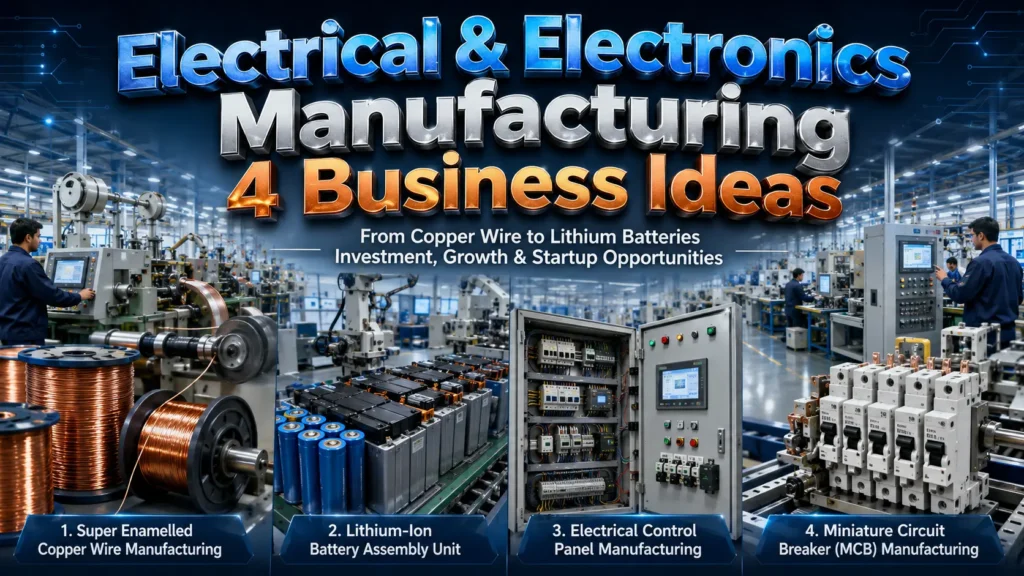
Electrical & Electronics Manufacturing Business For those who are looking around for business ideas with a long-term horizon, it is a good idea to take a second look at India’s electrical and electronics manufacturing base, because it is one of the most significant changes that the industry is currently undergoing. The reasons are not philosophical. Wiring and protection devices are required on every new residential tower; batteries packs are required for every electric two-wheeler, control panels are required for every industrial shed and every motor rewinding shop requires enamelled copper wire. This article outlines four real manufacturing opportunities – Super Enamelled Copper Wire, Lithium-Ion Battery Assembly, Electrical Control Panels, and Miniature Circuit Breakers (MCBs) – in a way that a consultant would approach when considering a project for a first-generation entrepreneur with practical, feasibility-oriented logic. Why This Sector Deserves Attention Right Now It is unusual and noteworthy that three separate demand curves are converging at the same time. Construction and real estate activities are driving up the demand for control panels and MCBs as distribution boards and protective switchgear are essential for any commercial or residential project prior to its use. At the same time, the electric mobility transition is generating a completely new supply chain for components: lithium-ion cells and battery packs—an industry that existed only in small quantities a decade ago. But there is an undercurrent to these, the simple enamelled copper wire, which is used in almost every motor, transformer and generator the country produces and whose consumption goes hand-in-hand with industrial growth and investment in infrastructure, rather than any one trend. The mix is appealing from a profitability perspective on a few reasons: It covers both established, cash-generating businesses (copper wire and MCBs) and growth businesses that offer more opportunity for new entrants (battery assembly and control panels for niche applications). A consultant who reviews this area will consider raw material cost pass-through, as well as the trust of the brand in products where safety is a critical issue, and the ability to service the OEM client on a recurring basis — and all three points would find electrical manufacturing to be reasonably defensible once a unit has proven themselves. There is another export aspect: Indian products such as wiring, panels and battery packs are increasingly selling in the African, Middle East and South Asian markets, where Indian products that are price competitive and reasonably certified are well-positioned against higher-priced options. Related Article: How to Start an Electrical Manufacturing Business in India – Profitable Ideas & Complete Guide Government Policies and Incentives Supporting New Entrants Entrepreneurs may not be aware but policy support for this sector is more widespread than they imagine and can substantially alter the economics of a project if used correctly. The Production Linked Incentive (PLI) for Advanced Chemistry Cell (ACC) battery storage has secured significant investments in large-scale Lithium-Ion Batteries (LIB) manufacturing in India, while the smaller battery pack assembly units indirectly benefit from the cell ecosystem being nurtured by the PLI scheme. The PLI scheme for White Goods and the overall PLI for electronics manufacturing similarly provide benefits for component suppliers that supply to the larger assembly business, such as control panel and switchgear component suppliers. On the borrower’s side, there is a credit guarantee scheme and the assistance of the Ministry of MSME for collateral-free loans provided to a first-time entrepreneur, which makes it a lot easier to avail the working capital without pledging family property and availability of interest subvention schemes that reduce the cost of the term loans for plant and machinery. The FAME and then the EV linked incentive program by the government of the country known as Ministry of Heavy Industries has benefited indirectly the demand for Lithium-ion battery assembly by providing subsidy to end-vehicles, which trickles down to the supplier of components. State-level industrial policies, especially in the states that actively promote the electronics and EV component industries, often add on power tariff concessions, stamp duty exemption, and capital subsidy. Eligibility details are updated periodically; therefore, readers can check scheme details directly on the Ministry of MSME portal for authentic and updated scheme details. Multiple Business Ideas for Startups in This Sector 1. Super Enamelled Copper Wire Manufacturing Super enamelled copper wire is the “plain vanilla” of the electrical motor and transformer industry, and this is why it’s a viable business venture for a serious entrepreneur and not a hobby. The product consists of copper conductor covered with a number of layers of enamel (polyester, polyesterimide or polyamide-imide) which are applied to the conductor by a continuous line of wire-drawing and enamelling, and then baked in ovens to the dielectric strength and thermal class desired by applying the end-user. The range of real-world applications is vast, including domestic and industrial motors, transformers, generators, relays, solenoids and household appliances, and is far from seasonal like some customer types. An important manufacturing tip is that most quality complaints come at the enamelling oven stage of the process and not at the wire drawing stage, so it’s important to budget enough for a sure-fire multiple pass enamelling machine, not the wire drawing. One of the key raw materials, which is subject to price volatility, is Copper wire (rod) used in electrolytic production and Enamel varnish used for coating the wires, which are sold to customers on a formula basis. Motor rewinding industry, OEM transformer manufacturers, fan and pump industry, the motor rewinding industry is a major consumer of copper wire and the fan and pump industry is a major user of copper wire, and the motor rewinding industry is a major demand driver for copper wire, and because copper wire is an actual input and not discretionary, the revenue can be tracked fairly closely with the industrial production data. Processing efficiency and working capital discipline are most important factors affecting profitability in this category, as copper content is significant in determining the overall cost, and a well-run processing unit with a consistent quality certification can benefit from
Madhuban Bapudham, Ghaziabad: NCR’s Next Industrial Powerhouse and 6 High-Potential Manufacturing Business Ideas for MSME Entrepreneurs
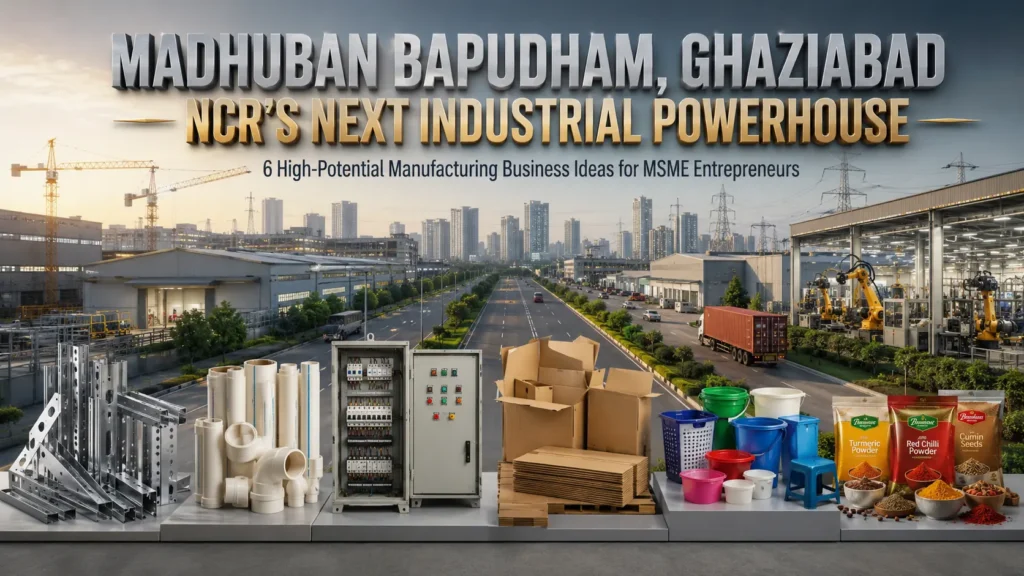
Madhuban Bapudham Industrial Hub One News Report That Could Reshape Your Business Direction Recently, the Navbharat Times published a report that has immense ramifications for not just entrepreneurs but MSMEs in the National Capital Region. As per this report in Navbharat Times, the Madhuban Bapudham area of Ghaziabad is slated to become a significant new industrial location with more than 200 factories in the area and the plan to provide jobs to over 5000 youths. It’s no ordinary real estate story. It’s a market shift signal, a signal that will create wide business opportunities for entrepreneurs, suppliers and service providers in coming 3-5 years. Ghaziabad has been one of the significant industrial centres of NCR for long. The key areas of the corridor has been manufacturing activity for decades at Sahibabad Industrial Area, Loni and Modinagar. Today, Madhuban Bapudham is becoming a new industrial pole and entrepreneurs who grasp this development early will be in key position to steer their sectors of the future. The development is particularly significant given the direct access via the Delhi-Meerut Express Highway, connection to the Duhai Namo Bharat RRTS station, and planned infrastructure growth by the Ghaziabad Development Authority. These combine to give conditions which are not usual for most emerging industrial zones. The question is not if this area will be growing, it is only if you will be part of that growth. What the Recent Navbharat Times Report Actually Signals Navbharat Times reports that Ghaziabad Development Authority (GDA) has formally given its approval to Madhuban Bapudham as an industrial area. The main facts of this development are: 200+ factory units to be systematically established 5,000+ direct, youth employment positions A total of 1,200+ hectares of integrated mixed-use township planning. 5 km from Duhai RRTS (Namo Bharat) station — direct rail connectivity with Delhi and Meerut. GDA-supported modern infrastructure: underground electrical power lines, cycle tracks, wide internal roads and central water supply What does this mean to entrepreneurs? When 200+ factories come together into one zone, a full-service economy develops around them. Canteens, logistics operators, safety equipment companies, staffing agencies and warehousing companies all have immediate demand. Navbharat Times’ report is the first official announcement in public and early movers often end up securing the biggest market share. Related Article: Ghaziabad’s ₹500 Crore Industrial Push: 6 Manufacturing Units Smart Entrepreneurs Are Setting Up in Madhuban Bapudham Why This Industrial Belt Is Growing — 5 Solid Reasons 1. Land Scarcity in Core NCR Creates a Ghaziabad Opportunity Small and medium entrepreneurs have found land in Delhi and Noida for their industrial purpose far too costly. With government support from the Madhuban Bapudham, it has started offering structured plots at fair prices without any party disputes and speculative pricing. It is very important for the first-time factory owners. 2. RRTS Connectivity Is a Genuine Game-Changer It takes less than 30-40 minutes to reach Delhi from Meerut from Duhai Namo Bharat RRTS Station, which is 1.5 km away from the township. Widely distributed commuters who can count on commuting. The expressway and rail access is an advantage for freight movement, and this is something that older industrialized areas in the region don’t have. 3. UP MSME Policy Offers Tangible Financial Benefits The Uttar Pradesh Government has announced the MSME policy that offers tangible financial support to industrial units in Ghaziabad with 50% stamp duty exemption, EPF reimbursement for 5 years, etc. These incentives are detailed in Invest UP’s official MSME page. These aren’t promises to be made, they’re active policy provisions. 4. Make in India and PLI Schemes Are Fuelling Manufacturing Demand Government of India’s Production Linked Incentive (PLI) scheme is encouraging massive investment in Indian manufacturing. Such national policies are directly impacting new industrial areas such as Madhuban Bapudham, which are welcoming anchor manufacturers, and thereafter there is demand for 40 or 50 MSMEs. 5. Five Thousand Jobs Mean Five Thousand Consuming Households Secondary spending is generated by 5000 new jobs in a zone. Demand surges in the housing, food, transport, healthcare, retail and personal services sectors. The business opportunity at Madhuban Bapudham is therefore not restricted to the industrial supply, it’s extended to the services of the working population. Government Schemes and Incentives That Will Support Your Business The combination of central and state government programmes provides a robust support program for MSME entrepreneurs entering new industrial areas. Some of the important schemes available on the official portal of the MSME Ministry are: PMEGP (Prime Minister’s Employment Generation Programme) — 25-35% capital subsidy to set up a new manufacturing unit This is government-initiated free online MSME registration for Udyam registration and availed government benefits and priority access. Collateral-free loans available to eligible MSME entrepreneurs up to ₹2 crore through CGTMSE. In Ghaziabad, stamp duty exemption has been introduced under UP MSME Policy, which will be 50% for 5 years, and EPF reimbursement will be 100% for 5 years. The PLI Scheme, which is a production linked incentive scheme for priority manufacturing sectors, was established. Production linked incentive scheme for priority manufacturing sectors, PLI Scheme was created. As per Startup India official website, registering on the platform gives a lot of advantages to the startups including tax exemption, a curated network of funding, a mentorship ecosystem, etc. which are directly relevant to the entrepreneurs launching their startups in emerging industrial zones. 6 High-Potential Manufacturing Business Ideas for Madhuban Bapudham Considering the industrial DNA present in Ghaziabad and the type of anchor factories that are most likely to establish in Madhuban Bapudham, six manufacturing units have been identified, which a first generation MSME entrepreneur can easily establish in this zone. Every idea is based on an existing demand, there are government schemes available, and it is kept at the MSME entry. These are viable from day one with reported Navbharat Times 200+ factory ecosystem, as buyers will be just a next-door neighbour! 1. Sheet Metal Fabrication Unit (Precision Components for Engineering Factories) All engineering, auto-ancillary and electrical equipment manufacturing companies in the zone will require
Pharma Manufacturing Business Telangana: Bulk Drug Park Guide
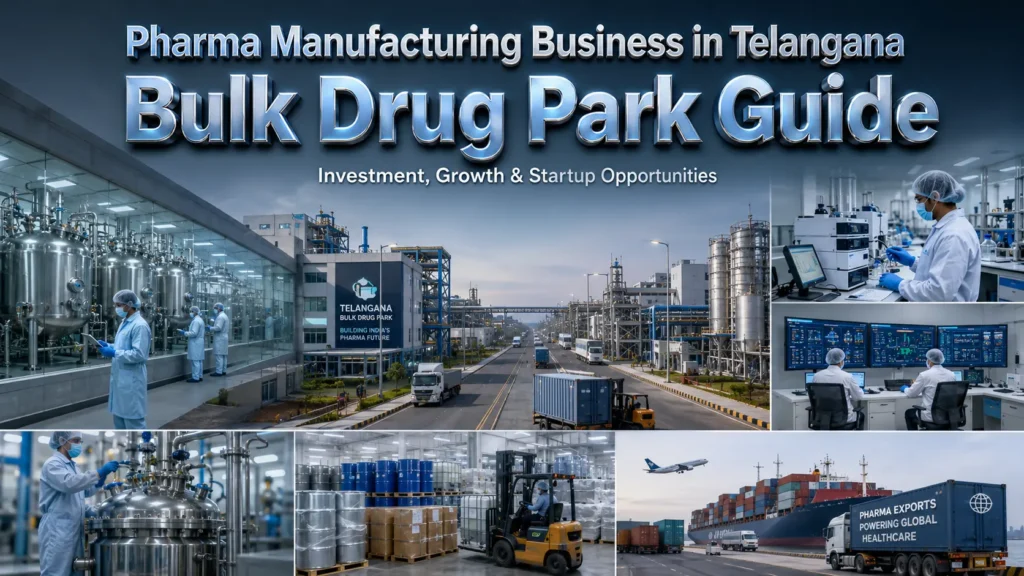
Pharma Manufacturing Business Telangana The Hyderabad alone produces about one third of India’s output of bulk drugs and APIs, with the core of these activities being Genome Valley and a pharma manufacturing base, which has been created over 30 years. It’s actually this concentration that makes the pharma manufacturing business that the Telangana entrepreneurs think about today appear daunting from the exterior: Dr. Reddy’s, Divi’s Laboratories and Hetero already possess the cake. But the state’s own Bulk Drug Park initiative, which has been aided by capital subsidy from the central government, has been created because the policy makers have realised that there is a room for new and specific players in the market, apart from the giants who are already working on a large scale. It is not an opportunity for a founder looking for a product for which every other unit in Hyderabad is doing business. It’s an invitation for one trouble-prone founder to focus on a single facet — one intermediate, one niche API, one contract manufacturing partnership — within a regulatory framework, a workforce, and a buyer base that other states take years to develop. Read the Complete Book Here: Business Ideas for Startup in Drugs & Pharmaceutical Industry with Project Profiles Why Telangana’s Pharma Cluster Is a Genuine Opening Get started with talent density. An advantage for Hyderabad over the pharma companies that have not built their capacity with API and formulation manufacturing in the city, is that a new startup can easily find experienced process chemists, regulatory affairs personnel and quality control staff, without having to import them from across the country. Add to this the government’s support. The special Bulk Drug Park developed with central PLI linked capital subsidy and allotted through Telangana State Industrial Infrastructure Corporation has plug and play infrastructure with shared effluent treatment specifically for API and intermediate manufacturing thereby reducing capex and approval time for the units to be located inside the park. The state’s own industrial policy with a focus on the pharmaceutical sector has another layer of capital and power tariff benefits that sit on top of central schemes implemented through the Ministry of Micro, Small and Medium Enterprises. The basic intermediate manufacturing unit costs start around fifteen to two dozen crore rupees for two hundred to three hundred tonnes per year, while API manufacturing for regulated markets is thirty to fifty crore rupees based on stringent quality and validation regulations. It takes around 10-14 months for the Telangana State Pollution Control Board to approve licenses and the Central Drugs Standard Control Organisation for drug manufacturing to approve infrastructure, specifically Bulk Drug Park. Business Selection Logic The margin structure is as elsewhere in the bulk drug industry in India: commodity intermediates, which a handful of existing firms in Hyderabad produce, trade at 12 to 18% margins, while specialty intermediates or niche APIs that cater to a single innovator molecule trade at 25 to 35%. The pharma cluster in Telangana is scalable because of the presence of well established buyers. A founder can launch with one multipurpose batch reactor, test one or two products with a local formulation company that doesn’t have to look far to find a qualified supplier, and then expand when repeat orders are received and the product has been proven to be in demand. The same risks identified in bulk drug manufacture in the country, such as regulatory clearance timelines and buyer concentration, apply in Telangana, however, the buyer search risk that the founders of companies in less pharma-dense states face is significantly less in Telangana due to the high concentration of buyers of bulk drugs in the state. Get Detailed Project Report (DPR): Business Opportunities in Telangana – Startup & Entrepreneurship Guide Product and Project Opportunities Worth Evaluating Antibiotic and Antiviral Intermediates Antibacterial and antiviral intermediates are being used by Hyderabad’s formulation units all the time and also the volume of customers within the state is such that if a new intermediate manufacturer wants to find a customer, they have to look within 50 km of Hyderabad. The capex for a plant of 150-250 tonne per annum is 18-25 crore rupees. The margins range from eighteen to twenty-two percent after the quality certification process with a formulation buyer is completed, which is quicker in Telangana than states with lesser concentration of pharma buyers because of their prior understanding of the qualification of suppliers. Contract Manufacturing for Global Innovator Companies With its proven regulatory track record, Telangana is a logical base for the CRAMS approach of contract manufacturing, offering global innovator pharma companies to explore India as a production partner for complex intermediates. A separate unit – one with capex of 12 to 20 crore rupees – enters into multi-year supply contracts instead of looking for volumes in the spot market. The margins are 22-28 per cent and the existing standing that Hyderabad has with the regulatory authorities is a good advantage in terms of trust building for the buyer than if the founder was coming from a lesser- established pharma hub. Niche API Manufacturing for Regulated Export Markets The best chance for a founder to carve out a niche in the Telangana pharma market is niche APIs which are molecules with a small number of qualified global manufacturers. A dedicated facility, the capex is in the range of Rs. 30 to 40 crore, which takes into consideration quality and validation infrastructure requirements, directly targets export formulation buyers in regulated markets. Once a Drug Master File (DMF) is filed and approved, the margins are twenty-eight to thirty-five percent, but the filing of a DMF takes between twelve to twenty-four months. Related Article: India’s ₹27,000 Crore API Import Problem Is Your Biggest Business Opportunity Pharma Packaging and Ancillary Component Manufacturing In addition to direct drug production, Telangana’s pharma density ensures a consistent demand for such special packaging and blister components, as well as ancillary manufacturing that every formulation and API unit in the state will need. The dedicated line requires capes expenditure of Rs 8-12
How to Start a Boxing and Martial Arts Equipment Manufacturing Export Business in India
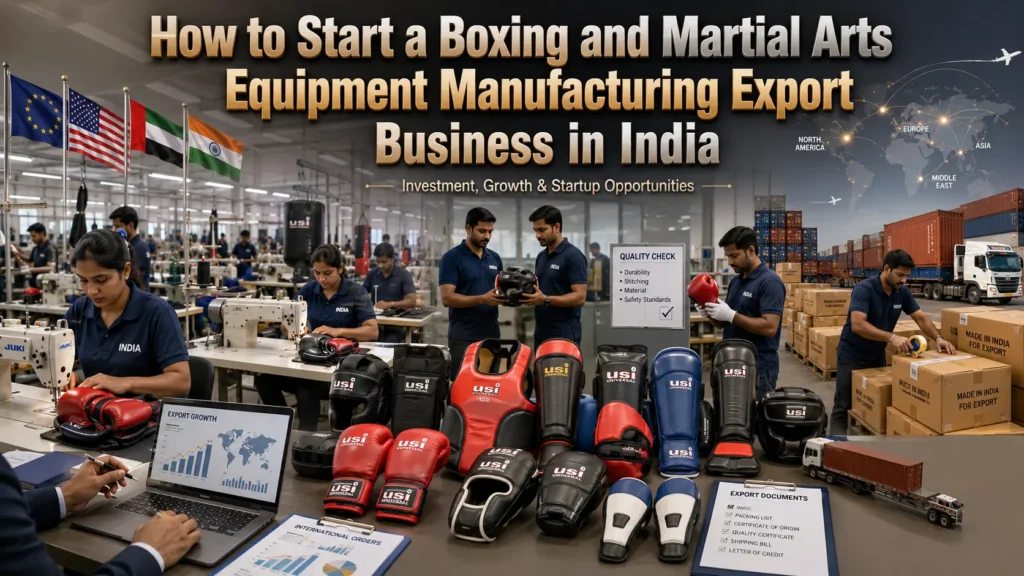
Boxing and Martial Arts Equipment Manufacturing Boxing and martial arts equipment exports is one of the fastest emerging business ideas for the sports goods industry in India. The global combat sports industry – which covers boxing, MMA (Mixed Martial Arts), kickboxing, muay Thai, judo, karate, taekwondo and Brazilian jiu-jitsu – is booming with the UFC’s mainstream entertainment success, Olympic combat sports’ rising participation and a global fitness culture which has embraced functional training and self-defence. Boxing gloves, punching bags, protective gears and martial arts training equipment have become the forte of sports goods manufacturing clusters in India, especially Jalandhar and Meerut, where the leather processing capabilities and competitive manufacturing costs in India have helped them become capable of making these products. The Sports Goods Export Promotion Council (SGEPC) is also in support of exporters of combat sports equipment’s and the market opportunity in the world is more than ever. Why Combat Sports Equipment Export Is a High-Growth Opportunity The UFC (Ultimate Fighting Championship) has made fighting a sport as popular as any other and a huge entertainment spectacle that hundreds of millions of people around the world can enjoy. The UFC has produced pay-per-view boxing shows, Netflix MMA specials, and popular boxing, MMA, and combat sports social media events which have brought awareness to the masses and interest in combat sports participation to the world. Boxing gyms are becoming more popular in the United States, the United Kingdom, the European Union, the Gulf and Southeast Asia, as well as for fitness purposes rather than for boxing competition. The global market for combat sports equipment is greater than $8 billion a year, and expanding at a rate of 6% to 9% each year. Boxing Gloves, Punching Bags, Speed Bags, Focus Bags, Hand Wraps, Mouthguards, MMA Equipment, and Headgear are all considered part of a large and growing product line. India’s legacy of leather craftsmanship, which has been used in cricket protective goods manufacturing and footwear manufacturing, can be directly adapted to leather manufacturing of boxing gloves and protective equipment, where leather quality, stitching quality, and other factors directly influence the performance and durability of products. Read the Complete Book Here: Our Books SGEPC and Government Policy Support The Sports Goods Export Promotion Council (SGEPC) caters to the boxing and martial arts equipment manufacturers via RCMC registration to avail export benefits from DGFT and facilitates market development and provides support for combat sports trade channels, and facilitates international trade fairs like ISPO Munich, Combat Sports trade fairs in USA and Europe. The DGFT RoDTEP Scheme offers export tax rebate on exports of boxing and martial arts equipment. In addition to SGEPC RCMC, these rebates will lower the actual cost of export and enhance the export competitiveness over Thai, Pakistani and Chinese boxing equipment manufacturers in the target markets. The DGFT EPCG Scheme is applicable to boxing equipment manufacturing machinery which includes Leather Die Cutting Machine, Multi-Layer Glove Pressing Equipment, Automated Stitching Systems for Fight Gloves and Foam Padding Moulding Equipment. The quality of the items used to make gloves is directly related to the quality of the gloves themselves and their durability – which is of great importance to a serious boxer and martial arts practitioner. The Ministry of MSME offers technology upgradation and credit guarantee support for small boxing equipment manufacturers under CGTMSE and CLCSS, which will help to lower the capital requirement for the new entrants in sporting goods manufacturing industry. Business Ideas in Boxing and Martial Arts Equipment 1. Premium Boxing Gloves Manufacturing Boxing Gloves are the iconic and highest valuable product of combat sports equipment. The category with high quality perception and premium pricing is the professional boxing gloves category, which consists of genuine leather outer shells, multi-layer foam padding systems and quality stitching. Indian leather boxing gloves are also competing with other boxing glove manufacturers like Thai (Fairtex, Twins Special) and Pakistani (Cleto Reyes OEM) manufacturers in the global boxing glove market at premium levels. Boxing Glove Manufacturing Unit Investment is between ₹25 lakh to ₹80 lakh, which includes leather die-cutting, foam padding making, multi-layer manufacturing, stitching and quality testing. The export price of premium genuine leather boxing gloves varies between ₹ 2,500 to 8,000 per pair to the international boxing equipment distributors. For the European market, CE marking for protective equipment is required for applications as a part of professional training. 2. MMA Gloves and Grappling Equipment MMA-specific gear, such as open-finger MMA gloves, grappling gloves, MMA shorts, rash guards, and shin guards is the fastest-growing part of the combat sports industry. With the resurgence of MMA in the mainstream thanks to UFC, ONE Championship, and Bellator, there is a demand for the training gear of all experience levels from mass consumers around the globe. The cost of investment in an equipments manufacturing unit is anywhere between ₹20 lakh and ₹60 lakh. Beyond leather, synthetic leather and neoprene are used in MMA equipment as well, which provide additional options in material sourcing as compared with leather. MMA export markets are the U.S., the UK, Australia, Brazil and Southeast Asia. Get Detailed Project Report (DPR): Project Reports & Profiles 3. Punching Bags and Training Equipment The combat sports equipment category is squarely heavy bags, speed bags, double end bags, uppercut bags, free-standing bags and wall mounted training bags, a category of equipment which is a high volume, low margin market. Consistent institutional and consumer demand is generated by gyms, commercial fitness centres, schools, and home fitness users. It costs ₹15 lakh to ₹50 lakh to invest in a punching bag manufacturing unit, which includes canvas/leather outer shell production, filling system (sand, water or foam), hardware fittings, and packaging materials. The main wholesale buyers are US and UK fitness equipment importers. Other channel access is through direct-to-consumer sales via Amazon Global Selling and fitness equipment e-commerce platforms. 4. Martial Arts Uniforms and Protective Gear Judogi (judo uniforms), karate gi, taekwondo doboks, BJJ (Brazilian jiu-jitsu) gis, MMA training shorts, and protective gear for contact martial arts—shin guards, headgear,