
Entrepreneur India August 2026: A Practical Magazine for Entrepreneurs Exploring New Business Opportunities in India

Entrepreneur India August Magazin It’s not hard to find a magazine that’s truly useful for entrepreneurs. It’s more difficult to find one that not only talks about startup motivation, but also talks about manufacturing, technology, project opportunities, and investment. The Entrepreneur India August 2026 issue takes a more practical approach, highlighting various industrial and business opportunities for entrepreneurs, MSMEs, investors and project developers. The August 2026 issue of the industrial monthly journal, which covers industrial development, technologies and project opportunities, investigates various sectors from non-ferrous metals to pharmaceutical manufacturing, hygiene products, renewable energy, battery assembly, medical disposables, food processing and packaging. This issue is relevant for those looking for a magazine for entrepreneurs in India, not just as a piece of reading matter, but as a point of discovery to find industries that can be explored. Why Entrepreneurs Should Look Beyond Generic Startup Ideas One mistake beginning business owners make is picking a business that’s touted as being in the “high growth” industry. A project cannot be a viable project if it does not grow. The economics in terms of capital requirements, machinery, raw materials, technologies available, market access, compliance, working capital and capacity utilization may make all the difference. This is illustrated clearly in the August issue with the project profiles. For instance, the IV-fluid manufacturing project has a capacity of 24,000 bottles/day, plant and machinery cost of ₹2,004 lakh and project cost of ₹2,808 lakh. Likewise, from the sanitary napkin project, it is seen that 90,000 packets can be produced per day, project cost of ₹2,100 lakh and cost of plant and machinery of ₹1,308 lakh. The numbers show that one has to think of a business idea as a project, rather than a trend. Manufacturing Opportunities Featured in the August 2026 Issue The manufacturing opportunity offered by India is one of the most salient themes in the issue. Copper, Aluminium and Non-Ferrous Metals The magazine looks at the production of copper cathode, copper wire drawing and aluminium ingots. They are linked with power transmission, EVs, electrical equipment, infrastructure and export. It also emphasizes the need to consider the availability of recycling and secondary-processing models, in comparison with the very high capital-intensive primary smelting. This is the type of industrial opportunity which can be explored in an Indian business magazine but not just for superficial “start this business” approach. Get Detailed Project Report (DPR): Copper and Copper Products and Projects Aluminium Beverage Cans The issue also examines the beer industry’s use of aluminium cans to produce beer. It is a discussion of a change in favour of cans over bottles, and of a lack of domestic supply of can-grade aluminium packaging. The capacity of the project is 40 lakh pieces per day and the total project cost is ₹879 crore. It’s a big opportunity, but the amount of capital needed is a good indication that it isn’t a low-budget start-up. That’s exactly the reason why a detailed project evaluation is important. Read the Complete Book Here: The Complete Technology Book on Aluminium and Aluminium Products Sanitary Napkins and Medical Disposables The manufacturing of sanitary napkins is discussed as a personal-care industry boon due to the constant demand by consumers, institutional procurement and rising interest in biodegradable sanitary napkins. The medical-disposables segment includes items like surgical drapes and hospital bed sheets, as well as masks and gowns. The magazine brings to the fore the recurring hospital demand as well as the increasing significance of BIS and CDSCO compliance. Access Complete Business Plan: Sanitary Napkins Manufacturing Project Report Lithium-Ion Battery Assembly Another area of opportunity is battery assembly. The problem links lithium-ion batteries to industrial, automotive and consumer energy storage devices. According to its project profile, it has several configurations for the battery packs, with plant and machinery cost of ₹86 lakh and project cost of ₹516 lakh. Explore This Book: Lithium-Ion & Lead-Acid Battery Manufacturing and Recycling Handbook CBG from Napier Grass Compressed biogas production from Napier grass is given attention as one of the renewable energy. This article covers feedstock availability, demand for SATAT, anaerobic digestion, gas purification and digestate as a by-product opportunity. View Full Project Details: Compressed Bio Gas (CBG) & Bio-CNG Plant Manufacturing Guide Food, Packaging and Consumer Manufacturing The problem doesn’t limit itself to heavy industry. It also explains an integrated opportunity between soya nuggets, Tea-packaging, Grinding and packing of turmeric and manufacturing of jam. These businesses are showcased on the basis of consumer demand, product quality, packaging and branding opportunities. Thus the issue is relevant for the readers who are looking for startup magazines in India, startup magazines pdf, or a practical startup magazine discussing both the industrial and consumer-based businesses. Related Article: India’s ₹5 Crore Food Processing Business: Gulf Export Opportunities for Manufacturers From Business Idea to Feasibility This is one of the most useful things you can learn from the magazine—you need to recognise an opportunity for only part of the job. Entrepreneurs have to decide if their chosen project is suitable for their situation, they have the money to invest and their target market. The study of the availability of machinery, raw materials, utilities, man power, production capacity, working capital, market demand, financial assumptions and more are essential before making an investment. It is for this reason that an entrepreneur startup magazine should offer more than inspirational success stories. However, serious entrepreneurs require information that can help them to take the leap from idea to a project that can be executed. Why This Can Be Useful for Startup and Business Research There are a lot of options to choose from if you are looking for the best startup magazines, startup magazines free, or, startup magazines subscription. Similarly, visitors to a business magazine PDF site or the top 10 business magazines might find very divergent magazines, since the editorial intent is completely different. Entrepreneur India is especially useful for those looking for industrial and project-based opportunities. This August, it’s all about pharmaceutical manufacturing, medical products, renewable energy, metals, packaging and
Furfural Derivatives Market Research Report 2026: Size, Growth, Trends and New Business Opportunities for Startups in India

Furfural Derivatives Market in India In the specialty chemicals field, furfural derivatives have quietly emerged as one of the more intriguing sectors. They are at a crossroads that other chemical categories do not share, as they are created from agricultural waste such as corn cobs, sugarcane bagasse and rice husks but are utilised in a wide range of industries, including foundries, pharmaceuticals, agrochemicals and next-generation bioplastics. That’s a bit difficult to ignore in a nation of hundreds of millions of tonnes of crop residue – like India. This report explains the current state of the global and Indian furfural derivatives market, insights on market drivers, challenges and opportunities for new players, and why it is worth the attention of MSMEs and first-generation entrepreneurs looking into a manufacturing business. What Are Furfural Derivatives? (Meaning, Types and Production) Furfural (C5H4O2) is an organic aldehyde that is produced by the acid hydrolysis of pentosans, which are one of the hemicellulose components of lignocellulosic biomass. Furfural is not a petroleum-derived industrial organic chemical; it is only produced from plant residues like corncobs, sugarcane bagasse, rice husk, oat hulls and cottonseed hull. After its generation, furfural itself is used as a platform chemical that is subsequently transformed into a series of higher value derivatives such as: Since the raw material is farm waste and not crude oil, furfural derivatives are firmly in the “green chemistry” and circular economy dialogue which is becoming more relevant with regulators and buyers demanding lower carbon industrial inputs. View Full Project Details: Furfural Manufacturing & Project Report Furfural Derivatives Market Size 2026 and Growth Forecast (CAGR) The estimates of the furfural derivatives market vary significantly from research agency to research agency, partly due to the varying definitions of what is counted as furfural derivatives (some consider only furfuryl alcohol and THF to be furfural derivatives, while others extend the definition to the much wider furan-chemical family). Overall, the estimates converge on a similar growth trajectory, though not on exact figures. According to recent industry estimates, the global furfural derivatives market is valued in a broad range of roughly USD 13–15.4 billion for 2025–26, with most forecasts projecting expansion to somewhere between USD 22 billion and USD 28 billion by the early 2030s, at compound annual growth rates generally clustering between 6% and 8.3%. One recent 2026 study by Persistence Market Research places the market at approximately USD 15.4 billion in 2026, climbing to USD 25.7 billion by 2033 — a CAGR of 7.6%. A separate, narrower estimate focused specifically on furfural itself (the parent compound, excluding derivatives) puts that market closer to USD 700–770 million in 2025-26, underlining how much value gets added once furfural is converted downstream into furfuryl alcohol, THF, and specialty derivatives. Figures: Assume the numbers provided above are fairly approximate and should be used to gain a sense of scale and trajectory—not as exact numbers that you could present in a fundraising deck without following up with a cross-check on the scope definition from the published market study. If you need investor-grade numbers, NPCS can prepare a custom TEFS, with figures that are scoped very close to your product line and capacity. Regional Breakdown Asia Pacific leads the furfural derivatives market by a huge margin with estimated market share of 42-67% of the global market share which is primarily due to China’s production base and the availability of agricultural biomass in the region. Chinese Batch Process is estimated to account for a majority of global furfural production capacity, at a staggering 80% production rate, as it is the most cost-effective method of production (CVP), Grand View Research’s furfural market analysis showed and China is expected to produce an overwhelming 89% of the world’s furfural in 2025. In contrast, in the EU and North America, furfural and furfural derivatives are net imports and the local production capacity has been decreasing over decades, due to the high production costs compared to Asia. Thus, Western markets are not only the largest markets for the supply of bio-based chemicals through mechanisms such as the EU’s Carbon Border Adjustment Mechanism, but also are structurally dependent on imports — and India’s manufacturers are well poised to fill this gap in the Western markets. Furfural Derivatives Market in India: Import Dependence and the Manufacturing Opportunity The part of the story that is important to Indian entrepreneurs is that although India has some of the largest stocks of furfural feedstock in the world, the country is a net importer of furfural, largely from China and to a minor degree from Germany and other producers. More than 500 million tonnes of agricultural residue is produced in India on a yearly basis. Rice husk, sugarcane bagasse, corn cobs and wheat straw are produced in vast quantities in various agricultural states of Punjab, Haryana, Uttar Pradesh, Maharashtra, Odisha etc. A significant amount of this residue goes into burning in the field (which is a key source of seasonal air pollution in North India) or is used as a low value fuel in boilers where it could be transformed into a chemical intermediate valued roughly at ₹80 per kg to ₹500 per kg depending on the derivative and its purity level. Bagasse, in particular, is concentrated in Uttar Pradesh and Maharashtra which have dense clusters of sugar mills, which already produce bagasse as a byproduct of sugar and ethanol production; thus feedstock logistics for a furfural unit in close proximity to these sugar mills is much simpler than if a business were to establish a new sugar-based agriculture supply chain from scratch. India’s specialty chemicals industry as a whole is valued at more than USD 220 billion and growing at 9–12% annually — a growth trajectory tracked by the Department of Chemicals and Petrochemicals under the Ministry of Chemicals and Fertilizers — and furfural derivatives fit squarely inside that growth story as an underpenetrated, import-substitution opportunity rather than a saturated one. Policy Tailwinds There are a number of developments that relate to this opportunity from the government
India’s Chemicals Sector Targets Up to $81 Billion in Exports by 2030: Inside the NITI Aayog Blueprint
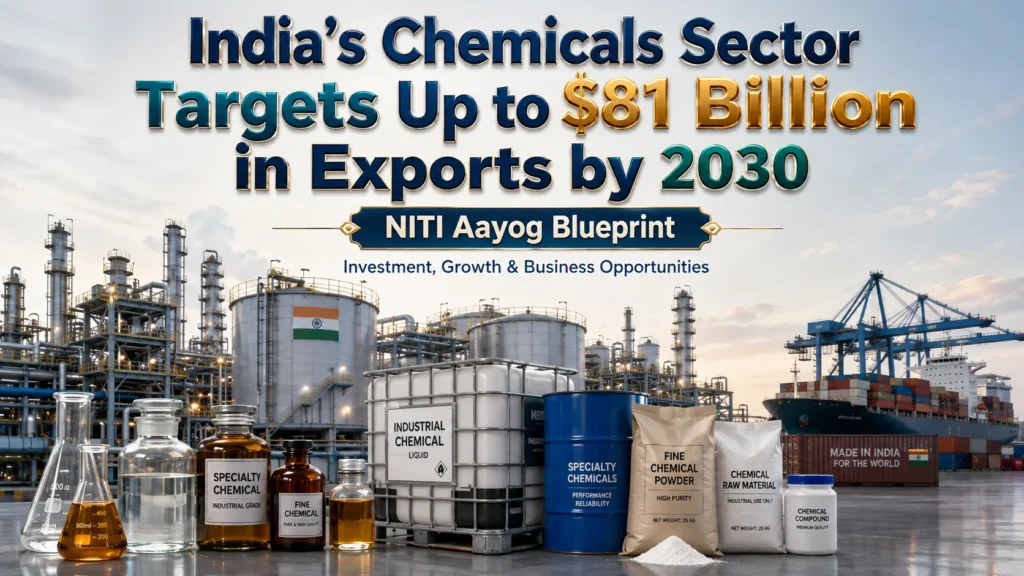
India Chemicals Sector Exports The chemicals industry in India is embarking on one of its biggest shifts in decades. The government’s top policy think tank, NITI Aayog, has recently submitted a report, which projects that the sector can drive exports to $81 billion by 2030—a nearly 2-fold increase from its current export value. Setting this target is part of a bigger picture: India becoming a net-zero chemical importer, a nation that now generates chemical products to keep pace with its rapidly growing consumption, and is also one of the major chemical exporters in the world. This is a bold move for an industry which has consistently experienced a persistent and growing trade deficit. It indicates that New Delhi is no longer considering chemicals as a sector that can support the other more prominent sectors such as pharmaceuticals, textiles, and agriculture but one that can sustain itself on a standalone basis in the process of India’s march towards a $5 trillion economy. Get Detailed Insights from This Book: Modern Technology of Industrial Chemicals The Numbers Behind the Ambition The NITI Aayog report details the export goal under various categories. Specialty chemicals are expected to shoulder the bulk of the load with anticipated exports in 2030 of $45 billion. The inorganic chemicals are in the middle somewhere between $5 billion and $10 billion, followed by the petrochemicals at about $26 billion. This adds up to a total export aspiration of $76 billion to $81 billion. In order to meet these levels, the report estimates that India’s chemicals industry will require a compound annual growth rate of 10 to 11 percent in consumption for the next five fiscal years, and even higher growth rates in the case of production — at about 14 percent per year. It’s a tough speed for an industry in a nation where infrastructure constraints, land acquisition time, and regulatory delays have held large-scale industrial development back in the past. The size of the domestic market opportunity behind this plan is massive. The chemicals consumption is expected to grow to $290 billion to $310 billion in Fiscal Year 2030, and India will be consuming 5-6 percent of the global amount. To meet that demand locally, rather than importing, India’s chemical production capacity must be scaled up by nearly 2x, from around $110 billion in fiscal 2023 to $220 billion-$280 billion by fiscal 2030, the report estimates. That’s not a simple capacity growth. It suggests a long-term sequence of new plants and plants that have grown larger, specialty chemical plants, and supporting infrastructure at ports, pipelines, and logistics corridors. If realised, it could also create 700,000 to one million new jobs by the end of the decade, which would be a major boost to the employment situation in the manufacturing sector in India, the report adds. Where the Growth Is Expected to Come From The report identifies four segments that have been identified as the main growth drivers for speciality chemical exports: dyes and pigments, paints and coatings, agrochemicals and flavours and fragrances. These are areas where India already enjoys a manufacturing capability and where international buyers have been willing to spread their purchasing beyond the traditional sources, mainly China. The change is already evident in trade figures. India’s exports of speciality chemicals have shown some solid ground in key markets, with the U.S. being around 17 percent of the exports, followed closely by Brazil with around 16 percent in 2024. These statistics indicate that speciality chemical producers from India have succeeded in gaining a foothold in markets which are not only large, but also tougher and more competitive. However, it is worth highlighting that India’s overall share in the major import markets is not high, approximately 8 percent. That’s not a liability, it’s a potential: while less than 10% of major markets are currently being accessed by Indian exporters, there’s significant scope for them to grow before they begin to face a level of saturation that would make it harder to gain market share. The other opportunities are the Petrochemicals. It is a “scale-intensive”, capital-intensive business in which the Indians already have a strong base in the sector of refining and cracker capacity, mostly public and private sector giants. The $26 billion export goal for this segment suggests a greater linkage of the refining complexes in India with their downstream petrochemical production, enabling the nation to monetise crude oil and naphtha feedstocks for an export value higher than that of exporting crude oil as intermediates or derivatives from it. Access Complete Business Plan: Chemicals (Organic, Inorganic, Industrial) Projects Why India Runs a Chemicals Trade Deficit in the First Place It is important to understand the significance of this export target by examining the present scenario of India’s chemicals trade. The country has a significant and increasing trade deficit in chemicals, for years. However, imports have far exceeded exports, with the demand for plastics, inorganic chemicals and petrochemical products increasing that domestic production has not matched. Import levels are high and the substantial proportion of these imports from China—providing a major source of chemical imports to India—as well as from other countries such as the United States, Southeast Asia, and South Korea. This dependence on imported chemicals, especially from the dominant single source, has emerged as a strategic worry for Indian policy-makers as world supply-chains have become more vulnerable than ever before in recent years. The structural challenge is the way India’s current petrochemicals plant capacity is currently structured. Very high percentage of Indian propylene is being used in the production of lower valued Polypropylene as compared to the world average. The same is true of ethylene, which is primarily used to make commodity-grade polyethylene, rather than the more valuable products like MDI, fluorochemicals or specialty feedstock for batteries and other advanced materials. This concentration on commodities lowers the value of the output for the large chemical industry in India than for more diversified industries in other countries. Existing industries in India, which are predominantly chemical, are not as
The Agile Business Playbook: How to Build a Future-Ready Organisation in the Age of Constant Disruption
Why the Business Agility that survive and thrive in a NAVI world are the ones that treat adaptability not as a crisis response, but as a core strategic capability Uncertainty has always been a part of business. The speed, the simultaneity and the interconnections of change are new in 2026. Now, disruptions come in waves, echoing each other in a chain reaction fashion and none of them is predictable as to which combination will shape the environment in the next quarter or the next year. The research and consulting worlds that have been exploring and studying organisational resilience have met in a helpful acronym for describing this world: NAVI — Nonlinear, Accelerated, Volatile, and Interconnected. In fact, answering the call to lead in this kind of complex and fast-changing environment is the top challenge CEOs face, as reported in EY’s 2026 CEO Outlook Pulse Survey, where 87% of CEOs said this was the greatest challenge of their job, up from 62% three years ago. Related Article: Best MSME Business Ideas in India for 2026: Top 50+ Profitable Projects What “Agility” Actually Means (And What It Doesn’t) Genuine agility is the organisational capacity to sense changes in the environment, interpret them accurately and quickly, decide on an appropriate response, and execute before the window of opportunity closes. McKinsey’s research on organisational agility identifies five trademarks of truly agile organisations: a shared purpose and vision, a network of empowered teams, rapid decision and learning cycles, dynamic people practices, and enabling technology. It is demonstrated through outcomes, not through the presence of flat hierarchies or Scrum methodology. Strategic Clarity: The Anchor in an Uncertain World The key paradox of agile organization is that you need stability on your strategic level. When there is no definition of purpose, values, direction, they simply rock back and forth endlessly when they are forced to react to all of the signals. This is the finding from Harvard Business Review’s research on strategic clarity, which showed that well communicated and clearly defined strategic intent enables organisations to make quicker, better decisions at every level, as people across the organisation can make decisions according to the intent without having to wait for instructions from the top. Sensing Capability: Building the Early Warning System Organisations that deal with the disruption best are the ones that first sense it. Information relating to market shifts, competitor activities, customer dissatisfaction and new technologies frequently resides at the fringes of organisations – in the frontline teams that directly engage with customers, markets and technologies. Structural and cultural changes are needed to develop a true sense of the task. The research, published in MIT Sloan Management Review, reveals that companies that establish a formal process to gather and funnel information from their frontline staff to senior management are more effective at making strategic decisions and responding to disruption than are companies that are mostly top-down in how they communicate information. Structural Sensing Mechanisms Decision Architecture: Making Good Decisions Faster Decision architecture is one of the biggest contributors to organisational delays. Companies that are effective at decision making see profits almost six percentage points greater than those that are not effective at decision making, according to Bain & Company’s research on decision effectiveness. What separates the great from the good is not so much the quality of each decision, it’s the velocity and uniformity at which decisions are made and executed across the organisation. Get Detailed Insights from This Book: Our Books Execution Discipline: Making Fast Decisions Stick The speed of decision without the discipline of execution creates one type of organizational chaos – the launching of initiatives that don’t really stick before the next one comes along. The most important practices to enhance the likelihood of execution success are: clear accountability (one owner, not a committee), explicit success measures, regular reviews in a rhythm and explicit stop processes for failed initiatives. Learning Orientation: Turning Experience into Advantage Organisations that compound their ability the quickest are able to get the most learning from every experience. Project Aristotle studies by Google on the elements of successful teams identified psychological safety as the most important part of team learning and success: the genuine belief that they will not be penalized for bringing up concerns or sharing unexpected information. Creating permission for the organisation to learn orientation, by leaders who publicly demonstrate it. The Role of Technology in Organisational Agility In today’s day and age, technology has been a necessary part of the agility of the organisation. According to Salesforce’s State of IT Report 2025, organisations using integrated real-time data platforms make strategic decisions 5x quicker than those using siloed, out-of-date reporting platforms. AI powered analytics, collaboration platforms and modular tech architectures all expand organisational capability in improved ways to sense and execute. Agility for Small and Mid-Sized Businesses: The Natural Advantage Smaller organisations are structurally better with faster communication, quicker access to decisions, and greater organisational culture. However, small firms are often very rigid too. OECD’s SME and Entrepreneurship Outlook highlights three elements that are the main sources of rigidity in small organisations, which hinder their adaptability: founder-centric decision making, informal processes depending on individual knowledge, and cultures that consider the founding approach as a sacred one. Access Complete Business Plan: Project Reports & Profiles The Leadership Requirement: What Future-Ready Leaders Do Differently Building an agile organisation ultimately requires a different kind of leadership. The command-and-control model is structurally incompatible with the sensing, decision-speed, and learning requirements of an agile organisation. Deloitte’s Global Human Capital Trends Report documents that the leadership capabilities most associated with business resilience are learning agility, comfort with ambiguity, collaborative decision-making, and the ability to develop organisational capability rather than simply demonstrating personal capability. Discover scalable startups tailored to your goals The Competitive Reality: Agility Is Not Optional The NAVI world does not reward organisational rigidity. The businesses pulling ahead in this environment share a common orientation: they view adaptability not as a response to crisis but as a core strategic capability requiring ongoing
Best MSME Business Ideas in India for 2026: Top 50+ Profitable Projects
India’s economic backbone is powered by Micro, Small, and Medium Enterprises (MSMEs), contributing significantly 30% to GDP, employing over 110 million people, and 45% of manufacturing outputs. Over 63 million MSMEs across the country, the sector is poised for massive growth in 2026. The Indian government has rolled out significant MSME reforms in 2026, including revised classification norms (effective April 2025), expanded investment and turnover limits, and enhanced support through Udyam Registration, which now unlocks collateral-free loans up to ₹5 crore and 25% government procurement reservation. With the government providing strong support and the market showing increased demand for local, sustainable, and value-driven services, MSME business projects are proving to be highly lucrative. Whether you’re a first-time entrepreneur or looking to expand into new sectors, or an NRI seeking investment opportunities in India. This comprehensive list of 50+ profitable MSME business ideas covers low-investment, high-growth, and policy-backed opportunities across sectors. Top 50 Profitable MSME Business Projects to Start in 2026 Here’s a curated list of 50 profitable MSME business projects across different sectors to help you identify the right opportunity based on your skillset, investment level, and market demand: 1. Packaged Food Manufacturing With the rise in urban lifestyles, ready-to-eat meals, snacks, and organic packaged food are in demand. This MSME business project is ideal for food technologists or home cooks. 2. Mobile Phone Repair Services Low investment and high demand make this a reliable urban MSME opportunity. Adding doorstep service or franchising can scale it faster. 3. Customised -T-Shirt Printing Great for creative entrepreneurs. Use online platforms to accept orders and deliver custom-printed clothing. 4. Handmade Organic Soaps Consumers are moving toward chemical-free personal care. This MSME business project requires basic training and minimal equipment. 5. Digital Marketing Agency As businesses move online, they require SEO, social media, and content marketing support. This is a service-heavy business with low setup costs. 6. Solar Panel Installation Green energy is the future. Residential and commercial sectors are increasingly adopting solar panels, creating a booming MSME sector. 7. Paper Bag Manufacturing With plastic bans, eco-friendly alternatives like paper bags are in demand. This MSME project is both sustainable and scalable. 8. Spice Powder Packaging Traditional spices are essential in Indian kitchens. Value-added packaging and branding can help tap global markets too. 9. Online Tutoring Services From school subjects to music or coding, online tutoring is gaining traction. A simple platform and internet access are all you need. 10. Furniture Making & Restoration Custom and vintage furniture is in demand. This MSME business project can be pursued locally with skilled labor. 11. LED Light Manufacturing Energy-saving products like LEDs are now in every home and office, offering large-scale demand. 12. Cloud Kitchen Without a dine-in space, you save costs and cater to online food orders. This model thrives on low investment and high returns. 13. Herbal Beauty Products Herbal creams, oils, and face packs are sought-after in both Indian and international markets. 14. Dairy Products Processing Paneer, ghee, flavored milk, and curd are daily essentials. With quality control, this MSME project offers high profitability. 15. Toy Manufacturing India is promoting local toy production. Unique, safe, and educational toys have a growing market. 16. Electric Vehicle (EV) Charging Station A future-ready MSME business project, particularly in urban and tier-2 cities. 17. Agarbatti & Dhoop Stick Manufacturing A religious and cultural staple, these products see daily use and repeat purchases. 18. Cold Storage Facility Fruits, vegetables, dairy, and meat require refrigeration—ideal for rural or semi-urban setups. 19. Event Management Weddings, corporate events, and brand launches provide continuous business if executed professionally. 20. Eco-Friendly Disposable Tableware Plates, cups, and cutlery made from leaves or sugarcane are becoming mainstream in catering and restaurants. 21. Mobile Car Wash Service On-demand cleaning services are gaining popularity due to convenience. 22. Pet Grooming & Care Pet ownership is growing, and this niche market is underserved. 23. Digital Printing Press From visiting cards to product labels, businesses and individuals need quick-print solutions. 24. Custom Jewelry Making Ethnic and designer jewelry always has a fanbase. This MSME business project needs creativity and design tools. 25. Coir Products Manufacturing Eco-friendly mats, ropes, brushes, and bags made from coconut fiber are popular in domestic and export markets. 26. Vermicompost Production As organic farming grows, so does the need for organic fertilizers like vermicompost. 27. Stationery & School Supplies Selling notebooks, pens, and art material to students, schools, and coaching centers ensures steady business. 28. Bakery Products Pastries, cakes, bread, and cookies have timeless demand. Home bakers are turning into full-scale MSMEs. 29. Packaged Drinking Water Plant A must-have in urban and industrial zones. Brand positioning is key here. 30. Plant Nursery Business Urban gardening, landscaping, and indoor plants are trending. It requires limited space and high profit margins. 31. Detergent Powder & Liquid Manufacturing Household cleaners are basic necessities. You can supply to local kirana stores or create your own brand. 32. Mushroom Farming Quick growth and high protein content make mushrooms a popular food item with good export potential. 33. Mobile App Development Apps are essential for businesses, events, and personal services. You can even develop your own product and monetize it. 34. Car Rental Services Ride-hailing and self-drive services are ideal for tier-1 and tourist cities. 35. Ice Cream Manufacturing Start with a local setup and expand through retailers or parlors. 36. Millet-Based Food Products As health consciousness rises, millet snacks and mixes are growing in popularity. 37. Paper Cup & Plate Manufacturing Single-use eco-disposables are necessary for events, eateries, and stalls. 38. Ayurvedic Medicine Manufacturing Traditional medicine has a strong hold in India and abroad. Requires licenses and formulation knowledge. 39. E-waste Recycling A fast-growing MSME business project that focuses on sustainability and tech waste management. 40. Fabric Printing & Embroidery Unit Traditional prints and custom embroidery are always in demand, especially in ethnic wear. 41. Photocopy & Documentation Services Schools, offices, and students need easy access to print, scan, and document facilities. 42. Ice Cube Production Essential for restaurants, bars, and caterers.
India–Czech Republic: High-Growth Manufacturing Business Ideas in Machine Tools, Industrial Automation & Precision Engineering
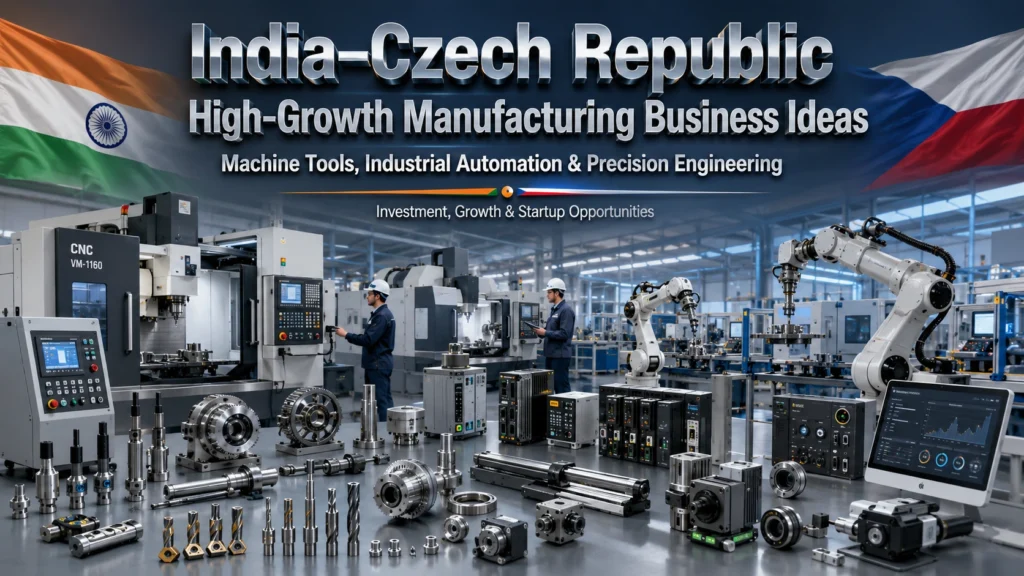
India Czech Republic Manufacturing A Strategic Industrial Corridor Taking Shape India and the Czech Republic are seldom found one and a half sentences back from each other in the business discussions. However, this two-way exchange might just be some of the most interesting manufacturing business opportunities today for entrepreneurs looking for real, fundable and globally accessible business ideas. The two nations have a shared history in sectors that are at the core of the global manufacturing economy such as machine tools, precision engineering, hydraulics, castings and advanced automation. The Embassy of India in Prague states that bilateral trade has reached a figure of US$ 4 billion, from less than US$ 86 million in 1993. This isn’t a trivial tweak. It’s a structural change and it represents that the industrial complementarity of the two economies has gone beyond diplomatic niceties to genuine commercial flows. This moment is not something to take lightly for a startup founder, MSME investor, or an industrial project planner. The Czech Republic has over 40 years of experience in precision manufacturing, not only in CNC machining, forging, hydraulics, environmental technology, but also in electrical power machinery. India offers scale, cost competitiveness, an ever-improving engineering talent pool and a growing domestic market with its increasing sophistication. Both countries can develop a strong two-way supply chain that will be beneficial to manufacturers and investors on both sides. The Embassy of India, Prague is very active in documenting this increasing industrial connection which can be very useful for entrepreneurs. In this article we will discuss specifically which sectors, the policy landscape, ideas for business projects and the trade dynamics make the India–Czech manufacturing corridor a meaningful project to develop? Related Article: How to Start a Fasteners and Precision Parts Manufacturing Export Business in India Why This Industrial Sector Deserves Your Attention Now The world of manufacturing is constantly evolving. The disruptions in the supply chain, geopolitical realignment and the “China Plus One” procurement strategy has compelled European industrial buyers to diversify their procurement aggressively. India has become one of the biggest beneficiaries of this change, especially in the areas of capital goods, precision components, casting, forging and automation in the industrial sphere. The other side of the coin, however, is the Czech economy, which is very engineering oriented. Its manufacturing sector features world-class skills in CNC machine tools, hydraulic & pneumatics, surface engineering, welding technology and Industry 4.0 integration. Czech companies offer technical expertise that is required by Indian manufacturers to enter into international markets. The cost efficiency and the size of Indian companies offer a number of advantages that Czech companies need to globally compete. The Numbers Behind the Opportunity India is already the 2nd largest producer of castings in the world. The turnover of the foundry industry alone is about US$ 20 billion and the exports are nearly US$ 3.54 billion. India Foundry Market is expected to post a CAGR of 10.30% to cross the US$ 31.77 billion mark by 2029. Data published by the IBEF shows that engineering industry makes up 27% of the total factories in the industrial sector in India and 63% of all foreign collaborations in the country. The India machine tool market is another indicator. One such indicator of the gaps in domestic manufacturing capacity is the quantum of import of machine tools which has crossed the ₹40,000 crore mark in a recent fiscal year. These gaps are opportunities for business investment by entrepreneurs who are able to establish import substitution or technology transfer businesses with a Czech business entity. In addition, Czech businesses are investing into India. India has attracted more than 37 Czech companies, such as Škoda Auto, Doosan Škoda Power and Bonatrans, who have invested over US$ 283m in the country. A significant partnership between Tata AutoComp and the Czech rail parts maker Škoda Group is another example of Czech trust in India’s manufacturing capabilities. This is the place in which a fresh entrepreneur can move with a thoroughly prepared feasibility plan. Government Policies and Incentives Supporting This Opportunity The bilateral manufacturing opportunity is viable for startups and MSMEs in India and Czech Republic due to robust policy frameworks. The policy momentum is strong on the Indian side. Production Linked Incentive (PLI) Scheme Now implemented in 14 critical sectors of industry, the PLI scheme has already attracted ₹2 lakh crore investment and incured incremental production of more than ₹18.7 lakh crore. The scheme has directly and indirectly generated more than 12.6 lakh jobs till September 2025. Strategic PLI beneficiaries are those in the capital goods and engineering industries that feed directly into the machine tools and automation industries discussed in this article. As an entrepreneur, you can have a steady and high demand pipeline by matching your project with the PLI connected anchor units. Please refer to Press Information Bureau, Government of India for more details. National Capital Goods Policy and Make in India A dedicated policy has been announced by the government namely National Capital Goods Policy for the machine tools and industrial equipment industry. It aims to boost value addition, cut imports and make India a global hub for capital goods manufacturing. Union Minister HD Kumaraswamy, at the event of IMTEX 2025, assured this would pave the way for innovation and help in cutting India’s reliance on imported precision machines. The Indian machine tool industry is expected to achieve a revenue of US$ 3.8 billion by 2030. Make in India initiative by DPIIT will continue to allow 100% FDI under the Automatic route for manufacturing of capital goods and machine tools. No licensing requirements for industry, no impediments to technology import agreements, and no foreign equity restrictions in most sectors involved. Investors looking into this path should utilise the Make in India portal. Get Detailed Insights from This Book: Our Books MSME Schemes and Credit Support The Ministry of MSME has a slew of support programs for small manufacturers, including the Credit Guarantee Fund Trust for Micro and Small Enterprises (CGTMSE), which offers collateral-free loans worth up
Manufacturing Business Ideas in Tamil Nadu: Best Opportunities Under ₹1 Crore
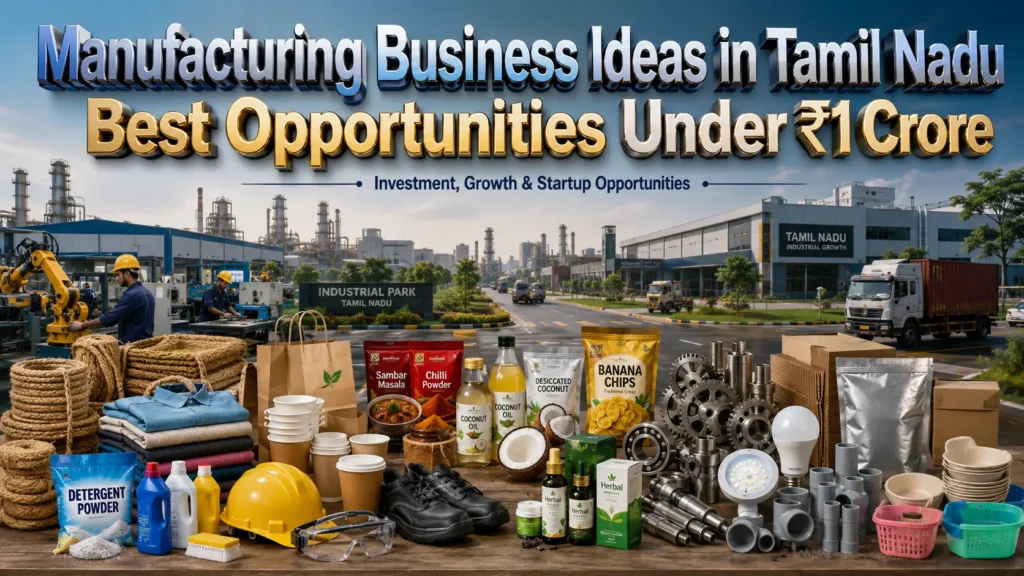
Manufacturing business ideas in Tamil Nadu Tamil Nadu is now one of India’s most powerful manufacturing states and entrepreneurs with ₹1 crore in their pocket have more business ideas that are real than in any other part of the country. The state has a mix of port facilities, skilled workers, and a rich network of suppliers that most first-timers fail to recognise until they begin to survey land. To build a new unit in Chennai, Coimbatore, Tiruppur or Hosur does not require a strong demand base to be created. As Chennai, Coimbatore, Tiruppur and Hosur already have established the demand base for the global supply chain, a new unit can be set up at these locations without facing any difficulty in creating demand. It just needs to connect to the existing. This article dissects where the real scope lies, which government schemes are effective at cutting down your capital expenditure, and which particular manufacturing lines make sense at an investment of ₹1 crore. The objective is not a wish list, but a practical decision making. Get Detailed Project Report (DPR): Tamil Nadu Business Opportunities Guide Why Tamil Nadu Is the Right Base for This Investment The production share of Tamil Nadu in India is one of the highest in the manufacturing sector, which isn’t a coincidence. For decades, the state has been spending money on developing industrial corridors and power plants and on vocational training colleges that churn out skilled manpower for the factories. Thus, a founder who establishes here can save time in training employees and more time in production stabilisation. Access to exports is also important. A significant proportion of India’s exports are carried by Chennai and Tuticorin ports, reducing the cost of logistics for those who produce components, textiles or processed foods for export to international markets. Further, the cluster system in Tamil Nadu reduces working capital cycle as raw material suppliers, job-work vendors and testing labs are within a 50-kilometre radius. Government Policies and Incentives Supporting New Units There are a handful of schemes that directly decrease the effective amount of money that a founder has to invest. For those who have only ₹1 crore in their bank account, the credit guarantee fund trust for micro and small enterprises (CGTMSE) with collateral-free loans up to a defined limit is significant, and the Prime Minister’s Employment Generation Programme (PMEGP) is crucial for financing new manufacturing units by the ministry of MSME. The Production Linked Incentive (PLI) scheme, under the Department for Promotion of Industry and Internal Trade (DPIIT), incentivises certain industries such as textiles and electronics for increasing their production and Tamil Nadu’s own state industrial policy also includes capital subsidy, stamp duty concession and power tariff relief. They should also visit Tamil Nadu Industrial Guidance Bureau to obtain single window clearance which takes away a significant portion of the delay in approvals that regularly drains the first year. The Ministry of MSME website provides the scheme details with eligibility and caps on subsidy for each of these schemes. Multiple Business Ideas Worth Evaluating Textile Weaving and Processing Unit Tamil Nadu also has a significant production of cotton yarn and knitwear – especially in Tiruppur and Coimbatore – and so a weaving or processing unit here exists within a pre-existing ecosystem rather than on the fringes. A mid-scale weaving unit, with dyeing and finishing capacity, and with a businessman with a capital of ₹1 crore, can start it with a selling price of direct transaction with export houses who are already procuring from the local market. Margins are far more related to the type of fabric and generally with processed cotton fabric, the realisation is higher than that of raw yarn trading, which makes it a better option for the new entrants than actually spinning. Read the Complete Book Here: The Complete Technology Book on Textile Spinning, Weaving, Finishing and Printing Auto Components and Precision Machining Hosur and Chennai have a high concentration of auto and auto-ancillary manufacturing facilities, resulting in consistent and recurring demand for precision-machined parts. A job-work unit based on CNC can have two or three machines that can be expanded as quality certificates are received and order volumes increase with the budget of ₹1 crore. Geography is also a competitive advantage for the founders outside Tamil Nadu as OEMs like to use vendors in the vicinity of their assembly lines. Food Processing: Millets and Spice Units There has been a significant increase in the demand for processed millets, as they are being sold to the health-conscious consumers, and agricultural belt of Tamil Nadu is providing raw material at competitive rate. Modest machine investment is required to set up a cleaning, milling and packaging plant for millets or regional spices, which can be utilized by the retail markets as well as the institutional markets. Founders need to invest in good moisture control and packaging equipment, since shelf-life and packaging quality are important factors for repeat orders. Related Article: Semiconductor & Electronics Manufacturing in India: MSME Entry Points, Realistic Costs, and Where the Real Money Is Leather Goods Manufacturing The leather industry is one of the oldest clusters in India and the area of Vellore and its surrounding areas has developed its tanning facilities and artisans. Having a ₹1 crore unit manufacturing finished leather goods, instead of raw leather tanning, greatly reduces the costs of environmental compliance and still provides lucrative margins for export products such as leather bags, leather belts and leather components for shoes. Explore This Book: Leather Processing & Tanning Technology Handbook Electronics Assembly Using SMT Lines Under the PLI push, electronics manufacturing is gaining momentum with Tamil Nadu already having several electronics parks. This budget is suitable for a smaller assembly, using SMT, unit that specializes in sub-components or contract assembly with larger OEMs and can make a profit if that stable anchor client is found prior to investing in the entire line of SMT machinery. Import-Export Opportunity for New Manufacturing Startups The ports of Tamil Nadu receive significant volumes
Top 16 Manufacturing Business Ideas in Jharkhand for ₹15 Crore+ Investment
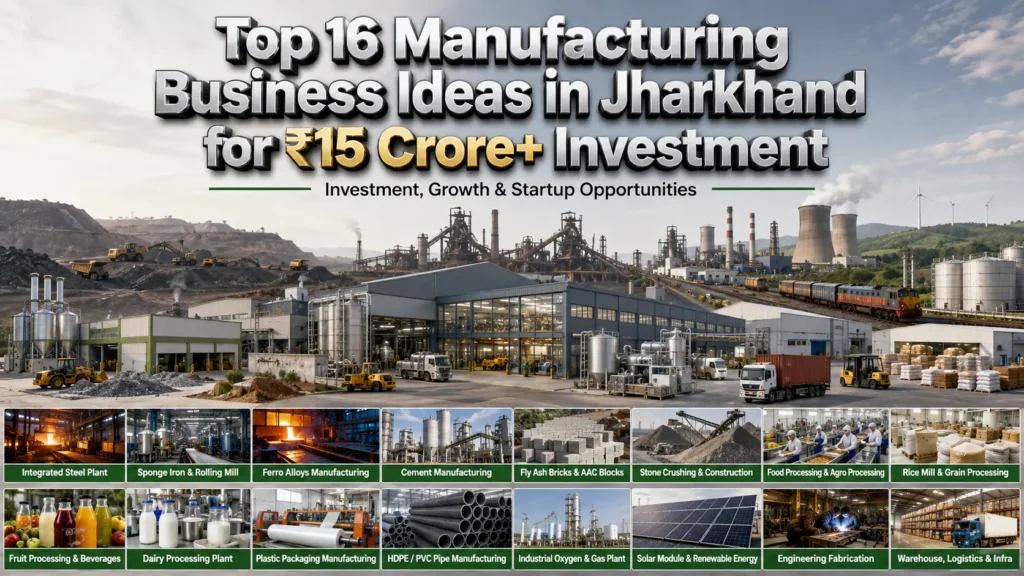
Manufacturing Business Ideas in Jharkhand Why Jharkhand Deserves More Investor Attention If investors are interested in finding big business opportunities in developing states in India, Jharkhand is not one of them. That’s a big mistake. With a young and growing labour force, and an ambitious state industrial policy, Jharkhand is one of the underutilized industrial opportunities in India today, with a rich mineral belt in Asia. The state has rich coal, iron ore, copper, mica deposits which form a significant percentage of the country’s total resources of these minerals. However, it has a very small share of manufactured goods and processed exports. Smart capital should be flowing in the opposite direction, to that gap. Investors with Rs.15 crore or more can buy the shares at an entry point that is exceptionally good. The Jharkhand Industrial and Investment Promotion Policy provides competitive land allocation, power tariff concession, tax benefits, especially for large scale manufacturing. Further, the country-level schemes initiated by the Ministry of MSME, DPIIT and Make in India further enhance the investment proposition. This article presents 16 judicious and economically viable business initiatives that meet the requirement of the availability of raw materials, have high domestic demand and also have a good export demand. Why Jharkhand Is the Right State for Large-Scale Industry The industrial appeal of Jharkhand is more than just its mineral resources. The state possesses over 40% of forest area, has good water resources in the shape of river systems like Damodar, Subarnarekha and Barakar and a developing network of national highways and railway lines linking it to the major port cities. This geographical advantage allows logistics costs to be kept to a minimum, which is a factor that is often a limiting factor for inland manufacturing companies. Moreover, the state of Jharkhand has a well-educated technical staff, primarily due to the presence of institutions such as the Indian Institute of Technology, Dhanbad (ISM), NIT Jamshedpur and Birsa Institute of Technology. Labour cost is much less than it is in Gujarat or Maharashtra and this directly helps to make the unit economic of capital-intensive projects. The state government has also simplified the single window system for clearance by introducing e-Nivesh portal, which was not as cumbersome as in previous years. Get Detailed Project Report (DPR): Jharkhand Investment & Entrepreneurship Guide Key Sectors Driving Industrial Growth Sectors that have seen the most promising growth patterns in Jharkhand are steel and metal fabrication, cement and construction materials, agro-processing, pharmaceuticals, power generation and electronics manufacturing. Besides this, State is becoming a potential place to establish food parks, textile industries and chemical industries. The Invest Jharkhand Portal is the official platform for new industrial project facilitation in Jharkhand and investors can keep track of the active investment opportunities and sector-wise data. Government Policies and Incentives Supporting New Businesses Multiple layers of policy support benefit investors in Jharkhand who intend to undertake large projects. Industrial area development authority (JIADA) gives industrial plots at subsidised rates in the industrial zone, capital investment subsidy, electricity duty exemption for 5–10 years, stamp duty refund and employment generation subsidy. JIADA is the first window for allocation of industrial land in the state. The Chief Minister’s Office, Jharkhand has actively promoted investor summits and fast-track clearance process of projects involving investment of Rs.50 crore and above. This political commitment at the highest level helps to minimise ground delays to the project than what would occur if industrial facilation is a bureaucratic formality in states. Central Government Schemes Worth Leveraging The national level includes the Production Linked Incentive (PLI) Scheme, which is applicable to industries such as specialty steel, food processing, pharmaceuticals, electronics, etc., which are considered viable in Jharkhand. CGTMSE is a scheme that provides project finance for MSMEs. The Ministry of MSME promotes cluster manufacturing through SFURTI scheme. A ready infrastructure plug is provided to the textile investors by the PM MITRA park scheme. Investors should proactively seek assistance from DPIIT (Department for Promotion of Industry and Internal Trade) on matters relating to central incentives and new policies. 16 Large-Scale Business Ideas in Jharkhand (Rs.15 Crore+ Investment) 1. Integrated Steel Re-Rolling Mill Steel re-rolling is perhaps the most natural business idea which can be implemented on a large scale in Jharkhand. The State is flanked by some of the richest iron ore and coking coal belts of India. An integrated re-rolling mill processing billet into TMT bars, sections and wire rods can cater to the demand of construction industry which uses explosions throughout the eastern and central parts of India. The investments of the project, which fall in the range of Rs.20 – Rs.50 crore, provide strong returns as the raw material procurement cost is structurally lower in this range as compared to any other state in India. Domestic demand for TMT bars has been steadily increasing, fuelled by infrastructure investment within the National Infrastructure Pipeline (NIP). Besides, there is also additional market access owing to its proximity to Odisha and West Bengal. Backward integration into sponge iron should be considered by investors to improve their margin profile even further. Improvements in power sector were a challenge in Jharkhand for industrial areas, but now it’s better. 2. CemenManufacturing t Plant Cement is one of the most feasible business ideas in Jharkhand as it has a good availability of limestone in Palamu district, of Hazaribagh and Latehar districts. The margin profile of a mid-scale cement plant is very strong in eastern India where supply has always been weak and the investment requirements are Rs.30–Rs.80 crores per day. Eastern corridor continues to be one of the most cement-starved ones in India. This deficit is expanding, not contracting, in light of the central government’s infrastructure push, which ranges from roads, housing, to bridges. Moreover, the housing schemes of the state government, the Mukhyamantri Awas Yojana, also provide a captive consumption channel. Investors setting up regional cement companies in Jharkhand are likely to create substantial pricing power against the national cement companies, which have to deal with higher logistics
How to Find the Perfect Business Idea for Your Budget: NPCS Startup Selector Tool
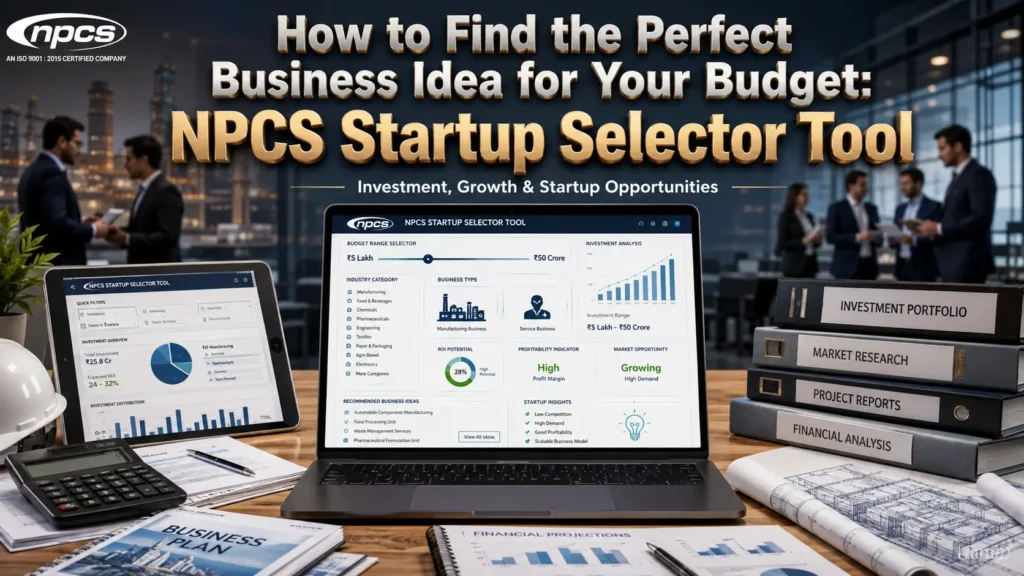
Startup Selector Tool India Each year, thousands of career professionals, MSME investors, and first-time entrepreneurs find themselves with the same question to ponder: what business should I really start? Most people spend weeks, even months, reading through random blogs, YouTube videos and even old, outdated lists trying to correlate a business idea with available resources and come up with a solution and then end up even more confused than they were at the beginning. The problem is an issue that Niir Project Consultancy Services (NPCS) has hidden away until now — a free, instant Startup Selector tool that matches entrepreneurs to real, data-driven business ideas in terms of their own investment capacity and financial goals — and few entrepreneurs looking for business ideas online even realize it exists. If you are looking for how to choose a business to start, best manufacturing business ideas within my budget or a free startup idea finder tool in India, this article gives you a resource that can save a lot of your scattered research – NPCS Startup Selector, available free at niir.org/startup-selector. Explore This Book: Just For Starters: How To Start Your Own Export Business What Is the NPCS Startup Selector and Why It’s a Genuinely Useful Tool Designed to automatically generate a list of projects that match the criteria you enter, the Startup Selector is a quick and easy project identification and selection tool based on NPCS’s comprehensive database of over 12,000 project reports and business profiles covering manufacturing, agro-processing, chemicals, food processing, packaging, engineering, and dozens of other industrial sectors. It eliminates the need for entrepreneurs to sift through thousands of pages to find the right business ideas and instead allows them to input their own financial considerations and get a short list of business ideas that really align with them. The Startup Selector personalises to each entrepreneur’s actual budget — giving far more actionable content than the majority of lists of business ideas found online today, which are the same for every reader. How the Startup Selector Works: Five Simple Search Parameters The entrepreneurs can use any combination of the following inputs to search the entire NPCS project database: Plant & Machinery Cost (in Lakhs): these are filters to help narrow down ideas depending on the type of machinery investment that you are willing to make Total Capital Investment (TCI) (Lakhs): align concepts with the overall capital available, including working capital. This filter is useful for planning bank loan or subsidy applications and helps narrow down the projects by total project cost (in Lakhs). This filter is useful to help narrow down the projects by the overall cost of the project (in Lakhs) when planning bank loan or subsidy applications. The business ideas must have the rate of return (ROR) (%) that is above your minimum desired rate of return. Break Even Point (BEP) (%) — recognize ideas that have a breakeven profile that are consistent with your risk tolerance These parameters can be entered in seconds and the tool returns a short, carefully selected list of matching project ideas and project profiles – from small businesses to larger industrial projects – from NPCS’s ever-growing database of business opportunities. Why This Tool Solves a Real Problem for Indian Entrepreneurs There are a number of honest reasons why this is a good idea for anyone considering a new business venture: It’s a free tool: There’s no payment to access the shortlist, and no login to the Startup Selector in order to create a shortlist of business ideas. No payment or login: No fees required for accessing the Startup Selector, and no login to the Startup Selector for creating a shortlist of business ideas. Saves hundreds of hours of research: Entrepreneurs get a list of relevant and focused sources they can search on, rather than having to compare dozens of random sources found through the web. It’s based on real financial data: No guessing, each project idea that is returned is backed by NPCS’s actual data from the Techno-Economic Feasibility Report, including ROI and Break-Even Analysis. The database is updated continuously: The ideas which have appeared are based on the latest market data, not on outdated lists, but on the latest market data. It serves all budgets: If you’re investing ₹5 lakh or ₹5 crore, the tool filters the ideas with relevance to your capital range and not shows irrelevant large scale and micro scale ideas. Related Article: You Don’t Need a Business Consultant to Find Your First Business Idea — Here’s Why Who Should Use the Startup Selector Tool 1. First-Time Entrepreneurs Exploring Options Knowing that you want to launch a manufacturing or industrial enterprise, but not a specific industry, the Startup Selector is the quickest approach to view a realistic and budget comparable set of industries without beginning from scratch. 2. MSME Owners Looking to Diversify The tool can be used by existing business owners who want to pursue a second line of business or a new product line and need to quickly see what other business lines are complementary and what amount of capital investment is needed. 3. NRIs and Investors Seeking Indian Manufacturing Opportunities The tool can be used remotely by NRIs and investors for manufacturing projects in India to shortlist the projects prior to detailed feasibility report and project consultancy by NPCS. 4. Students and Young Professionals Planning Their First Venture For anyone who is still saving for their business or just thinking about investing in a long-term business venture, the tool can help clarify what businesses are viable at various levels of investment, which can help guide savings and business-planning objectives well before the capital is needed. View Full Project Details: Project Reports & Profiles From Business Idea to Bankable Project: What NPCS Offers Next The Startup Selector has been created as a starting point of the NPCS journey of entrepreneurship, and not as an end product. After narrowing down the list of business ideas that are matched, NPCS provides complete Market Survey cum Detailed
How to Prepare a Techno-Economic Feasibility Report for a Bank Loan

Techno Economic Feasibility Report for Bank Loan The Rejection That Wasn’t About the Business In India, about 70% of MSME loan applications may be rejected not due to the strength of the business idea but because of the project documents. That number, often quoted in the Reserve Bank of India’s financial inclusion reports, is an unfortunate paradox – India has the capital, and the ideas are brought to the table by the nation’s entrepreneurs, but the paperwork doesn’t. Techno-Economic Feasibility Report (TEFR) is the document that forms the basis of all possible bank sanction processes. If you ask any MSME relationship manager from Punjab National Bank, Bank of Baroda or SIDBI, they will all reply the same: MSME feasibility report. It’s not about the entrepreneur’s enthusiasm. Not the opportunity pitch for the market. The report. In India, most first-generation entrepreneurs, who are rice mill owners in the state of Chhattisgarh, garment manufacturing in Tiruppur, cold storage investor in Agra, etc., take months to choose the equipment and negotiate land, and invest just two days in the report. That’s the exact opposite ratio. Poorly written TEFR will sink an otherwise good project. With a proper structure a one can sanction a ₹5 crore in 8 weeks. Here’s the inside scoop on what a bank-grade TEFR includes, how to assemble each section, and what sets it apart from the rejected documents that languish in a credit manager’s rejection bin. Related Article: Detailed Project Report (DPR) Consultants in India: How to Get Bank Loan and Government Subsidy for Your Business Why Most Project Reports Fail at the Bank Counter The formal banking system consisting of public sector banks, private banks and development finance institutions (DFIs) such as SIDBI have together allocated more than ₹22 lakh crore to support MSME loans as per their respective priority sector policies. However, penetration of credit into micro and small businesses is still very low. The shortage is not due to the lack of money. It is caused by poor quality project documentation. One of the most consistent findings in the Reserve Bank of India’s annual report on MSMEs is that ‘inadequate financial data’ and ‘insufficient technical details’ are the main reasons for the MSME applications to be rejected. There are many applicants that present what they term a ‘project report’ which is actually a simple spreadsheet with projected revenues and a quotation from a supplier pasted into it. A structured document which contains three layers of analysis is called a Techno-Economic Feasibility Report: Analysis of the technical aspects — what is to be produced, how it is to be produced, and what infrastructure is required for the production. Economic analysis — will the unit be able to produce cash sufficient to pay back the loan and to show a profit? Risk evaluation – what can go wrong and have they done something to minimise the risk? The TEFR is used by banks in India as a report for Due Diligence Input Report (DDIR) before the credit sanction committee meeting. The credit officer has nothing to go on but the entrepreneur’s past, if there is a credible TEFR. As per the Ministry of MSME’s Udyam registration portal, there are more than 4.6 crore MSME’s in India registered with the ministry. Only a small proportion of these have sought formal bank finance. One of the reasons is the quality of documentation – which is 100% fixable. Table 1: Common TEFR Deficiencies and Their Impact on Loan Applications TEFR Deficiency Section Affected Bank’s Concern Rejection Risk No break-even analysis Financial Projections Can the unit survive a bad quarter? High Missing pollution NOC reference Regulatory Compliance Will the plant face shutdown orders? High Equipment cost without quotations Capital Cost Estimate Is the capex realistic or inflated? Medium-High No raw material sourcing plan Technical Feasibility Supply disruption risk unquantified Medium Promoter contribution not shown Funding Pattern Is the promoter committed? High No sensitivity analysis Risk Assessment What if revenue falls 20%? Medium Generic market study, no India data Market Feasibility Is there real demand for this product? Medium-High Missing working capital estimate Financial Projections How will day-to-day operations run? High The Window That Policy Has Opened The credit scenario for MSMEs manufacturing has significantly improved in India. There are now several policy instruments that reduce the risk on bank lending to units that provide a credible feasibility plan. Collateral free loan guarantees up to ₹5 crore have been introduced for micro and small enterprises through the Credit Guarantee Fund Trust for Micro and Small Enterprises (CGTMSE) run by Government of India and SIDBI. Banks are much more likely to make loans through CGTMSE — and a decent TEFR is the most important document needed to activate the guarantee. PMEGP (Prime Minister’s Employment Generation Programme) is administered by KVIC, which provides capital subsidy ranging from 15% to 35% of the project cost for the first-generation entrepreneurs for the setting up of manufacturing units. Subsidy shall be disbursed based on the Detailed Project Report (DPR) – which is equivalent to a TEFR. Production Linked Incentive (PLI) schemes in 14 sectors (food processing, specialty chemicals, electronics, etc.) mandate for larger investments demand techno-economic documents to be submitted when claiming incentives. Some states such as Gujarat, Tamil Nadu, Karnataka and Telangana have state-level MSME investment policies which require a feasibility report for disbursement of incentives. Having a well-balanced TEFR is more than just a business case for bank loans. A well-formulated report is also a: Rationale for the application of CGTMSE guarantee Requests for refinancing by SIDBI will be handled technically by the technical input The main exhibit in an equity investment or joint venture talks The compliance documents required for availing the MSME incentive from the state governments. According to SIDBI’s MSME Pulse report, credit is available at lower interest rates and with faster sanctioning periods at MSMEs with structured techno-economic documentation (6–10 weeks) as compared to the undocumented ones (18–24 weeks). Get Detailed Insights from This Book: Select & Start Your Own Industry