
Acetic Anhydride Market Research Report 2026: Size, Growth, Demand-Supply Gap and Business Opportunity for Startups in India
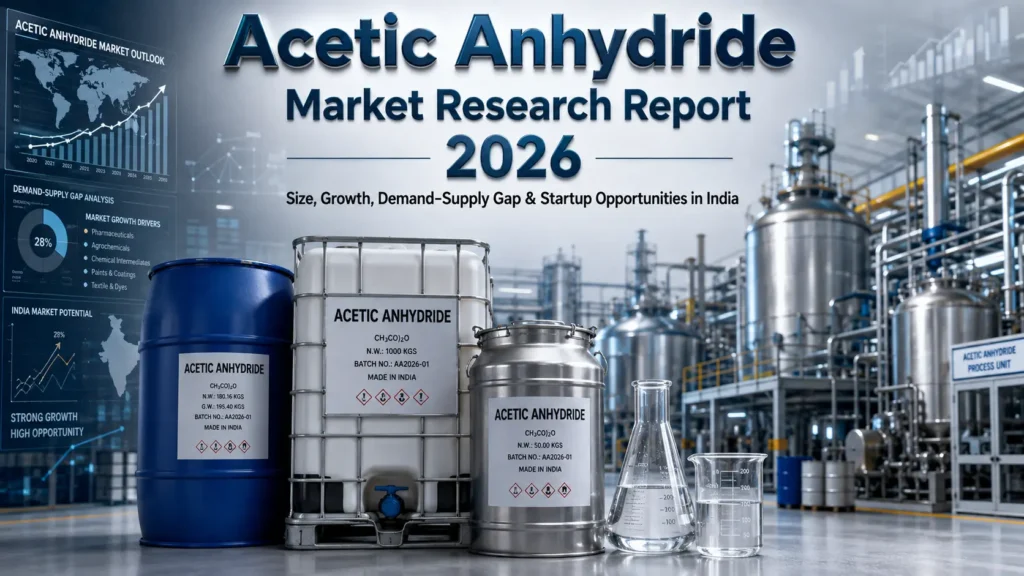
Acetic Anhydride Manufacturing in India India’s pharma sector is estimated to expand from USD 65 billion in 2024 to USD 130 billion by 2030 and acetic anhydride plays a central role in the synthesis process of some of the most widely consumed drugs produced by the industry, such as aspirin and paracetamol. However, the higher molecular weight acetyl chemical chain to which acetic anhydride belongs is one of the most import dependent industries in India as India imports over 85% of its need for upstream acetic acid. This opportunity is embedded in that dynamic: a growing demand for the pharma products downstream coupled with a highly import-dependent feedstock supply chain. What Is Acetic Anhydride? Acetic anhydride or ethanoic anhydride is a clear colourless liquid carboxylic acid anhydride produced mainly by the ketene process using glacial acetic acid as the raw material. It acts as a powerful acetylating agent (reacts with an alcohol or amine to add an acetyl group), which is useful in a number of key industrial value chains: Get Detailed Project Report (DPR): Acetic Anhydride Global and India Acetic Anhydride Market Size and Growth Global estimates for market value vary widely, depending on scope, from approximately USD 3.36 billion to USD 6.98 billion in 2025-26, rising to between USD 5.42 billion and USD 9.12 billion by the early-to-mid 2030s, with the CAGRs in the middle band. The size of India’s domestic market is estimated to be around USD 87–400 million (2024), with volume estimates ranging from approximately 76,000 metric tonnes (MT) in 2023, and most estimates of the Indian portion of the market CAGRs are significantly higher than the global average — ranging from 2.1% to as high as 7.8% across different studies — reflecting the country’s skewed higher growth pharmaceutical and agrochemical demand base compared to more mature global markets. Note on figures: Market studies of the acetic anhydride market differ in scope, some covering only the volume of the merchant market, others including the captive/integrated market. NPCS can develop an investor-grade numbers-based techno-economic feasibility study to suit your target application (pharma-grade vs. industrial-grade) and capacity. The Upstream Acetyl Chain Import Dependency The Indian supply position of acetic anhydride cannot be viewed in isolation as it is downstream of acetic acid and India’s acetic acid supply chain is extremely import dependent. India is the biggest consumer of acetic acid (around 1.2 million tonnes of acetic acid was consumed in 2024 ahead of China and the United States) but also imports over 85% of its acetic acid consumption, making the whole acetyl chain (including acetic anhydride, ethyl acetate and other derivatives) one of the most import dependent chemical sectors in India. The Indian acetyl chain market is estimated to be about USD 567 million, and could be significantly bigger by 2032 with the expansion of the downstream pharmaceutical and industrial market. This gives a unique strategic situation: domestic acetic anhydride capacity is growing (and recently has grown from established producers) – but even with this additional capacity, the production process still generally relies on the import of upstream acetic acid as feedstock – not just at the conversion stage of the process, but that stage is upstream. Explore This Book: Handbook On Chemical Industries (Alcohol Based) Policy Tailwinds 1. Pharmaceutical self-sufficiency push: India’s government emphasis on domestic API (Active Pharmaceutical Ingredient) production, aimed at reducing reliance on imports for critical drug intermediates, directly strengthens demand for domestically-manufactured, traceable, consistent-quality acetic anhydride. 2. PLI scheme of bulk drugs and key starting materials: Supporting the business case for backward integration investments for Acetyl chain – including Acetic anhydride – in indirect terms through PLI scheme for bulk drugs and key starting materials. 3. Expanding agrochemical export industry: India exports about 50% of its agrochemicals and the demand for acetic anhydride is closely linked to this export-intensive growth industry as it is used as a key raw material in the manufacture of organophosphate pesticides such as acephate. 4. Manufacturing relocation from stricter-regulation markets: Increasing environmental restrictions on pesticide manufacturing in the US and Europe are shifting agrochemical production toward India, further increasing domestic acetic anhydride demand. 5. Resurgent interest in cellulose acetate/bio-based materials: Revival of global interest in the use of cellulose acetate in the field of biodegradable plastics and sustainable textile products has generated new market opportunities for acetic anhydride in addition to the traditional cigarette filter tow market. India Demand-Supply Gap: Acetic Anhydride and the Broader Acetyl Chain Parameter Current Position India’s acetic acid position World’s largest consumption market (~1.2 million tonnes, 2024), yet imports over 85% of this requirement Broader acetyl chain market size ~USD 567 million (encompassing acetic acid, ethyl acetate, acetic anhydride, and related derivatives) India acetic anhydride market (2023) ~76,000 metric tonnes, growing at a CAGR estimated between 2.1% and 7.8% depending on the study Recent domestic capacity expansion IOL Chemicals & Pharmaceuticals expanded acetic anhydride capacity from 25,000 to 32,000 MTPA (March 2026); Laxmi Organic Limited has proposed further expansion at its Raigad, Maharashtra facility Nature of the gap A compound, two-tier import dependency — India’s acetic anhydride production capacity is growing, but much of it still relies on imported upstream acetic acid, meaning the more structural opportunity sits in backward integration across the full acetyl chain, not acetic anhydride conversion alone Downstream demand driver India’s pharmaceutical industry, projected to grow from ~$65 billion (2024) to ~$130 billion (2030), directly and substantially grows the addressable acetic anhydride market as a critical drug synthesis intermediate Opportunity for new entrants Strongest for integrated players capable of backward integration from acetic acid production through to acetic anhydride and downstream cellulose acetate/pharma intermediate manufacturing Reading in the gap: This is a multi-layered opportunity, not a one-and-done opportunity. India’s own government recognised acetyl-chain research explicitly states that the country is “one of the most import dependent chemical industries in India” since 85%+ dependence on Acetic Acid, and in turn, this is a constraint on realising self-sufficiency at the level of Acetic Anhydride with an increase in conversion capacity.
How to Start Empty Capsule Manufacturing Plant in India: Cost, Investment & Profit
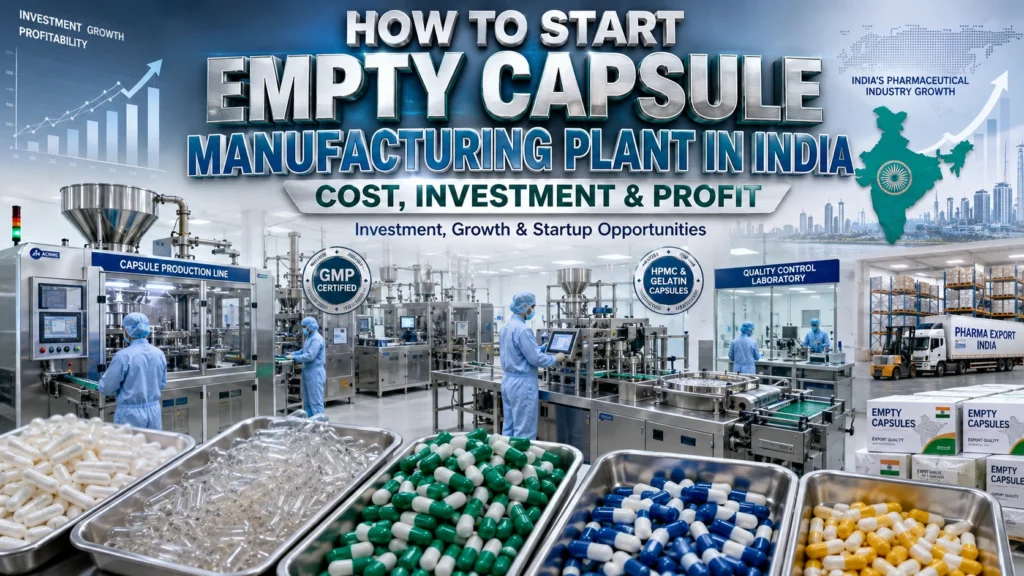
Each tablet that is not produced is a capsule order and each capsule order requires an empty capsule before the first milligram of active ingredient is placed in the capsule. However, India’s low bulk capsule production market is concentrated with just a few large-scale manufacturers, with mid-size formulation companies and nutraceutical brands waiting for days for orders which would fill their weeks in a free competitive market. It is the space where India businessmen can create an empty capsule manufacturing plant that can be sold to other business-to-business players – not branded as a consumer product. It’s packaging-adjacent manufacturing — not sexy, not obvious to the purchaser, and not a business that first-generation entrepreneurs typically think about. The vegetarian and HPMC capsule market is expanding more quickly than the domestic supply, due to the demand of halal, kosher and vegan consumers, which can’t be met by the gelatine capsule market. Get Detailed Project Report (DPR): Empty Gelatin Capsules Why This Is a Genuine Opening In this case, the demand reasons aren’t based on convincing anyone of anything. All tablet manufacturers making the move to capsule dosage, all new supplement brands from the nutraceutical industry, and every export order from Africa or Southeast Asia requires a dependable capsule supplier, but the supply base at home has not been able to keep up with the increase in formulation and nutraceutical manufacturing it feeds. There’s a special challenge for vegetarian HPMC capsules: consumers’ growing preference for plant-based shells for religious, dietary, and ethical reasons has created a shortage that’s exacerbated by the fact that only a few Indian manufacturers are currently producing HPMC capsules on a scale that meets demand. The entry cap-ex is not negligible. The cost of the single-line hard gelatin capsule unit, which is capable of producing about one billion to 1.5 billion capsules a year, is about eight to 15 crore rupees, involving investment in dip-pin machines, drying tunnels and printing equipment. The processing and drying conditions for the polymer used to make capsule lines are significantly different from those used in the case of gels and the lines are therefore more expensive, fifteen to twenty-five crore rupees. FSSAI registration is required for licensing and in case of export oriented pharmaceutical formulators, facility approval from CDSCO or USFDA clearance is required, which takes around twelve months of the commissioning process. Margin and Risk Structure This is because the commodity hard gelatin capsules is a thin margin business itself (gross margins are 8-12 percent) and because buyers change suppliers by fractions of a rupee per thousand capsules. The gross margin on HPMC vegetarian and specialty capsules is very high, anywhere from 18-25% gross margin, due to the fact that far fewer manufacturers can reliably produce these capsules to pharmacopeia specification, allowing the early movers to really have the pricing power that commodity gelatin manufacturers do not. In this segment, scalability typically comes from installing lines, not from building new facilities — a founder typically launches with a handful of dip-pin machines, tests out quality uniformity with a few formulation buyers, then expands lines based on repeat demand. The primary risks are raw material dependent; the price for gelatin is tied to the prices of bone and hide collagen on the global market, and is liable to sudden fluctuations, while HPMC is a derivative of cellulose, with a smaller and more concentrated global base of suppliers for its raw polymer. The other risk is rejection by quality-sensitive pharmaceutical buyers; if a buyer orders a year’s worth of sales but finds that one batch is out-of-specification, he or she may not order the next one. Product and Project Opportunities Worth Evaluating Standard Hard Gelatin Capsules The standard hard gelatin capsules are by far the biggest share of the market, providing generic pharmaceutical formulations to the overcrowded manufacturing camps in Baddi, Hyderabad and Ankleshwar in India. A unit designed to serve 1-1.5 billion capsules per year requires capex of ten to fourteen crore rupees, with an expectation of supplying companies in the formulation business within a radius of 300-400 kilometres to ensure cost of logistics. With the strong competition in the price of the existing large suppliers, it is obviously not a margin play that the new entrants can make the economics work with, but a business model based on volume and reliability. Gross margins finally settle at 8-12 percent. Related Article: Building a Successful Pharmaceutical Manufacturing Business HPMC Vegetarian Capsules For nutraceutical brands, halal and kosher export buyers, and pharmaceutical formulators seeking alternatives to animal-derived capsules, HPMC vegetarian capsules are the right choice. A dedicated line, which costs between a hundred and two crore rupees, accounting for the specialised polymer-processing and humidity-control specifications, directly targets nutraceutical contract manufacturers and export-based supplement brands. Margins are 18-24 % which is significantly better than gelatin, since there is very limited number of qualified HPMC capsule manufacturer in India till now with a growing demand. Colored and Printed Specialty Capsules Colored and custom printed capsules meet the brand differentiation needs of nutraceutical and consumer wellness companies looking to achieve a white shell that stands out on the shelf. Print and multi-colour capability is an additional cost of 2-4 crore rupees over the existing capsule line, margins are between 20-28 percent as the pricing is done based on brand value and not on the economics of capsules. A good second phase addition for an existing base gelatin or HPMC brand with a founder who does not want to invest in an additional facility for the higher margin brand-conscious consumers. Enteric-Coated Capsule Shells The enteric coated shells, which resist stomach acid and only open up in the intestine, appeal to a more niche but higher-value pharmaceutical and probiotic buyer segment. The additional cost of a specialised coating line at an existing capsule plant is of the order of Rs.5 to 8 crore, and margins are 25-30 per cent due to the technical barrier to entry, where the ability to replicate the coating consistency is a skill that
Pharma Manufacturing Business Telangana: Bulk Drug Park Guide
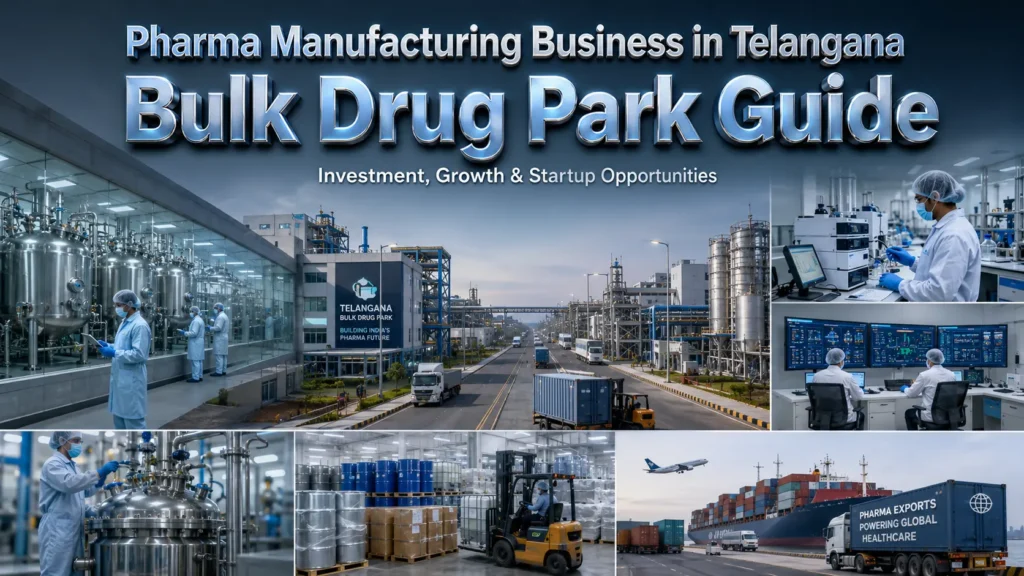
Pharma Manufacturing Business Telangana The Hyderabad alone produces about one third of India’s output of bulk drugs and APIs, with the core of these activities being Genome Valley and a pharma manufacturing base, which has been created over 30 years. It’s actually this concentration that makes the pharma manufacturing business that the Telangana entrepreneurs think about today appear daunting from the exterior: Dr. Reddy’s, Divi’s Laboratories and Hetero already possess the cake. But the state’s own Bulk Drug Park initiative, which has been aided by capital subsidy from the central government, has been created because the policy makers have realised that there is a room for new and specific players in the market, apart from the giants who are already working on a large scale. It is not an opportunity for a founder looking for a product for which every other unit in Hyderabad is doing business. It’s an invitation for one trouble-prone founder to focus on a single facet — one intermediate, one niche API, one contract manufacturing partnership — within a regulatory framework, a workforce, and a buyer base that other states take years to develop. Read the Complete Book Here: Business Ideas for Startup in Drugs & Pharmaceutical Industry with Project Profiles Why Telangana’s Pharma Cluster Is a Genuine Opening Get started with talent density. An advantage for Hyderabad over the pharma companies that have not built their capacity with API and formulation manufacturing in the city, is that a new startup can easily find experienced process chemists, regulatory affairs personnel and quality control staff, without having to import them from across the country. Add to this the government’s support. The special Bulk Drug Park developed with central PLI linked capital subsidy and allotted through Telangana State Industrial Infrastructure Corporation has plug and play infrastructure with shared effluent treatment specifically for API and intermediate manufacturing thereby reducing capex and approval time for the units to be located inside the park. The state’s own industrial policy with a focus on the pharmaceutical sector has another layer of capital and power tariff benefits that sit on top of central schemes implemented through the Ministry of Micro, Small and Medium Enterprises. The basic intermediate manufacturing unit costs start around fifteen to two dozen crore rupees for two hundred to three hundred tonnes per year, while API manufacturing for regulated markets is thirty to fifty crore rupees based on stringent quality and validation regulations. It takes around 10-14 months for the Telangana State Pollution Control Board to approve licenses and the Central Drugs Standard Control Organisation for drug manufacturing to approve infrastructure, specifically Bulk Drug Park. Business Selection Logic The margin structure is as elsewhere in the bulk drug industry in India: commodity intermediates, which a handful of existing firms in Hyderabad produce, trade at 12 to 18% margins, while specialty intermediates or niche APIs that cater to a single innovator molecule trade at 25 to 35%. The pharma cluster in Telangana is scalable because of the presence of well established buyers. A founder can launch with one multipurpose batch reactor, test one or two products with a local formulation company that doesn’t have to look far to find a qualified supplier, and then expand when repeat orders are received and the product has been proven to be in demand. The same risks identified in bulk drug manufacture in the country, such as regulatory clearance timelines and buyer concentration, apply in Telangana, however, the buyer search risk that the founders of companies in less pharma-dense states face is significantly less in Telangana due to the high concentration of buyers of bulk drugs in the state. Get Detailed Project Report (DPR): Business Opportunities in Telangana – Startup & Entrepreneurship Guide Product and Project Opportunities Worth Evaluating Antibiotic and Antiviral Intermediates Antibacterial and antiviral intermediates are being used by Hyderabad’s formulation units all the time and also the volume of customers within the state is such that if a new intermediate manufacturer wants to find a customer, they have to look within 50 km of Hyderabad. The capex for a plant of 150-250 tonne per annum is 18-25 crore rupees. The margins range from eighteen to twenty-two percent after the quality certification process with a formulation buyer is completed, which is quicker in Telangana than states with lesser concentration of pharma buyers because of their prior understanding of the qualification of suppliers. Contract Manufacturing for Global Innovator Companies With its proven regulatory track record, Telangana is a logical base for the CRAMS approach of contract manufacturing, offering global innovator pharma companies to explore India as a production partner for complex intermediates. A separate unit – one with capex of 12 to 20 crore rupees – enters into multi-year supply contracts instead of looking for volumes in the spot market. The margins are 22-28 per cent and the existing standing that Hyderabad has with the regulatory authorities is a good advantage in terms of trust building for the buyer than if the founder was coming from a lesser- established pharma hub. Niche API Manufacturing for Regulated Export Markets The best chance for a founder to carve out a niche in the Telangana pharma market is niche APIs which are molecules with a small number of qualified global manufacturers. A dedicated facility, the capex is in the range of Rs. 30 to 40 crore, which takes into consideration quality and validation infrastructure requirements, directly targets export formulation buyers in regulated markets. Once a Drug Master File (DMF) is filed and approved, the margins are twenty-eight to thirty-five percent, but the filing of a DMF takes between twelve to twenty-four months. Related Article: India’s ₹27,000 Crore API Import Problem Is Your Biggest Business Opportunity Pharma Packaging and Ancillary Component Manufacturing In addition to direct drug production, Telangana’s pharma density ensures a consistent demand for such special packaging and blister components, as well as ancillary manufacturing that every formulation and API unit in the state will need. The dedicated line requires capes expenditure of Rs 8-12
Adult Diaper Manufacturing Business in India: BIS IS:17015, SAP Technology, Market Demand and Investment Guide
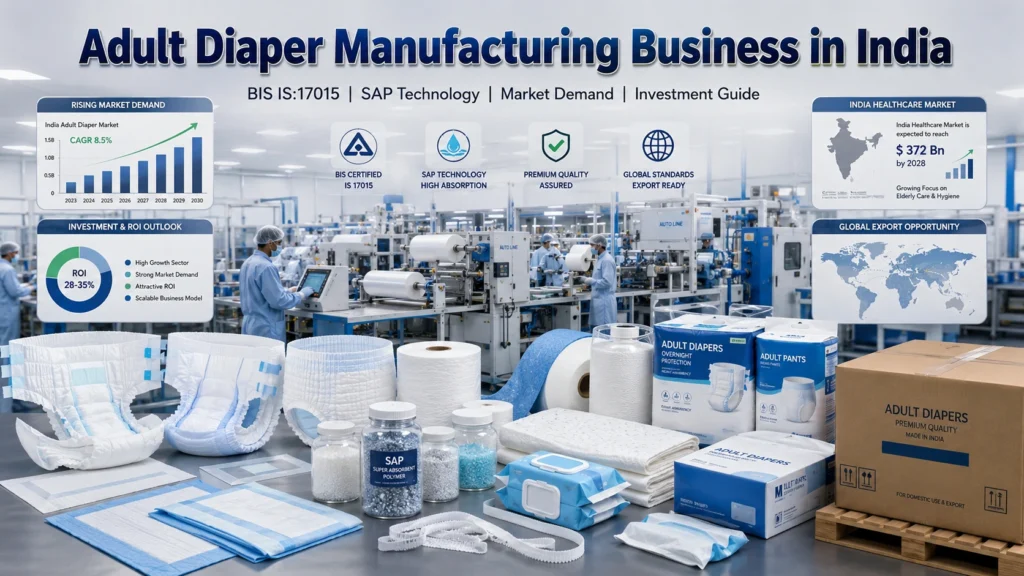
Adult Diaper Manufacturing Business in India The adult diaper segment is one of the fastest growing consumer healthcare product segments in India, owing to the increase in the aging population, awareness about incontinence, adoption of nursing/ post-surgical care in the hospital sector and formalization of home care for the elderly and nursing. The market value is estimated at Rs 1,500-2,000 crore and is growing at a healthier rate of 20-25 percent CAGR as compared to most medical consumable categories, with India importing a large proportion of its need even though it has the infrastructure, technology and expertise to manufacture medical-grade adult diapers, SAPs (superabsorbent polymer) and packaging. According to Research published in NCBI: Urinary Incontinence Prevalence in India, there is a massively under-served domestic market as it is estimated that 20-30 percent of the elderly population in India suffers from urinary incontinence. According to WHO Global Report on Ageing and Health, access to adult incontinence products is among the most important parameters of quality of life of the ageing population of middle-income countries. Market Opportunity: Why This Business Cannot Be Ignored Multinational brands such as Kimberly-Clark’s Depend and Tena by the Essity dominate the market of diapers for adults in India, with a few organised domestic producers. The majority of the Rs 2000 crore+ growth in the market is happening in institutional channels such as hospitals and home care, where quality is the main procurement criterion of choice, per the standards set by the Bureau of Indian Standards (BIS) under the IS:17015 (Adult Diaper Specification) standard. One that is growing rapidly is hospital and home care institutional supply. The growth of national programme initiatives such as elder care and palliative care provided by NHM and the growing market of registered adult care facilities under the Ministry of Social Justice is generating huge institutional buyer markets for the quality domestic producers of certified adult incontinence products, thereby opening up government procurement channels as well as consumer retail outlets. Get Detailed Insights from This Book: Sanitary Napkins, Baby and Adult Diapers Industry Analysis: Growth Drivers and Demand Outlook The adult diaper market in India is currently Rs 1,500-2,000 crore with a growth rate of 20-25 per cent per year. According to the FICCI’s Consumer Healthcare Report, India’s adult incontinence market will swell to Rs 5,000 crore by 2030, as the ageing population of 140 million +60 years will grow at 3 per cent every year, and there is a growing awareness across the country about the management solutions available for incontinence. The PIB: India Census and Elderly Population Statistics indicates that the ageing population is growing at a compound annual rate of 3 percent and by 2050, the number of elderly people in India will be more than 300 million and one of the world’s largest ageing populations. To get private label supply to the pharmacy chains (Apollo Pharmacy, MedPlus, Wellness Forever) is an effective way to enter the market, without burdening consumer brand building costs and with access to proven retail distribution channels on institutional rates. The PMEGP scheme of MSME Ministry offers up to a maximum of 25-35 percent capital subsidy for manufacturing a new manufacturing unit in the consumer healthcare product manufacturing sector, which brings down the net equity required for a new manufacturing unit by an adult diaper manufacturing entrepreneur. India’s consumer healthcare market is expanding at more than 15 percent per year and among the fastest-growing sub-categories are products for elder care and incontinence management, according to the IBEF: India Consumer Healthcare Market. India Adult Diaper Market Overview Parameter Market Data Notes India Adult Diaper Market Value Rs 1,500 – 2,000 crore Industry estimates Market Growth Rate 20-25% CAGR Ageing population and care awareness India Population Aged 60+ 140+ million people Growing at 3% annually BIS Standard IS:17015 (Adult Diaper Specification) Mandatory for institutional supply Core Technical Ingredient SAP (Superabsorbent Polymer) 250-300g/m2 in absorbent core Key Market Segments Hospital, nursing home, home care, retail Multiple buyer channels Market Leaders Kimberly-Clark, Tena, Romsons, Nobel Hygiene Domestic brands growing How to Start: Step-by-Step Guide for Entrepreneurs Step 1: Business Setup and BIS IS:17015 Certification Dedicate entity, get Udyam MSME registration, and factory licence and GST. Request the BIS IS:17015 (Adult Diaper) Certificate which is required for hospital / medical institution supply. The absorbency under pressure, acquisition time, rewet, pH and odour parameters are specified in IS:17015. No CDSCO Device Licence for incontinence management (wound care) diapers. Step 2: Technology: SAP Core and Absorbent Layer Design Adult diapers feature a superabsorbent polymer (SAP) core that absorbs urine 30 times its weight, surrounded by absorbent fluff pulp, and topped with a top sheet (nonwoven) and backed by a breathable PE or PP film. Absorbency capacity is dependent on SAP concentration (250 – 300 g/m2). Forging R&D partnership with domestic supplier of SAP (Nippon Shokubai India, SDP Global / imported specialty polymer distributors). The Wikipedia: Adult diaper encompasses international technology standards for adult incontinence products, such as SAP concentration, acquisition time and rewet performance. Get Detailed Insights from This Book: Our Books Step 3: Production Line: Diaper Converting Machine An integrated diaper converting machine is utilized for the production of adult diapers, which combines the process of creating the fluff pulp-SAP core, attaching top sheet and backsheet, adding leg cuffs, applying elastic waist bands, applying adhesive fastening tapes, cutting and folding into individual pads into one process. The typical production rate of an adult diaper machine is 200-400 per minute. Investment: Rs. 1-3 crore for a simple converting machine, which can be purchased from Chinese or European suppliers. Step 4: Product Range: Tape Style and Pull-Up Style Tape-type adult diapers (adhesive tabs) are used by bedridden patients at a hospital or nursing home. Pull-up adult diapers (underwear style, stretch panels) are used by ambulatory incontinent adults in home care and retail pharmacy. Pull-ups are retail priced at Rs 40-80 per piece, growing faster as retail awareness is increasing, compared to tape-style which is priced at Rs 25-50 per piece. Step 5:
Disposable Syringe and Needle Manufacturing Business in India: Investment, Licensing and Profit
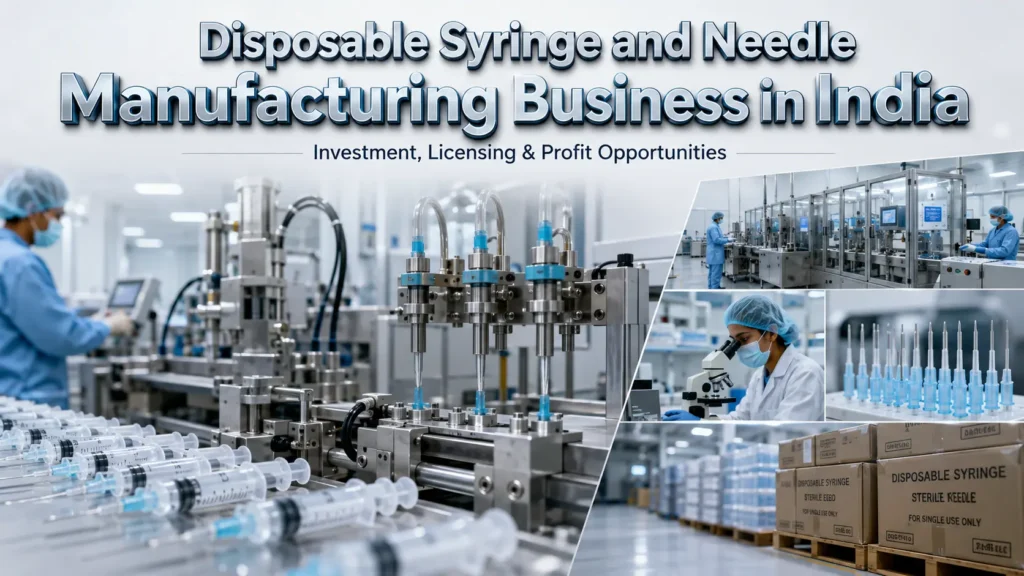
Disposable Syringe Manufacturing Business in India Although India produces more than 16 billion syringes per year and exports almost 80 percent of the world’s auto-disables, the demand for both from government and PMJAY hospitals and export markets still lags behind supply in a number of geographies making this one of the most stable and scalable manufacturing opportunities in India’s medical devices sector. The disposable syringe market is a guaranteed market for an entrepreneur who can understand CDSCO and BIS certification, as well as have clear regulatory pathways, a runway of demand over many years. Market Opportunity: Why This Business Cannot Be Ignored Though the country is a global power in the manufacture of syringes, the production base is concentrated in a few centres in Faridabad (Haryana) and Baddi (Himachal Pradesh) thereby posing procurement risk to hospital buyers in lesser served states, according to Association of Indian Medical Device Industry (AIMED). Tier-2 and tier-3 cities are actively looking for regional suppliers for reliability and quick turnaround time, presenting a solid commercial opportunity for new manufacturing companies that are certified.State government health missions and new PMJAY-empanelled hospitals are also keen on sourcing from the region for reliability and quick turnaround time, offering a clear commercial opportunity for new certified manufacturers. The segment is a geographic quality bottleneck and the Make in India production incentives by the MSME Ministry are specifically targeted to overcome this quality bottleneck. The production entrepreneurs who set up their business in less developed states are eligible for the benefit of capital subsidy under PMEGP, government industrial incentives, and preference in procurement from government health departments to diversify their medical consumables procurement from single cluster dependence. Get Detailed Project Report (DPR): Disposable Plastic Syringes Manufacturing Project Report Industry Analysis: Growth Drivers and Demand Outlook Indian domestic syringe market is worth about Rs. 4,000 crores with growth rates of 10-12% CAGR. With registration on the Government e-Marketplace (GeM), all those manufacturers will automatically get guaranteed business from the public sector as it comes through NHM, CGHS and defence hospitals, which has proven to be one of the most consistent and expanding revenue streams for any medical device manufacturer in India. SYRINGES and INJECTION DEVICES are one of the top export categories for the medical devices sector in India, with the market expected to grow at a CAGR of 14.3% to USD 50 billion by 2030, according to the IBEF Medical Devices Sector Report. With the introduction of mandatory product changeover from non-auto disable syringes to auto-disable (AD) syringes as a part of the National Health Mission’s Universal Immunisation Programme guidelines, only BIS IS:10654 manufacturers can leverage this product upgrade. The ISO 13485 and WHO-GMP certifications open the door to the UNICEF and UNFPA procurement programmes, which are among the most predictable international sources of income that are available. Auto-disable syringes have been identified as a top-10 priority import substitution product by the Invest India Medical Devices investment guide and PLI scheme incentives and government procurement preference are actively helping domestic manufacturers. The Directorate General of Foreign Trade (DGFT) handles the administration of RoDTEP and duty drawback claims, thereby enhancing the net export realisation of eligible syringes to international buyers by 2-5 percent. Indian manufacturers can follow these WHO Medical Devices Access Programme (MDAP) prequalification pathways to provide products to the UNICEF and UNFPA procurement agencies in 120+ LMICs. India Syringe Industry Snapshot Parameter Data Source / Note India Annual Syringe Output 16+ billion units FICCI and AIMED estimates Domestic Market Value Approx. Rs 4,000 crore Industry estimates Market Growth (CAGR) 10-12% per year NHM hospital expansion India Global AD Syringe Share ~80% of world supply Hindustan Syringes data Main Production Cluster Faridabad, Haryana Industry survey Key Government Buyer NHM, CGHS, state CMSDs, defence hospitals GeM procurement Leading Indian Brand Dispovan (Hindustan Syringes and Medical Devices) Faridabad, Haryana How to Start: Step-by-Step Guide for Entrepreneurs Step 1: Business Registration and MSME Enrollment Get your entity (Private Ltd, LLP or Sole Proprietorship) registered and enroll on the Udyam portal at udyamregistration.gov.in to avail MSME benefits. Locate in a state MIDC, GIDC or RIICO industrial estate on an industrial plot of at least 2,000 sq.ft. to avail benefit of lower utility charge and state capital subsidy. Before going for CDSCO License get a Factory License (Act 1948) and get GST Registration. Under the capital subsidy scheme, the new manufacturing units will have to register on the Udyam MSME Registration Portal to get benefits of the capital subsidy scheme for syringe manufacturing units, collateral-free loan under CGTMSE, and state industrial incentive which helps to keep the equity requirements minimised for setting up a syringe plant. Step 2: CDSCO Class B License and BIS Certification Disposable syringes are medical devices of class B under MDR 2017 which must be obtained from the State Licensing Authority in the form of a Manufacturing License (Form MD-5). Apply for BIS certification for both auto-disable syringes (IS:10654) and hypodermic syringe (IS:10178). Prepare your Quality Management System documentation for ISO 13485 certification which is strongly recommended to participate in government tenders and export. Read the Complete Book Here: Handbook on Medical & Surgical Disposable Products Step 3: Machinery Procurement and Clean Room Setup The core machinery mainly consists of polypropylene injection moulding machines for barrel, plunger, piston; blister sealing machine; needle tube cutting and grinding equipment; automated assembly conveyor. Set up ISO Class 7 or 8 cleanroom for assembly and packaging according to CDSCO GMP guidelines. Early stage, you can avail the contract with the certified third-party ETO or gamma sterilisation centres in Delhi NCR, Mumbai, and Bengaluru. Step 4: Quality Control Lab and Sterility Testing Maintain an in-house QC laboratory to perform dimensional checks, break-out point testing (AD syringes), dead space checks and sterility spot checks. Common instruments are a profile projector or digital calipers, a burst pressure tester, and a particle counter. Before you get a manufacturing licence, your QC lab protocol should meet the needs of CDSCO GMP and the appropriate BIS product standard specifications. Step
Blood Bag Manufacturing Business in India: CDSCO Class D Licensing, BIS IS:15716, Investment and Market Demand
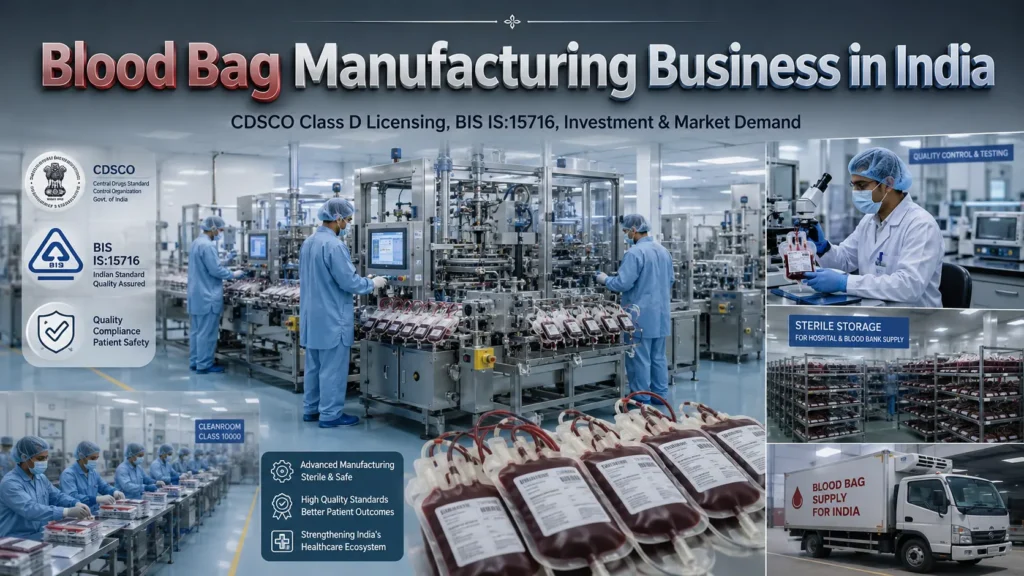
Blood Bag Manufacturing Business in India With less than 15 active manufacturers in India, serving a market of Rs 700-900 crore, every blood bag collected is clinically necessary as there is a shortage of blood units while a non-existent supply chain makes every single blood bag collected indispensable for blood banks across India, with quality manufacturers charging premium prices and secured vendor status. Market Opportunity: Why This Business Cannot Be Ignored Blood bags are added to the highest risk class D medical devices under MDR 2017, as defects may pose a direct threat to patients’ lives during a transfusion. All the class D manufacturers are required to be licensed by central CDSCO in addition to state SLA, have validated ETO processing, have thorough biocompatibility testing as per ISO 10993 and have validated ISO 13485 QMS. The barriers help quality producers to exclude the low-quality producers and make the market very attractive to serious and compliant manufacturers. The National AIDS Control Organisation (NACO), India, oversees more than 3200 blood banks which are licensed and have established certain technical requirements for the blood bags in government blood banking. The approved vendor list is the first step towards national procurement programmes which ensure payment of multi-year supply contracts to technically compliant manufacturers, one of the most predictable, and margin resilient, revenue models within the Indian medical device industry. Get Detailed Insights from This Book: Handbook on Medical and Surgical Disposable Products Industry Analysis: Growth Drivers and Demand Outlook The blood bag market in India is estimated at Rs. 700-900 crore with 10-12 percent growth year-on-year. The Ministry of Health and Family Welfare has formulated a National Blood Policy that has been implemented in district hospitals under NHM, and which requires hundreds of new blood banks per year, all of which constitute a captive, predictable buyer of blood bags in single, double, triple and quadruple packs. The National AIDS Control Organisation (NACO) Blood bank portal keeps the list of approved vendors, technical specifications, and procurement procedures that blood bag producers need to meet and provide before they can receive contracts for blood bag supply from across 3200+ blood banks across the country. There are very few manufacturers that cater this sector namely BPL Biotech, Span Medical Products, Hi-Tech Medical and international brands. When a new company gets CDSCO Class D approval and NACO vendor list approval, they instantly have access to all the procurement opportunities across the country. Blood bags are identified as a medical devices initiative priority product category by Make in India and available for PLI Medical Devices for Class D approved manufacturers. According to Invest India blood storage systems are one of the high priority local manufacturing segments which can benefit from PLI scheme and also be preferred by the government for procurement as per the blood bag import substitution report, based on government data. India Blood Bag Market Overview Parameter Market Data Source or Notes India Annual Blood Requirement 15+ million units per year Ministry of Health estimates Actual Blood Collection 12-13 million units per year NACO Annual Report Blood Bag Market Value Rs 700 – 900 crore Industry estimates Market Growth Rate 10-12% per year NACO blood bank expansion Number of Licensed Blood Banks 3,200+ across India NACO national survey CDSCO Classification Class D (highest risk category) MDR 2017 India BIS Standard for Blood Bags IS:15716 Mandatory BIS certification How to Start: Step-by-Step Guide for Entrepreneurs Step 1: Technical Feasibility Study and Regulatory Strategy The manufacturing of blood bags is the most technically challenging business in medical devices industry in India. Prior to investment, perform a comprehensive technical feasibility study that includes clean room requirements, ETO sterilisation validation plan, biocompatibility testing, ISO 13485 QMS scope and a CDSCO class D licensing timeline. NPCS can do this feasibility study as the base of your investment decision as well as bank loan application. Blood bag manufacturing units should enrol on the Udyam MSME Registration Portal so that they can avail collateral free loan from CGTMSE, term loan from SIDBI and government subsidy on investment in the huge investment of clean room and ETO sterilisation equipment. Get Detailed Project Report (DPR): Blood Bags Manufacturing Plant Report Step 2: CDSCO Class D Manufacturing Licence Please apply for CDSCO Class D Medical Device Manufacturing Licence in Central office at New Delhi. Requirements are validated ISO Class 7/8 clean rooms, validated ETO sterilisation process with biological indicator monitoring, ISO 13485 QMS certification, biocompatibility data (ISO 10993) and a complete device master record. The whole process of getting CDSCO inspection and approval to get registered as a class D can take 12-18 months, so start preparing early. Step 3: Clean Room, RF Welding, and Sterilisation Infrastructure The required minimum size for a blood bag plant is 6,000-10,000 sq ft, and includes critical assembly (RF or HF dielectric welding machines for sealing PVC bag bodies) and secondary assembly (tube assembly, needle stations, anti-coagulant pre-fill stations) equipment, as well as validated ETO sterilisation chambers. Step 4: Anticoagulant Formulation and Fill Blood bags are provided pre-filled with anticoagulant-preservative solutions: CPDA-1 (blood shelf life of 35 days, most commonly used in India), CPD (blood shelf life of 21 days) or SAG-M (Additive solution bag with blood shelf life of 65 days for the storage of red cells). The formulation needs to be validated for fill accuracy and to be sterile and pharmaceutical grade mixed and filled. The CPD, CPDA-1 and SAG-M blood storage systems are as per the WHO guidelines for Blood Transfusion services and are matched to the BIS IS:15716 compliance of blood bags in India. Step 5: BIS Certification, NACO Approval, and Sales Get BIS IS:15716 certification and join the list of approved Vendors of NACO for Government blood bank procurement. At the same time develop private blood bank connections at corporate hospitals like Apollo, Fortis, Medinat, Max etc., where the premium pricing allows a much larger margin over the government tenders. Find high-return business ideas based on your budget & ROI Project Investment Breakdown for Blood
Pharmaceutical MSME Business in Tamil Nadu: Investment, Govt Subsidy & Export Guide
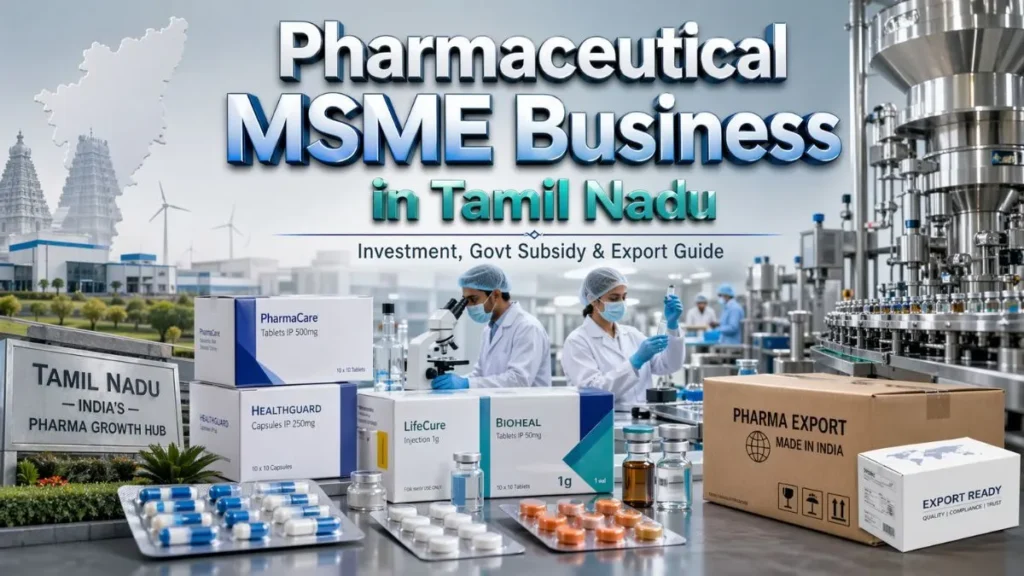
Introduction: Pharmaceutical MSME Business in Tamil Nadu The pharmaceutical industry in India is largely identified with Gujarat and Hyderabad but in the past ten years Tamil Nadu has silently become one of the most organized and stable pharmaceutical manufacturing center in India. The growth of Tamil Nadu has been consistently smooth, policy supported, and well incorporated into its larger industrial ecosystem, unlike rapid industrial booms that were led by single clusters. Over 1,500 pharmaceutical production facilities (APIs, formulations, nutraceuticals, herbal products, and veterinary pharmaceuticals) are licensed in the state today. To the MSME entrepreneurs, this is not only a business opportunity in the industry but a long-run base of export-oriented manufacturing that is well supported by the government and has a well-developed infrastructure. Related Article: India Pharmaceutical Excipients Market: Demand–Supply Gap and Manufacturing Opportunities (2026–2031) Why Tamil Nadu is Becoming a Pharma Manufacturing Powerhouse The emergence of Tamil Nadu as a pharmaceutical powerhouse is no coincidence. It is a product of sixty years of education, development, and industrial strategy. Availability of skilled human capital is one of the greatest strengths. This means that the state graduates a huge amount of pharmacy graduates, chemical engineers and biotechnology professionals on an annual basis, which means that the state is guaranteed of steady supply of skilled manpower. The other important consideration is the logistics and connectivity. Through Chennai port and Tuticorin port, the pharmaceutical companies have direct access to global shipping routes, and hence, it is easy to make exports more cost effective and quicker. This is essential in the regulated industry where timing of supply chain can affect product quality and approvals. The state government has also come up with specific pharma manufacturing industrial ecosystems such as: Chennai API and formulation cluster (Pharma City) SIPCOT industrial estates in various districts. Emerging pharma zones in Hosur, Coimbatore, Salem, and Vellore, MSME. The clusters provide better operational efficiency because they assist in infrastructure establishment and maintenance tasks, which benefit MSME investors through their ability to share resources. Get Detailed Insights from This Book: Just For Starters: How To Start Your Own Export Business High-Potential Pharmaceutical MSME Segments Tamil Nadu presents chances in various levels of pharmaceutical production. The different sectors need different funding and skill requirements according to their operational needs. Entrepreneurs in the MSME sector generally join depending on the size of capital and technical competence. 1. API Manufacturing (High Growth, High Stability). Active Pharmaceutical Ingredients (APIs) form the essential core component of the worldwide pharmaceutical supply chain system. India is already becoming less reliant on imports, particularly that of China, which is a huge market. The main APIs that are in demand are: Metformin (anti-diabetic) Atorvastatin (cholesterol management) Amlodipine (cardiovascular treatment) This segment has long-term contracts, predictable demand, and high export opportunities but demands greater technical compliance. Get Detailed Insights from This Book: Business Ideas for Startup in Drugs & Pharmaceutical Industry with Project Profiles (3rd Edition) 2. Nutraceutical and Herbal Extract Industry (Swiftest growing segment). Currently, the world is experiencing a high speed of the demand of preventive healthcare products. One of the fastest-growing pharma-adjacent industries are nutraceuticals and herbal extracts. Products are herbal extracts, vitamin formulations, amino acids and plant-based health supplements. Tamil Nadu has a natural advantage due to availability of medicinal plants and agricultural raw materials like turmeric and spices. Reduced regulatory burden in comparison to drugs. Strong demand of exports in USA and Europe. High profitability of branded formulations. 3. Veterinary Pharmaceutical Manufacturing It is among the least developed, but the most promising MSME segments. The development of poultry, dairy, and aquaculture business in India has augmented the necessity of the animal health products. Typical products include: Veterinary antibiotics Anti-parasitic drugs Feed supplements Reduced regulatory burden compared with human pharma. Good rural and export demand. Speedier product commercialization period. 4. Ophthalmic Formulations Eye drops, sterile solutions, and ointments are examples of a high-margin niche. When a facility is compliant and certified, then competition becomes low since it has entry barriers. This division needs cleanroom production and high level of sterility but has stable long term demand within the home and export markets. Government Incentives Supporting Pharma MSMEs in Tamil Nadu Government policy has a very important part to play in rendering pharmaceutical manufacturing viable. In Tamil Nadu, both the state and central governments promote the development of MSME. Central Government Support The Scheme of greatest significance is the Production Linked Incentive (PLI) Scheme on Bulk Drugs which promotes local production of API by providing financial incentives based on production output. Additional key support systems are: CGTMSE (collateral-free MSME loans) SIDBI financing support Startup India Recognition Benefits. Tamil Nadu State-Level Support The state offers a number of industrial incentives such as capital subsidies and infrastructure benefits. MSMEs established in endorsed industrial zones can also be provided with: Stamp duty exemptions Power tariff concessions Land allocation via TIDCO under subsidies. Fast-track clearances in industrial parks. Such incentives are very effective in lowering the initial project costs and enhancing financial viability. Get Detailed Project Report (DPR): Pharmaceutical Drugs and Bulk Drug Intermediates Export Opportunities for Tamil Nadu Pharma Industry India is internationally known as the Pharmacy of the world and Tamil Nadu has a significant role in this ecosystem. A high level of compliance and quality production is increasing the pharmaceutical exports of the state. Some of the major export destinations are: United States and Canada. European Union countries African nations ASEAN region Latin America The regulatory needs of each market are varied, yet when MSMEs meet GMP, they can enjoy the benefits of high-value global supply chains. The fast-growing demand of low-priced generic medicines and nutraceuticals makes Africa and ASEAN the most appealing venues of MSMEs. Investment Overview for MSME Entrepreneurs The amount of investment required differs greatly with the type of product. The capital required of a small nutraceutical unit can be comparatively moderate, whereas the production of API must be accompanied with a greater investment because of the infrastructure and the regulations. Typical investment ranges: Nutraceutical
Unlocking Growth in India’s Emerging High-Purity Nicotine Market: NPCS Launches Definitive Market Research Report on USP Grade Nicotine (2025–2034)
New Delhi, July 2025 — With increasing health awareness, regulatory changes, and booming demands for nicotine replacement therapy, India is poised to become a leader in the production of high-purity USP grade nicotine. Niir Project Consultancy Services has launched a comprehensive report based on data to address this potential opportunity. “India USP Grade Nicotine Market: Growth Rates, Size, Share and Drivers: Competitive Landscape and Forecast Up to 2034” This comprehensive market research report provides a strategic resource that is essential for manufacturers, investors, and healthcare companies. It also serves as a valuable tool for industry consultants, policymakers, and other stakeholders who are looking to gain clarity on a rapidly evolving niche. This report, based on primary and secondary research of extensive scope, identifies key market drivers, challenges, and opportunities in India’s multimillion-dollar pharmaceutical-grade nicotine market. A Market Overview of a Rapidly Growing Industry According to NPCS, the Indian USP Grade Nicotine Market was valued at USD 25.82 million in 2024. It is projected to grow with a robust growth rate of 7.70% to reach USD 52.14 million by 2034. This growth is driven by: What Makes This Report Unique? This report, unlike generic global market reviews, provides detailed, region-wise analyses of the Indian market. It also includes detailed projections for consumption, production, and growth across East, West, and Central India. Highlights of the Report: Why the Market Matters Nicotine USP meets United States Pharmacopeia standards. It is used widely in: India is one of the world’s largest tobacco producers and has a unique position to take advantage of its agricultural resources, technical expertise, and market knowledge to dominate this value-added sector. Until now, however, the lack of clear data and market insight has prevented many investors from investing confidently in this space. NPCS fills this gap with the most authoritative, practical, and useful guide for those interested in entering or expanding into this niche. Detailed Application Analysis The report offers actionable insights, such as: Each category includes trend graphs and data on consumption volumes, forecasts of value, and forecasts of future values. Geographic Hotspots: Regional Insights The study focuses on regional differences, including market performance, consumer patterns, and competitive dynamics. The supply chain capacity of each region, the production trends, and demand projections for that area are all meticulously described. View our Handbooks Industry Leaders and Competitive Landscape The report includes detailed profiles of India’s top USP Nicotine producers, including: The profiles include: This information is useful for anyone interested in the dynamics of partnership and competition, whether you are a buyer or a supplier. Regulatory, Export & Market Challenges NPCS provides a complete overview of: The reader is better prepared to make business decisions that are compliant with the data-backed analysis of policy and market dynamics. Who Should Read This Report? This report is a valuable resource for: Why NPCS? Niir Project Consultancy Services (NPCS) has over 20 years of experience in delivering high-quality market intelligence, feasibility reports, and DPRs for more than 10,000 projects. NPCS has an ISO 9001:2015 certification and a pan-India team of economists, technologists, and business analysts. NPCS has a track record of identifying emerging industry opportunities and empowering its clients with accurate data, reliable insights, and strategies that are ready for implementation. Order Your Copy Today The India USP Grade Nicotine Market Report 2025–2034 is now available in PDF format, featuring all tables, graphs, and company data. Contact: Email: info@niir.org Website: www.niir.org Buy our research report by clicking here Tap Into India’s Emerging Nicotine Opportunity This report is much more than just a report. It’s a launchpad for a pharmaceutical niche with high growth and little exploration. This NPCS report is a valuable resource for anyone seeking to establish a business that can thrive in the future. It covers everything from strategic planning to investment decisions.
Exporting Ayurvedic and Unani Products: Strategies That Work

Guide to Exporting Ayurvedic and Unani Products Successfully People everywhere are turning to natural, plant-based health products, and experts say the herbal-supplement business could hit over $430 billion by 2032, growing at about 7.2% a year. India, home to centuries-old Export Ayurvedic Products , stands out in this wave. Years of herbal knowledge, now backed by lab tests and consistent quality, make Indian formulas popular on almost every continent. here are the step by step Guide to Exporting Ayurvedic and Unani Products Successfully. Why India Leads This Surge: Top Export Markets Include: Country Estimated Import (INR) Product Focus USA ?1,520 crore Supplements, Herbal Oils Germany ?522 crore Homeopathy, Oils, Capsules UAE ?378 crore Skin Care, Herbal Blends UK ?320 crore Powders, Teas, Tinctures With the right tips and tools, Indian businesses can quickly meet rising demand around the world. What Makes the Handbook So Critical for Exporters The Handbook on Ayurvedic & Unani Medicines is more than just reading material; it is your day-to-day guide in the export game. Why It’s a Must-Have: Having this handbook on your desk gives you both the know-how to create quality goods and the confidence to sell them abroad. Grab your copy today and kick off your Ayurvedic brand What to Export Ayurvedic Products The book splits products by traditional use and modern form, making it easier to pick what to launch first. Top Product Picks: Popular Product Segments for Exporters: By picking long-lasting products that shoppers actively seek, exporters can cut risks and boost returns. Related: Ayurvedic Medicine Business: Step by Step Startup Guide Legal and Regulatory Requirements for Exporting Ayurvedic and Unani goods usually count as natural health products abroad, and each nation sets its own rules. Basic Indian Requirements: Country-Specific Regulations: The Handbook includes ingredient profiles and process notes, making paperwork and safety clear. Setting Up Manufacturing: In-House vs. OEM New brands basically face two paths: In-House Production: Third-Party (OEM) Manufacturing: Use Handbook formulas to guide your OEM partner. Doing so keeps every batch original and consistent—even outsourced items still feel authentic and hit export quality marks. Related: Unlock the Secrets of Herbal Medicine: Mastering Ayurveda & Unani Pricing, Branding & Product Positioning Moving herbs overseas is as much about image as it is about the plants themselves. Brand Tips: Ayurvedic supplements with strong branding often sell for 3× the manufacturing cost abroad, especially when the recipe is backed by the Handbook. Check our projects for more brief information Marketing Strategies That Work Exporting is not only about moving boxes—it’s also about clever, patient marketing. Promotion Ideas: Logistics, Packaging & Shelf Stability Choose products with a shelf life of 12 to 24 months. Herbal powders (churna), capsules, and oils usually fit that timeline quite well. Practical Preservation Steps: The Handbook’s full chapters on shelf life and storage still serve as the best step-by-step guide. Challenges to Watch For (and How to Overcome Them) The export prize is huge, but hurdles still pop up: Common Challenges: Scaling for Long-Term Success Smart Scaling Moves: Conclusion: Use the Handbook to Stay Ahead of the Market Building a strong export business for Ayurvedic and Unani products takes more than big dreams—it takes a clear plan. The Handbook on Ayurvedic and Unani Medicines with Formulae, Processes and Their Uses gives you that plan. Packed with over 100 standardized recipes, step-by-step processing notes, and real-world use tips, it turns your idea into a brand people around the world trust. Whether you’re launching your first product or growing a larger factory, this book helps you deliver quality, meet rules, earn respect, and most important—boost profits. FAQs:Guide to Exporting Ayurvedic and Unani Products Successfully What certifications are required to export Ayurvedic and Unani products? Common certifications include GMP (Good Manufacturing Practices), AYUSH/AYUSH premium mark, Free Sale Certificate (FSC), and any country-specific approvals (e.g., EU/US requirements) as needed by the target market. Which countries have the highest demand for Ayurvedic and Unani products? High-demand markets typically include the USA, UAE, Saudi Arabia, European countries, Canada, and parts of Southeast Asia where interest in natural and herbal wellness products is rising. Do I need a license from AYUSH to export? Yes — an AYUSH manufacturing license or registration is usually required for Ayurvedic and Unani formulations, especially for classical and proprietary medicines intended for export. What documents are required for exporting Ayurvedic products? Typical documents are commercial invoice, packing list, Certificate of Origin, Bill of Lading/Airway Bill, Free Sale Certificate (FSC), GMP certificate, lab test reports, and any importer-specific paperwork. Can Ayurvedic and Unani products be exported without clinical trials? Classical formulations listed in recognized pharmacopeias can often be exported without new clinical trials, but some countries may require safety/stability data or additional testing before allowing sale or registration. Is it necessary to register products in the importing country? Registration requirements vary—some countries accept standard export documents, while others require product registration or dossier submission to the local health authority prior to import or sale. What challenges do exporters face in herbal product exports? Common challenges include differing regulatory frameworks across countries, long approval timelines, strict quality and labelling standards, documentation complexity, and ensuring consistent raw-material quality. Looking for more books on any Specific Topic? Click here to explore.
Starting an IV Fluid Bag Manufacturing Plant: A Comprehensive Guide
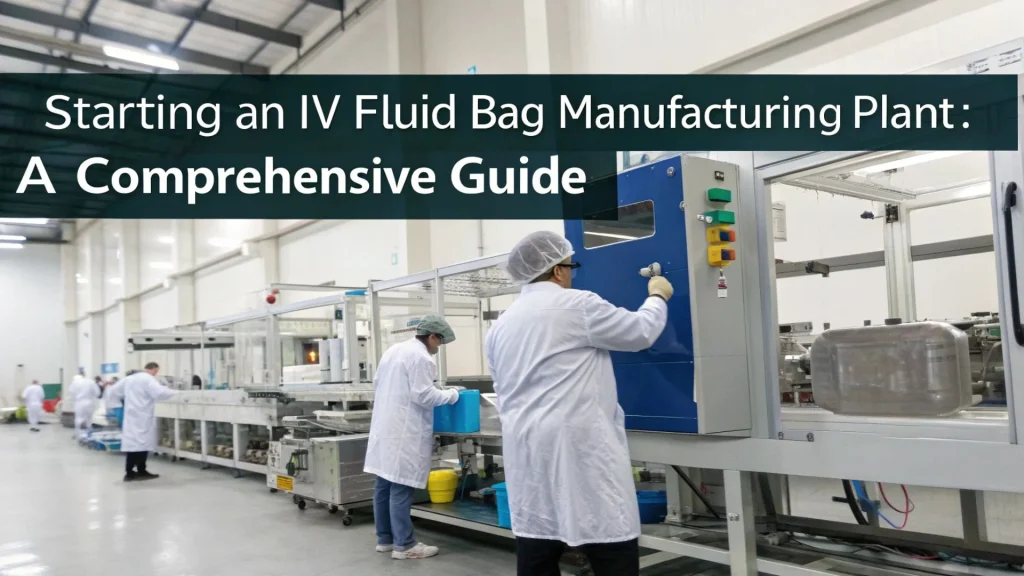
Intravenous (IV) fluids are critical in the patient care industry as the primary means of administering drug therapy, fluid, and electrolyte therapy.Their use is commonplace in both emergency situations and everyday medical practice at primary health centers and multi-specialty hospitals. IV fluids in the healthcare system are packaged and protected in sterile and tamperproof IV fluid bags which require stringent compliance to regulatory quality requirements. The growth of health care facilities into new regions and rising demand for sterile medical supplies have made the IV fluid bag industry a recession-proof venture. Starting an IV fluid bag manufacturing plant involves producing plastic bags and actively incorporating sterile filling, sealing, and packaging processes in controlled environments. This opportunity is attractive to social entrepreneurs looking for a blend of clear commercial risk with advanced technological requirements and strong social benefit. On the flip side, the business does require a strong compliance to medical grade standard operating procedures, well established infrastructure, and an aggressive upfront investment to set up a clean validated production line. Grasping the Product and Its Uses Intravenous (IV) fluid bags are pliable plastic containers that store and administer controlled quantities of sterile fluids into a patient’s body through the vascular system. Such fluid solutions are classified as simple saline, dextrose solutions, ringer lactate, multivitamin blends, and even more intricate fluids for parenteral nutrition. The fluid packaging must be sterile and intact before dispensing, and the bags are made of medical grade polyvinyl chloride (PVC), polyolefin, or multi-layer co-extruded films depending on the market’s regulatory standards and the appropriate use. The IV fluid bags provide a very significant benefit over conventional glass bottles, as they are lighter, more resistant to breakage, more portable, and are easier to use and dispense with automated systems. This makes them preferred in modern day hospitals and mobile healthcare facilities. Furthermore, there is a rapid increase in the use of IV therapy in outpatient and homecare treatment; therefore, the demand for simple-to-use pre-filled IV fluid bags is on the rise. Setting Up IV Fluid Bag Manufacturing Facility The planning and execution of an IV fluid bag manufacturing plant starts with a proper site selection as one of the core prerequisites. The location has to be in an industrial area where there is easy access to clean water, consistent electricity supply, and closeness to suppliers of pharmaceutical raw materials. The facility construction must also observe Good Manufacturing Practices (GMP) along with WHO/ISO cleanroom specifications as the manufacturing process entails cleanroom and microbiological environment control. The facility control drawing needs to indicate predefined areas of raw material pantry, compounding, bag making, filling, sterilization, inspection, packaging, and finished goods pantry. Also, a cleanroom of ISO Class 7 or 8 is required to fill and seal ampoules under aseptic conditions. Control of the environment requires control measures that include HVAV with HEPA filters, pressure differences, airlocks, and controls for particulates and microbial contamination. Purified water is one of the critical requirements needed in the manufacturing process of IV fluids. Furthermore, the plant needs to have a purified water generation system with reverse osmosis (RO), front-end deionization, ultraviolet (UV) sterilization, and loop distribution which have to comply with Pharmacopoeial standards of Water for Injection (WFI) and Purified Water (PW). Operators must continuously monitor and control the water used to prepare IV fluids for microbial load, endotoxin content, conductance, and temperature. Machinery and Technical Setup Setting up the machinery for an IV fluid bag manufacturing unit is both capital-intensive and essential for ensuring product safety. It encompasses three primary segments: bag manufacturing, fluid compounding and filling, and terminal sterilization. In bag manufacturing, there are specific machines like film extruders, bag forming machines, and welders to customize and seal plastic film into bags with injection ports and hanging eyelets. Moreover, the operation can be streamlined by purchasing ready-to-use medical-grade bags from certified vendors. The filling line typically includes compounding tanks that prepare bulk solutions, filling devices, and high-precision sealing units. Operators perform these processes in a Class 100 environment, ensuring sterility with laminar flow units. They filter the solution through a 0.22-micron membrane and validate the entire operation to maintain asepsis and batch uniformity. Technicians subject the filled and sealed bags to terminal sterilization using either an autoclave or ETO (ethylene oxide) sterilizer, depending on the materials and the product’s thermal tolerance. Among the three methods, manufacturers prefer steam sterilization for its low cost and high efficacy. However, they must carefully validate the process to ensure the bags don’t degrade or deform. Consumables and Raw Materials The production plant requires bulk chemicals such as pharmaceutical-grade sodium chloride, dextrose, potassium chloride, calcium lactate, and injectable-grade salts and sugars. These materials need to comply with IP/BP/USP pharmacopoeia requirements. For bag manufacturing, we need medical grade polymer films like PVC or multilayer PE/PP. Medically safe Ports, injection spikes, caps, labels, and packing boxes are also required. All consumable materials need to have documentation of their quality in paper and full traceability from certified vendors. The process must use GMP manufacturing-grade cleaning agents and reagents that comply with all manufacturing quality standards, and teams must evaluate all materials for quality before applying them in product processes. Compliance and Licensing The operating protocol for an intravenous fluid manufacturing unit defines complex checklists and procedures that regulate all these elements, given the product’s sensitive and critical nature. The most important approval comes as a primary validation from the Drug Controller General of India (DCGI) as per Drugs and Cosmetics Act since IV fluids are also classified as Schedule M pharmaceutical products.In addition, the State FDA issues a drug manufacturing license, which businesses must obtain and comply with GMP, GLP (Good Laboratory Practices), and other standards. Compliance requires regular audits, stability studies, documentation of batch records, in-process testing, product validation reports, microbiological assays, and more. Additional certifications are required for export products fore such as WHO-GMP, ISO 13485, and CE marking for the European markets. The products also need environmental compliance, water testing certifications, and waste disposal norms which falls under regulatory purview and is critical to observe in order to prevent penalties and disruption of