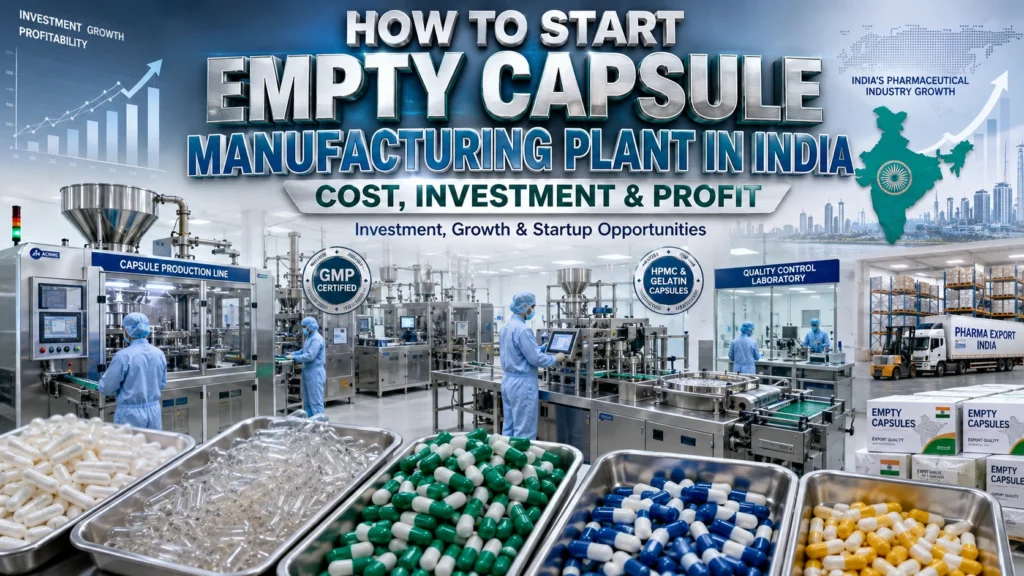

Each tablet that is not produced is a capsule order and each capsule order requires an empty capsule before the first milligram of active ingredient is placed in the capsule. However, India’s low bulk capsule production market is concentrated with just a few large-scale manufacturers, with mid-size formulation companies and nutraceutical brands waiting for days for orders which would fill their weeks in a free competitive market. It is the space where India businessmen can create an empty capsule manufacturing plant that can be sold to other business-to-business players – not branded as a consumer product. It’s packaging-adjacent manufacturing — not sexy, not obvious to the purchaser, and not a business that first-generation entrepreneurs typically think about. The vegetarian and HPMC capsule market is expanding more quickly than the domestic supply, due to the demand of halal, kosher and vegan consumers, which can’t be met by the gelatine capsule market.
Get Detailed Project Report (DPR): Empty Gelatin Capsules
Why This Is a Genuine Opening
In this case, the demand reasons aren’t based on convincing anyone of anything. All tablet manufacturers making the move to capsule dosage, all new supplement brands from the nutraceutical industry, and every export order from Africa or Southeast Asia requires a dependable capsule supplier, but the supply base at home has not been able to keep up with the increase in formulation and nutraceutical manufacturing it feeds. There’s a special challenge for vegetarian HPMC capsules: consumers’ growing preference for plant-based shells for religious, dietary, and ethical reasons has created a shortage that’s exacerbated by the fact that only a few Indian manufacturers are currently producing HPMC capsules on a scale that meets demand.
The entry cap-ex is not negligible. The cost of the single-line hard gelatin capsule unit, which is capable of producing about one billion to 1.5 billion capsules a year, is about eight to 15 crore rupees, involving investment in dip-pin machines, drying tunnels and printing equipment. The processing and drying conditions for the polymer used to make capsule lines are significantly different from those used in the case of gels and the lines are therefore more expensive, fifteen to twenty-five crore rupees. FSSAI registration is required for licensing and in case of export oriented pharmaceutical formulators, facility approval from CDSCO or USFDA clearance is required, which takes around twelve months of the commissioning process.
Margin and Risk Structure
This is because the commodity hard gelatin capsules is a thin margin business itself (gross margins are 8-12 percent) and because buyers change suppliers by fractions of a rupee per thousand capsules. The gross margin on HPMC vegetarian and specialty capsules is very high, anywhere from 18-25% gross margin, due to the fact that far fewer manufacturers can reliably produce these capsules to pharmacopeia specification, allowing the early movers to really have the pricing power that commodity gelatin manufacturers do not.
In this segment, scalability typically comes from installing lines, not from building new facilities — a founder typically launches with a handful of dip-pin machines, tests out quality uniformity with a few formulation buyers, then expands lines based on repeat demand. The primary risks are raw material dependent; the price for gelatin is tied to the prices of bone and hide collagen on the global market, and is liable to sudden fluctuations, while HPMC is a derivative of cellulose, with a smaller and more concentrated global base of suppliers for its raw polymer. The other risk is rejection by quality-sensitive pharmaceutical buyers; if a buyer orders a year’s worth of sales but finds that one batch is out-of-specification, he or she may not order the next one.
Product and Project Opportunities Worth Evaluating
Standard Hard Gelatin Capsules
The standard hard gelatin capsules are by far the biggest share of the market, providing generic pharmaceutical formulations to the overcrowded manufacturing camps in Baddi, Hyderabad and Ankleshwar in India. A unit designed to serve 1-1.5 billion capsules per year requires capex of ten to fourteen crore rupees, with an expectation of supplying companies in the formulation business within a radius of 300-400 kilometres to ensure cost of logistics. With the strong competition in the price of the existing large suppliers, it is obviously not a margin play that the new entrants can make the economics work with, but a business model based on volume and reliability. Gross margins finally settle at 8-12 percent.
Related Article: Building a Successful Pharmaceutical Manufacturing Business
HPMC Vegetarian Capsules
For nutraceutical brands, halal and kosher export buyers, and pharmaceutical formulators seeking alternatives to animal-derived capsules, HPMC vegetarian capsules are the right choice. A dedicated line, which costs between a hundred and two crore rupees, accounting for the specialised polymer-processing and humidity-control specifications, directly targets nutraceutical contract manufacturers and export-based supplement brands. Margins are 18-24 % which is significantly better than gelatin, since there is very limited number of qualified HPMC capsule manufacturer in India till now with a growing demand.
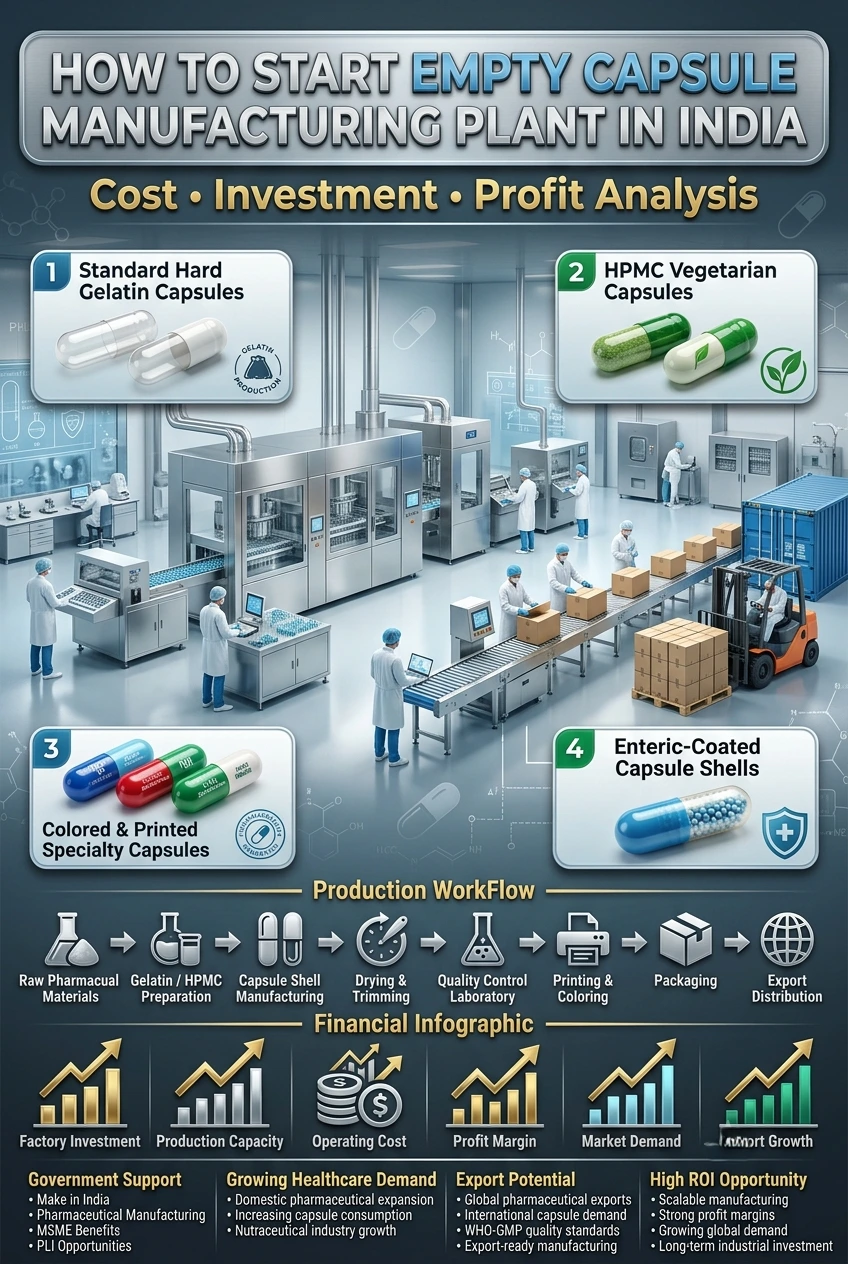
Colored and Printed Specialty Capsules
Colored and custom printed capsules meet the brand differentiation needs of nutraceutical and consumer wellness companies looking to achieve a white shell that stands out on the shelf. Print and multi-colour capability is an additional cost of 2-4 crore rupees over the existing capsule line, margins are between 20-28 percent as the pricing is done based on brand value and not on the economics of capsules. A good second phase addition for an existing base gelatin or HPMC brand with a founder who does not want to invest in an additional facility for the higher margin brand-conscious consumers.
Enteric-Coated Capsule Shells
The enteric coated shells, which resist stomach acid and only open up in the intestine, appeal to a more niche but higher-value pharmaceutical and probiotic buyer segment. The additional cost of a specialised coating line at an existing capsule plant is of the order of Rs.5 to 8 crore, and margins are 25-30 per cent due to the technical barrier to entry, where the ability to replicate the coating consistency is a skill that is limited to a few serious coating manufacturers and not the vast number that stand ready with standard gelatin capsules.
Indian Promoters Who Built This
India’s pharmaceutical packaging component base, tracked within the broader industry data compiled by the India Brand Equity Foundation, has scaled alongside formulation manufacturing but remains concentrated among a small number of capsule producers. Ajit Singh built ACG Worldwide into India’s largest capsule manufacturer, and eventually one of the largest globally, by integrating backward into raw materials and forward into packaging machinery rather than staying a single-product capsule supplier. That integration gave ACG control over cost and quality that single-line competitors could not match, and it is the specific lesson worth studying: a capsule business scales faster when it controls more of its own supply chain rather than depending entirely on external raw material suppliers.
Amsar Private Limited, based in Indore, took a narrower but equally instructive route — building one of India’s earliest dedicated HPMC vegetarian capsule manufacturing operations at a time when almost no domestic supplier addressed that segment seriously. Rather than competing in commodity gelatin capsules against established players, Amsar picked the underserved vegetarian shell segment and built specifically for it. The applicable lesson for a new entrant: competing directly against ACG-scale players in commodity gelatin capsules is a losing proposition for a first-time founder, but a narrow, underserved segment like HPMC or specialty coatings remains genuinely open.
Import-Export Opportunity Analysis
India currently imports a meaningful share of the HPMC polymer itself from European and North American chemical suppliers, since domestic cellulose-derivative manufacturing has not scaled to match capsule demand growth. That creates a genuine backward-integration opportunity for a founder with access to chemical processing capital: manufacturing HPMC polymer domestically rather than importing it would meaningfully improve a capsule manufacturer’s cost structure relative to competitors still buying imported raw material. On the export side, Indian capsule manufacturers are steadily gaining share in Africa and Southeast Asia, where formulation industries are growing faster than local capsule supply, trade data tracked by the Pharmaceuticals Export Promotion Council of India confirms, and Indian shells compete well on cost against European alternatives while offering shorter delivery timelines than Chinese suppliers currently managing longer shipping routes. The Department of Pharmaceuticals has separately flagged packaging-component self-reliance as an adjacent priority to its bulk drug incentive schemes.
Read the Complete Book Here: Handbook on Active Pharmaceutical Ingredients (API), Drugs & Pharmaceutical Products
Feasibility Planning and Input Chain Reality
The polymer chemistry underlying HPMC capsules connects back to the petrochemical sector more directly than most founders realise — propylene oxide, a refinery-linked petrochemical intermediate, is a key input in cellulose ether production. The Annual Report 2024-25 of Ministry of Petroleum and Natural Gas, Government of India — accessible at mopng.gov.in — outlines the scale of India’s domestic refining and petrochemical base, a supply chain that ultimately underpins raw material availability for polymer-based capsule manufacturing even though the connection is rarely discussed in pharma packaging circles.
Before finalising machine specification or a gelatin-versus-HPMC product mix, founders typically commission a Market Survey cum Detailed Techno-Economic Feasibility Report. Niir Project Consultancy Services prepares these specifically for entrepreneurs entering industrial manufacturing, covering process flow, machinery and raw material specification, capacity planning, and full project financials — turning a founder’s instinct into a number a bank or investor can evaluate properly.
Conclusion
An empty capsule manufacturing plant India entrepreneurs build today is not a business that will ever generate consumer buzz. Nobody outside the pharma and nutraceutical supply chain notices who made the shell. But invisibility to consumers does not mean invisibility to demand — every formulation company, without exception, needs a capsule supplier, and the supply base has not kept pace with India’s expanding nutraceutical and generic pharmaceutical manufacturing.
The decision hierarchy for a founder evaluating this sector is straightforward. Avoid competing head-on in commodity hard gelatin capsules against ACG-scale players unless a captive anchor buyer is already secured; the margin simply is not there for a first-time entrant. Instead, target the HPMC vegetarian segment, where supply genuinely lags demand, or a specialty niche like colored, printed, or enteric-coated shells where technical barriers keep competition thin. Secure FSSAI and, if export is the goal, DCGI clearance early, since these timelines run in parallel with construction rather than after it.
The capsule business rewards founders who think like component suppliers rather than brand builders — reliability, consistency, and quality certification matter more than marketing. For a founder willing to specialise in an underserved shell segment rather than chasing commodity volume, an empty capsule manufacturing plant India business remains a genuinely defensible, recurring-revenue manufacturing bet hiding in plain sight inside the country’s much-discussed pharmaceutical growth story.
Turn your budget into a successful business plan
| Capsule Type | Capex Range | Gross Margin | Target Buyer |
| Standard Hard Gelatin Capsules | ₹10-14 Cr | 8-12% | Generic pharma formulators |
| HPMC Vegetarian Capsules | ₹15-20 Cr | 18-24% | Nutraceutical & export/halal-kosher buyers |
| Colored/Printed Specialty Capsules | +₹2-4 Cr add-on | 20-28% | Brand-focused nutraceutical companies |
| Enteric-Coated Capsule Shells | +₹5-8 Cr add-on | 25-30% | Pharma & probiotic formulators |
| HPMC Polymer (backward integration) | Higher capex | Improves overall margin | Captive use + external capsule makers |
Frequently Asked Questions
What is the minimum capex for an empty capsule manufacturing plant India buyers will order from?
A basic hard gelatin line starts near ten crore rupees for roughly one billion capsules annual capacity, but most formulation buyers expect proven quality consistency before placing large orders, so budget for extended qualification batches beyond initial commissioning.
Is HPMC or gelatin the better starting product?
HPMC vegetarian capsules carry meaningfully higher margin and thinner competition, though the equipment costs more. Gelatin capsules are cheaper to start but crowded with established suppliers, so HPMC is generally the stronger choice for a founder without an existing anchor buyer already lined up.
How long does buyer qualification typically take?
Formulation buyers usually require three to six months of sample batches meeting exact specification before committing to a purchase order, and pharmaceutical buyers with export ambitions may extend that to nine months given stricter documentation requirements.
What licensing is required before commissioning?
FSSAI registration is mandatory at minimum. DCGI facility approval becomes necessary if pharmaceutical formulators are the target buyer, and USFDA or EU-GMP certification is needed for direct export sales, typically adding six to twelve months to the timeline.
What is the biggest operating risk in this business?
Raw material price volatility — gelatin tracks global collagen markets, and HPMC depends on a concentrated global polymer supplier base. A single batch quality failure can also cost a buyer relationship that took a year or more to establish, so quality control investment matters more than most founders initially budget for.