
LED Bulb Manufacturing Plant
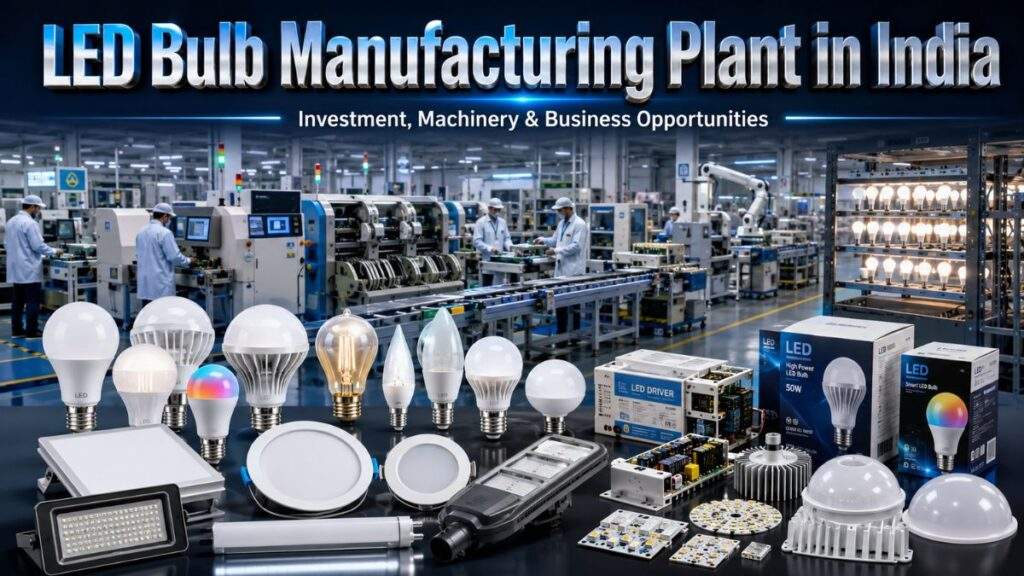
The LED light revolution in India is one of the most successful government initiatives in the field of transitioning from traditional lighting to LED technology, and it offers entrepreneurs an exciting opportunity in the electronics manufacturing business with a Rs.5 Crore LED light manufacturing unit at a sweet spot of high domestic demand, institutional procurement by the government and the emerging export possibilities.
Mass LED adoption has been achieved through the UJALA programme and the energy efficiency regulations that have ensured that LED is the standard light for the household, commercial and industrial sectors in the country under the leadership of the Bureau of Energy Efficiency (BEE), Ministry of Power. Beyond just replacing bulbs, India’s LED market is still expanding with the introduction of smart lighting, horticulture LED, and solar powered LED systems.
Why LED Manufacturing Is a Strategic Opportunity in India
The LED lighting market in India has witnessed tremendous growth over the years, driven by the increasing push for energy conservation, declining LED lighting chip prices, and government regulations. Institutional demand alone saw the UJALA scheme roll out over 36 crores of LED bulbs at subsidised rates in India. Commercial and Industrial LED use – factories, office buildings, hospitals, and street lighting – is also expanding with energy cost savings being measurable and payback periods generally ranging from 12-24 months.
The Ministry of New and Renewable Energy also supports solar LED systems for rural electrification, thus establishing a renewable energy market for LED. Based on the BIS certification, an LED manufacturer from India will be able to sell LED products to the private sector and institutions across India.
Get Detailed Project Report (DPR): LED Light Bulbs, Tubes, Fittings, Spotlights and Wall Lights Projects
Government Policies Supporting LED Manufacturing
LED products are certified under the star rating programme by BEE under the Ministry of Power and procurement preference is given to LED products that are BEE rated in government procurement. The Government e-Marketplace (GeM) portal provides access to Government as one of the biggest institutional buyers to MSME manufacturers registered on GeM. The technology upgradation funds under MSME Ministry are used to acquire the modern LED assembly and testing machine. LED Lamps sold in India must have BIS (Bureau of Indian Standards) certification as per IS 16102 and can be checked from BIS portal. There is a PLI scheme for electronics manufacturing that offers production subsidy to LED manufacturing companies that meet its criteria.
Top Business Ideas in LED Manufacturing at Rs.5 Crore Scale
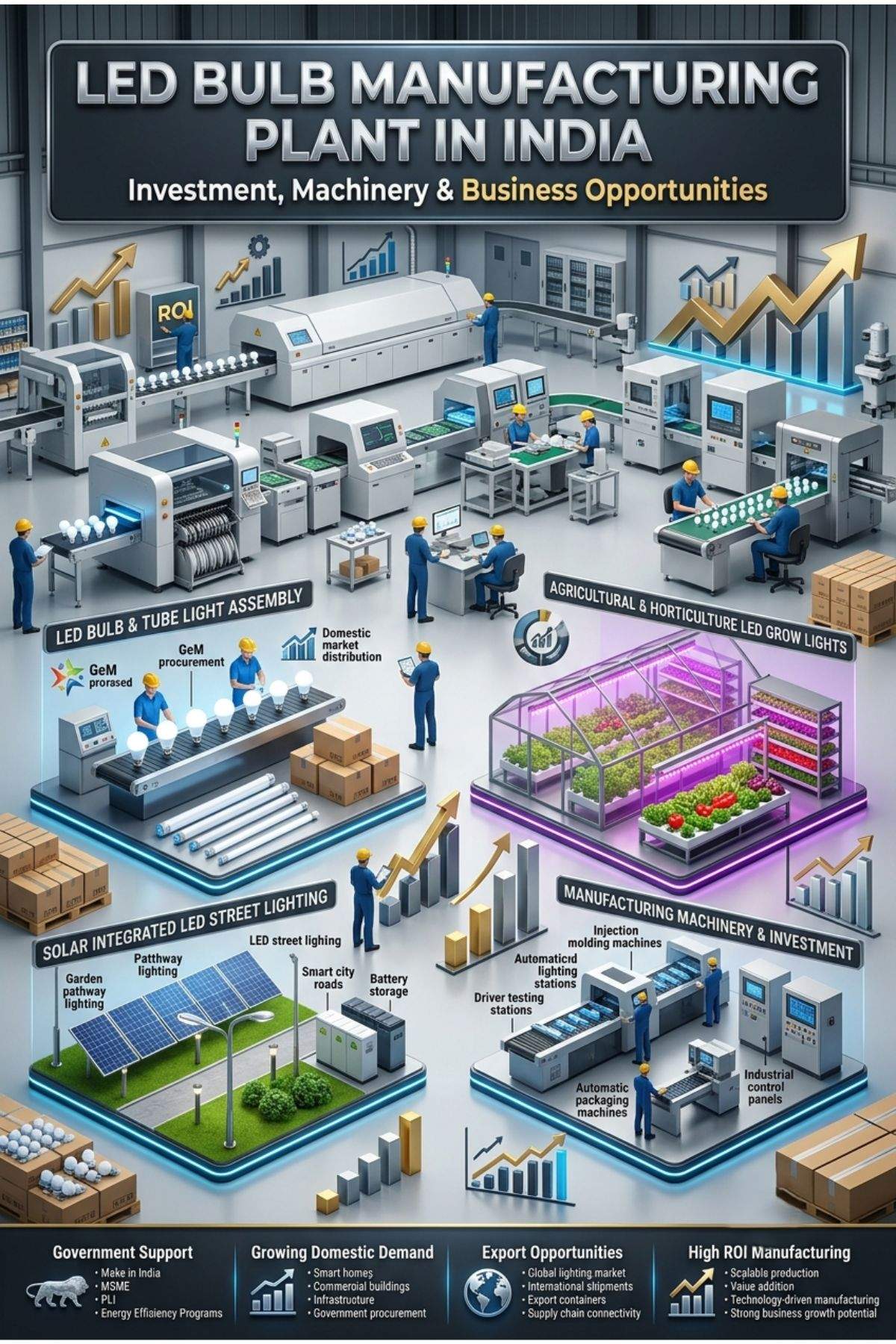
LED Bulb and Tube Light Assembly for Domestic Market and GeM
A semi-automated LED assembly machine with an investment of Rs.5 Crore can produce 10,000 to 30,000 LED bulbs as well as tube lights per day for imports of LED chips and drivers and domestically manufactured LED housing and heat sink. The main quality marks for the domestic market sale are IS 16102 certified by BIS. The GeM portal enables MSME manufacturers to directly sell to Government departments, Municipal corporations and public sector units, making it one of the biggest LED buyers in India. The municipal street lighting, government building lighting and school and hospital LED projects are big tender categories for institutions in which MSME manufacturers having GeM registration and BIS certification compete directly with each other.
Agricultural and Horticulture LED Grow Lights
The use of plant growth LEDs is a niche segment of LED manufacturing that is growing rapidly, and is tailored for greenhouse horticulture, vertical farming, and controlled environment agriculture. The growing protected agriculture in India, poly-house and vertical farming by urban farms place demand on the light spectrum specific grow lights, which stimulate plant growth and electricity usage compared to conventional horticulture lighting. The cost of grow lights per watt is 3–5 times as much as normal LED bulbs, which results in a better revenue per unit and margin profile. There is also good export potential to horticulture markets in South East Asia and Europe for this product category.
Solar-Integrated LED Street Lighting and Garden Lighting
The use of solar powered LED street lights, including solar panel, battery storage, LED luminaire and intelligent controller, is required in rural electrification projects, border area lighting and off-grid community lighting. There is a significant budget for solar LED street-lighting procurement in the MNRE and the state electricity boards. One manufacturing unit with the capacity of Rs.5 Crore per set of solar LED integrated systems can apply for state/central government tenders for rural street lighting.
The average unit price is also much higher than the price of a retail LED bulb, which ranges from Rs.50 to Rs.200, to the cost of a solar LED street light system ranging from Rs.8,000 to Rs.25,000 per system, which greatly enhances the revenue per order.
Get Detailed Insights from This Book: Solar PV Power and Solar Products Handbook
Import-Export Opportunity Analysis
India presently imports a substantial quantity of LED chips (epitaxial wafers) and LED drivers mainly from China, Taiwan and South Korea. The PLI scheme by the government for electronics manufacturing and global buyers’ China Plus One policy are providing opportunities for Indian LED manufacturers to increase the supply of chips and drivers from domestic manufacturers. Indian LED manufacturers are price competitive and quality as compared with the markets of Africa, South Asian and Middle East region of the world. The DGFT registers LED product exporters for RoDTEP benefits. Other LED export market development is through export promotion of electronics through APEDA equivalent, in the form of Electronics and Computer Software Export Promotion Council (ESC).
Indian MSME Success Stories in LED Manufacturing
Syska LED: Building India’s Largest LED Brand
The Rajesh and Govind Uttam Chandani of the Syska Group developed the India’s most recognised LED lighting brand, choosing to specialise entirely in LED as India began its energy transition from a small electronics company. Its aggressive distribution strategy – that is, introducing Syska LED products in all segments of the Indian retail from modern trade to kirana stores – gave the company national visibility, which was cherished not only by the consumers but also the institutional buyers. Among the two factors, in LED manufacturing, distribution reach is the most important thing, as well as quality assurance through BIS compliance, which makes it a business success.
Related Article: LED Light Assembling
Havells India: Engineering Quality LED Manufacturing
Havells India, one of the most trusted brands in electrical equipment manufacturing in India, established a comprehensive manufacturing enterprise for LED products using its distribution base and brand image. They invested in energy efficient LED technology and stringent quality testing equipment to produce products that always exceed expectations when it comes to life expectancy, which is a key factor when making a purchase — a factor which is of utmost importance to institutional customers who tend to consider Total Cost of Ownership over the unit price. Havells’ quality documentation and life testing is the standard for MSME LED manufacturers to assess their supply partners.
How NPCS Can Help You Set Up Your LED Manufacturing Unit
We at Niir Project Consultancy Services (NPCS) provide professional consulting for the preparation of Market Survey cum Detailed Techno-Economic Feasibility Reports (DPRs) for setting up new industries or businesses. Our reports include detailed manufacturing processes, market research and demand analysis, process flow diagrams, product mix and capacity planning, machinery and raw material details, and complete project financials with profitability analysis. Visit us at www.niir.org
Conclusion
A Rs.5 Crore LED manufacturing unit with BIS certification and GeM registration is positioned to access both institutional government procurement and growing private sector demand for energy-efficient lighting. The combination of BEE star rating for consumer credibility, GeM access for government sales, and PLI incentives for qualifying manufacturers creates a well-supported business environment for Indian LED entrepreneurs who commit to quality manufacturing standards.
Find high-return business ideas based on your budget & ROI
Rs.5 Crore LED Manufacturing Unit — Key Parameters
| Parameter | Details |
| Total Investment Range | Rs.4 Crore to Rs.6 Crore |
| Production Capacity | 10,000 to 30,000 units per day |
| Key Certification | BIS IS 16102 (mandatory), BEE Star Rating |
| Key Government Scheme | PLI for Electronics + GeM Registration + MSME Tech Fund |
| Expected ROI Timeline | 3 to 5 years at 65%+ utilisation |
| Employment Generation | 40 to 80 direct employees |
| Key Buyer Channels | GeM government procurement, modern retail, private institutions |
| Revenue Range by Product | Rs.50 (bulb) to Rs.25,000 (solar street light system) |
Frequently Asked Questions (FAQ)
Is BIS certification mandatory for LED products in India?
Yes. BIS certification under IS 16102 is mandatory for all LED lamps and luminaires sold in India. Selling uncertified LED products is a legal violation. Apply for BIS product certification through BIS portal. The certification process involves factory inspection and sample testing at BIS-approved laboratories. Manufacturing must begin only after BIS certification is received.
How do I sell LED products to the government through GeM?
Register on GeM portal as an MSME seller after obtaining Udyam MSME registration. List your BIS-certified LED products with complete technical specifications, pricing, and delivery terms. Government departments search GeM for LED products and place direct purchase orders. MSMEs receive price preference of 15% on GeM. Street lighting projects and building retrofits generate large recurring orders.
What is the UJALA scheme and is there still opportunity?
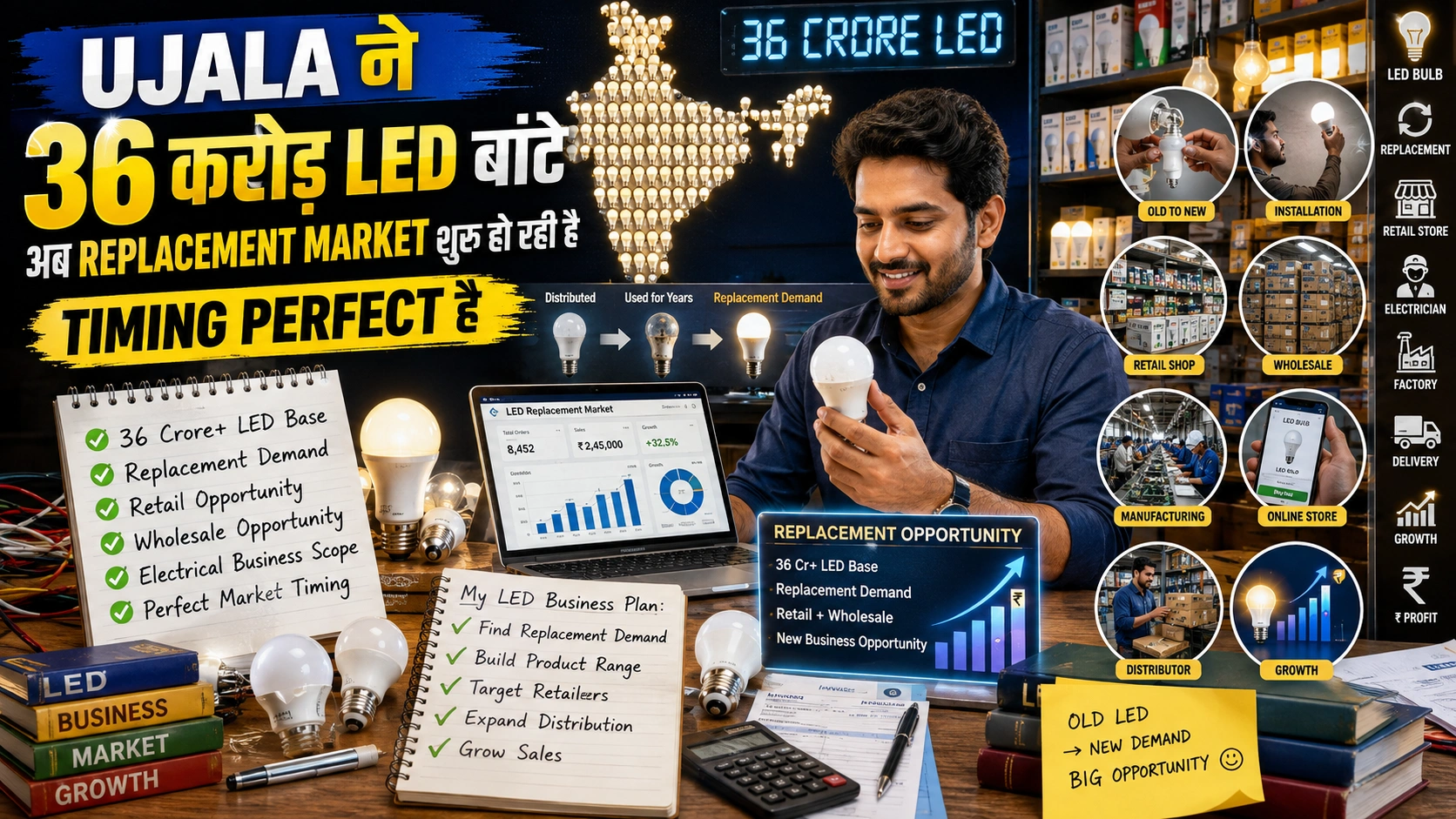
The UJALA scheme distributed 36+ crore LED bulbs at subsidised prices through state DISCOMs, driving mass LED adoption. While the subsidy phase is largely complete, UJALA created a large population of LED users who are now replacing their first-generation LEDs with newer, better products. The replacement market for LEDs — where 5 to 7 year old LED bulbs are being replaced — is a growing procurement opportunity for manufacturers with quality products.
What is the PLI scheme benefit for LED manufacturers?
The PLI (Production Linked Incentive) scheme for electronics manufacturing provides incentives of 4 to 6% on incremental production value for qualifying manufacturers. LED manufacturers with annual production above a specified threshold and minimum domestic value addition qualify. Apply through the Ministry of Electronics and IT (MeitY) for PLI registration. Incentives are paid annually based on actual incremental production.
Can a small LED manufacturer compete with large brands?
Yes — particularly for institutional and B2B segments where price, BIS compliance, and delivery reliability determine purchase decisions more than brand recognition. Government GeM procurement is accessible to MSME manufacturers on equal terms with large companies. Industrial LED buyers prioritise specifications and price over brand. A quality-focused MSME LED manufacturer with BIS certification and GeM registration can build a sustainable Rs.5 to Rs.15 Crore revenue business supplying institutional buyers without competing against Syska or Philips on consumer retail shelves.