
A consultant’s view of where regulatory necessity meets strong margin in Indian water treatment.
Water is the only input that every industry, institution, and household needs, and treating it is becoming non-negotiable. Environmental regulations, health awareness, and scarcity are converging to make water treatment one of India’s most reliable industrial sectors. For a newcomer, water treatment business ideas are rare in the sense that demand driven by necessity, reorders, and strong policy support converge simultaneously.
This article reviews water treatment as would a feasibility consultant. We will explore demand, actual government schemes, five practical manufacturing and service options, and trade openings and Indian success stories.
Why Water Treatment Is a Non-Negotiable Sector
Regulation Makes Demand Inescapable
Industries, municipalities, and hospitals must treat water to meet environmental norms. Because regulators are intensifying standards, buyers cannot defer these investments. Therefore, a reliable water treatment supplier has demanded that regulatory action, not just economics, enforces.
Water scarcity is increasing focus on recycling and reusing, which is opening up fresh demand for advanced treatment systems. A founder who serves both compliance and resource efficiency has a doubly durable market.
Recurring Revenue From Chemicals and Service
Water treatment is not a one-time purchase; chemicals, consumables, and maintenance recur every day. Therefore, a supplier who sells equipment and recurring consumables has steady, predictable cash flow. Sector guidance from the Central Pollution Control Board and Ministry of Jal Shakti helps founders chart out compliance requirements and market demand.
Government Policies and Incentives
Support is broad and growing. The Jal Jeevan Mission is funding rural drinking water infrastructure at scale, creating sustained demand for treatment equipment. AMRUT cities need wastewater treatment plants (WTPs) and industrial zones must meet effluent norms.
Founders should register on Udyam for MSME credit. Environmental compliance runs through CPCB and state pollution boards. National Mission for Clean Ganga (NMCG) also funds treatment projects along major river basins, adding institutional demand.
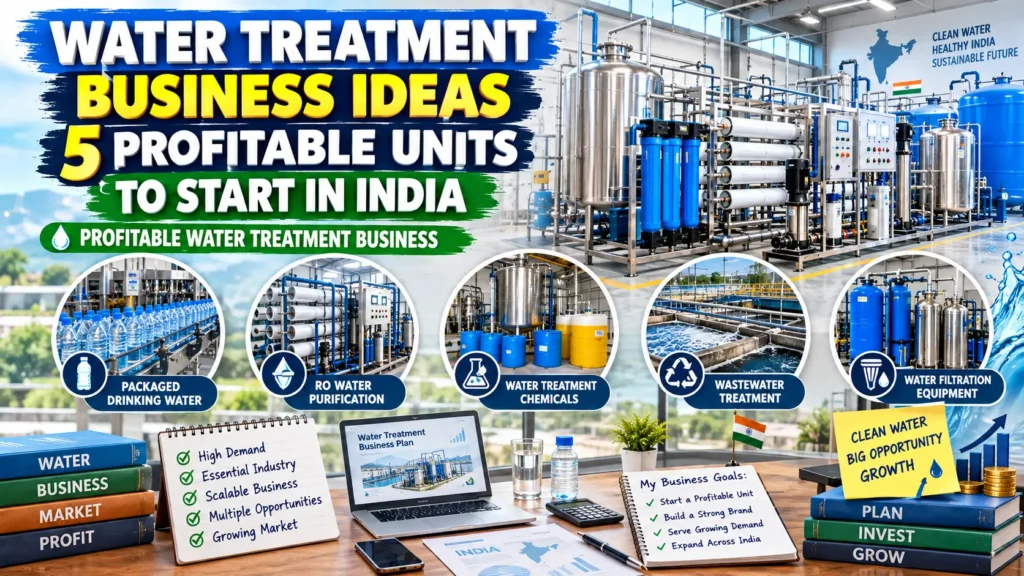
5 Water Treatment Business Ideas for Startups
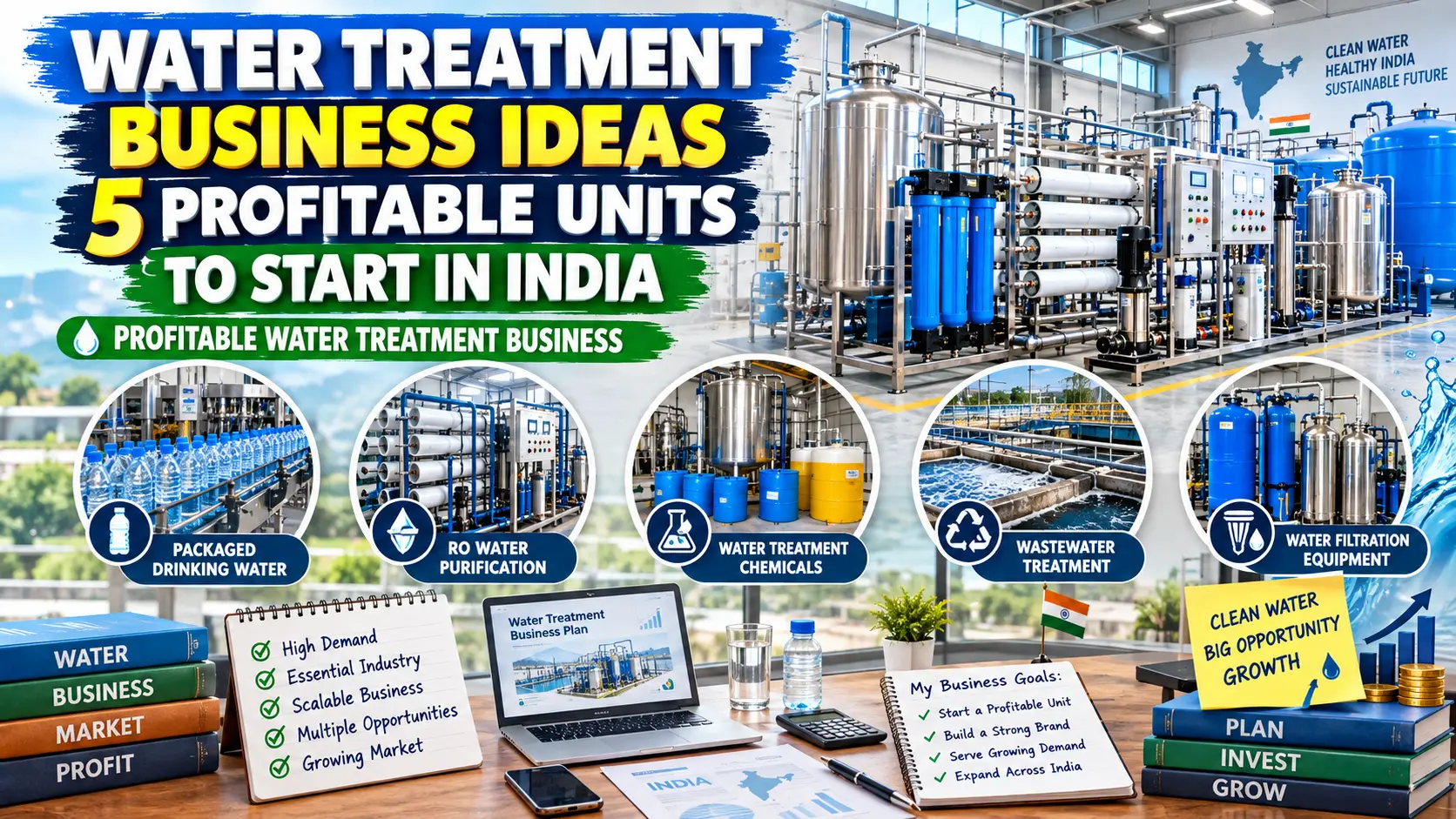
Idea 1 — Water Treatment Chemicals
Coagulants, flocculants, disinfectants, and pH adjusters are essential inputs for every treatment plant. As plants operate daily, buyers reorder constantly. A founder who manufacturers reliable treatment chemicals gets recurring, predictable revenue. Consistent performance and reliable supply build lasting relationships with plant operators. Starting with widely used chemicals builds volume, while specialty products add margin. Furthermore, industrial effluent treatment creates additional demand across sectors. Local production shortens lead times and freight charges. A water treatment chemicals unit that couples reliable quality and technical support can grow steadily alongside the expanding treatment infrastructure.
Idea 2 — RO and Water Purification Equipment
Reverse osmosis systems serve homes, offices, hospitals, and industry, giving them a vast and multi-segment market. Because water quality concerns are universal, demand keeps growing. A founder who assembles and supplies RO systems taps both institutional and retail channels. Reliable performance and after-sales service builds strong customer loyalty. Starting with standard systems builds volume, while customised and high-capacity plants add margin. Additionally, service contracts create recurring income after sale. Local assembly shortens delivery and lowers cost. An RO and purification equipment unit that combines quality and strong service can grow steadily as water awareness deepens across India.
Idea 3 — Effluent Treatment Plants (ETPs)
Industrial units must treat their effluent before discharge, and compliance enforcement keeps intensifying. An ETP design, supply, and installation business serves text, pharma, food, and chemical industries. Because compliance is mandatory, demand is regulatory-driven and durable. A founder with treatment engineering knowledge can offer turnkey solutions that command strong margins. Starting with smaller SME clients builds credibility, which then opens up larger industrial and municipal projects. Furthermore, operation and maintenance contracts create recurring income. A focused ETP firm that combines technical reliability with honest commissioning can build a durable, institutional business in this compliance-driven sector.
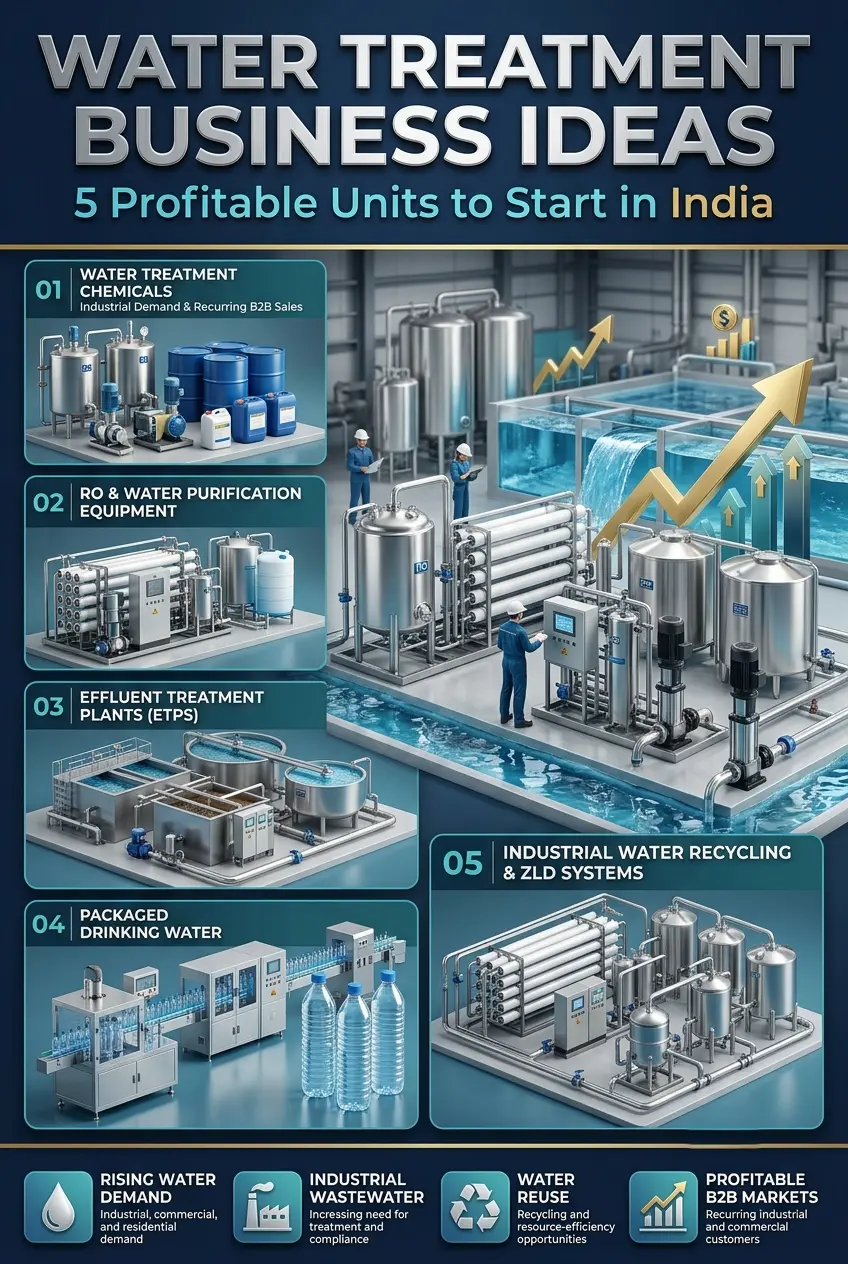
Idea 4 — Packaged Drinking Water
Packaged drinking water demand keeps rising as consumers prioritise safety and convenience. As the product is a daily essential, volumes are large and recurring. A founder who sets up a quality water plant serves retail, institutional, and hospitality markets. Consistent purity, reliable supply, and clean packaging builds consumer trust. Starting with local distribution builds volume, while branded variants add margin. Additionally, institutional supply to offices and hospitals provides steady bulk orders. BIS certification is essential and builds credibility. A packaged water unit that combines certified quality and reliable local distribution can grow steadily across urban and peri-urban consumer bases.
Idea 5 — Industrial Water Recycling and ZLD Systems
Zero Liquid Discharge systems allow industries to recycle and reuse all their water, eliminating effluent discharge totally. As environmental regulations increasingly mandate ZLD compliance, demand is strong and growing. A founder who designs, supplies, and commissions ZLD systems serves industries that face regulatory pressure. Technical expertise and reliable system performance is the core requirements. Starting with advisory and small plant installations builds credibility. Larger industrial plants and clusters then follow. Furthermore, water scarcity makes recycling financially attractive even beyond compliance. A focused ZLD engineering firm that delivers reliable systems can build a high value, defensible business in this technically demanding, regulation-backed niche.
Import-Export Opportunity Analysis
Trade patterns open up water treatment founders. India imports many specialty membranes, pumps, and advanced treatment chemicals, so capable local manufacturers can substitute this supply. At the same time, Indian water treatment equipment finds buyers in South-East Asia and Africa.
Export readiness is dependent on quality certification and technical credibility. Guidance from DGFT helps founders navigate export norms. Therefore, a unit built for quality from the start can serve both domestic and international demand, steadying revenue across market cycles.
Indian MSME Success Stories Worth Studying
Va Tech Wabag grew from a project engineering firm into a major water treatment solutions company by combining technical depth with project discipline. Its founders-built credibility by delivering reliable delivery on complex projects. The lesson is that technical trust compounds into a genuine moat.
Ion Exchange and Thermax also built strong water treatment businesses by combined chemicals, equipment, and service into integrated offers. Many regional ETP and RO MSMEs have scaled by serving local industrial clusters reliably. For new founders, the shared message is that technical reliability, consistent chemicals supply, and honest commissioning build durable relationships that this sector rewards.
About NPCS
We at Niir Project Consultancy Services (NPCS) provide professional consulting for the preparation of Market Survey cum Detailed Techno-Economic Feasibility Reports for setting up new industries or businesses. Our reports have detailed manufacturing processes, market research and demand analysis, process flow diagrams, product mix and capacity planning, machinery and raw material details as well as complete project financials with profitability analysis. Our objective is to help entrepreneurs evaluate feasibility, profitability, and long-term scalability before investment.
NPCS has published a comprehensive printed reference book on water treatment, covering technology, market analysis, investment parameters, and manufacturing processes in depth — the printed book: The Complete Book on Waste Treatment Technologies (Industrial, Biomedical, Water, Electronic, Municipal, Household/Kitchen, Farm Animal, Dairy, Poultry, Meat, Fish & Sea Food Industry Waste and Machinery Equipment Details)
For a detailed techno-economic Project Report on setting up a manufacturing business in this sector — including plant economics, machinery lists, financial projections, and applicable government incentives — the NPCS Project Report: Projects on Water Industry — Packaged Drinking Water, Water Purification, Water Treatment Chemicals, Water Softener, Filter, Bottled Drinking Water, Effluent Treatment
Conclusion
Water treatment is a sector where regulation and scarcity combine to create durable, non-negotiable demand. Recurring chemical and service revenues stabilises cash flow, and technical credibility builds a moat. Therefore, the winners are those who combine reliable products and strong technical support and grow steadily alongside India’s expanding treatment infrastructure. A detailed feasibility report maps demand, technology, and profitability before investment.
Your Investment Deserves the Right Opportunity
Every serious investment begins with choosing the right sector and right business model. With hundreds of industrial opportunities available across India’s manufacturing and clean-energy landscape, making the most informed choice is critical. Niir’s Startup Selector tool helps entrepreneurs, MSMEs, and investors identify the most suitable business opportunities based on their investment capacity, location, and interests — your capital is directed toward a venture with the strongest fit and potential. Explore your best-fit business opportunity today.