
Paper and Packaging Business Ideas: 5 Profitable Units to Start in India
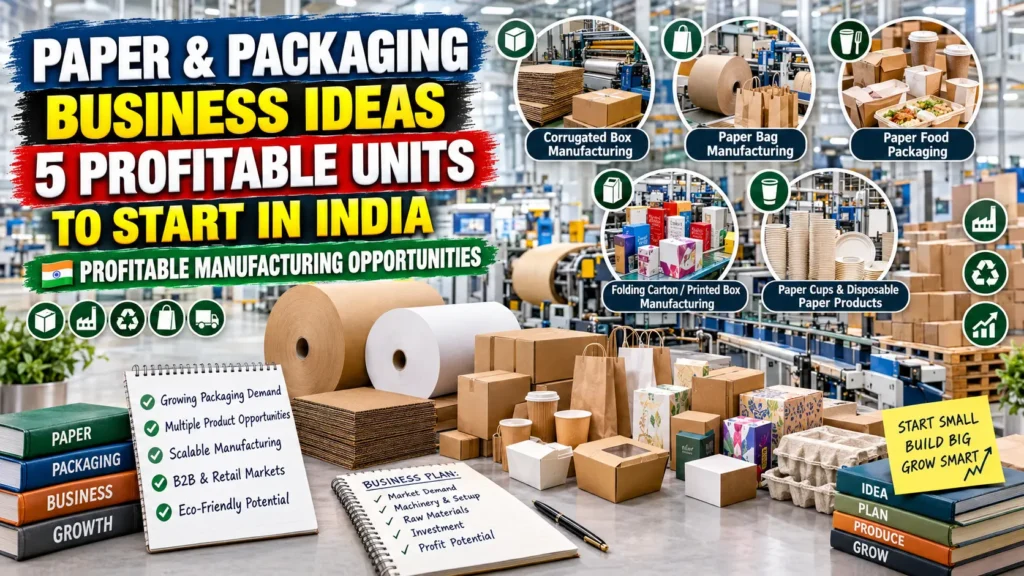
A feasibility-led look at where e-commerce demand meets sustainability in Indian packaging. Any online order, product on a shelf, and shipment requires packaging, making paper and packaging business ideas always in demand. As e-commerce grows and plastic faces pressure, demand for paper-based and sustainable packaging is on the rise. For a first-time founder, that shift is a rare combination of rising volume and regulatory preference. The article will explore the sector through the lens of a project consultant, weighing demand drivers, viable schemes, and 5 possible manufacturing routes, and trade-opening opportunities and successful Indian success stories. Why Paper and Packaging Demand Keeps Rising E-Commerce and Retail Fuel Growth Packaging demand follows economic activity, and with retail and online sales growing, orders occur constantly, making for a steady, recurring revenue source for a well-run unit rather than a one-time sale. The push against single-use plastic also drives demand for paper-based packaging. A founder who can supply sustainable packaging benefits from both the e-commerce boom and the green shift. Sustainability Opens Premium Niches Buyers are increasingly seeking recyclable and biodegradable packaging, creating room for value-added products. Consequently, a producer of eco-friendly packaging enjoys better margins and loyal buyers. Sector guidance through the Ministry of MSME and Central Pollution Control Board can help align with the changing norms. Government Policies and Incentives Support is primarily through MSME and cluster schemes. The Ministry of MSME backs small manufacturers by encouraging credit and cluster development, and Make in India promotes domestic manufacturing, lowering barriers for new units. Founders should register on Udyam for collateral-free credit and preferential lending. Plastic-waste regulations from the Central Pollution Control Board benefit paper alternatives, supporting demand. State support also aids; for example, Uttar Pradesh’s MSME and export promotion portal aids small manufacturers with facilitation and incentives. 5 Paper and Packaging Business Ideas for Startups Idea 1 — Corrugated Boxes Unit Corrugated boxes form the backbone of shipping, with demand rising with each e-commerce order. This unit benefits from the constant reordering by manufacturers and online sellers. A founder can begin with standard sizes and add custom printing. Consistent strength and dimensions help secure buyer trust, so quality control is crucial. Local supply reduces delivery and freight costs, giving a new unit an edge. Furthermore, branded and printed boxes command higher margins. A corrugated box unit that provides reliable strength and printing capability can grow steadily alongside the expanding retail and online economy. Idea 2 — Paper Bags and Eco-Friendly Packaging Paper bags and biodegradable packaging enjoy rising demand as more places ban plastic. This trend benefits the founder who can supply quality paper bags. Starting with common sizes builds volume, while custom-printed bags add margin. Additionally, food-grade and premium packaging can access higher-value markets. Local manufacturing competes on cost and delivery. A unit that can offer strength, design, and eco-credentials can build strong demand across retail, food, and branded segments. Idea 3 — Paper Cups and Disposable Tableware Paper cups, plates, and disposable tableware cater to a vast food and hospitality market. As restrictions on plastic disposables grow, paper alternatives see strong, policy-driven demand. A founder who can manufacture these products benefits from constant reordering from caterers, cafes, and events. Food-safe quality and consistent supply win contracts. Starting with standard products builds volume, while custom branding adds margin. Furthermore, institutional and event demand provides steady bulk orders. Local manufacturing shortens delivery and lowers cost. A disposable tableware unit that maintains food-safe standards and reliable supply can grow steadily across the expanding food-service sector. Idea 4 — Recycled Paper and Board Recycling waste into board and packaging material benefits manufacturers seeking greener inputs. With abundant and cost-effective raw material, margins are stable. Policy pushes for recycled content boost demand. A founder can benefit from both cost advantage and green positioning. The output feeds box, carton, and packaging makers, providing a wide customer base. Additionally, institutional buyers increasingly require recycled feedstock, opening steady contracts. A recycled paper and board unit turns an abundant waste stream into a profitable, purpose-driven business that aligns with the sector’s sustainable future. Idea 5 — Flexible and Food Packaging Food and consumer brands need attractive, safe packaging for pouches, wraps, and cartons. With constant new brands and products launching, demand grows. A founder should focus on print quality and food-safe standards, as these win contracts. Starting with a defined segment builds volume, while custom and premium packaging adds margin. Additionally, sustainable and recyclable materials attract premium buyers. Local supply competes on cost and delivery time. A packaging unit that combines quality, food safety, and responsible materials can grow steadily alongside the fast-expanding retail and food economy, building durable brand relationships. Import–Export Opportunity Analysis Trade patterns favor capable manufacturers. India imports certain specialty packaging materials, so a reliable local producer can substitute that supply. At the same time, Indian packaging products find buyers abroad, giving founders a two-way opportunity. Export readiness depends on consistent quality and compliance and guidance from DGFT helps founders align early. Consequently, a unit designed for both substitution and export builds resilience. When domestic demand dips, overseas orders help fill the gap, steadying cash flow through the cycle. Indian MSME Success Stories Worth Studying Many regional corrugated box makers grew into substantial suppliers by serving e-commerce and FMCG clients reliably. Their steady, quality-led growth shows how recurring demand compounds. The lesson is that dependable supply builds durable businesses. Several eco-packaging MSMEs scaled quickly by reading the plastic-ban shift early and offering compliant alternatives. Similarly, recycled-board units built strong positions by combining cost advantage with sustainability. For new founders, the shared message is clear: align with policy trends, deliver consistent quality, and grow distribution patiently. About NPCS We at Niir Project Consultancy Services (NPCS) provide professional consulting for the preparation of Market Survey cum Detailed Techno-Economic Feasibility Reports (DPRs) for setting up new industries or businesses. Our reports include detailed manufacturing processes, market research and demand analysis, process flow diagrams, product mix and capacity planning, machinery and raw material details, and complete project financials
Plastic Business Ideas: 5 Profitable Manufacturing Units to Start in India
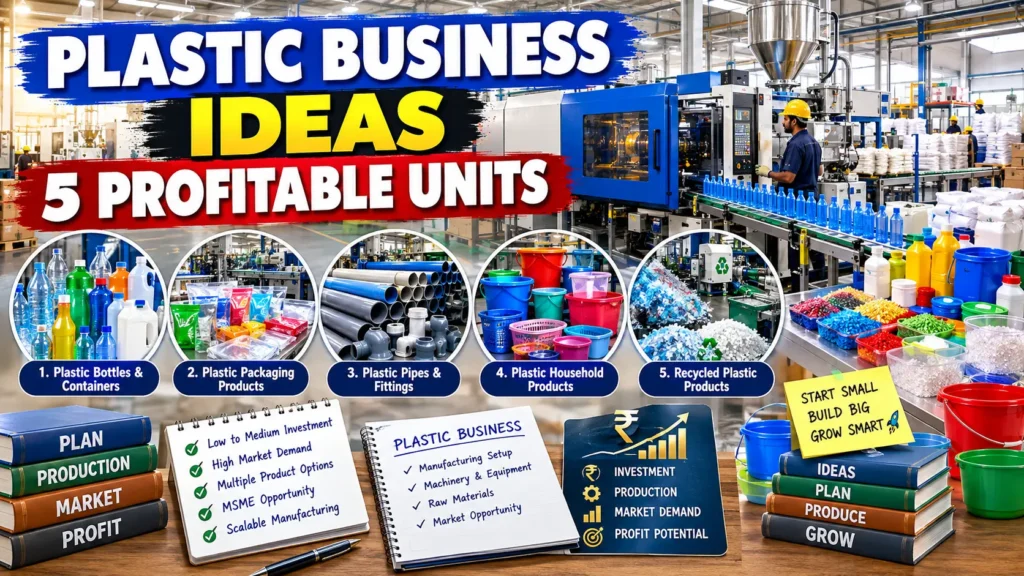
A feasibility-led look at where volume demand and value-addition meet in Indian plastics. Plastic Business Ideas in India Plastic is ubiquitous, and that’s why plastic business ideas are such a reliable choice for a first-time founder. From packaging and construction to agriculture and consumer products, we use plastic every day. And, as we move towards a more sustainable future, the demand for quality, responsibly sourced plastic products will only grow. For a founder who notices the change, the opportunity is real. This article examines plastics the way a project consultant would. We will weigh demand, policy support, and five practical manufacturing routes, then map trade openings and lessons from Indian founders. Why Plastics Remain a Strong Manufacturing Bet Volume Demand That Keeps Growing Plastic in many forms is an input to most sectors of the economy, providing diversity to withstand bad years in one part of the economy. Packaging alone accounts for massive quantities, while construction using plastic pipes, fittings and profiles is another large user. No one sector rises or falls enough to flatten the entire market, so niche units find customers from all quarters simultaneously. The phasing in of sustainable and biodegradable materials has created new opportunities. An innovator willing to champion responsible production will be riding the wave of change. Value-Addition Beats Commodity Play The smartest entry avoids pure commodity competition. Instead, value-added products such as engineered components or branded consumer goods earn better margins. Consequently, a producer who adds design, durability, or sustainability captures more value. Sector data through the Central Institute of Petrochemicals Engineering and Technology (CIPET) and Department of Chemicals and Petrochemicals helps founders target the right segments. Government Policies and Incentives Policy support flows through infrastructure, skilling, and MSME programmes. CIPET offers technical training and testing that lift product quality, while plastic park schemes provide ready industrial infrastructure. These reduce the fixed costs that once deterred small entrants. Founders should register on Udyam for collateral-free credit and priority lending. Environmental compliance runs through the Central Pollution Control Board, and early planning around recycling norms avoids disruption. Several states court plastics investment; the Tamil Nadu industrial guidance bureau is a strong example of state facilitation. 5 Plastic Business Ideas for Startups Idea 1 — Plastic Recycling Unit Recycling is at the very heart of the sector’s future, and the appetite for recycled granules is only growing. A recycling unit that gathers, cleans and recycles plastic waste into usable material provides manufacturers with a more environmentally friendly product. The low cost and ready availability of the raw materials mean that margins remain healthy. Environmental regulations encourage brands to incorporate recycled material into their products – further increasing demand. A founder benefits from the price advantage as well as the ability to position the product as environmentally friendly. Institutional customers also need recycled raw material and long-term contracts look assured. Idea 2 — PVC Pipes and Fittings Pipes and fittings are in even greater demand from construction and irrigation. With infrastructure and irrigation always growing, demand is from the need for a constant supply of the products. A single unit supplying PVC pipes reaches out to plumbers, builders and farmers all over, a much larger pool. To gain buyer confidence, a standard size and pressure rating are recommended. A founder can start with common sizes and add specialised fittings later. Local production shortens delivery and cuts freight, giving new units an edge. Furthermore, government water and housing programmes sustain demand. Reliable supply turns first orders into durable relationships with dealers and contractors. Idea 3 — Flexible Packaging Products Needs increase with every new consumer brand or e-commerce order. Flexible packaging (that can be pouches or film), is used for food, personal care and industrial products. This is a recurring revenue stream because brands are always reordering the unit. A founder should focus on print quality and food-safe standards, since these win contracts. Starting with a defined segment builds volume, while custom packaging adds margin. Moreover, sustainable and recyclable films now attract premium buyers. A packaging unit that combines quality with responsible materials can grow steadily alongside the fast-expanding retail and online economy. Idea 4 — Household and Consumer Plasticware Everyday plastic goods, such as storage boxes, buckets, and kitchenware, enjoy vast, price-sensitive demand. A unit making these products serves retail markets across towns and cities. Because volumes are large, disciplined production and cost control drive profits. A founder can begin with a focused range and grow through steady distribution. Attractive design and consistent quality win repeat retail orders. In addition, branding lifts margins above pure commodity pricing. Local manufacturing competes well against imports on cost and delivery. With careful design and reliable output, a consumer plasticware unit can build strong regional demand and expand its catalogue over time. Idea 5 — Injection-Moulded Industrial Components Why they are great: Injection moulding creates high-quality, accurate plastic pieces for appliances, automotive, or electronics. Demand for these parts is global and continual since everyone uses them. A founder designing for one industry can scale to all industries on the same machinery. Tooling quality and dimensional accuracy matter most, since buyers demand exact fit. Local supply shortens lead times, which industrial clients value highly. Over time, the catalogue can widen and margins improve with engineered grades. Furthermore, import substitution offers a clear opening, as many components still arrive from abroad. Consistent precision turns industrial buyers into long-term, repeat customers. Import–Export Opportunity Analysis Trade patterns favour capable new manufacturers. India imports several engineered plastic components and specialty films, so a reliable local producer can substitute that supply. At the same time, Indian packaging and moulded goods find buyers abroad, giving founders a two-way opportunity. Export readiness depends on consistent quality and compliance, and guidance from the DGFT helps founders align early. Consequently, a unit designed for both substitution and export builds resilience. When domestic demand dips, overseas orders help fill the gap, which steadies cash flow through the cycle. Indian MSME Success Stories Worth Studying Supreme Industries: Growth by steady segment-by-segment
Top 8 Products from Waste PET Bottles: Business Ideas & Manufacturing Guide
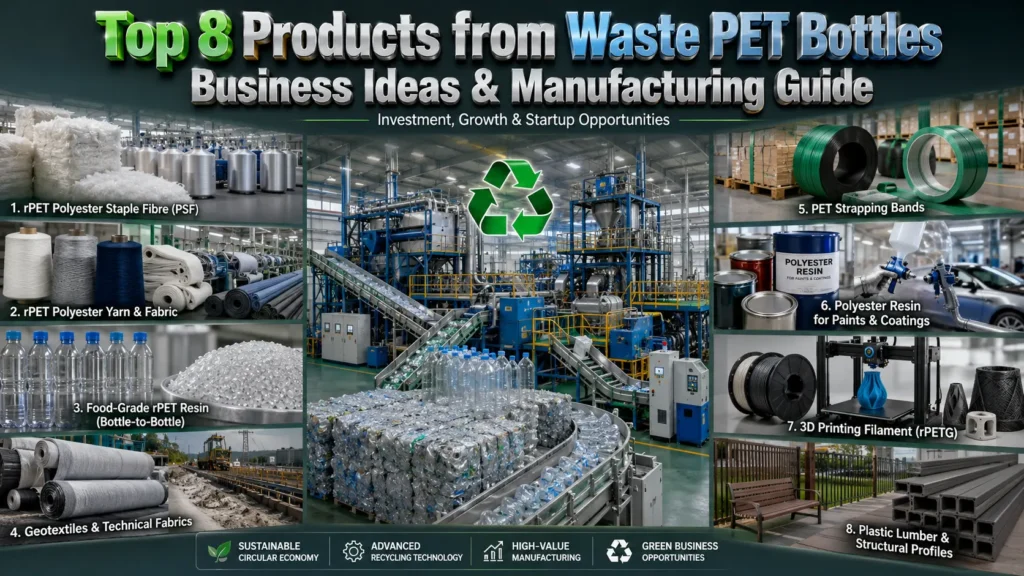
PET bottle recycling business The PET Recycling Opportunity Transformed by EPR Although most commonly recycled plastic in India, polyethylene terephthalate (PET) – clear plastic made for water, soft drink, cooking oil and food packaging – also poses one of the biggest plastic waste concerns for the country. Annually, India generates about 3.5 million tonnes of plastic waste, most of it-60-70%-being collected through an informal network of rag pickers, Kabadiwala networks and small recyclers, and the other 30-40% ending up in landfills, scattered in dumpsites, and often through incinerators. The implementation of EPR – Extended Producer Responsibility – on all plastic packaging producers in the 2022 Plastic Waste Management Amendment Rules has shifted the economics of PET recycling. Now it comes down to the brand owners to prove they collected and recycled the same amount of plastic they added to the market. This has changed the price of recycled PET from a commodity to an EPR compliance tool, with a lower price limit — thus enhancing the investment argument for formal PET recycling. The current trend of entrepreneurs entering this sector has both genuine demand for the product and value of the raw material driven by the regulations. Related Article: Packaged Drinking Water with PET Bottles The PET Recycling Value Chain PET recycling is a chain starting from collection and sorting by colour (clear, green, blue), followed by baling, washing (hot wash lines remove labels, adhesives and contaminants), flaking (shredding into clean PET flakes) and ending with the conversion of PET flakes into end products. The cost of the investment increases significantly at each step downstream — a “baler” costs Rs. 5 lakhs, a hot-wash line Rs. A fibre spinning line Rs. 50 – 150 lakhs. But so do the margins, 3–8 crore. Entrepreneurs may join anywhere and can sell semi-processed material to the downstream processors or can go forward to get more realisation. Top 8 Products from Waste PET Bottles 1. rPET Polyester Staple Fibre (PSF) The most significant end product from PET bottle recycling worldwide is recycled PET polyester staple fibre. After being washed and dried, PET flakes are melted, extruded through spinnerets, drawn, crimped and cut into short fibers (32-64 mm) that are used as pillows, quilts, sleeping bags, stuffed toys and automotive seat cushions. As European and US brands make their recycled fibre content commitments, the demand for exported materials continues to rise.As Europe and the US brands make commitments to recycled fibre content, the demand for exported materials continues to rise. The cost of 10 TPD rPSF plant is Rs. The stake he has in 2–5 crore and the money he generates is Rs. 60,000–90,000 per tonne of output. Explore This Book: The Complete Technology Book on Expanded Plastics, Polyurethane, Polyamide and Polyester Fibres 2. rPET Polyester Yarn and Fabric The high-quality PET flakes are melted and extruded to continuous filament polyester yarn. These high-quality yarns have a range of uses that include fabrics for Apparel, such as active wear, outerwear and linings, Home & Lifestyle, Home & Technical products. As, many globally recognised fashion brands set recycled targets for Polyester, to some extent that you’re more likely to find some of the leading companies making commitments, you could even be looking at, like adidas, H&M, Patagonia and IKEA setting some standards. Indian rPET yarn manufacturers who cater to these brands have established their export business. When making a rPET yarn spinning Plant, the following is required: This makes it a cheaper product than the other 3–8 crore which produces yarn at Rs. 80,000–1,20,000 per tonne. 3. Food-Grade rPET Resin (Bottle-to-Bottle) The most profitable PET recycling process is the bottle-to-bottle process, where rPET (recycled PET resin) is used to make food-grade resins for new beverage bottles. To get the required high intrinsic viscosity for bottle resin, this will need Solid State Polymerisation (SSP) equipment. There is a considerable investment (Rs. The price of food-grade rPET resin is Rs. 10–25 crore. The price of 80,000 to 1,10,000 per tonne is almost comparable to virgin PET resin price, and raw material (PET flakes) price is much lower. Domestic food-grade rPET is a preferred option as beverage brands under EPR pressure look to fill supply chain. 4. Geotextiles and Technical Fabrics Needle-punched geotextile fabrics used in road constructions, slope stabilisation and soil erosion control are made of rPET fibres. The rPET geotextiles have similar performance to virgin polyester but with a price reduction of 20-30%, which is appealing to infrastructure contractors. Specifying geotextile use is increasing the demand, especially from NHAI and state highway departments. The cost of rPET needle-punch geotextile line is Rs. The value is in the range of 1.5–3 crore and directly serves infrastructure supply chains. 5. PET Strapping Bands rPET flakes can be used directly in packaging and logistics industry for PET strapping. The use of PET strapping has been largely superseded by the use of steel strapping because it is lighter, it is rust-proof and it does not break on impact. The price of a PET strapping extrusion line is Rs. The cost of 30–80 lakh and produces strapping at Rs. $60,000-$80,000 per tonne — for large domestic packaging and logistics industry. Get Detailed Project Report (DPR): Plastics, Polymers & Resins Manufacturing Projects 6. Polyester Resin for Paints and Coatings By performing glycolysis on PET waste, bis-hydroxyethyl terephthalate (BHET) and mixed glycol terephthalate oligomers can be used as polyol for polyurethane foams, alkyd resins and polyester resins in paints and coatings. This is a chemical recycling step which needs more advanced chemistry (Rs.). High value-added chemical intermediates having better margin profiles than mechanical recyclables can be generated (1–3 crore). 7. 3D Printing Filament (rPETG) These PET flakes can be extruded and spooled into filament for desktop FDM printers, which are usually made in a high clarity varnish. The niche, high value application fetches Rs. 3,000–6,000 per kg of filament versus Rs. A value multiplier of 40–75x 60-80 per kg of input PET flakes. Small-scale production (Rs. The 20–50 lakh price segment is aimed
3 High-Demand Manufacturing Business Ideas – PET Preform, PET Bottle & Tile Adhesive – Each with ₹50 Lakh+ Annual Profit Potential
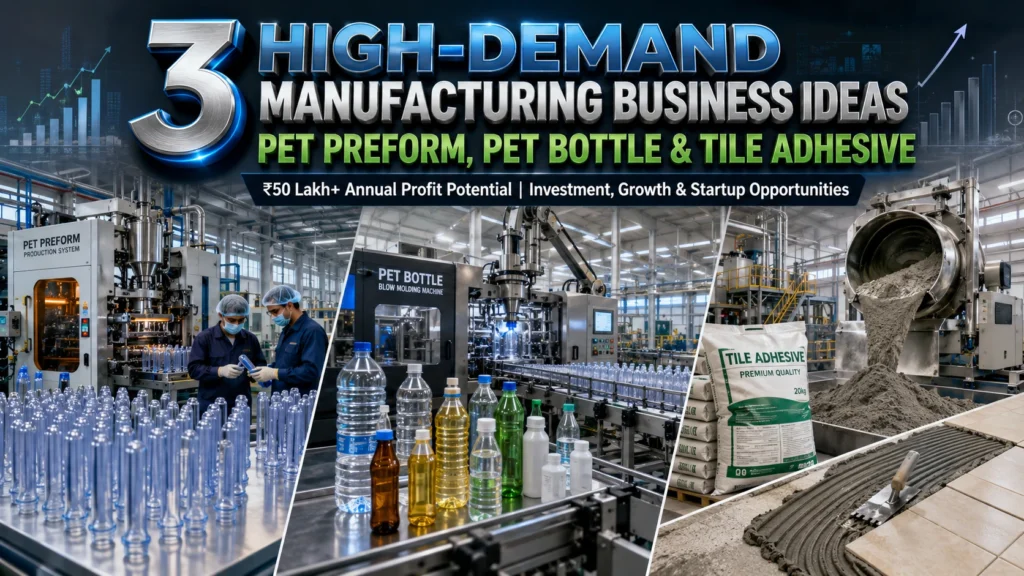
PET Preform Manufacturing Business Where Real Manufacturing Business Ideas Are Made As a nation on a fast track to a $5 trillion economy, the best business concepts often cannot be enjoyed in apps or fintech, but rather reside in the supply chain of everyday materials. PET preforms, PET bottles and tile adhesive might not be in the headlines, but they work behind the scenes to provide the backbone to India’s booming beverage sector, construction industry, and pharmaceutical supply chain. They’re not down-under plays. They are policy-mandated, demand-driven, capital efficient manufacturing avenues that are increasingly seen as one of the surest bets entry points for the manufacturing sector by first-generation entrepreneurs, MSME investors, and industrial consultants. These three segments are ones that should be closely monitored by anyone who is considering investing money on a project at the next investment cycle. Get Detailed Insights from This Book: Our Books Why This Sector — And Why Now Urbanization, organised retail and government infrastructure initiatives have put packaging and construction materials in a highly conducive situation. India’s per capita consumptions of packaged beverages are far below the global average and, for the PET packaging entrepreneur, this is nothing but structural space for growth. The disorganized construction material segment, on the other hand, is undergoing transformation in response to the rising demand for performance-based adhesives for tiles, as seen in the quality-driven approach of real estate developers and the mass housing goal of Pradhan Mantri Awas Yojana. India’s export prospects are good as the quality-price positioning is in their favour in the markets of Southeast Asia, Middle East, and parts of Africa. The domestic tile adhesives market is at a similar juncture—with the Indian flooring market shifting away from commodity tiles to higher value formats, the adhesive requirement per square metre has risen and so has the margin. These are not cyclical tailwinds; they are structural trends that are being fueled by regulatory adjustments, construction standardisation and urbanisation and income growth. Government Policies and Incentives Supporting Entry The government has made clear its intention to drive growth through manufacturing and it has given support for this in practice. The industrial infrastructure support, funding for technology upgradation, and single-window clearances are applicable to plastic packaging and construction material manufacturing units under the Make in India scheme. The Credit Guarantee Fund Trust for Micro and Small Enterprises (CGTMSE) scheme is a crucial support for first-generation entrepreneurs who do not have legacy assets to put up as collateral for loans for up to ₹2 crore, for MSME-registered units by the Ministry of Micro, Small & Medium Enterprises (MSME). The CLCSS (Credit Linked Capital Subsidy Scheme) of the DPIIT offers Capital subsidy of up to 15% for Technology Upgradation in Small Enterprises, applicable for Small PET Processing units who are investing in newer Injection Moulding or Blow Moulding technology. The Production Linked Incentive (PLI) framework is now focussed on the high investment sectors, but has generated momentum in the ecosystem, resulting in Tier-2 suppliers such as PET preform manufacturers, who serve large FMCG customers being benefitted. The National Housing Bank (NHB) and PM Awas Yojana are fueling the demand for tile adhesive in affordable housing market, which is providing regular off-take for new manufacturers. Other state governments have provided interest subventions, power tariff concessions and land package in the greenfield clusters of manufacturing units located in the industrial estates offered by various states, which significantly reduces capital deployment by the proponents of new projects. Manufacturing Business Ideas for Startups: Product-Wise Analysis 1. PET Preform Manufacturing from PET Resin A crucial entry point in the Indian packaging economy is PET preforms, intermediate mouldings in test tubes that are then stretch blow-moulded into PET bottles. The business model is simple in structure and requires utmost care in execution: raw PET resin (mostly obtained from Reliance Industries and IOCL and imported grades from Korea and China) is dried and then injection moulded with precise temperatures and pressures to get preforms of specific neck finish, weight and wall thickness as per client specifications. If a mid-size unit (4-6 injection moulding machines with a combined output of 8-12 million preforms per month) operates at prevailing market prices, it can generate a revenue of ₹4-6 crore/month, excluding other expenses such as resin cost, while the EBITDA margin is likely to range from 12-18% depending upon the efficiency of resin procurement and capacity utilisation. This is especially appealing to new investors thanks to the customer profile. PET preform buyers in the Indian market include some of the most credible players in the FMCG, beverage, and pharmaceuticals and personal care segments where the entire payment cycle is more or less standardised and there is a predictable offtake. Even having a committed supply contract with two or three local branded mineral or beverage water companies can give the base revenue predictability necessary to repay project debt. The following are important technical factors: 28mm, 38mm or custom finishes for the neck, IV (Intrinsic Viscosity) control in order to achieve the barrier properties, and optimisation of cycle time for the control of the per-unit conversion cost. The payback period is usually 3 – 4 years, for a commercially viable plant capital investment is in the range of ₹1.5 – 3 crore with 70%+ utilization of the machines. 2. PET Bottle Manufacturing The downstream part of the PET bottle value chain, after preform production, is the PET bottle segment, and it can be said that it is the more commercial part from the perspective of the public. These are either bought or produced in-house and are then stretched to the final bottle shape under air pressure in a mould (stretch blow moulding). PET bottles are used in beverages (carbonated soft drinks, juices, water), edible oil, pharmaceutical syrups, personal care (shampoo, hair oil, lotions) and home care products in India. Every segment is driven by specific specification demands – such as pressure ratings for CSD bottles and HDPE demands for pharma applications – and the small business person stepping into
ABS Resin Manufacturing Plant in India: ₹20 Crore Revenue in 2 Years?
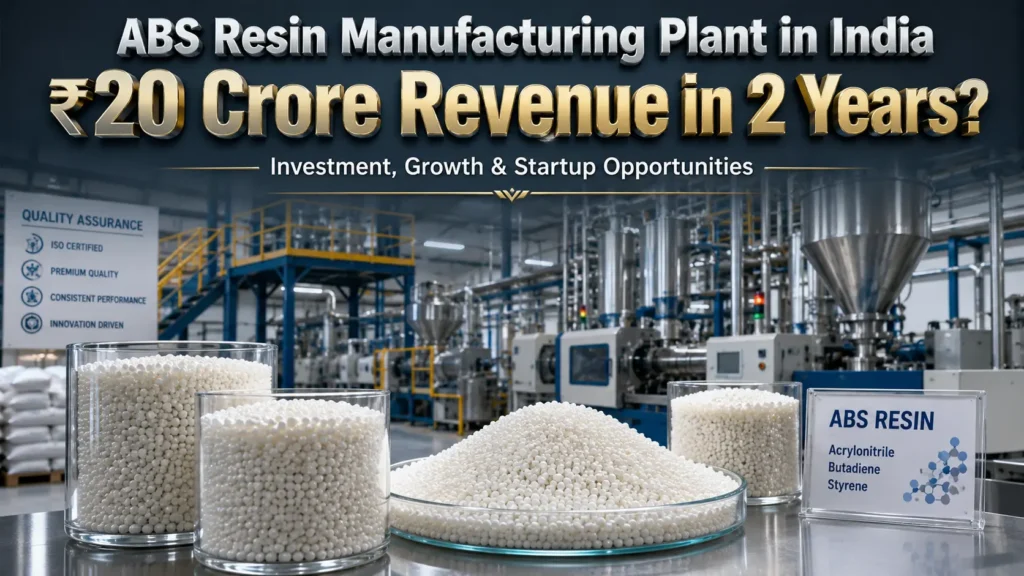
ABS resin manufacturing plant in India ABS (Acrylonitrile butadiene styrene) is a hard-working thermoplastic. It flows inside consumer electronics cases, home appliances, automotive dashboards, medical devices and pipes. It is both manufactured and imported in India. Until recently, it was able to withstand the competition of inferior foreign goods. It has however changed with the enforcement of the Bureau of Indian Standards Quality control order on ABS resin (IS 17077:2019) which comes with the requirement of BIS certification for all ABS imported or produced in the country. If an entrepreneur is considering a new manufacturing venture, this change in regulations significantly increases the investment case. Why This Sector Has Real Growth Behind It ABS resin is a product of the performance plastics group of India’s petrochemicals industry. According to the Ministry of Chemicals and Fertilizers, Government of India’s Annual Report 2025-26, the production of ABS is 176,540MT with the installed capacity of 203,000MT, which represents a CAGR of 9.7% over 4 years. That compounded growth rate is better than all other products in the Performance Plastics segment such as nylon, SAN, and PET chips. The capacity utilization of about 87% is indicative of a deficient supply side. This is not a sector that has spare capacity that awaits demand. Demand is there. The only question is: can production catch up? Demand Drivers are structural, NOT cyclical. ABS is used in Indian automotive application such as dashboards, pillar trim, bumper, interior parts. ABS housings, keyboards, and enclosures are being pulled by consumer electronics, which continues to grow in Tier-2 and Tier-3 cities. ABS pipes and fittings are employed in the construction industry. There’s no clear justification for any of these demand channels to turn around. Get Detailed Project Report (DPR): Plastics, Polymers and Resins: A Comprehensive Guide The BIS QCO: A Regulatory Wall That Protects Domestic Producers The Ministry of Chemicals and Fertilizers has been diligently implementing the mandatory BIS standards in the chemicals and petrochemicals value chain in a systematic way. Currently in effect, the ABS Quality Control Order mandates that all units of ABS resin (domestic and imported) must be marked with the BIS Standard Mark. The foreign exporters have to secure certification under the Foreign Manufacturers Certification Scheme (FMC Scheme) which introduces cost, time and compliance burden on the exporters. In the case of a domestic ABS resin manufacturing line or compounding line, this means a competitive floor. However, the lower cost Chinese and South Korean imports that once put domestic goods at a price competition disadvantage are now beset with a very real compliance challenge. The entrepreneur who establishes a certified and quality consistent operation is not playing on the level playing field with uncertified imports, the QCO levels the playing field in the entrepreneur’s Favor. Capex Range and Plant Setup Reality Before setting up an ABS manufacturing plant in India it is necessary to have clarity of what kind of plant is being established. There are three different entry points. Small-scale ABS compounding unit — This involves processing imported or domestically procured ABS base resin and adding colorants, fillers, flame retardants, and stabilizers to produce specialty compounds. Capacity range: 2,000–5,000 MT per year. Capital investment: Rs. 3–6 crore for machinery and equipment, plus Rs. 1–2 crore for civil works, utilities, and working capital. Target buyers include injection moulders, auto ancillary manufacturers, and electronics OEMs. Gross margins at this scale run 14–20%, tightening as resin input prices rise with crude. Mid-Scale Compound / Blending Plant — 5 Kilo to 15 Kilo per year, with a production of several specialty grades. Capital requirement: Rs. The cost for plant and machinery is ₹12 crore, for civil construction, ₹30–40 lakh and for six months of working capital, ₹40 lakh. Direct OEM supply and reasonable grade diversification can achieve 10-16% net margins before tax. Break-even is usually achieved between 18 and 28 months after commissioning. Greenfield ABS polymerization plant — It refers to the polymerization of the ABS base resin made by emulsion and continuous mass polymerization method from acrylonitrile, butadiene rubber and styrene monomers. The minimum amount of capital required: Rs. In the range of 80-200 crore, depending on technology licensing, logistics of feedstocks and location. It is no MSME’s land. It is suitable for big industrial groups that have access to feedstocks and already established relationships in the polymer market. Related Article: Why Performance Plastics Manufacturing Is India’s Next Big MSME Opportunity Business Selection Logic for MSME Promoters Integrated petrochemical complexes are more desired for base resin polymerization. The profit-making entry point for an MSME-type promoter is specialty compounding, which involves modifying off-the-shelf ABS grades to be more suited to a specific application. The segmentation matters. The automotive grade ABS is heat and impact resistant and has a premium price compared to commodity grades. There are also dedicated buyer profiles for flame-retardant grades for electronics; these have annual supply contracts. The UV stabilized grades are in a somewhat narrower market, but have stronger relationships with customers. The risks are not concealed. Acrylonitrile, butadiene and styrene are products of crude oil. They fluctuate in price, sometimes drastically, with world cycles in petroleum chemicals. If feedstock prices increase steadily, the margin for compounders can be reduced by as much as eight percent in 2 quarters. Most of the small compounders are facing difficulties in working capital management to maintain lean raw material inventory while holding finished goods in inventory for the buyers. Commodore-grade without application differentiations is a low-margin dead end. The winning strategy: Find a niche application, build consistency to that niche, and get OEM or distributor relationships before the plant is up and running. That’s how Indian polymer businesses have been created – on application-specific positioning and not on volume bets. Indian Entrepreneur Case References Kanoria Chemicals and Industries Ltd. (R.V. Kanoria) evolved into a specialty chemicals and polymers business due to product specialization. They would be less exposed to pure commodity price fluctuations because of their approach, technical grade manufacturing and application-specific supply. The lesson to
Asia Pacific Business Press Inc. Launches Definitive Manufacturing Handbook on Paper Water Bottles, Bioplastics & Biodegradable Products
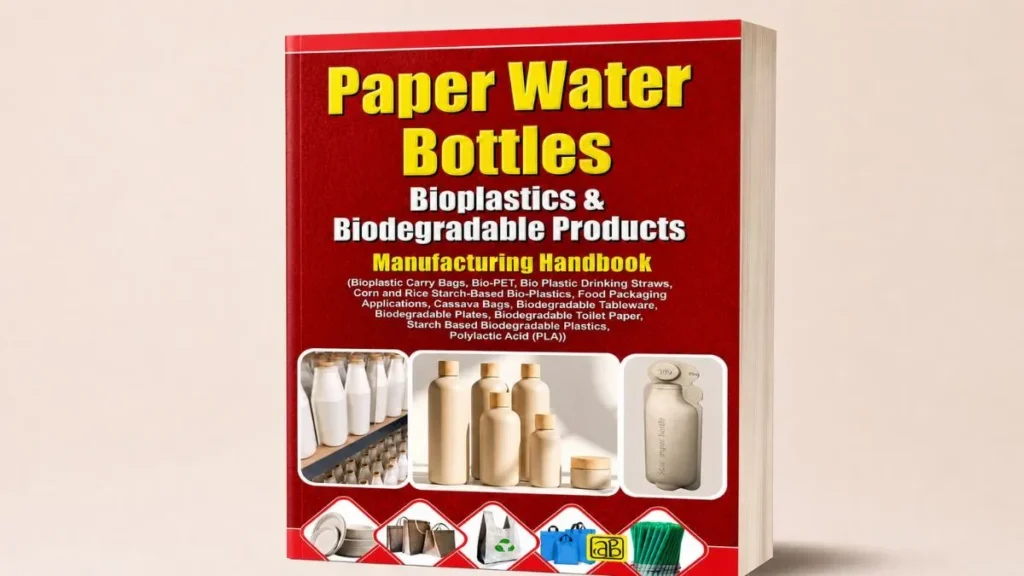
Biodegradable products manufacturing business Publication Equips Entrepreneurs, Startups and Manufacturers to take part in the rapidly expanding world global green economy. The publication of its new comprehensive handbook: Paper Water Bottles, Bioplastics and Biodegradable Products Manufacturing Handbook has been announced by Asia Pacific Business Press Inc. which is one of the most trusted industrial and technical publishing houses in Asia. The most comprehensive, practical and commercially oriented guide to biodegradable manufacturing in the Indian market and beyond, this handbook covers key product categories such as bioplastic carry bags and biodegradable tableware to corn-based starch materials, cassava bags, biodegradable toilet paper, and polylactic acid (PLA). A Crisis Demanding Action — and a Market Demanding Innovation Every year, the world generates hundreds of millions of tones of plastic waste. The vast majority of this pollution consists of single-use plastics, such as shopping bags, straws, food containers, water bottles, etc. Sensible amounts of microplastics can now be measured in oceans, rivers, soil and even the human bloodstream. This is not a mere environmental tale to traders and investors: it is an economic message of titanic proportions. The governments of other countries are also reacting to this by enacting laws to prohibit single-use plastics. The nationwide ban on identified single-use plastic products in India, the European Union guidelines on sustainability of packaging, and sustainability commitments of its corporate brands by world-renowned brands are all coming together to generate an unprecedented demand on biodegradable alternatives. To those willing to take action, this change is one of the most exciting and profitable manufacturing opportunities of the decade. This handbook has been created with a specific purpose to enable entrepreneurs, startup founders, small enterprises, and established manufacturers to take advantage of this opportunity with confidence. What Makes This Handbook Unique This handbook is constructed upon a foundation of practical industrial guidelines as opposed to an academic text or a generic environmental report. Its material has been edited to accomplish only one major task, which is to prepare the reader with all necessary materials to plan, set up and run a successful biodegradable products manufacturing unit. The handbook incorporates technical rigour with commercial transparency in a number of key dimensions: Full specifications of manufacturing process – starting with the acquisition of raw materials, up to the final product. Specific plant layout specifications and flow charts of production. Specifications of machinery requirements and directions of suppliers in every category of products. Market size, growth forecast and demand analysis of India and worldwide markets. Regulatory environment such as government regulations, and compliance. Business viability analysis and insights on investment planning. Opportunities to export and to certify international markets. Spotlight: Paper Water Bottles — The Next Big Green Opportunity Of all the products that are discussed in this handbook, the paper water bottles are given a lot of attention that is dedicated and extensive – and rightly so. One of the largest types of beverages in the world is the global bottled water market which generates billions of plastic bottles of bottled water every year. Small artisanal manufacturers and multinational giants in the beverage industry are actively exploring scalable, cost-effective solutions to small, single-use plastic water bottles. The most commercially viable solution is emerging as paper water bottles, which are made of sustainably sourced paperboard with little or no plastic coating. The handbook is end-to-end guidance on this product category, including barrier coating technology, structural engineering issues, filling line integration, shelf-life management, and branding customization. It also looks at the business case in detail: what it takes to invest, how scalable the production will be, what pricing strategies will be involved, which customer segment are the most promising entry points to new manufacturers? To the entrepreneurs who are in need to create a unique, high demand product that is not only environmentally responsible but also commercially compelling, the manufacturing of the paper water bottle is a first-mover advantage of extraordinary values. This handbook contains all the technical and business information that is required to get started. Comprehensive Product Coverage Across the Biodegradable Spectrum The coverage of the handbook spans across the entire spectrum of commercially viable biodegradable and bioplastic products that are presently in the process of gaining momentum in both Indian and global markets: Bioplastic Carry Bags — a blend of starch and PLA, adherence to standards of Indian carry bags, and positioning against conventional plastic bags. Bio-PET – the manufacturing of bio-based polyethylene terephthalate and its utilization in bottles, textiles and packaging. Bio-Plastic Drinking Straws – the production of PLA-based and paper straws, taking into account the performance and cost maximization requirements. Corn and Rice Starch-Based Bioplastics – extraction, compounding and conversion technologies of the rich agricultural byproducts available in India. Food Packaging Applications — films, trays, clamshells and wraps that are food safe and 100 percent compostable. Cassava Bags: leveraging cassava starch in water-soluble and fully biodegradable shopping bags, a product that has been gaining regulatory approval across several countries. Biodegradable Tableware – plates, bowls, cups and cutlery made of bagasse, bamboo, wheat straw and areca palm leaf. Biodegradable Toilet Paper – manufacturing of the product using recycled fiber and bamboo pulp and position the product in the rapidly expanding eco-personal care segment. Starch-Based Biodegradable Plastics — formulations based on potato, wheat and mixed starch sources to make flexible or rigid products. Polylactic Acid (PLA) – manufacturing, grades, properties and full-spectrum uses in packaging, medical devices and consumer goods. India’s Green Manufacturing Opportunity: Why Now Is the Time to Act India is at a strategic cross-road of regulatory reform, the maturing consumerism and the industrial preparation. The large agricultural sector in the country, which produces large quantities of corn, rice, cassava, sugarcane and potato, furnishes a low-cost, domestically-available source of raw materials on which bioplastics can be manufactured. Meanwhile, the growing middle-income group of India is proving to be more and more willing to pay a premium price to purchase environmentally responsible products in the urban centres. Policymakers are busy developing a regulatory framework that will incentivize
The Increasing Demand for Manufacturing Businesses of FRP Gratings, Manhole
India’s industrial infrastructure is rapidly modernizing, and with that comes the demand for robust, corrosion-resistant, and cost-effective materials. One such product that has emerged as a preferred alternative to traditional metals in various industries is FRP (Fiber Reinforced Plastic) gratings. The Manufacturing Businesses of FRP Gratings are witnessing increasing traction as they serve sectors like chemicals, oil and gas, food processing, wastewater treatment, and marine applications. Starting this business is not only profitable but also strategically aligned with India’s focus on sustainable, high-performance materials. Click here to send your queries/Contact Us Reasons for Buying NIIR Report: See More Links:
How to Initiate Cellulosic Cellophane Film Business?
As the global packaging industry continues to seek sustainable, biodegradable, and non-toxic alternatives to plastic, starting a Cellulosic Cellophane Film Business has become a highly promising opportunity. Made from natural cellulose derived from wood pulp or cotton linters, cellophane is a biodegradable and compostable film known for its transparency, breathability, and ability to preserve freshness in food packaging. This eco-friendly material has made a strong comeback in markets demanding green alternatives to synthetic packaging. With increasing global environmental regulations and the consumer shift toward sustainability, launching a cellulosic cellophane film business is not only viable but also visionary. The cellulosic cellophane film business allows entrepreneurs to tap into a niche that is both profitable and environmentally responsible. This product is extensively used in packaging for bakery goods, candies, pharmaceuticals, and personal care products. Let’s explore the technical, market, and investment aspects of this innovative green business idea. Click here to send your queries/Contact Us Overview of Cellulosic Cellophane Film Market The cellulosic cellophane film market has been resurging with global emphasis on sustainability. This film decomposes completely within 30–60 days in industrial composting systems and is safe for incineration. With zero microplastic pollution, it is being adopted by organic and eco-label food brands, cosmetic packaging, and artisanal producers who value visual appeal and green credentials. According to recent market reports, the global biodegradable films market is projected to exceed USD 9.5 billion by 2030, and cellulosic films are expected to maintain a strong share due to their aesthetic, compostable, and renewable properties. Visit this Page for More Information: Start a Business in Plastics and Polymers Industry Applications of Cellulosic Cellophane Film Food Packaging – Especially for baked goods, chocolates, dry fruits, tea, and cheese. Pharmaceutical Packaging – Transparent wrapping for blister packs and supplements. Cosmetics and Personal Care – Used in transparent pouches and outer product wrappers. Gift and Decorative Wrap – Popular in gift items, flowers, and luxury product wrapping. Industrial Uses – Anti-static, heat-sealable films for electronics or sensitive components. Its superior oxygen and aroma barrier properties, while allowing moisture permeability, make it ideal for products that need freshness and aroma retention. Related Business Plan: Packaging Industry How to Start a Cellulosic Cellophane Film Business 1. Business Plan and Feasibility Study Begin with a detailed market analysis and feasibility report. Consider the following: Target sectors: food, pharma, retail Competitor analysis: local and international cellophane manufacturers Sourcing of raw materials (wood pulp, cotton linters) Compliance with environmental laws and packaging standards 2. Location and Infrastructure A medium-scale production unit requires: 10,000 to 15,000 sq. ft. of space for production, storage, and utilities Proximity to pulp suppliers and transport hubs 3. Machinery and Technology Cellulose pulp preparation unit Film casting machine Coating units (for moisture-proofing or printability) Drying tunnels Slitting, cutting, and packaging machines Automation and precision in film thickness and surface treatment are crucial for quality. 4. Raw Materials Refined cellulose pulp Glycerin (as softening agent) Sulfuric acid and sodium hydroxide (for processing) Coating agents (PVA, nitrocellulose if needed) Read Similar Articles: PACKAGING AND PRINTING INDUSTRY Investment and Setup Cost Component Estimated Cost (INR) Land & Infrastructure ?1.5 – ?2 crore Machinery & Equipment ?3 – ?5 crore Working Capital ?1 – ?2 crore Certifications & Licensing ?10 – ?15 lakh Total Investment: ?5.5 crore to ?9 crore (USD $650,000 to $1.1 million approx.) Certifications and Compliance To operate smoothly and export globally, acquire: ISO 9001 – Quality management ISO 14001 – Environmental management FDA & FSSAI – For food-grade packaging Compostable Certification – From relevant national agencies MSME Udyam Registration – To avail subsidies and schemes Related Feasibility Study Reports: Packaging Industry, Beverage Can Profitability and Revenue Model Production Cost per Kg: ?120–?160 depending on coating Selling Price per Kg: ?200–?350 depending on customization Profit Margin: 30%–50% Breakeven Period: Within 2 to 3 years Selling to premium eco-conscious brands allows premium pricing, boosting overall margins. Marketing and Sales Strategy B2B Partnerships: Approach organic food brands, pharma companies, and luxury product manufacturers. Trade Expos: Exhibit at packaging and sustainability expos. Online Presence: Showcase samples and capabilities on a professional website and B2B portals. Certifications & Eco-Labels: Highlight compostable credentials for market differentiation. Export Opportunities: Countries like Germany, Japan, and Canada offer strong markets for biodegradable films. Sustainability & Future Outlook Governments worldwide are banning single-use plastics. Brands are seeking alternatives that are: Biodegradable Compostable Transparent and printable Cellophane film fits perfectly into this trend. Unlike PLA and other bioplastics, cellophane decomposes without leaving microplastics, making it a favorite among green consumers. India’s EPR (Extended Producer Responsibility) norms and ban on non-compostable plastics will further increase demand for biodegradable films. With a shift in FMCG and retail packaging, the future of cellulosic cellophane film business is both stable and scalable. Conclusion Launching a cellulosic cellophane film business combines the advantages of sustainability, innovation, and high demand. With investment in the right technology, adherence to eco-certifications, and market-focused branding, this business promises long-term profitability and environmental contribution. As packaging norms evolve and consumers prioritize green alternatives, your venture in this biodegradable film segment can become a market leader in sustainable packaging. Read our Books Here: Packaging Industry Niir Project Consultancy Services (NPCS) prepares multiple project reports on different segment one of the project report by NPCS is Cellulosic Cellophane Film – Manufacturing Plant, Detailed Project Report, Profile, Business Plan, Industry Trends, Market Research, Survey, Machinery, Raw Materials, Feasibility Study, and Investment Opportunities. The detailed project report by NPCS covers all the important aspects of a business from analyzing the market, confirming availability of various necessities such as plant & machinery, raw materials to forecasting the financial requirements. The project reports are not only used in India but worldwide by engineers, project consultants & industrial consultancy firms. You can get the project reports from the official site of NPCS. Click here to send your queries/Contact Us Reasons for Buying NIIR Report: Our research report helps you get a detailed picture of the industry by providing an overview of the industry
Startup Manufacturing Business of PVC Edge Banding Tape
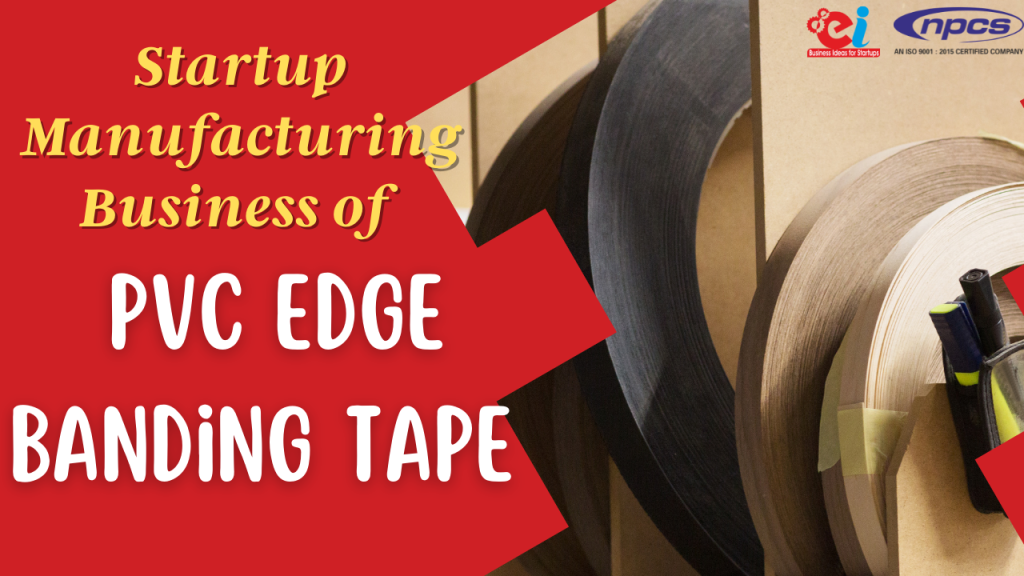
Starting a PVC Edge Banding Tape business can be a highly profitable and sustainable venture in today’s fast-evolving interior design and modular furniture industry. As the demand for aesthetic yet durable furniture products continues to grow, PVC edge banding becomes indispensable for furniture manufacturers. In this in-depth guide, we explore every facet of setting up a successful PVC edge banding tape business, from market analysis to manufacturing and marketing strategies. Understanding the PVC Edge Banding Tape Industry What is PVC Edge Banding Tape and Why It Matters PVC edge banding tape is a thermoplastic strip applied to the raw edges of furniture made from MDF, plywood, or particle board. It acts as both a functional and decorative layer, protecting the furniture from moisture, dust, and chipping while enhancing its appearance. Available in various textures such as wood grain, high gloss, and matte, PVC edge banding is used extensively in the production of office furniture, modular kitchens, wardrobes, and shop interiors. The tape is generally made from polyvinyl chloride (PVC) and is processed with additives like plasticizers, lubricants, stabilizers, and colorants to achieve desired flexibility, adhesion, and finish. Why the Market for PVC Edge Banding Tape is Growing Rapidly The PVC edge banding industry has witnessed exponential growth due to: Surge in modular furniture adoption Expanding urban population and real estate sector Increased consumer spending on home and office decor Export demand from countries in the Middle East, Africa, and Southeast Asia According to industry estimates, the global edge banding materials market is projected to grow at a CAGR of over 7% in the next five years, presenting vast opportunities for new players entering the market. Steps to Start a Successful PVC Edge Banding Tape Business Step 1: Market Research and Competitor Analysis Start by conducting detailed market research on your target regions, product demand, pricing models, and competitors. Evaluate customer preferences such as the thickness (0.45mm to 2mm), width (12mm to 54mm), finishes, and colors. Survey existing PVC edge banding tape sellers to understand supply gaps and value-added services you can offer, such as custom shades or faster deliveries. Step 2: Prepare a Comprehensive Business Plan A strong business plan will act as a roadmap for success. Your business plan should include: Market insights and goals Budget breakdown (machinery, labor, materials) Product range Funding sources SWOT analysis Break-even analysis Risk management plan This document is also essential for presenting to banks and investors when applying for loans or venture capital. Step 3: Legal Compliance and Business Registration To operate legally, register your business under an appropriate entity such as Proprietorship, LLP, or Private Limited Company. Obtain the following licenses: GST Registration MSME/Udyam Registration Pollution Control Certification Factory License (if manufacturing) Import Export Code (IEC) if planning to export These licenses are crucial to avoid legal hassles and to apply for government subsidies. Step 4: Choose Your Business Model – Trading or Manufacturing You can either trade or manufacture PVC edge banding tape: Trading: You source tape from manufacturers and supply to furniture makers or distributors. Lower investment, faster ROI. Manufacturing: You produce edge banding from raw materials. Higher profit margin, brand control, scalable. Many entrepreneurs begin with trading and transition into manufacturing once they understand the market and have built a client base. Step 5: Set Up Your Manufacturing Plant If you choose manufacturing, setting up a well-planned production facility is vital. Essential machinery includes: PVC Extruder Machine: For melting and shaping the tape Printing Machine: For applying wood grain and textured finishes Calibrating Machine: To maintain exact thickness Cooling Line: Ensures consistency Slitting and Cutting Machines: For precision finishing Packing Machine: To roll and seal the product Install all equipment following industrial safety standards. Maintain proper air ventilation, waste disposal, and fire safety equipment. Step 6: Source High-Quality Raw Materials Key materials required: PVC Resin (Base material) Plasticizers (Improve flexibility) Heat stabilizers (Increase thermal stability) Color masterbatches (Add color) Lubricants (Enhance processing) Printing inks (For textured patterns) Establish contracts with multiple reliable suppliers to ensure consistent production. Step 7: Hire and Train Your Workforce To run your unit efficiently, hire: Plant Manager Machine Operators Quality Inspectors Warehouse & Logistics Staff Sales and Admin Staff Train your team on safety protocols, machine handling, and quality assurance. Efficient Production Process for Quality Edge Banding Maintaining High Standards of Quality Control Quality control is crucial for market reputation. Key parameters to monitor: Tape thickness uniformity Accurate color matching Bonding strength with substrate Surface smoothness Roll length and weight Regular inspections and sample testing help reduce defects and maintain consistency. Packaging and Logistics Neatly packaged rolls ensure product safety during transit. Use waterproof, tear-resistant materials and print your brand logo and product details on the labels. Offer customization in roll lengths for larger orders. Establish distribution points in major cities to reduce delivery times. Marketing and Scaling Your PVC Edge Banding Tape Business Develop a Strong Distribution Network Approach: Furniture factories Interior designers Carpenters and contractors Modular kitchen manufacturers Hardware and plywood shops Offer volume-based pricing, free samples, and credit periods to gain trust. Boost Your Online Presence Create a professional website showcasing your PVC edge banding tape range with HD product images, downloadable catalogs, and client testimonials. Optimize for SEO using relevant keywords such as: PVC edge banding tape manufacturer PVC edge banding tape suppliers in India Edge banding for modular furniture Leverage social media platforms like LinkedIn, Instagram, and Facebook. List your products on B2B platforms like IndiaMART, TradeIndia, and Alibaba for global exposure. Participate in Industry Exhibitions Trade fairs such as: DelhiWood IndiaWood Acetech Interzum (Germany) offer excellent opportunities to network, find bulk buyers, and stay updated on the latest trends in PVC edge banding tape technology. Financial Planning and Profitability Cost Breakdown and ROI Initial Investment: ?30–?50 lakhs (for manufacturing) Machinery: ?20–?30 lakhs Raw materials: ?5–?10 lakhs (monthly) Labor & utilities: ?1–?2 lakhs/month Break-even: 12–18 months (average) With strategic planning, manufacturers can expect profit margins of 20–30%, while traders may earn 10–15% based on volumes and market penetration.
Setting up a Plastics Material and Resin Manufacturing Business
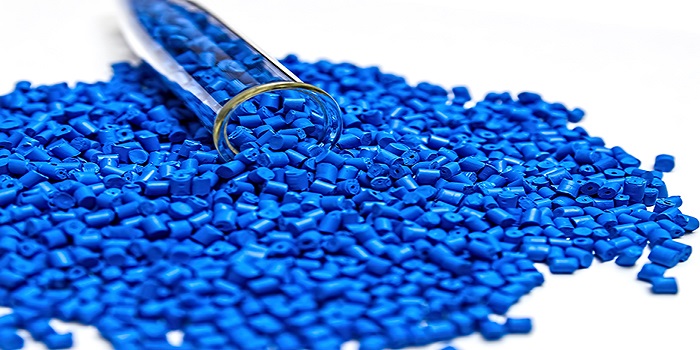
Introduction to Plastics & Resin Manufacturing The plastics & resin manufacturing industry is one of the most lucrative and expanding sectors in the global economy today. Driven by rapid industrialization, urban development, and the ongoing demand for innovative materials, starting a plastics & resin manufacturing business offers an exceptional opportunity for entrepreneurs and investors to establish a strong and profitable enterprise. Plastics are used in virtually every industry—from automotive, construction, and electronics to packaging, textiles, and healthcare. Similarly, resins serve as critical components in adhesives, coatings, and composite materials, helping improve durability, flexibility, and performance. The beauty of this industry lies in its diversity and adaptability. Whether producing basic polyethylene products or specialty epoxy resins for aerospace applications, this field allows for deep customization, scalability, and consistent demand. With proper planning, technological integration, and a commitment to sustainability, a plastics & resin manufacturing business can thrive in both domestic and international markets. Understanding the Scope of Plastics & Resin Industry The plastics & resin industry encompasses a vast array of products and services. Plastics can be broadly classified into two categories: Thermoplastics, such as polyethylene (PE), polypropylene (PP), polyvinyl chloride (PVC), and polystyrene (PS), which can be melted and reshaped multiple times. Thermosetting plastics, like epoxy, phenolic, and melamine resins, which harden permanently after being molded once. Resins, on the other hand, are crucial for creating adhesives, paints, varnishes, and plastic composites. These materials are the backbone of several end-use industries including automotive, aerospace, consumer goods, medical devices, and more. The global plastics market is valued at over USD 600 billion and is projected to surpass USD 750 billion in the next five years. With innovations in biodegradable and recyclable plastics, the industry is pivoting toward greener solutions while maintaining a steady growth trajectory. Step-by-Step Guide to Launching a Plastics & Resin Manufacturing Business 1. Conduct Comprehensive Market Research To begin with, perform an in-depth market analysis. Key factors to study include: Global and regional trends Product demand and supply gaps Target customer segments Existing competitors and their market share Raw material sourcing opportunities Government regulations and subsidies Environmental impact and sustainability demands Studying these parameters helps in identifying profitable niches such as biodegradable plastics, medical-grade polymers, or industrial resins. 2. Choose the Right Product Niche Identifying the right product segment is vital. You can focus on: Commodity plastics: such as HDPE, LDPE, PP, and PVC, used in packaging, construction, and consumer goods. Specialty resins: including epoxy, alkyd, acrylics, and unsaturated polyesters for high-performance applications. Eco-friendly bioplastics: made from renewable resources such as corn starch or sugarcane. Define whether you want to serve as an OEM (Original Equipment Manufacturer), supply raw resins to processors, or offer custom-molded plastic products for specific industries. 3. Legal Setup, Certifications, and Licensing Set up a legal entity such as: Proprietorship Partnership firm Limited Liability Company (LLC) Private Limited Company You must obtain: Business registration Pollution Control Board (PCB) clearance Factory license Fire and safety certifications GST registration ISO certifications (ISO 9001, ISO 14001, etc.) In some regions, especially for export, certifications like CE and REACH may be required. 4. Factory Location and Infrastructure Planning Selecting the ideal location is critical. An industrial zone with proximity to raw material suppliers and distribution hubs reduces logistical costs and improves efficiency. Key infrastructure elements include: Manufacturing unit with proper layout and machinery Storage space for raw materials and finished goods Office for administrative functions Waste management and effluent treatment facilities Backup power supply and fire protection systems Ensure the factory meets all zoning and environmental guidelines to avoid legal complications. 5. Machinery and Equipment Setup Investment in high-quality machinery ensures smooth production and long-term durability. Common equipment includes: Extrusion machines Injection molding machines Blow molding and thermoforming equipment Polymerization reactors Mixing and blending units Quality control laboratories Granulators and shredders Packing and sealing machines Advanced automation and Industry 4.0 technologies like IoT, AI, and robotics are increasingly being adopted for real-time monitoring, predictive maintenance, and productivity optimization. 6. Raw Materials and Supplier Management Secure a consistent supply chain for essential raw materials: Petrochemical derivatives (naphtha, ethylene, propylene) Bio-based feedstocks (corn starch, cellulose, lactic acid) Additives (stabilizers, plasticizers, flame retardants, colorants) Fillers and reinforcements (glass fiber, calcium carbonate) Negotiate bulk procurement contracts to manage price volatility and ensure timely delivery. Building strong supplier relationships is crucial for a plastics & resin manufacturing business. 7. Hiring and Training Skilled Workforce Recruit skilled professionals, including: Chemical engineers and process technicians Production managers Maintenance engineers Safety and compliance officers Machine operators and packaging staff Provide regular training programs focused on: Equipment handling and safety Quality control and assurance Regulatory compliance Sustainable practices A competent team ensures smooth operations, fewer breakdowns, and higher product quality. 8. Compliance with Environmental and Safety Standards The plastics & resin industry faces intense scrutiny for environmental and health impacts. Ensure compliance with: Local environmental laws and pollution control norms International standards such as RoHS, REACH, and ISO 14000 Occupational safety regulations under OSHA or equivalent Set up effluent treatment plants (ETPs), air scrubbers, and recycling systems to minimize environmental damage. Promote responsible handling of hazardous materials and maintain transparent records. 9. Develop a Strong Sales and Distribution Network Explore multiple sales channels including: Direct B2B contracts with manufacturers Industrial distributors and wholesalers Online platforms and marketplaces Export to high-demand countries Participate in trade shows, expos, and industry forums to build visibility. Invest in a CRM system for lead management, customer engagement, and after-sales service. 10. Branding, Digital Marketing, and Business Development In today’s digital age, visibility equals viability. Establish a strong brand identity through: A professional website with product catalogs, datasheets, and certifications SEO-optimized content targeting keywords like plastics & resin manufacturing business LinkedIn and social media campaigns Google Ads and remarketing strategies E-newsletters, whitepapers, and product demos Focus on customer education through blogs, video content, and case studies to showcase expertise and innovation. Financial Planning and ROI Expectations Initial investment for setting up a plastics & resin manufacturing plant ranges from ?2 crore to