
ABS resin manufacturing plant in India
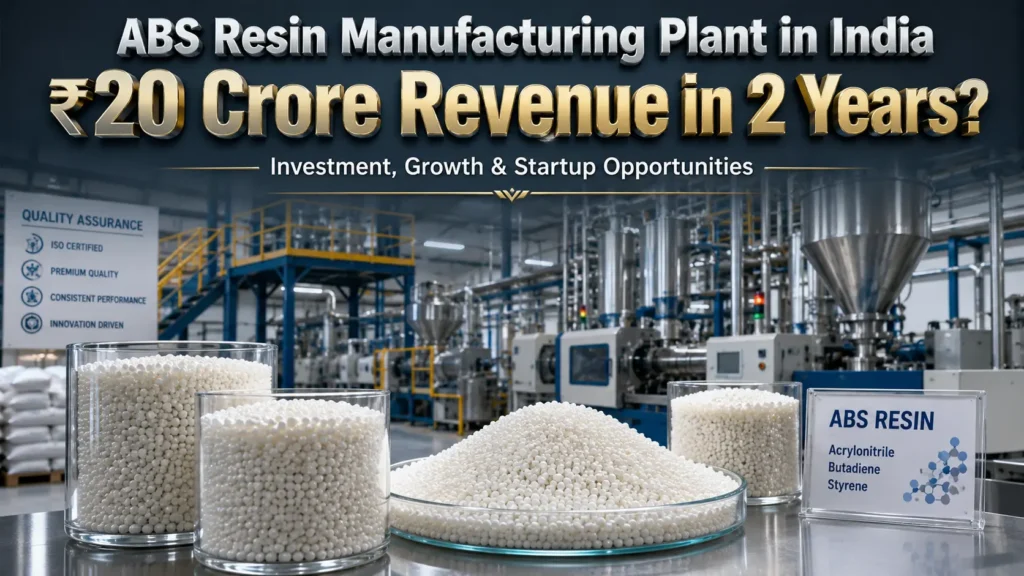
ABS (Acrylonitrile butadiene styrene) is a hard-working thermoplastic. It flows inside consumer electronics cases, home appliances, automotive dashboards, medical devices and pipes. It is both manufactured and imported in India. Until recently, it was able to withstand the competition of inferior foreign goods. It has however changed with the enforcement of the Bureau of Indian Standards Quality control order on ABS resin (IS 17077:2019) which comes with the requirement of BIS certification for all ABS imported or produced in the country. If an entrepreneur is considering a new manufacturing venture, this change in regulations significantly increases the investment case.
Why This Sector Has Real Growth Behind It
ABS resin is a product of the performance plastics group of India’s petrochemicals industry. According to the Ministry of Chemicals and Fertilizers, Government of India’s Annual Report 2025-26, the production of ABS is 176,540MT with the installed capacity of 203,000MT, which represents a CAGR of 9.7% over 4 years. That compounded growth rate is better than all other products in the Performance Plastics segment such as nylon, SAN, and PET chips.
The capacity utilization of about 87% is indicative of a deficient supply side. This is not a sector that has spare capacity that awaits demand. Demand is there. The only question is: can production catch up?
Demand Drivers are structural, NOT cyclical. ABS is used in Indian automotive application such as dashboards, pillar trim, bumper, interior parts. ABS housings, keyboards, and enclosures are being pulled by consumer electronics, which continues to grow in Tier-2 and Tier-3 cities. ABS pipes and fittings are employed in the construction industry. There’s no clear justification for any of these demand channels to turn around.
Get Detailed Project Report (DPR): Plastics, Polymers and Resins: A Comprehensive Guide
The BIS QCO: A Regulatory Wall That Protects Domestic Producers
The Ministry of Chemicals and Fertilizers has been diligently implementing the mandatory BIS standards in the chemicals and petrochemicals value chain in a systematic way. Currently in effect, the ABS Quality Control Order mandates that all units of ABS resin (domestic and imported) must be marked with the BIS Standard Mark. The foreign exporters have to secure certification under the Foreign Manufacturers Certification Scheme (FMC Scheme) which introduces cost, time and compliance burden on the exporters.
In the case of a domestic ABS resin manufacturing line or compounding line, this means a competitive floor. However, the lower cost Chinese and South Korean imports that once put domestic goods at a price competition disadvantage are now beset with a very real compliance challenge. The entrepreneur who establishes a certified and quality consistent operation is not playing on the level playing field with uncertified imports, the QCO levels the playing field in the entrepreneur’s Favor.
Capex Range and Plant Setup Reality
Before setting up an ABS manufacturing plant in India it is necessary to have clarity of what kind of plant is being established. There are three different entry points.
Small-scale ABS compounding unit — This involves processing imported or domestically procured ABS base resin and adding colorants, fillers, flame retardants, and stabilizers to produce specialty compounds. Capacity range: 2,000–5,000 MT per year. Capital investment: Rs. 3–6 crore for machinery and equipment, plus Rs. 1–2 crore for civil works, utilities, and working capital. Target buyers include injection moulders, auto ancillary manufacturers, and electronics OEMs. Gross margins at this scale run 14–20%, tightening as resin input prices rise with crude.
Mid-Scale Compound / Blending Plant — 5 Kilo to 15 Kilo per year, with a production of several specialty grades. Capital requirement: Rs. The cost for plant and machinery is ₹12 crore, for civil construction, ₹30–40 lakh and for six months of working capital, ₹40 lakh. Direct OEM supply and reasonable grade diversification can achieve 10-16% net margins before tax. Break-even is usually achieved between 18 and 28 months after commissioning.
Greenfield ABS polymerization plant — It refers to the polymerization of the ABS base resin made by emulsion and continuous mass polymerization method from acrylonitrile, butadiene rubber and styrene monomers. The minimum amount of capital required: Rs. In the range of 80-200 crore, depending on technology licensing, logistics of feedstocks and location. It is no MSME’s land. It is suitable for big industrial groups that have access to feedstocks and already established relationships in the polymer market.
Related Article: Why Performance Plastics Manufacturing Is India’s Next Big MSME Opportunity
Business Selection Logic for MSME Promoters
Integrated petrochemical complexes are more desired for base resin polymerization. The profit-making entry point for an MSME-type promoter is specialty compounding, which involves modifying off-the-shelf ABS grades to be more suited to a specific application. The segmentation matters. The automotive grade ABS is heat and impact resistant and has a premium price compared to commodity grades. There are also dedicated buyer profiles for flame-retardant grades for electronics; these have annual supply contracts. The UV stabilized grades are in a somewhat narrower market, but have stronger relationships with customers.
The risks are not concealed. Acrylonitrile, butadiene and styrene are products of crude oil. They fluctuate in price, sometimes drastically, with world cycles in petroleum chemicals. If feedstock prices increase steadily, the margin for compounders can be reduced by as much as eight percent in 2 quarters. Most of the small compounders are facing difficulties in working capital management to maintain lean raw material inventory while holding finished goods in inventory for the buyers. Commodore-grade without application differentiations is a low-margin dead end.
The winning strategy: Find a niche application, build consistency to that niche, and get OEM or distributor relationships before the plant is up and running. That’s how Indian polymer businesses have been created – on application-specific positioning and not on volume bets.
Indian Entrepreneur Case References
Kanoria Chemicals and Industries Ltd. (R.V. Kanoria) evolved into a specialty chemicals and polymers business due to product specialization. They would be less exposed to pure commodity price fluctuations because of their approach, technical grade manufacturing and application-specific supply. The lesson to take from the class is that Vulnerability to raw material cycles is diminished when there is a mix of grades and application stickiness.
Organized regional manufacturing on a massive scale is exemplified by Supreme Industries (M.P. Taparia). They spread their presence throughout India with 25+ plants, which helped to lower logistics costs and bring them near to regional OEM buyers, which added to their competitive advantage over time. A geographic location close to automotive and electronics manufacturing is built into the business model of ABS compounders.
Apar Industries — a major cable and conductors’ manufacturer — ventured into polymer processing due to the need to consume polymers on large volumes and due to the fact that it understands that back-ward integration helps to capture more margin. The relevant insight: Once the demand for polymer becomes a threshold, it becomes financially sound to make it. Multiple mid-size electronics manufacturer companies are now considering similar integration for ABS grade that they are purchasing in bulk quantities from Pune and Chennai.
Get Detailed Insights from This Book: The Complete Technology Book on Industrial Polymers, Additives, Colourants and Fillers
Import-Export Opportunity Analysis
India is a large importer of ABS from South Korea and China. In addition, the new BIS QCO requirement will directly drive up the landed cost to the non-certified importer, thus reducing the price differential that was available in the past to low-cost Asian suppliers. This opens up an opportunity for import substitution for domestic producers.
On the export side, Indian ABS compounders are working on supply agreements with auto component manufacturers in Southeast Asian countries and the Middle East. Indian units have an incentive to export as competition with South Korean or Taiwanese producers is more cost competitive once volumes are above 3,000-4,000 MT per year.
Government Support Worth Accessing
MSME promoters must consider the collateral-free credit facility of CGTMSE till Rs. The Industrial Incentive Schemes (IIS) of polymer processors in three different clusters in Gujarat (Dahej), Andhra Pradesh (Kakinada) and Odisha (Paradeep) all provide subsidies for infrastructure costs, namely 5 crores, PMEGP for initial equity support in manufacturing, and state industrial incentives. Parks have been approved under the Plastic Parks scheme of the Department of Chemicals and Petrochemicals of Karnataka, Uttar Pradesh, Tamil Nadu and Madhya Pradesh providing cluster infrastructure and thereby, the per unit fixed cost is reduced.
Feasibility Validation Before Capital Commitment
A structured feasibility analysis is a must before investing in an ABS resin manufacturing plant. Market Survey cum Detailed Techno-Economic Feasibility Report for an industrial entrepreneur is prepared by Niir Project Consultancy Services (NPCS), which includes the manufacturing process selection, market demand analysis, specifications of various types of machinery, strategies for procuring raw materials, and complete project financials including the profitability projections, break-even timelines and sensitivity to the change in the input prices. This structured analysis is the difference between the sanctioned loan and unsanctioned loan for a first-generation promoter going to a bank or putting in equity capital.
Find high-return business ideas based on your budget & ROI
Conclusion
The business case for a plant to manufacture ABS resin in India is based on real data and not on projections. Production has increased by 9.7% CAGR at 176,540 MT with a capacity of 203,000 MT. The BIS Quality Control Order enforcement has been systematically increasing the cost of substandard imports. Demand downstream is from four groups all at once — automotive, electronics, construction and consumer goods — and it has no plausible reason to turn around.
The cost of the investment of a viable MSME entry is in the range of Rs. Shows a green flag on the “Show Results” button. Displays a green icon on the “Show Results” button The cost is 25 crore for a mid-scale type operation having multiple application specific grades. Well-positioned units can achieve gross margins of 14-22% while commodity-grade compounding without differentiation can achieve a much less.
The risks are physical and must be factored in when deciding. The volatility of feedstocks due to the oil price cycles can crush margins in a strait jacket fashion. Large integrated producers can better take the price hit as they are bigger and can simply absorb it, so MSMEs will either have to differentiate or else be squeezed. Operators who are able to withstand the swings in raw material prices are those who practice working capital discipline.
The way forward is sustainable – first select an application area, develop a consistent quality for the application area, commit buyers in advance before the plant is started and then conduct the financials secondly via a thorough feasibility study before committing the first rupee. This isn’t a conservative way. That’s the way to get plants that will continue to run.
Sector Data Table: ABS Resin — Key Manufacturing Metrics for Entrepreneurs
| Parameter | Small-Scale Unit | Mid-Scale Unit | Large Industrial Unit |
| Annual Capacity (MT) | 2,000–5,000 | 5,000–15,000 | 50,000+ |
| Capex — Plant & Machinery (Rs. crore) | 3–6 | 12–25 | 80–200 |
| Total Project Cost (Rs. crore) | 5–9 | 18–38 | 120–300+ |
| Gross Margin Range (%) | 14–20% | 14–22% | 10–18% |
| Break-Even Period (Months) | 15–22 | 18–28 | 36–48 |
| Primary Target Buyer | Injection moulders, OEM assemblers | Auto ancillaries, electronics OEMs | Large polymer processors |
FAQ Section
Q1. How much is the minimum investment required for setting up an ABS resin compounding plant in India?
The total project investment for a small-scale ABS compounding unit of 2000-5000 MT per year is Rs. Machinery, civil works, utility connections, licensing and six months working capital – 5-9 crore. Lower entry costs usually mean that the infrastructure is not fully planned.
Q2. In India, which are the necessary licenses to get for manufacturing ABS resin?
A factory license from the Factories Act, GST registration, consent to operate from the State Pollution Control Board, ABS QCO under IS 17077:2019 and MSME registration of the factory are required for accessing government schemes. Environmental clearance is for capacities greater than threshold.
Q3. What raw materials does one need to manufacture ABS and where do they come from?
The main raw materials used are ABS base resin sourced from local manufacturers or from BIS certified sources from abroad, stabilisers, flame retardants, colourants and glass fibre for reinforced grades. Most of the input is available locally either from chemical distributors in Gujarat, Maharashtra or Rajasthan.
Q4. What is the reasonable time to break even in a mid-scale scale ABS manufacturing plant?
A medium scale compounding plant with capacity ranging from 5000 to 10,000 MT (Rs.). Typical break-even period 18-28 months post-commissioning with capacity utilisation of 65-75% in the first year of full operation and direct supply to 3-5 OEM buyers; 18-28 crore investment, total.
Q5. Which is the most serious risk of running a business to produce ABS resin in India?
The major operational risk is price volatility of the feedstocks. The crude input into ABS is called inputs and include acrylonitrile, butadiene and styrene. A 15–20% increase in the input price can shrink margins from 16% to single digits in a quarter. MSMEs should strike pass through pricing with the buyers and keep the inventory of raw materials to 30-45 days maximum.