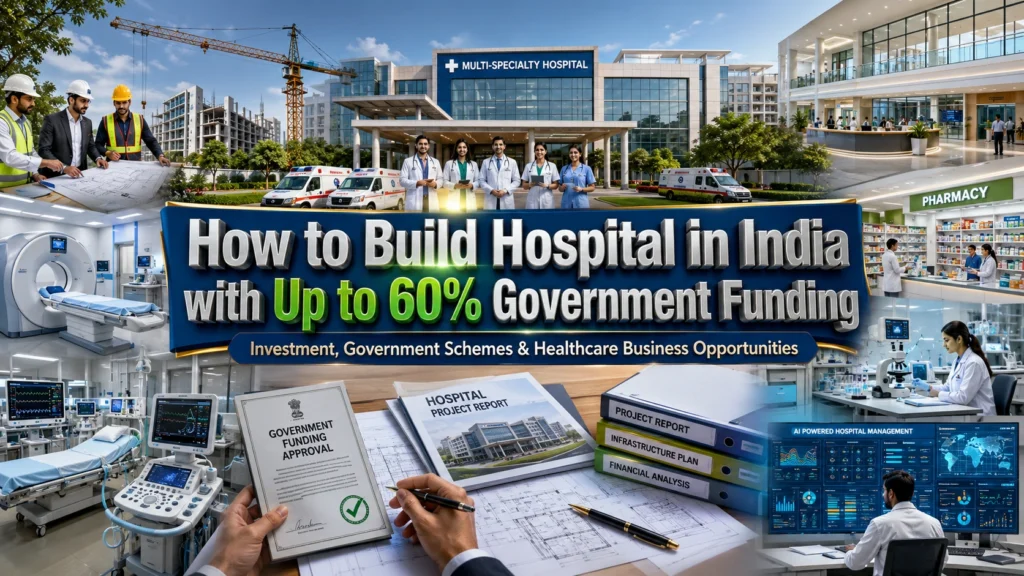

Hospital business in India
India has a shortfall of more than 6 lakh hospital beds to meet the WHO recommended norms, and the government has put a number of financial instruments in place to address this shortfall — many of which the majority of entrepreneurs are unaware of. When the project is structured properly, the government can provide Rs.25–30 Crore to the hospital through the scheme of Viability Gap Fund (VGF) under the State Government, National Health Mission (NHM) capital funding, Ayushman Bharat Health Infrastructure Mission (AB-HIM) grants, and NABARD concessional long-term loan. These are ideas for businesses in healthcare that are both commercial and directly hit a public national health problem that’s being actively pursued by the government with allocated resources.
Why India Urgently Needs Private Hospital Investment
India has an average of 0.55 hospital beds per 1,000 individuals, which is significantly below the WHO recommendation of 3 beds/1,000 people. The gap is particularly acute in Tier-2 and Tier-3 cities where the capacity of the public health system is not being utilized optimally. More than 60% of healthcare expenditure is already on the private side in India, clearly showing that patients opt for private care when it’s available and affordable.
The Ayushman Bharat PMJAY scheme has opened up insurance coverage for more than 55 crore beneficiaries, leading to assured inflows of patients into empanelled private hospitals provided the hospitals are available in the right places. Health entrepreneurs can use the district level health infrastructure gap data published by the Ministry of Health and Family Welfare to help them choose project locations.
Get Detailed Insights from This Book: Investment Opportunities In Hospitality, Medical, Entertainment, Ware Housing & Real Estate Projects
Government Schemes That Can Fund Up to 60% of Your Hospital
A number of complementary Government schemes are available to be rolled up to finance a substantial part of a private hospital project. The National Health Mission (NHM) PPP component is in charge of funding the initiatives of private hospitals in low-density regions. Different states like Uttar Pradesh, Bihar, Rajasthan, Jharkhand and Odisha provide private hospitals with Viability Gap Funding (VGF), which is a grant of between 20-35% of the project cost that is provided for hospitals investing in district towns where healthcare facilities are inadequate. NABARD offers concessional long term loan facilities at lower interest rates in rural and semi urban areas for healthcare.
Thousands of crores have been allocated under the Ayushman Bharat Health Infrastructure Mission (PM-ABHIM) for development of Healthcare Infrastructure with a provision for participation of the private sector. Having VGF grants and concessional NABARD loans along with operational revenue from PMJAY gives rise to a project financial model which makes the entrepreneur’s net capital requirement much less.
Top Business Ideas Within the Hospital Development Model
100-Bed District Hospital with Surgical and Emergency Focus
Most of the health needs of a population of 10 to 30 lakh people in a district is met by a 100-bed district hospital having a general surgery OT, orthopaedic surgery capability, obstetrics and gynaecology, ICU, NICU and 24×7 emergency services. After considering the state VGF, NABARD debt, the entrepreneur’s investment in equity comes to Rs.18-20 Crore. First Quality Milestone, get NABH Accreditation – mandatory for empanelment with PMJAY and CGHS and will ensure institutional revenue. Fill online application form on the National Health Authority website for empanelment under PMJAY.
PPP Model Hospital Under NHM or State Government Concession
The most capital efficient model is the Public-Private Partnership (PPP) model where a private operator constructs and operates a hospital in a public land, on the condition that the government will provide him a minimum patient volume or a subsidy for the operation of the hospital. The NHM has issued PPP guidelines that outline the mechanisms of engagement between the NHM and State health departments for district level hospital PPP arrangements.
The State Governments in Tamil Nadu, Karnataka, Andhra Pradesh and Maharashtra have well established PPP hospital frameworks. In some state models, the government constructs the building and pays for the equipment and the private operator operates it and delivers clinical services — eliminating the need for a significant investment from the entrepreneur.
Get Detailed Project Report (DPR): Healthcare Business Ideas in the Medical Sector
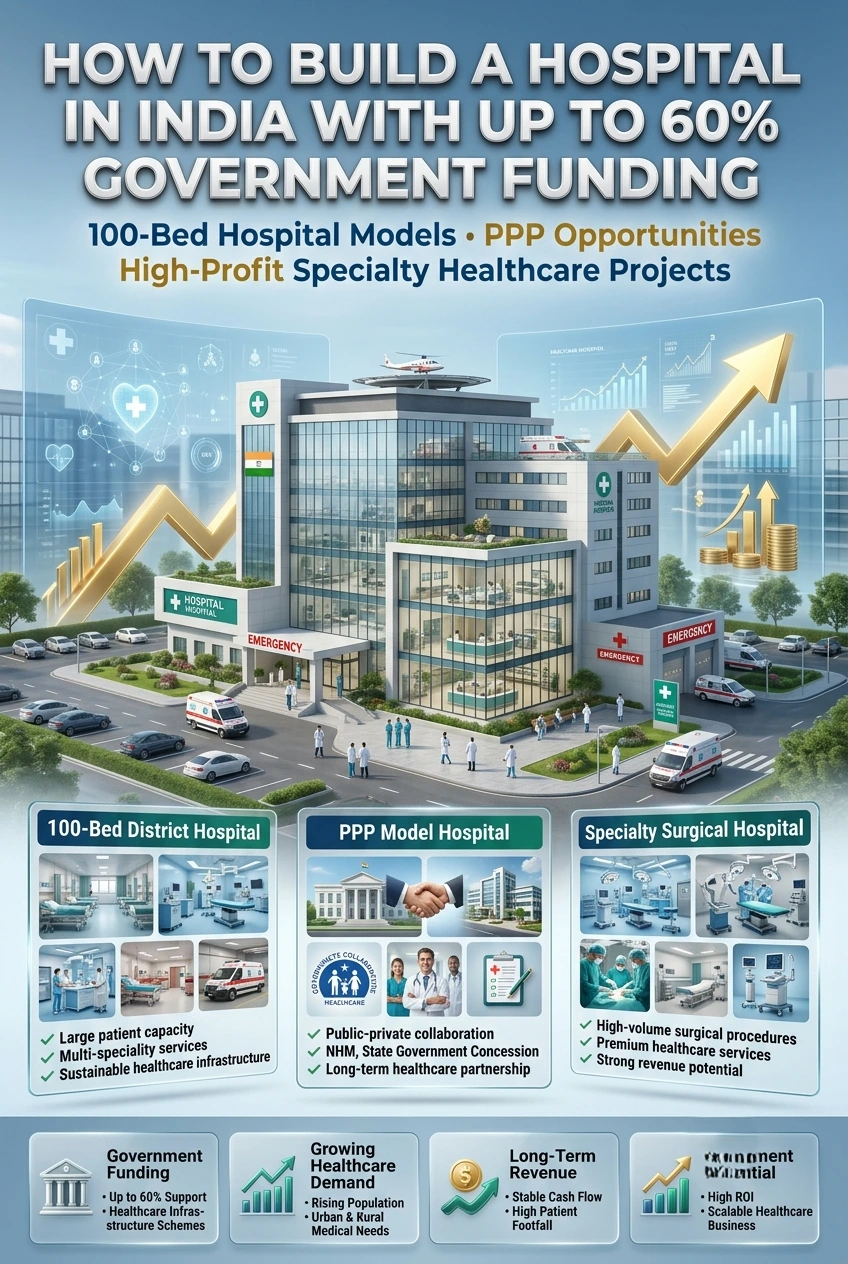
Speciality Hospital Targeting One High-Volume Surgical Procedure
Single specialty hospitals (cardiac, orthopaedics, ophthalmology or oncology) have better clinical outcomes and financial performance than generalist hospitals for the same size. A 50-bed cardiac care hospital in Tier-2 city can achieve the same revenue as 100 bed generalist hospital given the higher complexity of the procedures, which command premium rates of PMJAY packages. Specialisation decreases the diversity of equipment needed, leading to more efficient capital deployment. Talk to SECI equivalent at NABH for their advice on the speciality hospital accreditation pathways that lead to premium insurance rates.
Import-Export Opportunities in Hospital Development
There is a high level of import activity because of the development of hospitals — medical equipment’s from Siemens, GE, Philips and Fujifilm. CDSCO portal can be used to verify duty concession on medicals which are lifesaving medicines. The medical tourism industry is a foreign exchange generation sector in India which is growing day by day. A modern, NABH certified well equipped district hospital can be developed to attract medical tourists from Bangladesh, Nepal, Myanmar and the Gulf countries for its quality, affordable care. The Ministry of Tourism has a medical tourism policy that offers marketing assistance for the facilities approved.
Indian MSME Success Stories in Hospital Development
Narayana Health — Making Super-Speciality Care Affordable at Scale
Located in Bengaluru, founded by Dr. Devi Prasad Shetty, Narayana Health challenged Indian healthcare by bringing to light the fact that cardiac surgery, when carried out in a high-volume, processes-driven fashion, can be a major cost-effective and yet world-class experience for every patient. Dr. Shetty’s shrewdness, that high volume would bring cost efficiency as well as improvement of quality, resulted in hospitals being constructed in areas where they were most needed. Narayana Health’s patient volume model was defined around the empanelment at all its facilities. Today, Narayana Health treats lakhs of patients each year at unbeatable rates of cardiac surgery procedures.
Your investment deserves the right opportunity
Lilavati Hospital — Building Mumbai’s Trust Over Decades
Lilavati Hospital and Research Centre, Mumbai, started as a community hospital and has been steadily investing in clinical quality, relationships with specialists and patient experience for decades, and has become one of the most reputed super-speciality hospitals in India. All decisions were made based on the hospital’s founding philosophy; Community Trust is the Hospital’s most valuable asset. This is a story of a slow building of reputation for an institution that happens so quickly in healthcare when standards and expectations of patient care are compromised, that is the story for new hospital entrepreneurs. Lilavati’s clinical consistency was ensured by the NABH accreditation.
How NPCS Supports Hospital Project Development
We at Niir Project Consultancy Services (NPCS) provide professional consulting for the preparation of Market Survey cum Detailed Techno-Economic Feasibility Reports (DPRs) for setting up new industries or businesses. Our reports include detailed manufacturing processes, market research and demand analysis, process flow diagrams, product mix and capacity planning, machinery and raw material details, and complete project financials with profitability analysis. Visit us at www.niir.org for detailed project reports on hospital development.
Related Article: Start a Profitable Hospitality Business in India
Conclusion
A Rs.50 Crore hospital project in an underserved Indian district, structured to capture maximum government funding through VGF grants, NHM support, and NABARD concessional loans, is both a high-impact social investment and a sound commercial proposition. Get NABH accreditation, apply for PMJAY empanelment, and engage with NHM’s PPP framework to create a hospital project that achieves the financial structure needed for sustainable long-term operations.
Rs.50 Crore District Hospital — Key Project Parameters
| Parameter | Details |
| Total Project Investment | Rs.45–60 Crore |
| Bed Capacity | 80–120 beds (phased to 200 beds over 5 years) |
| Key Government Funding Schemes | State VGF, NHM PPP, NABARD Healthcare Loans, PMJAY |
| Government Funding Available | Rs.25–35 Crore (VGF + concessional debt) |
| Entrepreneur Net Equity Required | Rs.15–25 Crore |
| PMJAY Revenue Potential | Rs.3–6 Crore annually from government-insured procedures |
| Target Bed Occupancy | 70–75% by Year 3 |
| Annual Revenue at Steady State | Rs.10–18 Crore |
| Payback Period | 7–10 years |
| Employment Generation | 200–400 direct jobs |
Key References and Government Resources
- National Health Mission (NHM) — PPP hospital framework, capital support in underserved districts
- NABH — National Accreditation Board for Hospitals — Hospital accreditation, mandatory for PMJAY and CGHS empanelment
- NABARD — Concessional long-term loans for healthcare in rural and semi-urban areas
- Ayushman Bharat Health Infrastructure Mission (PM-ABHIM) — Healthcare infrastructure funding for private sector participation
- Ministry of Health and Family Welfare — District health infrastructure gap data, hospital regulatory framework
Frequently Asked Questions (FAQ)
What is Viability Gap Funding and how does it apply to hospital projects?
Viability Gap Funding (VGF) is a one-time government grant provided to private investors in PPP projects where the project is socially essential but commercially marginal. For hospitals, state governments provide VGF of 20–35% of project capital cost for private entrepreneurs setting up in underserved districts. Apply through NHM’s state directorate or state finance department PPP cell.
How does PMJAY benefit a newly established private hospital?
Hospitals will be able to treat cashless 55 crore beneficiaries through this empanelment process. All expenses associated with pre-specified procedures at pre-defined package rates, are reimbursed by the government in 30-60 days after claim. This may include 30-60% of patients as PMJAY patients in unserved districts. The hospitals need to register for empanelment in NHA portal.
What is NABARD’s role in hospital financing?
NABARD provides long-term concessional loans for healthcare infrastructure in rural and semi-urban areas under its Priority Sector lending programmes. NABARD loans typically have 15-year tenures at interest rates below commercial bank rates, significantly improving project return on equity. Contact your state NABARD office for application and eligibility details.
What licences are required to open a hospital in India?
Core licences include Clinical Establishment Registration, State Pollution Control Board (SPCB) compliance for biomedical waste, fire NOC, building plan approval, AERB licence for radiation equipment, blood bank licence (if applicable), pharmacy licence for in-house pharmacy, and NABH accreditation for PMJAY and CGHS empanelment.
Can a hospital in a Tier-3 district town attract quality doctors?
Increasingly yes. Hub-and-spoke specialist visiting models — where senior specialists based in state capitals visit the district hospital 2–3 days per week for OPD and planned procedures — allow district-level specialty care. Telemedicine linkages under NHM’s telemedicine framework enable real-time specialist consultation for ICU and emergency patients, significantly improving clinical capability at the district level.
What is PM-ABHIM and how does it fund private hospitals?
The Ayushman Bharat Health Infrastructure Mission (PM-ABHIM) is a Rs.64,180 Crore investment programme for healthcare infrastructure. Private sector participation channels under PM-ABHIM include VGF grants for hospitals in districts with defined bed shortfalls. Contact the Ministry of Health and Family Welfare’s PM-ABHIM cell for private sector participation guidelines.