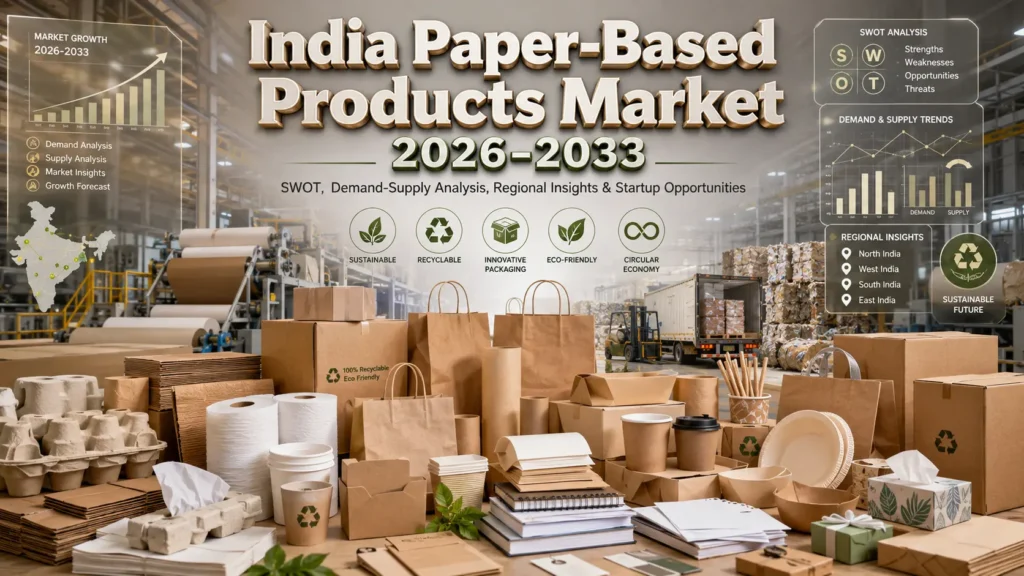

India Paper Based Products Market
Market Insight
The paper-based products sector in India is at a juncture – where policy support initiatives, increasing e-commerce volumes and a significant change in consumer mindset from single-use plastics are shaping the entire demand curve. Indian paper and paper products market is estimated at USD 9.25 billion and will reach a value of USD 11.91 billion by 2030 with steady growth of approximately 4.37% during the forecast period. The packaged paper market, meanwhile, is growing at much higher rates, and India’s paper packaging market alone was worth about USD 18.6 billion, which by 2033 should be worth USD 28.3 billion, according to data tracked by the India Brand Equity Foundation (IBEF).
The headline growth rate is not the most compelling part of this opportunity. It is the increasing disconnect between the demand and supply of domestic consumption, which must be clearly analyzed by policy makers, investors and manufacturing entrepreneurs.
India Paper-Based Products: Market Overview and Growth Trajectory
India is now among the fastest growing paper markets of the world and the total paper and paperboard consumption have reached 23-24 million tonnes per annum. The production capacity of the operating mills is in the range of 22-24 million tonnes, whereas installed capacity of mills is in the range of 30-32 million tonnes, which is a contradiction and highlights under-usage of production capacity as well as structural deficiency of supply.
According to the data given by the Central Pulp & Paper Research Institute (CPPRI), which is an autonomous body under Ministry of Commerce & Industry in the Government of India, the manufacturing of paper in the country is around 900 with only 550-560 being operational. This figure alone represents the level of investment and consolidation needed in the sector.
Generally, there are four application segments of the paper market in India – packaging paper and paperboard, writing and printing paper, newsprint, and specialty papers. The packaging is the largest growth driver of these, representing almost 65% of paper usage, with an annual increase of more than 8%, and is fueled by growth from FMCG, organized retail, pharmaceutical packaging and the structural development of e-commerce logistics. India shipped more than 5.2 billion online shipments in one recent year alone, and that figure is still rising — all of these shipments need corrugated packaging, paper bags, labels, or protective paper inserts.
Writing and printing paper is the second-largest segment and is expected to see a fairly consistent demand from education institutions, publishing houses, government documentation and stationery from the value chain, as they consume paper at the rate of about 35%. India, despite the digital disruption, has more than 105000 registered newspapers published in various languages of which more than 100000 are daily newspapers in India, according to the Registrar of Newspapers in India, which is the highest in the world in terms of newspaper and writing paper demand.
The turnover of Indian paper industry is about Rs. It is estimated to be about Rs. 70,000 crores for the national exchequer. 8,000 crores. Not only is it an industry sector, but it directly and indirectly employs more than five lakh people and helps thousands of agro-forestry farmers all over the country, too.
Get Detailed Insights from This Book: Modern Technology of Pulp, Paper and Paper Conversion Industries
Per Capita Consumption Gap: The Single Biggest Market Opportunity
The one figure that sums up the investment case of the paper-based products industry in India is this: India consumes about 15-17 kilograms of paper per capita annually. The average for the world is 57 kilograms. In developed countries such as the USA, it is over 200 kg per person/year.
This is an abysmal consumption deficit and it is not just a number — it is an economic deficit. Increase in India’s per capita paper consumption by 1kg is approximately equivalent to one million additional tonnes of paper consumption per year. In India, the economy is rapidly formalizing, urbanization is increasing rapidly and literacy is on the rise, which will lead to a per capita consumption of 28 to 30 kilograms of paper in 2030. It does not take much imagination to realize that this alone would mean the need for adding up to 15–16 Mt of consumption capacity in this decade—an extraordinary manufacturing opportunity.
The Indian Paper Manufacturers Association (IPMA) data shows domestic use of packaging paper is more than 8% a year now, and the total paper market is expanding at 6-7% a year. But a lot of this incremental demand growth is being satisfied right now not by domestic manufacturers but by imports, and especially from China, the ASEAN countries and South Korea.
Demand–Supply Gap: Where the Real Opportunity Lies
The Indian paper-products industry has a real, measurable and commercially important demand-supply gap. On the other, the domestic consumption is expected to increase to 23.5 million tonnes per annum while the domestic production capacity (with only the operational mills considered) is around 22 MT per annum. This is being addressed mainly by new imports, which have increased dramatically, of around 1.5 to 2 million tonnes per year.
IPMA data shows that at certain junctures, imports of paper and paperboard have demanded over 15% of the total Paper Market in India — almost 2.8 to 3 million tonnes of paper per year. Imports from China have increased by more than 13% on an annual basis in value terms and imports from ASEAN have soared by more than 78% in certain quarterly periods. Most of the paper which India imports are coated papers, specialty papers, tissue, kraft paper and newsprint which can be produced locally in India, with the exception of coated papers, which are imported from the Far East.
The import surge is structural, not cyclical, according to information from the Directorate General of Commercial Intelligence and Statistics (DGCI&S). Nearly Rs. 14 billion worth of paper and paperboard were imported. This amounts to 10,000 crores in a single nine-month period and is a straight-line impact on the viability of domestic manufacturing. The IPMA has always raised concerns about this indiscriminate flow of imports to the government, as India possesses sufficient installed domestic capacity in most grades that are in question.
For entrepreneurs and MSMEs, this creates a specific opportunity: invest in paper grades where import dependency is highest — coated specialty papers, pharmaceutical-grade papers, barrier-coated packaging boards, tissue and hygiene papers — and serve a domestic market that is currently being supplied from overseas. The import substitution case here is structurally sound and commercially viable.
SWOT Analysis: India Paper-Based Products Sector
Strengths
The Indian paper industry has wood as its raw material, but also uses bamboo, bagasse, agricultural waste (wheat straw, rice husk and others), and recycled wastepaper, providing manufacturers across the country with locally available raw materials. The northern and western mills can be especially good at agro-residue and wastepaper-based pulping, and the southern and eastern mills can make use of wood and bamboo pulping. There is a reduced concentration risk on raw materials from this regional specialization.
Moreover, India has a huge pool of paper industry manpower, established network of paper testing laboratories and technical support infrastructure at CPPRI which give a strong manufacturing base for this product. Moreover, India has the world’s largest and most educated English reading middle class, which supports a high demand for writing, printing and educational paper, which few other emerging markets can offer.
Weaknesses
Energy and raw material cost competitiveness is the most important structural weakness. Wood pulp procurement costs are much higher for Indian paper manufacturers than for ASEAN manufacturers. Paper from ASEAN countries that is manufactured using raw wood can be imported at the approximate rate of USD 40 per tonne, whereas it is produced at a cost of about USD 110 per tonne in India, according to estimates by the IPMA.
This price gap is not a matter of efficiency alone and needs policy measures related to raw material access, farm forestry and import tariffs. The industry is also very fragmented: there are almost 60% small mills that may not be able to withstand commodity price fluctuations due to limited scale, technology or financial resources.
Water intensity is another challenge. The paper industry utilizes more water than any other manufacturing sector and there is growing regulatory interest in what is being discharged into the environment, which has increased compliance expenses. In smaller mills, the use of outdated technology further reduces productivity per tonne.
Get Detailed Project Report (DPR): Complete Paper Industry Guide
Opportunities
The opportunity arena for India’s paper-based products sector is perhaps better today than ever. The government recently banned the use of identified single-use plastic products under the Plastic Waste Management Rules, which has changed the demand equation of alternatives to plastic that are made of paper. Previously plastic-dominated disposable paper cups, plates, bowls, straws, food boxes and even carry bags are now required to switch to paper or other biodegradable materials. The paper industry can take as much as a quarter of the market share which will be lost by single-use plastics, which is a huge increase of volume.
The Ministry of MSME has dedicatedly designed provisions under its ongoing schemes for promoting enterprises that are either switching to or producing alternatives to banned single-use plastics like capacity building workshops, technical support and financial assistance. This is a very favourable policy climate for paper products startups.
Yet another structural tailwind: ecommerce growth. Corrugated boxes, paper envelopes, and honeycomb paper void fill are becoming standardized across all the major logistics and quick-commerce platforms in India, and the e-commerce packaging industry is growing at double figures every year. In a recent measurement year, the corrugated board category accounted for more than 54% market share in India’s paper packaging market and this could be further fuelled by e-commerce.
Global brands that buy into India are increasingly using sustainability mandates to drive the adoption of certified, recyclable and paperboard packaging, which is good news for domestic converters. Further, the niche application for technical papers in the pharmaceutical industry, where packaging is used for medicines, is one of the fastest-growing niche applications.
Threats
The main and continuing danger is low-priced imports. Many mid-size domestic mills are now considered “commercially unviable” due to low-cost paper from China, Chile and Indonesia, as well as the trade barriers imposed by various Free Trade Agreement provisions and claims of below-market pricing. The sector remains under the pressure of the prospect of further import liberalisation in trade talks. The global supply chain disruptions, inflationary pressure on energy pricing and constant pressure on wastepaper raw material pricing add to the margin volatility.
Longer-term structural threats are climate related and regulatory compliance pressure on effluent treatment, which are risks that new entrants need to plan for from project inception.
Application-Based Market Segmentation
About 65% of paper usage is in Packaging Paper and Paperboard. Corrugated boxes, folding cartons, kraft paper, barrier coated boards and multi-wall sacks all come under this segment. Growth is fuelled by FMCG, e-commerce, pharmaceuticals and food & beverage industries.
Writing and Printing Paper is used in the education system, in publishing, in government and corporate applications and in stationery. This area has a steady volume demand even as digital media grows and is especially prevalent at the school, college and government procurement level.
Newsprint and Publication Paper’s future is uncertain due to the migration towards digital but at the same time it is relevant because of the size of the print media consumption in India especially the regional language newspapers.
Specialty & technical papers, such as tissue paper, cigarette paper, filter paper, electrical-grade and pharmaceutical packaging papers, are high value and import-intensive markets and offer great potential for MSME manufacturers. Specialty papers are promising with per tonne realizations of 3-5 times that of commodity grades, which makes them appealing for capital efficient manufacturing units.
Tissue and Hygiene Paper are one of the fastest-growing application categories, owing to evolving hygiene habits during and after pandemic, growing organized retail and mushrooming of Quick Service Restaurant (QSR) chains. International investors are confident in the growth trajectory of this segment; the acquisition of tissue major Origami by APRIL group is a testament to that.
Regional Analysis
Paper Industry of India In India the industry is regionally concentrated and most of the mills are concentrated in areas where there is ample supply of raw materials, water facilities and industrial infrastructure are available.
Some of the largest and most consolidated paper mills are based in the South India (Tamil Nadu, Andhra Pradesh, Telangana & Karnataka) – among them are TNPL (Tamil Nadu Newsprint and Papers Ltd) and Andhra Paper Ltd. Wood and bamboo pulping and investments in new capacity of tissue paper and packaging boards are given major importance for the southern region. Andhra Paper Limited recently released… The region’s investment hunger is typified by a 125-crore investment in a new tissue paper production line at the Andhra Pradesh plant, in collaboration with Sweden’s Valmet AB.
Western India (Maharashtra, Gujarat) is the largest paper consuming region especially for FMCG packaging and specialty grades. Gujarat has the highest number of paper-making units in the country and several medium size paper mills are operating in the state that make papers from agro-residue and kraft. Maharashtra, especially the Mumbai-Pune industrial corridor, is the biggest center for converting and packaging operations.
Agro-residue mills have been concentrated in North India (in Punjab, Uttar Pradesh, Haryana, Madhya Pradesh) where wheat straw, bagasse and rice husk are being used as raw materials to produce paper as an alternative to wood, which makes it an important region for low-cost paper production.
Historically, mills utilizing bamboo and mixed hardwood pulping have been present in East India (West Bengal, Odisha, Jharkhand). The region is a low penetration consumption market and holds scope for capacity addition and conversions in the downstream.
Choose the right startup backed by real market demand
Major Indian Players in the Paper-Based Products Sector
ITC Paperboards and Specialty Papers Division (ITC PSPD) is India’s biggest integrated paper and paperboard manufacturer, having recently bought Century Pulp and Paper in October in a recent fiscal year, with annual capacity of nearly 850,000 tonnes. ITC PSPD is a specialty paper, coated paperboard and premium packaging boards company. It is considered the standard bearer for the industry in sustainability and recycles 1.1 lakh tonnes of wastepaper every year while undertaking certified forestry programs.
JK Paper Ltd. is one of the leading manufacturers of office paper, coated paper and packing boards in India. The company has huge integrated plants, and is keen on increasing its capacity, including a 200,000-tonne paperboard plant in Gujarat with barrier coating technology. JK Paper has revealed that it will spend USD 100 million by 2026 to increase its production capacity and increase energy and water efficiency. The company also grew by strategic acquisitions like Horizon Packs and Securipax Packaging.
West Coast Paper Mills Ltd., is a company that specializes in printing papers, writing papers as well as packaging papers with a strong pan-India distribution network. The company is one of the major vertically integrated manufacturers of India and has been known for its operational discipline even in times of margin pressure due to imports.
Tamil Nadu Newsprint and Papers Limited (TNPL) is also significant, as it is a state-owned paper manufacturing company based on agro-residue and also has a few other big players such as Seshasayee Paper and Boards Ltd., Emami Paper Mills Ltd., N.R. Agarwal Industries Ltd., Pudumjee Paper Products Ltd., and Satia Industries Ltd. The organized segment consists of large mills accounting for 40% of the overall mill count, whereas the fragmented MSME segment has almost 60% mill count, mainly producing commodity kraft and writing paper grades.
Import–Export Trend Analysis
The trade balance of India for paper and paper products is significant for new investors in the country. On export front India has shown tremendous potential — the paper and paperboard exports almost doubled in one year to become a record Rs. In monetary terms, this is worth 1,396 billion. The exports of paper increased by almost four times in 7 years in volume, from 0.66 million tonnes to 2.85 million tonnes. Writing and printing papers, coated papers, tissue and kraft all saw decent export growth.
But at the same time there is a parallel and troubling increase in imports. India has significant imports of coated papers, specialty papers, newsprint and tissue paper from China, ASEAN countries and South Korea. The landed cost advantage, along with access to cheap raw wood, lower energy costs and FTA benefits, always puts the ASEAN producers at an edge with Indian manufacturers, especially in the writing and printing and specialty paper products. For the investors this brings a clear opportunity: domestic manufacturing on competitive scales and technology can have a share of the import substitution volume and a share of the export market potential.
Startup Opportunity Insight: Why Entrepreneurs Should Consider This Sector Now
The fact that the paper-based products segment in India could be one of the lucrative MSME investment opportunities of this decade has nothing to do with sentiment but structural market data.
First, the regulatory landscape has changed the demand for good. The Ministry of Environment, Forest and Climate Change (MoEFCC) has banned identified single-use plastic items as per Plastic Waste Management Rules. This ban has now formally removed the competition in a substantial number of food service, retail packaging and consumer categories for paper alternatives. Paper, plastic on a level playing field is no more – government is in fact setting up paper and compostable alternatives to win market share.
Second, the policy environment for MSMEs is pro-active towards new firms. The Ministry of MSME has offered financial support, capacity development training and soft infrastructure to the units, which are converting to paper based product manufacturing. State Governments like Rajasthan have instituted certain capital subsidies of 50% upto Rs. The government has allocated Rs 40 lakh for businesses that produce alternatives to plastic such as paper products.
Third, the downstream paper conversion (e.g., paper bags, paper cups, moulded pulp trays, honeycomb boards, paper straws, and kraft paper rolls) requires comparatively small capital investment as compared to the upstream pulp and paper manufacturing. The paper conversion unit can be planned in a well manner in the Rs. 30 lakhs to Rs. At the MSME scale, it ranges in the range of 3 crore depending on the mix of products and the level of automation, and can be operational in 12 to 18 months. The raw material supply chain (paper and paperboard from domestic mills or from imports) is well established and poses no input sourcing risk as would be the case in new manufacturing businesses.
Related Article: Paper Cup & Disposable Products Manufacturing: A Low-Investment Guide for First-Gen Entrepreneurs
Government Initiatives Supporting the Paper Sector
The Indian manufacturing sector has received a shot in the arm with the launch of campaigns like Make in India and Aatmanirbhar Bharat, the paper industry being a beneficiary too. DPIIT of the Indian government is working on easing the procedures related to approvals for manufacturing activities, doing its best to reduce the compliance load on manufacturers while encouraging FDI. To date, the National Single Window System (NSWS) has accepted millions of applications for regulatory clearance of new manufacturing units, thereby streamlining the regulatory clearance pathway.
Under the umbrella of DPIIT, the Development Council for Pulp, Paper and Allied Industries (DCPPAI) periodically assesses the policy requirements of the sector, such as tariff protection, access to raw materials through farm forestry and market support for exports. Paper entrepreneurs, who are looking for technical testing, process optimization services and consultancy solutions can turn to CPPRI, Saharanpur, which is a cost-effective option for them.
The paper industry in India is another contributor to the national exchequer with around Rs. Tax revenue of 8,000 crores and it creates more than 5 lakh direct and indirect jobs. The data highlights its economic value for the government and indicates that government policy support for the industry will continue to be available, especially for sustainable packaging units and MSME units.
Investment Feasibility and Scalability Assessment
The feasibility matrix for the paper-based products segment is, in general, favorable for all the sub-segments, except that the raw material sourcing strategy and the product grade are the key elements which make or break the financial viability of the paper-based products segment.
Investments in the range of Rs. 1000 crores are required for the upstream paper manufacturing i.e. establishment of a new pulp and paper mill. 50 crores to Rs. It requires a large amount of capital and has a long payback period with 500crore depending on the capacity (MSME scale typically 50-300 tonnes per day) and it is capital intensive and depends on raw material. The projects are suitable for investors with existing raw material access or backward integration in the wood plantation.
Paper conversion projects downstream of paper mills, such as corrugated box, paper bag, moulded pulp, tissue product, kraft paper roll conversion and specialty paper converting, are much more capital efficient. These units can be invested in Rs. 30 lakhs to Rs. 5 crore range is scalable in phases and have payback period of 3-5 years with support of anchor customer contracts.
The hybrid model, i.e. establishment of a small mill in 20-50 TPD capacity, with Old Corrugated Carton (OCC) wastepaper as the main raw material, is now profitable and gaining traction from financial and regulatory perspectives, and it is a perfect fit for the first-generation entrepreneur who can access urban wastepaper supply chains.
Market Data Summary Table
| Indicator | Value |
| India Paper & Paper Products Market (2024) | USD 9.25 billion |
| Projected Market Size (2030) | USD 11.91 billion |
| Market CAGR | ~4.37% |
| India Paper Packaging Market (2024) | USD 18.6 billion (Rs. 1,57,263 crore) |
| India Paper Packaging Market (2033 forecast) | USD 28.3 billion |
| Total Paper Consumption (Annual) | ~23–24 million tonnes |
| Domestic Production Capacity (Operational Mills) | ~22 million tonnes |
| Per Capita Paper Consumption (India) | ~15–17 kg/year |
| Global Average Per Capita Consumption | 57 kg/year |
| Packaging Paper Share of Total Consumption | ~65% |
| Paper Industry Contribution to Exchequer | ~Rs. 8,000 crore |
| Total Paper Industry Turnover | ~Rs. 70,000 crore |
| Operational Paper Mills in India | ~550–560 (of ~900 registered) |
| Paper Industry Employment | 5+ lakh direct & indirect |
Key Quality Citations & References
- IBEF – India Paper & Packaging Industry — https://www.ibef.org/industry/paper-packaging (Market sizing, packaging sector growth data, recent investment activity)
- MoEFCC – Ministry of Environment, Forest and Climate Change (Single Use Plastic Ban) — https://moef.gov.in (Regulatory framework under Plastic Waste Management Rules, SUP ban notifications)
- DPIIT – Department for Promotion of Industry and Internal Trade — https://dpiit.gov.in (Industry policy, Make in India, FDI facilitation, PLI schemes, NSWS approvals)
- Ministry of MSME – Government of India — https://msme.gov.in (MSME scheme support for paper-based product startups transitioning from plastics)
Frequently Asked Questions (FAQs)
Q1. What is the scale of business of the paper-based products industry in India today?
India paper and paper products market has an estimated value of USD 9.25 billion. If the paper packaging segment is excluded, the packaging-specific market is estimated to be valued at USD 18.6 billion. When downstream manufacturing value is considered, it easily surpasses USD 25 to 30 billion across all paper-based products, from raw paper to converted paper packaging and to specialty products.
Q2. What is making the market for Paper-based Products in India grow?
These five forces are pushing growth: rapid growth of e-commerce, government-enforced ban on single-use plastics, increased FMCG consumption and structured growth in packaging requirements for organised retail, growth of pharmaceutical packaging and the relatively small per capita paper consumption in India, providing huge headroom for growth as incomes and urbanisation ramp up.
Q3. Which are the most suitable segments for a new start-up or MSME to enter into?
In terms of capital efficiency, the first step is to convert downstream: paper cups, paper bags, kraft packaging rolls, corrugated box manufacturing, paper straws, moulded pulp packaging trays and tissue paper products. The entry capital requirements for these segments are low (Rs. 30 lakhs to Rs. The robust government policy support, particularly under the Ministry of MSME’s schemes for plastic alternative manufacturers, growing demand from institutional buyers, and establishment of raw material supply chains (3 crore range) are the major factors driving the market.
Q4. What is the imbalance between demand and supply of paper in India?
India’s internal demand for paper is estimated to be 23.5 million tonnes per year (MTY) and the available production capacity is approximately 22 MTY. The deficit of about 1.5-2 million tonnes is now covered by imports, notably coated papers, specialty grades, tissue and newsprint, mainly from China, ASEAN and South Korea. The volume of imports has been more than 15% of the Indian paper market at different periods of time, giving a good opportunity for domestic manufacturers to consider import substitution.
Q5. Which areas in India are the most important for paper making and using paper?
Tamil Nadu, Andhra Pradesh, Maharashtra, Gujarat, Punjab and Madhya Pradesh have the maximum number of paper mills in relation to production. Gujarat has the largest number of paper making units. From consumption perspective, the western region (led by Maharashtra) is the top consumer of paper products, which is being led by FMCG, organized retail and industrial packaging. The highest rate of investment in new capacity growth is in southern India.
Q6. Name some raw materials used in paper industry in India?
The raw materials employed by Indian paper mills are varied in accordance with the different geographical areas, the nature of mills and their capacities. These include recycled wastepaper (Old Corrugated Cartons or OCC), imported wood pulp, sugarcane bagasse, bamboo, wood, and rice husk. Most of the northern and western mills use agro-residues and recycled fibre. Wood and bamboo pulping is used in the southern and eastern mills. In India, recycled fibre is the major raw material used for packaging grade paper due to the cost effectiveness of the fibre and the trend towards sustainable use of fibre in the paper industry.
Q7. Is there any scope in exporting paper in India?
Yes, significantly. Paper exports from India have increased by almost four times in volume in the last few years, with coated papers, writing and printing papers, tissue and kraft paper recording good volumes of exports. India enjoys a cost and quality edge in certain specialty grades and is competitive in export markets in South Asia, Middle East and Africa. But the momentum of exports demands ongoing domestic investments in capacity and quality standards, especially in coated paper and pharmaceutical papers.
Q8. How does the single-use plastic ban affect the paper-based products business opportunity? The Government of India’s ban on identified single-use plastic items has permanently reallocated demand to paper and compostable alternatives. Paper cups, plates, straws, carry bags, cutlery, food boxes, and thin-film wraps are among the directly impacted categories. The paper industry has estimated it can capture up to 25% of the market share previously held by single-use plastic if domestic capacity is adequately developed. For startups in the paper conversion space, this regulatory intervention represents a government-backed demand guarantee for the foreseeable future.
About Niir Project Consultancy Services (NPCS)
Niir Project Consultancy Services (NPCS) is a respected name in industrial project consulting and techno-economic feasibility advisory in India. For entrepreneurs, MSMEs, and investors looking to establish paper-based product manufacturing units — whether in upstream paper mill setup or downstream paper conversion — NPCS provides comprehensive Market Survey cum Detailed Techno-Economic Feasibility Reports (DPRs) tailored to the investor’s specific project scope, capital outlay, and target market.
NPCS reports for the paper sector typically cover:
- Detailed manufacturing process documentation for paper grades and converted products
- Market research and demand analysis based on sector consumption data, regional demand mapping, and end-user industry growth
- Process Flow Diagrams (PFD and BFD) for specific product categories
- Product mix and capacity planning aligned with market demand and raw material availability
- Machinery and equipment specifications with supplier identification and costing
- Import–export dependency analysis identifying substitution opportunities and export market potential
- Project financials and profitability evaluation including capital cost, working capital requirements, operating cost breakdowns, revenue projections, IRR, and payback period analysis
NPCS’s objective is to equip entrepreneurs and investors with a thorough assessment of:
- Technical feasibility of the manufacturing process
- Financial viability of the proposed investment
- Market demand validation through primary and secondary research
- Scalability potential for phased capacity expansion
First generation entrepreneurs are often engaged with the set-up of paper cup making industries, corrugated box units, kraft paper mills, recycled paper plants, specialty paper conversion or moulded pulp packaging projects. NPCS DPR is the basic analytical report to invest into this type of projects.