
India RHA-Based Products Market Analysis 2026–2033: SWOT, Demand-Supply Gap, Applications & Startup Investment Opportunities
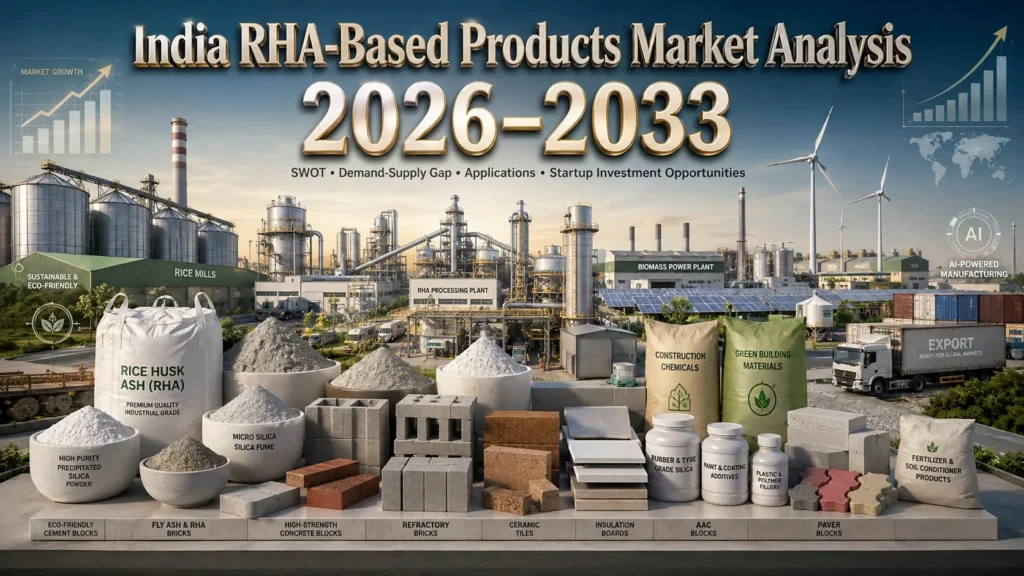
India RHA Based Products Market The market for Rice Husk Ash (RHA) in India is emerging at a time when the country’s agriculture sector is producing more rice than ever before, its infrastructure sector has a $175-billion investment pipeline, and the country is experiencing a shortage in specialty silica supply. The global market for RHA is estimated to be in the range of USD 3.0–3.2 billion, expanding at a 4.8–5.3% CAGR to USD 4.1–4.8 billion by 2033. In this global context India has one of the most dominant raw material positions in the world, but is structurally dependent on imports for high-purity silica, still from that very raw material. The big business opportunity for Indian MSME chemical and agro industries this decade will be closing that gap. The demand–Supply Gap India (D-S-G) is a result of the imports of silica precipitated from China, Germany, Japan, Malaysia and Taiwan at a compounded rate of 20.59% CAGR (2020-2024) and the fragmented nature of the RHA processing capacity with quality inconsistencies in India. The country produces 30+ million tonnes of rice husk a year, but only a small proportion is used to make value added silica products, resulting in a structural gap being addressed by importing rice husk. Organized players in various product segments of RHA include Major Indian Players Guru Metachem Pvt. Ltd., Usher Agro Limited, and Rescon (India) Pvt. Ltd., ranging from steel-grade insulating compounds, high-purity silica, to construction additives. With raw material which is almost free from rice mill clusters, the MSME scale silica unit with a capital investment of ₹ 3–8 crore can expect to generate a profit of 20–30% IRR. The multi-sector pull from green tyre demand, EV sector growth and construction sector boom insulates this investment from single industry cyclicality. India’s Hidden Industrial Asset: 30 million Tonnes of Wasted Silica India’s rice mills produce in excess of 30 million tonnes of rice husk as an end product of the milling process annually in the rice bowl states of Uttar Pradesh, Telangana, West Bengal, Punjab, Chhattisgarh and Andhra Pradesh. This husk, when fired at well-controlled temperature of 500°C to 700°C, produces Rice Husk Ash (RHA) rich in amorphous silica (80-95% by weight) which is the most reactive form of SiO2 available from any raw material on earth with a highest surface area. The contradiction is obvious. As per the Department of Agriculture & Farmers Welfare (DA&FW), India is the world’s largest or second-largest rice producing country based on the crop year with the total paddy production of 1,364 lakh tonnes in 2024–25. The Economic Survey 2025-26 reveals that Uttar Pradesh is the leading contributor of rice, with a production of 20.76 million tonnes, followed by Telangana with 17.45 million tonnes and West Bengal with 16.02 million tonnes, making the top three states contribute to more than 36% of the national rice production. India, however, despite having what is supposed to be a world-class silica manufacturing raw material base, continues to import hundreds of thousands of tonnes of specialty silica annually, due to the lack of pace of development of the processing infrastructure. It’s not a farming issue. It is a gap in industrial policy — and one of the most obvious MSME business opportunities in India’s manufacturing industry. Related Article: Why Rice Husk Silica is the Future of Green Tyres: Market Growth and Demand Gap Understanding RHA: Not Just Ash, But Industrial-Grade Silica It is important to be aware of what RHA is in fact providing that has made it commercially viable to a number of industries, before assessing the market opportunity. In the controlled combustion of rice husk, the organics are burned, leaving a concentrated ash of organic silicon compounds which is extremely porous and amorphous. The result is RHA that has amorphous silica — a much more chemically active form of silica than the crystalline silica from traditional quartz quarries. That’s what makes RHA so valuable. In the field of construction, it reacts with calcium hydroxide to produce more calcium silicate hydrate, which strengthens and makes the concrete impermeable at 10 to 25% cement replacement. It is used as a top-notch filler in the rubber and tyre industry to enhance the resistance to abrasion and minimize rolling resistance. Its thermal stability of over 1500°C is ideal for steel ladle and tundish linings in refractory applications. Global rice production is expected to reach a record high of more than 535 million tonnes (milled basis) in 2024–25, according to the Food and Agriculture Organization of the United Nations (FAO). India has the biggest share of the global upward revision, and also contributes the largest share of the world’s total rice husk production. This places India not just as the producer of RHA for in-house use but as one of the future suppliers of high purity silica derivatives in the global market, which so far India has not fully occupied. Global and India RHA Market: Size, Growth, and What the Numbers Mean for Investors The RHA market is expected to grow to USD 4.1–4.8 billion by 2033, from USD 3.0–3.2 billion in 2026, with the forecast range indicating scope differences among various market segments. The base RHA market is expected to reach nearly USD 1.0 billion in 2034 at 10.4% CAGR, whereas the higher value-added sub-market of Precipitated Silica from RHA will cross USD 608 million by 2026 at 19.2% CAGR. This is because the demand for higher purity of silica for application in tyres, rubber, pharmaceuticals, cosmetics, and specialty chemicals is increasing, while bulk ash for construction products is decreasing. India is poised for faster growth compared to the global rate of 12–15% CAGR, owing to the infrastructure investments that are accelerated in the country, the rapid growth of the rubber and tyre sector, and growing awareness among institutions of the use of pozzolanic materials as carbon efficient alternatives to OPC. The domestic precipitated silica market, the primary commercial product of RHA, was estimated at USD 76.2 million in 2024 and will expand at 10.2% CAGR, to
India Paper-Based Products Market 2026–2033: SWOT, Demand-Supply Analysis, Regional Insights & Startup Opportunities
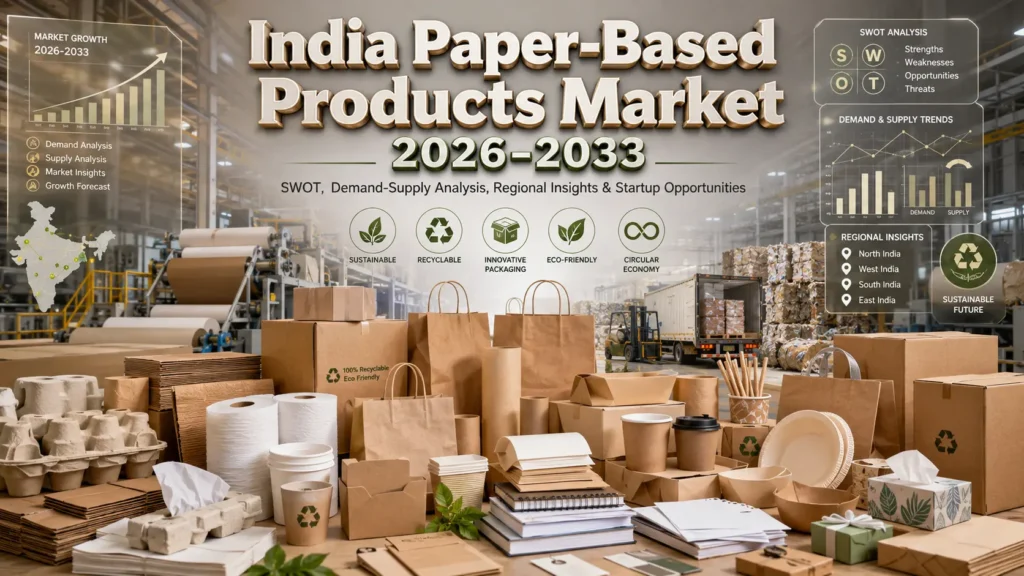
India Paper Based Products Market Market Insight The paper-based products sector in India is at a juncture – where policy support initiatives, increasing e-commerce volumes and a significant change in consumer mindset from single-use plastics are shaping the entire demand curve. Indian paper and paper products market is estimated at USD 9.25 billion and will reach a value of USD 11.91 billion by 2030 with steady growth of approximately 4.37% during the forecast period. The packaged paper market, meanwhile, is growing at much higher rates, and India’s paper packaging market alone was worth about USD 18.6 billion, which by 2033 should be worth USD 28.3 billion, according to data tracked by the India Brand Equity Foundation (IBEF). The headline growth rate is not the most compelling part of this opportunity. It is the increasing disconnect between the demand and supply of domestic consumption, which must be clearly analyzed by policy makers, investors and manufacturing entrepreneurs. India Paper-Based Products: Market Overview and Growth Trajectory India is now among the fastest growing paper markets of the world and the total paper and paperboard consumption have reached 23-24 million tonnes per annum. The production capacity of the operating mills is in the range of 22-24 million tonnes, whereas installed capacity of mills is in the range of 30-32 million tonnes, which is a contradiction and highlights under-usage of production capacity as well as structural deficiency of supply. According to the data given by the Central Pulp & Paper Research Institute (CPPRI), which is an autonomous body under Ministry of Commerce & Industry in the Government of India, the manufacturing of paper in the country is around 900 with only 550-560 being operational. This figure alone represents the level of investment and consolidation needed in the sector. Generally, there are four application segments of the paper market in India – packaging paper and paperboard, writing and printing paper, newsprint, and specialty papers. The packaging is the largest growth driver of these, representing almost 65% of paper usage, with an annual increase of more than 8%, and is fueled by growth from FMCG, organized retail, pharmaceutical packaging and the structural development of e-commerce logistics. India shipped more than 5.2 billion online shipments in one recent year alone, and that figure is still rising — all of these shipments need corrugated packaging, paper bags, labels, or protective paper inserts. Writing and printing paper is the second-largest segment and is expected to see a fairly consistent demand from education institutions, publishing houses, government documentation and stationery from the value chain, as they consume paper at the rate of about 35%. India, despite the digital disruption, has more than 105000 registered newspapers published in various languages of which more than 100000 are daily newspapers in India, according to the Registrar of Newspapers in India, which is the highest in the world in terms of newspaper and writing paper demand. The turnover of Indian paper industry is about Rs. It is estimated to be about Rs. 70,000 crores for the national exchequer. 8,000 crores. Not only is it an industry sector, but it directly and indirectly employs more than five lakh people and helps thousands of agro-forestry farmers all over the country, too. Get Detailed Insights from This Book: Modern Technology of Pulp, Paper and Paper Conversion Industries Per Capita Consumption Gap: The Single Biggest Market Opportunity The one figure that sums up the investment case of the paper-based products industry in India is this: India consumes about 15-17 kilograms of paper per capita annually. The average for the world is 57 kilograms. In developed countries such as the USA, it is over 200 kg per person/year. This is an abysmal consumption deficit and it is not just a number — it is an economic deficit. Increase in India’s per capita paper consumption by 1kg is approximately equivalent to one million additional tonnes of paper consumption per year. In India, the economy is rapidly formalizing, urbanization is increasing rapidly and literacy is on the rise, which will lead to a per capita consumption of 28 to 30 kilograms of paper in 2030. It does not take much imagination to realize that this alone would mean the need for adding up to 15–16 Mt of consumption capacity in this decade—an extraordinary manufacturing opportunity. The Indian Paper Manufacturers Association (IPMA) data shows domestic use of packaging paper is more than 8% a year now, and the total paper market is expanding at 6-7% a year. But a lot of this incremental demand growth is being satisfied right now not by domestic manufacturers but by imports, and especially from China, the ASEAN countries and South Korea. Demand–Supply Gap: Where the Real Opportunity Lies The Indian paper-products industry has a real, measurable and commercially important demand-supply gap. On the other, the domestic consumption is expected to increase to 23.5 million tonnes per annum while the domestic production capacity (with only the operational mills considered) is around 22 MT per annum. This is being addressed mainly by new imports, which have increased dramatically, of around 1.5 to 2 million tonnes per year. IPMA data shows that at certain junctures, imports of paper and paperboard have demanded over 15% of the total Paper Market in India — almost 2.8 to 3 million tonnes of paper per year. Imports from China have increased by more than 13% on an annual basis in value terms and imports from ASEAN have soared by more than 78% in certain quarterly periods. Most of the paper which India imports are coated papers, specialty papers, tissue, kraft paper and newsprint which can be produced locally in India, with the exception of coated papers, which are imported from the Far East. The import surge is structural, not cyclical, according to information from the Directorate General of Commercial Intelligence and Statistics (DGCI&S). Nearly Rs. 14 billion worth of paper and paperboard were imported. This amounts to 10,000 crores in a single nine-month period and is a straight-line impact on the viability of