
IV Fluid Manufacturing Using BFS Technology: Plant Setup, Machinery, Investment and Compliance
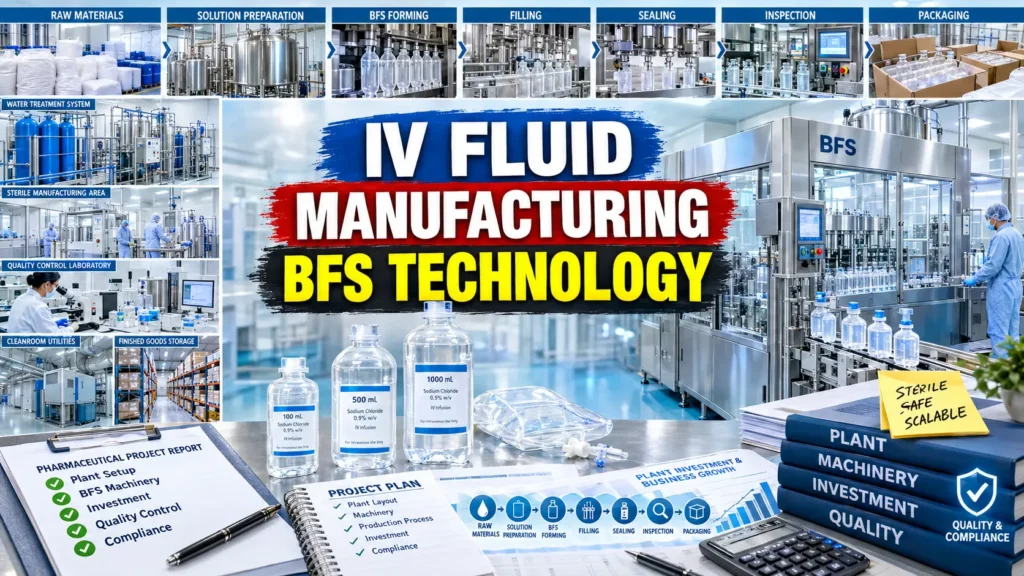
Every hospital bed in India requires a consistent supply of intravenous fluids, making IV fluid manufacturing using Blow-Fill-Seal technology one of the more lucrative business ideas in pharmaceutical manufacturing. BFS technology, which creates, fills, and seals a container in one automated, sterile sequence, lowers contamination risk compared to traditional glass-bottle methods. For entrepreneurs with pharmaceutical or engineering backgrounds, this sector presents a steady institutional demand with significant barriers to entry that protect established players from casual competition. Why IV Fluid Manufacturing Using BFS Technology Is a Smart Business Idea Right Now Hospital bed capacity, surgical volumes, and critical care admissions have all grown steadily, and IV fluids are one of the few pharmaceutical products every hospital consumes regardless of disease pattern or season. BFS technology has become the manufacturing route of choice due to reduced particulate contamination and lower labour cost compared with traditional glass-bottle filling, and is increasingly preferred by regulators during facility inspections. Since setup of compliant BFS manufacturing requires serious capital and regulatory clearance, existing demand consistently outpaces the number of new compliant entrants, protecting pricing. Government Policies & Incentives Essential medicine and critical care manufacturing, including IV fluids, receives policy attention from Department of Pharmaceuticals – Pharmaceutical Industry Policies & Schemes, including production-linked incentive support for bulk drugs and associated formulations. Regulatory approval runs through CDSCO – Drugs and Cosmetics Rules, whose Schedule M and revised good manufacturing practice norms increasingly favour BFS-based sterile manufacturing. Pharma-focused MSME units can also access dedicated cluster development support and collateral-free credit through Ministry of MSME – Credit Guarantee Scheme. Several states also offer dedicated pharma park infrastructure with pre-approved environmental clearances and shared effluent treatment facilities, which can significantly shorten the regulatory timeline for a new sterile manufacturing plant. Multiple Manufacturing Business Ideas for Startups Large-Volume Parenteral (LVP) Manufacturing via BFS Normal saline, Ringer’s lactate, and dextrose solutions in 100ml to 1000ml formats represent the highest-volume, most consistent demand segment for IV fluids. A BFS line dedicated to LVP products can serve hospital chains, government tenders, and distributors simultaneously, and because these are standardised formulations, the main competitive differentiators are reliability of supply and consistent regulatory compliance. Small-Volume Parenteral & Specialty Solutions Beyond basic saline, hospitals also need smaller-volume specialty IV formulations for electrolyte correction, nutrition support, and specific therapeutic uses. While margin is better than commodity LVP products, this segment involves a broader formulation and regulatory approval effort, making it a natural second phase after establishing core LVP manufacturing. Contract Manufacturing for Domestic Pharma Brands Many mid-sized pharmaceutical companies want IV fluid capacity without building their own sterile manufacturing plants, creating steady demand for contract manufacturing partners. A BFS plant that positions itself as a reliable third-party manufacturer can secure multi-year supply agreements with pharma brands, providing revenue stability that pure own-brand selling often lacks. Ancillary Sterile Consumables Manufacturing A BFS plant’s cleanroom infrastructure and sterile handling expertise can be extended to manufacture ancillary consumables such as sterile irrigation solutions, ophthalmic rinses, or inhalation solutions, which share similar manufacturing conditions. Diversifying into these adjacent sterile products can spread fixed cleanroom and compliance costs across a broader product line. Institutional Tender Specialisation Government hospital procurement runs through structured tender processes that reward consistent quality documentation and delivery history over aggressive pricing. A manufacturer that builds specific expertise navigating institutional tender requirements rather than as an afterthought to private sales can secure large, recurring government supply contracts. Import–Export Opportunity Analysis India already exports IV fluids and essential parenterals to price-sensitive markets across Africa and South Asia, an area regularly facilitated through pharmaceutical export support by Department of Pharmaceuticals – Pharmaceutical Industry Policies & Schemes. Domestically, hospital capacity expansion under public health missions keeps consumption rising steadily, while dependence on a handful of large established manufacturers means new, WHO-GMP-aligned entrants have room to win institutional and export tenders once they clear initial hurdles. Market Outlook & Scaling Roadmap Hospital bed capacity expansion under public health infrastructure programmes, along with steady private hospital growth, points to continued demand growth for IV fluids beyond current domestic manufacturing capacity. Plants that achieve WHO-GMP certification alongside domestic Schedule M compliance can access a significantly larger addressable market, since export tenders and larger private hospital chains increasingly specify this higher certification tier as a baseline requirement for new suppliers. Skills, Manpower & Quality Control Sterile pharmaceutical manufacturing is one of the more staffing-intensive categories in this list, requiring qualified pharmacists, microbiologists, and quality assurance personnel alongside trained machine operators. A compliant plant typically needs at least one qualified quality control head with pharmaceutical regulatory experience from the outset, since this position determines whether the plant passes CDSCO inspection. Machine operators can be trained over several months, but the quality assurance and documentation team generally needs prior pharmaceutical industry experience, making recruitment lead time an important factor. Indian MSME Success Stories Claris Lifesciences — Arjun Handa (building on Chandulal Patel’s foundation) Claris built one of India’s strongest reputations in IV fluids and injectables by investing early and heavily in BFS and sterile manufacturing technology, a decision that later opened export markets that few Indian generic manufacturers had accessed for parenteral products. Nirlife Healthcare (Nirma Group’s pharma arm) — Nirma Group leadership Nirma’s diversification from consumer chemicals into pharmaceutical manufacturing, including IV fluids, shows how disciplined process manufacturing expertise from an unrelated industry can transfer successfully into sterile pharma production when quality systems are taken seriously from day one. How NPCS Can Help Entrepreneurs Evaluate the Opportunity We at Niir Project Consultancy Services (NPCS) provide professional consulting for the preparation of Market Survey cum Detailed Techno-Economic Feasibility Reports (DPRs) for setting up new industries or businesses. Our reports include detailed manufacturing processes, market research and demand analysis, process flow diagrams, product mix and capacity planning, machinery and raw material details, and complete project financials with profitability analysis. Entrepreneurs use these reports to evaluate feasibility, profitability, and scalability before investing, reducing guesswork at the most capital-intensive stage of a new venture. For anyone evaluating IV Fluid Manufacturing Using
Sodium Hydrosulphite Market Research Report 2026: Size, Growth, Demand-Supply Gap and Business Opportunity for Startups in India
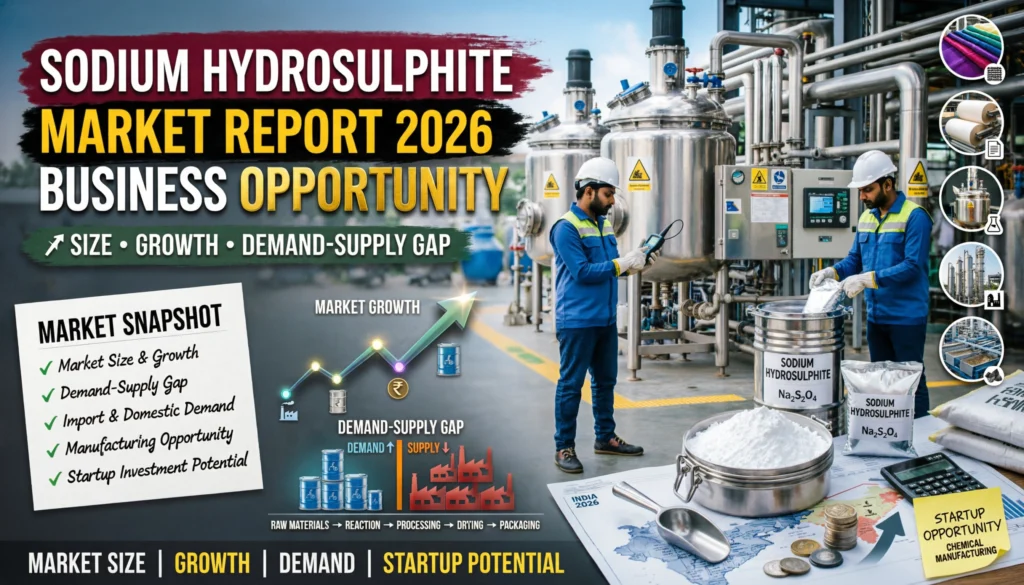
Sodium Hydrosulphite Manufacturing Business The vast textile and apparel manufacturing infrastructure in India is the largest in the world, and almost every metre of cotton, viscose or denim fabric that comes off the mill floor in India has been treated with sodium hydrosulphite, at some point in its life. It’s a non-glamorous reducing agent, but it’s also a chemical India still imports the majority of its requirements to meet: a simple opportunity with no seasonality, and the demand is assured. What Is Sodium Hydrosulphite? Sodium hydrosulphite is a white crystalline powder, and one of the strongest commercially available reducing agents, commonly called sodium dithionite or “hydros” in industry. It is produced by three major industrial processes: However, its essential characteristic, strong reducing power which easily breaks down in acidic or hot aqueous conditions, makes it indispensable in several industries: Get Detailed Project Report (DPR): Sodium Hydrosulphite Manufacturing Project Report Global and India Sodium Hydrosulphite Market Size and Growth Global market-size estimates for sodium hydrosulphite (sodium dithionite) in the most recent of the estimated base years (2022–2025) span from about USD 1.0 billion to USD 1.6 billion, and forecasts range from USD 1.46 billion to USD 1.7 billion by 2030–2034, at CAGRs that tend to cluster between 2.2% and 5.2% depending on study, a moderate, mature-market growth profile due to steady demand and emerging substitution threat from alternative reducing chemistries. The domestic market is projected to grow at a significantly higher CAGR of around 5.0% with rising demand in various applications, such as textile dyeing, paper bleaching and water treatment during 2020-2024, and forecast to reach a size of 200 MT by 2035 with the growth of environmentally friendly and high efficiency hydrosulphite products. Note on figures: Sodium hydrosulphite is also known by various names in market studies (sodium dithionite, “hydros” or hydrosulfite) and the amount in some studies may be stated as part of the liquid/stabilised formulations, as reported in the powder column. NPCS can provide an investor-grade TEFS that can be customized for your selected process route (sodium formate vs zinc dust) and application segment. India’s Import Dependence Industry sources say India’s domestic sodium hydrosulphite market is import-dependent with the product not just a niche specialty chemical but a base industrial input for the huge Indian textile industry, and that domestic capacity has not matched the demand. This translates into an “immediate opportunity for domestic manufacturers” – that is, demand that is not seasonal, not dependent on a single industry’s cycle and that is already partly being satisfied by imports. Policy Tailwinds Read the Complete Book Here: Modern Technology of Industrial Chemicals India Demand-Supply Gap: Sodium Hydrosulphite Parameter Current Position Demand base Broad and non-seasonal — spread across textile dyeing/bleaching (largest), paper bleaching, water treatment, mineral processing, and food preservation Domestic production base Limited number of established producers, most notably TCP Limited (the only Indian plant using the sodium formate process, one of only five such plants worldwide) and Gulshan Chemical Ltd. Import dependence Documented by industry sources as an ongoing structural gap — India imports a share of its sodium hydrosulphite requirement despite having a substantial textile-driven demand base that could support more domestic capacity Textile sector linkage India’s textile industry is one of the largest in the world by volume; as polyester and blended fabric usage grows alongside cotton and viscose, reducing-agent demand grows correspondingly Nature of the gap An import-substitution opportunity tied directly to India’s textile manufacturing scale — demand growth is assured by the underlying textile sector; the gap is in domestic reducing-agent production capacity, particularly using the cleaner, more compliant sodium formate process Opportunity for new entrants Strong for regional manufacturers positioned near textile clusters (Gujarat, Maharashtra, Tamil Nadu), particularly those adopting the sodium formate process for lower environmental compliance cost Reading the gap: This is a straightforward, demand-secure opportunity: India makes more textiles than almost anywhere else in the world, and sodium hydrosulphite is a non-substitutable input for a large share of that dyeing and bleaching process. The gap isn’t about proving demand exists — it’s about India’s current domestic manufacturing base (concentrated in a small number of established players) not yet matching the country’s textile-sector scale, leaving room for regional capacity closer to specific textile clusters. Major Indian Sodium Hydrosulphite Manufacturers Company Base/Region Process Notes TCP Limited India (with Mitsubishi Corporation, Japan technology collaboration) Sodium formate process India’s only plant using this cleaner process — one of only five such plants in the world; produces “Hydros” free of zinc, iron, or mercury traces Gulshan Chemical Ltd. Bhiwadi, Rajasthan Established process Recognised registered synthesizer supplying premium-grade sodium hydrosulphite to the textile trade across Mumbai and other markets Veeraj Chemtech Pvt. Ltd. India Established manufacturer Recognised Indian sodium hydrosulphite producer S.D. Dyes & Chemicals India Established manufacturer Recognised regional producer serving textile dyeing and paper industry customers Regional Gujarat/Rajasthan-based manufacturers (Ahmedabad, Vapi, Bhiwadi clusters) Gujarat, Rajasthan Various The MSME-scale entry tier — smaller regional producers serving local textile mill demand Major International Sodium Hydrosulphite Players Company Country Notes BASF (BASF Canada) Germany/Canada Major global chemicals company among the top players by market share in the sodium hydrosulphite/dithionite market Guangdong Zhongcheng (Zhongcheng Chemical) China Major Chinese producer; China holds an estimated 60% share of global sodium hydrosulphite production, driven by its massive textile manufacturing sector Yantai Jinhe China Recognised major Chinese sodium dithionite manufacturer Hubei Yihua China Recognised major Chinese chemicals producer with sodium dithionite capacity Huidelong China Recognised Chinese sodium dithionite manufacturer Transpek-Silox (India-linked international operations) India/international Cited among the top global players in some market studies, reflecting India’s growing manufacturing relevance in this category Market Segmentation By Process By Form By Application By End-Use Industry Key Growth Drivers 1. The size of India as a global textile producer. India has one of the largest textile industry bases in the world and the production of polyester and mixed fabrics continues to rise, so the base demand for reducing agents, such as sodium hydrosulphite continues to grow in India. 2. Move towards sodium formate
Hume Pipes (RCC Pipes) Market Research Report 2026: Size, Growth, Demand-Supply Gap and Business Opportunity for Startups in India
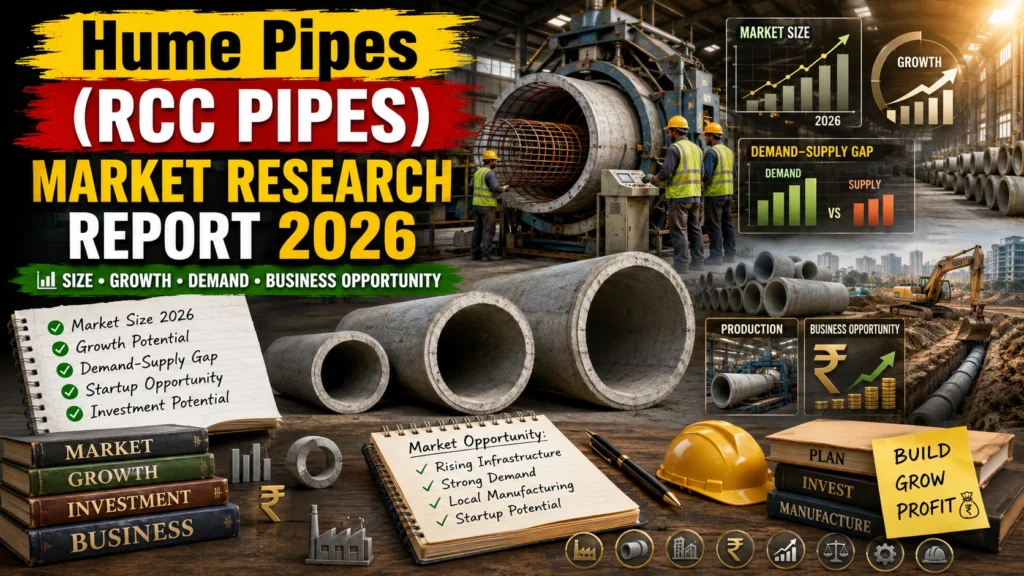
Hume Pipe Manufacturing Business The Hume pipe is one of the products that can be equated directly to India’s largest public infrastructure programme. Along with the expansion of AMRUT 2.0 water sewerage, India’s Jal Jeevan Mission is installing pipe networks in all the rural households in the country, the biggest water infrastructure programme in the world’s history with the spending of about ₹8.69 lakh crore till December 2028. The large diameter variety of reinforced concrete pipe is the backbone of stormwater drains, sewerage trunk lines and canal-lining projects, especially at large-scale, for which plastic pipe cannot match. That’s as close to a bottom floor as an entrepreneur can get. What Are Hume Pipes? Hume pipes, or also known as reinforced cement concrete (RCC) pipes, are pipes that have been precast with steel bars or steel mesh and are made by either centrifugal (spun) casting or vertical vibration-casting processes. It took its name from the patenting in 1910 of the centrifugal spinning process for making concrete pipes by the Hume brothers of Australia. They are produced in India to the Indian Standard specification IS 458 which is similar to the Australian, British and American standards and are available in strength grades (usually NP2, NP3, NP4) that are classified by the load-bearing requirements. There are several variants of the Hume pipe: Service life is typically specified as 50+ years (high grade concrete M30/M40) with good concrete installation. Diameters range typically from 150mm up to over 2600mm and lengths are typically from 2.5–3 metres. Related Article: Medium-Density Polyethylene (MDPE) Pipes Are A Lucrative Business for Any Entrepreneur Global and India Concrete Pipe Market Size and Growth The concrete pipe market is a well-established and a steady growing market in the world. It is estimated to be around USD 13.4-15.6 billion in 2025 and will reach USD 19.9 billion–USD 45.2 billion in 2034-2035, at beggar-taker rates of 3.5-4.5%, a mature-market rate, reflecting the balance of replacement-demand in developed markets and the new-build demand in urbanising economies. The story of India is a much more dynamic one. In total, the India pipes market (all materials) is expected to reach USD 16 billion by 2025 with a compound annual growth rate of more than 11% — and in this, concrete pipes will continue to hold a strong and non-substitutable position in irrigation canal projects, stormwater drainage, and sewerage trunk lines where plastic and HDPE pipes are not structurally viable at a large scale. Note on figures: This is not a stand-alone market segment for reinforced concrete pipes, but is a sub-segment of the “pipes” or “concrete pipe” market and can therefore be reported in different market studies. NPCS can provide a custom techno-economic feasibility study that can be developed for the diameter range you are interested in and can be tailored to the target customer (government water boards, PWD, private EPC) for investor grade numbers. The Government-Backed Demand Floor Concrete pipe demand in India is quite different from most of the manufacturing categories because it is not just a market demand but it’s a demand which is funded and policy-driven by the government. Policy Tailwinds 1. Mandatory BIS specification (IS 458): RCC pipes supplied to government water boards, PWD, and municipal corporations must conform to IS 458:2003, creating a quality-compliance barrier that favours established, certified manufacturers over informal producers. 2. Government direct project procurement: The concrete pipe demand is huge with government direct project tenders for multi years with empanelling of a manufacturer (Public Health Engineering Department, Public Works Department, municipal corporations, NHAI). 3. MSME manufacturing incentives: RCC pipe manufacturing units are labour and capital-intensive precast concrete units; therefore, they are eligible for MSME capital subsidy schemes in various states. 4. State industrial policies for precast concrete units: Some states provide land, power tariff and capital subsidy for the precast concrete product manufacturing due to its contribution towards the delivery of public infrastructure. View Full Project Details: Emerging Business of Ductile Iron Pipe Fittings India Demand-Supply Gap: Hume Pipes (RCC Pipes) Parameter Current Position Demand driver scale Jal Jeevan Mission 2.0 alone represents an ~₹8.69 lakh crore infrastructure programme through 2028, alongside AMRUT 2.0 urban sewerage expansion and PMKSY irrigation projects Domestic manufacturing base A mix of large organized players (The Indian Hume Pipe Co. Ltd., with 20+ factories) and hundreds of regional/MSME-scale manufacturers spread across nearly every Indian state Nature of the gap Primarily a regional capacity and logistics gap — concrete pipes are heavy, low-value-density products with high transport cost relative to product value, meaning demand often outpaces locally available capacity even where national aggregate capacity looks adequate Market structure Highly fragmented — organized players with pan-India reach coexist with a very large number of regional and local manufacturers; competitive dynamics are shaped by pricing, logistical proximity, and quality-standard adherence rather than brand power Opportunity for new entrants Strong for regionally-positioned manufacturers near government project clusters, given the product’s poor economics for long-distance transport and the sheer scale of ongoing government procurement Reading the gap: Hume pipes are a rare manufacturing category where the constraint is rarely “does demand exist” — government infrastructure spending guarantees that — but “is there enough locally-positioned, quality-compliant manufacturing capacity near where the pipe is needed.” Because transport cost is a large share of delivered price for a heavy, low-value-density product, a new regional manufacturer doesn’t need to compete nationally; it needs to be the best-positioned qualified supplier for its own district or state’s ongoing JJM, AMRUT, or PWD tenders. Major Indian Hume Pipe / RCC Pipe Manufacturers Company Base/Region Scale Notes The Indian Hume Pipe Co. Ltd. (IHP) Mumbai, Maharashtra (HQ); 20+ factories pan-India Large integrated national player Established 1926 by Walchand Hirachand; India’s original and largest Hume pipe manufacturer; also manufactures PSC pipes, PCCP, bar-wrapped steel cylinder pipes, and PSC railway sleepers; over 100 projects under execution; recently secured a ₹357+ crore water supply project from Madurai City Municipal Corporation Sneh Precast & ConstoSolutions Maharashtra Regional manufacturer Produces NP3/NP4-class RCC pipes for drainage and sewerage with spigot-socket joint configurations
UJALA ने 36 करोड़ LED बांटे — और अब replacement market शुरू हो रही है। Timing perfect है
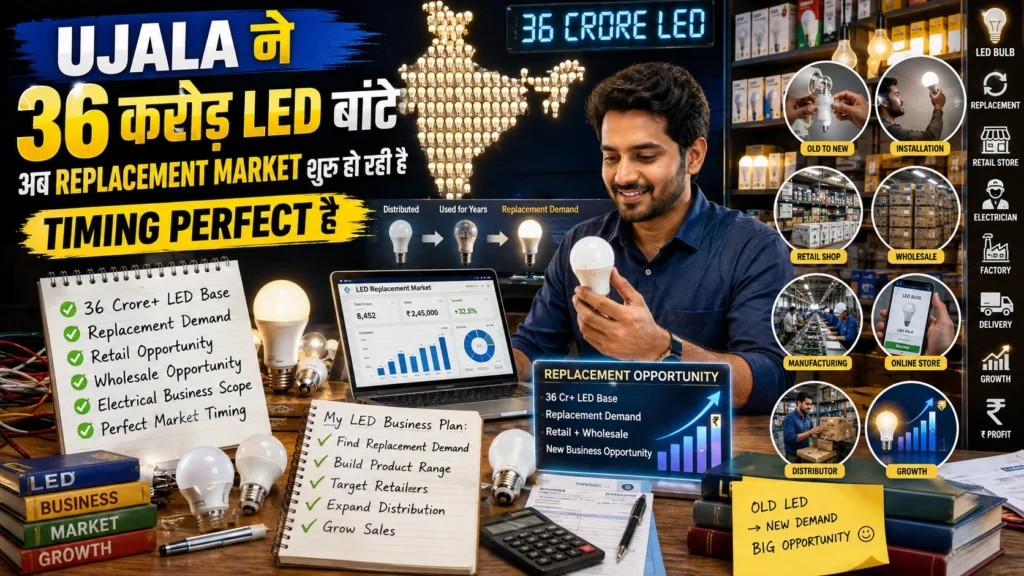
LED Bulb Manufacturing Business India में IBEF Electronics India के अनुसार, India का electronics market $150 billion+ का है। UJALA Official Portal की scheme ने LED penetration dramatically increase की है — India अब world का largest LED market है। PIB UJALA Scheme के अनुसार, UJALA ने 36 crore+ LED bulbs distribute किए हैं। DPIIT Electronics PLI scheme LED component manufacturing को incentivize कर रही है। Invest India Electronics में electronics manufacturing को Make in India का pillar बताया गया है। World Bank Energy India report में India की energy efficiency progress में LED transition का crucial role है। इस article में LED Bulb Manufacturing Business India में की complete guide दी जाएगी — setup process, financing, market strategy और government support के साथ। India में यह sector unprecedented growth पर है। Ministry of MSME Schemes के through MSME financing और World Bank India Industry report में India के industrial growth में इस sector का critical role documented है। Get Detailed Project Report (DPR): LED Light Bulbs, Tubes, Fittings, Spotlights and Wall Lights Projects Market Size और Growth Opportunity यह sector India के fastest growing manufacturing businesses में से एक है। Domestic demand strong है और export potential भी excellent है। Government support, growing consumer demand और import substitution push — तीनों factors मिलकर इस business को ideal बनाते हैं। Invest India MSME के अनुसार, इस sector में MSME units को priority financing मिलती है। Small और medium entrepreneurs के लिए market entry का यह सही समय है। सरकारी Support और Schemes Ministry of MSME Schemes के under इस sector के businesses को PMEGP (25-35% subsidy), MUDRA loan और CGTMSE guarantee scheme का लाभ मिलता है। Application process: Udyam registration → DPR preparation → bank application। State-specific incentives भी available हैं। Industrial policy के under land, power और infrastructure में concessions। Additional central schemes sector-specific हैं — APEDA, DPIIT, Ministry of Commerce के माध्यम से। Related Article: LED Bulb Manufacturing Plant in India: Investment, Machinery & Business Opportunities Business Ideas — Detailed Analysis 1. Residential LED Bulb Assembly 9W, 12W, 18W — standard residential bulbs India की highest volume segment है। Assembly cost ₹35-45/unit, retail ₹80-120/unit। BIS IS 16102 certification mandatory है। Component sourcing: LED chips, drivers, aluminum heat sinks — from Delhi और Shenzhen wholesale markets। यह business segment profitability के लिए proven है। Raw material sourcing, quality control और consistent delivery — ये तीन success factors हैं। 2. Street Light और Commercial LED Fixtures Municipal tenders और industrial clients के लिए high-power fixtures। B2B model with larger margins। GeM portal पर government procurement। Minimum unit investment ₹50-80K। Monthly output 200-500 fixtures। Revenue potential ₹3-8 लाख/month। यह business segment profitability के लिए proven है। Raw material sourcing, quality control और consistent delivery — ये तीन success factors हैं। Access Complete Business Plan: LED Street Light Assembling 3. Agricultural LED Grow Lights Indoor farming और greenhouse sector में growing demand। Premium product — ₹2,000-15,000 per unit। Specialty spectrum LEDs urban farming revolution को drive कर रहे हैं। यह business segment profitability के लिए proven है। Raw material sourcing, quality control और consistent delivery — ये तीन success factors हैं। 4. Solar LED Hybrid Products Solar panel + LED combination road lights, garden lights। Off-grid areas में massive demand। PIB UJALA Scheme और MNRE दोनों solar LED को support करते हैं। यह business segment profitability के लिए proven है। Raw material sourcing, quality control और consistent delivery — ये तीन success factors हैं। Check Out This Recommended Book: Solar PV Power and Solar Products Handbook Financial Planning Investment analysis: Basic unit ₹50,000-₹1 लाख से शुरुआत possible है। PMEGP से 25-35% subsidy effective investment reduce करती है। MUDRA loan working capital provide करती है। Revenue projections: Month 1-6: ₹30,000-₹1 लाख (client building phase). Month 7-12: ₹1-3 लाख (established phase). Year 2+: ₹3-8 लाख (scale-up phase). Break-even typically 8-12 months। Profitability drivers: Product mix optimization, bulk buying, quality consistency और repeat clients। Higher margin products पर gradually shift करें। Marketing और Client Acquisition B2B marketing में industry associations, trade directories और referral network most effective हैं। B2C में online platforms, social media और local retail important हैं। GeM portal पर registration government procurement access देता है। Consistent quality और reliable supply chain से repeat business और referrals generate होते हैं। Satisfied clients से testimonials collect करें। Explore proven business ideas with high success potential Import-Export Opportunity APEDA Export Data के through export channels available हैं। IEC code DGFT से, relevant Export Promotion Council registration, और quality certification से export ready हो सकते हैं। Per unit export realization domestic से 1.5-3x होती है। MSME Success Stories कई Indian entrepreneurs ने इस sector में शुरुआत ₹50,000-₹1 लाख से की और आज lakhs earn कर रहे हैं। Consistent quality, strong client relationships और strategic expansion इनकी success का formula है। Government schemes का सही उपयोग — PMEGP subsidy, MUDRA loan, MSME Technology Centre training — ने entrepreneurs को faster scale up में help किया है। Conclusion यह manufacturing business sector India की growth story का important chapter है। Government support, market demand और technology advancement तीनों favorable हैं। अभी शुरू करें — Udyam registration, market research और पहली manufacturing unit।
Construction Chemicals Market Research Report 2026: Size, Growth, Demand-Supply Gap and Business Opportunity for Startups in India
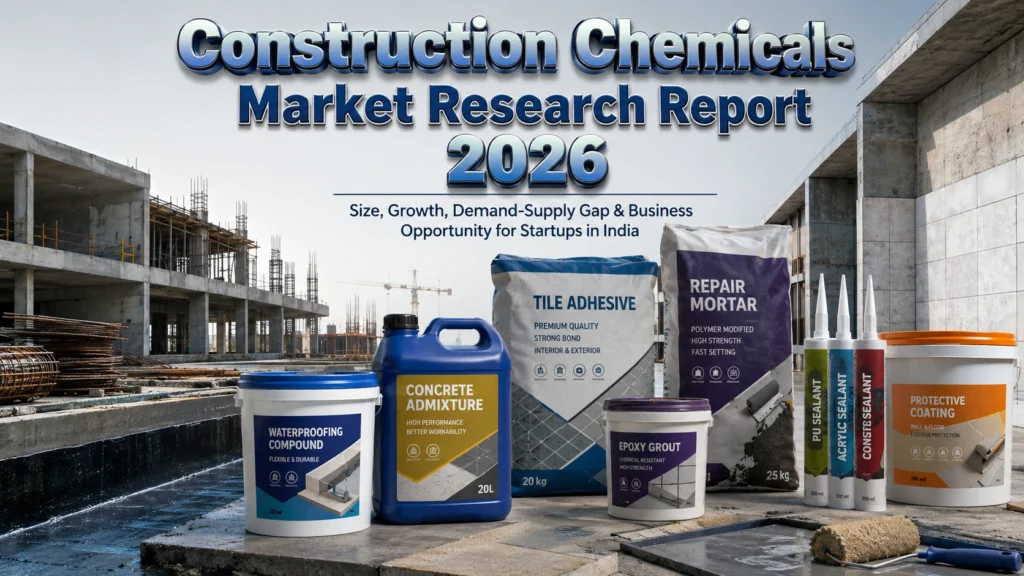
Construction Chemicals Market in India India’s construction industry is in the midst of its biggest capital expenditure cycle in decades – metros, highways, smart cities and a housing boom in Tier-2 and Tier-3 cities. Each of those projects requires the use of construction chemicals: admixtures to create workable and durable concrete; waterproofing systems; tile adhesives, grouts, sealants and repair compounds. But it’s a category that’s expanding even faster than the construction industry, as the intensity of the use of chemicals relative to square feet is increasing even as construction volume is increasing. The entrepreneurs find that sweet soup of volume growth and growing penetration a rare double whammy. What Are Construction Chemicals? Construction chemicals are sold on performance specification, as opposed to commodity pricing, are generally higher-margin, technically differentiated products, in contrast to bulk construction materials (cement, steel, aggregates). View Full Project Details: Construction Chemicals Projects India Construction Chemicals Market Size and Growth Market sizes published by different research firms have significant variations both due to the extent of the product scope (some include paints and coatings while others exclude these) and the base year methodology (some use a different base year than others) but all major studies indicate double-digit growth in India. The India market is estimated to be between USD 2.25 billion to USD 4.64 billion in 2025-26, and is expected to grow at a CAGR of around 10% to 14% in the near future, significantly higher than the global market, which is expected to grow at an average CAGR of ~3.5% over the same period. Note on figures: The wide range is because there is a genuine variation in scope of product activity between different research agencies (including paints, coatings and adhesives which are not used in non-construction applications). Consider the numbers above as directional. NPCS can put together a personalized techno-economic feasibility study tailored to your particular product line (admixtures, waterproofing, tile adhesives etc.) for investors grade numbers. What’s Driving the Faster-Than-Construction Growth The reason for this is that the construction chemicals market is expanding at a meaningful rate faster than the construction market – the number of square metres of ready-mix concrete (which relies heavily on admixtures) has increased, the number of buildings being constructed using advanced waterproofing, instead of traditional, has increased, and the number of developers using tile adhesives and epoxy grouts, as opposed to sand-cement mortar, has increased. The double-digit growth rates come from this progression from “no chemical” to “basic chemical” and then “advanced chemical”” specification, added to the increased construction volumes. Policy Tailwinds 1. National Infrastructure Pipeline (NIP): An investment plan for roads, railways, urban infrastructure and housing, with the total planned capital investment of approximately INR 111 lakh crore (₹11.1 trillion+). 2. Smart Cities Mission and metro rail expansion: This requires high-performance construction chemicals for tunnels, bridges, elevated structures, which are higher than the specification for residential building. 3. Pradhan Mantri Awas Yojana (PMAY) and affordable housing push: Mass housing construction drives volume demand for tile adhesives, waterproofing, and basic admixtures even in cost-sensitive segments. 4. BIS standards for construction materials: Increasing enforcement of Bureau of Indian Standards specifications for concrete and building materials is pushing informal/unorganised segments of the market toward branded, tested construction chemical products. 5. MSME and Make in India manufacturing incentives: Domestic manufacturing of construction chemicals — as opposed to imported formulations — is supported by manufacturing-linked incentive frameworks and MSME capital subsidy schemes. Check Out This Recommended Book: The Complete Book on Construction Materials India Demand-Supply Gap: Construction Chemicals Parameter Current Position Market structure Fragmented — the top five companies together hold only an estimated ~19% of the India construction chemicals market by some industry analyses Organized vs. unorganized share Several sub-segments (sealants, grouting) see meaningful unorganised/local competition; segments requiring stricter quality compliance (protective coatings, repair chemicals) are more organized-player dominated Domestic manufacturing base A mix of large MNC-linked players (Sika India, BASF/MBCC, Fosroc, Mapei, Saint-Gobain Weber) and strong domestic majors (Pidilite, Asian Paints, STP Ltd., Chembond Chemicals) manufacturing within India Nature of the gap Primarily a regional and category-specific capacity gap rather than an import-dependency gap — India largely manufactures domestically, but Tier-2/Tier-3 city demand and specific sub-categories (advanced repair systems, specialty flooring) remain underserved by regional-scale manufacturing Opportunity for new entrants Regional manufacturing closer to Tier-2/3 construction clusters, MSME-scale entry into specific product categories (tile adhesives, waterproofing coatings, admixtures), and contract manufacturing for established brands Reading the gap: Unlike categories where India depends heavily on imports, construction chemicals in India are largely manufactured domestically — the gap here is about market fragmentation and regional reach rather than a supply shortfall. With the top players collectively holding under a fifth of the market, and demand growing fastest in Tier-2/Tier-3 cities where large national brands often have thinner distribution, there is genuine room for a well-positioned regional manufacturer to build a defensible niche. Major Indian Construction Chemicals Manufacturers Company Base Focus Area Notes Pidilite Industries Ltd. Mumbai, Maharashtra Adhesives, waterproofing, sealants, tile fix systems India’s largest adhesives and construction chemicals company; brands include Dr. Fixit and Roff; revenue of ~₹13,094 crore (2025) Asian Paints Ltd. Mumbai, Maharashtra Waterproofing, protective coatings India’s largest paint company, with an expanding construction chemicals and waterproofing portfolio STP Limited Kolkata, West Bengal Protective coatings, waterproofing, repair chemicals Long-established Indian construction chemicals manufacturer (STP Berger) Chembond Chemicals Ltd. Mumbai, Maharashtra Protective coatings, admixtures, industrial flooring Established Indian specialty chemicals manufacturer with a construction chemicals division Bigbloc Construction Ltd. Gujarat Adhesives, putty, waterproofing (new entrant) Diversified into construction chemicals in 2024–26 under the Nxtfix/Nxtplast/Nxtgrip brands; representative of new domestic entrants Sunanda Specialty Coatings Pvt. Ltd. India Flooring, protective coatings Recognised Indian specialty coatings and flooring systems manufacturer Ramco Cements (Hard Worker brand) Chennai, Tamil Nadu Construction chemicals (new brand, 2025) Major cement company’s new construction chemicals brand, targeting ₹2,000 crore revenue within 4–5 years Sakshi Chem Sciences India Waterproofing agents, concrete admixtures, polymer additives R&D-focused domestic manufacturer Cera Chemicals / Cera-Chem Pvt. Ltd. India Waterproofing, admixtures Established regional Indian manufacturer Major International/MNC
5 Seamless Tube Production Business Ideas That Can Earn You ₹2 Crore/Year
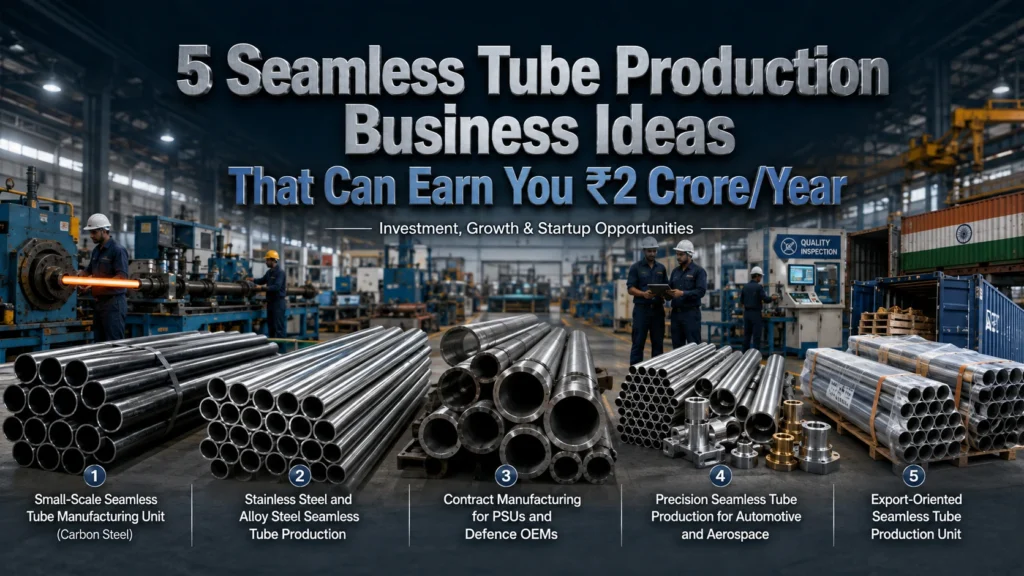
Why Seamless Tube Production Is One of India’s Most Compelling Business Ideas India’s goal of infrastructure development is on a full throttle. There’s no application where failure isn’t a concern, and there are no products as important as oil and gas pipelines, power plant boilers, automotive axles, aerospace assemblies, chemical reactors — and no place where a weld failure isn’t an option. Seamless tube manufacturing is a viable business venture as it has good industrial demand, export potentials and real government support when compared to other business ideas. Seamless tubes are manufactured from a solid billet, not welded, no weak point, unlike welded tubes. This structural superiority makes them essential in applications with high-pressure, high-temperature and corrosion. The demand is rising where India has the most aggressive expansion plans – energy, defence, railways, petrochemicals and nuclear power. However, domestic production is still not meeting demand which means there is a significant import deficit that enterprising manufacturers can exploit. This article analyzes the seamless tube production business in India in detail based on the available data providing a detailed outlook on the market opportunity, government incentives, various business models, trade dynamics and lessons learnt from the most successful MSME stories in this space in India. View Full Project Details: Seamless Tubes Manufacturing Project Report Why Seamless Tube Production Is a High-Growth Sector Right Now The global seamless tube and pipe market is estimated at more than USD 100 billion and is expected to grow at a moderate CAGR mainly due to the investments in energy infrastructure, urbanisation and defence modernization. This is the worldwide picture and, in some areas, India’s domestic demand outstrips it. India’s steel demand growth has been surpassing many developed economies, with finished steel demand posting a solid year-over-year growth due to infrastructural and manufacturing activity, as mentioned in IBEF Indian Steel Sector Report. Multi-Sector Demand: The Core Strength Seamless production of tubes is especially strong as a manufacturing investment because of its multiple industry end-user applications. There is no dominant end-industry in terms of consumption. Large diameter, high pressure seamless line pipes are needed for oil and gas exploration. The precision metallurgic requirements for boiler tubes in power generation, thermal and nuclear, are well known. Seamless tubes are applied to manufacturing of axle shafts, drive shafts and structural parts for the automotive industry. Seamless tubes in special alloys are needed for aerospace and defence applications. Corrosion resistant seamless tubes are used in chemical/pharmaceutical plants in stainless steel and duplex grades. This diversification will ensure that the demand does not slow down when any one sector slows down. India’s Infrastructure Push: A Direct Demand Catalyst The seamless tube consumption is directly related to the Government of India’s spending on infrastructure, such as the implementation of the National Infrastructure Pipeline, the PM Gati Shakti corridors, the city gas distribution network, and defence self-reliance initiatives. For every kilometre of gas distribution line, for every new boiler installation, for every renewal of a railway wagon. This initiative, known as Make in India — Metals and Mining, is actively encouraging the push towards domestic manufacturing and providing a demand signal as well as a preference towards buying seamless tubes made in India by government projects. Import Substitution: The Commercial Opportunity The current market demand for seamless tubes in India is fairly high particularly for high quality products like stainless steel, alloy steel, specialty API grade, etc. The prices these imports come in at are based on world freight, duties, and traders’ margins. An immediate and natural competitive advantage is achieved if a local company is able to compete at a lower effective cost while providing products of equivalent quality. Heavy engineering and capital goods manufacturing is growing at an accelerated pace as explained by Invest India’s study on the capital goods manufacturing boom in India that’s providing a tactical opportunity to Indian seamless tube manufacturers to outcompete imports in several grade categories. Government Policies and Incentives for Seamless Tube Production The policy landscape in India has been made one of the most conducive for manufacturing in the country’s history. There are some central government schemes that directly benefit the entrepreneurs who are contemplating investing in seamless tube production. PLI Scheme for Specialty Steel The Ministry of Steel’s Production Linked Incentive (PLI) Scheme offers support to business owners in the seamless tube segment directly for seamless tube products in alloy steel, stainless steel and other high value grades. This scheme offers monetary support for manufacturers for sales exceeding a base year sales amount. In a PIB press release announcing the launch of PLI Specialty Steel Round 3, it has been affirmed that investment commitments made under the scheme have reached ₹43,874 crore so far, creating jobs worth more than 13,000 direct jobs, and the scheme now covers 22 product sub-categories, such as seamless tube grades. The incentive rates vary by product sub-category from 4% up to 15% of incremental sales. MSME Credit and Financial Support If the seamless tube unit is registered on the Udyam portal, it will be eligible for obtaining loans up to ₹2 crore through MSME Credit Guarantee Fund Trust (CGTMSE), which offers collateral-free loans to eligible manufacturing units. New entrants’ financial burden further decreases because of concessional rates on priority sector loans, subsidised power tariffs in several states, and preferential consideration in government procurement. MSME registration can be done digitally and it should be done at the earliest by the new manufacturers. Invest India Capital Goods Support The Invest India Capital Goods sector page provides a complete solution to invest in India’s heavy engineering and capital goods manufacturing industry, which includes seamless tube manufacturing equipment and facilities. The sector has 100% FDI with automatic approval, no industrial licensing and no restrictions on technology transfer payments. Invest India’s investor facilitation services are designed specifically to assist manufacturers with approvals, to facilitate linkages with state governments for allocation of industrial land and to access central incentive schemes. Startup India and DPIIT Recognition Startups operating innovative seamless tube manufacturing ventures, especially
Entrepreneur India July 2026: 13 Manufacturing Business Opportunities in India
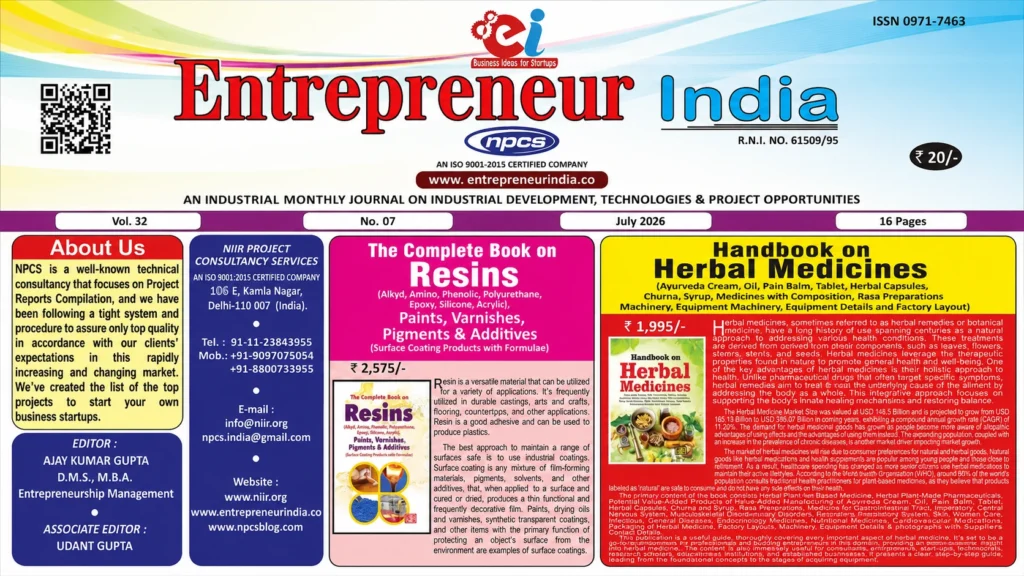
Technologies, infrastructure, sustainability, healthcare, energy efficiency and value addition are setting the stage for new opportunities for entrepreneurs and investors in the manufacturing sector in India. If you’re seeking actionable manufacturing business ideas for 2026, the new Entrepreneur India July 2026 issue features a targeted list of industrial projects and industry-focused insights. The July 2026 edition is intended for entrepreneurs, startups, MSMEs, investors, consultants, financial institutions, and industrial planners, and published by Niir Project Consultancy Services (NPCS). The focus is not just on business ideas but also on the practical aspects of developing manufacturing ventures, such as technology, plant capacity, machines, raw materials, project economics, compliance and market positioning. Explore the Entrepreneur India July 2026 Issue The July 2026 edition lists 13 manufacturing opportunities including construction material, industrial insulation, logistics, healthcare, food processing, packaging, specialty products and renewable energy. According to the official magazine page, the issue is an industrial reference for decision makers who are seeking manufacturing opportunities that is supported by market realities and feasible execution strategies. Read or download the complete issue here: Every effort is made to ensure that the information provided to readers is accurate and does not contain any errors. All information provided to the readers are made sure to be accurate and error free. 13 Manufacturing Opportunities Featured in the July 2026 Issue 1. Micro Porous Insulation Boards The Micro Porous Insulation Boards are a niche industrial application for steel, cement, aluminum, glass, furnace, electric vehicle and other energy-intensive industries. The project demonstrates the rising significance of energy saving and innovative thermal insulation in industrial processes. Get Detailed Project Report (DPR): Micro Porous Insulation Boards Manufacturing 2. AAC Blocks Another key construction material opportunity is the use of Autoclaved Aerated Concrete (AAC Blocks). The project’s emphasis is on light weight and energy efficient building materials which have the potential to contribute to urbanization and infrastructure development in India. Access Complete Business Plan: AAC Blocks Manufacturing Business Guide 3. Continuous Sandwich Panels Continuous Sandwich Panels are applicable across the broad spectrum of industrial construction, cold storage, warehouses, pharmaceuticals, logistics and pre-engineered buildings. Growing industrial development may bring opportunities to specialized manufacturers for providing effective insulated building systems. View Full Project Details: Discontinuous Sandwich Panel 4. Compressed Wood Pallets Compressed Wood Pallets show how production can integrate logistics requirement and sustainability. The project is a way to add value to an otherwise underutilised resource, the wood waste, which is used to make pallets for warehousing, exports, logistics and supply-chain applications. Get Detailed Insights from This Book: The Complete Technology Book on Wood and Its Derivatives 5. Nicotine Extraction from Tobacco Leaves and Waste This special project concentrates on the utilization of tobacco leaves and waste. It illustrates the greater potential of waste-to-wealth manufacturing process and how products with higher value such as pharmaceutical and specialty chemical products can be produced from the agricultural by-products. Get Detailed Project Report (DPR): Nicotine Extraction from Tobacco Waste – Detailed Project Report 6. Packaged Drinking Water The packaged drinking water sector is an important consumer sector which is being supported by urbanisation, hospitality, tourism, retail and demand for safe drinking water. But it is important for entrepreneurs entering this segment to take care of quality standards, regulatory compliance, packaging, distribution and competition besides just the demand being a sure shot of profit. Access Complete Business Plan: Packaged Drinking Water Manufacturing Guide 7. LPG Cylinder Manufacturing LPG Cylinder Manufacturing is a capital-intensive industrial opportunity related to the energy infrastructure of households and homes. The project is reflective of the ongoing need for cylinders in India’s energy system. View Full Project Details: LPG Cylinder Manufacturing Project Report 8. Surgical Latex and Nitrile Gloves Another big opportunity mentioned in the issue is healthcare manufacturing. Surgical Latex and Nitrile Gloves fulfil the Infection control needs of Hospitals, Clinics, Clinics as well as in other medical facilities; in addition, if the manufacturing are of top quality, they can help export markets as well. Get Detailed Project Report (DPR): Surgical Latex and Nitrile Gloves 9. Glass Reinforced Concrete Glass Reinforced Concrete (GRC) is a recent development of a durable construction material that offers applications where durability, fire resistance, design flexibility and up-to-date architectural requirements are significant. It is an indicator of the increasing use of specified materials in construction. Access Complete Business Plan: Glass Reinforced Concrete Manufacturing Project Report 10. Flavoured Cashew Processing Special attention is also given to flavoured cashew processing and dry-fruit packaging. This opportunity involves the commercialization of food processing by value addition, product differentiation, branding and packaging. Explore This Book: The Complete Book on Cashew (Cultivation, Processing & By-Products) 11. Biodegradable Plates and Cups from Rice Husk When suitable processing technology is available, agricultural wastes can be used as feedstock in manufacturing. For instance, the use of disposable plates and cups in the project marked by the conversion of agricultural waste into biodegradable tableware is an example of this. Related Article: Products from Rice Husk and Rice Husk Ash: Business Ideas, Manufacturing Process, and Project Opportunities 12. Expanded Polystyrene Expanded Polystyrene or EPS is used in various industries such as packaging, cold storage logistics, electronics, fisheries, building and insulation. It can be used in a variety of applications, making it an interesting project for entrepreneurs who are studying industrial materials. View Full Project Details: Expanded Polystyrene Manufacturing Guide 13. Ethanol as Bio-Fuel One of the renewable-energy opportunities featured in the issue is ethanol as Bio-Fuel. The project is linked to agriculture as a source for feedstock, fuel blending programmes and India’s push towards low carbon energy. Check Out This Recommended Book: Handbook on Biofuel, Ethanol and Bioenergy Based Products What Entrepreneurs Can Learn from These Projects The most important lesson from the July 2026 issue is that opportunities in manufacturing are not limited to any one industry. Opportunities are coming into existence in: The diversity is important because the investment, technical skills, market access, and risk aversion of these entrepreneurs is different. A new business that is just starting may
5 Hypochlorous Acid Spray Manufacturing Business Ideas That Can Transform Your Entrepreneurial Journey
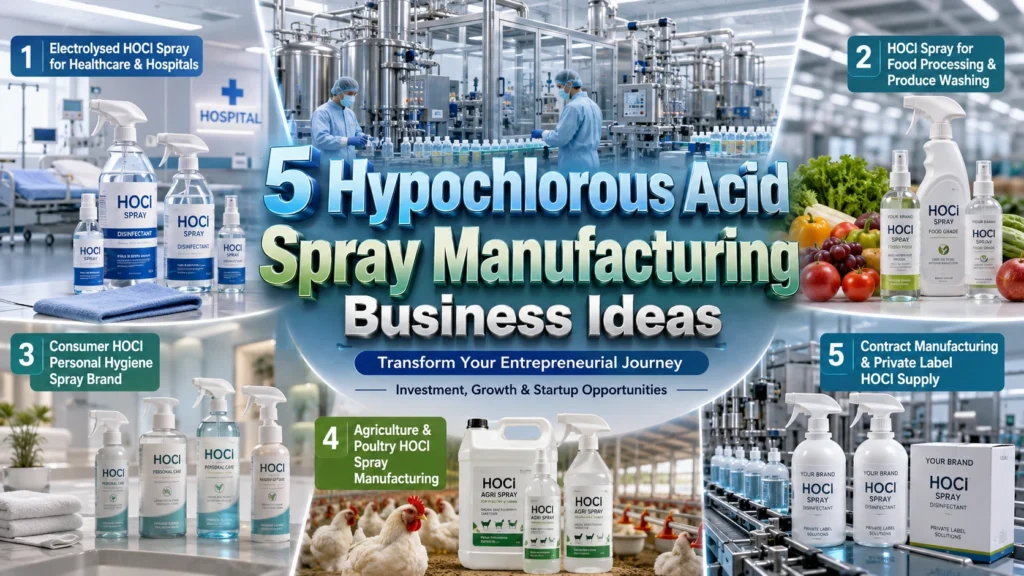
Hypochlorous Acid Spray Manufacturing Business The Indian disinfectant and antimicrobial market is undergoing a dramatic change. In the Chemical Processing business, one of the most promising ideas for entrepreneurs and MSME investors is hypochlorous acid (HOCl) spray manufacturing. Hypochlorous acid (HOCl) spray manufacturing is one of the most promising business ideas for entrepreneurs and MSME investors in the chemical processing industry. To gauge the manufacturing potential, Government support framework, trade dynamics and actionable business ideas in hypochlorous acid spray segment, this article delves into the matter in a detailed manner before the first-generation founders can invest. Hypochlorous acid spray is no longer a “scientific curiosity”. It has infiltrated the mainstream of health care, food processing, agriculture and consumer hygiene. It is a good opportunity for Indian entrepreneurs who are realizing its importance and the regulatory acceptance is growing. Why the Hypochlorous Acid Spray Industry Is Growing So Fast The need for non-toxic, broad-spectrum antimicrobial solutions has been rapidly growing worldwide over the last few years. Created by the electrolysis of salt and water, hypochlorous acid is a strong disinfectant with none of the corrosive or toxic properties associated with traditional chlorine-based disinfectants. This places it in an ideal position in several high growth verticals. Healthcare, food safety and agriculture sectors are all stepping up their hygiene measures in India. Increased demand is being placed on hospitals, food processing plants, poultry farms, and schools to use disinfectants that can be used safely for human exposure; that are biodegradable and that can kill bacteria, viruses and fungi. HOCl spray meets all these specifications. Market Drivers Supporting Rapid Growth The HOCl spray market is gaining momentum due to several strong market forces. The first is that more and more evidence is surfacing about growing microbe resistance to quaternary ammonium compound disinfectants, prompting institutional buyers – such as hospitals, hotel chains, airport authorities and others – to move away from these products. HOCl spray is a viable and scientifically proven alternative. Second, the food processing industry in India, as one of the world’s largest, requires multiple stages of disinfection in the surfaces and produce during the process of food manufacturing. The food-safe profile of HOCl spray and its approval by international food contact material norms are making it quickly popular in this segment. Third, the market of domestic animal care and veterinary hygiene is growing swiftly. In veterinary clinics in metros of Indian, HOCl spray has emerged as the preferred woundcare and sanitisation solution. Besides, there is a tremendous export potential as countries in the Middle East, Southeast Asia and Africa are actively importing the antimicrobial products from India. These export corridors are a good revenue diversification avenue for GMP and WHO-GMP manufacturers. Government Policies and Incentives Favouring HOCl Manufacturing The policy landscape in India is actively geared towards establishing chemical processing and disinfectant manufacturing MSMEs. There are several schemes providing direct monetary and operational benefits to start-up entrepreneurs in this space. MSME Udyam Registration and Credit Linked Capital Subsidy The Ministry of MSME launched the Credit Linked Capital Subsidy Scheme (CLCSS) to offer a capital subsidy of 15% in the initial stage for technology upgradation in small-scale manufacturing units, on the institutional credit. Electrochemical activation (ECA) manufacturing units are eligible for this scheme. This support is provided via MSME CLCSS portal (L1) for entrepreneurs. PLI and Chemical Sector Incentives via DPIIT The Department for Promotion of Industry and Internal Trade (DPIIT) has been working on strategies for the various sectors for chemical and pharmaceutical adjacent manufacturing. The Make in India promotion of manufacturing will help MSMEs in the disinfectant manufacturing segment. Make in India Chemicals Sector page (L2) contains relevant policy briefs. Startup India Recognition and Tax Benefits Private limited company/LLP based spray manufacturing startup can apply for Startup India recognition benefits such as exemption from income tax for 3 years, self-certification for labour and environmental laws and tenders eligibility to prioritise government tenders. The Startup India Government Schemes portal (L3) provides a single window access to programmes available. Further, the Production Linked Incentive (PLI) Scheme for bulk drugs and chemicals also indirectly benefits the disinfectant producers. Additionally, most state governments now have some sort of single window clearance system for chemical manufacturing enterprises; entrepreneurs should investigate this. 5 High-Potential Business Ideas in Hypochlorous Acid Spray Manufacturing Business Idea 1 — Electrolysed HOCl Spray for Healthcare and Hospital Supply A potential, highly profitable entry into the HOCl spray market is to product a concentrated or ready-to-use hypochlorous acid disinfectant spray specifically designed and packaged for use in a hospital, clinic or diagnostic center setting. Both private hospital chains and government hospitals in India are actively working on improving their surface disinfection practices in line with the guidelines laid down by National Accreditation Board for Hospitals (NABH) and Joint Commission International (JCI). A small scale ECA-based HOCl manufacturing unit can be set up by an entrepreneur to manufacture disinfectants in the spray format as per IS/ISO standards and can be sold to the institutional procurement departments. The business model is based on repeat orders, large supply contracts and somewhat inelastic demand: Hospitals disinfect every day, irrespective of the economy. Distribution can be done via pharmaceutical distributors, medical consumables suppliers or through their own sales team at the institution. This is a good manufacturing opportunity that has a defined and organized buyer population, and an attractive value proposition with respect to non-toxicity and surface safety. View Full Project Details: Healthcare and Medical Businesses Business Idea 2 — HOCl Spray for Food Processing and FSSAI-Compliant Produce Washing India’s food processing industry processes millions of tonnes of fresh produce, meat, seafood and dairy products annually. It’s essential to get validated disinfection of the surfaces and produce for all processing units to adhere with FSSAI guidelines. Spraying with hypochlorous acid, especially at concentration levels in between 50 ppm and 200 ppm, has been recognised worldwide as a food-contact safe sanitiser. This presents a tremendous under-served manufacturing opportunity. A start-up company might be able to manufacture food grade
8 High-Barrier Technical Manufacturing Business Ideas That Engineering Graduates Can Build Into Dominant Ventures

Technical Manufacturing Business Ideas India produces over 1.5 million engineering graduates every year. The majority of them become employed; either in IT or manufacturing companies or in the public sector. However, large numbers are taking advantage of their technical education and have started manufacturing enterprises which most non-engineers can’t easily duplicate. They are business ideas that have high barriers to entry. The barriers are not only monetary, they’re knowledge-based, precision-based, and technical. That’s what makes them worth. If a product has a niche customer base and only a few companies can enter the market, then the existing companies in the market will have a better price, higher profit and able to maintain a longer customer relationship. This is the time when engineering graduates in India can turn their degree into a business that creates sustainable competitive edge. Why Technical Manufacturing Is the Best Path for Engineering Graduates The Indian engineering graduate who is starting a technical manufacturing business has an in-built moat which others don’t have: Domain knowledge. Knowing metallurgy, polymer science, circuit design, chemical engineering or mechanical systems is not something a competitor can learn in a single day. Where the consequences of product failure are real, as in the manufacturing industry, buyers want suppliers they know are aware of the technical requirements of what they are manufacturing. That’s why engineering-based MSMEs providing automotive OEMs, defence, chemical companies and electronics manufacturers keep customers for years and decades. It is clear from the PLI scheme for Advanced Chemistry Cell batteries, the PLI for Electronics and White Goods as well as India’s semiconductor mission that the country’s industrial future is being built around technical manufacturing and that engineering graduates are best suited to do that. Government Support for Technical MSMEs The momentum of technical manufacturing in India has been created by the policy of government. Make in India Manufacturing sector initiative has been introduced to encourage manufacturing of defence, electronics, aerospace and advanced materials, which are all engineering-intensive. The DPIIT’s Production Linked Incentive schemes offer cash incentives to manufacturers in 14 sectors, such as the telecom sector, pharmaceuticals, textiles, and food processing, based on production targets, yielding substantial revenue uplift for small manufacturers. The Atal Innovation Mission’s ARISE programme explicitly supports research and innovation-based MSMEs (directly applicable for the technically differentiated products of engineering undergraduate entrepreneurs). According to Invest India’s data on sectors, Electronics system design and manufacturing is one of the top growing sectors attracting FDI — providing opportunities for downstream supply chain businesses for technically skilled MSMEs. The IBEF electronics sector report forecasting India’s electronics market to reach $300 billion, offers small technical manufacturers the opportunity to carve out significant spaces in this market. 8 Technical Manufacturing Business Ideas for Engineering Graduates 1. Precision CNC Machined Components Manufacturing CNC (Computer Numerical Control) is used to manufacture highly accurate automotive, aerospace, defence and industrial machinery parts. Manufacturing process transforms the digital design (CAD) into real metal/polymer part within micron tolerance. Mechanical and production engineers have a natural understanding of the programming, tooling, material selection and quality control necessary. A small CNC job shop, from just one or two machines, can provide components to local OEM, engineering workshops and export-oriented manufacturing businesses. This is a high barrier business, because it’s a precision business; buyers don’t work with suppliers who can’t maintain a consistent precision. That knowledge barrier excludes casual competitors and means that clients who find a reliable precision supplier are loyal customers for the long haul. 2. Industrial Automation and Control Panel Manufacturing The manufacturing ecosystem in India is advancing towards automation at a significantly rapid pace, owing to various factors including labour cost, quality standards and the need for Industry 4.0 from the multinational clients. Many factories in industries such as automotive, pharmaceuticals, food processing and chemical require control panels, SCADA systems, PLC-based automation solutions or custom control enclosures. A person who is an electrical/electronics engineer and knows programming PLCs (Siemens, Allen Bradley, Mitsubishi) can start a control panel fabrication and integration company. It’s a project business, that is, each order is tailored to the individual; premiums are charged to technically able manufacturers. Indian market for automation is expanding at more than 12% per year, and the Indian government’s electronics manufacturing initiative Make in India is being promoted by manufacturing of control systems in India. 3. Chemical Synthesis and Specialty Chemical Manufacturing The margins for specialty chemicals, such as pharmaceutical intermediates, agrochemical active ingredients, industrial process chemicals and surface treatment chemicals are significantly higher than those of commodity chemicals. But they must have an understanding of chemistry to produce safely and reliably. An engineering graduate trained in chemical engineering or applied chemistry can install a specialty chemical synthesis plant that produces chemicals for a particular product type, such as a pharmaceutical intermediate now in demand or a water treatment chemical that is a substitute for an imported product. The technical barrier is high – Regulatory compliance (CPCB, PESO, factory inspectorate), hazardous material handling and precise reaction control; skills that untrained operators cannot handle. This is the kind of expertise that is the barrier to unskilful competition at established small chemical businesses. Get Detailed Insights from This Book: The Complete Technology Book on Chemical Industries 4. Electronic PCB Assembly and Testing Printed Circuit Board (PCB) assembly for consumer electronics, industrial controls, medical devices and telecom equipment provides a high growth manufacturing segment. As India’s electronics manufacturing landscape grows rapidly, driven by the PLI scheme and the semiconductor mission, the need for secure local PCB assembly services is outpacing the supply. A surface mount technology (SMT) assembly line can be set up by an electronics engineer using automated pick-and-place machines, reflow soldering, automated optical inspection, and functional testing. This keeps the market away from generalist manufacturers, because of the technical expertise needed for component selection, soldering profile management, conformance to IPC standards and functional testing. Medical, defence, and industrial segments are specific clients that require clients to own and operate their assembly vendors. Get Detailed Project Report (DPR): Printed Circuit
How Salaried Professionals Can Build a Manufacturing Business Without Resigning — Real Business Ideas That Work
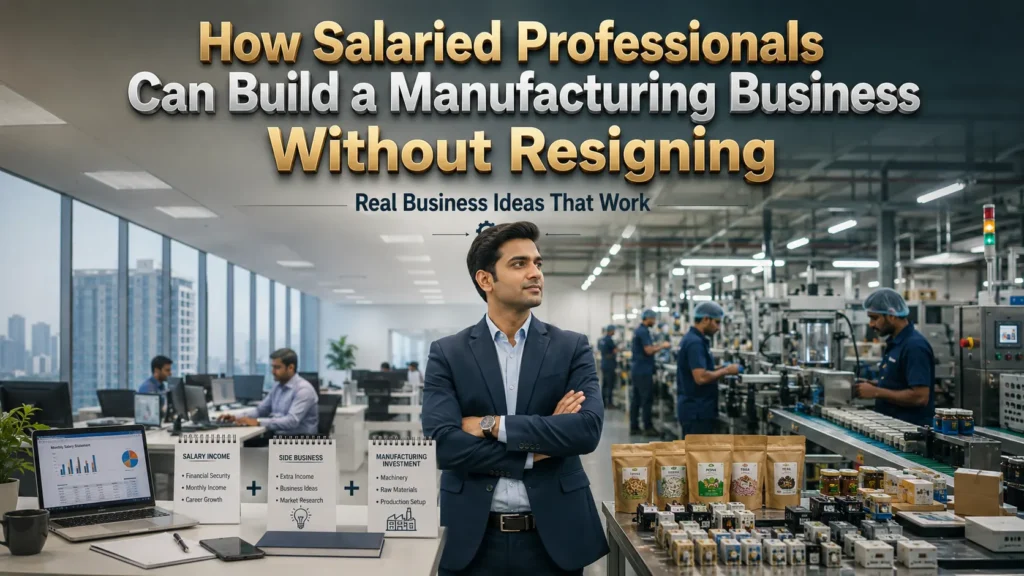
Manufacturing Business for Salaried Professionals Most salaried professionals think that they have to leave their jobs, gamble their money, and take a leap on their first day in business, to start a manufacturing enterprise. That’s incorrect. The Indian business landscape today is evolving and a lot of working people are pursuing a side business of making a profitable manufacturing venture without giving a single day a break from their jobs. Not side jobs that make pocket change. These are organized business concepts that can be developed into standalone businesses with the proper business models, management delegation and funding plan. In fact, there are a number of business models available that can work well in an absentee-owner business model (where the entrepreneur invests, manages, and runs, but is not in the business all day). Why Manufacturing Is Ideal for a Salaried Investor-Entrepreneur There are several significant differences between the business model of manufacturing and service. If the manufacturing unit is set up properly, then it can run without the owner with a supervisor and skilled workers, and there is an SOP for production. The owner’s responsibilities shift to the strategic ones: sourcing raw materials, connection to sales, quality control, and finance. These are activities that a salary earner can do during his/her leave, late nights or at weekends. Additionally, an employer who has founded his business during his working time has a financial buffer. The salary keeps on paying the personal needs of the entrepreneur and EMIs, and the business continues to grow with its earnings. Many businessmen who are successful in India as MSMEs have followed exactly the same model, especially in chemical, food processing, auto components, and packaging industries. Government Policies That Support Part-Time Entrepreneurs This permit is not required if the salaried employee is not in conflict with the terms of the employer (you may always need to check with HR or legal counsel) but can be required to run a manufacturing MSME. Support for setting up a new manufacturing enterprise is available to the owner, whether or not they are working elsewhere. The MSME Ministry’s Priority Sector Lending guidelines also provide for a specific percentage of banks’ loan portfolios that banks are required to put towards MSME business, giving credit to first-time manufacturing entrepreneurs. The CGTMSE scheme will offer collateral-free credit guarantee facilities to MSME loans, thereby eliminating the major challenge for the salaried professionals who might not have the property to offer as loan security. Employed persons can avail of the tax benefits and ease in regulatory compliances as the recognition of DPIIT’s Start-Up India is applicable even for the manufacturing start-ups. The IBEF MSME sector report validates the MSME sector’s systemic significance and the government’s long-term commitment to the growth of the same, such as being responsible for about 30% of GDP and 49% of exports. 7 Manufacturing Business Ideas Suited for Salaried Professionals 1. Plastic Injection Moulding Component Manufacturing Plastic injection moulding is an excellent business for the supervisor because once the machine and processes are set up, it is a high-precision high demand business. The business manufactures plastic parts for automotive, electronics, packaging and other consumer goods companies that demand dependable and consistent supply from small parts makers. An engineering or industrial professional who is paid can establish the moulding unit, recruit skilled machine operator and supervisor, and oversee orders, quality and procurement in a part-time capacity. The cash flow is predictable because repeat business from industrial clients makes up the “core” of the revenue. The PLI scheme for chemicals and petrochemicals and the automotive PLI creates downstream demand for plastic components across the supply chain. Get Detailed Project Report (DPR): Plastic Injection Moulding for Auto Parts 2. Chemical Blending and Specialty Products Manufacturing India’s chemical specialty industry is expanding at a fast pace due to import substitution, China plus one sourcing and the demand from domestic industries. There are many chemical blending and formulation companies that are manufacturing cleaning solutions, industrial lubricants, water treatment chemicals, construction chemicals or agro-chemicals that do not need to be operated on a 24/7 basis. After standardisation of formulation, manufacturing process is essentially repeatable by trained personnel with SOPs. Chemistry and chemical engineering professionals with a salary background are well suited to start a speciality chemical manufacturing company. It can be operated in a small rented building using a few employees, with production of an order, for industrial customers. Specialty chemicals have generally much wider margins than commodity chemicals, and switching costs for industrial buyers result in customer retention. Get Detailed Insights from This Book: The Complete Technology Book on Chemical Industries 3. Packaged Food Manufacturing Under Contract The contract production model in packaged food manufacturing enables an expert to create a food brand without operating a food factory. The model is as follows: the entrepreneur creates the product recipe, brand and packaging, while a licensed contract manufacturer (co-packer) manufactures the product, the entrepreneur concentrates on marketing and distribution of the product. There are a lot of small food brands in India working like this — sourcing production from an FSSAI-licensed plant and emphasizing on branding. With an increase in volumes, the entrepreneur can set up their own manufacturing unit. But if the professional is more interested in having the product in his or her own hands from the start, a small production unit for a single SKU (a specific snack, condiment or packaged ingredient) can be operated by a production supervisor who is employed. The food processing schemes registered under MSME gives capital subsidy for exactly this kind of model. Explore This Book: Food Packaging Technology Handbook 4. LED Lighting and Electronic Products Assembly The LED Lighting market has witnessed exponential growth in India due to the government’s UJALA scheme and the BEE standards that are promoting the transition from traditional lighting. There are a number of types of LED drivers, downlights, streetlights and panel lights which are produced during an assembly process and once standardised, these are engineered little if at all. With the