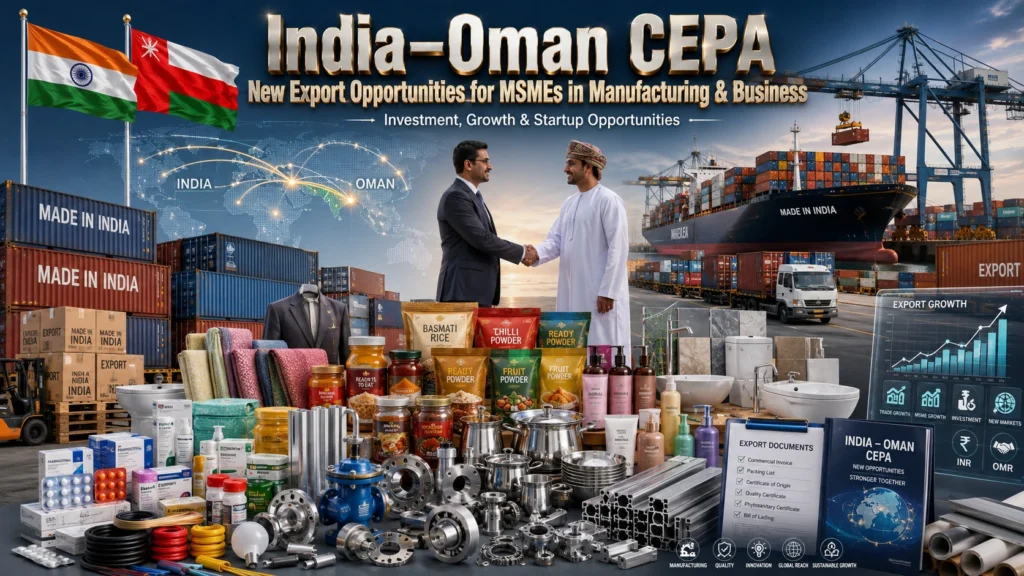

India Oman CEPA Export Opportunities
A Trade Agreement That Changes the Manufacturing Math
Trade pacts do not generally evoke excitement in the minds of MSMEs. Most of them are framed in bilateral diplomacy and not in terms of any practical business ideas for manufacturers/exporters on the ground. The India-Oman Comprehensive Economic Partnership Agreement (CEPA), however, is unique — and the difference is significant to anyone who operates or is considering a manufacturing unit in India.
The CEPA was signed by India and Oman in a strategic setting. Oman is located at the mouth of the Arabian Sea, part of the Gulf Cooperation Council (GCC) trade corridor and is actively diversifying its economy from hydrocarbons. This deal is a boon to Indian manufacturers and exporters, especially MSMEs as they gain access to a high-income and import-dependent market on preferential tariffs.
The timing coincides with India’s own desire to expand its exports of goods massively. This treaty is beneficial to several business sectors — processed foods, Pharma, Engineering Goods, Chemicals, Textiles and Handicrafts. In this article, we examine which sectors have the best export prospects for the MSMEs and what government initiatives can help magnify those benefits, and how Indian MSMEs can capitalise on the Oman corridor for long-term export success.
Why the India-Oman Trade Corridor Is Gaining Strategic Importance
Oman is not a big economy in the world. It is a strategic one, though. The country imports almost 80% of its food, most of its industrial raw materials and increasing amounts of its manufactured products. Such reliance leads to a permanent market for foreign suppliers. Traditionally, India has been a main source of imports for Oman, especially in the areas of Food Products, Textiles, Engineering Goods, and Construction Materials. The CEPA is an agreement that formalises and strengthens this relationship.
The CEPA between India and Oman encompasses thousands of product lines as per the Ministry of Commerce and Industry, Government of India. The biggest advantage for India’s exporting companies is the gradual removal of customs duties on a host of manufactured products. This directly helps the price competitiveness, the main problem of Indian SME exporters in the Gulf countries where Chinese and SE Asian competition is dominating the market.
Oman is also a re-export point to the wider GCC region outside of tariffs. A manufacturing company which develops a distribution chain up into Oman effectively places itself to distribute into Saudi Arabia, United Arab Emirates, Kuwait, Bahrain and Qatar. The corridor’s multiplier effect is the reason why the area is seriously considered by people monitoring business growth through exports.
Related Article: India-Oman CEPA: The Trade Gateway Every Indian Exporter Has Been Waiting For
Government Policies and Incentives Supporting MSME Exporters
India has put together an effective package to facilitate Indian manufacturers from entering the export markets. These schemes work better under the CEPA framework as the pricing difference at the destination is decreased through preferential tariffs. Below are the most relevant policies for MSME exporters for Oman:
MSME Export Promotion Schemes
Small manufacturers directly get financial relief from Interest Subvention Scheme, Credit Guarantee Fund Trust for Micro and Small Enterprises (CGTMSE) and the Ministry of MSME’s ZED (Zero Defect Zero Effect) Certification Programme. Export-oriented units (EOU) are supported in a way that is very advantageous for an MSME with collateral-free credit of ₹2 crore provided by the CGTMSE.
RoDTEP: Duty Refund for Exporters
The Remission of Duties and Taxes on Exported Products (RoDTEP) scheme is implemented by Directorate General of Foreign Trade (DGFT) that will refund embedded taxes that exporters are unable to claim elsewhere. RoDTEP provides a 1–4% extra margin on FOB value for manufacturing industries such as processed foods, pharma, engineering goods, etc. which are some of the best beneficiaries of RoDTEP. That is a minimal amount but on an annual export order worth of ₹5 crore it’s ₹ 5 – 20 lakh of direct savings.
ECGC and Export Credit
The Export Credit Guarantee Corporation of India (ECGC) offers a risk cover to exporters who have dealings with foreign buyers. ECGC coverage is highly beneficial for new MSME exporters, who are entering into the market of Oman, as it reduces the risk of non-payment. It is coupled with post-shipment credit lines by the partner banks, which makes it possible even for an exporter with a turnover of ₹1-5 crore. Learn more at ECGC.
PLI and Sector-Specific Incentives
The PLI Scheme applies to 14 sectors such as food processing, pharmaceuticals, textiles, advanced chemistry cells, specialty chemicals, etc. for larger manufacturing plays. The PLI offers incentives of up to 20% on incremental production to MSMEs. When PLI is combined with preferential access to CEPA, a strong cost competitiveness can be gained.
State-Level Export Incentives
There are a few incentives available for export-oriented manufacturers in several states of India. Both Invest Rajasthan and Gujarat Industrial Development Corporation (GIDC) provide subsidy on land, power and infrastructure for MSMEs establishing export units. There are also MSME export promotion policies for Tamil Nadu, Karnataka and Maharashtra. Entrepreneurs should check with various state industrial development corporations to determine the best mix of central and state incentives.
Manufacturing Business Ideas for MSMEs Under the India-Oman CEPA
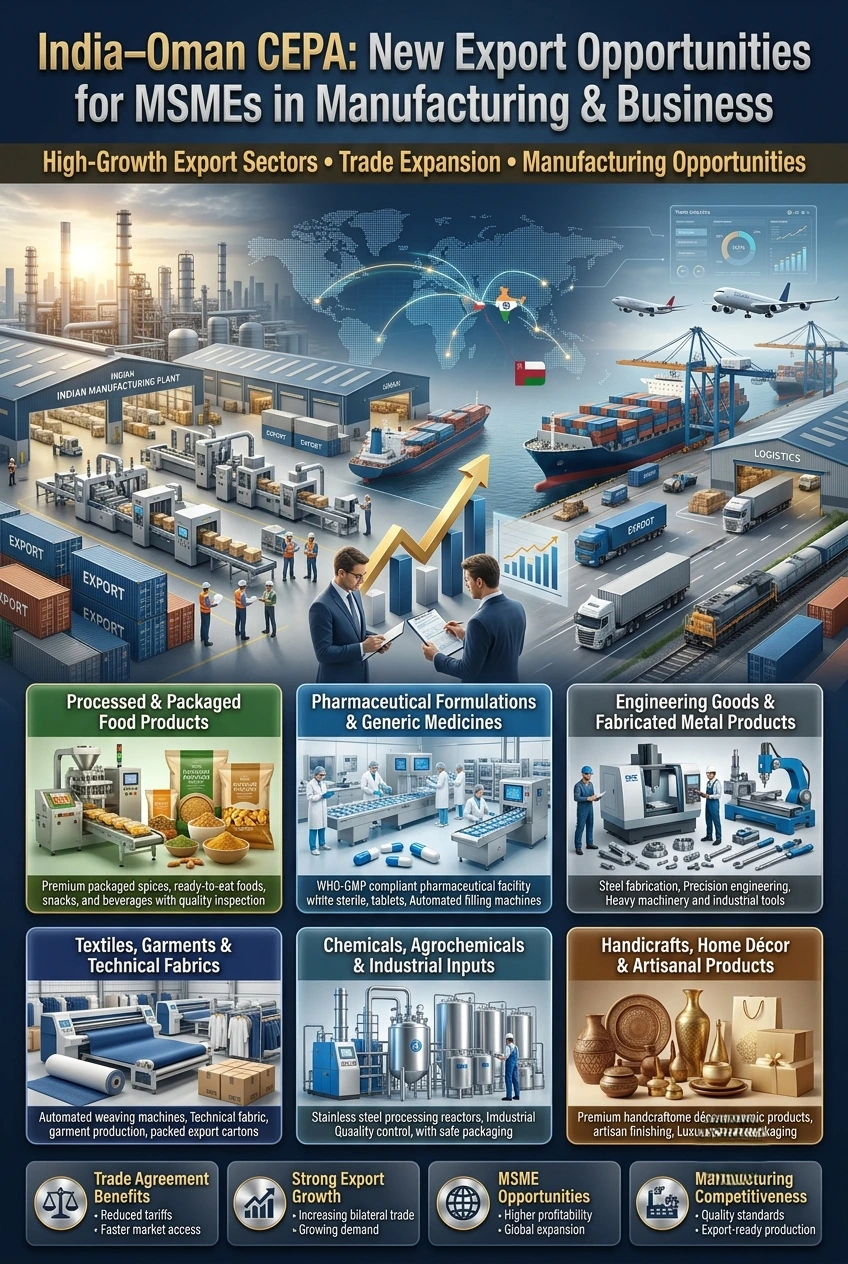
The CEPA brings concrete benefits to a number of manufacturing and export sectors. Specific business ideas are presented below that can be taken as action points by MSME entrepreneurs who wish to either start or expand their manufacturing businesses with the main export markets in Oman.
1. Processed and Packaged Food Products
Oman is a net importer of food. The tariff concession in CEPA can have substantial benefits for Indian processed food manufacturers, especially in the spices, ready-to-eat foods, cereal-based foods, pickles and packaged snacks sector. Lowering or removing import taxes on complete food products makes Indian food more competitive than those from Thailand, Malaysia and Turkey, which have traditionally held a commanding position on the shelves of the Gulf countries.
With an initial investment of about ₹50 lakh to ₹2 crore, an MSME entrepreneur setting up a food processing business based on BIS certified or FSSAI compliant packaging as per the food safety norms in Gulf countries can realistically achieve an export potential of ₹1 crore to ₹3 crore per annum with the period of stabilisation within 2–3 years. The main is to ensure uniformity of quality, labelling in Arabic language (GCC requirement), and ensure the reliable logistics chain through ports in Gujarat or Kerala. The Agricultural and Processed Food Products Export Development Authority (APEDA) assists food exporters with market development and also offers buyer-seller platforms.
Get Detailed Project Report (DPR): Processed & Packaged Food Manufacturing Guide
2. Pharmaceutical Formulations and Generic Medicines
Indian pharmaceutical industry is well known all over the world and Oman’s health care system heavily depends on imported medicines that are generic. The CEPA provides a streamlined process for the entry of Indian pharma manufacturers (including small-scale formulation units) into the Oman market with less tariff barrier. Oman’s Ministry of Health has an approved product list and manufacturers from India who have WHO-GMP certificate, ISA certificate or similar quality assurance certificates are well placed to be called for institutional procurement contracts.
A Pharma MSME with an investment of ₹1-5 crore in tablet / capsule / liquid formulation manufacturing can provide OTC medicines, generic medicines and nutritional supplements. The pharma export margin for the Gulf countries is significantly better than that of domestic sales and is in the top earning manufacturing basket in the CEPA framework. The length of the registration process in Oman usually takes anywhere from 12 to 18 months, so it’s crucial to plan ahead for any new entry.
Explore This Book: Drugs & Pharmaceutical Technology Handbook
3. Engineering Goods and Fabricated Metal Products
Oman is putting significant investments into industrial infrastructure and logistics parks, as well as urban development initiatives to support its Vision 2040 programme. This ensures a steady demand for structural steel components, industrial fasteners, pressure vessels, pipes and fittings, and construction hardware. Indian engineering MSMEs can cater to this demand in CEPA-supported preferential access, especially those located in the cluster areas of Rajkot, Ludhiana, Coimbatore and Pune.
The export potentials of a fabricated metal products unit of capacity in tune with the country’s infrastructure procurement plan is significant. Lower production cost, availability of skilled manpower, and the recently lowered tariff rates under CEPA are the Indian manufacturers were favoured. An investment ranging from ₹75 lakh to ₹3 crore in CNC machining, press tools or welding fabrication; and quality certifications like ISO 9001, are good starting points for entrepreneurs who are planning to set up an engineering goods unit. The Engineering Export Promotion Council of India (EEPC) will be able to help you identify your buyers and guide you through the compliance process.
4. Textiles, Garments, and Technical Fabrics
The Gulf apparel market is huge and highly fragmented. Oman’s population along with a large expatriate community demands a variety of garments that range from work wear to uniforms to ethnic wear and top-quality textiles. Clusters in Tiruppur, Surat, Panipat and Bhiwandi are in a better position to cater to this market.
CEPA treats textiles favourite, thereby mitigating the preferences that Indian manufacturers get when compared to Bangladesh and Vietnam’s own preferences under the region’s trade agreements. Investment in a garment/ fabric manufacturing unit to serve the work wear, home fabric or ethnic wear segment in Oman & other GCC countries can be between ₹40 lakh to ₹2 crore. The secret to success is consistency of the delivery dates and quality compliance; Omani importers are well-experienced buyers who prefer reliability over price.
Get Detailed Insights from This Book: The Complete Technology Book on Textile Spinning, Weaving, Finishing and Printing
5. Chemicals, Agrochemicals, and Industrial Inputs
Oman’s agriculture industry, although small, is dependent on agrochemicals and fertilisers from abroad. Industry brings in cleaning chemicals, paints and coatings, adhesives, sealants and specialty chemicals. This market is available at a reduced tariff cost under CEPA to Indian chemical manufacturers; including well established chemical clusters in Gujarat and Maharashtra.
The investment required for an MSME starting agrochemical formulation or specialty chemical blending ranges from ₹80 lakh to ₹4 crore. The main compliance criterion is conforming to the import requirements of the Oman chemical authority and for agrochemicals, conforming to the requirements of the Ministry of Agriculture of Oman. Frictions in getting into the market are reduced when working with an established local distributor in Muscat.
Check Out This Recommended Book: Agrochemicals Manufacturing Technology Book
6. Handicrafts, Home Decor, and Artisanal Products
Oman boasts a robust tourism industry, and a culture that’s very aware of the need for hand-crafted items, decorative pieces and artisanal household items. The CEPA preference allows Indian handicraft MSMEs, especially those registered with the Export Promotion Council for Handicrafts (EPCH), access to a market that appreciates authenticity and aesthetic appeal.
The export of handicrafts to Oman under the CEPA scheme offers a genuine price advantage for the entrepreneur in states such as Rajasthan, Uttar Pradesh and West Bengal where the manufacturing of handicrafts is very strong. The typical investment for a structured handicraft export unit is ₹15–50 lakh. Margins to Gulf markets for handcrafted goods are often very high (150–300% above domestic wholesale prices).
Import-Export Opportunity Analysis: What the Trade Data Tells Us
Indo-Oman trade relations are already very well developed. India is always present in the list of the top trading partners of Oman. The CEPA is intended to enhance this relationship and, for manufacturers, there are tangible commercial benefits.
India’s exports to Oman have been increasing in several categories. The most robust export markets are for petroleum products, precious metals, machinery, food products and base metals. But under CEPA, the non-petroleum manufacturing sectors are the main winners – as the petroleum sector already operates under other frameworks.
India imports mainly from Oman in the areas of petroleum, fertilisers, polyolefins and increasing number of petrochemical derivatives. These imports from the UAE are also opportunities for MSMEs as raw materials, including in the plastics processing, polymer compounding and fertiliser blending industries.
Indian businesses have active trade facilitation desks with both the India-Arab Chamber of Commerce and the Oman Chamber of Commerce and Industry. These are avenues for MSMEs to get entry into buyers, market information and regulatory support to commit to export infrastructure.
One such unexplored opportunity is triangular trade whereby Indian manufacturers export semi-finished goods to Oman, where they are converted into finished goods and re-exported to other GCC nations. Oman’s free trade zones, such as Sohar Port and Freezone, support this model. A company from India can export components or sub-assemblies to an Oman-based company without any presence in each market of the GCC.
Choose the right startup backed by real market demand
Indian MSME Leaders Who Built Export Businesses: Lessons for New Entrants
Prabha Engineering: Precision Components to the Gulf
Prabha Engineering Works, Rajkot, Gujarat is a small, precision machine shop that started out as providing auto-component buyers in the local market with precision machined parts. The founders, a family of first-generation entrepreneurs, made a conscious choice to shift focus to export markets when competition in the domestic market increased. The company expanded its export turnover to a major proportion of its business within five years of ISO 9001 certification and developing business relationships with an Oman based industrial supplier. The lesson is simple: quality certification is the key that pricing is not.
Synthite Industries: From Kerala Spices to Global Shelves
Synthite Industries is one of the biggest spice extract and oleoresin manufacturers in India and is based in Kerala. Led by T.V. Thomas and his family and professional management team, Synthite turned a domestic spice trading business into a global processing and export powerhouse. Synthite’s processed spice products are also sent to the Gulf markets such as Oman. Their model shows what a consistent quality investment, backward integration with the farming community and export market discipline can achieve for a food processing MSME that grows purposefully.
Nikhil Adhesives: Chemical Manufacturing for Export
Nikhil Adhesives Limited, a mid-sized chemical company of Maharashtra, has established a reputable brand name in the export market of the gulf countries by assuring the customers with consistent quality and competitive pricing. The company is exporting Construction chemicals, Adhesives and Sealants products to several countries in the Middle East region. Their strategies (developing technical documentation, meeting Gulf import requirements and having a dedicated export team) create a model that can be replicated by MSME chemical manufacturers wanting to enter or grow in Oman through CEPA.
Professional Feasibility Consulting: How NPCS Supports Export-Oriented Manufacturers
Establishing an export manufacturing unit demands more than product knowledge, especially when it comes to exporting to Oman or any other market in the Gulf. It needs to be well planned in terms of finance, regulatory, technology, and demand. That is where professional consulting comes in and can make the difference between a well-designed project and one that has unnecessary capital and compliance issues.
Niir Project Consultancy Services (NPCS) prepares detailed Market Survey cum Techno-Economic Feasibility Reports (DPRs) for MSMEs and entrepreneurs which want to establish new manufacturing units. We provide detailed reports covering the entire project planning process – from the selection of manufacturing process and its flow diagram, raw material details, machinery details, plant layout, capacity planning, product mix strategy, complete financial projections which includes capital cost, working capital, income forecast, profitability analysis, break-even calculation, ROI calculation etc.
Our DPRs include export pricing analysis, international compliance factors and market demand evaluation, for businesses aiming at export markets such as Oman under the CEPA. A feasibility report outlines the potential of a project before a decision is made on the investment. It is used for various kinds of projects including a food processing unit, a chemical plant, an engineering goods plant, and a pharmaceutical formulation unit and is essential for making informed investment decisions.
NPCS, with more than 30 years of consulting experience, with over 150,000 project reports delivered, with clients across 85 countries, has the depth of market knowledge and financial modelling rigour that entrepreneurial manufacturers need at the project evaluation stage.
Key Export Sectors Under India-Oman CEPA: At a Glance
| Manufacturing Sector | Investment Range (₹) | Key Oman Demand Driver | CEPA Benefit | Target Margin |
| Processed Foods | ₹50L – ₹2Cr | High food import dependency | Duty elimination / reduction | 18–30% |
| Pharma Formulations | ₹1Cr – ₹5Cr | Healthcare demand, generic medicines | Preferential tariff access | 25–45% |
| Engineering Goods | ₹75L – ₹3Cr | Infrastructure & Vision 2040 | Tariff concessions on metal goods | 15–25% |
| Textiles & Garments | ₹40L – ₹2Cr | Large expatriate population | Duty reduction vs. competitors | 20–35% |
| Specialty Chemicals | ₹80L – ₹4Cr | Industrial inputs, agriculture | Tariff preference over competitors | 18–28% |
| Handicrafts & Home Décor | ₹15L – ₹50L | Tourism, cultural consumer base | Zero or near-zero duty | 150–300% over wholesale |
Frequently Asked Questions (FAQ)
1. What is India-Oman CEPA and its benefits for MSMEs?
The India-Oman Comprehensive Economic Partnership Agreement is an India-Oman bilateral trade agreement that gives preferential tariff treatment to the goods traded between the two countries. It translates to reduced or elimination of customs duty on a variety of manufactured items sent to Oman for Indian MSMEs, directly impacting price competitiveness with other suppliers.
2. What are the most advantageous sectors for the Indian manufacturing industry to take advantage of the India-Oman CEPA?
The most important beneficiary sectors are processed foods, pharmaceutical formulations, engineering goods and fabricated metals, textiles and garments, specialty chemicals, and handicrafts. These are aligned with the high import dependency in Oman and Oman’s Economic diversification programme, Vision 2040.
3. Is there any special certification required for MSME to export under CEPA?
Exporters are required to get a Certificate of Origin (COO) which provides a confirmation that the goods are manufactured in India to avail preferential benefits under CEPA at Oman customs. It is issued by the designated agencies like DGFT or export promotion councils. Often there are product specific certifications like FSSAI for food products, WHO-GMP for pharmaceutical products, ISO for engineering goods that are also required for market acceptance.
4. Given below are the government schemes that support MSME exporters for targeting Oman.
Important schemes are RoDTEP (refund of embedded taxes), CGTMSE (collateral free credit), Interest Subvention Scheme (IS), interest subvention for MSMEs, export credit risk cover (ECGC), support for market development (PLI Scheme), export promotion (EEPC/EPCH) for various sectors. There are export-oriented manufacturing units for which several state governments provide extra subsidies.
5. Where can I get buyers for my manufactured products in Oman?
The most feasible avenues include: Buyer Seller Meetings organised by the Export Promotion Councils (APEDA, EEPC, EPCH); Business introduction by the India-Arab Chamber of Commerce; Trade Missions to Oman (Oman International Trade Fair); and Digital communication through the B2B platforms. For new exporters, it can be the quickest to market to have a local Oman-based distributor or agent.
6. Should 6060 be seen as a stand out market or a stepping stone to the broader GCC?
Oman’s a direct market and a strategic gateway. Indian manufacturers can process or consolidate goods in the free zones, especially the Sohar Port & Freezone, for re-export to the rest of the GCC region (Saudi Arabia, UAE, Kuwait, Bahrain, Qatar). This gives the opportunity for MSMEs with ambitions to expand their businesses to the GCC region, and those who want to get started in a smaller, more manageable market, to enter Oman.
Conclusion: The CEPA Window Is Open — Act With Precision
Trade agreements create windows of opportunity. The India-Oman CEPA opens a meaningful window for Indian manufacturers — particularly MSMEs — to access a well-developed, import-reliant Gulf market with structural price advantages.
However, opportunity without preparation produces poor results. The manufacturers who gain most from CEPA will be those who enter with a clear product strategy, quality certifications aligned with Oman’s import requirements, a reliable logistics and distribution chain, and sound financial planning that accounts for export working capital and currency exposure.
The combination of central government incentive schemes (RoDTEP, CGTMSE, PLI), CEPA preferential tariffs, and state-level MSME export subsidies creates a genuinely supportive environment for first-generation and growth-stage exporters. Business ideas that seemed borderline viable for Gulf exports may now be clearly viable once preferential tariff arithmetic is applied.
For MSMEs at the planning stage, the most important immediate step is a rigorous techno-economic feasibility assessment — one that integrates export pricing, regulatory compliance costs, working capital requirements, and realistic revenue ramp-up timelines. That is what separates successful export manufacturers from those who enter impulsively and retreat.
The Oman corridor, backed by CEPA, is one of the more credible near-term export opportunities for Indian manufacturing businesses. The question is not whether the opportunity exists. The question is which manufacturers will prepare well enough to capture it.