
Source: Ministry of Commerce & Industry, Government of India | Press Information Bureau
India Oman CEPA export opportunity MSME
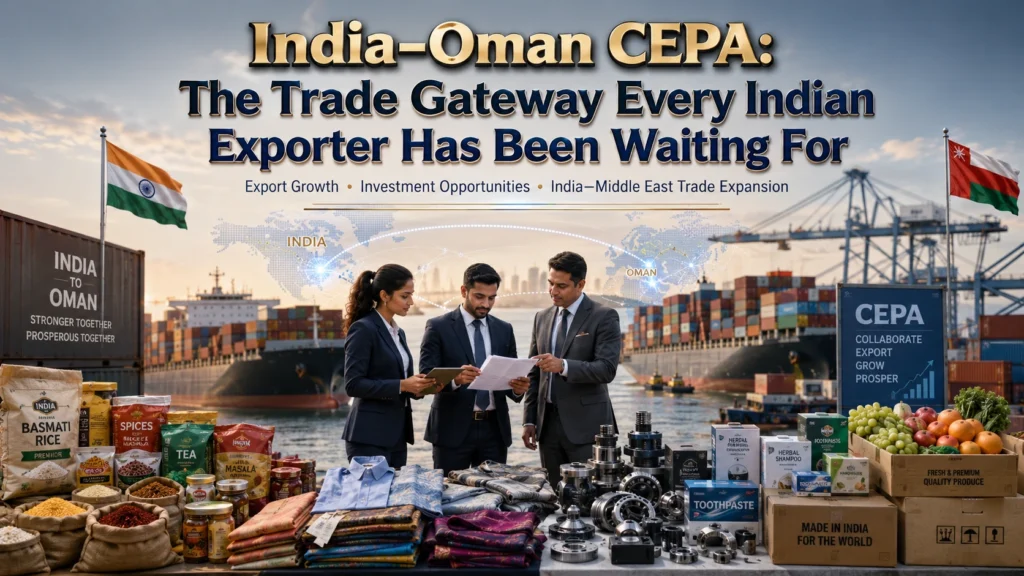
Until June 1st this year, there was a quiet competition between Italian jewellers, Thai seafood processors and Chinese engineering exporters for a share in the USD 28 billion import market in Oman; a market which had been dominated by Indian players. Until June 1st this year, outsiders — Italian jewellers, Thai seafood processors and Chinese engineering exporters — enjoyed a quiet lead in the USD 28 billion import market in Oman, which was dominated by Indian players. They both had the same 5% tariff. So did the Indians! This balance is now out of equilibrium. Under the new norms of India-Oman CEPA, 99.38% of India’s exports are being duty-free. Not next quarter. Today.
Imagine the implications for a textile exporter in Surat, a seafood processor in Andhra Pradesh or a pharmaceutical manufacturer in Ahmedabad. From Italy, Turkey, Thailand and China, each competitor is now at a structural disadvantage in Oman because of the tariffs they still have to pay.
India and Oman have also signed an all-embracing bilateral trade pact, a first for a country after the USA. This exclusivity is what creates a time-sensitive window. MSMEs and Industrial Units that are first in the queue, getting Compliant, Export Ready and connected to Oman’s Ports will grab their market share before it is too late.
Oman is not a far-remote destination in the Gulf. It provides access to the broad market of the rest of the GCC and East Africa via hubs in Sohar, Duqm and Salalah. Three ports that link South Asia with some of the world’s fastest growing consumer markets.
View Full Project Details: Investment Opportunities and Business Ideas in Oman (Middle East)
The Gap That Has Held Indian Exporters Back
Bilateral trade between India and Oman was worth USD 11.18 billion during the previous financial year as compared with USD 10.61 billion during the previous year. Impressive on paper. However, when looking carefully at sector level data, the difference is stark.
Bring gems and jewellery. Oman’s total imported market for this is USD 1.07 billion per year. India’s current share? Just USD 25.78 million, less than 2.5%. The clusters, which are key suppliers of polished diamond and gold jewellery export to the world, are excluded from the market which is sitting on India’s doorsteps, as the Italian, Turkish and Thai competitors are also paying the same import duty of five per cent as the Indian exporters.
Marine products tell an even more clear-cut story. Oman imported USD 35.3 million in seafood and India, despite being home to some of the biggest clusters of shrimp and fish processing in the world in Andhra Pradesh, Kerala, Tamil Nadu and Gujarat, had only imported USD 10 million of seafood. A 5% import duty on shrimp and cuttlefish was sufficient to kill the exporters’ business, operating on slim margins.
Oman’s import market is worth USD 302.84 million and expanding at 6.6% CAGR in the pharmaceutical sector. Approvement delays, duplicate inspections and regulatory bumps delayed Indian generic drug makers from gaining market access and took months to approve. The USFDA, EMA or UK MHRA approved products now receive marketing authorization in Oman within 90 days. The acceleration is not just a minor bureaucratic adjustment but a structural change.
In the previous financial year, India exported USD 875.83 million of engineering goods to Oman, such as machinery, electrical products, automobiles, iron and steel. The actual “total addressable market” is much bigger. The imports of electronics are only USD 1.7 billion in Oman, whereas India claims only USD 146 million.
Source: Ministry of Commerce & Industry, Press Information Bureau | APEDA Export Statistics
TABLE 1: Sector-wise Export Opportunity Under India-Oman CEPA
| Sector | India’s Current Exports to Oman | Oman Market Size | Duty Before CEPA | CEPA Duty Status |
| Gems & Jewellery | USD 25.78 mn | USD 1.07 bn | Up to 5% | Zero (Day 1) |
| Marine Products | USD 10 mn | USD 35.3 mn | Up to 5% | Zero (Day 1) |
| Agriculture & Processed Food | USD 552.85 mn | ~USD 3.1 bn share | Varies | Eliminated |
| Pharmaceuticals | Growing | USD 302.84 mn | Varies | Zero (binding) |
| Engineering Goods | USD 875.83 mn | USD 1.7 bn (electronics alone) | 0-5% | Zero |
| Textiles & Footwear | Significant | Large | Varies | Eliminated |
| IT & Professional Services | USD 863 mn (bilateral services) | USD 12.52 bn (Oman global) | Various barriers | 127 sub-sectors opened |
Source: PIB Press Release, Ministry of Commerce & Industry, Government of India
Why This Is the Right Moment to Move
There are various forces in play at this moment and an alert MSME operator shouldn’t underestimate any of them.
The duty removal is immediate, that’s the first. As of June 1st, the day the agreement entered into force, all concessions with a zero duty rate were to be implemented. There is no phased schedule, no waiting period, no transitional clause for the 99.38% of export lines covered. Exporters who ship now reap rewards now.
Second, the NTBs have been addressed head on. Oman will now accept mandatorily, at its ports, Indian certificates from the Export Inspection Council (EIC) eliminating any duplicate testing. Both NPOP Organic and halal certification is recognised in India. This eliminates months of compliance hassles at the border for food processors, agri-exporters and organic product producers.
Third, the services and professional mobility provisions open up doors which pure goods exporters do not often reach. Oman has offered 127 services sub-sectors, the most comprehensive offer to India by any GCC country. Oman has now provided legally binding certainty for IT professionals, engineers, doctors, architects and educators.
Independent professionals have a time limit of up to 180 days. The Intra-Corporate Transferees are allowed to remain for a period of up to four years. Almost 6000 joint ventures between India and Oman are directly affected.
There are various support mechanism provided by the government that can be utilized by the MSME manufacturers for export market. Production Linked Incentive (PLI) offers 4-6% incentive on incremental sales for sectors that are directly linked to sectors that are top CEPA beneficiaries, such as pharmaceuticals, food processing and electronics. APEDA offers grants for agri-exporters to upgrade packaging, develop cold chain and for certification.
The Interest Equalisation Scheme is available for export credit at a rate of 2-3% interest subvention from the scheduled banks. CGTMSE offers collateral free credit guarantee of up to Rs 5 crore to MSMEs getting working capital for availing export orders.
Key References: DGFT – Foreign Trade Policy | APEDA – Agricultural & Processed Food Exports | MSME Ministry – Schemes
Get Detailed Insights from This Book: Just For Starters: How To Start Your Own Export Business
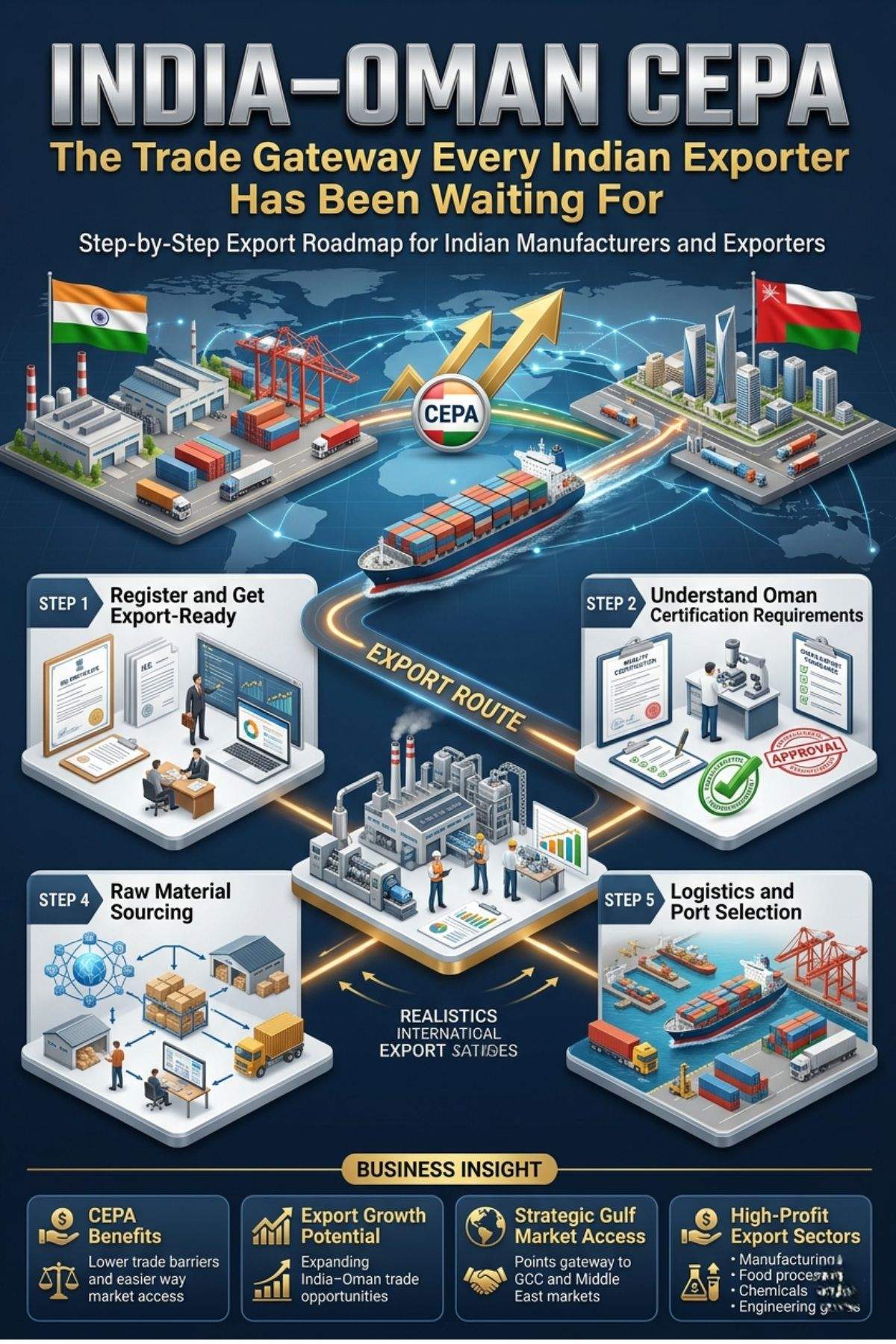
How to Position Your Unit for Oman Exports: Step-by-Step
Step 1 – Register and Get Export-Ready
Begin with MSME Ministry (online, free, within a day) Udyam Registration. Enlist its services with IEC (Importer-Exporter Code) issued by DGFT, which is required for any export operation, for Rs 500/-. For any relevant RoDTEP/Export incentive claims, register on the DGFT portal.
Step 2 – Understand Which Certifications Oman Requires
There are different import needs across sectors in Oman. At least food and agri-products require to be certified by FSSAI. While the Gulf market is commercially vital for the certification of certain foods, one can avail this certificate from organizations such as Jamiat Ulama-i-Hind or Halal India.
Exporters of marine products must be registered with EIC. As of now, Oman accepts EIC certificates under the CEPA as mandatory, which saved a considerable amount of time. WHO-GMP certification is required for the pharmaceutical exporters. Products already approved by USFDA, EMA, UK MHRA or TGA receive accelerated clearance for a 90-day approval in Oman.
Step 3 – Production Setup and Investment
The minimum investment amounts are different from one sector to another. For a small-scale agri-processing or food export unit, the total capital outlay for setting up may be Rs 42-50 lakh which includes the cost of machines, workspace, raw material buffer and certification fees.
The cost of mid scale pharmaceutical or engineering goods unit will be Rs 1.5-3.7 crore. The space requirement is 1000-3000 sq ft for the small processing units and 5000-15000 sq ft for medium scale manufacturing solutions. Industrial estates are available in Gujarat, Maharashtra, Andhra Pradesh, Tamil Nadu and Rajasthan with plug in units available at subsidised rentals.
Step 4 – Raw Material Sourcing
Find raw material clusters that are near your manufacturing location. Fisheries: Visakhapatnam, Kochi, Surat. The gems are made in Surat (diamonds) and Jaipur (coloured stones). Agri-inputs: Punjab, Haryana, UP (basmati, soybean), Maharashtra (cashews, mangoes). Pharmaceuticals: Hyderabad API clusters, Ahmedabad API clusters, Mumbai API clusters. BTEC: A Level.
Step 5 – Logistics and Port Selection
Oman has three strategic ports. The town of Sohar is located near the industrial region surrounding the Gulf hubs. Duqm is a special economic zone and gateway to East Africa. Salalah is a transhipment point. All three provide multiple entry options for Indian exporters.
JNPT, Mumbai, Chennai and Vishakhapatnam, India, process most of the cargo for onward shipment to Oman. FREIGHT TIME: 7-12 days. Perishables like seafood, mangoes and eggs require pre-booking with reefer container operators for cold chain freight.
Timeline from Registration to First Shipment
Month 2: Market research, identification of buyers, and development of a business plan. Month 3: Registration of the new business and of the Udyam. Month 4: Identification of the market and the buyers. Months 2-3: Production Set up, Application for Certification. As of month 4-5: Trial production, packaging compliance and first sample shipment. Month 6: CEPA preferential documentary commercial shipment.
Team Size to Start
Minimum staffing for a lean export-oriented unit is 8-12 staffs, 1 production manager, 4-6 skilled workers, 1 quality/compliance officer, 1 logistics coordinator and 1 sales/export documentation executive.
TABLE 2: Estimated Investment Breakdown for an Export-Oriented MSME Unit (Oman-Focused)
| Cost Head | Small Unit (INR) | Medium Unit (INR) | Remarks |
| Factory / Workspace | Rs 8-15 lakh (leased) | Rs 25-50 lakh (owned/leased) | State-specific, industrial estate preferred |
| Machinery & Equipment | Rs 15-35 lakh | Rs 50-1.5 cr | Depends on product category |
| Raw Material (3 months working capital) | Rs 10-20 lakh | Rs 30-75 lakh | Build 90-day buffer for export orders |
| Export Compliance & Certification | Rs 1.5-3 lakh | Rs 3-6 lakh | EIC, APEDA, FSSAI, BIS as applicable |
| Packaging & Labelling (export-grade) | Rs 2-4 lakh | Rs 6-12 lakh | Halal, NPOP as required |
| Logistics & Freight (first shipment) | Rs 1-2.5 lakh | Rs 3-7 lakh | Sohar/Duqm ports preferred |
| Misc / Contingency (10%) | Rs 4-8 lakh | Rs 12-25 lakh | Always keep buffer |
| TOTAL ESTIMATED CAPEX | Rs 42-88 lakh | Rs 1.3-3.7 cr |
Estimates are indicative and vary by sector, state, and scale. All figures in INR.
Identify high-growth industries before others do
Financial Snapshot: What the Numbers Look Like
The following approach is recommended for a small agri-processing or marine products unit who focuses on Oman:
- Capital expenditure ranges from Rs 42-88 lakh (small unit) and Rs 1.3-3.7 crore (medium unit)
- Monthly operating cost: Rs 18-35 lakhs (for medium) and Rs 6-12 lakhs (for small)
- Revenue at 60% capacity: Rs 22-30 lakh/month (small); Rs 65-90 lakh/month (medium)
- Revenue at 100% capacity: Rs 35-50 lakh/month (small); Rs 1.1-1.5 crore/month (medium)
- Gross margin: 22 to 30% for food processing, 28 to 40% for gems & jewellery, 35 to 50% for pharma generics
- Net margin after all costs: 12-18% in food/marine segment; 18-28% in pharma segment; 20-35% in jewellery segment
- Payback period: 3-5 years (food processing); 2-4 years (gems, pharma)
By duty elimination the Indian exporters will get direct price advantage of 3-5% at the Port of Entry. That translates to competitive headroom of USD 3,000-5,000 per shipment for a USD 100,000 price per shipment. It means either higher margins or lower quotes that result in winning the contract.
Engineering goods and electronics are more competitive, margins are 10-15% net and orders are larger. The PLI framework offers extra incentive on increment of exports to the eligible sectors which is 4-6%.
Data Reference: FIEO – Federation of Indian Export Organisations | EEPC India – Engineering Exports Promotion Council
TABLE 3: Key Government Schemes for MSME Export Units – CEPA-Aligned Sectors
| Scheme | Nodal Agency | Key Benefit | Who Should Apply |
| PMEGP | KVIC / MSME Ministry | Subsidy 15-35% of project cost (up to Rs 25 lakh) | First-gen entrepreneurs, rural units |
| Production Linked Incentive (PLI) | Respective Ministry | 4-6% incentive on incremental sales | Pharma, electronics, food processing exporters |
| CGTMSE | SIDBI / MSME Ministry | Collateral-free credit up to Rs 5 cr | MSMEs needing working capital for export orders |
| MEIS / RoDTEP | DGFT | Duty drawback/remission on export inputs | All goods exporters |
| ASIDE / Market Development Assistance | Ministry of Commerce | Partial reimbursement for export promotion | MSMEs entering new export markets |
| APEDA Export Development | APEDA | Grants for certification, cold chain, packaging | Agri-processors, food exporters |
| Interest Equalisation Scheme | RBI / Banks | 2-3% interest subvention on export credit | MSME exporters across all sectors |
Source: MSME Ministry, DGFT, APEDA, RBI. Eligibility criteria apply. Figures and scheme details subject to annual revision.
Related Article: 7 Profitable MSME Manufacturing Business Ideas in India (₹25 Lakh to ₹3 Crore Investment)
Entrepreneur Spotlight
Ravi Kumar, Andhra Pradesh – Marine Export Pioneer
Ravi Kumar, a first-generation entrepreneur from Nellore, Andhra Pradesh is running a shrimp processing unit with Rs 55 lakh investment and is catering for the Middle East buyers. In 5 years, exports went past Rs 4.5 crore. His rule of thumb: “Register your EIC and complete your halal certification from the beginning! No gulf buyers will do business without them. Now, with the duty removed under CEPA, his per container profit has risen by about Rs 1.8 lakh on the regular orders of frozen shrimps to Muscat. Now, he is thinking about expanding his business by building another floor.
Project Planning Support for Entrepreneurs
NIIR Project Consultancy Services (NPCS) is a practical first step for entrepreneurs that wish to do more than just to wait and see what happens but instead look to make the project happen despite a lack of internal capabilities in DPR preparation, plant layouts, techno-economic feasibility and compliance roadmaps. NPCS is a market research, feasibility and project report preparation firm based out of New Delhi, with decades of experience in the manufacturing industry, having customized their services for MSME level operations.
The units covered are export-oriented food processing, pharmaceuticals, engineering and agro-processing units. The reports include estimates of capital cost, procurement of machinery, regulatory approvals, and financial projections to suit Indian conditions. A list of resources and reports can be found at niir.org and entrepreneurindia.co.
What You Should Do in the Next 30 Days
The tariff benefit is alive. The longer you delay, the longer a competitor will be able to price to your Oman customer more favorably. There are no moving parts but the pace is urgent.
Choose the category in which you are already a manufacturer (seafood, basmati, cashew processing, polished diamond, pharma generic, engineering components). Obtain the IEC code from DGFT (costs Rs 500, gets approved online in 2-3 days). Contact APEDA or EIC to obtain export certification specific to your industry. Trace three Omani importers through Oman Chamber of Commerce and Industry, or through India-Arab Chamber of Commerce.
Oman Chamber of Commerce & Industry: www.chamberoman.om | India-Arab Chamber: www.indoarabchamber.com
First movers are already on the way. From June 1, consignments of agri products and gems moved out from Mumbai, Kolkata and Chennai at preferential CEPA rates. In Muscat, the buyer is already comparing prices. If you are still busy doing your homework as to when to begin, a competitor has already started quoting. Select your sector, get your IEC application, and schedule your buyer meet within the month.
Key Reference Links Embedded in Article
- PIB – India-Oman CEPA Official Press Release: pib.gov.in
- DGFT – Foreign Trade Policy & IEC: dgft.gov.in
- APEDA – Agri Export Statistics & Certification: apeda.gov.in
- MSME Ministry – Schemes & Udyam Registration: msme.gov.in
- FIEO – Federation of Indian Export Organisations: fieo.org
- EEPC India – Engineering Exports Promotion Council: eepcindia.org
- Oman Chamber of Commerce & Industry: chamberoman.om
Frequently Asked Questions
Q1. How much investment is needed for an MSME to start exporting to Oman under CEPA?
A small-scale unit can require a total investment of 42 to 88 lakh with investment in machinery, workspace and working capital, along with the cost of obtaining necessary certification. For a mid-scale unit, investment is between 1.3 to 3.7 crore, depending on the sector. Those exporting food and involved in agri-processing require lower investment, while the pharmaceutical and engineering sector have a high requirement for investment.
Q2. Which are the licenses and certificates needed for export to Oman?
An IE Code (DGFT), Udyam registration (MSME Ministry) and GST registration are the minimum requirements. The relevant export promotion council provides an RCMC for the particular goods to be exported. Additionally, if exporting marine products, the concerned party needs EIC registration (now accepted at Oman ports under CEPA), while food products require FSSAI and halal certification. Pharmaceuticals need to obtain the WHO-GMP certification and engineering goods need BIS.
Q3. From where to source raw materials for products destined for Oman?
For the seafood products to be exported to Oman, it is suggested that one source from the coastlines of Kerala, Gujarat, Andhra Pradesh and Tamil Nadu. Oman imports gems and diamond from Surat and Jaipur. For agricultural commodities, consider sourcing from the northern plains such as Punjab, Haryana, U.P and Maharashtra. Mumbai, Hyderabad and Ahmedabad are the clusters for pharmaceutical APIs. Pune, Coimbatore and Chennai provide a supply of engineering components. APEDA lists a registry of agri commodity suppliers for sourcing.
Q4. Is this opportunity feasible and the margins not too thin for MSMEs?
The net margins for these sectors vary. Gems and jewellery exports can range between 20 to 35%, pharmaceutical exports can fetch 18 to 28%, and food processing units are able to get a profit between 12 and 18%. CEPA provides a direct price advantage of 3 to 5% overnon-CEPA countries when goods arrive at the Oman port. This extra benefit can increase profit margins or make the products competitive and enable winning of contract awards. For sectors which are eligible under the PLI scheme, an additional incentive up to 4 to 6% on incremental export sales is provided.
Q5. Which government schemes benefit the MSMEs targeting the Oman market?
There are many schemes which a MSME can benefit from, including PMEGP to cover capital requirements up to Rs 25 lakh subsidy, CGTMSE for credit guarantee for working capital, and loans of up to Rs 5 crore without any collateral requirement. Interest Equalisation Scheme helps to give a rebate of 2-3% on export credits. Grants can be received from APEDA for certifications and packaging for goods exported, while RoDTEP is available as duty remission on export inputs. Pharmaceuticals, food processing and electronics can avail benefits of PLI schemes.
Q6. Can NPCS help me prepare a project report for an export unit focusing on Oman?
NIIR Project Consultancy Services (NPCS) prepares customized, detailed project reports for various types of export-oriented projects and sector specific reports required to export to Oman under CEPA. The reports detail the plant layout, specify necessary machinery, source raw materials, outline the approval process for licenses, show financial viability including pay-back period and others calibrated to the Indian MSME conditions. The reports cover almost all CEPA relevant sectors such as food processing, pharmaceuticals, marine products, and engineering goods. Visit niir.org or entrepreneurindia.co to browse and order an available report or commission custom ones.