
From the Farm to the Factory: High-Growth Opportunities in Food Processing, Agricultural Inputs, and Specialty Products
Agro Manufacturing Business Ideas in India
India is at a unique turning point. There is a daily need for food, feed and specialty ingredients, which is driven by a billion-plus population. There are still a number of manufacturing sectors that are not yet well developed. For the right entrepreneur, this void is not a hindrance, it’s a chance.
This opportunity is being supported by government policy. However, the Production Linked Incentive scheme for food processing, PMEGP for small manufacturers and the consistent thrust under Make in India has helped to create a conducive environment for the first-generation entrepreneurs. But policy is not enough to establish a business. A business is created by knowing which products are in structural demand, what the real costs of producing them are and where the margins are.
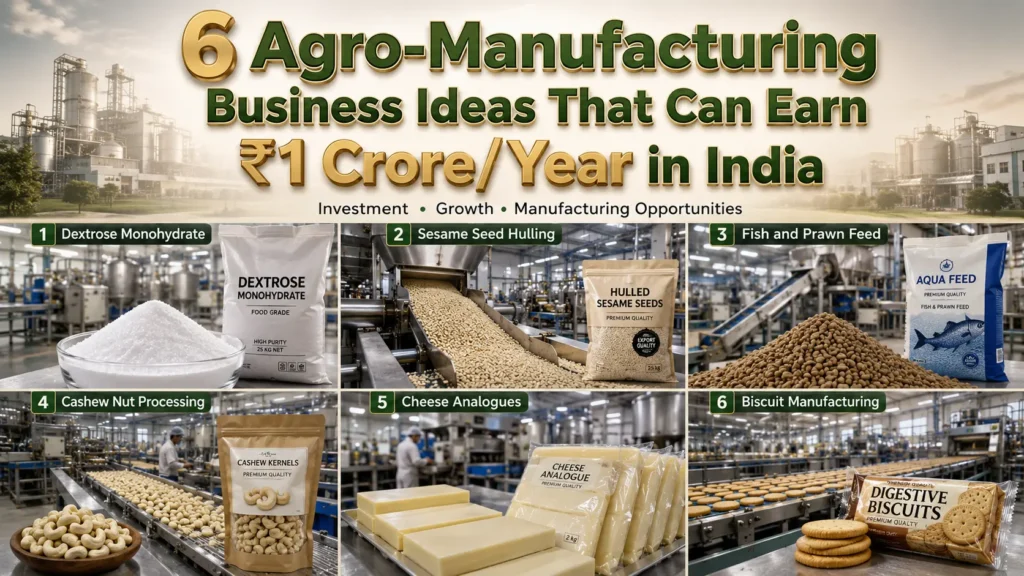
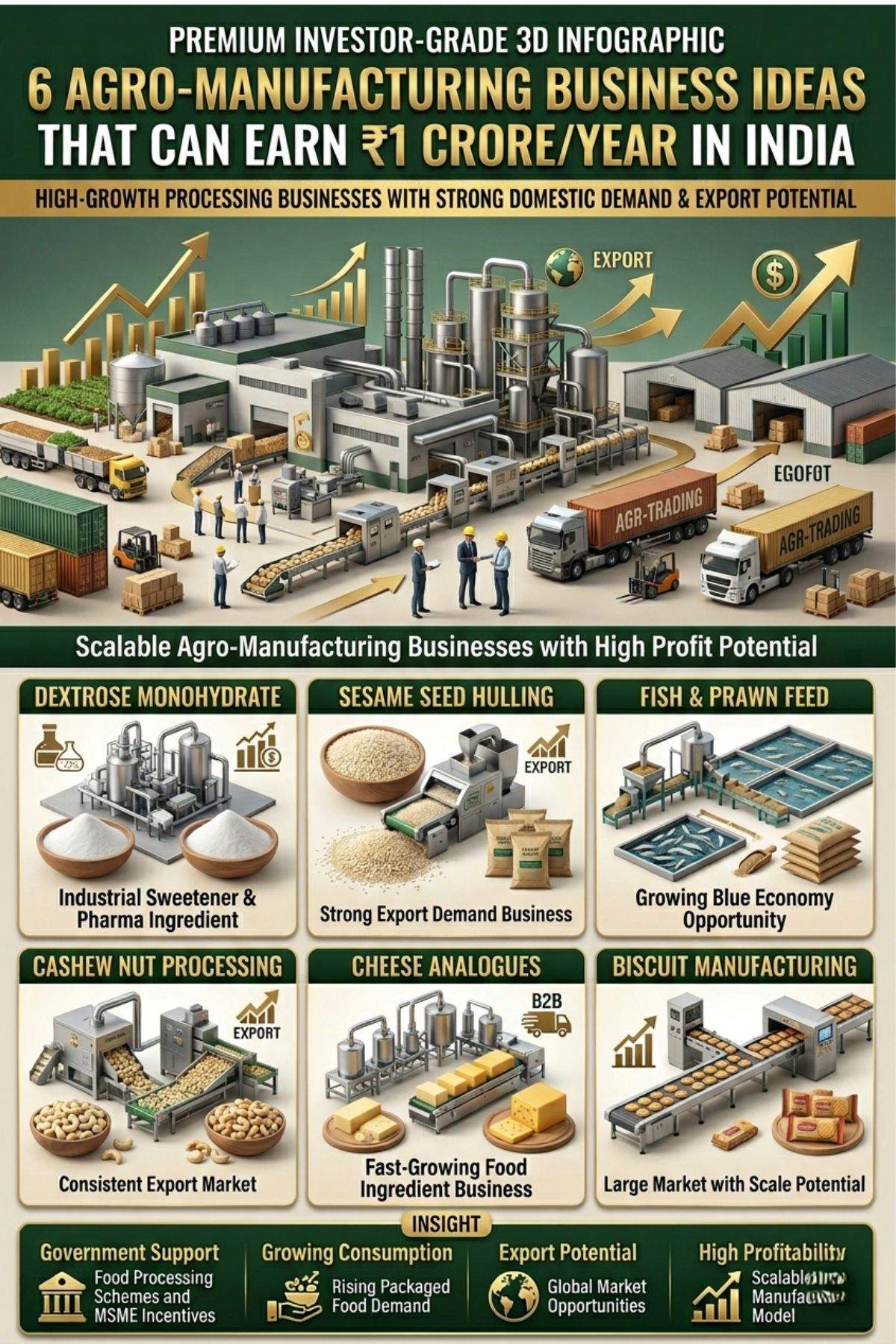
This article will explore six manufacturing and processing business ideas that have a strong depth of demand, approachable processes and good margins. Practical aspects of production logic, cost structure and commercial opportunity are presented for each sector: dextrose monohydrate, sesame hulling, aqua feed, cashew processing, cheese analogues, and biscuits.
Get Detailed Insights from This Book: Profitable Agro Based Projects
1. Dextrose Monohydrate: The Quiet Workhorse of Indian Industry
What It Is and Where It Goes
Dextrose monohydrate, a hydrolysate of starch, is one of the most commonly used functional ingredients used in the Indian manufacturing. The infusion for the pharmaceutical application, called Intravenous Dextrose Normal Saline, is familiar. But the food-grade derivative market is arguably bigger and bigger.
Dextrose is used in a variety of key food applications such as:
- Confectionery, bakery products and hard candy formulations.
- The production of energy drinks, sports nutrition and baby food.
- Amino acid, citric acid, and API production fermentation substrates
- Specialty chemical applications and special applications in textile processing
Starch derivatives industry is located in the main part of the country in Maharashtra, Uttar Pradesh and Andhra Pradesh. There are a few big players controlling the organised segment. But demand downstream has reached a critical threshold and regional processors are discovering commercially viable niches that the large processors cannot be agile enough to serve.
Investment and Growth Outlook
This core process consists of starch liquefaction by alpha-amylase enzymes, saccharification by glucoamylase, purification activated carbon and crystallisation. The capital cost of a small to mid-sized plant with 10-25 tonnes per day capacity lies between ₹4 crore to ₹12 crore. Dextrose intended for food use should be in conformity with the FSSAI specifications.
Dextrose used for food should comply with the FSSAI requirements. Other certifications are required for producers that sell into export markets or for pharmaceutical ingredient producers. Please refer to the FSSAI website for full regulatory requirements.
The starch derivatives industry in India is expanding at about 8 – 10% CAGR due to the processed foods, sports nutrition, and expanding pharmaceutical industry. The true market potential is in differentiated applications: ultra-pure types for infant formula companies and blends of dextrose-maltodextrin types for sports nutrition companies.
2. Sesame Seed Hulling: A Business Idea with Strong Export Pull
Why Sesame Deserves Serious Attention
India is the largest producer and exporter of sesame seeds. It is true that there has been a world market for raw sesame from the beginning. But, hulled sesame (also called natural white sesame) fetches a much larger price, and is the preferred form for almost all international buyers.
Main export destinations are Japan (150,000–180,000 metric tonnes per year), South Korea, China, Middle East and emerging markets such as North American Countries and EU. The premium for raw to hulled sesame has been between 25% and 45%. This ensures a simple value addition game called hilling and is one of the easiest agro-processing business ideas for India.
Investment and Commercial Viability
A sesame hulling plant is comprised of cleaning, soaking, mechanical hulling, flotation separation, washing, drying and colour sorting. Colour sorting is a crucial stage, as international buyers have stringent quality requirements, and if the colour isn’t good, even if the lot is properly hulled, it will be rejected. The investment in plants for 5–10 tonne per day operation can be from ₹80 lakh to ₹2 crore.
The consistent supply of 99.95% purity by Indian exporters, ensures them premium price buyers. Exporters are assisted by the Agricultural and Processed Food Products Export Development Authority (APEDA) with regard to quality certification and market development funding.
A natural raw material advantage can be acquired while setting up near major growing belts in Rajasthan or Gujarat. Another planning point of importance is working capital management and storage infrastructure, and procurement should be focused on a 2–3-month window post-harvest.
Related Article: Top 3 Profitable Agro-Based Manufacturing Business Ideas in India
3. Fish and Prawn Feed: Riding the Blue Economy Wave
The Structural Demand Story
The aquaculture industry in India has silently undergone a change in the last 15 years. Shrimp exports have reached the levels of ₹50,000 crore per year, and consumption of fish is increasing gradually. Quality compound feed is part of the rapidly expanding demand which lies behind both of those trends.
The fish and prawn reared on nutritionally balanced feeds grow faster, have less mortality rate, and yield better quality meat. The organised aqua feed market is valued at more than ₹18,000 crore and will be expected to reach ₹30,000 crore by the end of this decade. The five key states that are boosting demand are Andhra Pradesh, Odisha, West Bengal, Kerala and Tamil Nadu.
Manufacturing and Margin Profile
A compound aqua feed formulation usually will include fish meal or soy protein concentrate, energy ingredients (such as wheat and maize), lipid sources, vitamins, minerals and binding agents. The protein content should be higher in prawn feeds (32-40%). This is due to the increased significance of the extruded feed technology, which means that water pollution can be alleviated and the feed consumption can be monitored better. A medium size extruded plant is likely to need an investment of ₹3-8 crore.
The margins of organised aqua feed producers are generally around 10-16% in EBITDA. Furthermore, low to medium scale direct farmer contact small producers that provide technical advisory services as well as feed to farmers have established sustainable regional businesses.
The National Fisheries Development Board (NFDB) provides assistance for the aquaculture sector through Pradhan Mantri Matsya Sampada Yojana.
4. Cashew Nut Processing: Labour-Intensive Business Ideas with Consistent Export Demand
India’s Position in the Global Cashew Market
India produces the largest raw cashew nuts in the world and processes and exports the largest amount of cashew kernels. Even at this magnitude, a considerable amount of raw cashew is still being exported in its raw form. This is a clear and continuous value addition opportunity in the processing sector.
Typical processing operations involve the softening of shell (steam conditioning or roasting), mechanical shelling or hand shelling, peeling of the inner testa skin, grading by kernel size and colour and then filling into tins or vacuum-packaging. Wheat with whole, unhusked kernels in grades W-180, W-210, W-240 and W-320 is most in demand for export. The economics are very sensitive to the out-turn ratio, the amount of kernel realized per unit of raw nuts (range is 20% to 28%).
Financial Profile and By-Product Opportunity
Capital investment required for a small-to-mid-scale unit (2–5 tonnes of raw cashew nuts processed in a day) is between ₹60 lakh and ₹2 crore. In addition, cashew nut shell liquid (CNSL) is a useful by-product employed in brake linings, marine paints and resins. Those entrepreneurs that recover and sell CNSL will significantly enhance the overall unit economics. Likewise, cashew shells, dried and baled are valuable for biomass fuel. Cashew Export Promotion Council of India (CEPC) acts as the nodal organisation for the export industry to provide statistics and certification assistance.
Discover business ideas that actually make money
5. Cheese Analogues: A Fast-Growing B2B Business Idea
Why Demand Is Rising Fast
A cheese analogue is a compound that simulates the functional and appearance characteristics of natural dairy cheese, but is produced from vegetable fats, modified starches, caseinates, or soy protein, emulsifying salts and flavour compounds. The final product lends itself to use on pizza, in slices for sandwiches and in shreds for fast food — and costs just a fraction of natural cheese.
Cheese Alternatives have become a huge and growing market in India due to the following factors:
- Quick service restaurants and pizza chains
- FFA and cloud kitchens
- Institutional food service and catering operators that prepare food for their own employees and serve it to patrons.
- Ready-to-eat and frozen food manufacturers
An average sized pizza shop with 200+ outlets can use 15–25 tonnes of cheese analogue every month. This establishes steady, high volume commercial B2B relations with producers.
Manufacturing and Commercial Opportunity
Manufacturing involves mixing of vegetable fats with caseinate or modified protein isolates, emulsification and flavouring in heated mixing systems, homogenisation, forming, chilling, and packaging. The current value of the cheese analogue market in India is approximately ₹4,000-5,500 crore and is expanding at a 12-15% rate per year. MARGINS FOR PRODUCERS WHO CAN PRODUCE FACES 15 TO 22% EBITDA. The cost of the capital investment required for a functional mid-scale plant is between ₹2 crore and ₹6 crore. Volume and pricing stability are available for new entrants through direct contract with QSR chains and institutional caterers (ICTs).
6. Biscuit Manufacturing: A Mature Market with Room for Smart Business Ideas
The Indian Biscuit Market — Bigger Than Most Assume
India is one of the three biggest markets for biscuits. Production is more than 4 million metric tonnes per year and the industry has already reached a retail price of ₹50,000 crore. From glucose biscuit packs at ₹5 in rural Kirana stores to superior multigrain biscuit which costs Rs 30-100 per pack.
The combination of Parle Products and Britannia Industries contributes to almost 50% share of the organised market. The other 50%, however, is spread among the regional manufacturers, private label producers and a large and unorganised sector. This is indicative of the regional preferences of the Indian states.
Where the Real Opportunity Lies
There are three markets that are most promising for new biscuit manufacturers. Firstly, the premium and specialty sections—functional biscuits, low-sugar biscuits, high-fibre biscuits and multigrain biscuits—in which national brands have yet to gain a strong foothold. Secondly, private label production to modern retail chains. Third, institutional supply to canteens and ICDS programmes and in mid-day meal schemes, where there is guaranteed supply of food contracts with fixed prices.
The investment varies from ₹1.5–4 crore for a simple single line plant to ₹15–20 crore for a fully automated plant. New players should steer clear of economy glucose — Parle dominates based on its distribution scale alone, something created over decades of time.
Get Detailed Project Report (DPR): Bakery, Confectionery, and Processed Foods
Government Policy Tailwinds Across All Six Sectors
There are schemes of both central and state governments that are useful to the Entrepreneurs who are planning to enter any of these sectors:
- MoFPI PLI Scheme: Incentives for incrementals sales growth for food processors who fulfill minimum sales volume and other conditions.
- PM FME Scheme: Credit-linked grant support for up-gradation of micro-enterprises
- Agri-Processors Export Development Authority (APEDA) Market Support: APEDA offers quality certification & market development assistance for agricultural exporters.
- PMMSY Aquaculture Support: NFDB offers sub-scheme support under Pradhan Mantri Matsya Sampada Yojana
- FSSAI Compliance: Licensing is mandatory for all food manufacturers — visit gov.in for registration requirements
- MoFPI Portal: For scheme eligibility and application guidance, visit gov.in
Furthermore, Niir Project Consultancy Services (NPCS) provides detailed technical and economic feasibility reports as structured market survey. They include manufacturing processes, source of raw materials, planning for capital expenditure, financial projections, and market demand evaluation, which are applicable for first-generation entrepreneurs as well as project finance applicants for MSMEs.
Frequently Asked Questions
Q1: Which sector has the lowest capital entry point for a first-time entrepreneur?
Entry points for both processing cashew nut and hulling sesame seeds are good at 60 lakhs to 2 Crores, with simple technology, ready supply channels and ready markets both domestic and export, requiring no market creation. These are some of the easiest manufacturing business ideas available for small scale entrepreneurs.
Q2: Is FSSAI licensing necessary for all food manufacturing businesses in India?
Yes. Any entity manufacturing food products for commercial sale in India requires registration or a license from the Food Safety and Standards Authority of India (FSSAI), depending on the scale and nature of operations. For export businesses, APEDA registration and BRC or HACCP certification are also typically required by international buyers.
Q3: How do I assess local demand before setting up a fish or prawn feed plant?
First, identify the area under cultivation for aquaculture in the selected region. State fisheries departments and NFDB reports provide relevant data. Calculate annual feed requirement by multiplying cultivation area with stocking density and feed conversion ratio of the feed. It is advisable to carry out a detailed techno-economic feasibility study involving a basic demand survey before investing capital.
Q4: Can a cheese analogue manufacturing unit access government MSME financing?
Yes. Food processing in terms of manufacture of cheese analogue are entitled for credit under CGTMSE scheme-guaranteed up to 2 crs, collateral-free bank loans for eligible MSMEs, PM FME scheme, priority sector lending norms etc. Good project report with detailed financial projections greatly increases the likelihood of approval.
Q5: What quality certifications are needed to export food products from India?
The BRC or IFS is usually demanded by the retail buyers in EU and UK. In US market, FDA registration and FSMA are the criteria for market entry. The markets of Middle East require the halal certification from recognized agency. HACCP and ISO 22000 certifications are prerequisite for all the markets. The guidelines for market specific certification requirements can be acquired from APEDA.
Q6: How important is location for a sesame hulling plant?
Location is quite significant. Proximity to major sesame growing belts in Rajasthan, Gujarat, and Madhya Pradesh reduces procurement costs and logistics delays. Access to clean water is operationally essential. Proximity to export ports such as Kandla, Mundra, or JNPT reduces finished goods logistics costs. Many successful sesame hulling operations clusters within 200–300 km of major growing districts for exactly these reasons.
Conclusion: Choosing the Right Business Idea with an Industrialist’s Mindset
If there is a single thread connecting all six sectors in this article, it is this: the best manufacturing business ideas in India today are rarely the ones that look most glamorous on paper. Sesame hulling is unglamorous. Cashew processing is labour-intensive and seasonal. Aqua feed manufacturing requires deep technical knowledge. Cheese analogues and biscuits compete in crowded markets. Dextrose production demands process chemistry expertise.
None of these is a business you can build on enthusiasm alone. However, each one has something that more exciting-sounding ventures often lack: real, identifiable, growing demand from buyers who need these products every single day and will pay a fair price for consistent quality.
That combination — demand depth plus process-driven differentiation — is the foundation of every sustainable manufacturing business. For entrepreneurs serious about building in this space, the starting point is always a rigorous feasibility exercise. Understand what the product requires, what it costs to make, what buyers will pay, and whether the margin structure justifies the investment. Done honestly and with access to reliable sector data, that exercise will either confirm the opportunity or save you from an expensive mistake.
India’s manufacturing decade is already here. The question is not whether these opportunities exist — they clearly do. The question is whether you have done the preparation to walk through the door with confidence.