
₹5 Crore Food Processing Business in India
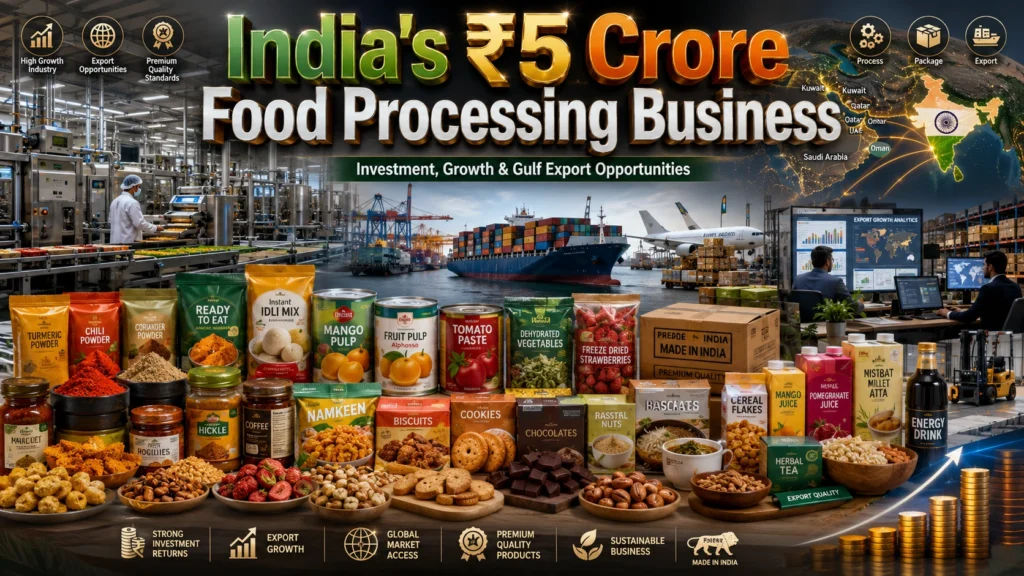
The food processing industry in India is at a turning point and for those who are thinking of entering into any serious business in manufacturing, the food processing unit with a capital investment of Rs.5 Crore for export to Gulf countries is one of the most commercially viable business ideas possible today. The Gulf Cooperation Council (GCC) countries – Saudi Arabia, UAE, Qatar, Kuwait, Oman and Bahrain – import billions of dollars in packaged and processed food each year. Geographic advantage of India along with huge population of NRIs in these countries leads to a natural demand pipeline.
The Ministry of Food Processing Industries has always identified this as a priority for export and the availability of policy support in terms of capital subsidies and export promotion schemes is as easy as ever.
Why the Food Processing Sector Is Booming in India
India is the second largest producer of fruits and vegetables in the world but a large proportion of them is wasted because of lack of processing facility. The food processing industry is a significant contributor to manufacturing GDP of India and it is an industry which continues to attract investment from both the domestic and foreign sector. The food import needs of the Gulf countries, especially in Saudi Arabia and UAE, have increased substantially due to the huge rate of urbanization and development of the middle class.
Indian processed food, including rice flour, spice blends, and ready to cook mixes, as well as frozen snacks, is always in demand in these markets. India’s agricultural exports have been continuously on the rise, with processed food playing a larger role, according to APEDA (Agricultural and Processed Food Products Export Development Authority). It’s an investment that’s also recession-proof — spending on food by consumers doesn’t slow down when the economy slows down, so consumer demand is always stable.
Get Detailed Insights from This Book: Handbook on Fruits, Vegetables & Food Processing with Canning & Preservation
Government Policies and Incentives for Food Processing Units
Entrepreneurs are provided with several targeted schemes by the Ministry of Food Processing Industries (MoFPI). PMKSY offers capital subsidy to food processing units in clusters up to 35%. The innovative product category and organic product category are included in the Production Linked Incentive (PLI) scheme and are given incentives based on incremental sales. Further, the Credit Guarantee Trust Fund scheme of MSME Ministry has made it possible to avail collateral-free loan of Rs.2 Crore.
APEDA is active in facilitating exports to the Gulf market in the following ways: Trade Fairs, Buyer-Seller Meetings, Export Certification. Food Safety and Standards Authority of India (FSSAI) has introduced fast-track licensing for export units, which can cut down the compliance timelines for the entrepreneurs. There are also electricity subsidy and provision of land in food parks by the State governments like Maharashtra, Gujarat, and Punjab. To get a detailed list of incentives available, please see the Startup India portal.
Top Business Ideas in Food Processing for Gulf Exports
Ready-to-Cook Indian Meal Kits and Spice Blends
There are more than 8 million Indians living in the Gulf who are actively looking for real Indian flavours. Production of standardised spice mixtures, masala powder, ready to cook curry base, and meal kits can create a huge export brand with a simple investment. From Rs.5 Crore you can operate an automated blending, grinding and vacuum-packaging line, which complies with Gulf food safety certifications like GCC conformity marks and Halal certification.
The two key factors in a supermarket’s success in retail shelf placement in the Gulf are consistency and packaging quality. Generally, gross margins for branded spice blends are between 35% and 50%, and hence this is one of the more profitable categories in the food processing industry. For direct buyer connect opportunities, APEDA’s export promotion programmes are for the benefit of entrepreneurs.
Rice Flour, Semolina, and Milled Grain Products
Domestic ag capacity is very low due to the arid conditions in the Gulf region which makes them very dependent on import of grains and milled products. This can be met by processing of rice and wheat in India which are available at competitive prices. A milling unit handling a capacity of Rs.5 Crore can mill the paddy or wheat to get refined flour, semolina, rice flour, beaten rice, and value-added grain products. Grain-based products are relatively easy to certify for the Halal markets in the Gulf (notably for the fact that this certification does not impose any extra compliance cost).
Shelf life of 12 to 18 months can be obtained with good cold chain and moisture-controlled packaging, which meets the retail distribution cycles in the Gulf. Entrepreneurs should visit DGFT (Directorate General of Foreign Trade) for export documents and for IEC code registration.
Your investment deserves the right opportunity
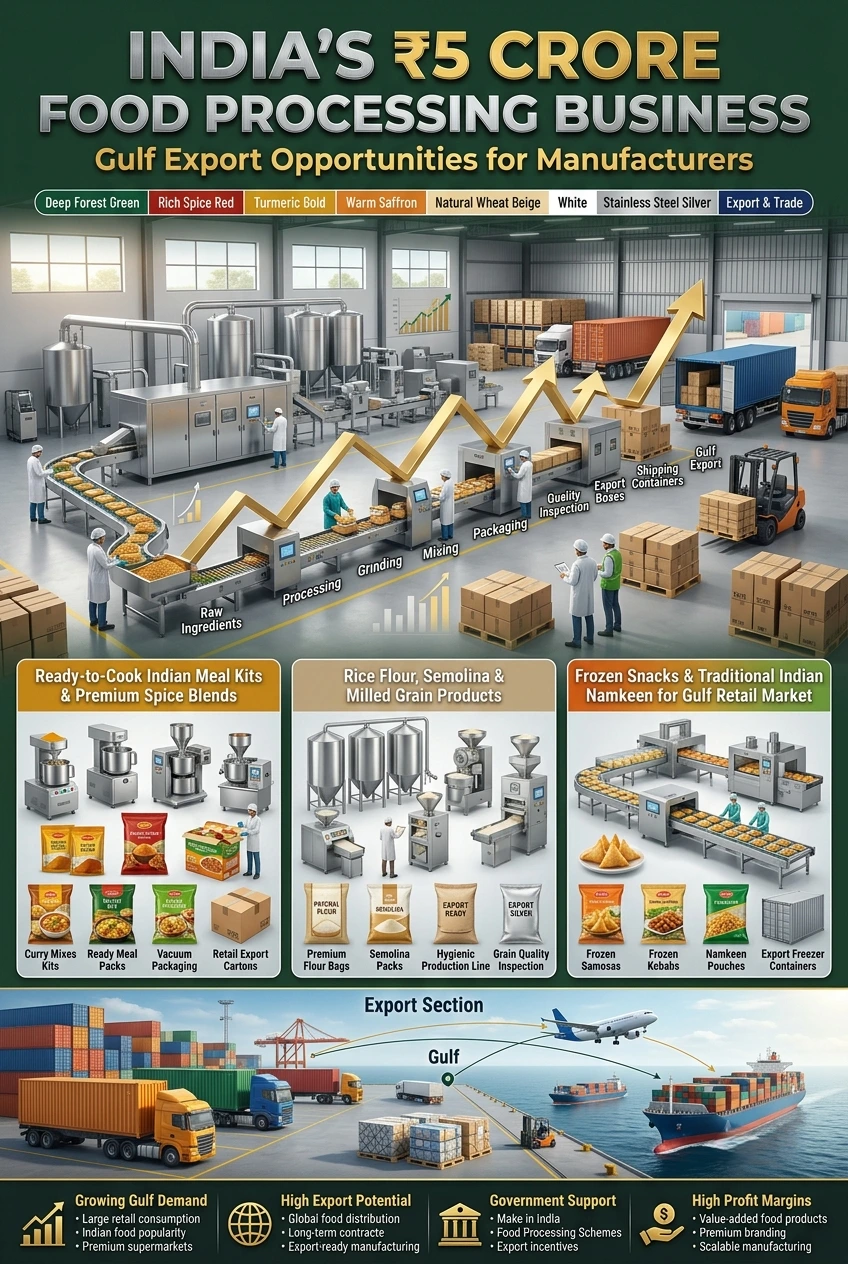
Frozen Snacks and Traditional Indian Namkeen for the Gulf Retail Market
One of the fastest-growing product line in the Gulf supermarkets is frozen food and packaged snacks. Indian namkeen, frozen samosa, frozen paratha and ethnic snack products have each a separate section in the Lulu Hypermarket, Carrefour and Spinneys in the Gulf. There is an investment requirement for the purchase of industrial fryers/ovens, individual quick-freezing equipment and cold storage packaging lines for setting up a frozen food processing unit at Rs.5 Crore. The unit should be HACCP standards and export-controlled temperatures. Many other Indian companies such as Haldirams, MTR Foods have proven this export model at large scale and enough opportunities are there for regional brands to establish niche positions.
Import-Export Opportunity Analysis
India has been steadily increasing its food and processed food exports to the Gulf region and bilateral agreements have ensured that most of the food categories have relatively low tariff. The APEDA data also reflects that rice, spices, processed vegetables and ready-to-eat products are the key commodities for India’s food export to the GCC.
The UAE is also a re-exportation hub; if an Indian exporter sets up distribution in the UAE, then it is relatively easy to gain access to the whole of the GCC. Further, the India-UAE Comprehensive Economic Partnership Agreement (CEPA) has also resulted in preferential tariff regimes which directly benefit Indian food exporters. Entrepreneurs can go to Ministry of Commerce and Industry for the latest trade information and export facilitation.
Get Detailed Project Report (DPR): Food Processing and Agriculture Based Projects
Indian MSME Success Stories in Food Processing
Prataap Snacks: From a Small Unit to a Listed FMCG Company
Prataap Snacks, founded by Arvind Mehta in Indore, started as a small namkeen manufacturing unit serving local markets in Madhya Pradesh. The company’s growth model was built on tight cost control, consistent product quality, and aggressive regional distribution. Arvind’s key insight was to target the mass-market price point — keeping products affordable while maintaining quality — which enabled rapid volume growth. The company eventually listed on Indian stock exchanges and expanded its product portfolio significantly. For entrepreneurs looking at food processing, Prataap Snacks demonstrates that starting with a focused product category and mastering it operationally is a more reliable path than launching too many products simultaneously.
LT Foods: Building an International Rice Brand from Punjab
LT Foods is promoted by the Arora family from Punjab and converted a rice commodity trading business to a global branded exporter of basmati rice in the Daawat brand. They were pioneers in the early establishment of processing infrastructure and quality grading facilities. Halal certification was an important differentiator enabling market entry into the Gulf and Middle East. Their export-first thinking is a model worth studying. Today, LT Foods exports to over 60 countries. The lesson for new food processing entrepreneurs is that export-readiness is equally about regulatory compliance, packaging standards, and relationship-building with overseas distributors as it is about product quality.
How NPCS Can Help You Get Started
We at Niir Project Consultancy Services (NPCS) provide professional consulting for the preparation of Market Survey cum Detailed Techno-Economic Feasibility Reports (DPRs) for setting up new industries or businesses. Our reports include detailed manufacturing processes, market research and demand analysis, process flow diagrams, product mix and capacity planning, machinery and raw material details, and complete project financials with profitability analysis. Our objective is to help entrepreneurs evaluate feasibility, profitability, and long-term scalability before investing. Visit us at www.niir.org for detailed project reports on food processing units.
Related Article: Top Food Processing Industry Consultants in India: A Complete Guide
Conclusion
A Rs.5 Crore food processing unit targeting Gulf exports combines the strength of India’s agricultural surplus with the consistent demand of one of the world’s wealthiest import markets. Government support through MoFPI, APEDA, and PLI schemes significantly de-risks the investment. Entrepreneurs who invest time upfront in market research, product standardisation, and compliance will find that the Gulf food export corridor is both profitable and sustainable. The time to enter is now — before the market becomes crowded and entry costs rise.
Rs.5 Crore Food Processing Unit — Key Investment Parameters
| Parameter | Details |
| Total Investment Range | Rs.4 Crore to Rs.6 Crore |
| Land Requirement | 10,000 to 15,000 sq ft (owned or leased) |
| Key Government Scheme | PMKSY — 35% capital subsidy on eligible plant and machinery |
| Estimated Market Size | Gulf food import market: USD 40 billion+ |
| Expected ROI Timeline | 3 to 5 years at 65–70% capacity utilisation |
| Employment Generation | 40 to 80 direct employees |
| Export Potential | UAE, Saudi Arabia, Qatar, Kuwait, Oman, Bahrain |
| Key Licenses Required | FSSAI Export License, APEDA Registration, Halal Cert, IEC Code |
Key References and Government Resources
- Ministry of Food Processing Industries (MoFPI) — Central government schemes, PLI, PMKSY details
- APEDA — Agricultural and Processed Food Products Export Development Authority — Export promotion, buyer-seller meets, Gulf market data
- FSSAI — Food Safety and Standards Authority of India — Export licensing, food safety standards and compliance
- DGFT — Directorate General of Foreign Trade — IEC code registration, export-import policy updates
- Ministry of MSME — CGTMSE credit guarantee, MSME Udyam registration
- Ministry of Commerce and Industry — Trade data, CEPA with UAE, bilateral trade agreements
Frequently Asked Questions (FAQ)
What is the minimum investment to start a food processing unit for Gulf export?
A functional food processing unit targeting Gulf markets can be set up with Rs.4 to Rs.6 Crore depending on the product category. Farmers under the PMKSY scheme can get assistance for 35% of the capital cost incurred. The full details about the scheme are available on the MoFPI website.
Which government schemes provide funding for food processing units?
The most prominent scheme offering a 35% capital subsidy is the Pradhan Mantri Kisan Sampada Yojana (PMKSY). PLI for food processing has been designed to include emerging areas. Credit up to Rs. 2 crores for MSMEs without collateral can be availed under the CGTMSE scheme. Support for export promotion including participating in buyer-seller meet and international trade fair comes from APEDA.
How long does it take to recover investment in a food processing unit?
A Rs.5 Crore food processing unit working at a capacity utilisation of 65-70%, with an active Gulf export has a pay back of 3-5 years. In fact, export-oriented units get much better rates than for their domestic sales, which help hasten the payback period if export brands are well placed.
What licenses are needed for Gulf food export from India?
Critical documentation involves: FSSAI Export License by FSSAI, APEDA Registration, Import Export Code (IEC) from DGFT, Halal Certification from accredited agency, GCC certification mark wherever applicable.
Is a food processing unit viable in Tier-2 cities?
Yes, tier 2 cities like Indore, Ludhiana, Coimbatore and Nashik have food processing ecosystems, ready with workforce and supporting infrastructure. Refer to the MSME Ministry for MSME cluster development assistance in these cities.
What is the export potential from India’s food processing sector?
Consistent growth has been observed in India’s food processing exports and one of the major markets for these goods has been the Gulf region, owing to close proximity and the same culture. CEPA with UAE facilitates preferential tariffs. Please log in to Ministry of Commerce website to find detailed information on bilateral trade statistics and exports prospects for specific countries.