
Citric Acid Manufacturing in India
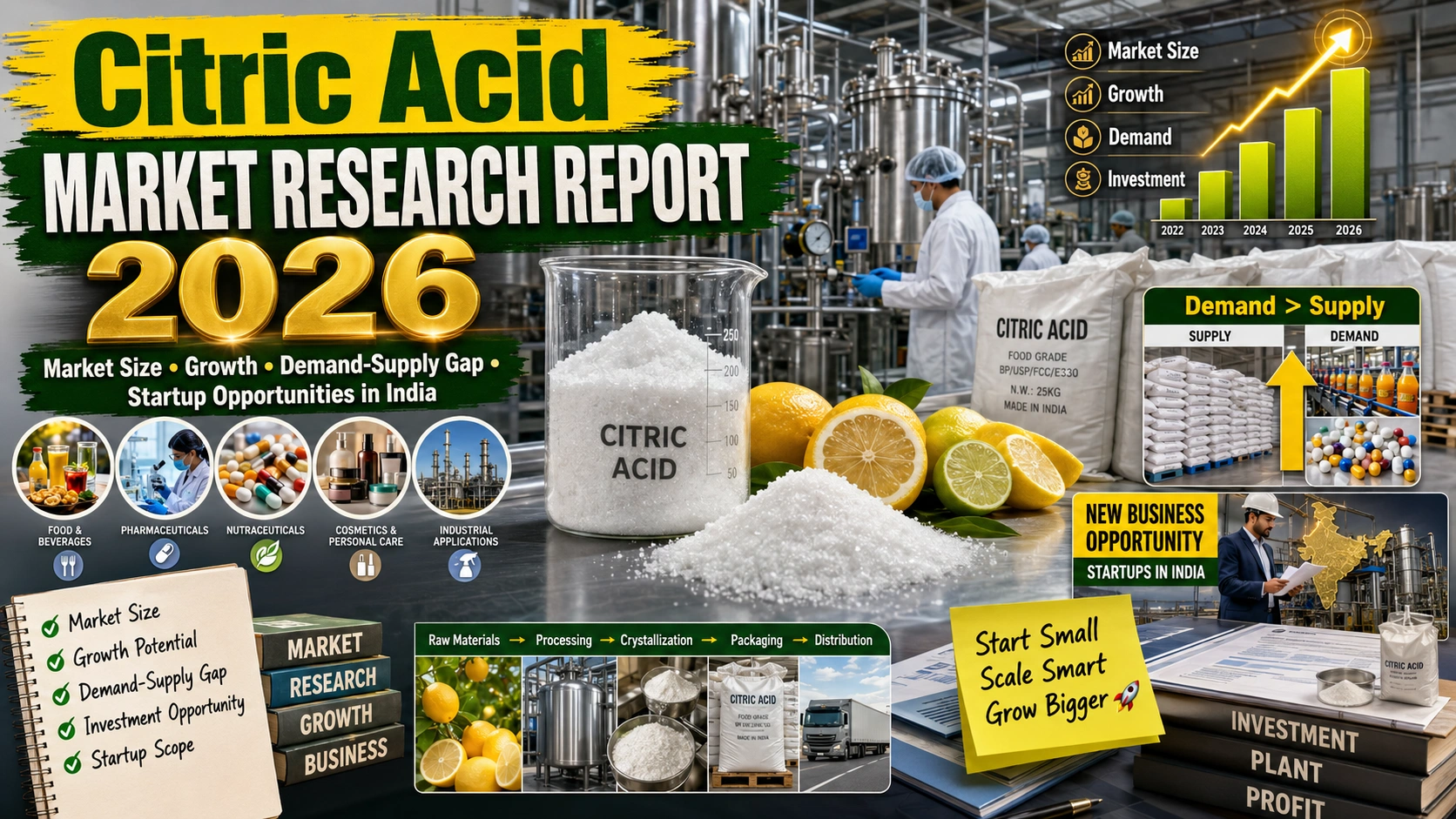
India is the second highest consumer of citric acid and second highest producer of citric acid in the world but it still imports almost the entire quantity of citric acid required to meet the domestic demand by the Chinese industry which produces nine times more citric acid than India. China’s export market is tightening through 2026 and India’s food, beverage and pharmaceuticals industry is still booming, while the fermentation process is one that India is familiar with.
View Full Project Details: Citric Acid Manufacturing Plant – Detailed Project Report & Business Plan
What Is Citric Acid?
Citric acid is a weak organic tricarboxylic acid, which is commercially produced almost exclusively by microbial fermentation; Aspergillus niger mould fermented on sucrose, molasses or corn-steep liquor that can yield over 90% (on substrate basis). The metabolic product of the mould is filtered out and citric acid is precipitated as calcium citrate with lime (calcium hydroxide) and re-dissolved in sulphuric acid (or can be separated by liquid-liquid extraction).
Citric acid is available in two main forms:
- Anhydrous citric acid – the dominant form – was the preferred form, accounting for about 70% of the global market share, it is more stable and has a longer shelf-life than the hydrated form and is crystallised from hot water.
- Monohydrate citric acid – crystallised from cold water – widely used when moisture content is less important
It is widely used in the following applications:
- Food and beverages – the major application (around 50-65% of the global consumption), where it is used as an acidulant, flavour enhancer and natural preservative in soft drinks, confectionery, dairy, sauces and also in plant-based dairy alternatives.
- Pharmaceuticals and nutraceuticals – an essential excipient for use as a buffering agent, as part of an effervescent tablet and as a flavour mask in syrups.
- Detergents and cleaning products – an effective, biodegradable chelating agent for water softening, that is growing in popularity in response to regulations pushing against use of phosphates as water softening agents.
- Cosmetics and personal care – pH adjuster / antioxidant
- Industrial applications – metal plating, oilfield services, and other specialty chemical uses
Related Article: How to Start a Citric Acid Manufacturing Business from Lemon
Global and India Citric Acid Market Size and Growth
The global citric acid market in 2025-26 was valued at an estimated range of USD 3.77–4.21 billion, and is expected to reach between USD 4.81–5.54 billion by 2031-2033, with the average rate of growth being in the range of 3.7% to 4.12%. China leads the world in production by volume, with an estimated 65-70% of global capacity, fueled by an integrated fermentation facility and a large supply of corn-based feedstock.
India has a truly noteworthy but structurally weak stake in this situation: It is the 2nd largest consumer of citric acid with an estimated consumption of 420,000 tonnes per year, behind only China (1.1 million tonnes), and the 2nd largest producer with domestic production of around 296,000 tonnes per year. China produces about 2.6 million tonnes, compared to India’s nine times less ability.
Note on figures: Citric acid market studies can be different in considering the acid alone or including its salts or esters (sodium citrate, potassium citrate, etc.). NPCS can provide a customised techno-economic feasibility study, tailored to your target product form (anhydrous vs. monohydrate) and your target grade (food versus pharmaceutical), for numbers for the investor.
India’s Quantified Supply-Demand Deficit
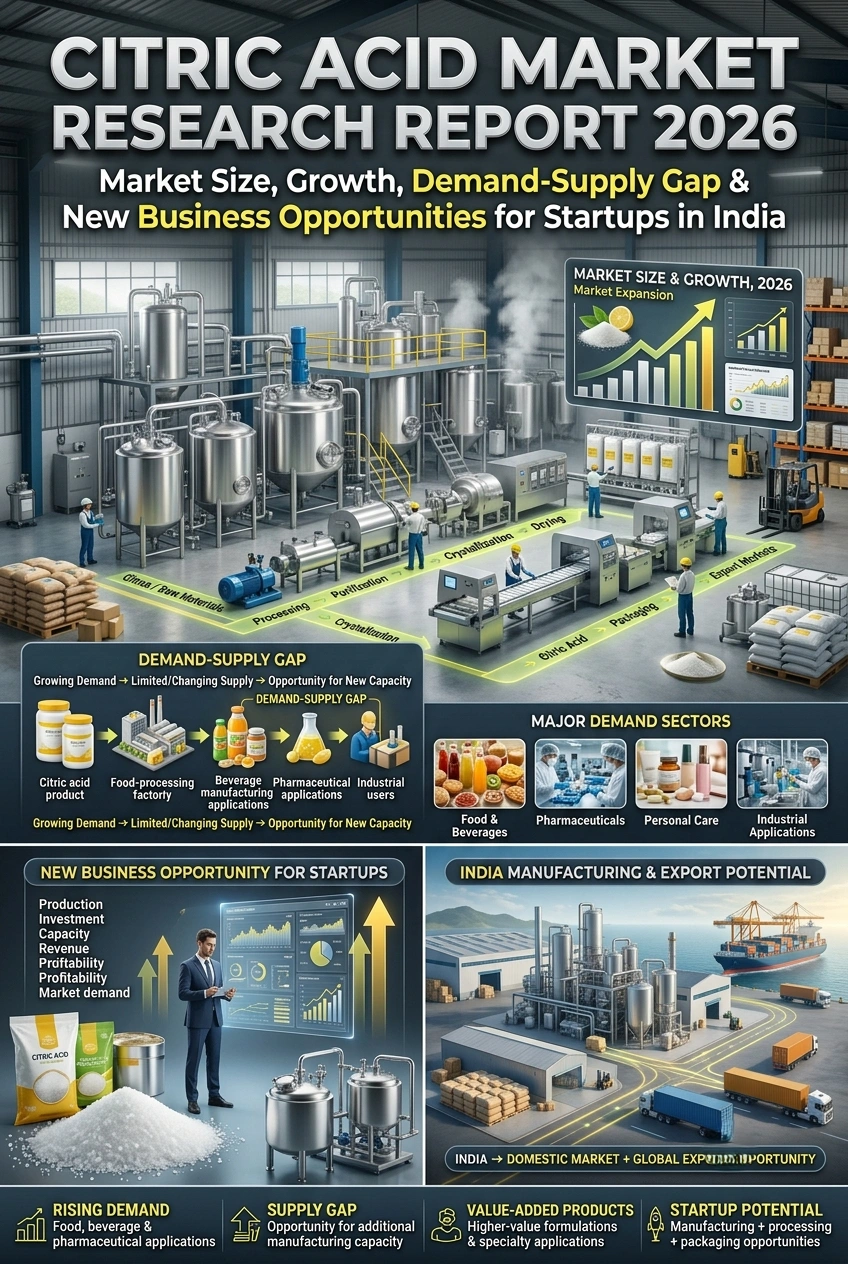
The consumption of about 420,000 tonnes, and domestic production of about 296,000 tonnes annually indicate that India has a structural deficit of about 124,000 tonnes per annum, which is met almost entirely by imports, with China being the predominant supplier. This gap is there while at the same time India maintains a significant market presence through valuable exports including to the United States, indicating a market where domestic supply is lacking, in terms of both volume and quality/grade mix, compared to market demand.
The dependence is real and near term: Chinese export monitoring has ratcheted up and freight risk has risen since 2026, with almost 70% of all citric acid imports from just one country, which is just the type of geopolitical and logistics risk that has spurred new domestic investment in import-dependent markets.
Policy Tailwinds
1. Capacity protection and incentives for domestic capacity: Thailand used anti-dumping duties on imports from China to protect and incentivise domestic supply of citric acid, a policy that India can use, as capacity is documented and significant and import dependency is high in the country as of January 2025 (in 57.79%).
2. Growing domestic food processing and beverage industry: India’s ready to drink (RTD) beverage, processed food and packaged food industry is a direct growth driver for citric acid, further supporting citric acid backward integration in the domestic market.
3. Clean label, natural preservative demand: Citric acid is GRAS/FSSAI approved as a natural preservative and acidulant, which is correlated with the demand of natural preservatives/synthetic preservative substitutes by the Indian consumer and regulatory preference.
4. Incentives for circular economy and waste valorisation: Indian citric acid producers have increasingly been looking into waste valorisation as a strategy, e.g., use of spent fermentation biomass for animal feed, biogas or compost, and it is being integrated into the overall value-addition and sustainability agenda of the government.
5. Domestic sugar production base: India has a large domestic sugar and molasses base, which gives an authentic raw material advantage for new capacity as a molasses and sugar-based fermentation process.
India Demand-Supply Gap: Citric Acid
| Parameter | Current Position |
| India’s annual demand | ~420,000 tonnes — the world’s second-largest national consumption |
| India’s annual production | ~296,000 tonnes — the world’s second-largest national production base |
| Annual supply deficit | ~124,000 tonnes, met almost entirely through imports |
| Comparison to China | China’s production capacity (2.6 million tonnes) is roughly 9x India’s output, despite India being a similarly large consumer |
| Import value (2024) | India imported approximately USD 105.2 million worth of citric acid ingredient streams in 2024 |
| Market structure | A few large players dominate domestic capacity, while many small and mid-sized units rely on imports or toll production, leaving the supply chain exposed to input shocks and logistics delays |
| Nature of the gap | A clearly quantified, persistent import-substitution gap — roughly 30% of India’s total demand is currently unmet by domestic production, a structural rather than cyclical shortfall |
| Opportunity for new entrants | Strong — greenfield fermentation capacity investment is already being actively evaluated in India, with feasibility studies indicating attractive project economics at meaningful scale |
Reading the gap: With India already the world’s second-largest producer, this is not a technology or process-knowledge gap — India’s fermentation industry (used similarly for enzymes, antibiotics, amino acids, and other bio-based chemicals) already has the relevant expertise. The gap is one of installed capacity relative to a demand base that continues to grow with India’s expanding food, beverage, and pharmaceutical sectors — and one that a documented feasibility study for a 30,000-tonne-per-annum greenfield plant estimates could achieve a 47% rate of return with break-even at just 45% capacity utilisation, indicating genuinely attractive project economics for well-capitalised new entrants.
Major Indian Citric Acid Manufacturers
| Company | Base/Region | Notes |
| Vinipul Inorganics Pvt. Ltd. | Mumbai, Maharashtra | Established Indian manufacturer, supplier, and exporter of citric acid, citric acid monohydrate, and citric acid food grade |
| Sigachi Industries Ltd. | Telangana | Recognised Indian citric acid API manufacturer with regulatory filings including Drug Master Files (DMF) |
| Corel Pharma Chem | Gujarat | Recognised Indian citric acid anhydrous API manufacturer with regulatory documentation |
| Gangwal Chemicals / Gangwal Healthcare | India | Recognised Indian citric acid manufacturer and supplier, both API and industrial grades |
| Nomisma Healthcare | India | Recognised Indian citric acid API manufacturer |
| Wang Pharmaceuticals | India | Recognised citric acid anhydrous manufacturer serving pharmaceutical and industrial buyers |
| A large base of regional trading/blending manufacturers | Gujarat, Maharashtra, Madhya Pradesh, Tamil Nadu | Numerous smaller manufacturers and toll processors, many relying on imported bulk citric acid for repackaging, blending, or downstream formulation rather than primary fermentation — representative of the market structure gap identified above |
Major International Citric Acid Players
| Company | Country | Notes |
| COFCO Biochemical | China | Major Chinese citric acid producer with individual plant capacities surpassing 100,000 tonnes per annum |
| RZBC Group | China | Major Chinese citric acid producer, among the largest globally |
| Weifang Ensign Industry | China | Major Chinese citric acid manufacturer with large-scale integrated production |
| Citribel (Citrique Belge, part of DSM) | Belgium | One of the largest citric acid producers globally, with a production capacity of 120,000 tonnes per annum; long-established European fermentation specialist |
| Cargill | United States | Major global agribusiness and ingredients company with significant citric acid production capacity |
| ADM (Archer-Daniels-Midland) | United States | Major global agribusiness and food ingredients company, among the top five global citric acid producers |
| Jungbunzlauer | Switzerland | Major European specialty ingredients and citric acid producer |
| Tate & Lyle | United Kingdom | Major global food ingredients company with citric acid and related specialty acid production |
Market Segmentation
By Form
- Anhydrous citric acid — dominant, ~70% market share, preferred for stability and precise industrial dosing
- Monohydrate citric acid — used where moisture content is less critical
- Liquid citric acid — smaller but faster-growing segment (~6.6% CAGR), offering advantages in automated production processes
By Application
- Food and beverages — largest segment (~50-65% of demand), led by RTD beverages, confectionery, dairy, and processed foods
- Pharmaceuticals and nutraceuticals
- Detergents and cleaning products (phosphate replacement)
- Cosmetics and personal care
- Industrial applications (metal plating, oilfield services)
By Grade
- Food grade — standard commercial grade for F&B applications
- Pharmaceutical grade — higher purity, commands premium pricing, growing demand as manufacturers explore strain optimisation and enhanced downstream filtration
- Technical/industrial grade
Key Growth Drivers
1. The fast-growing Indian food and beverage industry. The growing disposable incomes and urbanization and the increasing demand for ready to drink drinks and processed food directly and structurally increase the base of citric acid consumption in India.
2. Trends for clean label / natural preservatives. The choice of natural rather than synthetic ingredients is gaining ground with consumers and regulators, leading food manufacturers to prefer citric acid for use in all food categories.
3. Replacement of phosphates for the detergent industry. Globally and in India the use of citric acid based biodegradable chelators are gaining acceptance as a result of regulatory restrictions on the use of phosphate based detergent builders.
4. China’s more restrictive export policy. Global buyers and Indian buyers are actively diversifying sourcing and considering domestic/regional capacity investment as a risk mitigation strategy due to the growing visibility and uncertainty of freight costs from China through 2026.
5. Demand for pharmaceutical & nutraceutical excipients. The market demand for higher purity, pharmaceutical grade citric acid is maintained by higher demand for APIs & excipients from domestic pharmaceutical manufacturers as well as other Make in India initiatives.
6. Attractive greenfield project economics. Documented feasibility analysis for new large-scale Indian citric acid capacity indicates strong potential returns (47% projected IRR in one cited study) with a relatively achievable break-even utilisation threshold (45%), a genuinely encouraging signal for new capital deployment.
Challenges and Restraints
- Partially fragmented domestic supply chain, dependency on imports and tolls. Considering the smaller and medium scale segment of the Indian citric acid industry, there is a considerable dependence on imports and toll production instead of primary fermentation, which is likely to expose the overall market to input shock and logistical delays.
- Feedstock price sensitivity. Citric acid is produced by a fermentation process made of sucrose, molasses or corn-steep liquor and is directly dependent on the volatile prices of agricultural commodities.
- China’s size and pricing power. Established, large-scale Chinese players are putting established Indian players under real cost-competition pressure, thanks to the individual capacity of the Chinese plants, which is currently more than 100,000 tonnes per annum, and their robust feedstock logistics.
- Differentiation requirements for quality and purity. Downstream filtration demands are on the rise in the pharma and food-grade purity market, driving industry to invest in strain optimisation.
- Process complexity and batch cycle time of fermentation process. The surface/submerged fermentation process is a batch process which lasts for several days (usually 8-12 days of surface fermentation) and needs a careful process control and quality consistency management.
Competitive Landscape
India’s citric acid market too has a small group of established primary fermentation producers and API-grade producers (Vinipul Inorganics, Sigachi Industries, Corel Pharma Chem, Gangwal Chemicals) and a much larger base of smaller regional traders, blenders, and toll processors who rely heavily on imported bulk citric acid, thereby reflecting and perpetuating the underlying supply imbalance.
In the global market, there are a number of large-scale Chinese manufacturers (COFCO Biochemical, RZBC Group, Weifang Ensign) with the control of about two-thirds of the world market, while the well-known western manufacturers (Cargill, ADM, Jungbunzlauer, Citribel/DSM, Tate & Lyle) compete mainly based on quality, reliability and regulatory requirements. This is a design that allows for a meaningful fermentation capacity to be established in India, one that could compete on logistics, reliability and differentiation on quality grades without having to match China’s raw scale.
Explore This Book: Modern Technology of Industrial Chemicals
Citric Acid Manufacturing: Business Opportunity for Startups and MSMEs
1. Investment in fermentation capacity in the greenfield. The former is India’s documented requirement of 124,000 tonnes per annum, while feasibility studies suggest project economics are attractive for an entrant with good capitalisation (47% projected IRR, 45% break-even utilisation for a 30,000 TPA plant).
2. Pharmaceutical/high-purity grade production. A new company can be distinguished from commodity grade import products by investing in strain optimization and improved downstream filtration for the higher margin pharmaceutical and food-grade purity market.
3. Molasses/sugar-mill-integrated fermentation. If the sugar mill/molasses supply infrastructure is used efficiently for citric acid production in the sugar mill or near the sugar mill then the cost advantage and logistics in the supply of feedstock can also be achieved.
4. Regional supply to detergent & food manufacturers. The benefits of domestic supply are logistics and lead time benefits if the source is kept closer to major manufacturing locations of FMCG and detergent and food industries.
5. Byproduct/circular economy integration. This waste valorisation strategy is similar to the one practiced by some Indian producers, and provides a secondary revenue stream and sustainability positioning to an existing citric acid production business.
The above IRR of 47% and break-even utilisation of 45% is based on a specific third-party feasibility study on a 30,000 TPA plant and is therefore indicative and not reflective of all plants. Actual returns will vary significantly with feedstock sourcing, technology choice and the target grade mix. NPCS generates detailed Project Reports and fermentation technology specifications, sourcing strategy of feedstocks and Grade-wise financial projections based on the required capacity and market.
Turn your budget into a successful business plan
How NPCS Supports Entrepreneurs Entering This Space
The initial step for any entrepreneur contemplating a citric acid manufacturing business is to have a well-formulated Detailed Project Report (DPR) that covers plant capacity, selection of fermentation technology, sourcing of raw materials (molasses/sucrose) required for the manufacture, manpower requirements, and the cost of the project along with its financial viability to the chosen product grade and market.
About NPCS (Niir Project Consultancy Services)
Founded in 1994, NPCS is a New Delhi based Industrial Consultancy firm and an ISO 9001:2015 certified organization with more than 30 years of experience in providing techno-economic and project consultancy services. In three decades, NPCS has supplied over 150,000 project reports and profiles to 85 countries and encompasses all manufacturing and process industries; including fermentation-based chemicals, food ingredients and pharmaceutical excipients.
NPCS is run on 3 connected platforms:
- niir.org — the primary repository of industry-specific Detailed Project Reports, business plans, and techno-economic feasibility studies
- entrepreneurindia.co — market research, project profiles, and manufacturing business opportunity content aimed at entrepreneurs and MSMEs
- npcsblog.com — industry insight, trend analysis, and manufacturing sector commentary
NPCS’s key outputs with regard to a citric acid business are:
- Detailed Project Reports (DPRs) including plant capacity, machinery specifications, and layout.
- Techno-economic feasibility studies (including guidance for compliance to FSSAI/pharmaceutical grade)
- Financial modelling – project cost, profitability analysis, ROI and break-even calculations
- Technical data on raw material and market evaluation as per the sugar/molasses producing areas of India
- Documentation assistance to support MSME loan applications, subsidy schemes and bank funding requirements.
Entrepreneurs evaluating this sector can access relevant citric acid manufacturing profiles directly on niir.org and entrepreneurindia.co, or request a custom feasibility study scoped to a specific product grade and capacity.
Government and Institutional Reference Links
- Food Safety and Standards Authority of India (FSSAI)
- Ministry of Food Processing Industries (MoFPI)
- Central Drugs Standard Control Organisation (CDSCO)
- Ministry of Micro, Small and Medium Enterprises (MSME)
- Development Commissioner, MSME (DCMSME)
- Directorate General of Trade Remedies (DGTR)
- Press Information Bureau (PIB), Government of India
- Startup India
- Invest India (National Investment Promotion and Facilitation Agency)
Entrepreneurs are advised to verify the latest FSSAI food-grade specifications, CDSCO pharmaceutical excipient requirements, and MSME subsidy norms directly on these portals, as regulatory provisions are periodically revised.
Conclusion
India is the second largest producer and consumer of citric acid in the world yet suffers from a chronic deficit of about 124,000 tonnes, the majority of which is imported from an export-hurt Chinese industry. The economic viability of the greenfield projects has already been proven in feasibility studies, and the domestic fermentation industry already has a grasp of the underlying bioprocess technology, making this a manufacturing opportunity, and not one that relies on speculation for growth.
Citric acid has unique quantified structural deficit, process technology familiarity and project economics, which make it an ideal case for entrepreneurs and MSMEs looking at investments in fermentation-based chemical manufacturing.