
Herbal Cosmetics Manufacturing for MSMEs: High-Profit Business Ideas
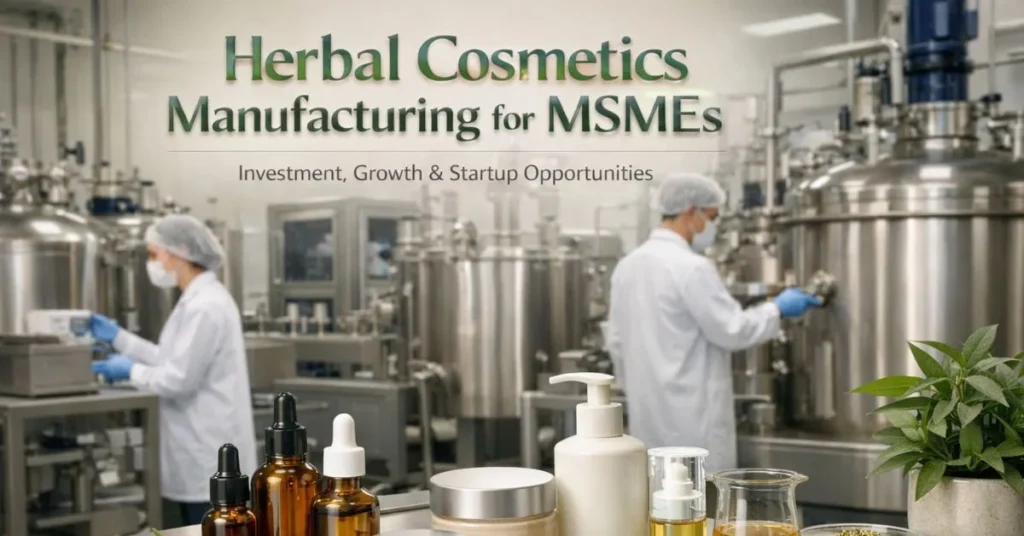
Herbal Cosmetics Manufacturing Business India’s manufacturing sector is in a new era of growth where small and medium industries are discovering opportunities outside traditional industries. One of the fastest growing areas of this transformation is that of herbal cosmetics manufacturing. Products made from natural ingredients are becoming increasingly popular due to consumer awareness of health, sustainability, and products safety. As a result, herbal personal care products such as a cleanser, moisturizer, shampoo, and conditioner are now widely used in households, salons, hospitals and in hospitality businesses. For entrepreneurs and investors, this shift is a good business opportunity. Herbal cosmetics manufacturing requires manufacturers to use agricultural raw materials together with their light industrial operations. The industry provides steady demand which requires minimal production expenses and allows businesses to increase their output. Get Detailed Insights from This Book : Herbal Cosmetics & Ayurvedic Medicines (EOU) (3rd Revised Edition) Why Herbal Personal Care Manufacturing is Good Business The herbal cosmetics industry has gained momentum because of a number of structural advantages in the Indian economy. India is one of the most prolific producers of medicinal and aromatic plants and the availability of these raw materials helps in providing growth to the manufacturing industry in the long run. The complete conversion of natural materials into final products results in major value increases. This process enables manufacturers to boost their financial returns. Some of the main reasons that entrepreneurs are venturing into this sector are: Moderate investment requirement as compared to heavy industries Strong domestic and export demand for herbal products Availability of raw materials throughout India Rising consumer demand for natural and chemical free products Friendly government policies towards MSMEs and traditional industries The current market conditions of herbal cosmetics manufacturing give businesses their best chance to expand and develop their operations through this industry. 1. Manufacturing Business Of Herbal Cleanser Herbal cleansers are fundamental personal care items used every day for cleaning up and hygiene purposes for the skin. Unlike traditional soaps which may contain harsh chemicals, herbal cleansers are made with natural extracts which help to keep your skin healthy while cleansing it gently. Because they are used on a regular basis, they create repeat sales and predictable revenue streams for manufacturers. The process of producing herbal cleansers is relatively simple and can be handled with semi-automatic machinery. Manufacturers usually prepare herbal extracts, blend them into mild surfactants, correct the pH level, and then package the finished item. With proper quality control, small manufacturing units can make consistent batches that meet consumer expectations. Common Raw Materials Used Neem extract Aloe vera gel Tea tree oil Vegetable oils Natural surfactants Preservatives and Fragrances The demand for herbal cleansers has been on rising as consumers have become more aware of their skin sensitivity and hygiene standards. Hotels, clinics and wellness centers are also using more and more herbal cleaning products which creates a larger market for the manufacturers. Estimated operating margin: 18% to 25% Get Detailed Project Report (DPR): Herbal Cosmetics 2. Herbal Moisturizer Manufacturing Business Herbal moisturizers are popular for providing hydration and protection of the skin. They are especially popular in urban markets where there are regular skincare routines by consumers. Moisturizers are also frequently bought by businesses such as hospitals, spas, and corporate organizations for the purpose of employee wellness and promotional programs. From the business point of view, moisturizers command better selling prices than the basic cleansing products. This enables manufacturers to produce greater profit margins even with medium production levels. The process of manufacturing includes the preparation of oil and water phases, heating and homogenization of two phases, and cooling of the product with subsequent packaging. Factors That Affect the Quality of Products Proper temperature control in mixing Emulsifier stabilized selection Concentrated quality of herbal extracts Suitable packaging design Packaging is an important factor in this category since consumers typically equate quality packaging with quality products. Investing in attractive packaging can enhance the perception of a brand and boost sales. Estimated operating margin: 20% to 28% 3. Manufacture of Herbal Shampoo and Conditioner Business Herbal shampoos and conditioners are among the hottest commodities on the personal care market. They deal with common hair problems like hair fall, dandruff, and dry scalp. Since hair care products are used so often, they are good sources of recurring income for manufacturers. The manufacturing process includes mixing surfactants with the herbal extracts, adjusting the viscosity of the mixture and adding fragrance and then filling the product into bottles. Conditioners need extra emulsification so that they provide a smooth texture with good conditioning performance. Major Demand Drivers Rising concerns of hair damage through chemical products Megatrends in the global beauty market and personal care products market Increasing use of herbal products for salons Increasing demand for exports from developing countries This category is especially appealing for long-term growth in business as it has one of the highest rates of repeat purchase in the consumer goods business. Estimated operating margin: 20% to 30% Related Article: How to Start a Successful Herbal and Organic Cosmetics Brand? Investment and Cost Structure Herbal Cosmetics Manufacturing Understanding the cost structure is the key before launching a manufacturing business. In most herbal cosmetics units, the cost of raw materials is the biggest expense followed by the cost of packaging and marketing. Labor and utility costs are normally manageable, especially in semi-urban areas where operating costs are lower. Typical Cost Distribution Raw materials: 35% to 40% Packaging: 20% to 25% Labor and utilities: 12% to 15% Marketing and distribution: 15% to 20% Most small-scale herbal manufacturing units achieve break-even point in two to three years, depending upon the capacity of production and demand from the market. Government Support for Herbal Manufacture Businesses The Indian government provides support to both small-scale manufacturing operations and traditional industrial sectors. Manufacturing entrepreneurs can access multiple programs which provide them with both financial assistance and training and technical support. These initiatives help in reducing the startup risks and boosts innovation in product development. Examples of
How to Start a Cosmetic Unit with Serum, Cream and Shampoo
Contact Us
Perfumes and Flavors Manufacturing: Formulations, Processes, and Business Insights
In today’s rapidly evolving consumer landscape, perfumes and flavors manufacturing stands out as a promising industry blending sensory science with business potential. From high-end fragrances and body sprays to everyday food flavorings and pharmaceuticals, these products play an integral role in our daily experiences. The formulations and production processes behind them are not only rooted in deep chemistry but also in creative innovation. With increasing consumer demand for unique, sustainable, and organic ingredients, the perfume and flavor market is booming. Global brands are constantly innovating, while startups are finding profitable niches with customized blends and clean-label products. For aspiring entrepreneurs and manufacturers, understanding the technical know-how of this business—from formulation to packaging—can open doors to a highly rewarding venture. This blog provides a detailed explanation of the processes, ingredients, and opportunities involved in building a successful perfumes and flavors manufacturing business. Understanding Perfumes and Flavors Manufacturing Formulations and Processes Manufacturing perfumes and flavors involves precision, creativity, and science. These products are used extensively across multiple sectors such as: Cosmetics and personal care (perfumes, deodorants, body mists) Food and beverages (essence, extracts, seasoning) Pharmaceuticals (flavored syrups, ointments) Household products (room fresheners, detergents, incense sticks) The industry thrives on carefully crafted formulations that combine natural extracts and synthetic chemicals. These mixtures go through standardized manufacturing processes to ensure consistency, quality, and sensory appeal. Visit this Page for More Information: Start a Business in Cosmetic Industry Key Ingredients Used in Perfumes and Flavors Formulation A successful formulation starts with the right ingredients. Each type of product uses a carefully selected combination of natural and synthetic substances. For Perfumes: Essential Oils: Natural oils extracted from flowers, fruits, resins, and woods (e.g., lavender, rose, sandalwood). Aroma Chemicals: Synthetic molecules such as linalool, coumarin, and aldehydes used to enhance or imitate natural scents. Solvents: Usually ethanol or a mix of alcohol and water that helps dissolve and carry fragrance components. Fixatives: Ingredients like musk or ambergris ensure that the scent lasts longer by slowing down the evaporation of volatile compounds. For Flavors: Natural Extracts: Derived from plants and fruits such as vanilla, mint, orange peel, or cocoa. Artificial Flavoring Agents: Lab-made compounds like ethyl vanillin and methyl anthranilate used when natural sources are unavailable or too costly. Carriers and Solvents: Substances like propylene glycol or vegetable oil that help dissolve and stabilize flavoring agents. Emulsifiers: Ensure proper mixing of oil- and water-based ingredients for homogeneity. The selection depends on the end-use of the product, safety standards, regional preferences, and cost factors. Related Business Plan: Cosmetics, Perfumery Compounds Perfume and Flavor Formulation Process Explained 1. Research and Concept Development This step involves market research, consumer trends analysis, and ingredient feasibility. The objective is to define what the end product should smell or taste like and determine its application. 2. Prototype Creation Chemists and perfumers (called “noses”) begin mixing raw materials in small batches, balancing top, middle, and base notes for perfumes or sweet, savory, and umami profiles for flavors. 3. Testing and Sensory Evaluation These prototypes are evaluated for smell, taste, strength, longevity, and performance in real-world conditions. Sensory panels may include experts or targeted consumers. 4. Final Formulation and Documentation After refinement, the final formula is documented with all ingredient percentages, safety data, regulatory compliance records, and performance benchmarks. Read Similar Articles: COSMETIC AND BEAUTY PRODUCTS Perfume and Flavor Manufacturing Process – Step-by-Step The manufacturing process transforms lab-tested formulations into market-ready products. Here’s how it works: Step 1: Raw Material Preparation All ingredients are measured, filtered, and stored under appropriate conditions to maintain quality. Ingredient traceability is crucial, especially for exports. Step 2: Mixing and Blending Ingredients are combined in mixing tanks. Temperature, pH, and blending speed are carefully controlled. This stage varies based on the product: Perfumes: Oils and solvents are blended, often aged for days or weeks. Flavors: Emulsions or suspensions are created, sometimes using ultrasonic homogenizers. Step 3: Filtration and Stabilization The mixture is filtered to remove particulates. Stabilizers or preservatives may be added to increase shelf life and product integrity. Step 4: Bottling and Packaging Automated or semi-automated machines fill the final mixture into bottles, sachets, or containers. Labeling is done according to industry standards. Step 5: Quality Control and Batch Testing Each batch undergoes final testing to ensure aroma/taste consistency, safety, microbial limits, and regulatory compliance. Certificates of analysis (CoA) may be generate. Read our Books Here: Perfumes and Flavours Technology Handbook with Manufacturing Formulations Equipment Required for Manufacturing Perfumes and Flavors To ensure efficiency and quality, investing in modern equipment is key: Stainless Steel Mixing Tanks with controlled temperature and agitation systems. Ultrasonic Emulsifiers for flavor emulsions. Vacuum Pumps and Agitators for perfume blending. Cartridge and Micron Filters for purity. Filling Machines (manual or automated) for precise bottling. Labeling and Coding Machines for batch traceability. Gas Chromatography Equipment for analytical testing. Download PDF: Perfumes and Flavours Technology Handbook with Manufacturing Safety, Regulatory, and Compliance Standards Perfumes and flavors must comply with strict industry guidelines and safety regulations: IFRA (International Fragrance Association) guidelines for fragrance components. FEMA (Flavor and Extract Manufacturers Association) regulations for food-grade flavors. FSSAI, FDA, and EU Regulations for regional compliance. MSDS and Allergen Declarations for consumer safety. REACH and GHS Compliance for export and labeling standards. Keeping up with documentation and certifications is essential for global trade. Business Opportunities in Perfumes and Flavors Manufacturing The perfumes and flavors industry is ripe with possibilities. Entrepreneurs can explore: Private Label Manufacturing: Produce custom perfumes or flavors for other brands. White Label Products: Create standard formulas that businesses can rebrand. Direct to Consumer (D2C): Build your own brand and sell via e-commerce platforms. Contract Manufacturing: Partner with large brands for scalable production. Export Business: Essential oils and organic flavors from India are in high demand globally. Aromatherapy and Wellness: With rising interest in natural healing, this niche is growing rapidly. Related Feasibility Study Reports: Cosmetics, Perfumery Compounds Trends Shaping the Future of Perfumes and Flavors Sustainable Sourcing: Brands are shifting toward eco-friendly, traceable raw materials. AI in Formulation:
Essential Oil Industry with Manufacturing Formulations
2 The Essential Oil Industry with Manufacturing Formulations is booming globally, driven by the growing demand for natural remedies, aromatherapy, clean beauty, and plant-based products. Essential oils—extracted from flowers, leaves, seeds, and bark—are widely used in cosmetics, wellness, perfumery, food flavoring, and pharmaceuticals. As the world turns to nature for holistic well-being and chemical-free alternatives, the essential oil market is gaining unprecedented momentum. According to market data, the global essential oil market was valued at over USD 21 billion in 2023 and is expected to cross USD 35 billion by 2030, growing at a CAGR of over 7%. This growth is not just led by consumer demand but also by small and medium-scale enterprises entering the space with locally sourced botanicals and customized blends. If you are looking to start a natural, sustainable, and highly scalable venture, exploring the essential oil industry with manufacturing formulations is an excellent opportunity. Whether it’s lavender oil for stress relief or tea tree oil for acne, every formulation meets a real consumer need, making this industry a rich blend of science, nature, and business. Visit this Page for More Information: Start a Business in Cosmetic Industry Why the Essential Oil Industry Is a Smart Business Investment The essential oil industry with manufacturing formulations holds significant advantages over other FMCG or wellness segments. Essential oils have applications in personal care, spa and massage therapies, household cleaning, and even medicine. What makes this industry so attractive is the low entry barrier, availability of raw materials in India (a biodiversity-rich country), and high-profit margins due to concentrated formulations. From Ayurvedic clinics to organic stores, the market for essential oils is only expanding. Consumers are now reading labels, avoiding synthetic fragrances, and seeking nature-backed alternatives. This gives entrepreneurs a chance to build honest, herbal, and health-driven brands with a loyal customer base. Related Business Plan: Cosmetics, Perfumery Compounds Key Essential Oils in Demand Globally Understanding demand helps in selecting which oils to produce. Here are some top-selling oils you can focus on: Lavender Oil – Relaxation, skin care, sleep aid Peppermint Oil – Cooling effect, muscle relief, oral care Eucalyptus Oil – Respiratory relief, anti-inflammatory Tea Tree Oil – Anti-acne, antimicrobial Lemon Oil – Skin brightening, mood-lifting, degreaser Rosemary Oil – Hair growth, cognitive support Frankincense Oil – Meditation, skincare, luxury perfume By combining these with unique manufacturing formulations, you can create signature products and target niche wellness needs. Read Similar Articles: COSMETIC AND BEAUTY PRODUCTS Essential Oil Manufacturing Formulations Explained The core of the essential oil industry with manufacturing formulations lies in two parts: extraction and blending/formulating. 1. Extraction Methods: Steam Distillation: Most common method. Plant material is steamed, and vapors are collected to separate the oil. Cold Pressing: Used mostly for citrus oils. Peels are mechanically pressed to extract oil. Solvent Extraction: Used for delicate flowers like jasmine. Chemical solvents pull oils from petals. CO? Extraction: Advanced method using carbon dioxide; yields pure oils with no residue. Download PDF: Handbook on Perfume 2. Formulation Process: Once oils are extracted, they can be used individually or blended for specific applications. A formulation includes: Base Oils/Carrier Oils: Like coconut, jojoba, or almond oil to dilute essential oils. Concentration Ratios: Typically 2-5% essential oil in body oils or lotions. Stability Additives: Natural antioxidants like Vitamin E to prolong shelf life. Preservatives (if water-based): Natural ones like Potassium Sorbate or Grapefruit Seed Extract for lotions and sprays. Watch Video: Production of Perfumes and Flavours with Formulations Example Formulation – Hair Oil Blend for Growth: Rosemary Oil – 10 ml Lavender Oil – 5 ml Peppermint Oil – 5 ml Castor Oil – 40 ml Coconut Oil – 40 ml Vitamin E – 1 capsule This mix can be bottled, labeled, and sold under your brand. Such customized formulations add value and brand uniqueness. Related Feasibility Study Reports: Cosmetics Machinery and Equipment Required Starting a small to medium-scale essential oil manufacturing unit requires specific equipment: Steam Distillation Unit – ?5 to ?10 lakh (based on size and output) Cold Pressing Machine – ?3 to ?7 lakh Oil Separators – For clean extraction Filtration System – To remove impurities Mixing Tanks/Blenders – For formulation Bottle Filling Machine – ?2 to ?5 lakh Labeling & Packaging Units Setting up a small plant can cost around ?15–25 lakh, while larger setups may require ?50 lakh to ?1 crore. However, the high retail price of essential oils ensures fast ROI if marketed right. Read our Books Here: Cosmetics and Beauty Products (Ayurvedic, Herbal) Formulation and Manufacturing Technology Regulatory and Safety Compliance To operate legally and safely, your essential oil industry with manufacturing formulations must comply with: FSSAI license (if for food-grade oils) AYUSH license (for therapeutic use) MSME/SSI Registration ISO 22716 (Good Manufacturing Practices for cosmetics) Proper labeling as per Drugs & Cosmetics Act or Cosmetic Rules 2020 Essential oils must also be tested for purity, allergens, and shelf life. A partnership with a NABL-certified lab is advisable. Marketing and Distribution Channels A successful essential oil industry with manufacturing formulations must also have a powerful go-to-market strategy: D2C Online Store: Sell blends, essential oils, and skin/hair care via Shopify, WooCommerce, or marketplaces. Retail Distribution: Supply to wellness stores, salons, spas, and Ayurveda centers. Corporate Gifting & Subscription Boxes: Bundle wellness kits for offices or monthly skincare programs. Export Market: India is a top producer of lemongrass, citronella, and vetiver oil. Get APEDA or DGFT registration and start exporting. White Labeling Services: Offer to formulate and manufacture for small brands. Profit Margin and Return on Investment Essential oils sell at high markups. A 10ml bottle that costs ?30–?50 to produce can retail between ?200–?600 depending on quality, certification, and branding. Customized blends fetch even higher margins. A small unit can break even within 6–12 months if sales are optimized through digital marketing and recurring customers. Challenges and Solutions 1 Challenge: Maintaining consistency in aroma and quality due to crop variationSolution: Source from contract farmers or grow your own herbs under organic guidelines. Challenge: Limited shelf
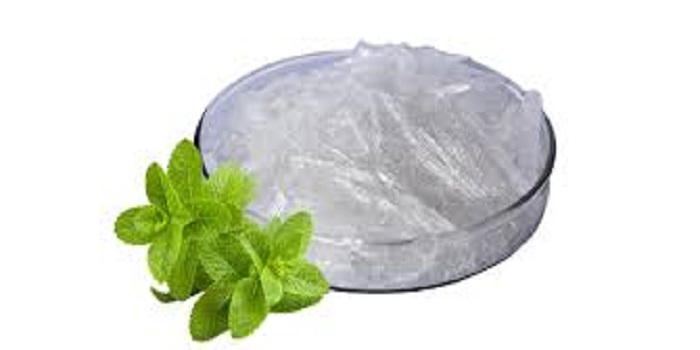
The Demand for Menthol Crystals is increasing in India Due to Increasing Demand for Natural-Based Products
India’s Agritech Revolution: Unlocking Agricultural Business Potential The agricultural landscape of India is undergoing a significant transformation, fueled by technological innovation and digital integration. Agritech in India has evolved beyond mere buzzwords to become a thriving industry poised to revolutionize how food is grown, distributed, and consumed. As the backbone of India’s economy, agriculture now stands at the cusp of a digital overhaul, supported by policy incentives, venture capital investments, and a growing population of tech-savvy farmers. With over 58% of India’s population relying on agriculture for their livelihood, the sector’s modernization through Agritech presents a monumental business opportunity for entrepreneurs, investors, and stakeholders alike. Rising Demand for Agritech in India The need for sustainable, efficient, and high-yield farming practices has created a ripe environment for the adoption of Agritech in India. Rising food demands, climate change concerns, land degradation, and labor shortages have all contributed to the surge in digital agricultural solutions. Whether it’s precision farming, drone monitoring, or AI-powered crop forecasting, Agritech startups are disrupting the traditional agricultural model with bold innovations. India is witnessing a surge in Agritech startups—over 1,300 companies currently operate in the sector, with total investments exceeding $1.6 billion by 2024. This showcases the market’s confidence in the long-term viability of Agritech in India as both a scalable business and a social necessity. Government Support and Policy Framework The Indian government has been instrumental in fostering the growth of Agritech businesses. Initiatives such as Digital India, PM-KISAN, and the National Agriculture Market (eNAM) provide a solid foundation for digital transformation in agriculture.Key policies and support mechanisms include: Startup India offering tax incentives and funding support to Agritech ventures. Agri Infra Fund (AIF) worth ?1 lakh crore to promote agri-entrepreneurship. FPO (Farmer Producer Organization) model integration with Agritech platforms. Such initiatives lower entry barriers and attract aspiring entrepreneurs to the Agritech in India market. Key Segments Driving Agritech Growth Smart Farming and Precision Agriculture Smart farming solutions—powered by IoT, GIS, sensors, and big data—enable farmers to optimize resource use and monitor crops in real time. Precision agriculture enhances crop yields, reduces input waste, and lowers operational costs. Soil health monitoring Weather forecasting Automated irrigation systems Sensor-based pest and disease detection Agri Supply Chain and Logistics Post-harvest management is crucial for reducing food waste. Agritech companies are offering supply chain solutions like: Blockchain-based traceability Cold storage logistics management Demand forecasting using AI/ML Direct-to-consumer (D2C) farm produce platforms These solutions bridge the gap between farmers and end-users, reducing middlemen and improving profit margins. Financial Services and Agri Lending Access to credit and insurance is a major challenge for Indian farmers. Fintech-powered Agritech platforms are providing: Credit scoring based on farm data Instant agri-loans through mobile apps Crop insurance based on satellite and weather data Flexible repayment models via digital wallets Farm Management Software & Advisory Services With increased smartphone penetration in rural areas, farmers now access digital advisory platforms offering: Farming best practices Real-time agronomic advice Market price alerts Crop selection based on soil and climate data Companies like DeHaat, AgroStar, and CropIn are helping farmers make data-backed decisions, resulting in improved productivity. Drone Technology and Remote Sensing Drones are revolutionizing field surveillance, pesticide spraying, and crop health analysis. Supported by the liberalized Drone Policy 2022, these UAVs are boosting yields and reducing manual labor dependencies. Opportunities for Entrepreneurs and Investors The Indian Agritech sector offers diverse monetization avenues: B2B SaaS platforms targeting agribusinesses and FPOs Subscription-based advisory services for farmers Marketplace models connecting farmers directly to consumers Hardware-as-a-service models for drones, IoT devices, and sensors With increasing internet penetration and smartphone adoption in Tier 2 and Tier 3 towns, the scalability potential of Agritech in India is immense. Challenges in Agritech Adoption Despite the growing interest, some key hurdles persist: Low digital literacy among smallholder farmers Fragmented landholdings limiting tech applicability Connectivity issues in rural and remote areas High upfront costs of advanced technologies However, these challenges open the door for inclusive innovation and local language interfaces, ensuring broader Agritech adoption. Top Agritech Startups Leading Innovation in India 1. Ninjacart A leading B2B agri supply chain company, bridging farmers with retailers and restaurants through tech-enabled logistics. 2. DeHaat Offers full-stack services from agri inputs to advisory, credit, and market linkages, serving over 700,000 farmers. 3. CropIn An AI and data-driven agri SaaS platform helping businesses monitor and improve farm productivity. 4. AgroStar An e-commerce platform for farm inputs with personalized advisory services, active across multiple Indian states. 5. Stellapps Focuses on the dairy industry using IoT to digitize the milk supply chain. These companies are setting global benchmarks and attracting significant investor attention, showcasing the global competitiveness of Agritech in India. The Future Outlook of Agritech in India The future of Agritech in India is promising. By 2030, the market is projected to reach a valuation of $24 billion, driven by the following trends: Climate-resilient farming using AI/ML Agrivoltaics and solar-powered irrigation Vertical farming and hydroponics in urban India 5G-enabled agricultural automation Decentralized agri-data platforms The integration of smart agriculture with sustainable practices, renewable energy, and digital financing is likely to create new paradigms in rural development and food security. Conclusion: Agritech – A Catalyst for Agricultural Transformation As the agricultural ecosystem in India embraces modernization, Agritech is not just a disruptor but a necessity. From increasing farmer incomes to ensuring food security, Agritech in India holds the power to transform the sector holistically. For entrepreneurs, investors, and stakeholders, the time is now to tap into this fertile domain and sow the seeds of sustainable growth and innovation. Agritech in India is no longer an emerging trend—it is the future of agriculture. Visit the page Select and Choose the Right Business Startup for You for sorting out the questions arising in your mind before starting any business and know which start-up you can plan. We, at NPCS, endeavor to make business selection a simple and convenient step for any entrepreneur/startup. Our expert team, by capitalizing on its dexterity and decade’s long experience in the field,
Guide to Start a Toothpaste Manufacturing Business
To start a toothpaste manufacturing business is to step into one of the most stable and evergreen sectors in the personal care industry. Oral hygiene is a daily essential, and toothpaste is a product used by nearly every household across the world. With growing awareness about dental health, increased consumption patterns, and a wide range of market segments from economy to premium herbal blends, the toothpaste industry offers strong potential for both startups and established manufacturers. Whether you plan to target general consumers, niche herbal markets, or private label clients, the toothpaste business remains highly scalable and rewarding. Market Potential and Industry Overview The demand for toothpaste is consistently high, driven by population growth, rising income levels, and better dental awareness campaigns. In India alone, the oral care market is valued at over ?10,000 crore, with toothpaste contributing nearly 70% of this. Urban consumers are increasingly switching to herbal and natural variants, while rural regions are rapidly catching up in terms of oral hygiene awareness. Globally, people are looking for fluoride-free, whitening, sensitive teeth, and eco-conscious options. When you start a toothpaste manufacturing business, you can cater to multiple niches like ayurvedic, kids’ toothpaste, charcoal-based, or even vegan-friendly products. The low dependency on seasonality and high repeat purchase behavior make this business sustainable with strong cash flow potential. Visit this Page for More Information: Start a Business in Cosmetic Industry Types of Toothpaste Products You Can Manufacture One of the first steps when you start a toothpaste manufacturing business is selecting your product range. The industry offers multiple variants: Fluoridated toothpaste (common for cavity protection) Herbal or ayurvedic toothpaste (with ingredients like neem, clove, babool) Sensitive toothpaste (for pain relief and enamel care) Whitening toothpaste (contains silica or activated charcoal) Kids toothpaste (fluoride-free, fruity flavors) Gel-based toothpaste (aesthetic and smooth texture) Medicated toothpaste (requires pharma license) Your choice will depend on the target demographic, market trends, and your investment capacity. Herbal toothpaste is growing rapidly, especially in export markets, offering a lucrative opportunity if you position your brand right. Read Similar Articles: Cosmetic and Beauty Products Manufacturing Process and Required Equipment The manufacturing of toothpaste involves a carefully controlled process to ensure consistency, texture, and safety. The typical steps include: Weighing and mixing raw materials (binders, abrasives, humectants, and active ingredients) Homogenizing the mixture to a smooth paste Deaerating the paste to remove air bubbles Filling and sealing the tubes or containers Quality testing and packaging To start a toothpaste manufacturing business, you’ll need essential equipment like: Mixing tanks and agitators Vacuum deaerator machines Paste filling machines (automatic/semi-automatic) Tube sealing machines Labeling and batch coding machines Water purification systems (if required) Setting up a small-scale unit can be done in a space of around 1000–1500 sq. ft. For medium- to large-scale production, you will require a more sophisticated setup with cleanroom standards and larger capacity machinery. Read our Books Here: Cosmetics and Beauty Products (Ayurvedic, Herbal) Formulation and Manufacturing Technology Raw Materials and Formulation Toothpaste formulation is the backbone of your product. Some of the key ingredients include: Abrasives: Calcium carbonate, silica Humectants: Sorbitol, glycerin Binders: Sodium carboxymethyl cellulose Surfactants: Sodium lauryl sulfate (SLS) Active agents: Fluoride, clove oil, neem extract, zinc compounds Flavoring: Mint, menthol, cinnamon Preservatives: Sodium benzoate Deionized or purified water To start a toothpaste manufacturing business, ensure all ingredients comply with BIS standards or international safety norms. You can work with a cosmetic chemist or R&D consultant to formulate unique variants. Consider offering herbal or fluoride-free alternatives to cater to health-conscious consumers. Business Plan: Start a Toothpaste Manufacturing Business Licensing, Compliance, and Legal Requirements Since toothpaste falls under the cosmetics category in most regions, you will need to comply with certain regulations. In India, the following licenses and documents are typically required: MSME/Udyam registration GST registration BIS certification (IS 6356 standard for toothpaste) Cosmetics manufacturing license from the Drug Control Department Pollution NOC (if applicable) Factory license and fire safety approval When you start a toothpaste manufacturing business, it’s crucial to adhere to proper labeling guidelines including batch number, ingredients list, expiry date, net quantity, and manufacturer details. If you’re planning exports, additional clearances like FDA, ISO 22716 (GMP), or Halal certification may be needed based on the destination market. Related Feasibility Study Reports: Cosmetics, Perfumery Compounds Packaging, Branding, and Labeling Packaging is one of the key success factors in the toothpaste market. Consumers are drawn to attractive, informative, and easy-to-use packaging. You can choose between: Laminated squeeze tubes Flip-top caps or nozzle caps Plastic or aluminum variants Eco-friendly packaging for sustainable brands Label design should highlight product USPs like “100% Herbal,” “Fluoride-Free,” or “Whitening in 7 Days.” Branding plays a huge role when you start a toothpaste manufacturing business. Choose a memorable brand name, invest in strong visual identity, and create trust through clinical claims or herbal certifications. Private labeling is another avenue where you can manufacture toothpaste for other companies under their brand name. This B2B segment offers great potential for consistent large orders. Cost Estimation and Financial Plan You can start a toothpaste manufacturing business on a small scale with an investment of ?10–15 lakhs. This includes machinery, raw materials, packaging materials, licenses, and working capital. A medium-scale unit may require ?25–40 lakhs or more depending on automation and capacity. Example cost breakdown for a 500 kg/day unit: Machinery and setup: ?8–10 lakhs Raw materials: ?2–3 lakhs (initial stock) Packaging and branding: ?2 lakhs Compliance and documentation: ?1 lakh Marketing and distribution: ?2–3 lakhs Total: ~?15–18 lakhs You can expect gross margins of 30% to 40%, with breakeven achievable in 12–18 months depending on volume and branding strength. Marketing and Distribution Strategy Once your product is ready, the next step is market penetration. Key channels include: General trade (chemist shops, retail outlets) Supermarkets and FMCG distributors Online platforms (Amazon, Flipkart, Nykaa) Dental clinics or wellness centers (for specialized variants) Export opportunities to Gulf, Africa, Southeast Asia Influencer marketing, sample distribution, and strong in-store visibility can help build initial traction. When you start
Talcum and Compact Face Powder Manufacturing Business
The cosmetics industry has witnessed substantial growth in recent years, with face care products leading the demand. Among these, Compact Face Powder is a daily-use product, especially popular among urban and semi-urban consumers. With the increasing consciousness about personal grooming and skincare, starting a business in talcum and compact face powder manufacturing can be a lucrative venture for entrepreneurs aiming to tap into the growing beauty and wellness sector. Scope and Market Potential of Compact Face Powder Manufacturing In India and globally, the cosmetics market is expanding rapidly. Compact face powder is a staple in most makeup routines because it helps set makeup, controls oil, and gives a polished finish. Talcum powder also holds a significant share in the personal care market, being used for body freshness, skin protection, and fragrance. According to recent market research, India’s cosmetic market is projected to grow at a CAGR of over 9% till 2028. The surge in demand is due to factors such as increasing disposable income, social media influence, celebrity endorsements, and changing lifestyles. Compact face powder forms a critical segment of this market, with opportunities ranging from low-cost options to premium luxury brands. Understanding the Product: Compact Face Powder vs Talcum Powder Compact Face Powder Compact face powder is a pressed powder used after applying foundation. It helps reduce shine, evens skin tone, and gives a matte finish. The formulation usually includes talc, kaolin, zinc oxide, and pigments for tint. Some also include SPF and nourishing agents like vitamin E or aloe vera. Talcum Powder Talcum powder is a soft, fine powder made from talc—a mineral composed mainly of magnesium, silicon, and oxygen. It is used to absorb moisture, reduce friction, and prevent rashes. Talcum powder is often fragranced and used as a body freshener. Both products have overlapping ingredients and manufacturing processes, allowing an entrepreneur to diversify their product line easily after setting up. Step-by-Step Guide to Start Manufacturing Step 1: Market Research & Business Plan Start by conducting thorough market research: Analyze the competition and identify popular compact face powder brands. Understand the pricing, packaging, and USPs of existing products. Determine your target audience: mass-market, mid-range, or luxury segment. Prepare a detailed business plan covering budget, location, scale, and marketing. Step 2: Business Registration and Licensing Legal compliance is crucial: Business Registration: Register your firm as a Proprietorship, LLP, or Private Limited Company. GST Registration: Mandatory for invoicing and tax compliance. Trade License & Factory License: Obtain from local municipal authorities. Drug and Cosmetic License: Required under the Drugs and Cosmetics Act, 1940, since you’re manufacturing cosmetics. BIS Certification: Especially if you plan to sell talcum powder. MSME Registration: For small-scale businesses to avail government schemes. Step 3: Location & Factory Setup Choose a location with proper sanitation, power supply, water availability, and logistics access. Industrial areas are preferred. Ensure compliance with pollution control norms. Design your layout into different sections: Raw material storage Mixing and blending Powder compression (for compact powders) Packaging area Quality control lab Finished goods storage Step 4: Raw Materials Required For Compact Face Powder: Talc (base) Kaolin clay Magnesium stearate Zinc oxide Titanium dioxide (for sun protection) Pigments and colorants Preservatives Fragrance oils Binding agents like isopropyl alcohol or dimethicone Vitamin E or herbal extracts (optional) For Talcum Powder: Talc Fragrance Triclosan (antibacterial agent) Preservatives Source raw materials from verified cosmetic-grade suppliers with MSDS and quality certificates. Step 5: Machinery and Equipment To manufacture talcum and Compact Face Powder, you will need the following machines: Ribbon blender or mixing vessel Pulverizer (for talc) Compact pressing machine (hydraulic or rotary press) Granulator and sifter Perfume spray machine Weighing scale Filling and sealing machines Labeling machine Quality testing equipment Estimated machinery cost for small-scale units: ?8 to ?15 lakhs. Step 6: Manufacturing Process For Compact Face Powder: Blending: Mix talc, kaolin, pigments, and other ingredients in the blender. Binding: Add liquid binder and mix to create a slightly damp mixture. Compression: Fill mixture into metal pans and compress using hydraulic pressing machine. Curing: Let powders sit to stabilize. Packaging: Place the compact pans into plastic containers with mirrors and puffs. For Talcum Powder: Pulverizing: Finely grind talc to remove grit. Blending: Add fragrance and antibacterial agents. Sifting: Pass through fine mesh for consistency. Filling: Fill into containers using automatic machines. Labeling and Sealing: Seal and label the bottles for final dispatch. Step 7: Quality Control and Testing Ensure product safety and efficiency through proper lab testing: Microbial testing pH level testing Skin irritation test Shade uniformity and stability Fragrance retention test SPF value (if applicable) Maintain batch-wise production records, quality check logs, and raw material traceability to comply with regulations. Step 8: Packaging and Branding Attractive packaging is critical for Compact Face Powder to succeed. Use eye-catching designs and secure, leak-proof compacts. Include important details: Product name Ingredients Expiry date Net weight Usage instructions Batch number Manufacturing and marketing company name Invest in custom branding and develop a strong identity with logo, tagline, and consistent visuals. Step 9: Marketing and Sales Channels Promote your compact face powder brand through: Social media campaigns (Instagram, YouTube tutorials) Influencer marketing Free samples and trials at salons and beauty parlors Collaboration with dermatologists and skincare clinics Listing on marketplaces like Amazon, Nykaa, Flipkart Offline distribution via cosmetic shops and pharma chains Highlight benefits such as “Paraben-Free,” “Dermatologist-Tested,” “For All Skin Types,” or “Organic.” Step 10: Scale-Up and Diversification Once your compact face powder gains traction, you can scale by: Introducing shades for different skin tones Launching liquid foundation, primer, or BB creams Creating seasonal or limited-edition collections Exporting to international markets after compliance with local cosmetic norms Investment and Profitability Analysis The average cost to set up a small to medium-scale Compact Face Powder manufacturing unit is ?20–?35 lakhs, including equipment, raw materials, labor, and marketing. Profit Margins: Talcum powder: 20–30% Compact face powder: 30–50% With proper branding and consistent quality, the breakeven point can be achieved within 12–18 months. Challenges and Tips for Success Common Challenges: Regulatory hurdles
Toothpaste Manufacturing Business
In today’s fast-paced world, personal hygiene and dental care are among the top priorities for individuals of all ages. One essential product that contributes significantly to oral health is toothpaste. With increasing awareness about dental hygiene and the expanding consumer base in urban and rural areas alike, starting a toothpaste manufacturing business is a lucrative venture. The demand is constant, and the market offers potential for innovation and niche products like herbal, medicated, or whitening toothpaste. If you’re considering entering this field, here’s a complete guide on how to start a successful toothpaste manufacturing business. Understanding the Market and Planning the Business Before diving into the actual manufacturing process, it’s vital to research the toothpaste industry thoroughly. Toothpaste is a daily-use item, meaning its market has steady and recurring demand. The global dental hygiene market has been growing steadily, and with increasing oral health awareness, the consumption of toothpaste is expected to rise even more in the coming years. You need to decide on the scale of your toothpaste manufacturing business—whether you plan to start a small-scale unit catering to local markets or a large-scale plant aimed at national or international distribution. Identifying your target market will also help you determine your product line—regular fluoride-based toothpaste, herbal formulations, gel-based toothpaste, or specialized products for sensitivity, whitening, or children’s oral care. Legal and Regulatory Requirements To launch your toothpaste manufacturing business, you must comply with all legal and regulatory requirements. These include: Company Registration: Register your business under a suitable structure—proprietorship, partnership, or private limited company. Trade License: Obtain a trade license from the local municipal authority. GST Registration: Mandatory for taxation purposes. FSSAI License: Since toothpaste is a personal care item that enters the human body (through the mouth), an FSSAI (Food Safety and Standards Authority of India) license is essential. BIS Certification: The Bureau of Indian Standards sets quality norms for toothpaste. You must comply with IS 6356 for toothpaste. Environmental Clearance: If your plant will have effluents or waste output, you may need clearance from the pollution control board. Trademark and Branding: Secure a trademark for your brand name and logo to protect your intellectual property. Setting Up the Manufacturing Unit Choosing the right location for your toothpaste manufacturing unit is key to operational efficiency. The space should be sufficient for raw material storage, production, packaging, and warehousing. Accessibility to transportation, water, and electricity is crucial. You’ll also need to invest in the necessary equipment, which typically includes: Mixing tanks Heating tanks Paste filling machines Tube sealing machines Packaging and labeling machines Water purification system Quality testing laboratory equipment Depending on your product line, you may also need specialized equipment for gel-based or herbal formulations. Setting up a standard laboratory for quality control is highly recommended to ensure product consistency and compliance. Raw Materials and Formulation The primary ingredients used in toothpaste manufacturing include: Abrasives (e.g., calcium carbonate, silica) for removing dental plaque and stains. Binders (e.g., cellulose gum) to give consistency to the paste. Humectants (e.g., glycerin, sorbitol) to retain moisture. Fluorides (e.g., sodium fluoride) to prevent tooth decay. Flavoring agents (e.g., mint, clove) to enhance taste and freshness. Sweeteners (e.g., saccharin) for flavor. Preservatives and colorants for product longevity and visual appeal. If you’re venturing into herbal or natural toothpaste, common ingredients include neem, clove oil, charcoal, and herbal extracts. It’s essential to work with a qualified chemist to develop safe and effective formulations. Adherence to BIS standards is a must, especially in ingredient composition and fluoride content. Manpower Requirements A toothpaste manufacturing plant will require trained and semi-skilled labor to manage production, quality testing, and packaging. The team may include: Production manager Lab technician/chemist Machine operators Packers and sorters Administrative staff Hiring experienced personnel can help maintain efficiency, reduce wastage, and ensure high product quality. Proper training in hygiene standards and handling of chemicals is also necessary. Packaging and Branding Packaging plays a significant role in consumer appeal. Tubes are the most common packaging option for toothpaste, but the design, material quality, and labeling should align with your target market. Invest in good-quality, tamper-proof, and leak-proof packaging. Branding is critical in a highly competitive segment like toothpaste. Your brand should communicate trust, quality, and value. This involves: Logo and label design Taglines that highlight product features (e.g., herbal, fluoride-free) Certifications and usage instructions Manufacturing and expiry dates Make sure your packaging complies with applicable labeling regulations, including ingredient lists and safety warnings. Marketing and Distribution An effective marketing strategy is crucial for the success of your toothpaste manufacturing business. You can explore several distribution channels: Retail stores Supermarkets and hypermarkets Pharmacies and health stores E-commerce platforms Direct-to-consumer (D2C) through your own website Marketing efforts can include: Digital marketing (SEO, PPC ads, social media) Traditional advertising (TV, radio, newspapers) Collaborations with dentists or dental clinics Free samples and in-store promotions Loyalty programs or discount schemes Focus on building a brand that resonates with your audience, whether it’s health-conscious urban consumers, budget-conscious rural markets, or niche segments like eco-friendly users. Financial Aspects and Investment The capital requirement for setting up a toothpaste manufacturing unit depends on the scale of your operations. A small-scale plant may require an investment of ?20-50 lakhs, while a medium to large-scale setup can go upwards of ?1 crore or more. Key costs include: Land and building Machinery and equipment Licensing and certification Raw materials procurement Staff salaries Marketing and branding Working capital You can seek financial assistance through bank loans, government subsidies, or venture capital if your business plan shows promise. Programs like MSME loans or subsidies under the Make in India initiative can be helpful. Quality Control and Compliance To succeed in toothpaste manufacturing, product quality and safety are non-negotiable. Establish a robust quality control system where raw materials, in-process goods, and final products are tested regularly. Testing should cover: pH level Fluoride content Microbial load Viscosity and spreadability Shelf life Regular audits and sample testing help in maintaining brand reputation and building consumer trust. Follow Good Manufacturing Practices (GMP)
Production of Plastic Toothbrushes
Plastic toothbrushes are one of the most widely used personal hygiene products across the globe. With growing awareness of oral hygiene, the demand for plastic toothbrushes has surged dramatically. Whether it’s for children, adults, or functional needs users, toothbrushes are a daily necessity. If you’re considering starting a plastic toothbrush manufacturing business, this comprehensive guide will walk you through the process step-by-step. From raw materials to marketing strategies, we cover it all. The keyword plastic toothbrush will be discussed in-depth to help you understand the nuances of this evergreen product market. Understanding the Plastic Toothbrush Manufacturing Process To begin with, it is essential to understand that toothbrushes are a blend of design, ergonomics, and material science. A plastic toothbrush typically comprises a plastic handle and nylon bristles. The production process involves several steps including material selection, molding, tufting, trimming, packaging, and quality control. 1. Raw Materials Required The major raw materials required to produce a plastic toothbrush are: Plastic Granules: Usually polypropylene (PP) or polyethylene (PE) for handles due to their lightweight and moldability. Nylon Bristles: Commonly nylon-6 or nylon-6.6, known for their flexibility and durability. Color Pigments: To add variety to the toothbrush handle and make them visually appealing. Packaging Material: Blister packs, cartons, or plastic pouches. The quality of raw materials directly impacts the final product. Sourcing from reliable vendors ensures consistency in toothbrush performance. 2. Machinery and Equipment Needed For plastic toothbrush manufacturing, several key machines are required: Injection Molding Machine: Used to mold plastic granules into handle shapes. Tufting Machine: Implants bristles into the holes of the plastic handle. Trimming Machine: Cuts bristles uniformly to ensure evenness and softness. Polishing Unit: Smoothens the toothbrush head and removes sharp edges. Packaging Machine: Automates the packing process to increase output. Investing in semi-automatic or fully automatic machines depends on your production capacity and budget. 3. Step-by-Step Manufacturing Process The manufacturing of a plastic toothbrush includes multiple coordinated steps. Here’s how it unfolds: a. Handle MoldingPlastic granules are heated in the injection molding machine and injected into molds. After cooling, the mold opens to eject the formed plastic toothbrush handles. b. Bristle TuftingThis step involves inserting nylon bristles into the head of the toothbrush. Modern machines use the staple-and-tuft method, ensuring bristles stay firmly in place. c. Trimming & End RoundingBristles are trimmed to uniform length and shaped for specific uses (flat, wavy, zig-zag). End rounding is essential to make the bristles safe for gums. d. Polishing and FinishingPolishing removes burrs or sharp edges. Some toothbrushes undergo laser engraving for branding. e. Cleaning and SterilizationThe finished plastic toothbrushes are cleaned and sterilized before packaging to ensure hygiene. f. PackagingToothbrushes are then individually packed using blister packs or eco-friendly alternatives and boxed in bulk for shipment. 4. Cost of Setting Up the Manufacturing Unit The cost varies depending on the scale of operation. Here’s a rough estimate: Small Scale: ?10 – ?15 lakhs Medium Scale: ?25 – ?50 lakhs Large Scale: ?1 crore and above Costs include machinery, raw materials, factory setup, labor, and utilities. Operating costs like electricity, water, maintenance, and salaries also need to be accounted for. 5. Location and Infrastructure The manufacturing unit should ideally be located in an industrial zone with access to electricity, water, and transportation. Space requirements can range from 1000 to 3000 square feet depending on your production capacity. Good ventilation and hygiene are critical, especially if you aim for ISO or FDA certifications. 6. Manpower Requirements A small-scale plastic toothbrush manufacturing unit typically requires: 2-3 machine operators 2 helpers for material handling 1 quality control supervisor 1 packaging and logistics staff 1 manager/admin Proper training must be provided to ensure operational efficiency and product quality. 7. Quality Control and Standards Quality plays a vital role in customer retention and brand image. Some important quality checks include: Bristle Pull Test: Ensures bristles are firmly attached. Handle Strength Test: Prevents breakage during use. End Rounding Check: Protects gums from injury. Sterility Test: Confirms the product is hygienically safe. Certifications like ISO 9001 (Quality Management) and ISO 13485 (Medical Devices) can boost credibility. 8. Marketing and Sales Strategy Once you have a ready product, focus on branding and marketing. Here are some effective strategies: Create a Brand: A memorable name and packaging design go a long way. B2B Channels: Distribute to wholesalers, dental clinics, hospitals, and pharmacies. Online Platforms: Sell through Amazon, Flipkart, and your own e-commerce site. Social Media Marketing: Promote your plastic toothbrush through Instagram and Facebook. Bulk Export: Consider exporting to developing countries with high demand. Offline and online efforts should be synchronized for maximum reach. 9. Environmental Concerns and Alternatives Traditional plastic toothbrushes contribute to plastic waste. To stay competitive and socially responsible: Explore biodegradable or bamboo handles with nylon bristles. Use recyclable packaging. Highlight eco-conscious branding to appeal to green consumers. Governments are tightening environmental norms, so adopting sustainability practices early on is a smart move. 10. Challenges and Risk Management Some common challenges in the plastic toothbrush business include: High Competition: Many local and global players. Price Sensitivity: Consumers often buy based on price. Supply Chain Issues: Raw material cost fluctuations can affect profitability. Changing Regulations: Eco-friendly compliance is becoming stricter. Mitigation strategies involve diversifying product lines (e.g., electric toothbrushes, kids’ variants), building brand loyalty, and maintaining a lean supply chain. 11. Future Scope of the Industry The toothbrush industry is expected to grow steadily due to increasing awareness of oral care and lifestyle improvements. Innovations in bristle technology, ergonomic designs, and sustainable materials are on the rise. Venturing into premium toothbrush segments or subscription models can further enhance revenue. Developing countries like India, Brazil, and parts of Africa are large untapped markets. Additionally, collaborations with dental clinics for co-branded products could open new sales channels. Conclusion Starting a plastic toothbrush manufacturing business can be a profitable venture when planned and executed carefully. From acquiring quality raw materials to installing efficient machines, every step plays a crucial role in producing a product that stands out in the market.
Learn Hair Dye Making – Industrial Production Guide
The global cosmetic industry is evolving rapidly, and one of the fastest-growing segments is hair colour manufacturing. With increasing awareness about beauty, fashion, and self-grooming, the demand for high-quality, safe, and effective hair colours is skyrocketing. Entrepreneurs looking to invest in this segment are eyeing lucrative opportunities, as consumers of all age groups are now exploring various shades and types of hair colouring products. This guide will walk you through everything you need to know to set up a Hair Colour Manufacturing unit, from planning and raw materials to the manufacturing process and marketing strategies. Understanding the Hair Colour Manufacturing Process Before you dive into the manufacturing process, it’s essential to understand what hair colour is and how it works. Hair colour products come in various forms—permanent, semi-permanent, temporary, natural, and synthetic. Each product formulation is different, depending on the desired outcome and type of colourant used. 1. Market Research and Business Planning The first step in launching a Hair Colour Manufacturing business is thorough market research. Study the trends, demands, competitors, and consumer preferences. Determine whether you’ll target the professional salon segment, retail market, or both. Identify gaps in the current offerings—such as organic hair dyes, ammonia-free options, or herbal-based formulas—to build a unique selling proposition (USP). Once you have your research, create a detailed business plan covering: Business model (B2B, B2C, or hybrid) Initial investment and funding sources Plant location and size Licensing and compliance requirements Target audience and marketing plan Profit margins and expected ROI 2. Legal Formalities and Compliance To start a Hair Colour Manufacturing unit in India (or most countries), you must fulfill legal and regulatory requirements. Some of the key registrations include: Company registration (Proprietorship, LLP, or Pvt. Ltd.) GST registration Trade license from local authorities Factory license under the Factories Act Pollution Control Board NOC BIS Certification for hair colour (IS 7669:1975) Drug & Cosmetic License from the State FDA Compliance with Good Manufacturing Practices (GMP) and quality standards is critical in the cosmetic industry to ensure safety and efficacy. 3. Infrastructure and Machinery Setup Set up your manufacturing plant with separate zones for raw material storage, production, quality control, packaging, and warehousing. Ensure good ventilation, dust control systems, and hygiene practices in your plant. Here are some of the essential machinery required: Mixing tanks and reactors Homogenizers and emulsifiers Filling and sealing machines Labeling machines Quality control lab equipment Water purification system Choose machinery based on your production scale—semi-automatic for small-scale units and fully automatic for large-scale units. 4. Raw Materials Used in Hair Colour Manufacturing The selection of raw materials plays a crucial role in determining the product’s quality. Typically, the following ingredients are used in the Hair Colour Manufacturing process: Colourants: Paraphenylenediamine (PPD), Resorcinol, and other dye intermediates Developers: Hydrogen peroxide or other oxidizing agents Conditioners: Silicones, panthenol, or herbal oils Thickeners: Xanthan gum or carbomers pH adjusters: Ammonia, monoethanolamine (MEA) Preservatives: Parabens, phenoxyethanol Fragrances and emulsifiers Many manufacturers are shifting toward herbal and ammonia-free formulas to cater to the demand for cleaner beauty products. 5. The Manufacturing Process The step-by-step process of Hair Colour Manufacturing includes: a) Formulation and TestingChemists or cosmetic scientists create a formula based on the desired shade, hair type, and safety regulations. Prototype batches are developed and tested in the lab for stability, pH, viscosity, and performance. b) Pre-MixingAll the ingredients are weighed as per the formulation and pre-mixed in a large stainless steel tank. This ensures homogeneity before the final processing. c) Emulsification and HomogenizationThe pre-mix is then passed through emulsifiers and homogenizers to achieve a smooth and stable emulsion. Heat may be applied depending on the ingredients used. d) Quality Control ChecksSamples are collected from each batch and sent to the QC lab for inspection. Parameters such as colour shade, pH, microbial contamination, and consistency are tested. Only batches that pass QC are sent for packaging. e) Filling and PackagingThe final product is filled into tubes, sachets, bottles, or jars using filling machines. Products are then sealed, labeled, and packed in cartons or display boxes. Packaging must be tamper-proof, attractive, and informative. f) Storage and DispatchFinished goods are stored in the warehouse under temperature-controlled conditions until they are dispatched to distributors or retailers. 6. Cost and Investment Estimation The cost of starting a Hair Colour Manufacturing unit varies based on scale. Here is an approximate breakdown for a small-scale setup: Land and building: ?20-30 lakhs (leased or owned) Machinery: ?10-15 lakhs Raw materials: ?5-10 lakhs (initial stock) Labor and staffing: ?1-2 lakhs/month Licenses and certifications: ?1-2 lakhs Marketing and branding: ?3-5 lakhs Miscellaneous expenses: ?2-3 lakhs Total investment: ?40-60 lakhs (approx.) Larger-scale plants may require ?1 crore or more. You can seek funding through bank loans, government subsidies (under MSME or Start-Up India), or private investors. 7. Branding and Marketing Strategy Building a strong brand is essential in the Hair Colour Manufacturing business due to intense competition. Here are some ways to promote your brand: Develop a strong logo, packaging design, and product identity Highlight USPs like “herbal-based,” “ammonia-free,” or “salon-quality” Use influencer marketing and beauty bloggers to create buzz Partner with salons for product trials and endorsements Sell via eCommerce platforms like Amazon, Nykaa, Flipkart, etc. List on B2B platforms like IndiaMART and TradeIndia Attend trade expos and beauty product exhibitions Also, invest in digital marketing—create social media pages, run Google Ads, and maintain an SEO-optimized website to reach a wider audience. 8. Challenges and Risk Factors While the Hair Colour Manufacturing industry is lucrative, it does come with certain challenges: Strict regulatory compliance and approvals Constant innovation to meet changing consumer preferences Managing product returns or allergic reactions Seasonal demand fluctuations High initial investment and working capital needs Sourcing quality raw materials consistently Having a solid risk management plan and staying up-to-date with cosmetic science trends can help overcome these hurdles. 9. Sustainability and Green Manufacturing Eco-conscious consumers are now driving the shift toward sustainable cosmetics. Consider adopting green manufacturing practices such as: Using natural or plant-based dyes and ingredients