
Soda Ash Market of Middle East/North Africa (MENA)
Overview of the Soda Ash Market in MENA The Soda Ash Market in the Middle East and North Africa (MENA) region is witnessing a significant transformation, marked by increasing industrial demand, infrastructure expansion, and rising consumer needs. Soda ash, also known as sodium carbonate (Na?CO?), is a vital raw material used across diverse sectors such as glass manufacturing, detergents, chemicals, water treatment, and pulp & paper. The strategic geographic positioning of MENA countries, paired with rich natural resources and industrialization, has turned the region into a lucrative zone for soda ash production and consumption. Current Trends Shaping the MENA Soda Ash Market 1. Industrialization and Urban Development Rapid industrial growth and urbanization in nations like Saudi Arabia, the United Arab Emirates, Egypt, and Morocco are driving the demand for construction materials and glass products. As soda ash is a critical component in the glass manufacturing process, this surge in demand is directly influencing the soda ash market positively. Additionally, infrastructure megaprojects such as NEOM in Saudi Arabia and New Administrative Capital in Egypt further bolster consumption. 2. Increased Demand in Detergents and Household Products With rising awareness of hygiene and health across the region, there is a notable increase in the demand for soaps, detergents, and household cleaners. Soda ash serves as a builder and pH regulator in detergent formulations, making it indispensable for manufacturers. The expanding middle-class population and higher disposable income levels are reinforcing this upward trajectory. 3. Strategic Government Initiatives and Investments Governments across MENA are actively supporting industrial development through Vision 2030 (Saudi Arabia), UAE Industrial Strategy 2031, and similar initiatives, which aim to diversify economies beyond oil. This strategic pivot is catalyzing growth in the chemicals and materials sectors, where soda ash plays a foundational role. Production Landscape and Supply Chain Dynamics 1. Key Producers and Market Players The MENA region, though not a major global producer of natural soda ash, is increasingly focusing on synthetic soda ash production due to the scarcity of natural trona deposits. However, countries like Egypt and Algeria have developed robust synthetic soda ash plants. Leading players involved in the region’s supply include: OCI N.V. Qatar Industrial Manufacturing Company Tata Chemicals Europe (regional partnerships) CIECH Group (logistics collaborations) 2. Import-Export Dependencies MENA countries, particularly the Gulf Cooperation Council (GCC) states, heavily rely on imports from the US, China, and Turkey to meet domestic demand. However, there is a noticeable shift towards local production to reduce dependency and improve supply chain resilience. Port infrastructure in Jebel Ali (UAE), Dammam (Saudi Arabia), and Port Said (Egypt) play crucial roles in enabling bulk soda ash imports and regional redistribution. Applications and End-Use Industries in MENA 1. Glass Manufacturing The glass industry is the largest consumer of soda ash, accounting for over 50% of total demand. The MENA region is witnessing a rise in: Architectural glass for modern buildings Container glass for food and beverage packaging Solar panel glass driven by clean energy initiatives With regional ambitions to become renewable energy leaders, demand for solar glass is especially gaining momentum. 2. Chemical Manufacturing Soda ash is essential in the production of various chemicals like sodium silicates, sodium bicarbonate, and percarbonates. As chemical parks and industrial zones expand in the region, especially in KIZAD (UAE) and Yanbu Industrial City (Saudi Arabia), consumption of soda ash in chemical synthesis continues to rise. 3. Water Treatment and Environmental Applications Governments in MENA are investing heavily in water desalination and treatment projects. Soda ash is used in the softening of water, pH adjustment, and removal of heavy metals. The expansion of municipal water systems and industrial wastewater treatment plants is a key driver of demand in this sector. Market Challenges and Opportunities 1. Environmental Concerns and Sustainability The soda ash production process, especially synthetic variants, can be energy-intensive and environmentally taxing. There is mounting pressure on manufacturers to adopt greener technologies and circular economy practices. The introduction of carbon capture systems and zero-liquid discharge (ZLD) in manufacturing units are positive developments in this direction. 2. Competitive Landscape and Pricing Volatility Global market fluctuations in energy and transportation costs can impact soda ash pricing in the MENA region. However, the development of regional free trade agreements, such as the Greater Arab Free Trade Area (GAFTA), provides a buffer against some of these volatilities by easing cross-border trade and improving supply chain efficiency. 3. Investment in R&D and Innovation The region is gradually investing in R&D to enhance process efficiency and product quality. Universities and private firms are collaborating to explore alternative raw materials and cleaner synthesis methods, which will shape the future competitiveness of local soda ash producers. Future Outlook of the Soda Ash Market in MENA The MENA soda ash market is expected to grow at a CAGR of 4.5% to 6.2% over the next five years, driven by construction booms, industrial expansion, and sustainability goals. Countries like Saudi Arabia, UAE, Egypt, and Morocco are poised to become regional powerhouses in soda ash consumption, with ambitions to localize more of the supply chain. Key future developments include: Establishment of local soda ash manufacturing units Integration of renewable energy sources in production processes Expansion of industrial ports and logistical capabilities Public-private partnerships for chemical sector growth Conclusion The Soda Ash Market in the MENA region is undergoing a pivotal shift, driven by industrial dynamism, government backing, and evolving end-use applications. While challenges like environmental impact and import dependence remain, the long-term trajectory points toward sustained growth, localization, and innovation. With strategic investments and market-driven policies, the MENA region is well-positioned to enhance its presence in the global soda ash landscape. NPCS (Niir Project Consultancy Services) Businessmen and entrepreneurs might benefit from obtaining detailed reports from NPCS (Niir Project Consultancy Services), and they soon recognize this through resource sales. Following are few justifications for purchasing NPCS report: Detailed Market Analysis NPCS reports include market research reports to understand market size, growth rates, and demand and supply volumes of the particular special area, as well as the analysis of key
Top 5 Growing Business Ideas in Angola
Angola, one of sub-Saharan Africa’s largest economies, is in the midst of a significant economic transformation. After decades of relying heavily on oil exports, the government has embarked on a robust program of economic diversification, infrastructure renewal, and private sector development. This new direction is opening up multiple fast-growing sectors ripe with opportunities for investors, entrepreneurs, and development partners. Business Ideas in Angola in 2026 We explore five of the most dynamic sectors shaping Angola’s economic resurgence — Oil & Gas, Agriculture, Construction, Renewable Energy, and Technology — each offering high growth potential in both the short and long term. Oil and Gas: The Backbone of Angola’s Economic Strength Despite efforts to diversify, the oil and gas industry continues to be Angola’s most dominant sector, contributing over 90% of export revenues and nearly 40% of GDP. However, the structure and focus of this sector are shifting toward sustainability, efficiency, and domestic value addition. Offshore Exploration and New Licensing Rounds Angola’s offshore basins remain some of the richest and most underexplored in the world. The government, through Agência Nacional de Petróleo, Gás e Biocombustíveis (ANPG), is actively pursuing new exploration licensing rounds. Deepwater and ultra-deepwater blocks are attracting interest from TotalEnergies, Chevron, Eni, and ExxonMobil. Refinery Expansion and Natural Gas Initiatives To reduce dependence on imported refined petroleum products, Angola is building and expanding several refineries, including the Cabinda Refinery, Lobito Refinery, and Soyo Refinery. Additionally, Angola is unlocking its natural gas potential with projects like the Angola LNG facility, focusing on monetization and domestic energy generation. Investment Potential Oilfield services and engineering firms Downstream fuel distribution Refinery technology providers Environmental and safety service firms Agriculture and Agribusiness: From Subsistence to Commercial Scale Angola has vast agricultural potential, with over 58 million hectares of fertile land and diverse climatic zones ideal for growing a wide variety of crops. For years, agriculture was neglected, but recent efforts have seen this sector rebound. Revitalizing Farming through Government Incentives The PRODESI program (Program for Production Support, Export Diversification, and Import Substitution) is leading efforts to enhance agricultural productivity. Farmers are receiving subsidies, training, seeds, equipment, and improved access to markets. Major crops under cultivation include maize, cassava, bananas, coffee, cotton, and sugarcane. Livestock farming (cattle, pigs, poultry) and fisheries are also gaining momentum, supported by new cold chain facilities and rural road projects. Growth in Agro-Processing and Value Chains Agro-processing is a key priority to prevent post-harvest losses and increase exports. Initiatives are promoting the local transformation of raw products into consumables like flour, fruit juice, dairy products, and preserved fish. Opportunities for Investors Large-scale commercial farming Agro-processing plants Export-oriented agribusiness hubs Supply chains for food storage and logistics Construction and Infrastructure: Building the Foundations for Growth Post-war Angola continues to undergo an ambitious rebuilding process, with massive investments in roads, railways, ports, housing, and public utilities. The government has committed to modernizing infrastructure as a catalyst for regional integration and economic development. National Development Plan 2023–2027 The government’s five-year National Development Plan (PND) includes targeted goals for modern infrastructure, smart cities, and integrated transport systems. There is significant activity in Luanda and other regional cities such as Benguela, Huambo, and Lubango. Projects like the Lobito Corridor, connecting Angola to Zambia and the DRC, are central to creating new trade routes across Southern Africa. Urban Housing and Industrial Zones With a population of over 35 million and rising urbanization, the demand for affordable housing is surging. Angola is also developing Special Economic Zones (SEZs) like the Luanda-Bengo SEZ, offering tax breaks and facilities for industrial manufacturing. High-Demand Construction Segments Real estate (affordable and luxury housing) Cement and construction materials Roads, bridges, and rail projects Water and sanitation infrastructure Renewable Energy: Meeting the Power Needs of the Future Angola is aiming to electrify 60% of its population by 2027, up from the current 45%. While hydroelectric power remains dominant, solar, wind, and biomass energy are emerging as essential components of Angola’s energy strategy. Hydropower Leading the Transition Major hydropower plants such as Laúca, Cambambe, and Capanda are already online and powering large parts of the country. Further investments in grid expansion and maintenance are expected under public-private partnership models. Solar and Decentralized Energy Systems The government, in collaboration with the International Renewable Energy Agency (IRENA) and the African Development Bank, is focusing on deploying solar mini-grids and off-grid solutions in rural provinces like Moxico, Lunda Sul, and Huíla. Recent projects include the development of solar parks in Bié and Huambo and the creation of local energy cooperatives to manage village-level microgrids. Areas with High Investment Potential Solar PV farms and microgrids Battery storage and power backup systems Hybrid renewable power stations Green technology R&D and training centers Technology and Telecommunications: Driving Digital Transformation Angola is witnessing a tech boom, with increased digital connectivity, mobile penetration, and investment in ICT infrastructure. The government’s Digital Angola 2025 strategy is steering this transformation, emphasizing digital governance, smart services, and private sector innovation. Broadband Expansion and Satellite Connectivity The launch of Angosat-2 in 2022 has enhanced national satellite coverage, improving communication across remote regions. Meanwhile, fiber-optic cable expansion, supported by companies like Unitel and Africell, is making high-speed internet more accessible. Fintech, E-commerce, and Startup Ecosystem Fintech is one of the fastest-growing verticals. With over 50% of the adult population unbanked, mobile money solutions and digital banking platforms are flourishing. E-commerce platforms are emerging to serve Angola’s young, urban, and mobile-savvy consumers. The rise of co-working spaces, incubators, and angel investors is helping launch local startups in education, healthcare, logistics, and entertainment. Investment Focus Areas Cloud computing and SaaS services Mobile payment solutions and fintech infrastructure Tech incubators and VC funds Digital education and e-health platforms Why Angola Is Positioned for Rapid Business Expansion Angola’s business environment is improving steadily. The government has implemented major reforms to streamline bureaucracy, attract foreign direct investment, and promote private sector-led growth. Incentives include tax exemptions, simplified licensing procedures, and investment protection agreements. Key advantages that make Angola a compelling destination: Natural
What Are The Best Business Opportunities in South Africa?
South Africa, as the most industrialized economy on the African continent, presents a wealth of business opportunities for new investors. With a diversified economy, strong infrastructure, and strategic location, the country is a gateway to regional markets across Sub-Saharan Africa. Investors looking for high-growth markets, favorable government incentives, and untapped sectors will find South Africa to be a land of immense potential. Why South Africa is Attractive to New Investors South Africa offers a blend of developed infrastructure and emerging market opportunities. It ranks among the top countries in Africa for ease of doing business, has a robust financial sector, and is known for its transparent legal and regulatory systems. The government actively promotes foreign investment through tax incentives, industrial zones, and funding initiatives. Top Industries Offering Lucrative Investment Opportunities 1. Renewable Energy and Green Technology The Integrated Resource Plan (IRP) aims to reduce reliance on fossil fuels and transition to renewables like solar, wind, and hydro. The Renewable Energy Independent Power Producer Procurement Programme (REIPPPP) offers private investors attractive long-term returns. With energy demand increasing, there’s room for new players in: Solar farm development Wind energy production Battery storage solutions Green construction and eco-friendly materials 2. Agriculture and Agribusiness South Africa has rich agricultural land, diverse climates, and strong export networks. New investors can explore: Organic farming Agri-processing for local and export markets Vertical farming in urban areas Agri-tech innovations for smallholder support South African agriculture exports, including citrus, wine, and macadamia nuts, are highly sought-after globally. 3. Technology and Digital Services Cape Town, known as “Silicon Cape,” is a rising tech hub. With a growing base of software developers and fintech startups, this sector offers numerous opportunities: App development and SaaS platforms AI and machine learning services eCommerce platforms tailored for African markets Cybersecurity and cloud infrastructure There is also a surge in blockchain-based solutions and mobile-based financial inclusion platforms. 4. Real Estate and Property Development Rapid urbanization and rising middle-class incomes are driving demand for residential, commercial, and industrial properties. Key opportunities include: Mixed-use developments in urban areas Affordable housing projects Student housing near major universities Eco-friendly and smart building innovations The government’s support for Social Housing Projects opens avenues for public-private partnerships. 5. Tourism and Hospitality South Africa’s diverse landscapes, wildlife, and cultural heritage attract millions of tourists annually. The pandemic created room for innovation and repositioning. High-yield opportunities now exist in: Eco-tourism and luxury safari lodges Adventure tourism like paragliding, hiking, and surfing Boutique hotels and B&Bs Cultural and historical tourism packages There’s also demand for local experience platforms similar to Airbnb Experiences. Government Incentives and Support for Investors The South African government actively promotes foreign direct investment (FDI) through numerous programs: Special Economic Zones (SEZs): Offer tax incentives, reduced tariffs, and infrastructure support. Black Industrialists Scheme: Encourages partnerships with local entrepreneurs. Industrial Development Corporation (IDC): Provides loans and equity financing for new industries. Section 12J Investments: Allow for tax deductions on investments into approved venture capital companies. These initiatives reduce the cost and risk for new investors entering the market. Strategic Location and Global Trade Access South Africa’s ports and logistics infrastructure are among the most developed in Africa. Its membership in the African Continental Free Trade Area (AfCFTA) grants businesses access to over 1.3 billion consumers across the continent. Major trade agreements include: SADC Free Trade Agreement EU-SADC Economic Partnership Agreement AGOA (African Growth and Opportunity Act) with the United States With access to both developed and emerging markets, investors gain a strategic advantage. Opportunities in Education and Skills Development South Africa faces a critical shortage in technical and digital skills, creating space for investors in: Private vocational training colleges Online education platforms Edtech startups delivering AI-based learning Corporate training and upskilling services Demand for STEM-focused education is rapidly increasing as the economy digitizes. Healthcare and Pharmaceuticals The public healthcare system is under strain, and there is increasing demand for private medical facilities and pharmaceutical services. Opportunities include: Medical technology and equipment supply Private clinics and day hospitals Telemedicine and digital health apps Pharmaceutical manufacturing and R&D South Africa also offers a growing market for wellness products, supplements, and mental health services. Mining and Natural Resources Although a traditional sector, mining remains a significant contributor to GDP. However, modern, sustainable mining practices and mineral beneficiation present new investment avenues: Mining equipment and automation Environmentally responsible mining solutions Local mineral processing Rare earth and battery metal extraction The push toward green energy has increased global demand for platinum, lithium, and cobalt, in which South Africa is richly endowed. Logistics, Supply Chain, and Infrastructure With South Africa being a gateway to the continent, investments in logistics, warehousing, and transport infrastructure are highly lucrative: Cold chain storage for agriculture and pharma Smart logistics software Private rail and road freight services Port expansion and modernization The National Infrastructure Plan 2050 prioritizes sustainable transport and smart logistics systems. Franchise and Retail Expansion South Africa’s modern retail sector is one of the largest in Africa. New investors can explore: Food and beverage franchises Health and wellness retail Fashion and beauty brands eCommerce logistics for last-mile delivery Local consumers are increasingly digitally savvy, and mobile-based retail platforms are seeing sharp growth. Steps to Enter the South African Market To successfully launch operations in South Africa: Conduct detailed market research and feasibility analysis. Register a local entity, typically a Pty (Ltd), and open a corporate bank account. Comply with B-BBEE regulations to enhance credibility and access to government tenders. Engage with local partners or consultants to navigate legal and regulatory frameworks. Leverage trade and investment offices for market entry support. Final Thoughts South Africa presents diverse and scalable opportunities for new investors who are ready to adapt to local dynamics and leverage government support. Its status as an economic powerhouse in Africa, combined with rising demand across industries, makes it one of the continent’s most promising destinations for forward-looking entrepreneurs. Visit the page Select and Choose the Right Business Startup for You for sorting out the questions arising in your
What Are Some Profitable Business Ideas in Algeria?
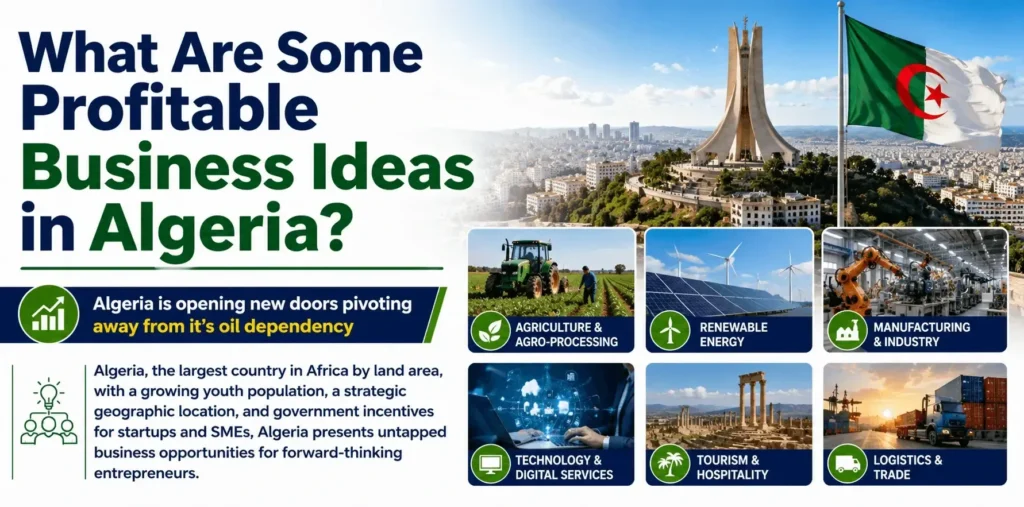
Algeria, the largest country in Africa by land area, is undergoing a transformation. As the largest nation in Africa, it is pivoting away from oil dependency and opening its doors to a new wave of entrepreneurs. If you are looking for Profitable Business Ideas In Algeria, the current landscape is a mix of high-tech innovation and much-needed industrial modernization. With a growing youth population, a strategic geographic location, and government incentives for startups and SMEs, Algeria presents untapped business opportunities for forward-thinking entrepreneurs. Profitable business ideas in Algeria for 2026 focus on import substitution, diversification, and digital transformation, particularly in agribusiness, renewable energy, manufacturing, and technology. Key opportunities include agro-processing, construction materials, logistics, ICT services, and sustainable energy components, supported by government initiatives to reduce import reliance. Below, we explore the most promising and profitable business ideas in Algeria that are well-suited for Algeria’s emerging market environment. 🌾 1. Agribusiness: Feeding a Nation, Beyond Basic Farming Algeria’s food security is a top national priority. Agriculture accounts for over 12% of Algeria’s GDP and employs a significant portion of the workforce. However, the country still imports a large percentage of its food. This is one of the most Profitable Business Ideas in Algeria for those who can bridge the gap between the field and the table. While traditional farming exists, there is a massive gap in technology-driven agriculture. Entrepreneurs who invest in modern farming techniques, greenhouse cultivation, and agro-processing can dominate this essential sector. Key Opportunities in Agribusiness: Organic farming: Rising health consciousness is driving demand for chemical-free produce. Livestock and dairy farming: With imports dominating the market, there’s an opportunity to establish local supply chains. Agro-processing: Value-added processing of dates, olives, and cereals can be highly profitable. Pro tip: Consider leveraging solar-powered irrigation systems to counter water scarcity and increase sustainability. ☀️ 2. Renewable Energy & “Green Tech”: Powering the Future Algeria is one of the sunniest countries on Earth, which is literally a solar goldmine. Receiving more than 3,000 hours of sunshine annually. Solar energy startups can thrive by catering to both urban and rural consumers. The government’s push for 15,000 MW of renewable capacity by 2035 means that small-scale solar startups have a clear runway. Top Business Ideas in Renewable Energy: Solar panel installation services Solar-powered water pumps for agriculture Micro-grid solutions for remote communities Battery storage and maintenance services Algeria’s government has also launched initiatives to attract renewable energy investors, making it a future-proof industry for entrepreneurs. 🏔️ 3. Tourism and Ecotourism: Rediscovering Algeria From the Mediterranean coastline to the vast Sahara, Algeria offers an incredibly diverse landscape for tourism. Despite its potential, the country remains largely unexplored by global travelers. Entrepreneurs can innovate in tourism infrastructure and create eco-friendly tourism models. High-Potential Business Models: Eco-lodges and desert camps in the Sahara Cultural tourism agencies offering guided historical tours of Roman ruins and Berber villages Adventure travel packages for hiking, sandboarding, and 4×4 desert expeditions Local cuisine-focused restaurants and cooking classes With the right digital marketing strategy, even small tour operators can attract a global clientele. 📱 4. The Digital Revolution: Tech & Fintech: Technology and Software Development With a tech-savvy young population and an increase in internet penetration, Algeria is ripe for digital innovation. From fintech to mobile apps and e-learning platforms, tech-based businesses are gaining traction. A tech-savvy youth population combined with a shift toward digital payments has made the tech sector one of the most exciting Profitable Business Ideas in Algeria. Profitable Ideas in Tech: Mobile payment solutions: Many Algerians remain unbanked, creating room for secure fintech apps. E-learning platforms: With unemployment and skill gaps, online education can address workforce readiness. Custom software development for local businesses and government agencies Tech outsourcing hubs for French- and Arabic-speaking countries The cost of entry in this sector can be low, especially with remote work capabilities and cloud infrastructure. 📦 5. E-Commerce & Digital Retail E-commerce in Algeria is still in its infancy, offering first-mover advantages. With increased smartphone usage and shifting consumer habits, launching online stores and delivery-based models can be highly lucrative. Winning Business Ideas in E-Commerce: Niche online retail stores for cosmetics, electronics, and fashion Local crafts and handmade goods marketplaces Online grocery delivery platforms Dropshipping businesses focused on imported items Setting up a cash-on-delivery payment system and optimizing logistics are key to succeeding in this domain. ♻️ 6. Waste Management & Recycling: Turning Scrap into Revenue Urban waste is an increasing problem in Algerian cities. With growing environmental awareness and regulatory pressure, the recycling industry offers both social impact and profit potential. This is one of the “greenest” Profitable Business Ideas in Algeria in terms of both impact and profit. Business Models in Recycling: Plastic and glass bottle recycling plants Scrap metal collection and resale Composting units for organic waste Electronic waste (e-waste) recycling services Innovators who can convert waste into reusable materials such as construction bricks or fuel alternatives stand to gain a competitive edge. 🏥 7. Specialized Healthcare & Wellness Healthcare infrastructure in Algeria is underdeveloped compared to global standards. There is also a growing demand for preventive healthcare and wellness services. This sector allows for innovation, especially through digital and community-based models. Startup Ideas in Healthcare: Private diagnostic centers and labs Home healthcare and older people care services Fitness centers and wellness retreats Telemedicine platforms for remote consultations The government supports private healthcare ventures and public-private partnerships (PPPs), making it easier for entrepreneurs to enter this space. 🎓 8. Education and Vocational Training Unemployment, especially among youth, is a pressing issue. The lack of alignment between formal education and market needs opens up opportunities for private education and skills training ventures. Opportunities in Education: Vocational training institutes focused on tech, agriculture, and renewable energy Language learning centers (English, French, German, Mandarin) Early childhood education centers STEM programs for schools Partnering with international education providers can add credibility and attract more students. 🏗️ 9. Real Estate Development and Construction Urbanization is accelerating, and Algeria’s housing deficit remains high. The construction
What Are The Fastest-Growing Businesses In Algeria?
Algeria, the largest country in Africa by land area, is undergoing a significant economic transformation. With its strategic location, abundant natural resources, and ambitious development policies, Algeria is positioning itself as a major player in several industries. The following are the top booming sectors in Algeria that are driving growth, creating jobs, and attracting both local and foreign investments. Hydrocarbon Industry: The Backbone of Algeria’s Economy Oil and Natural Gas Production The hydrocarbon sector remains the lifeblood of Algeria’s economy. Accounting for nearly 95% of export revenues and over 60% of the government’s budget, this sector is critical. The country holds the 10th-largest proven natural gas reserves globally and is one of the world’s top natural gas exporters, particularly to Europe. Recent exploration deals, new infrastructure developments like pipelines and LNG terminals, and Sonatrach’s modernization projects are rejuvenating the industry. The government is also updating regulatory frameworks to encourage foreign direct investment (FDI), particularly from Europe, Russia, and China. Renewable Energy Sector: Powering the Future Solar and Wind Energy Projects on the Rise Algeria has set an ambitious goal: producing 22,000 MW of renewable energy by 2030. The solar energy potential is massive, with over 3,000 hours of sunshine annually across the Sahara region. The government is investing heavily in photovoltaic plants, solar farms, and wind projects. International companies are being incentivized to invest in Algeria’s green energy drive. The Algerian Renewable Energy Development Center (CDER) has also launched partnerships to support R&D in clean technologies, opening new paths for innovation and investment. Agriculture and Agribusiness: Feeding Growth From Traditional Farming to Agri-Tech Algeria’s government is focused on achieving food security and agricultural self-sufficiency. The country is encouraging modern irrigation systems, mechanized farming, and digital agri-tech solutions. Vast expanses of arable land in the High Plateaus and southern oases are being transformed through public-private partnerships. Major crops include wheat, barley, dates, citrus, olives, and vegetables, with new export markets being explored, particularly in the Middle East and Sub-Saharan Africa. Agri-processing and food packaging industries are also seeing rapid growth, making this a highly attractive sector for investors. Construction and Infrastructure Development Mega Projects Transforming the Nation Algeria is undergoing a massive infrastructure boom, with billions being spent on roads, airports, seaports, and housing projects. Key developments include: East-West Highway: One of Africa’s largest road projects. Algiers Metro Extension: Enhancing urban mobility. New Port of El Hamdania: A $6 billion deep-water port designed to compete with Tangier Med in Morocco. Urban expansion, government-subsidized housing, and increasing demand for commercial infrastructure are driving a construction boom. Cement production, steel manufacturing, and real estate development are sectors benefiting directly from this trend. Telecommunication and Information Technology Digital Economy and Startup Ecosystem Algeria’s digital economy is catching up fast. With a young, tech-savvy population, the ICT sector is growing thanks to investments in 4G/5G infrastructure, data centers, and fiber-optic networks. Government programs like Algeria Startup Fund and Algeria Venture are nurturing a new generation of tech entrepreneurs. The startup scene is thriving in cities like Algiers, Oran, and Constantine, with innovations in fintech, edtech, agritech, and e-commerce. Algeria is now also focusing on developing AI, blockchain, and cloud computing solutions in collaboration with international tech firms. Tourism and Hospitality: An Untapped Goldmine Cultural Heritage and Ecotourism Potential Despite being underdeveloped compared to its North African neighbors, Algeria’s tourism industry is a sleeping giant. The country boasts UNESCO World Heritage Sites, Roman ruins, Mediterranean coastlines, and vast Saharan landscapes perfect for ecotourism and desert safaris. The government is easing visa restrictions and investing in hotel infrastructure, especially in cities like Algiers, Annaba, Tlemcen, and Ghardaïa. Adventure tourism, religious tourism, and cultural circuits are all gaining popularity. There is significant potential for hospitality chains, tour operators, and local artisans to thrive. Automotive and Manufacturing Industry Local Production Gains Momentum The Algerian government is actively encouraging local car manufacturing to reduce imports. Several joint ventures have been established, including: Renault Algeria: A major car assembly plant in Oran. Volkswagen, Hyundai, and Peugeot: Investing in local production. Algeria is also building a supply chain ecosystem for the automotive industry, including spare parts, tires, batteries, and maintenance services. This is creating thousands of jobs and reducing dependence on foreign goods. Pharmaceutical and Healthcare Industry Rapid Expansion and Local Production The pharmaceutical sector in Algeria is among the fastest growing in Africa. With an expanding population and growing health awareness, the demand for locally manufactured drugs is skyrocketing. Major players include: Saidal Group: A leading state-owned pharmaceutical company. Sanofi, Novartis, and Pfizer: Partnering with local firms for joint production. The government’s policy to reduce drug imports has fueled massive investment in pharma manufacturing plants, research centers, and healthcare infrastructure. Mining and Minerals: Tapping Untouched Wealth Rare Earths, Gold, Iron, and More Algeria is rich in mineral resources, yet much remains underexplored. The government is focusing on exploiting reserves of: Gold (Tamanrasset and Hoggar regions) Phosphate (Tébessa) Iron ore (Gara Djebilet) Zinc, lead, copper, and even rare earth minerals The new Mining Law of 2020 provides better incentives for foreign companies, easing entry barriers and tax burdens. Strategic partnerships with Chinese and Turkish mining firms are already in motion, promising to transform this sector. Logistics and Transport: Algeria as a Trade Hub Intercontinental Trade Routes and Connectivity Algeria’s geographic position makes it a gateway to Africa and Europe. With new investments in ports, highways, and trans-Saharan trade corridors, the country is becoming a strategic logistics hub. Major projects include: Trans-Saharan Highway (Algiers to Lagos) North Africa Logistics Hub (in Bejaia and Algiers) Rail network modernization These investments are enhancing cargo handling, customs efficiency, and intermodal transport solutions, creating vast opportunities for logistics companies, warehouse operators, and e-commerce distributors. Education and Training: Building Human Capital Modernizing the Workforce for Tomorrow Algeria’s development strategy includes investing in vocational training, digital literacy, and higher education reform. Partnerships with European and Arab universities are facilitating dual-degree programs and R&D collaboration. The rise of edtech platforms, language institutes, and STEM programs is preparing the Algerian
What Are The Fastest-Growing Businesses In Botswana?
Botswana has emerged as one of the most attractive destinations for business in Southern Africa. With its stable political environment, transparent regulatory framework, and increasing focus on economic diversification, Botswana is experiencing a business boom in several key sectors. In this 2026 update, we highlight the fastest growing industries that are setting the pace for sustainable development, job creation, and international investment. Why Botswana Is Africa’s Rising Economic Star Botswana’s reputation for sound governance and anti-corruption policies has enabled it to attract regional and international investors. The government’s Vision 2036 strategy has prioritized infrastructure, ICT, education, and value-added sectors, propelling economic transformation across the country. Top Fastest Growing Businesses in Botswana 1. Renewable Energy and Solar Power As Botswana moves away from coal dependency, the renewable energy sector is witnessing unprecedented growth. The country boasts over 3,200 hours of sunshine annually, making it an ideal hub for solar energy farms and green tech investments. The Power Corporation (BPC) has launched multiple solar tender projects, including a 100 MW solar power plant. Independent Power Producers (IPPs) are being encouraged through Public-Private Partnerships (PPPs), giving rise to new opportunities in solar equipment distribution, installation, and maintenance services. 2. Tourism and Eco-Lodges Botswana’s tourism sector continues to flourish, particularly with its focus on high-value, low-impact ecotourism. The Okavango Delta, a UNESCO World Heritage site, and the Chobe National Park draw thousands of high-end tourists annually. Investors are now focusing on luxury eco-lodges, cultural heritage tours, and wildlife conservation startups. Adventure and experiential tourism such as glamping safaris, helicopter tours, and photographic excursions are witnessing surging demand. 3. Agribusiness and Agro-processing Botswana has taken strategic steps to reduce its dependence on imported food products. This has catalyzed the growth of the agriculture and agro-processing sector. New business opportunities include greenhouse farming, hydroponics, organic poultry, and animal feed production. The government offers land grants and financial incentives under the ISPAAD (Integrated Support Programme for Arable Agriculture Development) scheme. Entrepreneurs are also tapping into value-added exports like dried fruits, meat products, and dairy. 4. ICT and Tech Startups The Botswana Innovation Hub and the government’s digital transformation agenda are laying the groundwork for a vibrant tech ecosystem. Fintech, e-commerce, and edtech startups are emerging rapidly in urban hubs like Gaborone and Francistown. Opportunities in software development, digital marketing, and mobile payment platforms are expanding, thanks to increasing internet penetration and smartphone usage. Initiatives like Botswana’s SmartBots strategy promote AI, blockchain, and cybersecurity innovation. 5. Mining Value Chain and Mineral Beneficiation Botswana has long been known for its diamond wealth, but the new focus is on mineral beneficiation and value chain development. Polishing, cutting, and jewelry manufacturing are creating downstream opportunities for SMEs. The government is promoting the localization of processing plants and reducing raw mineral exports. Rare earth elements, copper, and coal bed methane (CBM) exploration are seeing new investor interest. 6. Construction and Real Estate Development With urban migration on the rise, residential and commercial real estate is booming. The demand for affordable housing and modern infrastructure is fueling the construction sector. The Gaborone and Francistown corridors are seeing rapid development of mixed-use complexes, gated communities, and retail centers. Construction materials manufacturing, such as bricks, cement, and prefabricated units, is a growing subsector. Public housing and road infrastructure projects are also generating significant B2B opportunities. 7. Financial Services and Microfinance As Botswana works toward greater financial inclusion, the financial services sector is diversifying at speed. The microfinance industry is expanding, offering small loans to underserved populations and SMEs. Insurtech, mobile banking, and wealth management services are attracting youth-led entrepreneurship. Regulatory reforms from the Non-Bank Financial Institutions Regulatory Authority (NBFIRA) are streamlining fintech licensing. 8. Education and Vocational Training The need for skilled professionals has triggered an expansion in the private education and skills development sector. Investment in vocational training institutes, e-learning platforms, and technical colleges is on the rise. The government supports public-private partnerships to bridge the skills gap in ICT, construction, and agriculture. Specialized training in AI, data analytics, and renewable energy is gaining traction. 9. Health and Wellness Industry There is growing demand for quality healthcare services and wellness facilities in Botswana, especially among the emerging middle class. New private hospitals, dental clinics, and diagnostic centers are opening up in urban areas. Health tech businesses focusing on telemedicine, digital health records, and remote diagnostics are growing. Botswana is also seeing increased investment in fitness studios, organic wellness products, and mental health services. 10. Logistics and Transport As Botswana strengthens its trade links with neighboring countries and beyond, logistics and transportation businesses are booming. Development of dry ports, rail cargo hubs, and cross-border trucking services are key growth drivers. E-commerce is fueling demand for last-mile delivery, freight forwarding, and cold chain logistics. The Kazungula Bridge connecting Botswana with Zambia enhances regional connectivity, making Botswana a regional trade hub. Emerging Business Opportunities to Watch in 2026 Green construction materials Biofuel and waste-to-energy solutions Blockchain-based land registries Luxury agritourism Drone services for agriculture and surveying Conclusion Botswana is positioning itself as a business-friendly, innovation-driven economy, with plenty of high-growth sectors offering lucrative opportunities for local and international investors. From solar power plants to fintech apps, from eco-lodges to processing plants, the country is shaping its future through dynamic enterprise and smart policy. Entrepreneurs and investors looking for a gateway into the African market should strongly consider Botswana in 2026 and beyond. Frequently Asked Questions (FAQs) FAQ 1: Why is Botswana a good destination for business? Botswana has emerged as one of the most attractive destinations for business in Southern Africa due to: Factor Advantage Stable Political Environment Peaceful and democratic governance Transparent Regulatory Framework Business-friendly policies Economic Diversification Moving beyond diamonds into multiple sectors Vision 2036 Strategy Focus on infrastructure, ICT, and value-added sectors Anti-Corruption Policies Sound governance attracting investors With its stable economy and growing sectors, Botswana offers excellent opportunities for entrepreneurs and investors. FAQ 2: What are the fastest growing business sectors in Botswana? The fastest growing business sectors in Botswana include: Sector Key Opportunities Renewable
What industries are in high demand in Cameroon?
Cameroon, located in Central Africa, is steadily emerging as a key investment destination in the region. With a population of over 27 million and a diversified economy, the country offers a variety of sectors that are ripe for development and expansion. Due to its geographical location, natural resources, and growing middle class, several industries are currently in high demand in Cameroon. These include agriculture, renewable energy, real estate, telecommunications, education, and health care. The Cameroonian government has been actively working on improving infrastructure, streamlining regulations, and encouraging public-private partnerships to stimulate these high-growth sectors. With strategic access to both Central and West African markets, Cameroon is becoming a regional trade and logistics hub. Entrepreneurs and investors willing to enter early into these industries can benefit from a rising demand, a youthful workforce, and multiple incentives designed to promote industrialization and technological advancement. Overview of Industries in High Demand in Cameroon Several industries are showing exponential growth due to both internal development and global trends. The ones in high demand in Cameroon cater to pressing local needs such as food, energy, healthcare, and digital services. 1. Agriculture and Agribusiness Agriculture is the cornerstone of Cameroon’s economy, employing about 70% of the working population. There is high demand for investments in modern farming techniques, agri-processing, storage, and logistics. Key crops include cocoa, coffee, palm oil, bananas, and cassava. Agribusiness ventures like fruit processing, dairy production, and poultry farming are among the top sectors in high demand in Cameroon. The government has launched several initiatives to boost productivity and reduce food imports, making this sector highly attractive. Visit this Page for More Information:Start a Business in Cameroon 2. Renewable Energy and Power Generation Due to frequent power shortages and rising energy needs, the renewable energy sector is experiencing rapid growth. Hydropower, solar, and biomass energy projects are increasingly prioritized by the government. Many rural communities still lack access to electricity, presenting opportunities for solar panel installation, off-grid energy solutions, and micro-hydroelectric plants. Renewable energy is not only sustainable but also vital to supporting industrial and technological development, making it one of the sectors in high demand in Cameroon. Related Business Plan: Best Business Opportunities in Cameroon, Africa 3. Construction and Real Estate As urbanization accelerates, the demand for housing, office space, and commercial property is rising sharply. Cities like Douala and Yaoundé are witnessing real estate booms driven by a growing middle class, infrastructure projects, and foreign investment. Low-cost housing, residential apartments, and commercial complexes are in high demand in Cameroon. Construction materials such as cement, steel, and prefabricated housing components also have growing markets, particularly in underserved rural areas. Read Similar Articles:Read Our Project Reports & Profiles 4. Telecommunications and ICT Cameroon’s digital infrastructure is expanding rapidly, thanks to rising smartphone penetration and internet usage. There is a high demand for telecom services, mobile applications, and broadband solutions. Tech startups focusing on e-commerce, fintech, mobile health, and online education are thriving. ICT is one of the most innovative sectors in high demand in Cameroon, supported by youth-driven entrepreneurship and international collaborations aimed at improving digital inclusion and services. https://youtu.be/4mPdjC9BmHA 5. Healthcare and Pharmaceuticals Cameroon’s public health infrastructure is under significant pressure, and private sector involvement is on the rise. There is growing demand for clinics, diagnostic centers, pharmacies, and medical supplies. Healthcare services such as maternal care, telemedicine, mental health, and disease prevention are gaining traction. Pharmaceuticals, including local drug manufacturing and distribution chains, are also in high demand in Cameroon, particularly in urban and semi-urban areas. The COVID-19 pandemic further emphasized the need for improved healthcare delivery systems. Click here to send your queries/Contact Us 6. Education and Vocational Training The need for quality education and skills training is critical for Cameroon’s development. Private schools, technical colleges, and vocational training centers are rapidly expanding. Courses in IT, engineering, business management, agriculture, and healthcare are especially in high demand in Cameroon, as they align with the country’s labor market needs. E-learning platforms and online courses are also becoming popular, particularly among urban youth and working professionals. Related Feasibility Study Reports:Best Business Opportunities in Cameroon 7. Transport and Logistics As Cameroon strengthens its position as a regional trade hub, the transport and logistics sector has seen increased demand. The country’s ports in Douala and Kribi, highways, and railways are vital to regional commerce. Trucking, warehousing, cargo handling, and last-mile delivery services are in high demand in Cameroon, particularly for businesses operating across Central and West Africa. Investment in logistics technologies and infrastructure continues to offer promising returns. Read our Books Here:Our Books and Database 8. Financial Services and Microfinance With a large portion of the population still unbanked, there is a huge opportunity in financial inclusion. Microfinance institutions, mobile money platforms, insurance, and SME banking services are in high demand in Cameroon. The rise of fintech solutions, combined with mobile penetration, has made financial services more accessible. Products tailored to rural communities, informal traders, and small businesses are gaining popularity and investor interest. 9. Manufacturing and Light Industry To reduce dependence on imports, Cameroon is promoting local manufacturing in sectors like textiles, beverages, food processing, packaging, and building materials. Small and medium-scale factories producing locally consumed goods are in high demand in Cameroon. Government incentives, such as tax relief and access to industrial zones, are designed to attract both local and foreign manufacturers to support this vital sector. 10. Tourism and Ecotourism Cameroon boasts a wide range of natural landscapes, wildlife reserves, and cultural heritage sites. While still underdeveloped, the tourism industry is slowly gaining attention. Ecotourism, adventure travel, and cultural tourism are in high demand in Cameroon, particularly among international visitors seeking off-the-beaten-path destinations. There is a need for quality hotels, tour operators, travel agencies, and eco-lodges to unlock the sector’s full potential. Conclusion The diverse range of industries in high demand in Cameroon showcases the country’s potential for sustainable growth and investment. From agriculture and real estate to renewable energy and digital services, Cameroon offers ample opportunities for entrepreneurs and
Best Startup Businesses Should I need to Start in Angola Today to being as Angola companies
Angola is one of the fastest-growing economies in Sub-Saharan Africa, with rising demand across sectors like agriculture, retail, logistics, construction, and digital services. Angola is undergoing significant economic transformation. With a population exceeding 35 million, abundant natural resources, and increasing government efforts to diversify beyond oil, Angola is becoming a hotbed for entrepreneurial opportunities. If you’re planning to start a business in Angola or already exploring business ideas in Angola, the opportunity is definitely strong, but success depends on strategy, not just investment. So if you’re asking, “What Business Should I Start In Angola?” Same question is in many business owners, you’re not alone. Many investors and entrepreneurs are exploring new ventures in this emerging market. Strategic reforms, infrastructure development, and improved access to finance have helped create a favorable environment for small and medium enterprises (SMEs). From agribusiness and retail to logistics and tech-based solutions, various industries are on the rise. Starting a business in Angola today not only positions you for local success but also allows access to a larger Southern African Development Community (SADC) market. If approached wisely and strategically, your business could play a key role in shaping Angola’s economic future and you’ll become a part of Angola companies by helping in economic development. The first step is understanding how to approach the market correctly. Best Business Opportunities to Start in Angola Entrepreneurs looking to enter the Angolan market should focus on sectors that align with the country’s development priorities, growing population needs, and import substitution goals. 1. Agribusiness and Food Production Angola has vast arable land and favorable climatic conditions, yet still imports a large percentage of its food. Agribusiness, especially in crop farming, poultry, fisheries, and food processing, is among the top answers to the question, “What business should I start in Angola?” Investing in modern irrigation, seed production, storage solutions, and local food processing offers strong returns. Government incentives support agricultural startups, and demand for locally produced, affordable food is high. Visit this Page for More Information:Start a Business in Angola 2. Renewable Energy Solutions With frequent power outages and limited electricity access in rural areas, there is a growing market for solar panels, mini-grid systems, and energy-efficient appliances. A renewable energy business in Angola would solve a key infrastructural gap while aligning with the government’s sustainability agenda. Entrepreneurs can start businesses that provide solar installation, battery systems, and solar-powered appliances for homes and small farms. 3. Retail and Consumer Goods Angola’s growing middle class and urbanization have boosted demand for consumer goods and retail stores. Starting a mini-mart, supermarket, or wholesale distribution business can be profitable, especially in secondary cities. Products in high demand include electronics, clothing, groceries, and home essentials. Import and resell models are also viable, though more entrepreneurs are exploring local manufacturing and private-label branding for higher margins. Related Business Plan: Best Business Opportunities in Angola 4. Logistics and Transport Transport infrastructure is still underdeveloped in many parts of Angola. This has created a significant demand for logistics solutions, trucking services, warehousing, and last-mile delivery services. Entrepreneurs who ask “What business should I start in Angola?” should consider logistics as a high-potential sector. The growth of e-commerce, construction, and agriculture further boosts this industry’s relevance. Even vehicle repair and spare parts shops can thrive. Read Similar Articles: Read Our Project Reports & Profiles 5. Construction and Real Estate Driven by urban growth, government infrastructure projects, and a housing deficit, construction is booming in Angola. Starting a business in construction materials (cement, tiles, bricks), low-cost housing development, or interior finishing services can be very lucrative. Real estate development, especially for affordable homes, gated communities, and commercial property, is another major opportunity. Related Feasibility Study Reports:Best Business Opportunities in Angola 6. Health and Pharmaceuticals With limited access to quality healthcare, there is a strong demand for private clinics, pharmacies, diagnostic centers, and health product distribution. Importing or producing generic medications and medical equipment locally could prove profitable. Angola’s Ministry of Health has also been welcoming partnerships to improve service delivery, making health one of the most impactful sectors to consider when evaluating what business to start in Angola. 7. Water Purification and Bottling Clean drinking water is still a major issue in many parts of Angola. Businesses offering water purification systems, bottled water, or mobile water delivery services can meet an urgent need. The startup cost is relatively low compared to other industries, and with rising health awareness, this sector is projected to grow. Read our Books Here: Our Books and Database 8. Education and Skills Training Education is a priority for Angolan families, especially after years of instability. There is strong demand for English language centers, STEM education, IT and coding bootcamps, business schools, and vocational training. Starting a school, daycare, or e-learning platform is a great way to contribute to national development while generating income. Offering courses in practical trades (plumbing, carpentry, electrical) is also highly effective in tapping into Angola’s skills gap. 9. Waste Management and Recycling With urban growth comes an increase in waste and pollution. Businesses that offer waste collection, recycling of plastics and metals, and eco-friendly disposal methods are in high demand. Green businesses are also likely to receive backing from NGOs and government initiatives. If you’re considering what business to start in Angola with environmental impact, waste management is a great choice. Recycling Business Handbook Industrial and Agricultural Waste Processing 10. Hospitality and Food Services As the economy improves and domestic tourism picks up, there is increasing demand for restaurants, hotels, cafes, and catering services. Luanda and other cities are experiencing a rise in demand for diverse cuisines and modern food experiences. A well-managed local restaurant or fast-food franchise in the right location can yield quick profits and long-term growth. 11. E-commerce and Online Services Internet access in Angola is expanding, and mobile phone penetration is high. E-commerce platforms selling fashion, electronics, groceries, and beauty products are gaining momentum. Launching a niche online store or service-based platform (like delivery, ride-hailing, or digital payments)
Most Profitable Business Ideas in Nigeria
Nigeria, often referred to as the “Giant of Africa,” offers an enormous landscape for entrepreneurial success. With over 220 million people and a rapidly growing middle class, the country is a thriving hub for startups and small-scale enterprises. The most profitable business ideas in Nigeria stem from everyday needs, technological shifts, and lifestyle changes across both urban and rural populations. Whether it’s food, transportation, fintech, education, or healthcare, entrepreneurs who can identify market gaps and provide value-driven solutions are seeing massive returns. As Nigeria continues its digital transformation, the demand for smart services, logistics, e-commerce, and sustainable products is increasing sharply. With government support for MSMEs and easier access to technology, launching a profitable business in Nigeria is more achievable than ever. By aligning your goals with market demands, you can launch a sustainable business that thrives both locally and internationally. Exploring the Most Profitable Business Ideas in Nigeria Understanding the sectors that consistently generate high returns helps aspiring entrepreneurs focus on ventures that combine stability and scalability. Below are the most promising and profitable options to explore. 1. Agribusiness and Agro-Processing Agriculture is still the cornerstone of the Nigerian economy, contributing around 25% to the GDP. From farming and fishery to processing and packaging, agribusiness remains one of the most profitable business ideas in Nigeria. Popular options include poultry farming, cassava processing, rice milling, and vegetable farming. Value-added production like tomato paste, palm oil refining, or packaged snacks increases profitability. Urban demand for organic and locally sourced foods adds more opportunities for premium pricing. Visit this Page for More Information:Start aBusiness in Nigeria 2. POS (Point of Sale) Business With a large unbanked population and limited access to traditional banks in rural areas, the POS business has grown exponentially. Entrepreneurs can earn from cash withdrawals, bill payments, and money transfers. Low startup costs and high daily transactions make it one of the most profitable small-scale business ideas in Nigeria. According to the Nigeria Inter-Bank Settlement System (NIBSS), there were over 1.6 million POS terminals in active use by 2024, and the number keeps growing. 3. Transportation and Logistics People and goods need to move constantly in Nigeria’s large cities and across states. Launching a transportation or logistics business can involve ride-hailing services (e.g., Bolt, Uber), inter-state transport, delivery bikes for e-commerce, or haulage services. With the rise in online shopping and the food delivery market, courier services and last-mile delivery platforms are in high demand. Related Business Plan: Best Business Opportunities in Niger 4. Real Estate and Property Rentals The real estate sector in cities like Lagos, Abuja, and Port Harcourt continues to thrive. Investing in rental apartments, short-term rentals (Airbnb), student hostels, or property management can yield steady income. The housing deficit in Nigeria, currently estimated at over 20 million units, offers a massive opportunity for developers and investors. Even small-scale investments, like converting residential spaces into mini-flats for young professionals, can be very lucrative. 5. Food Business and Restaurants Nigerians love good food, and with urban work schedules getting tighter, food delivery services, fast food outlets, and local canteens (buka) are booming. You can start small with a food cart, mobile kitchen, or catering service and scale as you grow. Niche businesses focusing on healthy meals, smoothie bars, or vegan dishes are now attracting a new generation of health-conscious consumers. Read Similar Articles: Read Our Project Reports & Profiles 6. Fashion and Tailoring Services Nigeria’s fashion industry is one of the largest in Africa. From custom tailoring to ready-to-wear clothing, shoe making, and fashion accessories, entrepreneurs can make substantial profits. With increasing demand for native wear like Ankara and Agbada for weddings and events, skilled tailors and fashion designers enjoy a loyal customer base. You can start from home and expand into a boutique or online fashion brand with Instagram as a key marketing tool. 7. Digital Marketing and Freelancing As businesses increasingly go online, the demand for digital marketers, SEO experts, content creators, and graphic designers continues to grow. With minimal investment and a laptop, you can start offering services to SMEs looking to boost their online visibility. Freelance platforms like Upwork, Fiverr, and LinkedIn provide access to international clients. It’s one of the most profitable business ideas in Nigeria for youth and skilled professionals. 8. Recharge Card and Data Reselling Every Nigerian uses airtime or data. Starting a recharge card and data reselling business involves little capital and has consistent daily demand. With platforms like VTU (Virtual Top-Up), resellers can earn commissions for every sale. The rise in mobile internet usage makes data selling even more profitable than airtime. Related Feasibility Study Reports:Best Business Opportunities in Niger 9. Education and Tutoring Services Education remains a priority for Nigerian families. From home tutoring and online classes to vocational training centers, there is growing demand for specialized learning. Subjects like Math, English, coding, and exam preparation (WAEC, JAMB) are always in demand. Entrepreneurs with strong teaching skills can create digital products or subscription-based learning platforms. 10. Hair and Beauty Salons Personal grooming is a big deal in Nigeria. Hair salons, nail studios, skincare clinics, and barbershops cater to a wide range of clientele. Starting a beauty salon with professional services and quality products can be highly rewarding, especially in densely populated areas. Mobile beauty services and natural skincare product lines are rising trends that offer additional income streams. Read our Books Here: Our Books and Database 11. Laundry and Dry Cleaning Business Urban professionals often lack the time to do their own laundry. Starting a laundry and dry cleaning service in residential or commercial neighborhoods ensures regular clients and quick cash flow. Offering pick-up and delivery services can further boost profits. 12. Mini Importation Business Mini importation involves importing goods (clothes, gadgets, accessories) from countries like China and reselling them in Nigeria. With the right supplier and marketing strategy, this business can scale rapidly. Many sellers use platforms like WhatsApp, Jiji, or Instagram to reach buyers. It’s a top example of most profitable business ideas in
Profitable Business Opportunities in Kenya

Kenya remains one of Africa’s fastest-growing economies, and as we analyze Profitable Business Opportunities in Kenya 2025, several high-potential sectors emerge. From agritech to digital innovation and sustainable energy, entrepreneurs have myriad options to explore. This article delves deeply into the top business ideas, challenges, and success strategies, helping you identify where to invest. 1. Agribusiness & Agritech Agriculture continues to be the backbone of Kenya’s economy. Tapping into Profitable Business Opportunities in Kenya 2025 in this sector means combining traditional farming with cutting-edge technology. High-value crops: Avocado and macadamia cultivation are particularly lucrative. Investors can expect ROI between 15–20% within 3–5 years. Agro-processing: Facilities that turn raw produce into finished goods—like fruit jam, oils, or dairy products—bring considerably higher margins and reduce post-harvest losses . Agritech solutions: Implementing soil sensors, drones, automated irrigation, and AI-driven yield forecasting can significantly boost productivity and reduce costs. By targeting agribusiness and agritech, entrepreneurs can capture a significant slice of Profitable Business Opportunities in Kenya 2025, especially as local farmers seek scalable, technology-driven solutions. 2. Renewable Energy Solutions Energy remains a core infrastructure challenge, and with Kenya generating around 80% of power from renewables, the industry offers robust Profitable Business Opportunities in Kenya 2025. Solar installations: Deploying off-grid solar systems to rural homes, powering water pumps, and enabling cold storage delivers both social and financial returns. Mini-grids and biomass: Rural electrification via mini-grids or biomass plants is increasingly viable with supportive government policies. Energy storage & consulting: Battery solutions for solar storage and energy efficiency consultancy for businesses and industries fill critical market gaps. Entrepreneurs focusing on affordable, scalable energy infrastructure stand to benefit from being part of Profitable Business Opportunities in Kenya 2025. 3. FinTech and Digital Payment Services Kenya revolutionized financial inclusion with M-Pesa, and the finite room left still offers Profitable Business Opportunities in Kenya 2025. Digital lending & microinsurance: Platforms delivering mobile-based credit and insurance services target underserved populations . Cross-border and B2B remittances: Demand for efficient international transfers makes remittance hubs and payment services increasingly vital newshub.co.ke+1bizz.ke+1. Start a mobile money agency: M-Pesa booths remain a robust small-business model at local hotspots . These models reinforce why Profitable Business Opportunities in Kenya 2025 include expanding fintech at both urban and rural levels. 4. E?Commerce, Digital Content & Marketing Digital entrepreneurship is thriving in Kenya thanks to mobile access and rising internet penetration. These trends offer innovative Profitable Business Opportunities in Kenya 2025 . Niche e?retail platforms: Selling eco?friendly goods, artisan crafts, or specialized products through platforms like Jumia, Instagram, or custom web stores. Dropshipping operations: Low-capital setups with high scalability in electronics, fashion, or home goods fulfillable via Jumia and Kilimall. Digital marketing agencies: With local businesses transitioning online, services such as SEO, social media management, influencer outreach, and content creation are hot commodities. Content creators and influencer marketing: The rise of YouTube, TikTok, and Instagram presents creators with sponsorship deals, ads, and affiliate revenue . These sectors clearly highlight why Profitable Business Opportunities in Kenya 2025 are shifting toward digital livelihoods. 5. Health, Wellness & EdTech There’s growing concern for health and learning outcomes, setting strong ground for Profitable Business Opportunities in Kenya 2025. Fitness centres & organic wellness: Gyms, yoga studios, organic food supply, and mental health services are gaining traction. Telemedicine & diagnostics: Clinics offering remote consultations and diagnostic wellness services plug vital gaps in rural and semi-urban settings . EdTech platforms: Mobile?friendly virtual classrooms, tutoring apps, exam prep tools, and vocational training serve Kenya’s large youth population. By addressing education and health needs, these solutions define a meaningful slice of Profitable Business Opportunities in Kenya 2025. 6. Smart Infrastructure, IoT & Cyber?Security Kenya’s smart city initiatives and digital infrastructure projects create fertile ground for tech-based solutions, integrating into Profitable Business Opportunities in Kenya 2025 . IoT deployment: Smart traffic systems, waste monitoring sensors, soil moisture trackers, and smart home devices align with government investment in Nairobi, Kisumu, and Konza . AI & machine learning services: Predictive farming, chatbot solutions, financial analytics, and AI-enabled risk models are increasingly viable . Cyber?security consulting: As mobile banking grows, securing systems becomes paramount—cybersecurity services and training are high in demand . These trends explain why Profitable Business Opportunities in Kenya 2025 often involve digital infrastructure and security services. 7. Transport, Logistics & Real Estate Kenya’s ongoing infrastructure growth and urbanization continue to reveal Profitable Business Opportunities in Kenya 2025 . Last?mile delivery services: E?commerce growth fuels demand for fast, reliable delivery in Nairobi, Mombasa, and Kisumu. Freight transportation: The Mombasa–Nairobi Expressway, expected in full by 2026, will cut transit time and expand logistics opportunities. Real estate development & management: Residential and commercial demand is rising, especially within SEZs like Tatu City and urban hubs. Affordable and boutique housing: Mid-range and luxury properties offer strong returns in Nairobi and coastal tourist towns. Transport and real estate are pillars of Profitable Business Opportunities in Kenya 2025 amid booming infrastructure. Landscape & Policy Dynamics Economic Context Kenya’s Central Bank recently reduced its lending rate to 9.75% (on June 10, 2025) in efforts to stimulate private-sector lending and support GDP growth forecasts of ~5.2% in 2025 and 5.4% in 2026 Likewise, the World Bank projected a 2025 growth rate of just 4.5%, noting credit constraints in manufacturing and finance, even as recovery toward 5% looms reuters.com. Trade & Industry Pressure Kenya’s tea and flower agriculture face international trade hurdles: Tea processors are rethinking certification models due to losses from Rainforest Alliance compliance theguardian.com. Rose exporters are adapting to EU pest-control standards after missing inspections reduced revenue by up to 30% apnews.com. Simultaneously, the looming expiration of AGOA (September 2025) may jeopardize textile manufacturing jobs unless alternative market strategies are adopted apnews.com+1reuters.com+1. Tourism & Luxury Investment Tourism is regaining momentum: luxury safari lodges (Marriott, Ritz-Carlton, JW Marriott) plan new openings, signaling Profitable Business Opportunities in Kenya 2025 within high-end hospitality businessinsider.com. Additionally, boutique investments in Mombasa and Nanyuki are gaining traction businessradar.co.ke. Strategic Takeaways To successfully pursue Profitable Business Opportunities in Kenya