
Epoxy Resins Technology Handbook 3rd Edition
(Synthesis, Epoxy Resin Adhesives, Epoxy Coatings) with Manufacturing Process and Machinery Equipment Details Epoxy resins Technology Handbook properly based on a class of chemicals knowledge. Chemicals usually composed of an epoxide cross-linked to a compound containing at least one hydroxyl group. They can be polymerized, or cured, using heat or UV light. Curing is often done in two stages, where the first stage creates a gel of mostly liquid resin, followed by hardening into a solid material. Epoxy resins have many uses, such as for adhesives, glues and coatings. Epoxies can also be used as insulating coatings on metal wires or electrical components; they provide abrasion resistance and good dielectric properties. Adhesive applications include bonding wood to composites (such as fiberglass) for boatbuilding; manufacturers typically apply the adhesive to both surfaces and then press them together under heavy pressure. Alternatively, the glue can be applied to one surface which is then spread out over another surface. In this method it may not be necessary to add additional pressure. An Overview on Epoxy Resins Technology Industry Epoxy refers to the basic components and the cured end products of epoxy resins, and also serves as a colloquial name for the epoxide functional group. Epoxy resins form a class of thermoset materials that engineers use extensively in structural and specialty composite applications because they offer a unique combination of properties unavailable in other thermoset resins. Epoxies are monomers or prepolymers that further reacts with curing agents to yield high performance thermosetting plastics. They have gained wide acceptance in protecting coatings, electrical and structural applications because of their exceptional combination of properties such as toughness, adhesion, chemical resistance and superior electrical properties. Epoxy resins contain a three-membered cyclic ether group, commonly known as an epoxy group, 1,2-epoxide, or oxirane. Manufacturers primarily use diglycidyl ethers of bisphenol-A, which they derive from bisphenol-A and epichlorohydrin. Global Market of Epoxy Resins Technology The market of epoxy resins are growing day by day. Today the total business of this product is more than 100 crores. Epoxy resins are used for about 75% of wind blades currently produced worldwide, while polyester resins account for the remaining 25%. A standard 1.5-MW (megawatt) wind turbine has approximately 10 tonnes of epoxy in its blades. Traditionally, demand in markets such as adhesives, building and civil construction, electrical insulation, printed circuit boards, and protective coatings for consumer durables has driven the growth of epoxy resins. Conclusion The major contents of the Epoxy resins Technology Handbook is  synthesis and characteristics of epoxy resin, manufacture of epoxy resins, epoxide curing reactions, the dynamic mechanical properties of epoxy resins, physical and chemical properties of epoxy resins, epoxy resin adhesives, epoxy resin coatings, epoxy coating give into water, electrical and electronic applications, analysis of epoxides and epoxy resins and the toxicology of epoxy resins and photographs of machinery with suppliers contact details. A total guide to manufacturing and entrepreneurial success in one of today’s most epoxy resin industry. This book is one-stop guide to one of the fastest growing sectors of the epoxy resin industry, where opportunities abound for manufacturers, retailers, and entrepreneurs. This is the only complete handbook on the commercial production of epoxy resin product. It serves up a feast of how-to information, from concept to purchasing equipment. Also Read: 5 Reasons Why Market Research is Vital for Start-ups Contact Us
How to Start Manufacturing Business of Floral Foam
Manufacturing businesses do not have the same visibility or branding opportunities as other business sectors. They often get relegated to being niche and insignificant, with little scope for growth. This is a false assumption. Manufacturing businesses are growing rapidly and offer new entrepreneurs plenty of opportunities. New manufacturers can build profitable and scalable businesses in almost any sector where there is demand but limited supply. The manufacturing of floral foam is one such industry, with low visibility but high demand and a lack of supply. It’s an unusual niche market, but it presents a great opportunity for new business owners who are ready to invest some time and money into buying the machinery required to start up as a manufacturer of floral foam. Why is Manufacturing Floral Foam a Good Business Opportunity? Building a manufacturing business does not have the same appeal as setting up a retail or service business. There are no ongoing sales, no customers to attract and no direct control over pricing. What’s more, many manufacturing businesses have a negative stigma of being unglamorous, dirty, and low-skilled. This is a false assumption. A manufacturing business will always be cheaper to run than a retail or service business. You can scale it up to meet demand, and it will always generate cash flow. You’ll never need to worry about having enough stock or customers, or the right price point. And the skills required to start a manufacturing business are just as varied as in any other industry. You may need to learn a whole new skill or repurpose an existing skill, but it will be a valuable addition to your skill set. With the scarcity of skilled workers in many industries, you’ll be in high demand. Your business is also likely to generate more profit per unit than other industries, which is another bonus of manufacturing over retail. Why Is There a Demand for Floral Foam Manufacturing? That’s a great question and one that many people will be asking when you’re trying to sell your new business idea. Floral foam (also known as flower foam, flower baskets, flower baskets, flower scoops, or flower scoops) is an essential component in the floral industry. Both florists and farmers benefit from floral foam as a support structure for the flowers and other foliage used in bouquets and floral arrangements. The two industries that use floral foam are the cut-flower and fresh produce industries. The cut-flower industry exports flowers too many countries around the world and has been struggling with a shortage of rose varieties due to weather conditions. The fresh produce industry uses floral foam to transport and display fruits and vegetables. The demand for floral foam is therefore directly linked to the demand for flowers and fresh produce, both of which are increasing, particularly in Asia and South America. Key Steps to Starting a Manufactured Floral Foam Business Identify your target market, then understand their needs and how floral foam can help them. Look for a gap in the market where there is demand for a product but no supply. Find a manufacturer that can produce a high-quality product with the design you want and the quantity you need. Create a brand for your product, and start marketing it. These are the key steps to starting a manufactured floral foam business. You first need to understand what your target market needs and how your product can help them. You then need to identify a gap in the market where there is demand for your product but no supply. Once you know you have a product that people want, you need to find a manufacturer who can produce it for you and ensure that the product meets your quality expectations. You then need to create a brand for your product and start marketing it to your target market. The Biggest Challenges in Starting a Floral Foam Business There are plenty of challenges in any manufacturing business, but especially one as niche as floral foam. You’re likely to be the only manufacturer in your area, so you’ll have to transport your product to customers. This means you’ll need to invest in a truck at some point so that you can get your product to the people who want it. You also need to be aware that the floral foam market is seasonal. Demand is highest in spring and autumn and the supply of fresh flowers is at its lowest. This means you’ll need to store and sell your product at the right time of year. You’ll also need to factor storage into your costs, as you won’t have enough products to sell year-round. Conclusion Manufacturing businesses do not have the same visibility or branding opportunities as other business sectors. They often get relegated to being niche and insignificant, with little scope for growth. This is a false assumption. Manufacturing businesses are growing rapidly and offer new entrepreneurs plenty of opportunities. New manufacturers can build profitable and scalable businesses in almost any sector where there is demand but limited supply. The manufacturing of floral foam is one such industry, with low visibility but high demand and a lack of supply. It’s an unusual niche market, but it presents a great opportunity for new business owners who are ready to invest some time and money into buying the machinery required to start up as a manufacturer of floral foam. Read our Books Here: Synthetic Resins, Oleoresins And Pine Chemicals Technology NPCS The Manufacturing Business of Floral Foam report by Niir Project Consultancy Services (NPCS) is an in-depth study of the floral foam manufacturing industry in India. The report covers the entire value chain of the industry, from raw materials to finished products. It provides a detailed analysis of the market size and growth, key players, manufacturing process, cost structure, and distribution channels. The report also offers a SWOT analysis of the industry and provides a detailed investment feasibility analysis. The report is a valuable resource for entrepreneurs and investors interested in the floral
How to Start Manufacturing Business of Epoxy Resin
You might have been a trader in the unorganized sector all your life, but now you’re ready to upgrade your business. To do this, you need to look for lucrative opportunities and invest in them. Manufacturing of epoxy resins is one such business that can prove to be profitable. The global demand for epoxy resins is increasing steadily and comes with several benefits besides being risk-free and cost-effective business. Moreover, you will not require large investments or an extended time period, only a small setup cost and some research on the market will help you launch this business successfully. Read on to learn more about manufacturing of epoxy resin and understand why it can be your ticket to financial freedom. Why Manufacturing Epoxy Resin? Epoxy resins are thermosetting polymers used for a wide variety of applications. These resins are widely used in the manufacturing of adhesives, coatings, paints, sealants, and composites. There are several reasons why you should start manufacturing epoxy resins. Firstly, the global demand for epoxy resins is increasing steadily. The demand for epoxy resins is mainly driven by the construction industry, automotive industry, and aerospace industry. The construction industry is expected to witness a significant rise in demand as the world’s population is growing at a rapid pace. Similarly, the automotive industry is likely to grow due to the growing vehicle production worldwide. The aerospace industry too will see an increase in demand for epoxy resins. This is because the aviation industry is experiencing steady growth. Moreover, the manufacturing of epoxy resins is an easy and risk-free process. This business is highly suitable for those who are looking to start a business but have limited capital. Another reason why you should start producing epoxy resins is that it is a cost-effective process. The raw materials required for producing epoxy resins are available easily, and the manufacturing process is not complicated. Key Elements of Manufacturing Epoxy Resin Epoxy resin is a thermosetting polymer created by the reaction of a resin and a hardener. It is commonly used in the aerospace, electronics, and automotive industries due to its high strength and durability. The key elements of manufacturing epoxy resin are the resin, hardener, and curing agent. The resin is the base of the epoxy and is typically a liquid. The hardener is added to the resin and reacts with it to form the final product. The curing agent is used to speed up the curing process or to allow the epoxy to cure at lower temperatures. The ratio of resin to hardener is important in the manufacturing process as it affects the final properties of the epoxy. If the ratio is not correct, the epoxy may not cure properly or may be too brittle. The curing process is also critical in the manufacturing of epoxy resin. If the epoxy is not cured properly, it will not reach its full strength and may be susceptible to degradation. Setup Cost of an Epoxy Resin Manufacturing Unit The setup cost of an epoxy resin manufacturing unit is not very high. The total investment required to start an epoxy resin manufacturing unit is moderate. The investment includes land cost, building construction, machinery and equipment, raw materials, and staff salary. These are the basic requirements for setting up a manufacturing unit of epoxy resin. The total investment required for the same may vary from state to state and from country to country. The major expenditure will go towards hiring suitable land for construction, hiring machinery for the manufacturing of epoxy resins, and raw materials. You can hire a joint venture partner or a financial partner to get funds for setting up the manufacturing unit. Things to Know Before Commence Epoxy Resin Business Before you start with the business, you need to understand a few things. First, you should know that the manufacturing of epoxy resins can be done in an organized or unorganized manner. The organized sector comprises companies that produce the product for a particular purpose. The unorganized sector, on the other hand, involves the manufacturing of epoxy resins for a variety of purposes. After you decide to manufacture epoxy resins in an organized manner, you will be required to obtain a valid license from the government. Therefore, you should first decide the type of license that you need. The next step is to decide the location of your manufacturing unit. You should select a suitable location for your business. You should consider factors like proximity to raw materials suppliers, availability of power supply, and the cost of land near your proposed location. Equipment and Premises required for Manufacturing of Epoxy Resins The basic equipment required for manufacturing epoxy resins are mixers, reactors, and filters. The raw materials required for producing epoxy resins include epoxides, catalyst, and polyol. Other basic equipment you require are filter, scrubber, storage tanks, and a weighing machine. The basic premises required for manufacturing epoxy resins are laboratories for quality testing, an administrative office, a storeroom for raw materials, and a manufacturing unit. Challenges in Epoxy Resin Manufacturing Business Manufacturing of epoxy resins is an easy process. Therefore, there are fewer challenges in this business. Finding buyers for your product can be challenging, but you can overcome this by investing in strong online marketing and building a recognizable brand. Staying updated with the latest technologies and industry trends is also crucial to remain competitive and adapt to market demands effectively. Conclusion Epoxy resins are a valuable product in the market. There are several advantages of manufacturing epoxy resins, such as the growing demand, easy and risk-free process, and an inexpensive process. However, you should be aware of the challenges faced in this business before starting. If you are passionate about the business and willing to put in the hard work, then you can start this business. This will help you increase your income and lead a financially secure life. Visit the page Select and Choose the Right Business Startup for You for sorting out the questions arising in
The Business of Manufacturing Epoxy Resin : Increasing Opportunities for Growth
In an increasingly material-driven industrial world, manufacturing epoxy resin stands out as a profitable and future-oriented business venture. Epoxy resins are valued for their exceptional mechanical strength, chemical resistance, and strong adhesive properties. From construction to electronics, the demand for epoxy-based materials is surging at a global scale—making this the perfect time to explore this dynamic field. With strategic investment and the right knowledge, manufacturers can unlock growth and export opportunities while serving diverse industries. What Is Epoxy Resin and Why Is It in Demand? Epoxy resin is a synthetic polymer formed through the chemical reaction between epichlorohydrin and bisphenol-A. Once cured with a hardener, it forms a durable, heat- and chemical-resistant material. Due to these properties, it’s widely used in adhesives, coatings, insulation, flooring, and composites. The increasing adoption of epoxy resin in infrastructure, aerospace, automotive, electronics, and renewable energy has fueled a steady growth curve globally. Especially in India, the resin market is poised for expansion with the growing need for high-performance materials. Visit this Page for More Information: Start a Business in Epoxy Resin Industry Key Industrial Applications of Epoxy Resin Understanding the broad applicability of epoxy resin helps in identifying potential customers when entering the manufacturing space. 1. Construction and InfrastructureUsed in flooring, waterproof coatings, crack repairs, and structural bonding agents. 2. Electrical and Electronics IndustryProvides insulation for motors, switchgear, and circuit boards due to its non-conductive nature. 3. Automotive and AerospaceIntegral in the creation of lightweight, durable composite components and bonding parts. 4. Paints and Protective CoatingsApplied on pipelines, ships, tanks, and industrial equipment to prevent corrosion. 5. Furniture and Decorative Resin ArtUsed extensively in tabletops, kitchen counters, and modern décor through casting and surface lamination. These sectors continue to drive demand, ensuring stability and scalability for entrepreneurs entering the field of manufacturing epoxy resin. Related Business Plan: Synthetic Resins How to Start a Business in Manufacturing Epoxy Resin Starting a manufacturing plant for epoxy resin involves a blend of chemistry, compliance, and smart business planning. Here’s how you can build a foundation for a successful venture. Step 1: Market Research and Feasibility Study Before investing in infrastructure or machinery, it is essential to conduct detailed market analysis. Determine: Local demand vs import reliance Regional industries needing epoxy resin Competing domestic manufacturers Export possibilities Potential partnerships or bulk buyers This groundwork ensures you’re not just manufacturing epoxy resin, but doing so strategically. Step 2: Choose the Right Production Process Epoxy resin production mainly uses two methods: Batch Process: Suitable for small to medium production; allows formulation flexibility. Continuous Process: Ideal for large-scale, uniform production and energy-efficient operations. The main raw materials used are: Epichlorohydrin (ECH) Bisphenol-A (BPA) Sodium hydroxide (NaOH) Advanced formulations may include flexibilizers, reactive diluents, and additives to meet specific industry requirements. Step 3: Infrastructure and Equipment Setup A standard epoxy resin manufacturing plant should include: Stainless steel or glass-lined reactors Condensers, heat exchangers, and distillation columns Storage tanks for raw and finished materials Pollution control units like scrubbers and ETP Laboratory for quality testing and R&D Plant capacity can range from 1 TPD (ton per day) to 20+ TPD based on your investment and market goals. Step 4: Obtain Necessary Licenses and Approvals To operate a compliant manufacturing facility, secure the following: Factory license under Factories Act NOC and consent from State Pollution Control Board Hazardous waste handling registration BIS certification (optional but preferred) GST and MSME registration for taxation and subsidies Following these legal norms not only ensures safety but also enhances your business credibility. Cost Estimation and Profitability Setting up a small to medium-sized epoxy resin plant can require an investment of ?4 crore to ?12 crore, depending on: Plant capacity and technology Level of automation Raw material sourcing (domestic or import) Quality certifications Manufacturing epoxy resin offers excellent margins—typically 15% to 25%. Long-term contracts, export orders, and innovation in formulation can further boost profitability. Click here to send your queries/Contact Us Environmental Considerations and Sustainability As epoxy resin is chemically synthesized, environmental management must be part of your business plan: Install effluent treatment and air filtration systems Implement a Zero Liquid Discharge (ZLD) policy Opt for solvent recovery units to minimize waste Explore bio-based or eco-friendly alternatives Sustainable manufacturing not only reduces operational risk but also opens doors to green markets and international clients. Marketing Strategies for Your Epoxy Resin Products Once production is underway, focus on building a customer base through: Direct sales to construction and automotive companies Partnerships with electrical and electronics manufacturers Presence on B2B marketplaces like IndiaMART, Alibaba, TradeIndia Participating in chemical and industrial expos Digital content marketing to showcase product specifications and case studies Building a strong, quality-driven brand is critical when you start manufacturing epoxy resin for B2B applications. Future Trends and Innovations in Epoxy Resin The field of epoxy resin is evolving quickly. Emerging trends include: Bio-based resins made from plant-derived BPA alternatives Nano-enhanced epoxy with improved mechanical and thermal properties Low-VOC and water-based formulations for eco-friendly coatings Smart resins for electronics that are self-healing or heat-conductive Investing in R&D can help you develop niche products and stay ahead of competitors. Final Words: Why Manufacturing Epoxy Resin Is a Smart Business Move With growing demand across sectors, consistent margins, and an ever-evolving technology landscape, manufacturing epoxy resin is an ideal business for entrepreneurs interested in chemicals, materials, and industrial applications. The versatility and scale of this business model make it resilient even during economic fluctuations. As industries continue to demand stronger, lighter, and more sustainable materials, epoxy resin manufacturers are in a prime position to deliver value. Read our Books Here: Synthetic Resins Visit the page Select and Choose the Right Business Startup for You for sorting out the questions arising in your mind before starting any business and know which start-up you can plan. We, at NPCS, endeavor to make business selection a simple and convenient step for any entrepreneur/startup. Our expert team, by capitalizing on its dexterity and decade’s long experience in the field, has created a list of
Growing Opportunities in Epoxy Hardener Business
The demand for epoxy hardener business is growing rapidly due to its wide usage in industries such as construction, electronics, automotive, marine, and aerospace. Epoxy hardeners are essential curing agents used with epoxy resins to enhance adhesion, mechanical strength, chemical resistance, and durability of surfaces. As global infrastructure projects rise and consumer demand for long-lasting, quality finishes increases, the need for reliable epoxy systems is soaring. Entrepreneurs looking to enter the specialty chemical industry should strongly consider establishing a business of epoxy hardeners due to its high margins, broad application range, and growing international market demand. The epoxy hardener business is not just capital-intensive—it’s innovation-driven. It requires a strong understanding of chemistry, quality control, regulatory compliance, and market dynamics. This article offers a comprehensive roadmap to successfully initiate and run a profitable epoxy hardener manufacturing enterprise. Visit this Page for More Information: Start a Business in Epoxy Resin Industry Understanding the Epoxy Hardener Industry The global epoxy resin market is projected to reach USD 14.7 billion by 2030, with hardeners accounting for a major portion of the consumption. Hardeners are chemical compounds that react with epoxy resins to form thermoset polymers, used in coatings, adhesives, composites, and encapsulants. The most commonly used epoxy hardeners include: Polyamides Polyamines Anhydrides Cycloaliphatic amines Phenalkamines Each hardener type has distinct curing profiles, mechanical strengths, and chemical resistance properties tailored to specific applications. Related Business Plan: Adhesives and Sealants Applications of Epoxy Hardeners Construction Industry – Floor coatings, primers, crack repair, sealants Electronics – Potting and encapsulation of circuit boards Marine and Aerospace – Structural adhesives and corrosion-resistant coatings Automotive – Body panel adhesives, composite reinforcement Industrial Equipment – Anti-corrosive and wear-resistant coatings The widespread adoption across sectors makes the epoxy hardener business a stable and scalable opportunity. Read Similar Articles: ADHESIVES AND SEALANTS How to Start an Epoxy Hardener Business 1. Conduct Market and Feasibility Study Analyze: Industry growth trends Local and export demand Raw material availability Competitive pricing and value-added offerings Target both B2B clients like construction contractors and OEMs, and B2C through paint or adhesive distributors. Click here to send your queries/Contact Us 2. Setup and Infrastructure Area Requirement: 5,000–10,000 sq. ft. Plant Location: Proximity to chemical hubs (e.g., Gujarat, Maharashtra, Tamil Nadu) Utilities: Adequate ventilation, power backup, chemical-safe flooring 3. Machinery and Equipment Reactor vessels (SS316) Mixing tanks and blenders Filtration units Barrel filling and packaging machines Quality control lab equipment (viscometers, gas chromatographs) Automation in formulation and filling improves efficiency and safety. 4. Raw Materials Epichlorohydrin Polyamine or polyamide compounds Anhydrides and catalysts Solvents (e.g., xylene, acetone for some variants) Additives and pigments (optional) Secure suppliers with REACH or ISO certifications to ensure export-ready compliance. Related Feasibility Study Reports: Adhesive (fevicol Type) Investment and Financial Overview Component Estimated Cost (INR) Land and Building ?75 lakh – ?1.5 crore Machinery and Equipment ?1 crore – ?2 crore Raw Materials Inventory ?50 lakh – ?1 crore Staff, R&D, Certifications ?25 lakh – ?50 lakh Working Capital ?1 crore Total Investment: ?3.5 crore to ?6 crore (USD $420,000 – $725,000 approx.) Expected Profit Margin: 25% – 40%Break-even: 2 to 2.5 years depending on scale and distribution reach Read our Books Here: Gums, Adhesives & Sealants Technology (With Formulae) Regulatory Compliance and Certifications To legally and safely operate, obtain: Factory License Pollution Control Board NOC Hazardous Chemical Handling License ISO 9001 (Quality) and ISO 14001 (Environment) REACH or RoHS (for export) Ensure labelling complies with GHS (Globally Harmonized System) for chemical safety. Marketing and Sales Strategy B2B Channels – Sell directly to epoxy resin manufacturers, construction material suppliers, and electronics assemblers. Online B2B Portals – Register on IndiaMART, TradeIndia, Alibaba for domestic and export leads. Trade Exhibitions – Participate in Paint India, PlastIndia, and industrial coatings expos. Sample Distribution – Offer trial packs to construction companies and industrial users. Partnerships – Collaborate with resin manufacturers for bundled sales. Position your product on quality, fast curing, heat resistance, and custom formulation as USPs. Sustainability & Innovation in Epoxy Hardener Business With environmental concerns rising, low-VOC and water-based epoxy hardeners are gaining popularity. Investing in green chemistry R&D for bio-based amine curing agents can set your brand apart and future-proof the business. Additionally, industries are now focusing on low-temperature curing and fast-set epoxy systems to speed up operations and reduce energy costs. Conclusion Setting up an epoxy hardener business offers a golden opportunity in the thriving industrial chemical sector. It combines high demand, recurring clients, and scope for innovation in sustainable formulations. With the right technical know-how, market strategy, and quality control, your venture can dominate the space in India and explore export potential to countries in Southeast Asia, the Middle East, and Africa. By offering customized, high-performance hardeners for diverse applications, you can establish a stronghold in a competitive yet growing market. Niir Project Consultancy Services (NPCS) has prepared project report on –Epoxy Hardener Plant, Detailed Project Report, Profile, Business Plan, Industry Trends, Market Research, Survey, Manufacturing Process, Machinery, Raw Materials, Feasibility Study, Investment Opportunities, Cost and Revenue, Plant Economics. The project report provided by NPCS gives a detailed market review. The report analyses the market confirms the availability of various necessities such as plant & machinery, raw materials and tells about the forecasting financial requirements. A lot of professionals have taken benefit from the project reports if you are interested in the manufacturing business of Epoxy Hardener Plant or any other business get in contact with us from the official website of NPCS. Click here to send your queries/Contact Us Reasons for Buying NIIR Report: Our research report helps you get a detailed picture of the industry by providing an overview of the industry along with the market structure and classification. Our report provides market analysis covering major growth driving factors for the industry, the latest market trends and the regulatory framework of the industry. Our Report provides an analysis and in-depth financial comparison of major Players / Competitors. Our Report provides indispensable buyers’ data with their company financials as well as
The Rising Business of Manufacturing Steel Epoxy Putty Stick
In recent years, the manufacturing steel epoxy putty stick business has gained tremendous momentum in the adhesive and repair product industry. As demand surges for durable and easy-to-apply bonding solutions, steel epoxy putty sticks are being widely adopted in the construction, plumbing, automotive, and DIY repair sectors. These sticks offer exceptional bonding strength, corrosion resistance, and a simple application method — making them an indispensable product in both industrial and household toolkits. The manufacturing steel epoxy putty stick process is highly scalable and profitable, with the growing emphasis on infrastructure development and repair across the globe. Businesses and entrepreneurs are investing in this sector because the initial setup requires relatively modest capital, while offering the potential for high returns. Whether you’re aiming to serve large-scale distributors or retail markets under your private label, this manufacturing niche holds great promise for steady revenue generation and long-term growth. Visit this Page for More Information: Start a Business in Adhesives and Sealants Industry Understanding Steel Epoxy Putty Stick and Its Industrial Relevance Steel epoxy putty sticks are two-part adhesive compounds that combine a resin and a hardener in a cylindrical, hand-kneadable form. These sticks are widely used for filling cracks, sealing leaks, bonding metal surfaces, and repairing worn parts. With an easy-to-use format that requires no mixing tools, users simply cut, knead, and apply the putty directly onto surfaces — making it highly favored across industrial and residential applications. Key Raw Materials Required for Manufacturing To initiate the manufacturing steel epoxy putty stick, the following raw materials are essential: Epoxy Resin – the primary adhesive base. Polyamide or Amine-Based Hardener – initiates the curing process. Metallic Fillers (Steel Powder or Iron Powder) – provides strength and durability. Fillers and Extenders – such as talc, calcium carbonate for bulk and body. Plasticizers and Thickeners – ensure flexibility and uniformity. Pigments – for coloration and aesthetic consistency. Packaging Material – laminated wrappers or blister packs for protection and branding. Quality sourcing is critical as it affects curing time, shelf life, and final adhesion performance. Click here to send your queries/Contact Us Production Process of Steel Epoxy Putty Sticks The manufacturing steel epoxy putty stick process follows a standardized production flow for efficiency and quality control. The major steps include: Material Weighing and MixingCarefully measured proportions of resin, hardener, steel powder, and other additives are blended in high-speed mixers under controlled temperatures. HomogenizationThe mixture undergoes further processing to eliminate air bubbles and ensure a uniform, dense composition. Extrusion and ShapingThe homogenous material is extruded into cylindrical logs and then cut into stick-sized lengths using automated machines. Wrapping and PackagingEach stick is individually wrapped in non-reactive films or aluminum foils to prevent premature curing. Labels and branding elements are applied during the final packaging stage. This process demands strict safety standards, as both resin and hardener are reactive chemicals that require controlled environments and trained labor for handling. Read Similar Articles: ADHESIVES AND SEALANTS Machinery and Equipment Needed Establishing a steel epoxy putty stick manufacturing unit involves acquiring the following machinery: High-Speed Mixer / Sigma Mixer – for homogeneous mixing of resin and hardener. Roll Mills / Extruders – to blend and shape the compound. Cutting Machines – to produce uniform stick lengths. Packaging Machines – for efficient and clean final product wrapping. Curing Chambers (Optional) – to speed up the initial hardening process in controlled environments. Automation in cutting and packaging significantly boosts efficiency and minimizes human error. Related Feasibility Study Reports: Adhesives – Manufacturing Plant Ideal Factory Layout and Space Requirement For a semi-automatic plant, a space of 1,000 to 1,500 square feet is generally sufficient. The factory should be divided into: Raw Material Storage Production Area Quality Testing Zone Packaging and Dispatch Area Office and Admin Section Proximity to raw material suppliers and target markets will reduce logistics costs and improve delivery times. Licensing, Compliance, and Safety Standards Before starting a manufacturing steel epoxy putty stick business, ensure you obtain: Factory License & MSME Registration GST Registration Pollution Control Board Clearance Fire Safety Certificate Material Safety Data Sheets (MSDS) for your chemical formulations Also, adhere to BIS standards if you plan to supply to government sectors or export. Market Demand and Applications The global epoxy market is expected to reach USD 11.5 billion by 2030, growing at a CAGR of over 6%. Epoxy putties are especially gaining traction in: Plumbing Repairs – fixing leaks in pipes and joints Automotive – sealing tanks, fixing cracks Construction – bonding metal supports and structural repair Home DIY Kits – small appliance repairs, craft projects This growing demand opens ample avenues for bulk B2B orders, retail pack distribution, and eCommerce sales. Related Business Plan: Adhesives and Sealants Branding, Packaging & Distribution Strategy In a competitive market, branding is vital. Ensure your product stands out with: Tamper-proof and Attractive Packaging Clear Usage Instructions & Curing Time Certification Labels (e.g., ISO, RoHS) Strong Shelf Visibility for Retail Sales Distribution should cover hardware stores, automotive suppliers, plumbing shops, and online platforms like Amazon and Flipkart. Partnering with construction and repair firms can also help generate bulk orders. Profit Margins and ROI The average cost to manufacture a standard-sized steel epoxy putty stick is around ?8–?12, depending on raw materials and scale. These retail between ?40–?100, offering a gross margin of 60–75%. With proper scaling and branding, ROI can be achieved within 6–12 months. Challenges and Solutions in the Manufacturing Process Curing Too Fast? – Adjust the hardener composition or use temperature-controlled storage. Stickiness or Oozing? – Improve filler ratio or packaging materials. Storage Stability Issues? – Vacuum seal each stick to increase shelf life up to 12–18 months. Regular R&D helps fine-tune the formulation and create variants like high-temperature or waterproof steel epoxy putties. Conclusion: A Profitable Niche in Adhesive Manufacturing With growing infrastructure and the rise in DIY repair culture, the manufacturing steel epoxy putty stick industry is set to witness significant expansion. Its scalable process, wide usage, and excellent profit margins make it a smart business choice for
Setting up a Plastics Material and Resin Manufacturing Business
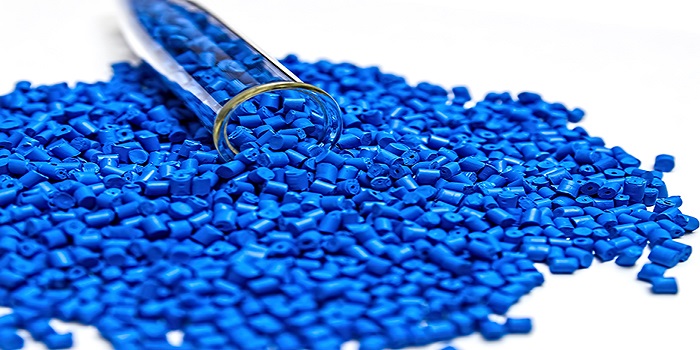
Introduction to Plastics & Resin Manufacturing The plastics & resin manufacturing industry is one of the most lucrative and expanding sectors in the global economy today. Driven by rapid industrialization, urban development, and the ongoing demand for innovative materials, starting a plastics & resin manufacturing business offers an exceptional opportunity for entrepreneurs and investors to establish a strong and profitable enterprise. Plastics are used in virtually every industry—from automotive, construction, and electronics to packaging, textiles, and healthcare. Similarly, resins serve as critical components in adhesives, coatings, and composite materials, helping improve durability, flexibility, and performance. The beauty of this industry lies in its diversity and adaptability. Whether producing basic polyethylene products or specialty epoxy resins for aerospace applications, this field allows for deep customization, scalability, and consistent demand. With proper planning, technological integration, and a commitment to sustainability, a plastics & resin manufacturing business can thrive in both domestic and international markets. Understanding the Scope of Plastics & Resin Industry The plastics & resin industry encompasses a vast array of products and services. Plastics can be broadly classified into two categories: Thermoplastics, such as polyethylene (PE), polypropylene (PP), polyvinyl chloride (PVC), and polystyrene (PS), which can be melted and reshaped multiple times. Thermosetting plastics, like epoxy, phenolic, and melamine resins, which harden permanently after being molded once. Resins, on the other hand, are crucial for creating adhesives, paints, varnishes, and plastic composites. These materials are the backbone of several end-use industries including automotive, aerospace, consumer goods, medical devices, and more. The global plastics market is valued at over USD 600 billion and is projected to surpass USD 750 billion in the next five years. With innovations in biodegradable and recyclable plastics, the industry is pivoting toward greener solutions while maintaining a steady growth trajectory. Step-by-Step Guide to Launching a Plastics & Resin Manufacturing Business 1. Conduct Comprehensive Market Research To begin with, perform an in-depth market analysis. Key factors to study include: Global and regional trends Product demand and supply gaps Target customer segments Existing competitors and their market share Raw material sourcing opportunities Government regulations and subsidies Environmental impact and sustainability demands Studying these parameters helps in identifying profitable niches such as biodegradable plastics, medical-grade polymers, or industrial resins. 2. Choose the Right Product Niche Identifying the right product segment is vital. You can focus on: Commodity plastics: such as HDPE, LDPE, PP, and PVC, used in packaging, construction, and consumer goods. Specialty resins: including epoxy, alkyd, acrylics, and unsaturated polyesters for high-performance applications. Eco-friendly bioplastics: made from renewable resources such as corn starch or sugarcane. Define whether you want to serve as an OEM (Original Equipment Manufacturer), supply raw resins to processors, or offer custom-molded plastic products for specific industries. 3. Legal Setup, Certifications, and Licensing Set up a legal entity such as: Proprietorship Partnership firm Limited Liability Company (LLC) Private Limited Company You must obtain: Business registration Pollution Control Board (PCB) clearance Factory license Fire and safety certifications GST registration ISO certifications (ISO 9001, ISO 14001, etc.) In some regions, especially for export, certifications like CE and REACH may be required. 4. Factory Location and Infrastructure Planning Selecting the ideal location is critical. An industrial zone with proximity to raw material suppliers and distribution hubs reduces logistical costs and improves efficiency. Key infrastructure elements include: Manufacturing unit with proper layout and machinery Storage space for raw materials and finished goods Office for administrative functions Waste management and effluent treatment facilities Backup power supply and fire protection systems Ensure the factory meets all zoning and environmental guidelines to avoid legal complications. 5. Machinery and Equipment Setup Investment in high-quality machinery ensures smooth production and long-term durability. Common equipment includes: Extrusion machines Injection molding machines Blow molding and thermoforming equipment Polymerization reactors Mixing and blending units Quality control laboratories Granulators and shredders Packing and sealing machines Advanced automation and Industry 4.0 technologies like IoT, AI, and robotics are increasingly being adopted for real-time monitoring, predictive maintenance, and productivity optimization. 6. Raw Materials and Supplier Management Secure a consistent supply chain for essential raw materials: Petrochemical derivatives (naphtha, ethylene, propylene) Bio-based feedstocks (corn starch, cellulose, lactic acid) Additives (stabilizers, plasticizers, flame retardants, colorants) Fillers and reinforcements (glass fiber, calcium carbonate) Negotiate bulk procurement contracts to manage price volatility and ensure timely delivery. Building strong supplier relationships is crucial for a plastics & resin manufacturing business. 7. Hiring and Training Skilled Workforce Recruit skilled professionals, including: Chemical engineers and process technicians Production managers Maintenance engineers Safety and compliance officers Machine operators and packaging staff Provide regular training programs focused on: Equipment handling and safety Quality control and assurance Regulatory compliance Sustainable practices A competent team ensures smooth operations, fewer breakdowns, and higher product quality. 8. Compliance with Environmental and Safety Standards The plastics & resin industry faces intense scrutiny for environmental and health impacts. Ensure compliance with: Local environmental laws and pollution control norms International standards such as RoHS, REACH, and ISO 14000 Occupational safety regulations under OSHA or equivalent Set up effluent treatment plants (ETPs), air scrubbers, and recycling systems to minimize environmental damage. Promote responsible handling of hazardous materials and maintain transparent records. 9. Develop a Strong Sales and Distribution Network Explore multiple sales channels including: Direct B2B contracts with manufacturers Industrial distributors and wholesalers Online platforms and marketplaces Export to high-demand countries Participate in trade shows, expos, and industry forums to build visibility. Invest in a CRM system for lead management, customer engagement, and after-sales service. 10. Branding, Digital Marketing, and Business Development In today’s digital age, visibility equals viability. Establish a strong brand identity through: A professional website with product catalogs, datasheets, and certifications SEO-optimized content targeting keywords like plastics & resin manufacturing business LinkedIn and social media campaigns Google Ads and remarketing strategies E-newsletters, whitepapers, and product demos Focus on customer education through blogs, video content, and case studies to showcase expertise and innovation. Financial Planning and ROI Expectations Initial investment for setting up a plastics & resin manufacturing plant ranges from ?2 crore to
Production Business of Liquid Epoxy Resin | Epoxy Resin Industry
The production business of liquid epoxy resin is gaining immense traction in the industrial chemical segment due to the widespread use of epoxy-based materials in adhesives, coatings, flooring, electrical systems, automotive, and composite manufacturing. Liquid epoxy resin, known for its exceptional strength, durability, chemical resistance, and bonding properties, has become a key ingredient in several high-growth industries. As global demand for lightweight materials and high-performance coatings increases, setting up a liquid epoxy resin production business can be a highly profitable venture for chemical manufacturers and new entrepreneurs with technical and industrial capabilities. Visit this Page for More Information: Start a Business in Epoxy Resin Industry Market Potential and Applications The demand for epoxy resins has surged across sectors such as electronics, construction, marine, aerospace, and renewable energy. A well-planned production business of liquid epoxy resin can supply high-quality resins to paint manufacturers, printed circuit board makers, automotive component producers, and flooring solution providers. The market is witnessing consistent growth due to the increased adoption of resin-based paints and corrosion-resistant coatings. Epoxy resins are also replacing traditional materials in wind turbine blades, electric vehicle (EV) batteries, and structural composites. Read our Book Here: Epoxy Resins Technology Handbook In construction, liquid epoxy resin is used in concrete bonding, waterproofing, and floor coatings. In electronics, it’s critical in encapsulating semiconductors and PCBs. This wide range of applications makes the production business of liquid epoxy resin resilient against market fluctuations, with scope for scaling and diversification. Read Similar Articles: Resins Industry Raw Materials and Chemistry The primary raw materials for the production business of liquid epoxy resin are epichlorohydrin (ECH) and bisphenol-A (BPA). These are reacted through a condensation reaction in the presence of a base like sodium hydroxide to produce bisphenol-A-based epoxy resins, which can be further modified for different viscosities and thermal properties. Some variants also use novolac or aliphatic modifiers for specific performance needs. Sourcing raw materials of consistent purity is critical to ensure product quality. Many manufacturers also add reactive diluents, flexibilizers, or hardeners depending on the target use. As the production involves exothermic reactions and precise temperature control, setting up proper safety and quality protocols is essential. Watch other Informative Videos: Profitable Projects on Paints Plant Setup and Machinery Requirements To start the production business of liquid epoxy resin, one requires a well-equipped chemical manufacturing plant with provisions for handling hazardous and flammable chemicals. Key machinery and equipment include: Stainless steel or glass-lined reactors with temperature and pressure control Condensers and reflux units Storage tanks for raw materials and finished resin Vacuum pumps, filters, and dosing systems Cooling and heating systems Automated packaging units (barrels, drums, or bulk tanks) Fume scrubbers and fire safety systems Depending on the production scale, a 500–1000 sq. m industrial unit may be needed with appropriate zoning and environmental clearance. Manufacturing Process Overview The production business of liquid epoxy resin typically follows a batch-wise or continuous manufacturing method. The general process includes: Charging the reactor with bisphenol-A and epichlorohydrin Initiating reaction with an alkaline catalyst (usually NaOH) Controlling temperature to manage the exothermic reaction Removing byproducts like water and salt Filtering and vacuum stripping of unreacted ECH Cooling, testing, and packing the resin into containers Each batch undergoes stringent QC tests for viscosity, epoxide equivalent weight (EEW), color index, and reactivity. Proper formulation adjustments are made to cater to different industrial requirements. Related Project: Epoxy Resin – Manufacturing Plant Licensing, Safety, and Compliance Since this is a chemical manufacturing unit, the production business of liquid epoxy resin must comply with local industrial, fire, and environmental laws. Key licenses and registrations include: Factory license under the Factories Act Consent to Establish and Consent to Operate from Pollution Control Board Hazardous waste handling approval MSME/Udyam Registration GST Registration and Excise documentation Worker safety and chemical handling training protocols The factory must be equipped with fire extinguishers, eyewash stations, personal protective equipment (PPE), and well-defined safety signage. Hazardous chemical storage protocols must be in place for raw materials like ECH. Branding and Packaging Strategy In the production business of liquid epoxy resin, packaging is usually done in: 30 kg to 220 kg plastic or metal drums Intermediate Bulk Containers (IBCs) Bulk tankers (for industrial supply) Branding plays a less visible role in B2B chemicals, but technical datasheets, product certifications (such as REACH or RoHS), and customer technical support become essential value additions. Having a dedicated sales and technical team helps build trust with industrial clients. Marketing and Distribution Channels The business is primarily B2B, so your production business of liquid epoxy resin should focus on: Bulk buyers like paint manufacturers, composite manufacturers, adhesive companies Distributors and chemical wholesalers Industrial procurement portals like IndiaMART or TradeIndia Direct sales through exhibitions, technical seminars, and online channels Export markets via merchant exporters or direct shipping to Southeast Asia, the Middle East, or Europe A technical brochure with TDS (technical data sheet) and MSDS (material safety data sheet) is crucial to gain industrial clients. Offering bulk discounts, credit terms, and custom formulations also boosts long-term partnerships. Read our Books Here: Synthetic Resins Cost Structure and Profit Margins An indicative cost breakdown for starting a production business of liquid epoxy resin: Plant setup and equipment: ?35–50 lakhs (for small to mid-scale plant) Licensing and pollution compliance: ?3–5 lakhs First batch raw material procurement: ?15–20 lakhs Working capital for 3 months: ?10–15 lakhs Packaging and logistics setup: ?5 lakhs The manufacturing cost per kg of epoxy resin ranges from ?160 to ?200, depending on purity and formulation. Selling prices range from ?220 to ?350 per kg. With bulk production and consistent quality, profit margins can reach 20–30%, and breakeven may occur within 1.5 to 2 years. Future Opportunities and Innovations As industries evolve, epoxy resin formulations are being optimized for sustainability, low VOC emissions, and bio-based feedstocks. The production business of liquid epoxy resin can expand into: Water-based epoxy systems Bio-based resins using plant oils High-temperature resins for aerospace Epoxy nanocomposites for electronics Custom adhesives for EV batteries and solar panels
Profitable Manufacturing Business of Unsaturated Polyester Resin.
The global Polyester Resin market continues to witness exponential growth as demand rises across multiple industries including automotive, construction, marine, electronics, and aerospace. As we step into 2025, the opportunities for entrepreneurs and industrialists to enter the Polyester Resin manufacturing sector have never been more promising. This comprehensive guide outlines every critical aspect needed to start and grow a profitable Polyester Resin manufacturing business in today’s competitive environment. Comprehensive Market Overview of Polyester Resin in 2025 The Polyester Resin industry has emerged as one of the most dynamic segments within the global chemical and composite materials sector. The material is valued for its mechanical strength, resistance to moisture and chemicals, and ease of processing, making it ideal for producing fiberglass, laminates, coatings, and castings. In 2025, the market is forecasted to exceed USD 15 billion, with demand surging particularly in the Asia-Pacific region, led by countries like India and China. The increased usage of Polyester Resin in lightweight composites for electric vehicles (EVs), sustainable construction materials, and marine equipment highlights the ongoing transformation and potential of the sector. Market drivers include: Accelerated urbanization and infrastructure development Growing preference for lightweight, corrosion-resistant composites Expansion in electric vehicles and renewable energy sectors Rise in DIY and consumer-level resin-based products Entering this booming industry requires strategic planning, technological understanding, regulatory compliance, and effective marketing. Detailed Business Planning and Financial Roadmap An in-depth business plan forms the backbone of any successful Polyester Resin manufacturing operation. Your plan must address: Industry analysis: Evaluate trends, regional growth, and competition. Product segmentation: Define your offering—Unsaturated Polyester Resin (UPR), Saturated Polyester Resin, Isophthalic vs. Orthophthalic types, etc. Target audience: Industrial buyers, composite manufacturers, automotive part suppliers. Investment projection: Estimate costs across setup, production, and operations. Revenue modeling: Based on capacity, pricing strategy, and market share goals. Financial estimates for a mid-scale plant in 2025: Component Estimated Cost (INR) Land and Building ?50 Lakhs – ?1.5 Crores Machinery and Equipment ?60 Lakhs – ?2.5 Crores Licensing and Registration ?5 – ?10 Lakhs Initial Raw Material Stock ?25 – ?60 Lakhs Staff Hiring and Training ?15 – ?30 Lakhs Miscellaneous Expenses ?10 – ?20 Lakhs Total investment ranges between ?1.6 Crores to ?5 Crores, depending on scale and location. Factory Setup, Location, and Infrastructure Requirements Selecting the right location is critical for optimizing operations. Your site should be in an industrial area with excellent road connectivity, proximity to raw material suppliers, access to skilled labor, and reliable utilities. Key infrastructure includes: Reactor vessels for esterification Heat exchangers and condensers Mixing tanks and blending units Emission control systems (scrubbers, incinerators) Storage facilities for raw materials and finished goods Testing labs with modern analytical equipment Plant layout must ensure smooth material flow and follow Good Manufacturing Practices (GMP) to meet domestic and international standards. Licenses, Permits, and Regulatory Compliance Manufacturing Polyester Resin involves handling hazardous chemicals, making regulatory compliance non-negotiable. Obtain the following licenses and certifications: Company Registration under MCA GST Registration for tax compliance Factory License under the Factories Act Pollution Control NOC from State Pollution Control Board Fire Safety Certificate Hazardous Waste Management Authorization ISO 9001, 14001, and 45001 for quality, environment, and safety Additionally, consider complying with REACH (EU) and EPA (USA) if you plan to export. Failure to adhere to environmental standards may result in hefty fines or closure orders. Engage legal consultants to streamline this process. Raw Material Management and Supplier Network The core of any Polyester Resin production unit lies in its raw materials. Essential inputs include: Maleic Anhydride Phthalic Anhydride Glycols (Propylene, Ethylene) Styrene Monomer Catalysts and Peroxides Additives, Fillers, and Pigments Build a strong procurement strategy: Establish relationships with multiple suppliers to avoid stockouts Import high-purity materials if required for niche applications Implement inventory management systems to track and control material flow Use bulk purchasing agreements to lock in pricing during market fluctuations Maintain an adequate buffer stock to prevent downtime and maintain production schedules. Polyester Resin Manufacturing Process: Step-by-Step The manufacturing process of Polyester Resin is a carefully controlled series of chemical reactions. The basic steps include: Charging Reactants: Glycols and anhydrides are added to a stainless-steel reactor. Heating and Esterification: The mixture is gradually heated, initiating the esterification reaction. Water Removal: During condensation, water is produced and continuously removed to drive the reaction forward. Monitoring Viscosity: Adjustments are made based on gel time, acid value, and viscosity targets. Styrene Addition: Post-reaction, styrene is added to control reactivity and handling. Cooling and Stabilization: The resin is cooled and inhibitors are added to prevent premature polymerization. Filtration and Packaging: The final product is filtered and filled into drums or containers. Maintain strict control over reaction temperature, catalyst dosage, and residence time for consistent batch quality. Quality Assurance and Product Testing Quality is the hallmark of a successful resin business. Each batch should undergo: Viscosity Analysis Gel Time Testing Acid Value Determination Color Check (Gardner Scale) Specific Gravity Measurement Cure Test (Hardness and Time) Accredited labs and in-house testing ensure that your product meets ASTM, BIS, or custom client specifications. Label each product with batch number, production date, and shelf life for traceability. Packaging, Storage, and Logistics Polyester Resin is sensitive to light, heat, and moisture. Packaging should include: UV-resistant HDPE or steel drums IBC tanks for bulk transport Vacuum-sealed liners to reduce air exposure Storage recommendations: Temperature: Below 25°C Humidity: Dry, cool area Shelf Life: 3 to 6 months under ideal conditions Invest in automated warehouse management systems (WMS) for efficient stock rotation and real-time tracking. Marketing Strategy for Polyester Resin in 2025 Today’s buyers are more informed and digital-savvy. Establish a solid online and offline presence to capture market share. Online: Create a technical website with detailed datasheets and case studies Run Google Ads and LinkedIn campaigns targeting industrial procurement professionals List products on B2B portals like IndiaMART, Alibaba, and TradeIndia Publish blogs, whitepapers, and video tutorials on application techniques Offline: Exhibit at composite expos, chemical trade shows, and industrial meets Offer samples and technical collaboration to large buyers Appoint territory-based distributors
Production of Urea Formaldehyde Concentrate UF85
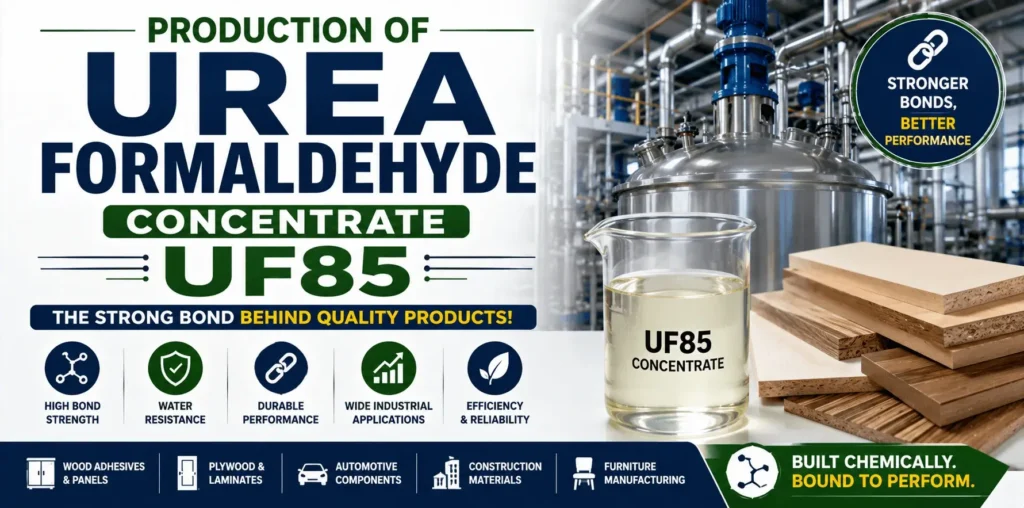
The production of Urea Formaldehyde Concentrate UF85 typically involves a controlled chemical reaction between urea and formaldehyde in the presence of a catalyst. This process is executed under precise conditions of temperature, pH, and reaction time to achieve the desired molecular weight and physical characteristics of UF85 resin. Growing demand from furniture manufacturing, construction materials, and industrial resin sectors continues to drive the global UF85 market. Urea Formaldehyde Concentrate UF85 is one of the most commonly used thermosetting resins, widely used in the production of thermosetting resins, adhesives, plywood, particle boards, MDF boards, laminates, textile finishing chemicals, and fertilizer additives. Due to its excellent bonding strength, high solid content, and cost-effectiveness, UF85 has become one of the most commonly used resin intermediates in the wood-processing and chemical industries. It has extensive use in industrial and commercial applications, understanding the production process of Urea Formaldehyde UF85 is crucial for manufacturers, engineers, and researchers in the field of polymer chemistry. What is Urea Formaldehyde Concentrate UF85? Urea Formaldehyde Concentrate UF85 is a viscous liquid intermediate containing approximately: 60% formaldehyde 25% urea 15% water It is commonly used as a raw material for manufacturing urea formaldehyde resins, adhesives, laminates, and slow-release fertilizers. UF85 is valued for its high reactivity, long storage stability, and strong bonding characteristics in industrial manufacturing applications. Production Process of Urea Formaldehyde Concentrate UF85 Let’s break down the steps involved in producing Urea Formaldehyde UF85. Step 1: Selection and Preparation of Raw Materials The two key raw materials required for manufacturing Urea Formaldehyde UF85 are: Urea (CO(NH?)?): A colorless, crystalline organic compound widely used as a nitrogen-release fertilizer and a base for resins. Formaldehyde (CH?O): A pungent-smelling, colorless gas that is commercially available in aqueous solution (formalin). A typical molar ratio used in the process is between 1:1.6 to 1:2 (urea to formaldehyde). This excess of formaldehyde ensures better cross-linking during polymerization and enhances the resin’s bonding properties. Step 2: Initial Methylolation Reaction The first chemical reaction in the production of Urea Formaldehyde UF85 is methylolation. This step involves mixing urea with formaldehyde at a temperature of about 50–60°C and an alkaline pH (typically 7.5 to 9). A base catalyst like sodium hydroxide (NaOH) is added to initiate the reaction. During methylolation, hydroxymethyl ureas are formed: Urea + Formaldehyde ? Mono-, Di-, and Tri-methylolureas These hydroxymethyl derivatives serve as intermediates for further polymerization. The concentration and time of the reaction at this stage determine the number of methylol groups, which directly influence the curing speed and final resin properties of UF85. Step 3: Condensation Reaction (Polymerization) Once methylolation is complete, the pH is adjusted to acidic conditions (typically pH 4.0 to 5.0) using formic acid or acetic acid, and the temperature is raised to 80–90°C. Under these conditions, the hydroxymethyl groups undergo a condensation reaction, forming methylene and dimethylene ether bridges. Condensation reaction: Hydroxymethylureas ? Linear and Branched Oligomers ? Crosslinked Polymer This step transforms the liquid monomers into a viscous polymeric resin. The degree of polymerization is closely monitored to achieve the specific viscosity and molecular structure characteristic of Urea Formaldehyde UF85. The timing is critical; if the reaction proceeds too far, the resin becomes too thick and unusable. Step 4: Stabilization and pH Adjustment After the desired level of polymerization is achieved, the reaction is stopped by neutralizing the pH back to 7–7.5 using sodium hydroxide or ammonia. This halts the condensation process and stabilizes the resin. At this point, stabilizers and modifiers may also be added to improve shelf life, reduce free formaldehyde content, and fine-tune the resin properties for different applications. Stabilization ensures that Urea Formaldehyde UF85 maintains its performance over time, especially during storage and transportation. Step 5: Concentration and Filtration The UF85 resin is then concentrated to the required solids content, typically 60–65%, through vacuum evaporation or distillation. Filtration is performed to remove any impurities or unreacted materials, ensuring a clean and consistent final product. The resulting viscous liquid is the commercial-grade Urea Formaldehyde UF85. Some manufacturers may further dry the resin into a powdered form depending on the end-use application. Step 6: Quality Testing and Packaging Once the resin is ready, it undergoes stringent quality control tests including: Viscosity Solids content Free formaldehyde content Gel time pH The manufacturer packages the Urea Formaldehyde UF85 resin into drums or containers only after it meets all specified standards, then delivers it to industries like wood panel production, textile finishes, and automotive interior manufacturing. Machinery Used in UF85 Production Major equipment used in the production of Urea Formaldehyde Concentrate UF85 includes: stainless steel reactors condensers vacuum evaporators agitators cooling systems filtration units storage tanks pH control systems packaging machines Modern automated process-control systems help maintain product consistency, quality, and production efficiency. Applications of Urea Formaldehyde UF85 Urea Formaldehyde UF85 is used in numerous applications across various industries: Wood adhesives: For particle board, MDF, and plywood Molded objects: Electrical fittings, buttons, and kitchenware Textiles: As a finishing agent to enhance wrinkle resistance Paper industry: For surface strengthening and gloss The choice of UF85 over other resins is often due to its cost-effectiveness, high reactivity, and favorable mechanical properties. Advantages of UF85 Some of the notable benefits of using Urea Formaldehyde UF85 include: High bond strength Fast curing time Economical production Low color and odor Customizable viscosity and solids content These features make UF85 a preferred material for large-scale industrial applications requiring reliable and consistent resin performance. Environmental and Safety Considerations Despite its advantages, Urea Formaldehyde UF85 does present environmental and health concerns primarily due to the release of formaldehyde gas. To mitigate this: Manufacturers add formaldehyde scavengers such as urea, melamine, or ammonia to reduce free formaldehyde levels. Manufacturers use closed reactor systems and maintain efficient ventilation during production. Workers must follow safety protocols and use personal protective equipment (PPE) during handling and processing. Manufacturers also focus on developing low-emission UF85 variants that comply with environmental regulations such as CARB (California Air Resources Board) and E1 European standards. Global Market Trends and Innovations The demand for