
Biomass and Waste Recycling Business Ideas: 5 Profitable Units in India
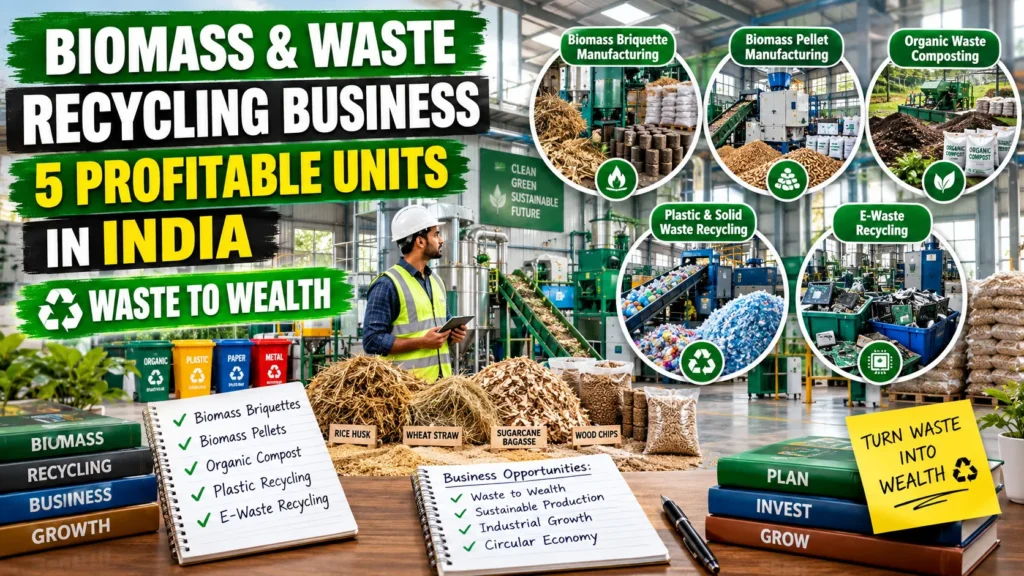
A consultant’s perspective on where sustainability policy intersects with true profits in Indian waste recovery. India generates huge quantities of agricultural, municipal and industrial waste every year. Although much of it is still burned or dumped, it is nonetheless valuable. This is the gap between how much waste is generated and how much can be recovered that the opportunities for biomass and waste recycling business ideas exist. Policies are now encouraging a circular economy and demand for recovered materials remains strong. This article takes the viewpoint of a project consultant for the profession. It will look at need and real plans, 5 business ways, a stroll through trade investments and Indian successes. Why Waste Recycling Is a Strong Business to Enter Cheap Raw Material and Rising Demand The economics of recycling works. Raw material availability is high and cheaper. Increased demand for recycled materials as stricter environmental norms and claims about usage of recycled material increases, so a good business will have low cost inputs and increasing revenue. Government regulations on waste processing and extended producer responsibility compel companies to use recycled material, which is an institutional need, which can be satisfied by small entrepreneurs. Policy Tailwinds Are Strong and Durable Swachh Bharat, plastic waste regulation, and biomass energy goals all favor this industry. Thus, the founder has policies behind him, not against him. Guidance for schemes from MoEF&CC as well as MNRE helps in setting up waste processing businesses. Government Policies and Incentives Support comes from multiple angles and in practice. Swachh Bharat mission supports waste processing infrastructure, while biomass energy schemes from MNRE encourage making pellets and briquettes. Regulations on plastic waste compel recycling. Founders should enroll in Udyam for MSME credit. Pollution compliance takes place via the Central Pollution Control Board and clearing out clearances beforehand avoids disruptions. State level government policy also helps; environment portal of Maharashtra helps with waste processing projects. 5 Biomass and Waste Recycling Business Ideas for Startups Idea 1 — Biomass Briquettes and Pellets Residues from agriculture, sawdust, and agricultural waste can all be compressed in briquettes or pellets and can serve as an industrial fuel. Because there is currently a market for cheaper and cleaner fuel, there is a lot of demand. The entrepreneur enjoys low cost of raw materials and a defined market for boilers and kilns. Calorific value and moisture content of the product define buyers’ confidence in it. There will be low cost through local procurement of the biomass, moreover, exports to Europe and Asia require biomass fuel, thus creating another source of income. The entrepreneur who is capable of producing high-quality briquettes or pellets and delivering them efficiently can develop progressively due to increasing demand for energy. Idea 2 — Plastic Waste Recycling There is plenty of post-consumer plastic, and brands are now compelled to use recycled plastic. The entrepreneur whose business involves collecting, sorting, and processing the waste plastic to create reusable plastic granules is tapping into an industry where the demand exceeds the supply. As the raw material is inexpensive, there are good profit margins even with competitive prices. There are many consumers of recycled plastic, including pipe manufacturers, packaging firms, and moulded products makers. The environmental policies also help with sustaining demand. Moreover, the EPR policy will compel the consumer goods firms to source their supply chain from the recycled plastics industry. Idea 3 — Organic Waste Composting Compost and organic fertilizer can be made out of food wastes, crop residues and organic municipal waste. The need for cost-effective soil conditioners is high amongst farmers while institutional need for the same is steadily increasing. The availability of raw materials being free or low in cost, the input will be minimal. A founder can enter into this business starting off small and scaling up as supply chain becomes more organized. The consistency of compost in terms of quality and nutrients leads to customer satisfaction amongst both farmers and distribution channels. Organic farming standards have changed, now preferring compost over chemicals. Idea 4 — E-Waste Recycling With the advent of smartphones, computers, and other household appliances, India becomes a large producer of electronic waste. Formal recycling capacity is way below requirements. A businessperson who starts a certified e-waste plant operates in a regulated and growing industry. Because the products contain valuable metals, money will be made through processing costs and material sales. Certification and compliance are crucial because the disposal must be proven to the purchaser. By working on a specific waste stream, you gain expertise. In addition, companies and institutions look for reliable partners for disposal, which means regular business-to-business turnover. Idea 5 — Waste Paper and Cardboard Recycling The waste paper and cardboard streams are huge, and the mills always require the recycled fiber. As it is expensive to produce the paper from scratch, using the recycled material becomes an economically feasible decision. A businessman who has an ability to collect, sort and form bales of waste paper may deliver these goods directly to the mills. The quality of bales and reliability of supply would become the basis of long-term relations. Local collecting chains become crucial, as proximity to waste sources reduces expenses. Also, sustainable policies of paper companies raise the demand for the recycled fiber. Import-Export Opportunity Analysis Trade routes offer trade possibilities for founders of the waste sector. There are trade routes for recycled plastics, paper bales, and biomass pellets. Indian founders capable of producing export-quality products have the ability to reach out to foreign buyers, especially in Europe and South-East Asia, since there is great need for recycled products. For one to be able to export, they must ensure that the products are of quality and documented. The DGFT offers guidelines on exports. As a result, a plant established based on quality can easily serve the domestic mills and foreign markets. Indian MSME Success Stories Worth Studying Under Nitin Gupta’s Attero Recycling, an industry leader in e-waste recycling, was formed using technology and certifications. They were early to realise the
प्लास्टिक बैन के बाद कौन से नए उद्योग उभरे — और कैसे करें शुरुआत
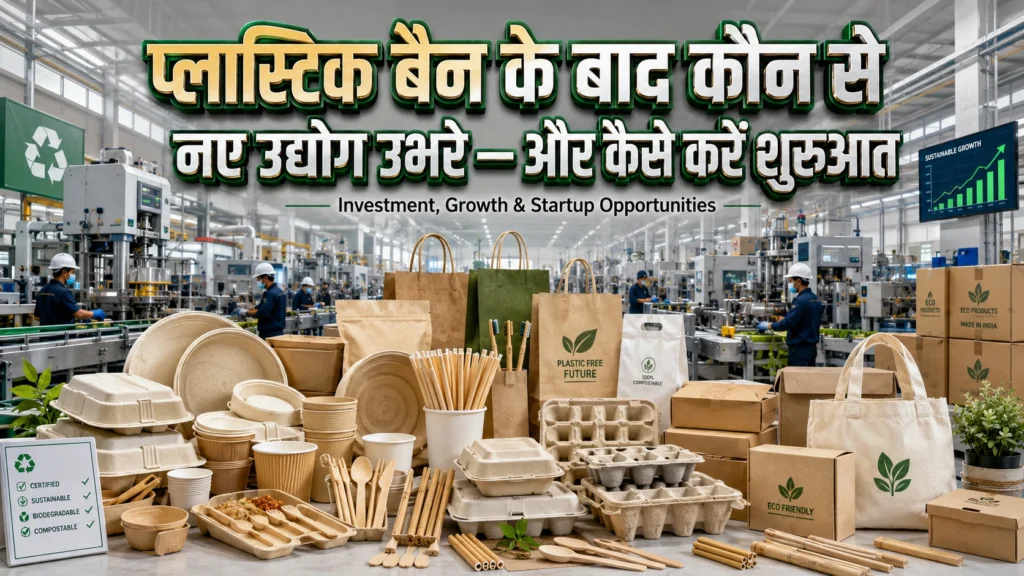
प्लास्टिक बैन के बाद बिजनेस आइडियाज Single-use plastic पर ban एक ऐसा decision था जिसने एक साथ एक industry को बंद किया और कई नई manufacturing industries के दरवाज़े खोल दिए। जो लोग इस shift को समझ गए, उन्होंने नए business ideas में जल्दी कदम रखा। और अब वे अच्छा कमा रहे हैं। इस आर्टिकल में हम देखेंगे — plastic ban के बाद कौन से नए उद्योग उभरे हैं, किसमें सबसे ज़्यादा demand है, और कैसे आप इस बड़े market opportunity का फायदा उठा सकते हैं। Related Article: The Green Manufacturing Revolution: Paper Water Bottles, Bioplastics & Biodegradable Products भारत में प्लास्टिक बैन — क्या बंद हुआ? जुलाई 2022 से भारत सरकार ने single-use plastic के 19 items पर complete ban लगा दिया। Ministry of Environment, Forest and Climate Change के इस फैसले ने plastic alternatives की demand एकदम बढ़ा दी। Plastic bags (75 micron से कम), straws, cutlery, thermocol cups — सब बंद हो गए। 1. पेपर बैग मैन्युफैक्चरिंग यह plastic bag का सबसे सीधा और popular alternative है। Shopping malls, grocery stores, restaurants, और pharmaceutical companies — सभी को paper bags चाहिए। Demand इतनी है कि छोटी paper bag units भी महीनों के orders advance में बुक हैं। इस business की शुरुआत ₹5-15 लाख में हो सकती है। एक small machine से रोज़ 10,000-20,000 bags बन सकते हैं। और profit margin 25-35% तक होता है। Access Complete Business Plan: Paper & Paper Products Manufacturing 2. जूट बैग और जूट प्रोडक्ट्स Jute एक eco-friendly, biodegradable material है। National Jute Board कई support schemes चलाता है। Jute bags, rugs, और packaging India और export दोनों markets में खूब बिकते हैं। Jute manufacturing units को raw material आसानी से मिलता है, खासकर पश्चिम बंगाल, असम, और बिहार में। Read the Complete Book Here: The Complete Book on Jute & Coir Products 3. बायोडिग्रेडेबल प्लेट और कप Areca palm leaf, sugarcane bagasse, और bamboo से बनी plates और cups का market बहुत तेज़ी से बढ़ रहा है। Hotels, caterers, और food delivery companies इन्हें prefer करते हैं। यह एक ऐसा business है जो rural areas में भी शुरू हो सकता है। Raw material local farms से मिलता है और machines की cost ₹3-10 लाख के बीच है। 4. कपड़े के थैले (Cloth Bag Manufacturing) Cotton, canvas, और non-woven fabric से बने bags की demand retailers, FMCG companies, और government schemes में है। ये bags reusable हैं और premium segment में भी अच्छी कमाई है। 5. कागज़ के स्ट्रॉ और बर्तन Paper straws, paper cups, और paper plates की demand cafes, QSR chains, और airlines में तेज़ी से बढ़ी है। एक small paper straw manufacturing unit ₹8-20 लाख में लग जाती है। 6. बांस के प्रोडक्ट्स Bamboo toothbrushes, bamboo straws, bamboo cutlery — ये सब premium eco-friendly products की category में आते हैं। Export potential भी बहुत अच्छा है। Identify high-growth industries before others do बैन के बाद उभरे उद्योग — तुलनात्मक जानकारी उद्योग शुरुआती लागत (₹) मुख्य बाज़ार Profit Margin Paper Bags 5–15 लाख Retail, Pharma 25–35% Jute Products 8–25 लाख Retail, Export 20–30% Areca/Bagasse Plates 3–12 लाख Hotels, Catering 30–40% Cloth Bags 2–8 लाख FMCG, Retail 25–35% Paper Straws/Cups 8–20 लाख Cafes, QSR 20–30% Bamboo Products 5–18 लाख Premium, Export 35–50% शुरुआत कैसे करें — प्रैक्टिकल गाइड सबसे पहले अपना product decide करें। फिर local market में demand check करें — nearby shops, hotels, restaurants से बात करें। Raw material suppliers identify करें और एक छोटे scale पर trial production करें। Udyam registration और GST के बाद अपना product B2B channels पर list करें। IndiaMART और TradeIndia पर profile बनाना एक अच्छी शुरुआत है। अक्सर पूछे जाने वाले सवाल (FAQ) Q1. क्या plastic alternatives का business profitable है? हां, यह highly profitable है। Demand बढ़ रही है और competition अभी उतना ज़्यादा नहीं है। Profit margin 25-50% तक होता है। Q2. Biodegradable products के लिए कोई certification चाहिए? BIS और CPCB certification आपके product को premium market में मदद करती है। हालांकि शुरुआत में FSSAI (अगर food packaging है) ज़रूरी है। निष्कर्ष Plastic ban ने एक नई manufacturing economy को जन्म दिया है। जो उद्यमी आज इन business ideas में निवेश कर रहे हैं, वे कल के market leaders बन सकते हैं। Environment-friendly होना अब सिर्फ नैतिकता नहीं, बल्कि एक smart business strategy भी है।
Green Manufacturing Business Ideas in India for 2026
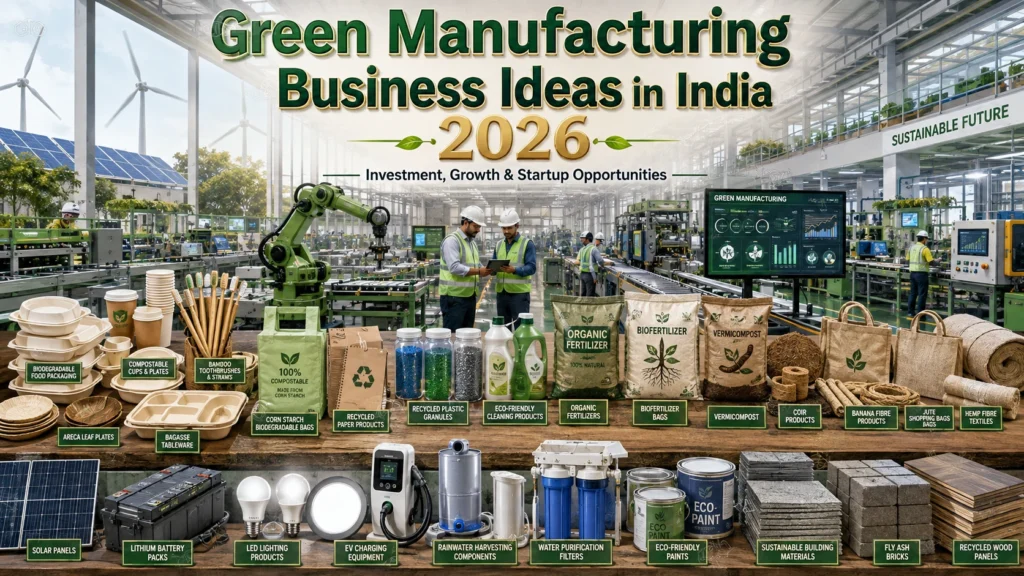
Opportunities for Circular Economy, Recycling and Eco-Friendly Products that are Profitable. The concept of sustainability has grown from being a catch phrase into a viable business model. With India taking a step toward a circular economy, recycling and eco-friendly manufacturing have become regulated, financeable, and future-proof industries. This is a once-in-a-lifetime opportunity for entrepreneurs looking for new and innovative green manufacturing business ideas in India for 2026. There are several trends pushing demand toward sustainable products, including tighter plastic bags, longer producer responsibility regulations, and green-financing incentives. The purpose of this guide is to highlight the most viable manufacturing concepts that are green and circular economy that can be pitched to startups, MSMEs and investors. Where they are successful, they have both a positive environmental benefit and a strong economic return, and many have a steady source of raw materials because they are a waste stream others are willing to pay for. Size of investment is no restriction; it is the process know-how and compliance that is important. In addition, you’ll get practical advice on licensing, government assistance, and how to take your idea from concept to product throughout. The agricultural residue, e-waste, used batteries and plastic waste that India produces annually is immense and a significant proportion of which is unutilised. Every waste stream is a raw material opportunity to a green manufacturer. Meanwhile, extended producer responsibility regulations are making brands responsible for recycling and sustainable packaging, meanwhile, which offers an assured market for conforming units. Thus, it is that green manufacturing is structurally attractive in 2026, being cheap inputs and mandated demand. Related Article: The Green Manufacturing Revolution: Paper Water Bottles, Bioplastics & Biodegradable Products Why Green Manufacturing Is Booming in India The move towards a circular economic system in India has taken recycling to an increased degree of regulation, bringing it to an industry level with long-term demand. The E-waste, battery waste and plastic reprocessing now have the regulatory certainty that provides a consistent flow of raw materials and access to green financing. Meanwhile, there is an increasing consumer demand for biodegradable and compostable products from global brands and Indian consumers which creates export avenues for eco-friendly products. Green manufacturing’s strategic value is “waste to value economics”. If your raw material is agricultural residue, old electronics or used batteries, your margins will be low, your environmental branding will be high, and you’ve got a powerful combination. Top Green Manufacturing Business Ideas in India for 2026 1. E-Waste Recycling and Metal Recovery In India, electronic waste recycling has been now legally regulated and has made the raw material available to the electronics recycling units and also created a steady demand for the recycling industry. Dematerializing copper, gold, aluminium and reusable parts from waste e-waste is a viable, eco-friendly, economically valuable scalable business. Only a tiny percentage of e-waste is processed in India and there is a huge gap in between of the organised recyclers. Building a regulated e-waste recycling centre complete with the required pollution-control and extended producer responsibility authorisations is the professional way to begin a business to securely and reliable provide this service to companies that are legally required to recycle their own products. View Full Project Details: E-Waste Recycling Projects 2. Lithium-Ion Battery Recycling As automotive and consumer electronic batteries end their service, the extraction of high-value minerals like nickel, lithium and cobalt presents an eco-friendly and economic choice. Battery recycling truly is one of the new manufacturing frontiers in India for 2026, supported by policy, and increased volumes. With India importing close to 100% of these critical minerals, it is essential that there is a strategic interest in their recovery in addition to being profitable, and cell manufacturers are more willing to purchase recovered minerals to mitigate their import risk. The first to learn the chemistry to recover the materials and to be able to obtain a regular stream of spent batteries will be able to establish a position which will serve them for decades. Read the Complete Book Here: Handbook on Lithium-Ion & Lead-Acid Battery Production and Recycling 3. PLA Bioplastic and Biodegradable Cutlery Manufacturing Poly Lactic Acid (PLA) is a biodegradable plastic, the world’s fastest growing, made from renewable corn starch. As single-use plastic restrictions increase, there is a great opportunity for restaurants, caterers and cloud kitchens to brand their cutlery, plates and packaging with PLA, a material that’s being manufactured for export. 4. Biochar Production from Agricultural Waste Biochar tackles both agricultural productivity and waste management by turning crop residue into a soil amendment and water filtration material. Crop residue is utilized as biomass in millions of tonnes every year in India which leads to air pollution; hence the conversion of this residue into a useful product has both commercial and environmental benefits. Biochar is a low barrier, high relevance, green manufacturing concept with relatively low start-up costs and increasing market relevance in the field of sustainable and organic agriculture, which is particularly suitable for bioentrepreneurs in rural regions who are close to agricultural clusters. 5. Sustainable and Biodegradable Packaging Sustainable packaging is on the rise as companies move away from plastic packaging and towards biodegradable options in response to legislation and consumer demand. The applications for bagasse tableware, moulded-fibre packaging and compostable films are of huge and increasing importance for restaurants, food delivery, airlines and e-commerce. Biodegradable packaging benefits from government incentives and increased consumer demand as single-use plastics are increasingly subject to regulation and large buyers are increasingly adopting and requiring sustainability objectives, making it one of the most bankable sustainable manufacturing ideas for 2026. Get Detailed Project Report (DPR): Biodegradable Packaging & Bio-based Polymers Guide 6. Plastic Reprocessing and Recycled Granules Plastic reprocessing units convert post-consumer and industrial plastic waste into plastic granules which are used to make plastic product. This business is now subject to the extended producer responsibility norms that guarantee it a consistent and stable supply of raw materials and sustained demand from packaging and moulding plants. Recycled content is a legal requirement and
Top 8 Products from Waste PET Bottles: Business Ideas & Manufacturing Guide
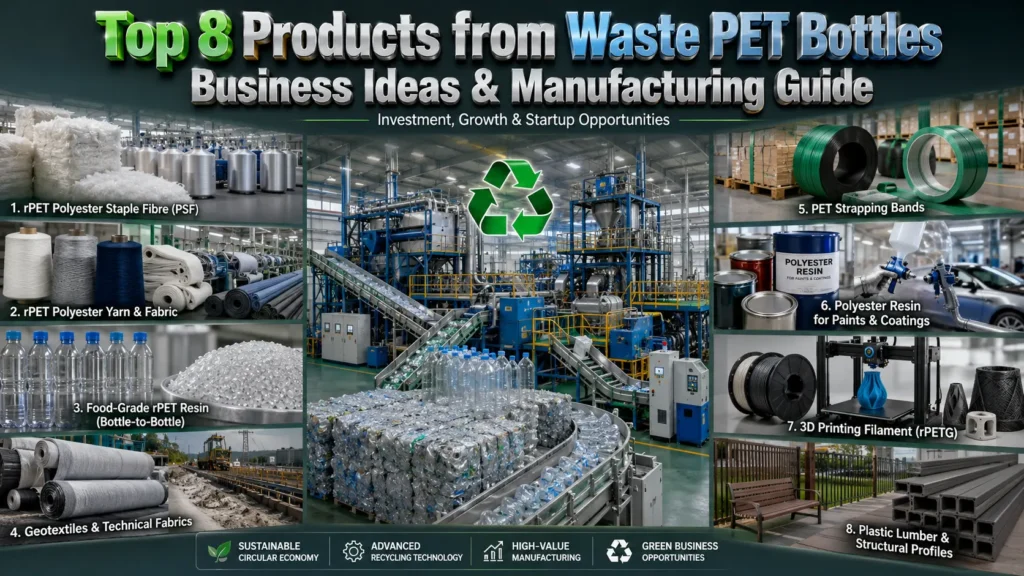
PET bottle recycling business The PET Recycling Opportunity Transformed by EPR Although most commonly recycled plastic in India, polyethylene terephthalate (PET) – clear plastic made for water, soft drink, cooking oil and food packaging – also poses one of the biggest plastic waste concerns for the country. Annually, India generates about 3.5 million tonnes of plastic waste, most of it-60-70%-being collected through an informal network of rag pickers, Kabadiwala networks and small recyclers, and the other 30-40% ending up in landfills, scattered in dumpsites, and often through incinerators. The implementation of EPR – Extended Producer Responsibility – on all plastic packaging producers in the 2022 Plastic Waste Management Amendment Rules has shifted the economics of PET recycling. Now it comes down to the brand owners to prove they collected and recycled the same amount of plastic they added to the market. This has changed the price of recycled PET from a commodity to an EPR compliance tool, with a lower price limit — thus enhancing the investment argument for formal PET recycling. The current trend of entrepreneurs entering this sector has both genuine demand for the product and value of the raw material driven by the regulations. Related Article: Packaged Drinking Water with PET Bottles The PET Recycling Value Chain PET recycling is a chain starting from collection and sorting by colour (clear, green, blue), followed by baling, washing (hot wash lines remove labels, adhesives and contaminants), flaking (shredding into clean PET flakes) and ending with the conversion of PET flakes into end products. The cost of the investment increases significantly at each step downstream — a “baler” costs Rs. 5 lakhs, a hot-wash line Rs. A fibre spinning line Rs. 50 – 150 lakhs. But so do the margins, 3–8 crore. Entrepreneurs may join anywhere and can sell semi-processed material to the downstream processors or can go forward to get more realisation. Top 8 Products from Waste PET Bottles 1. rPET Polyester Staple Fibre (PSF) The most significant end product from PET bottle recycling worldwide is recycled PET polyester staple fibre. After being washed and dried, PET flakes are melted, extruded through spinnerets, drawn, crimped and cut into short fibers (32-64 mm) that are used as pillows, quilts, sleeping bags, stuffed toys and automotive seat cushions. As European and US brands make their recycled fibre content commitments, the demand for exported materials continues to rise.As Europe and the US brands make commitments to recycled fibre content, the demand for exported materials continues to rise. The cost of 10 TPD rPSF plant is Rs. The stake he has in 2–5 crore and the money he generates is Rs. 60,000–90,000 per tonne of output. Explore This Book: The Complete Technology Book on Expanded Plastics, Polyurethane, Polyamide and Polyester Fibres 2. rPET Polyester Yarn and Fabric The high-quality PET flakes are melted and extruded to continuous filament polyester yarn. These high-quality yarns have a range of uses that include fabrics for Apparel, such as active wear, outerwear and linings, Home & Lifestyle, Home & Technical products. As, many globally recognised fashion brands set recycled targets for Polyester, to some extent that you’re more likely to find some of the leading companies making commitments, you could even be looking at, like adidas, H&M, Patagonia and IKEA setting some standards. Indian rPET yarn manufacturers who cater to these brands have established their export business. When making a rPET yarn spinning Plant, the following is required: This makes it a cheaper product than the other 3–8 crore which produces yarn at Rs. 80,000–1,20,000 per tonne. 3. Food-Grade rPET Resin (Bottle-to-Bottle) The most profitable PET recycling process is the bottle-to-bottle process, where rPET (recycled PET resin) is used to make food-grade resins for new beverage bottles. To get the required high intrinsic viscosity for bottle resin, this will need Solid State Polymerisation (SSP) equipment. There is a considerable investment (Rs. The price of food-grade rPET resin is Rs. 10–25 crore. The price of 80,000 to 1,10,000 per tonne is almost comparable to virgin PET resin price, and raw material (PET flakes) price is much lower. Domestic food-grade rPET is a preferred option as beverage brands under EPR pressure look to fill supply chain. 4. Geotextiles and Technical Fabrics Needle-punched geotextile fabrics used in road constructions, slope stabilisation and soil erosion control are made of rPET fibres. The rPET geotextiles have similar performance to virgin polyester but with a price reduction of 20-30%, which is appealing to infrastructure contractors. Specifying geotextile use is increasing the demand, especially from NHAI and state highway departments. The cost of rPET needle-punch geotextile line is Rs. The value is in the range of 1.5–3 crore and directly serves infrastructure supply chains. 5. PET Strapping Bands rPET flakes can be used directly in packaging and logistics industry for PET strapping. The use of PET strapping has been largely superseded by the use of steel strapping because it is lighter, it is rust-proof and it does not break on impact. The price of a PET strapping extrusion line is Rs. The cost of 30–80 lakh and produces strapping at Rs. $60,000-$80,000 per tonne — for large domestic packaging and logistics industry. Get Detailed Project Report (DPR): Plastics, Polymers & Resins Manufacturing Projects 6. Polyester Resin for Paints and Coatings By performing glycolysis on PET waste, bis-hydroxyethyl terephthalate (BHET) and mixed glycol terephthalate oligomers can be used as polyol for polyurethane foams, alkyd resins and polyester resins in paints and coatings. This is a chemical recycling step which needs more advanced chemistry (Rs.). High value-added chemical intermediates having better margin profiles than mechanical recyclables can be generated (1–3 crore). 7. 3D Printing Filament (rPETG) These PET flakes can be extruded and spooled into filament for desktop FDM printers, which are usually made in a high clarity varnish. The niche, high value application fetches Rs. 3,000–6,000 per kg of filament versus Rs. A value multiplier of 40–75x 60-80 per kg of input PET flakes. Small-scale production (Rs. The 20–50 lakh price segment is aimed
Top 8 Products from Dairy Whey and Cheese Waste: Business Ideas & Manufacturing Guide
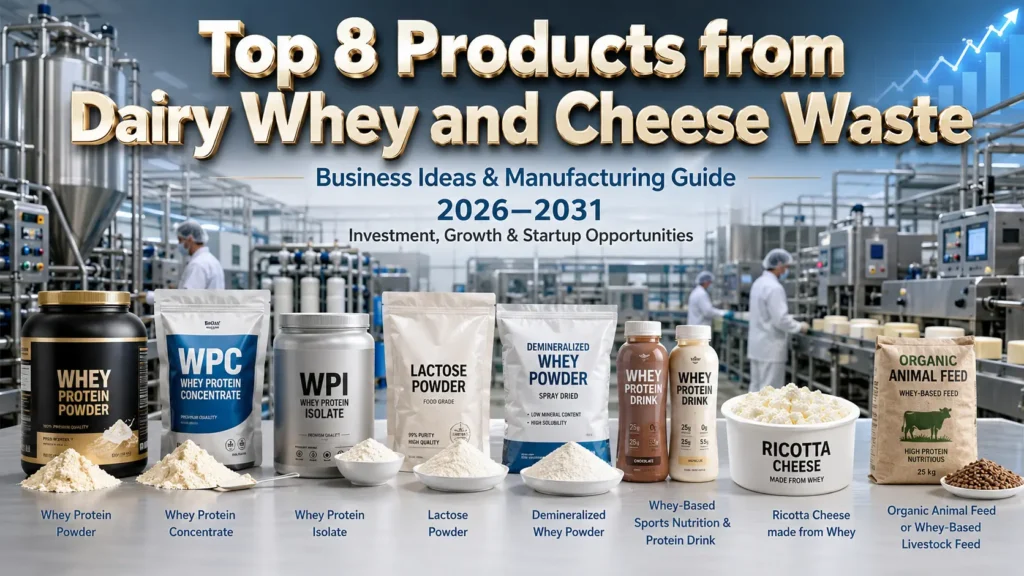
Dairy Whey Processing Business Whey — India’s Most Wasted High-Value Food Industry By-Product India is the world’s largest milk producer, with 220 million tonnes of milk being produced annually. The dairy processing industry generates huge quantities of Paneer, Cheese and Casein in the country and along with each of the above product comes a waste stream which is literally being dumped by most of the processors. The liquid end of cheese, paneer, and casein is called whey, which contains about 6.5 grams of protein (in the form of beta-lactoglobulin, alpha-lactalbumin, immunoglobulins and lactoferrin) that are among the most highly nutritious and most rapidly absorbed proteins in human nutrition. About 13-15 MT of whey is produced in India every year due to paneer, chhena and cheese production. If whey protein concentrate (WPC-80) prices are Rs. The protein content in India’s wasted whey is Rs. 400-600 per kg. 5,000 crore+ annual opportunity. The opportunity for specialised whey processing entrepreneurs who can collect, process and supply to the booming sports nutrition, infant formula and pharmaceutical market in India is created by most of the small and medium dairy processors lacking in capital and technology to recover this value. Get Detailed Insights from This Book: Milk Processing & Dairy Products in India Market Research Report The Whey Processing Chain and Entry Points The technological development of whey processing includes collection from the dairy processors (sweet whey or acid whey), pasteurisation, pre-treatment, ultrafiltration (UF) to concentrate protein, spray drying for whey protein concentrate (WPC-35, WPC-70, WPC-80) or further ion exchange chromatography for whey protein isolate (WPI-90). The protein content as well as market value increases significantly at each step. Lactose from the UF (permeate) will be a separate product stream, as lactose powder for pharmaceutical and food applications. This can be done by entrepreneurs at any stage of their business, whether they are interested in selling the semi-processed concentrate to existing driers or they would like to participate as fully-fledged companies and generate finished products for the consumer-market. Top 8 Products from Dairy Whey 1. Whey Protein Concentrate (WPC-80) WPC-80, which contains 80% protein, is the most popular sports nutrition ingredient on the world market, and the main raw ingredient in protein bars, shakes, meal replacement powders and functional foods. Currently, India sources most of its WPC-80 imports from New Zealand, Australian, Europe and the USA. Reprocessing Indian dairy whey domestically would be extremely cost competitive. The cost of a 5 MTPD WPC-80 plant (ultrafiltration + spray dryer) is around Rs. The revenue that the 5–15 crore earns is Rs. 400–600 per kg. 2. Whey Protein Isolate (WPI-90) The highest quality sports nutrition ingredient, WPI-90 is protein-rich, with 90% protein or higher and is faster digested than WPC, low in lactose, and virtually fat-free. An extra ion exchange chromatography/microfiltration step is needed for production in addition to the step required for WPC production. WPI sells at Rs. India’s sports nutrition market (estimated Rs. The value of the market (12,000crore by 2026) is expanding by 15-20 per cent per year, and it is highly import-dependent thereby offering significant opportunity for domestic manufacturing. Build a profitable business with the right idea 3. Whey Powder (Food Industry Grade) Sweet whey powder (12% protein, 70% lactose) is obtained by the simple spray drying of the concentrated whey without protein separation. It is used in bakery products, confectionery, infant formula, animal feed and processed cheese. At Rs. Whey powder is the cheapest product available but is the lowest value product with requirement of Rs. 80-150 per kg. Installing a spray dryer unit for Rs 80-200 lakh, which is an entry point for dairy processors producing whey. 4. Pharmaceutical Lactose Lactose concentration in the permeate from whey ultrafiltration is 4-5%. Crystallised and dried lactose is used in the manufacturing of pharmaceutical tablets as an excipient, in infant formula as well as confectionery and as a fermentation substrate. Lactose is sold at a price of Rs. per unit in Pharmaceutical Grade. The import prices of 150-250 per kg are high and India is importing a huge amount. The cost of a lactose crystallisation and drying unit is Rs. The market is large and import-substitutable, and they are at 2-5 crore. 5. Lactulose (Pharmaceutical Laxative) Lactulose is formed by alkaline isomerization of whey lactose. A pharmaceutical grade laxative and prebiotic for treating hepatic encephalopathy, selling more than USD 500 million world-wide each year. Currently, India depends on the imports of lactulose from Europe. A lactulose synthesis unit (Rs.) The market potential of 3-6 crore for converting lactose from whey into the pharmaceutical product is a very high margin specialty chemical opportunity with good import substitution potential. 6. Whey-Based Animal and Aquafeed Liquid whey can be spray dryed into whey-enriched animal feed pellets without protein concentration for poultry, swine and aquaculture. A fishmeal replacement ingredient which has been shown to improve fish growth. Due to the trend towards dairy and plant protein-based fishmeal alternatives, whey-based aquafeed is becoming an increasing share of the market. Investment: Rs. For blending and pelletising Rs 20-60 lakh. 7. Lactic Acid from Whey Permeate Whey permeates, containing abundant lactose, can be subsequently fermented by Lactobacillus species to yield lactic acid, which can be used in bioplastic (PLA) production, food acidulants, personal care products and pharmaceuticals. The price of lactic acid is Rs. 80–150 per kg. The price of a 100L whey fermentation and lactic acid recovery unit is Rs. 1-3 crore and is linking dairy waste processing to the rapidly expanding bioplastics value chain. 8. Biogas from Whey and Dairy Effluent Whey and wash water from dairy are good substrates for biogas digestion as they have very high BOD value (35,000-60,000mg/l). The effluent from dairy processing plants must be processed legally before discharge. The biogas digester helps in reducing electricity bill and energy cost in ETP compliance by using whey and dairy effluent as raw material to generate biogas as a fuel to provide energy for boilers. Dairy wastes produce biogas, which is also eligible for benefits under
India RHA-Based Products Market Analysis 2026–2033: SWOT, Demand-Supply Gap, Applications & Startup Investment Opportunities
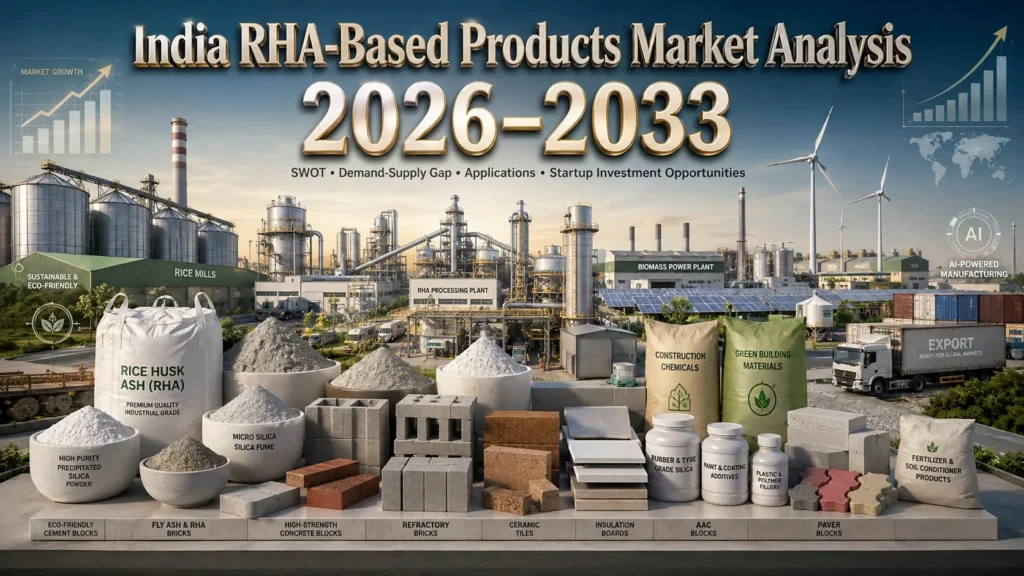
India RHA Based Products Market The market for Rice Husk Ash (RHA) in India is emerging at a time when the country’s agriculture sector is producing more rice than ever before, its infrastructure sector has a $175-billion investment pipeline, and the country is experiencing a shortage in specialty silica supply. The global market for RHA is estimated to be in the range of USD 3.0–3.2 billion, expanding at a 4.8–5.3% CAGR to USD 4.1–4.8 billion by 2033. In this global context India has one of the most dominant raw material positions in the world, but is structurally dependent on imports for high-purity silica, still from that very raw material. The big business opportunity for Indian MSME chemical and agro industries this decade will be closing that gap. The demand–Supply Gap India (D-S-G) is a result of the imports of silica precipitated from China, Germany, Japan, Malaysia and Taiwan at a compounded rate of 20.59% CAGR (2020-2024) and the fragmented nature of the RHA processing capacity with quality inconsistencies in India. The country produces 30+ million tonnes of rice husk a year, but only a small proportion is used to make value added silica products, resulting in a structural gap being addressed by importing rice husk. Organized players in various product segments of RHA include Major Indian Players Guru Metachem Pvt. Ltd., Usher Agro Limited, and Rescon (India) Pvt. Ltd., ranging from steel-grade insulating compounds, high-purity silica, to construction additives. With raw material which is almost free from rice mill clusters, the MSME scale silica unit with a capital investment of ₹ 3–8 crore can expect to generate a profit of 20–30% IRR. The multi-sector pull from green tyre demand, EV sector growth and construction sector boom insulates this investment from single industry cyclicality. India’s Hidden Industrial Asset: 30 million Tonnes of Wasted Silica India’s rice mills produce in excess of 30 million tonnes of rice husk as an end product of the milling process annually in the rice bowl states of Uttar Pradesh, Telangana, West Bengal, Punjab, Chhattisgarh and Andhra Pradesh. This husk, when fired at well-controlled temperature of 500°C to 700°C, produces Rice Husk Ash (RHA) rich in amorphous silica (80-95% by weight) which is the most reactive form of SiO2 available from any raw material on earth with a highest surface area. The contradiction is obvious. As per the Department of Agriculture & Farmers Welfare (DA&FW), India is the world’s largest or second-largest rice producing country based on the crop year with the total paddy production of 1,364 lakh tonnes in 2024–25. The Economic Survey 2025-26 reveals that Uttar Pradesh is the leading contributor of rice, with a production of 20.76 million tonnes, followed by Telangana with 17.45 million tonnes and West Bengal with 16.02 million tonnes, making the top three states contribute to more than 36% of the national rice production. India, however, despite having what is supposed to be a world-class silica manufacturing raw material base, continues to import hundreds of thousands of tonnes of specialty silica annually, due to the lack of pace of development of the processing infrastructure. It’s not a farming issue. It is a gap in industrial policy — and one of the most obvious MSME business opportunities in India’s manufacturing industry. Related Article: Why Rice Husk Silica is the Future of Green Tyres: Market Growth and Demand Gap Understanding RHA: Not Just Ash, But Industrial-Grade Silica It is important to be aware of what RHA is in fact providing that has made it commercially viable to a number of industries, before assessing the market opportunity. In the controlled combustion of rice husk, the organics are burned, leaving a concentrated ash of organic silicon compounds which is extremely porous and amorphous. The result is RHA that has amorphous silica — a much more chemically active form of silica than the crystalline silica from traditional quartz quarries. That’s what makes RHA so valuable. In the field of construction, it reacts with calcium hydroxide to produce more calcium silicate hydrate, which strengthens and makes the concrete impermeable at 10 to 25% cement replacement. It is used as a top-notch filler in the rubber and tyre industry to enhance the resistance to abrasion and minimize rolling resistance. Its thermal stability of over 1500°C is ideal for steel ladle and tundish linings in refractory applications. Global rice production is expected to reach a record high of more than 535 million tonnes (milled basis) in 2024–25, according to the Food and Agriculture Organization of the United Nations (FAO). India has the biggest share of the global upward revision, and also contributes the largest share of the world’s total rice husk production. This places India not just as the producer of RHA for in-house use but as one of the future suppliers of high purity silica derivatives in the global market, which so far India has not fully occupied. Global and India RHA Market: Size, Growth, and What the Numbers Mean for Investors The RHA market is expected to grow to USD 4.1–4.8 billion by 2033, from USD 3.0–3.2 billion in 2026, with the forecast range indicating scope differences among various market segments. The base RHA market is expected to reach nearly USD 1.0 billion in 2034 at 10.4% CAGR, whereas the higher value-added sub-market of Precipitated Silica from RHA will cross USD 608 million by 2026 at 19.2% CAGR. This is because the demand for higher purity of silica for application in tyres, rubber, pharmaceuticals, cosmetics, and specialty chemicals is increasing, while bulk ash for construction products is decreasing. India is poised for faster growth compared to the global rate of 12–15% CAGR, owing to the infrastructure investments that are accelerated in the country, the rapid growth of the rubber and tyre sector, and growing awareness among institutions of the use of pozzolanic materials as carbon efficient alternatives to OPC. The domestic precipitated silica market, the primary commercial product of RHA, was estimated at USD 76.2 million in 2024 and will expand at 10.2% CAGR, to
India Paper-Based Products Market 2026–2033: SWOT, Demand-Supply Analysis, Regional Insights & Startup Opportunities
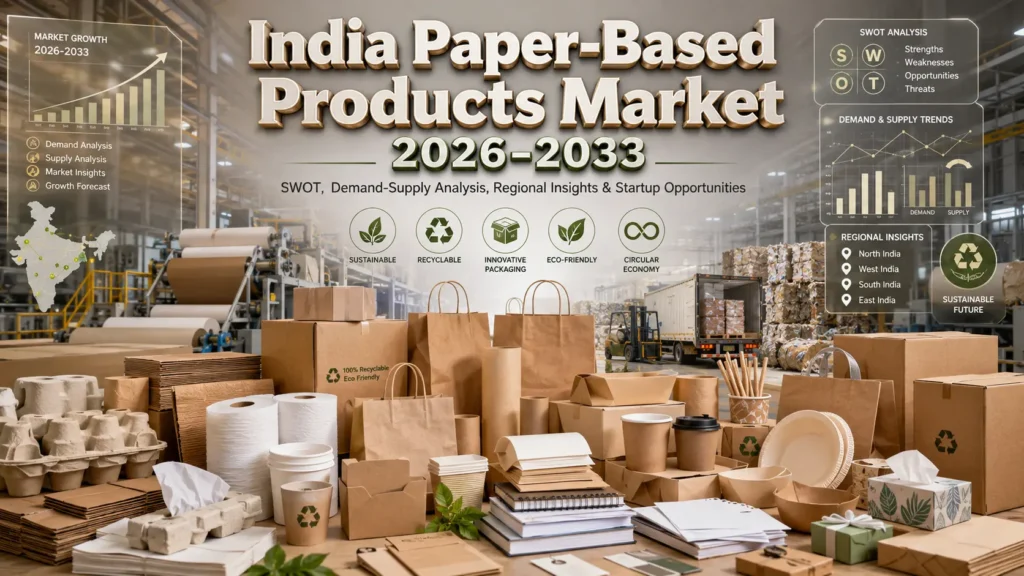
India Paper Based Products Market Market Insight The paper-based products sector in India is at a juncture – where policy support initiatives, increasing e-commerce volumes and a significant change in consumer mindset from single-use plastics are shaping the entire demand curve. Indian paper and paper products market is estimated at USD 9.25 billion and will reach a value of USD 11.91 billion by 2030 with steady growth of approximately 4.37% during the forecast period. The packaged paper market, meanwhile, is growing at much higher rates, and India’s paper packaging market alone was worth about USD 18.6 billion, which by 2033 should be worth USD 28.3 billion, according to data tracked by the India Brand Equity Foundation (IBEF). The headline growth rate is not the most compelling part of this opportunity. It is the increasing disconnect between the demand and supply of domestic consumption, which must be clearly analyzed by policy makers, investors and manufacturing entrepreneurs. India Paper-Based Products: Market Overview and Growth Trajectory India is now among the fastest growing paper markets of the world and the total paper and paperboard consumption have reached 23-24 million tonnes per annum. The production capacity of the operating mills is in the range of 22-24 million tonnes, whereas installed capacity of mills is in the range of 30-32 million tonnes, which is a contradiction and highlights under-usage of production capacity as well as structural deficiency of supply. According to the data given by the Central Pulp & Paper Research Institute (CPPRI), which is an autonomous body under Ministry of Commerce & Industry in the Government of India, the manufacturing of paper in the country is around 900 with only 550-560 being operational. This figure alone represents the level of investment and consolidation needed in the sector. Generally, there are four application segments of the paper market in India – packaging paper and paperboard, writing and printing paper, newsprint, and specialty papers. The packaging is the largest growth driver of these, representing almost 65% of paper usage, with an annual increase of more than 8%, and is fueled by growth from FMCG, organized retail, pharmaceutical packaging and the structural development of e-commerce logistics. India shipped more than 5.2 billion online shipments in one recent year alone, and that figure is still rising — all of these shipments need corrugated packaging, paper bags, labels, or protective paper inserts. Writing and printing paper is the second-largest segment and is expected to see a fairly consistent demand from education institutions, publishing houses, government documentation and stationery from the value chain, as they consume paper at the rate of about 35%. India, despite the digital disruption, has more than 105000 registered newspapers published in various languages of which more than 100000 are daily newspapers in India, according to the Registrar of Newspapers in India, which is the highest in the world in terms of newspaper and writing paper demand. The turnover of Indian paper industry is about Rs. It is estimated to be about Rs. 70,000 crores for the national exchequer. 8,000 crores. Not only is it an industry sector, but it directly and indirectly employs more than five lakh people and helps thousands of agro-forestry farmers all over the country, too. Get Detailed Insights from This Book: Modern Technology of Pulp, Paper and Paper Conversion Industries Per Capita Consumption Gap: The Single Biggest Market Opportunity The one figure that sums up the investment case of the paper-based products industry in India is this: India consumes about 15-17 kilograms of paper per capita annually. The average for the world is 57 kilograms. In developed countries such as the USA, it is over 200 kg per person/year. This is an abysmal consumption deficit and it is not just a number — it is an economic deficit. Increase in India’s per capita paper consumption by 1kg is approximately equivalent to one million additional tonnes of paper consumption per year. In India, the economy is rapidly formalizing, urbanization is increasing rapidly and literacy is on the rise, which will lead to a per capita consumption of 28 to 30 kilograms of paper in 2030. It does not take much imagination to realize that this alone would mean the need for adding up to 15–16 Mt of consumption capacity in this decade—an extraordinary manufacturing opportunity. The Indian Paper Manufacturers Association (IPMA) data shows domestic use of packaging paper is more than 8% a year now, and the total paper market is expanding at 6-7% a year. But a lot of this incremental demand growth is being satisfied right now not by domestic manufacturers but by imports, and especially from China, the ASEAN countries and South Korea. Demand–Supply Gap: Where the Real Opportunity Lies The Indian paper-products industry has a real, measurable and commercially important demand-supply gap. On the other, the domestic consumption is expected to increase to 23.5 million tonnes per annum while the domestic production capacity (with only the operational mills considered) is around 22 MT per annum. This is being addressed mainly by new imports, which have increased dramatically, of around 1.5 to 2 million tonnes per year. IPMA data shows that at certain junctures, imports of paper and paperboard have demanded over 15% of the total Paper Market in India — almost 2.8 to 3 million tonnes of paper per year. Imports from China have increased by more than 13% on an annual basis in value terms and imports from ASEAN have soared by more than 78% in certain quarterly periods. Most of the paper which India imports are coated papers, specialty papers, tissue, kraft paper and newsprint which can be produced locally in India, with the exception of coated papers, which are imported from the Far East. The import surge is structural, not cyclical, according to information from the Directorate General of Commercial Intelligence and Statistics (DGCI&S). Nearly Rs. 14 billion worth of paper and paperboard were imported. This amounts to 10,000 crores in a single nine-month period and is a straight-line impact on the viability of
Products from Brewery Spent Grain and Distillery By-Products: Manufacturing Guide and Business Opportunities
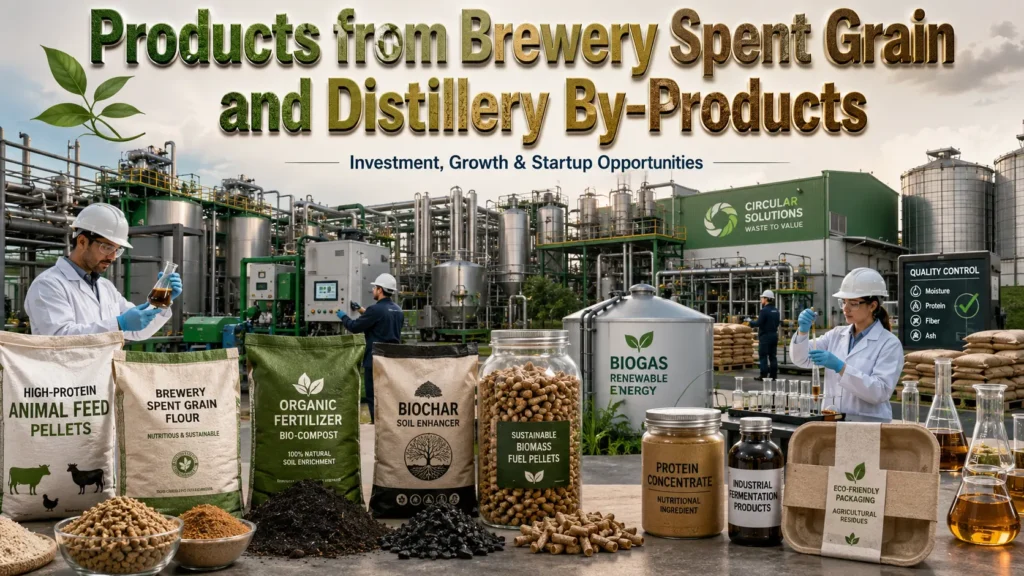
Brewery Spent Grain Business in India Beer and Spirits in India has experienced a tremendous growth in the last 10 years. The Indian market is now the second biggest in the world for whisky and 8–10% of the population are drinking beer every year. This growth equates to increasing amounts of processing waste, such as brewer’s spent grain (BSG) from the brewing industry and distillery spent wash from alcohol production. BSG is the barley malt and adjunct grain used to make the wort that is left over from the brewing processes. About 20kg of wet BSG is produced for every 100 liters of beer produced. The wet BSG is produced by a large Indian brewery (1 lakhs liters per month) and is sold/donated as cattle fodder at Rs. 200 per ton. 1,000–3,000 per ton. BSG is 25–30% protein, 15–25% dietary fiber and has a high content of B vitamins and antioxidants. With the rise in market demand for high fiber, high protein food ingredients like protein bars, sports nutrition, functional foods, food enrichment, there is scope for processing BSG into food grade ingredients which fetches high price of Rs. 100–250 per kg versus Rs. 1- 3 per kg feed as wet cattle feed. The distillery spent wash is a by-product of the alcohol distillation process that contains high levels of BOD (50,000-100,000mg/l) and is rich in potassium, nitrogen and organic compounds useful as crop fertilizers. However, the regulatory pressure (i.e. effluent discharge prohibition) and fertilizer requirement creates a business structure for valorization of spent wash. Top 8 Products from Brewery and Distillery Waste 1. Brewer’s Spent Grain Protein Flour Dried (drum dryer or spray dryer) spent grain after centrifuge and ground to fine flour has a protein content of 25-30% and a fibre content of 15% (dietary fibre). Protein enriched bread, crackers, pasta and health food products use food grade BSG flour. It sells at Rs. 80–150 per kg versus Rs. 1–3 per kg wet. A BSG drying and milling unit will cost Rs. 60–150 lakh. 2. Dried Distillers Grain (DDG) for Animal Feed Dried and pelletised distillery grain residue (corn, sorghum or barley based) is high in protein (26–30%), high in metabolisable energy and high in fat (9–11%) making it a premium animal feed ingredient. DDG can be used in rations for dairy cattle, poultry and swine as a protein-energy source at a competitive price. DDG is a product of large grain-based distilleries and smaller operations can be given the chance to complement their facility with drying and pelletising. Get Detailed Project Report (DPR): Business Plan for Starting Animal Feed Production 3. Spent Wash Potash Fertiliser (Bio-Composted) Distillery spent wash (after multi-effect evaporation) is mixed with agricultural biomass (bagasse, press mud) and forms an organic manure containing 2-3% K₂O, 1.5-2% N and 1% P₂O₅. The Fertiliser Control Order allows spent wash compost as an acceptable organic fertiliser. The cost of the spent wash treatment by composting plant is Rs. It is able to save 50-150 lakh and also addresses the effluent compliance. 4. Biogas from Spent Wash Amongst all industrial effluents, spent wash generates the most energy efficient biogas from high-rate reactors such as UASB and CSTR with 25-35 m³ of gas per m³ of spent wash. The biogas is fired in boilers in place of biomass or coal. A number of large Indian distilleries (United Spirits, Radico Khaitan, Allied Blenders) have installed biogas plants from spent wash. Cost of 1 million litre/day distillery spent wash biogas plant is Rs. 3–8 crore. Get Detailed Insights from This Book: Handbook on Biogas and Its Applications 5. Protein Supplement for Aquaculture Feed Dried and pelletised with balanced amino acid profile, Brewer’s spent grain protein is accepted in tilapia, rohu, catla and shrimp aquafeed at inclusion levels of 10-20%. In the context of the rising production in Andhra Pradesh, West Bengal and Odisha, the demand for plant-based protein feed alternatives to fishmeal is increasing. The price of BSG protein supplement is Rs. 40,000–70,000 per tonne in the aquafeed market. 6. Yeast Extract (from Surplus Brewing Yeast) Protein-rich by-product of the brewing process, surplus brewer’s yeast can be lysed (heated or treated with enzymes) before spray drying into yeast extract, a savory flavour ingredient found in processed soups, sauces, seasoning blends and pet food. The price of yeast extract is Rs. It is imported at present, and costs 200–500 per kg. The cost of a yeast extract production unit is Rs. 1–3 crore. 7. Biosorbent (Spent Grain for Heavy Metal Removal) Chemical processed (acid washed and crosslinked) spent grain is used to make a biosorption material that is efficient in the removal of heavy metals (lead, cadmium, chromium) from industrial effluents. A specialty, niche chemical application for the ETP industry. The cost of a specialty biosorption preparation unit is Rs. 40–100 lakh. 8. Compostable Packaging Material Dried and compressed BSG fibre with starch binders, can be used to create rigid compostable packaging trays, plates and containers. These products are in competition with bagasse and wheat bran moulded packaging products — the single-use plastic alternative market. The cost of a BSG moulded packaging unit is Rs. 80–200 lakh. Discover business ideas that actually make money Investment and Market Summary Product Investment (Rs.) Price Key Buyer BSG Protein Flour (Food Grade) 60–150 lakh Rs. 80–150/kg Health Food, Bakeries DDG Animal Feed Pellets 40–100 lakh Rs. 25–40/kg Dairy, Poultry, Aquafeed Spent Wash Compost 50–150 lakh Rs. 4,000–8,000/MT Organic Farmers Biogas from Spent Wash 3–8 crore Fuel Cost Saving Self-Consumption, OMC Yeast Extract 1–3 crore Rs. 200–500/kg Food Flavour, Pet Food Related Article: Strategic Role of Zinc and Copper in Animal Nutrition: Why Every Feed Formulation Must Include Trace Elements Raw Material Contracts with Breweries and Distilleries Formal contracts must be signed with breweries and distilleries to assure supply of BSG and spent wash including agreed delivery dates, quality data (moisture, protein content), and price. In addition, large breweries are willing to outsource the entire BSG logistics to a processor, even if they have to pay
How to Start a Seaweed and Marine Algae Products Export Business in India

Seaweed and Marine Algae Products Export Business The seaweed and marine algae products manufacturing for export is one of the promising and fastest-growing business ideas in the blue economy in India. The global seaweed market is over 16 billion dollars annually and is expanding at a rate of 10% to 12% per year, due to the increasing trend in the world towards natural, plant-based, and sustainable products. Seaweed farming and processing is a high priority marine export category promoted by MPEDA and there are significant natural resources of seaweeds in India available along the coast, especially in Tamil Nadu, Gujarat and Andaman and Nicobar Islands. Seaweed and marine algae products represent a business opportunity for entrepreneurs who have access to coastal land, interest in aquaculture or a chemistry processing unit, and are interested in supporting sustainable, healthy, and sustainable business development and future growth. Why Seaweed Products Export Is a Growing Blue Economy Opportunity The potential benefits of seaweed are its exceptional chemical diversity, with carrageenan, agar, alginates, fucoidan, laminarin and various bioactive compounds being used as food additives, excipients for pharmaceuticals, cosmetic actives, agricultural bio stimulants and sustainable packaging materials. This chemical variety provides several opportunities for market penetration and investment and margin characteristics. Seaweed has a strong competitive edge for India because of coastal biodiversity, tropical water temperature, availability of sunlight and its traditional harvesting knowledge among the seaweed harvesting communities in Tamil Nadu and Gujarat. The use of seaweed aquaculture (cultivation of species such as Kapahulu’s alvarezii (cottonii) and Gracilaria (used for agar) production can supplement the natural harvest in terms of scale and consistency. MPEDA and Government Support The Marine Products Export Development Authority (MPEDA) is actively encouraging the cultivation and processing of seaweed products with financial assistance for seaweed cultivation infrastructure, processing equipment, quality certification, and developing market. MPEDA’s seaweed development programme offers subsidies for systems of raft and ropes, for drying facilities and for extraction machines. Seaweed farming infrastructure such as rope, raft cultivation system and seaweed processing equipment are given capital subsidy in the Department of Fisheries PMMSY. The support given to PMMSY is also generous, especially for the cultivation of seaweeds which aligns to the coastal livelihood development and blue economy goals. Central Institute of Fisheries Technology (CIFT), ICAR, offers technical support and technology transfer for the processing of seaweed such as carrageenan extraction, agar production and manufacture of seaweed biostimulant technologies to help entrepreneurs with proven technologies for setting up new enterprises. Exports of seaweed and marine algae products are covered under DGFT RoDTEP Scheme. MPEDA RCMC must be claiming these benefits. Seaweed products are one of the most promising marine export products for MSME entrepreneurs, due to their relatively low investment requirements and the increasing global demand. Read the Complete Book Here: Handbook on Fisheries and Aquaculture Technology Business Ideas in Seaweed and Marine Algae Products 1. Dried Seaweed and Raw Seaweed Export The exported seaweeds are mainly sun-dried Kappaphycus alvarezii (cottonii) from Tamil Nadu coastal farms for processing in food grade carrageenan by the carrageenan extraction companies in Philippines, China and Europe. This is the most readily available seaweed export venture which has minimal processing facilities. Cost investment range between ₹10 lakh to ₹30 lakh for seaweed drying platforms, packaging and basic quality testing. The farmers and SHG of Tamil Nadu involved in seaweed farming under the support of MPEDA and PMMSY provide raw seaweed which is processed and packaged by the traders/exporters. The export price of dried cottonii seaweed is from ₹25 to ₹50 per kg, depending on the quality and the amount of carrageenan present. 2. Carrageenan Extraction and Export A widely used food additive in this country, carrageenan is a natural hydrocolloid obtained from red seaweed, which is used in dairy products, processed meats, infant formula, and cosmetics. The Kappaphycus seaweed cultivation in India is the source of raw material used in the production of carrageenan. The investment amount in an extraction vessel, filtration unit, drying and milling is in the range of ₹1crore to ₹4crore in a carrageenan extraction unit. Premium food industry buyers must use carrageenan that is food grade and certified by JECFA as well as Kosher and Halal. Carrageenan is sold internationally as a stabiliser and gelling agent for dairy manufacturers and processed food producers in the EU, US, Japan and Southeast Asia. 3. Agar Production from Gracilaria Seaweed Agar is a gelling agent from red seaweeds (Gracilaria and Gelidium) that is widely used in microbiology laboratory media, food production and in the manufacture of pharmaceutical capsules. In India natural Gracilaria resources are found in Tamilnadu and Gujarat. The cost of investment for a production unit of the bacteriological agar and food grade agar lies between ₹80 lakh and ₹2.5 crore. The bacteriological agar used in laboratories is one of the most expensive seaweed derivatives in international markets where its prices range from Rs. 2000 to 5000 per kg. Its export markets include some of the global research institutions, food manufacturers, diagnostic laboratories and pharmaceutical companies. To gain access to the pharmaceutical market, the USP and BP agar specifications must be adhered to. Get Detailed Project Report (DPR): Agar Agar (Bacteriological Grade) Manufacturing Industry 4. Seaweed Biostimulant for Agriculture With the growing popularity of organic farming and sustainable agriculture, the use of seaweed based agricultural biostimulants is accelerating in the form of liquid seaweed extracts, seaweed powder and seaweed meal. They are used to enhance crop productivity, tolerance to stress and soil quality when applied to a crop or soil. Mechanical or chemical extraction of fresh or dried seaweed can be used to establish a seaweed biostimulant production unit with an investment of ₹20 lakh to ₹60 lakh. Premium market for organic agriculture opens by compliance with EU Organic Regulation and US organic certification (USDA NOP). The countries with the highest adoption of biostimulants in their export markets are organic farming communities in EU, US, Japan, and Australia. Import-Export Opportunity Analysis The export of seaweed products is steadily increasing in India.
Products from Rice Husk and Rice Husk Ash: Business Ideas, Manufacturing Process, and Project Opportunities
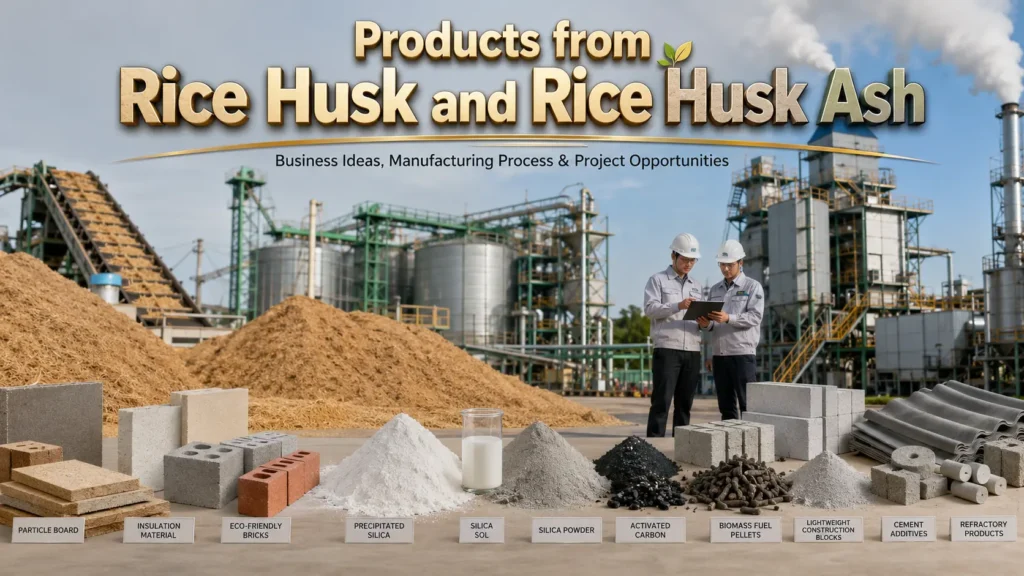
Rice Husk Products Business Ideas Why Rice Husk Is One of India’s Most Undervalued Industrial Raw Materials The one thing that most business people fail to consider when they start a business based on agricultural waste is that the raw materials are nearly free. Rice husk, the sheathing of paddy is just such an opportunity. India is the second largest rice producer, producing around 12 million tonnes of rice husk as a by-product of the milling process every year. Most of this husk was used as fuel for boiler generation of steam in rice mills until recently, but was accompanied by particulate pollution. What entrepreneurs are finding is that rice husk is not only a fuel, but also a chemical feedstock, construction material, and an industrial input that is much more valuable than its fuel value. Rice husk is about 20% silica in a highly amorphous and reactive form. Ash from the controlled combustion known as Rice Husk Ash (RHA) is about 85-92% amorphous silica. This silica is used as a raw material in the production of precipitated silica, sodium silicate, activated carbon, cement additives and refractory materials. The business is real and proven and can be done by the MSME entrepreneurs with an understanding of the processing. Get Detailed Insights from This Book: Manufacture of Value Added Products from Rice Husk (Hull) and Rice Husk Ash (RHA) Top 10 Products from Rice Husk and Rice Husk Ash 1. Precipitated Silica Precipitated silica is produced by reacting RHA with caustic soda to produce sodium silicate solution, and then precipitating silica by acidification with sulphuric acid. The white powder produced is used as a rubber tyre reinforcement, a flow aid in toothpaste, an anti-caking agent in animal feed and a tablet excipient in pharmaceuticals. India is now importing so many materials from China and Germany. The cost of a 5 TPD unit is Rs. The investment requirement for this is about 80 lakh to 150 lakh and has the potential to create Rs. The annual net profit lies in the range of 40-60 lakh at market price of Rs. 35,000–70,000 per tonne depending on grade. 2. Sodium Silicate (Water Glass) Sodium silicate can be obtained by melting RHA with soda ash at high temperature or by dissolving RHA in caustic soda at high pressure. It is used for making detergents, paper adhesives, foundry core binding, textile processing and water treatment. There is a big domestic market in India. In the case of a 10 TPD plant, the investment costs are: 30–80 lakh. It is easy to process and there is a reliable industrial buyer base for the product. 3. Activated Carbon Rice husk activated carbon is obtained when the rice husks are carbonised at 500-700°C and then activated with steam or CO₂ at 800-950°C. Surface areas of 800-1200 m2/g are used for water purification, air filtration, decolourisation in pharmaceuticals, food processing and gold recovery. The cost of a 3 TPD unit is around Rs. Investment required is 60 to 120 lakh and the revenues earned are Rs. Depending on application grade between 50000 and 1,50,000 per tonne. 4. Rice Husk Particle Board Particle board is made from rice husk, Urea Formaldehyde or isocyanate binders and is hot pressed into panels that are used for furniture, partition and low-cost housing. The boards have termite resistance and moisture stability. The cost of a 5,000 m³/year plant is Rs. 1.5–3 crore. Clients are furniture makers, government housing schemes, interior fit out companies etc. Get Detailed Project Report (DPR): Rice Husk, Rice Hull, Rice Husk Ash (Agricultural Waste) Based Projects 5. Rice Husk Briquettes and Pellets The biomass fuel of dense quality with calorific value of 3200 – 3600 kcal/kg is produced by compressing the rice husks under high pressure, without using binders. These briquettes are used in industrial boilers of the food processing, textile, ceramic and brick industries as an alternative to coal. Investment: Rs. 25–60 lakh. Renewable energy requirements around the world are increasing, and so are European and South Korean demands on biomass fuel exports. 6. RHA as Cement Pozzolan The rice husk ash contains a large amount of amorphous silica ash, which has excellent pozzolanic activity, when the rice husk is burned at 600–700°C. RHA can be used as a substitute for 10 – 25% of the Portland cement used in concrete, enhancing durability and reducing carbon footprint. As per contract, RHA is supplied to cement companies at the rate of for 2,000-5,000 per tonne, only investment for collection and quality control is required. It is a low-cost product with 10 to 25 lakh customers and low processing cost. 7. Refractory Products High-silica RHA used in the refractory bricks and castable for industrial furnace, which has high resistance to temperature above 1,600℃, is suitable for steel ladles, foundry furnaces, ceramic kilns, etc. The niche, higher margin product is well-balanced with an industrial buyer base. The price of a small refractory unit begins at Rs. 50–100 lakh. 8. Oxalic Acid Rice husk cellulose is treated with alkaline water at high temperature and pressure to produce oxalic acid which is further acidified to produce oxalic acid. Currently it is imported for use in the textile industry, in leather manufacturing and in the synthesis of pharmaceuticals as well as in metal surfaces. The cost of a 2 TPD unit is Rs. 40–80 lakh. RHA is a cost competitive alternative to imported production. 9. Silicon Metal (Advanced Application) High-temperature carbothermic reduction is being used commercially to provide a source of high purity silicon for electronic and solar cell applications for RHA. India and abroad there are several pilot and commercial plants. This requires a lot of capital (Rs.). The selling price of silicon metal is Rs. 10 lakh – 50 lakhs (10 – 50 crore). The rice husk has the highest value-addition of Rs 1.5–3 lakh per tonne. Discover business ideas that actually make money 10. Cellulosic Ethanol (2G Biofuel) Rice husk is rich in cellulose (35-40%) and hemicellulose (25-30%) which can be fermented