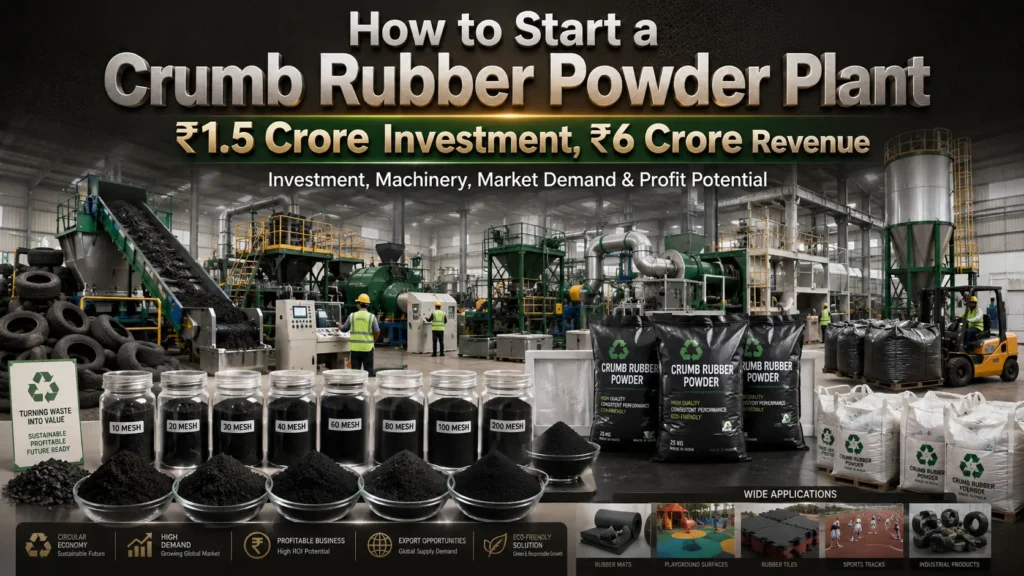

Crumb Rubber Powder Plant in India
A Business Idea the Recycling Economy Is Crying Out For
In the field of environmental-friendly manufacturing, a crumb rubber powder plant is one of the most missed out business ideas in India for a simple reason, waste tyres are everywhere and the demand for manufactured rubber granules is increasing rapidly. Entrepreneurs who know this are entering a business with solid profit margins, abundant raw material supplies and government tailwinds rolling down the road ahead. Not a niche opportunity — it’s a real industrial play with a real scalability.
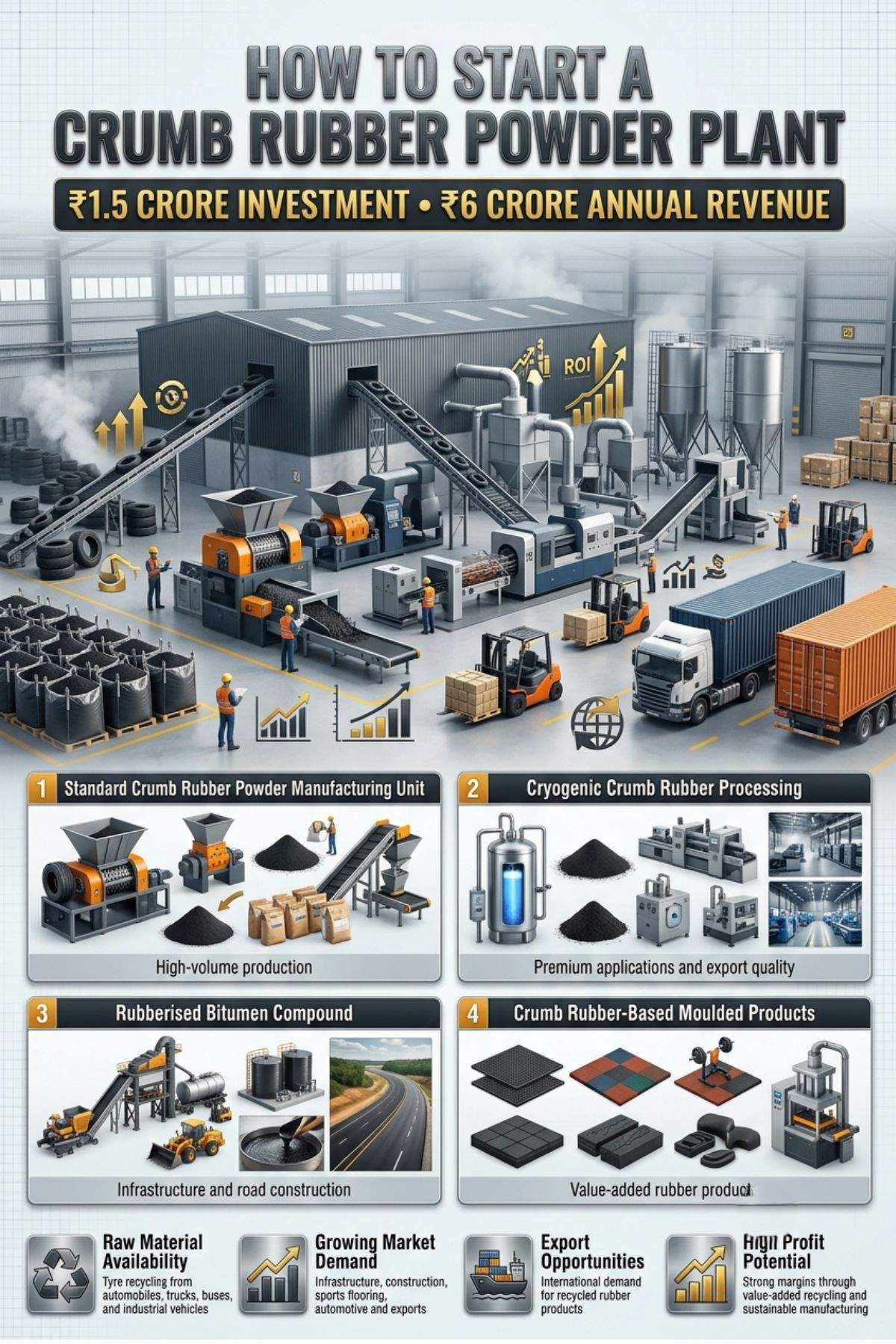
The Ministry of Environment, Forest and Climate Change numbers show that India produces more than 1.1 million metric tonnes of end-of-life tyres every year. The majority of this rubber is deposited in uncontrolled dump sites, thereby not only posing a threat to the environment, but also creating a raw material that could not be used. This waste is transformed at a crumb rubber powder plant into a high-value industrial input: used in roads, sports surface, automotive component and construction material. The economic arguments are strong. The total project investment is around ₹1.5 crores and a well-managed plant can yield an annual revenue of anywhere between ₹5–6 crore, which means first-generation entrepreneurs and MSME investors will get a handsome return on their investment.
Get Detailed Insights from This Book: The Complete Book on Rubber Processing and Compounding Technology
Why This Sector Is Growing Fast
The crumb rubber industry is a dynamic area of business poised at the crossroads of two trends: the circular economy and the wave of infrastructure expansion. An increasing number of industries are experiencing a surge in demand for crumb rubber powder (also known as recycled rubber granules). Road construction accounts for the greatest use. Rubberised bitumen (with crumb rubber as a modifier) provides an extended service life, improved skid resistance and reduced maintenance costs for pavements. The National Highways Authority of India (NHAI) has issued orders for several NH projects to use rubberised bitumen, taking the demands away from the processors.
On the other hand, sports infrastructure, which includes artificial turf, running tracks, playgrounds etc., is booming in tier-2 and tier-3 cities. A lot of crumb rubber infill is needed for each installation. Demand is also on the rise for exports, especially to South Asia and Middle East, where there is not enough tyre recycling facility. So entrepreneurs who are coming in to this industry are not only going to benefit from domestic consumption; they are investing in export revenues as well.
The raw material side is also very good. The amount of end-of-life tyres is large, low cost and increasing. Tyres are produced every day by steel mills, transportation companies, logistics companies and municipalities. Since it is an expense to dispose of, many suppliers would be willing to sell scrap tyres at close to zero cost. It helps to lower input costs and maintain solid profit margins, even during recessions.
Government Policies and Incentives Supporting This Business
Extended Producer Responsibility (EPR) and Waste Tyre Regulations
The Central Pollution Control Board (CPCB) has issued notification of EPR rules for Hazardous and Other Wastes Management Rules relating to waste tyres. Tyres must be passed through registered tyre recyclers and processors under these regulations. As a result, tyre Original Equipment Manufacturers (OEMs) are actively looking for authorized crumb rubber processors. For new plants, it is the formalisation of raw material linkages right from the beginning, which gives them a major competitive edge over unorganised players.
MSME Credit and Subsidy Schemes
MSME Ministry has launched a collateral-free loan facility for MSMEs for manufacturing projects with the Credit Guarantee Trust for Micro and Small Enterprises (CGTMSE) scheme, which offers loans of up to ₹2 crore. The scheme reduces the financing costs of an investment project worth ₹1.5 crore to a great extent. Moreover, the Government offers capital subsidy of 15-35% under its Prime Minister’s Employment Generation Programme (PMEGP) scheme for manufacturing MSME based on the category and geographical area. These should be investigated by new business owners before they approach the banks directly.
Make in India (DPIIT) also facilitates green manufacturing projects by having single window clearance systems and facilitation cells in most states. Some of the state governments such as Rajasthan, Gujarat and Maharashtra provide extra subsidy on land cost and rebate on power tariff for recycling units and green manufacturing units.
Environmental Clearance and Registration
Crumb rubber plants come under the category of Orange Environmental Regulation and are to be gotten proper Consent to Establish (CTE) and Consent to Operate (CTO) from the State Pollution Control Board. The registration procedure is not complicated but is streamlined for small units. Planning for environmental clearances for a new plant takes 60-90 days, so this should be added to the project schedule.
Get Detailed Project Report (DPR): Crumb Rubber Powder from Waste Tyre Manufacturing: A Promising Venture for Startups
Multiple Business Ideas Within the Crumb Rubber Powder Sector
1. Standard Crumb Rubber Powder Manufacturing Unit
The entry point is the most direct – a standard crumb rubber powder making plant, which processes the old tyres into granules with different mesh sizes such as 10-mesh chips, 40-mesh granules, 80-mesh powder etc. Ambient temperature processing mechanical shredding line is used in the unit. Main equipment refers to a primary shredder, secondary granulator, cryogenic or wire separator, and a vibrating sieve classifier. An entrepreneur can have a plant installed for commissioning which will have a capacity of 5–8 tonne per day for a ₹1.5 crore investment. The key is product diversification, however, and selling 10-40 mesh granules to sports surface installers, 40-60 mesh to automotive sealing product manufacturers and fine 60-80 mesh to paint and coating manufacturers. The combination of these product lines optimises the revenue per tonne and lessens the reliance on a single customer segment.
2. Cryogenic Crumb Rubber Processing for Premium Applications
The tyres are frozen in a cryogenic tank with liquid nitrogen prior to size reduction, which results in a cleaner, more uniform crumb rubber particle with a smoother surface. The end product sells for 20–40% more than crumb rubber processed in ambient conditions, especially for high quality manufacture of automotive components and high-quality sports surface applications. The price is also high — the capital investment increases by around ₹30–40 lakh — but the premium price and value of the market compensate for this amount for the entrepreneur who wants to sell at high value in the automotive OEM value chain or into export markets. In addition, the production of a co-product, cleaner steel fibre, is derived from the cryogenic processing of crumb rubber, providing an additional revenue stream. This is the model that will work for entrepreneurs who already have linkages with automotive manufacturers or sports infrastructure developers.
3. Rubberised Bitumen Compound for Road Construction
An entrepreneur can include a downstream mixing stage to create rubberised bitumen compound directly from raw crumb rubber powder. This includes the addition of crumb rubber to the bitumen in certain proportions to make a ready-to-use road paving material. Add value is huge – the value of crumb rubber is around 25-35 Rs/Kg and rubberised bitumen compound realises at much higher per unit value. The end-users of the target customers are National Highway contractors, State PWD departments and municipal corporations. With the thousands of kilometres of planned highways in India, demand from this segment can consume the entire output of several processing units. An extra blending reactor and storage structure is required, increasing the base project cost by ₹20–25 lakh, but the profit margins make it an interesting upgrade.
Build a profitable business with the right idea
4. Crumb Rubber-Based Moulded Products Manufacturing
Next step in the business model is taking the crumb rubber powder and producing end-moulded rubber products such as rubber tiles, rubber flooring, anti-fatigue matting, rubber dock bumpers and rubber parking stoppers. These products are manufactured from crumb rubber as the main material and are bound together with polyurethane (PU) binders and molded in hydraulic presses. The finished products are sold directly to the schools, gymnasiums, hospitals, warehouses and residential complexes. The margins of finished moulded products are significantly higher than that of raw powder — a rubber tile with a selling price of ₹350–500 uses raw material at a cost of ₹80–120 per square metre. This is a viable model for marketing-savvy entrepreneurs who have a distribution network, as over time it can turn a commodity processing business into a business with a brand.
Import–Export Opportunity Analysis
The export potential of the crumb rubber powder industry is an untapped one in India. There is no organised tyre recycling infrastructure in several neighbouring and Gulf countries such as Bangladesh, Sri Lanka, Nepal, UAE and Saudi Arabia. They currently bring in crumb rubber granules to use in their sport surface and road construction businesses. Indian processors have an advantage due to their lower production costs and availability of raw material; therefore, they are well positioned to cater to these markets.
Crumb rubber is classified under HS Code 4004 in the trade data available from the Directorate General of Foreign Trade (DGFT) and exports have been consistently growing from Indian processors in the past few cycles. Cost is the major advantage of exporting the crumb rubber powder from India as the raw material is readily available in the country and the energy cost in many states is also cheaper compared with the other countries in the Southeast Asia region.
It is important for entrepreneurs to know that the equipment used for cryogenic processing is mostly imported from Germany, South Korea and China, especially the Liquid Nitrogen systems and Precision granulators. Import duties on capital goods, along with import promotion benefits provided under the Foreign Trade Policy for MSMEs makes import planning of machinery cost-effective. The entrepreneurs should refer the latest Foreign Trade Policy from the website of DGFT for better optimisation of their capital expenditure for imported equipment.
Indian MSME Success Stories in Crumb Rubber and Tyre Recycling
Tinna Rubber and Infrastructure Ltd. – Scaling the Recycling Model
Delhi NCR based Tina Rubber and Infrastructure Ltd. is one of the biggest tyre recycling companies in India which is an interesting case study for the aspiring entrepreneurs. The Garg family’s fountain of energy and their newest company began as a small tyre recycling business and evolved into a diversified rubber recycling and road construction material company. The most important strategic move of theirs was the vertical integration wherein they would process crumb rubber in-house then utilise it to formulate rubberised bitumen and road construction compounds to be sold directly to NHAI and the state highway contractors. It is an obvious lesson to new entrepreneurs that raw powder has a much lower value per tonne as compared to the downstream value-added products.
Related Article: Crumb Rubber Powder from Waste Tyres: Business Ideas, Market Opportunity & Setup Guide for Indian Entrepreneurs
Geofabrics Engineered Soils Pvt. Ltd. – The Rubber Tile Market
Geofabrics Engineered Soils, a Hyderabad based MSME, developed a profitable niche in the manufacturing of crumb rubber for rubber tiles and impact absorbing surfaces for schools, playgrounds and fitness centres. Their founder realised early on that there was an institutional buyer market, one that involved government schools under the smart city and Samagra shiksha schemes, and that these institutions had relatively low order collection risk, and they were large orders, of course. They targeted one particular segment of customers, established relationships with government architects and urban local bodies and experienced a steady growth which did not demand any significant marketing investments. This segment is attractive for an entrepreneur with MSME linkages or Government contracting experience as it has a reliable base of demand.
A South Indian Recycler – The Export-First Strategy
One of the other growth drivers identified by one of the medium-sized processors based in Coimbatore, a city with excellent connectivity with Chennai port, was export demand from the Gulf nations. Instead of trying to get a foothold in an over-crowded domestic commodities market, this entrepreneur signed export orders with sports surface companies from the UAE and Bahrain, and organised production around the export requirements. They have tailored product quality, particle size distribution and packing to the requirements of export buyers to achieve better prices and longer-term trading arrangements than domestic traders. Their lesson: export orientation requires more discipline, but it provides better price realisation and decrease in the buyer concentration risk.
How NPCS Supports Entrepreneurs Planning a Crumb Rubber Plant
Niir Project Consultancy Services (NPCS) offers expert Consulting services for the preparation of Market Survey cum Detailed Techno-Economic Feasibility Reports (DPRs) for establishing any new industry (including a crumb rubber powder plant). We don’t just provide generic project templates, we provide reports. We provide detailed descriptions of manufacturing processes, process flow, raw material sourcing analysis, specifications of machines and shortlist of vendors, capacity planning, manpower requirement, project financials including capital cost, working capital, revenue estimation and profitability analysis.
If you are considering building a crumb rubber plant, our feasibility reports answer the questions that are relevant to your investment decision: What throughput is appropriate with my capital budget? Which combination of products will give the greatest amount of revenue per tonne? How is the payback period affected with varying raw material costs? We want to provide founders with the critical analysis they need to determine feasibility, profitability, and scalability – before they invest. For further details please visit our website www.niir.org.
Project Financial Summary – Crumb Rubber Powder Plant (Indicative)
| Parameter | Details | Approximate Value |
| Plant Capacity | Ambient Process Line | 6–8 Tonnes per Day |
| Land & Building | Owned / Leased | ₹20–30 Lakh |
| Plant & Machinery | Shredder, Granulator, Sieve | ₹70–90 Lakh |
| Working Capital | 3 Month Cycle | ₹25–35 Lakh |
| Total Project Cost | All-In Investment | ₹1.3–1.5 Crore |
| Annual Production | 300 Days Operation | ~1,800 Tonnes |
| Average Selling Price | Mixed Product Portfolio | ₹30–40 per kg |
| Gross Annual Revenue | At 80% Capacity | ₹5.5–6.0 Crore |
| Gross Margin | After Raw Material & Power | 35–45% |
| Payback Period | Conservative Estimate | 2.5–3.5 Years |
Note: All figures are indicative estimates for planning purposes. Actual costs and revenues will vary based on location, plant design, product mix, and market conditions.
FAQ: Starting a Crumb Rubber Powder Plant in India
1. What is the minimum investment required to start a crumb rubber powder plant?
A practical ambient processing crumb rubber plant will cost somewhere between 1.2-1.5 crore for leasing or purchasing land, machinery, civil work, pre-operative costs, and working capital. For a cryogenic processing unit, expect an investment to be about 30-40 lakh more. To cut back on the initial investment load, one can avail benefits under MSME schemes, like CGTMSE (for collateral free loans) and PMEGP (capital subsidy).
2. Where do I source raw material — scrap tyres — reliably?
We access tyre scrap from various channels – transport truck companies, retreading firms, urban waste collectors, vehicle service centers and authorised tyre vendors. Moreover, if they fall within the net of CPCB EPR legislation, manufacturers too have to supply scrap tyres through authorised recycler agents. As an approved processor as defined by norms set by the State Pollution Control Board, they open up official supply channels for raw materials that their unorganized competitors lack.
3. What are the key permits and licences needed?
Crumb rubber powder unit requires consent to establish (CTE) and consent to operate (CTO) from State Pollution Control Board, MSME Udyam registration, GST registration and authorisation as waste tyre processor fromHazardous and Other WastesManagement Rules. Most of the states mandate a factory license under Factories Act where a unit’s power consumption is more than some criteria. Total time required for all clearances varies between 3-6 months.
4. Which product mix maximises profitability?
The most profitable product mix balances fine powder (60–80 mesh) sold to paint, coating, and automotive sealing companies — which commands the highest per-kg price — with medium granules (20–40 mesh) supplied to sports surface and rubberised bitumen manufacturers. Coarse chips can be sold to rubber tile manufacturers or exported. Diversifying across at least three mesh sizes reduces dependency on any single buyer and improves average revenue realisation per tonne processed.
5. Is there export potential for crumb rubber powder from India?
Indeed, quite a bit, with GCC countries, Bangladesh, Nepal and Sri Lanka as the most obvious export opportunities. Indian processors have a price advantage of around 15-25% over other exporters from Southeast Asia. Interested entrepreneurs should register with the FIEO (Federation of Indian Export Organisations) for access to export promotion services, information on the target market, and introductions to buyers. Generally, production for exports gets higher price and more assured long-term contract as compared to simply domestic sales.
6. How does the crumb rubber industry align with India’s sustainability and circular economy goals?
The process of crumb rubber is also linked with the National Policy of Zero Waste Manufacturing, guidelines of green procurement for road construction and Swachh Bharat Mission objectives of Government of India. BIS has brought out standards for road application of crumb rubber (IS 17452), which provides a reference for certified producers for supply to the Government. Entrepreneurs entering this business are, therefore, participating in a sector with both commercial tailwinds and policy backing — a combination that reduces business risk over the medium term.
Conclusion: A Well-Timed Entry into a Supply-Short Market
The crumb rubber powder business is not a speculative idea. It is a fundamentally sound industrial venture supported by raw material abundance, policy backing, rising downstream demand, and genuine export opportunity. An entrepreneur who enters this market with the right project planning, product mix strategy, and buyer linkages can realistically build a ₹5–6 crore revenue business from a ₹1.5 crore investment within a three-year horizon.
The most important step, however, is thorough pre-investment planning. A detailed feasibility report, covering process design, machinery selection, market analysis, and financial modelling, is not a bureaucratic formality — it is the decision-making tool that separates profitable plants from underperforming ones. Moreover, startups must capitalize on government schemes, obtain explicit buyer commitments for at least two product grades, and register under the EPR norms soon to assure the official raw material supply.
For those willing to do the groundwork, the crumb rubber powder plant is one of the most compelling green manufacturing business ideas available to Indian entrepreneurs today — combining environmental purpose with hard commercial logic.\
For more resources on industrial project planning and feasibility in India, refer to:
- Ministry of MSME – Government Schemes
- DGFT – Export-Import Policy
- NHAI – Road Construction Specifications
- BIS – Standards for Crumb Rubber
- FIEO – Export Promotion for MSMEs