
CGTMSE loan scheme for MSME collateral free loan
When No Asset Is Good Enough — And the Bank Still Says Yes
A Tirupur-based garment unit owner started in a bank with five years’ GST returns and standing order from an exporter from Mumbai but no land to hand over. The bank said no. He then went into the same bank after being informed that there was a government guarantee. Same returns. Same order. The bank agreed — and gave the loan in three weeks for ₹18 lakh.
This is not an exception. This is what Credit Guarantee Fund Trust for Micro and Small Enterprises (CGTMSE) is designed to do. This scheme has sanctioned over 70 lakh loan accounts with guarantees of over ₹2.5 lakh crore over the last 10 years. But millions of eligible MSMEs don’t know about it — or think it requires forms too difficult to complete, or officials too hard to contact.
The mechanics are not as complicated as they sound. The credit risk is borne by the bank. CGTMSE covers it. The borrower receives cash — without having to put up land, machinery, or a relative’s assets to obtain the cash.
Anyone who owns or is thinking of owning a micro or small enterprise who is not familiar with this scheme is probably leaving money on the table.
Related Article: Collateral-Free Business Loan up to ₹10 Crore in India: Complete CGTMSE Guide for MSMEs
The Collateral Wall That Stops Most MSME Founders
Collateral deficiency is always the biggest hurdle to overcome for MSME loan applications, as seen in the Reserve Bank of India’s annual report, the MSME Pulse Report, even as credit scores and business turnover were the other looming issues. As per data from the Ministry of MSME, India’s 63 million MSMEs are entirely unserved or underserved by formal credit, with approximately 60% of them in this category.
The issue is a structural one. In states such as Jharkhand, Odisha, Chhattisgarh, Uttar Pradesh, most first-generation entrepreneurs are not the owners of their own land. They do their work in hired workshops. They have not been able to participate formally in the banking system, their families have not. They cannot provide borrowers with an extra ₹25 lakh mortgage to finance their working capital loans of ₹12 lakh, which is what most commercial banks require.
This is one huge opportunity cost to the Indian economy. The International Finance Corporation (IFC) has estimated that the credit gap in MSMEs is more than USD 530 billion in India. When informal sources are also taken into consideration, the amount of credit that is not available for formal loans at affordable rates at collateral-free institutions falls in lakhs of crores of rupees each year.The gap between unavailability of formal loans at reasonable rates at no collateral institutions is still in lakhs of crores of rupees even after considering the informal sources.
Banks are not the bad guys. The bank absorbs the loss if a borrower defaults when there is no collateral. It is a rational risk that a commercial lender will not take if there are no security interests, unless another party takes the risk. The CGTMSE does just that.
Table 1: State-wise MSME Credit Concentration and CGTMSE Activity
| State / UT | MSME Units (Approx.) | Key CGTMSE-Active Clusters | Avg. Loan Size (INR) | Dominant Sector |
| Uttar Pradesh | 90 lakh+ | Kanpur, Agra, Varanasi | ₹8–15 lakh | Leather, Food, Textiles |
| Maharashtra | 50 lakh+ | Pune, Nashik, Aurangabad | ₹12–25 lakh | Engineering, Pharma |
| Tamil Nadu | 45 lakh+ | Coimbatore, Tirupur, Salem | ₹10–20 lakh | Auto Ancillary, Textiles |
| Gujarat | 35 lakh+ | Rajkot, Surat, Ahmedabad | ₹15–30 lakh | Chemicals, Gems, Diamond |
| Rajasthan | 28 lakh+ | Jodhpur, Jaipur, Bhilwara | ₹6–12 lakh | Handicrafts, Textiles |
| West Bengal | 25 lakh+ | Howrah, Siliguri, Durgapur | ₹7–14 lakh | Steel Fabrication, Jute |
Why This Scheme Matters More Right Now
The Union Budget’s enhanced CGTMSE coverage from ₹2 crore to ₹5 crore is the biggest ever increase in the scheme. This one change has created opportunities for the little guys of small manufacturers, service providers, agro-processors, which were too big for micro-credit and too small for corporate banking.
The value of CGTMSE access is growing more than ever before, due to a number of trends:
- The government’s move to formalization of MSMEs under the Udyam Registration has increased the number of MSMEs that can avail the benefits of the scheme. As of now, more than 4.5 crores units have been registered.
- Many member banks have now accepted GST data as proof of income, which means that units with no tax returns can now provide proof of turnover.
- SIDBI’s digital lending platforms have reduced loan processing time for loans sanctioned by CGTMSE to 15-21 days in several urban clusters.
- The PLI scheme for 14 sectors is creating tier-2 supplier opportunities, which are in the working capital sweet-spot range of ₹20 lakh – ₹2 crore.
A SC/ST founder, a woman entrepreneur or a unit from the NE states will benefit from a guarantee cover of 85% (compared to 75% of the general category), which means that the bank’s risk exposure is only 15 paise per rupee loaned. That’s often the difference between approval and rejection!
The scheme is not a subsidy scheme. There is a market linked interest rate for the bank. CGTMSE requires a small annual guarantee fee (usually 0.37% to 1.35% based on loan size). But the door opens. That is the chance.
Get Detailed Insights from This Book: Grow Rich By Starting your Own Business
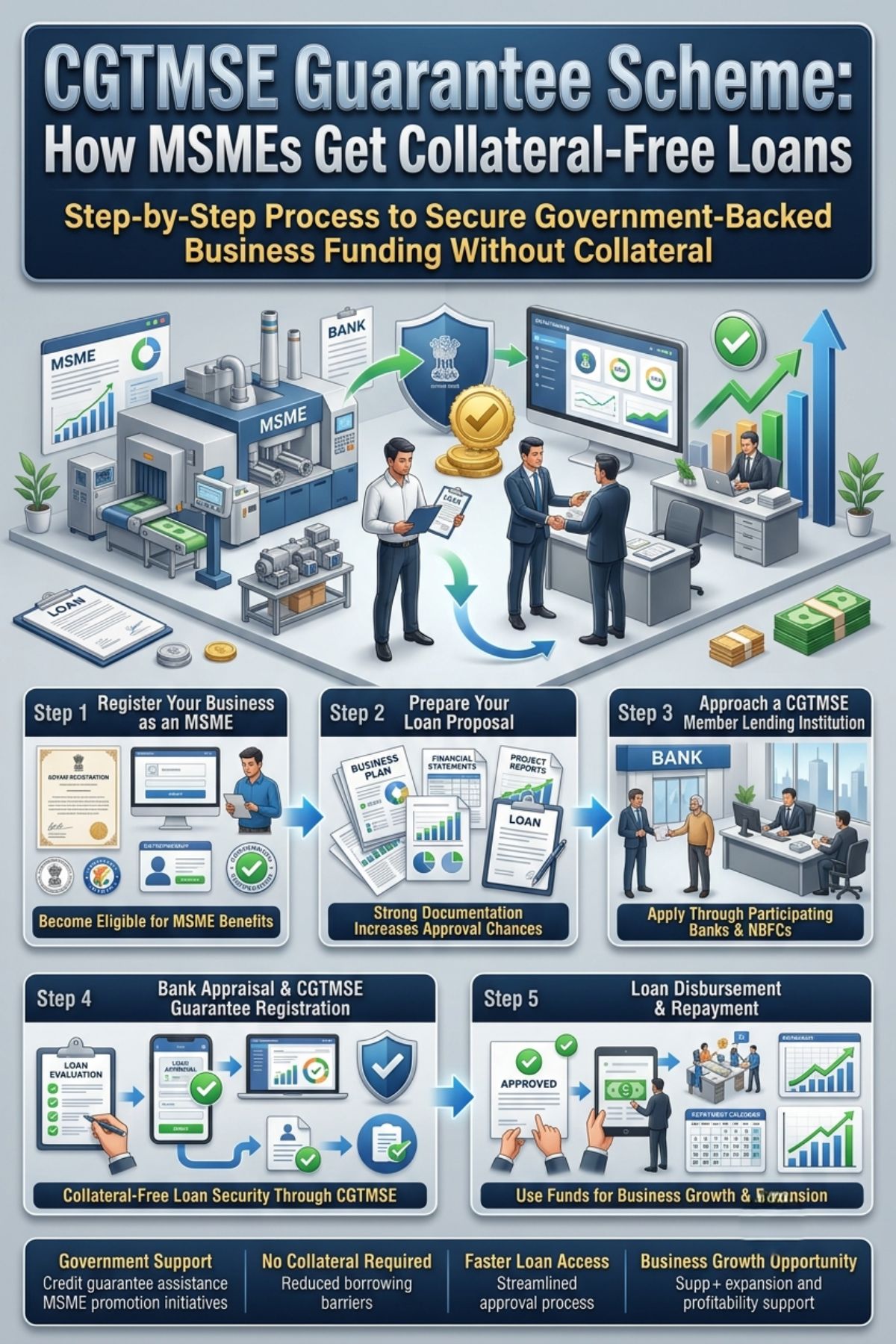
How to Apply for a CGTMSE-Backed Loan: A Step-by-Step Guide
The CGTMSE is not a lender. It operates via Member Lending Institutions (MLIs) now more than 130 banks, NBFCs and financial institutions are registered with the Trust. From an entrepreneur’s perspective, how it works.
1. Register Your Business as an MSME
Before that, register your business on the Udyam portal (free and in less than 30 minutes with Aadhaar and PAN). An Udyam Registration Number (URN) will be issued to you. This is required for a scheme to be eligible. Annual investment in plant and machinery for small plant should not be more than ₹10 crore and for micro enterprise it is ₹1 crore.
2. Prepare Your Loan Proposal
Banks require: business plan or project report, bank statements of the last 2 years, proof of business premises (rental agreement is acceptable), identity/address proof, and the GST returns and Udyam certificate. A Detailed Project Report (DPR) makes it easier to secure a loan, particularly if the loan amount is over ₹10 lakh.
3. Approach an CGTMSE Member Lending Institution
Go to any of the branches of SBI, Bank of Baroda, Canara Bank, Union Bank, PNB or any of the scheduled commercial banks. Specifically ask for a loan in the CGTMSE scheme — many branch staff aren’t going to mention this loan if not asked. If your loan requirement is in the range of ₹10 lakh to ₹1 crore, you can access SIDBI’s digital portal which works for direct processing.
4. Bank Appraisal and CGTMSE Guarantee Registration
The bank’s own credit appraisal is performed. Once approved, the bank will register the loan with CGTMSE and pay you the guarantee fee (Generally, the guarantee fee will be recovered by adding it to the loan amount or as an upfront charge). There is no form provided for CGTMSE to fill.
5. Loan Disbursement and Repayment
Funds are released when the guarantee is signed. The duration of the repayment period varies from 3 to 7 years for working capital and up to 10 years for term loans. The interest rates are bank specific and range between 10.5% to 14% per annum in this scheme for borrowers of MSMEs.
The parallel licenses you need to obtain are GST registration, Udyam Registration, Factory Licence (if applicable, if you are in a factory), FSSAI (food units), Pollution NOC from the State Pollution Control Board and BIS Certification if your product has to come under the mandatory quality norms.
Time taken to get documentation to the first disbursement: Micro loans up to ₹10 lakh can be disbursed in 3 to 6 weeks, while loans for small business above ₹25 lakh take 6 to 12 weeks.
Get Detailed Project Report (DPR): Project Reports & Profiles
Table 2: CGTMSE Loan Parameters — Micro vs Small vs Medium Units
| Cost Head | Micro (INR) | Small (INR) | Medium (INR) |
| Guarantee Fee (Annual) | 0.37% of loan | 0.55% of loan | 1.35% of loan |
| Processing Fee (Bank) | ₹2,000–₹5,000 | ₹5,000–₹15,000 | ₹15,000–₹50,000 |
| Loan Amount Range | Up to ₹10 lakh | ₹10 lakh–₹1 cr | ₹1 cr–₹5 cr |
| Guarantee Cover | 85% of default | 75% of default | 75% of default |
| Repayment Tenure | 3–5 years | 5–7 years | 7–10 years |
| Collateral Requirement | Nil | Nil | Nil |
Source: CGTMSE Official Guidelines | SIDBI Annual Report
Financial Snapshot: What CGTMSE Access Actually Costs and Returns
Suppose a small food processing unit located in Rajasthan needs funding of ₹25 lakh to establish a spice grinding and packaging unit. With CGTMSE backing, these numbers look like this:
- Loan period: 36 months (30 months is the term loan + 6 months working capital mix)
- The annual guarantee fee per month, which is paid by the borrower through the bank, is ₹13,750 or 0.55% of the loan amount.
- The interest rate is 12% per annum (floating, bank-specific).
- EMI (at 5 years tenure) is around crores per month
- Raw material + labour + overhead: ₹4.5 – 5 lakh per month.
- Monthly revenue (60 capacity): ₹7-8 lakh
- Monthly revenue at 100% capacity: ₹12–14 lakh
- Gross margin at 60% capacity: 28–32%
- Net profit after EMI and overheads: 12-16%
- Payback period: 3.5–4.5 years
These are reasonably accurate estimates for a city in Tier 2. Food parks or industrial clusters such as Jodhpur, Ajmer or Kota can provide subsidised land and common facilities to units that boost their net margins by 3-5 percentage points.
Costs unique to CGTMSE are the guarantee fee. No subsidy on the interest, no capital grant and no dilution of equity. The value of the scheme is that it provides access — access that can be of compounding value when it allows you to begin earning rather than waiting to save the collateral you may never achieve.
Table 3: CGTMSE vs Comparable Government Credit Support Schemes
| Scheme | Nodal Body | Max. Benefit | Best Suited For | Apply Via |
| CGTMSE | SIDBI / MOF | ₹5 crore | All MSMEs without collateral | Member Banks |
| MUDRA (Shishu/Kishore/Tarun) | MUDRA Ltd. | ₹10 lakh | Micro & small start-ups | Banks / MFIs |
| PMEGP | KVIC / KVIB | 35% subsidy | Rural manufacturing | KVIC portal |
| Stand-Up India | SIDBI | ₹1 crore | SC/ST, Women entrepreneurs | Scheduled Banks |
| Credit Linked Capital Subsidy (CLCSS) | MSME Ministry | 15% subsidy on plant | Technology upgrade | SIDBI / Banks |
| Emergency Credit Line (ECLGS) | NCGTC | 20% of turnover | Existing MSMEs stressed | Member Lending Instns. |
Source: Ministry of MSME | NCGTC | MUDRA Official Portal | KVIC
Your investment deserves the right opportunity
Entrepreneur Spotlight
Sunita Rathore | Jodhpur, Rajasthan | Agarbatti & Dhoop Manufacturing
Sunita Rathore began her small incense-stick business with ₹4 lakh and a borrowed space. As her unit expanded and she required a packaging machine and extra personnel, none of the banks would loan without her providing property collateral which she lacked. A KVIC district officer directed her to CGTMSE, via a local bank. She got ₹8 lakh; she improved her equipment and now runs a business with a monthly turnover of ₹3.5-4 lakh and three full time employees. Her advice is to “ask the bank specifically for CGTMSE. If they don’t know, ask the branch manager; if the branch manager doesn’t know, go to the next bank.
Expert Consultancy for Your Project Report and Loan Application
The merits of the project report could be the deciding factor for an entrepreneur who is ready to avail credit under CGTMSE, especially when the loan application is made for a loan amount exceeding ₹10 lakh. Niir Project Consultancy Services (NPCS) is a plant consultancy company located at New Delhi, providing Detailed Project Reports (DPRs), techno-economic feasibility studies, plant layout and market survey reports in more than 5000 manufacturing and service sectors. The Reports are designed according to the appraisal formats of public sector banks and SIDBI. NPCS has operated in more than 50+ countries for more than four decades and is qualified under the ISO 9001:2015 system. DPRs for various sectors are available along with investment calculators and schemes guides on entrepreneurindia.co and niir.org.
One Step That Changes Everything
No land is required. There is no need for a guarantor. No need of a family member having a crore saving account. You need a business that has a clear plan, has an Udyam Registration number and is prepared to step into a bank and request, specifically, a loan through CGTMSE.
It has already supported more than 70 lakhs businesses. Most of those founders did not have any collateral. What sets them apart from the millions yet to be eligible is not eligibility, but information.
This week, identify 3 Member Lending Institutions in your district. For further details check out the CGTMSE scheme brochure from cgtmse.in. For a Detailed Project Report to enhance your application, please consult NPCS, niir.org. Then come in and inquire. You might be surprised at the answer.
Frequently Asked Questions
Q1. What is the maximum loan amount covered under CGTMSE?
The scheme, as of now, facilitates collateral-free loans to MSMEs with guaranteed coverage of up to 5 lakhs for eligible MSE units. In case of loan above 2 lakhs, guarantee is 75 per cent of the defaulted amount. Loan above 10 lakhs for micro units enjoys 85% coverage, thereby enticing lenders operating in the rural and semi urban space of India.
Q2. Which licences must an MSME have before applying?
At minimum, you need Udyam Registration and GST registration. Manufacturing units also require a Factory Licence from the state Labour Department if employing more than 10 workers with power. All businesses functioning in the food industry require this certificate. It is required for the chemical and waste generating business processes to obtain no-objection certificate from the State Pollution Control Board.
Q3. Is there a subsidy on interest rates under CGTMSE?
No. CGTMSE does not subsidise interest rates — that is not the scheme’s function. It provides a guarantee to the lending institution, enabling the bank to approve a loan it would otherwise decline. Interest rates are set by the bank based on your credit profile, typically ranging from 10.5% to 14% per annum for MSME accounts.
Q4. Can a service business apply, or is CGTMSE only for manufacturers?
Small & manufacturing and service units: MSME enterprises can avial benefit of CGMSE. However retail and other services units like transport units, IT services, repair units, units dealing in hospitality are eligible provided they are classified under Small or Micro enterprise under MSMED Act. Other than agriculture related units, only schools are not eligible.
Q5. What happens if I default on a CGTMSE-backed loan?
If you default, the bank files a claim with CGTMSE. The Trust reimburses the bank for the guaranteed portion (75–85% of the outstanding amount). You remain liable for the full loan — CGTMSE pursuing recovery is separate from your obligation to the bank. A default will also impact your credit score and future borrowing ability across all lenders.
Q6. Where can I get a Detailed Project Report to strengthen my loan application?
Niir Project Consultancy Services (NPCS) offers ready-made and customised Detailed Project Reports for over 5,000 business sectors — including food processing, chemicals, textiles, agro-based industries, and renewable energy. DPRs from NPCS are formatted to the appraisal standards used by PSU banks and SIDBI. Visit niir.org or entrepreneurindia.co to access reports and scheme guides.