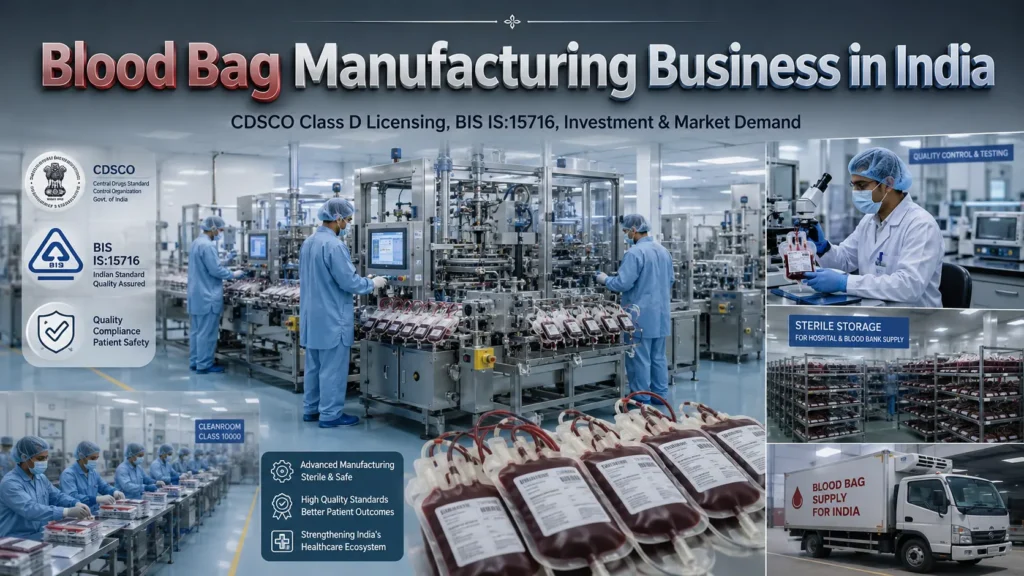

Blood Bag Manufacturing Business in India
With less than 15 active manufacturers in India, serving a market of Rs 700-900 crore, every blood bag collected is clinically necessary as there is a shortage of blood units while a non-existent supply chain makes every single blood bag collected indispensable for blood banks across India, with quality manufacturers charging premium prices and secured vendor status.
Market Opportunity: Why This Business Cannot Be Ignored
Blood bags are added to the highest risk class D medical devices under MDR 2017, as defects may pose a direct threat to patients’ lives during a transfusion. All the class D manufacturers are required to be licensed by central CDSCO in addition to state SLA, have validated ETO processing, have thorough biocompatibility testing as per ISO 10993 and have validated ISO 13485 QMS. The barriers help quality producers to exclude the low-quality producers and make the market very attractive to serious and compliant manufacturers.
The National AIDS Control Organisation (NACO), India, oversees more than 3200 blood banks which are licensed and have established certain technical requirements for the blood bags in government blood banking. The approved vendor list is the first step towards national procurement programmes which ensure payment of multi-year supply contracts to technically compliant manufacturers, one of the most predictable, and margin resilient, revenue models within the Indian medical device industry.
Get Detailed Insights from This Book: Handbook on Medical and Surgical Disposable Products
Industry Analysis: Growth Drivers and Demand Outlook
The blood bag market in India is estimated at Rs. 700-900 crore with 10-12 percent growth year-on-year. The Ministry of Health and Family Welfare has formulated a National Blood Policy that has been implemented in district hospitals under NHM, and which requires hundreds of new blood banks per year, all of which constitute a captive, predictable buyer of blood bags in single, double, triple and quadruple packs. The National AIDS Control Organisation (NACO) Blood bank portal keeps the list of approved vendors, technical specifications, and procurement procedures that blood bag producers need to meet and provide before they can receive contracts for blood bag supply from across 3200+ blood banks across the country.
There are very few manufacturers that cater this sector namely BPL Biotech, Span Medical Products, Hi-Tech Medical and international brands. When a new company gets CDSCO Class D approval and NACO vendor list approval, they instantly have access to all the procurement opportunities across the country. Blood bags are identified as a medical devices initiative priority product category by Make in India and available for PLI Medical Devices for Class D approved manufacturers. According to Invest India blood storage systems are one of the high priority local manufacturing segments which can benefit from PLI scheme and also be preferred by the government for procurement as per the blood bag import substitution report, based on government data.
India Blood Bag Market Overview
| Parameter | Market Data | Source or Notes |
| India Annual Blood Requirement | 15+ million units per year | Ministry of Health estimates |
| Actual Blood Collection | 12-13 million units per year | NACO Annual Report |
| Blood Bag Market Value | Rs 700 – 900 crore | Industry estimates |
| Market Growth Rate | 10-12% per year | NACO blood bank expansion |
| Number of Licensed Blood Banks | 3,200+ across India | NACO national survey |
| CDSCO Classification | Class D (highest risk category) | MDR 2017 India |
| BIS Standard for Blood Bags | IS:15716 | Mandatory BIS certification |
How to Start: Step-by-Step Guide for Entrepreneurs
Step 1: Technical Feasibility Study and Regulatory Strategy
The manufacturing of blood bags is the most technically challenging business in medical devices industry in India. Prior to investment, perform a comprehensive technical feasibility study that includes clean room requirements, ETO sterilisation validation plan, biocompatibility testing, ISO 13485 QMS scope and a CDSCO class D licensing timeline. NPCS can do this feasibility study as the base of your investment decision as well as bank loan application. Blood bag manufacturing units should enrol on the Udyam MSME Registration Portal so that they can avail collateral free loan from CGTMSE, term loan from SIDBI and government subsidy on investment in the huge investment of clean room and ETO sterilisation equipment.
Get Detailed Project Report (DPR): Blood Bags Manufacturing Plant Report
Step 2: CDSCO Class D Manufacturing Licence
Please apply for CDSCO Class D Medical Device Manufacturing Licence in Central office at New Delhi. Requirements are validated ISO Class 7/8 clean rooms, validated ETO sterilisation process with biological indicator monitoring, ISO 13485 QMS certification, biocompatibility data (ISO 10993) and a complete device master record. The whole process of getting CDSCO inspection and approval to get registered as a class D can take 12-18 months, so start preparing early.
Step 3: Clean Room, RF Welding, and Sterilisation Infrastructure
The required minimum size for a blood bag plant is 6,000-10,000 sq ft, and includes critical assembly (RF or HF dielectric welding machines for sealing PVC bag bodies) and secondary assembly (tube assembly, needle stations, anti-coagulant pre-fill stations) equipment, as well as validated ETO sterilisation chambers.
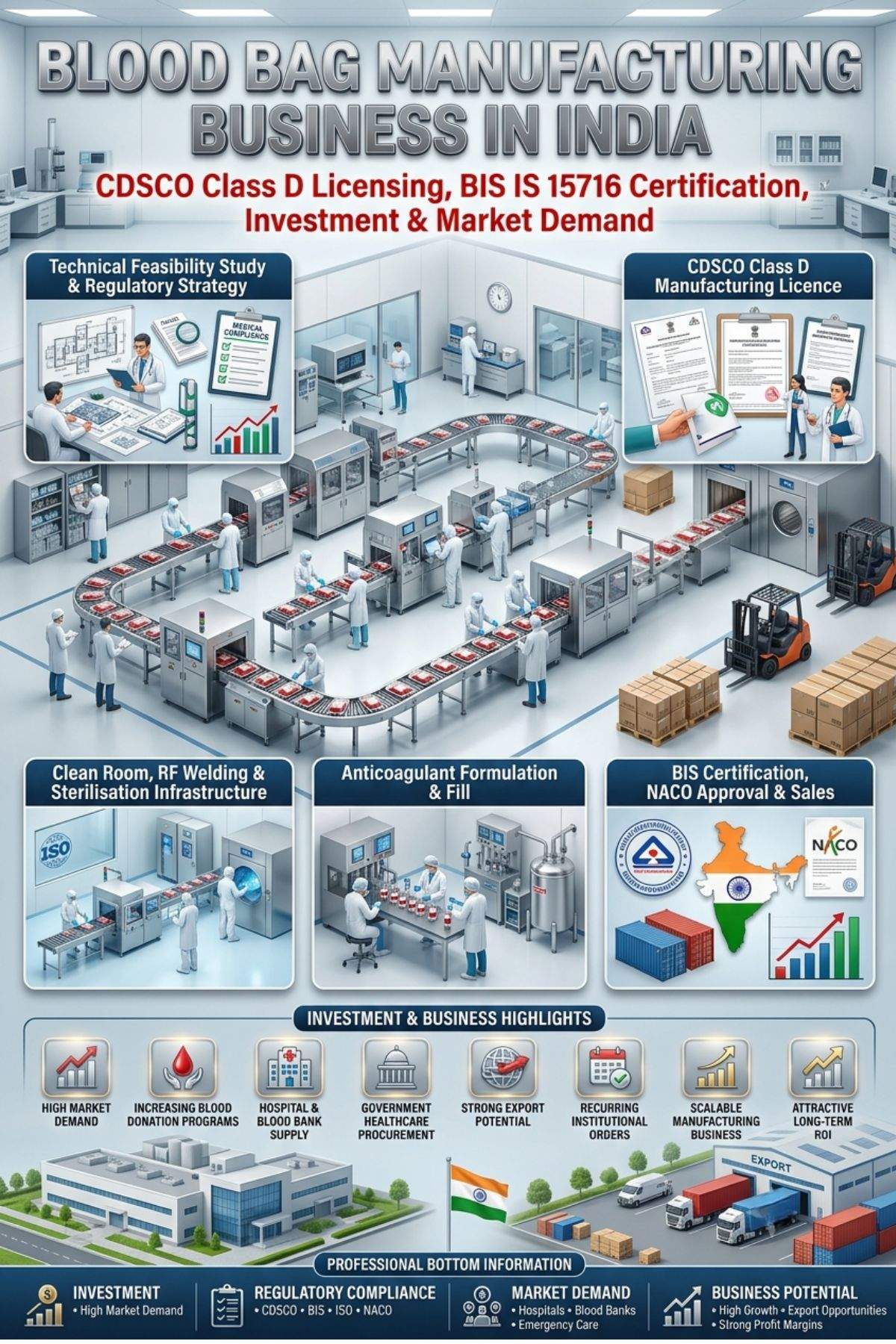
Step 4: Anticoagulant Formulation and Fill
Blood bags are provided pre-filled with anticoagulant-preservative solutions: CPDA-1 (blood shelf life of 35 days, most commonly used in India), CPD (blood shelf life of 21 days) or SAG-M (Additive solution bag with blood shelf life of 65 days for the storage of red cells). The formulation needs to be validated for fill accuracy and to be sterile and pharmaceutical grade mixed and filled. The CPD, CPDA-1 and SAG-M blood storage systems are as per the WHO guidelines for Blood Transfusion services and are matched to the BIS IS:15716 compliance of blood bags in India.
Step 5: BIS Certification, NACO Approval, and Sales
Get BIS IS:15716 certification and join the list of approved Vendors of NACO for Government blood bank procurement. At the same time develop private blood bank connections at corporate hospitals like Apollo, Fortis, Medinat, Max etc., where the premium pricing allows a much larger margin over the government tenders.
Find high-return business ideas based on your budget & ROI
Project Investment Breakdown for Blood Bag Manufacturing
| Cost Item | Estimated Amount (INR) | Notes |
| Clean room construction (ISO Class 7 and 8) | Rs 40 – 70 lakhs | Largest single capital item |
| RF or HF bag welding machine (2 units) | Rs 30 – 55 lakhs | Core production equipment |
| ETO sterilisation chamber (validated) | Rs 40 – 70 lakhs | Validation adds significant cost |
| Blood bag tubing extrusion or purchase setup | Rs 15 – 25 lakhs | PVC medical tubing |
| Anticoagulant mixing and sterile fill station | Rs 20 – 35 lakhs | Pharma-grade mixing |
| QC laboratory (LAL, sterility, biocompatibility) | Rs 20 – 35 lakhs | Class D regulatory requirement |
| ISO 13485 implementation and CDSCO fees | Rs 8 – 15 lakhs | Regulatory and QMS costs |
| Raw material stock (1 month) | Rs 15 – 25 lakhs | Medical PVC, anticoagulant, packaging |
| Working capital (4 months buffer) | Rs 25 – 40 lakhs | Long regulatory approval timeline |
| TOTAL PROJECT COST | Rs 2.13 – 3.70 crore | Scale to Rs 5Cr+ for larger plant |
Financial Projections and Profitability
The annual revenue of a blood bag manufacturing unit at blended NACO and private blood bank pricing is between Rs 4-7 crore for those producing 50,000 units of blood bags each month. The average net margins of CDSCO Class D certified manufacturers range between 18-25 percent and they are not faced with competition from other manufacturers in this category and serve an area of product with low price elasticity which is clinically critical, FICCI’s Healthcare Sector Committee said. According to IBEF India Healthcare Sector report, the hospital sector will grow to USD 372 billion by 2030 and in the process, will generate compound demand for blood bags in licensed hospitals, especially blood banks, that will expand their capacity.
Payback period is usually 4-6 years, as there is a high initial investment in regulatory and clean room. But after establishment, the repeat nature of blood bank procurement and the high switching costs for changing bag suppliers results in outstanding customer retention. Blood bags have been identified by Invest India as a high priority product for import substitution with government procurement programme support, which will give a stable income to the medical device industry. Blood bag manufacturers with CDSCO Class D certificate can promote their products to the blood bank networks of the Middle East and Africa via export promotion bodies such as Pharmexcil that act as a provider of databases of buyers and support participation in trade fairs.
Related Article: Blood Bag Manufacturing Plant Cost in India: Investment, Machinery, License & Profit Guide
Government Schemes and Incentives for Medical Manufacturers
| Government Scheme or Programme | Key Benefit | Applicability |
| NACO Blood Safety Programme | Guaranteed recurring procurement via approved vendor list | NACO-approved manufacturers |
| PLI – Medical Devices (Class D) | Production incentive on approved Class D device sales | Eligible device manufacturers |
| CGTMSE (SIDBI) | Collateral-free loan up to Rs 5 crore | MSME blood bag manufacturers |
| MSME Technology Centre | Technical assistance and testing support services | MSME-registered units |
| State Industrial Investment Subsidy | 15-30% capital subsidy on eligible investments | State-notified manufacturers |
| SIDBI Direct Lending | Term loan for medical device capital investment | All manufacturer scales |
Entrepreneur Spotlight
Dr. Rajesh Kumar Singh | Patna, Bihar
In 2019, Dr. Rajesh Kumar Singh, an experienced trained haematologist (15 years’ experience in blood bank operations) at Patna Medical College, started a blood bag manufacturing enterprise as a result of the frequent scarcity of blood bags in Bihar, Jharkhand and Odisha as well as their poor quality. He got a SIDBI term loan and manufacturing subsidy from the State government to set up a 7,500 sq ft plant in the Hajipur Industrial Area.
The production of triple blood bags began after an 18-month regulatory process of CDSCO Class D inspection, ISO 13485 certification, BIS IS:15716 approval and inclusion in NACO vendor list. Now, he feeds 35,000 bags in a month to government blood banks in three states in the east with an annual turnover of Rs 3.8 crore.
How NPCS Supports Your Business Launch
It has been 45 years since Niir Project Consultancy Services (NPCS) has prepared more than 8,000 Detailed Project Reports (DPRs) on various industrial sectors such as medical devices and hospital disposables. The NPCS DPR is applicable for blood bag and blood bank consumable manufacturing and includes plant layout, machine specification with supplier details, raw material procurement, CDSCO approval process, financial analysis, and bank ready investment analysis.
A NPCS DPR provides entrepreneurs with assistance in application for Govt. Schemes, Export Registration and Quality certification roadmap tailored to their State and Industry scale. See project reports on niir.org or read sector case studies and do sector investment analysis in Entrepreneur India magazine at entrepreneurindia.co.
Key Reference Links and Further Reading
Ministry of Health and Family Welfare – National Blood Policy: https://mohfw.gov.in
Bureau of Indian Standards – IS:15716: https://www.bis.gov.in
Make in India – Medical Devices Sector: https://www.makeinindia.com/sector/medical-devices
Invest India – Medical Device Sector Profile: https://www.investindia.gov.in
Frequently Asked Questions
1. Blood bags are classified as a Class D medical device, why?
According to MDR 2017, the blood bags belong to Class D (high risk) because they come in direct extended contact with blood throughout the blood’s collection, storage and transfusion phase. A transfusion recipient can be seriously compromised by any defect, contamination or incorrect anticoagulant volume. Central CDSCO license, ISO 13485 QMS, validated sterilisation, biocompatibility data (per ISO 10993) are required for class D.
2. All NACO vendors are required to go through a vendor approval process for the manufacture of blood bags.
NACO has an approved vendor list where blood bags used in government blood banks can be sourced from. In order to be listed, a manufacturer must be registered with CDSCO Class D Manufacturing Licence, BIS IS:15716 certificate, have a validated product technical dossier and be selected in a technical committee review by NACO. The manufacturer is able to enter into blood bank CMSD procurement once the manufacturer is listed.
3. Indian blood bags use anticoagulant solutions of which the most commonly used include ethylenediaminetetraacetic acid (EDTA) and diatomaceous earth.
Commonly used anticoagulant preservative solution in India are CPDA-1 (Citrate Phosphate Dextrose Adenine, 35-day blood shelf life); CPD (Citrate Phosphate Dextrose, 21-day blood shelf life); and SAG-M (Sterile Additive Solution-Glycine, 65-day shelf life for red cells and the additive solution). CPDA-1 is the most preferred in India. Formulation should be validated, fill volume should be verified as per specification and details of the solution should be stated in the bag labelling as per requirement of CDSCO and BIS.
4. What is the meaning of RF welding and what is the purpose of using it in the manufacture of blood bags?
RF (Radio Frequency) Dielectric welding utilizes energy to weld products together – No outside heat is applied nor is an external adhesive needed. Seams are smoothly welded for a perfectly leak tight and hermetic seal required in the design of sterile, leak tight blood bags. Because of RF welding’s accuracy, uniform repeatability, and ability to make reliable welds even at very high speeds, it has become the accepted technology for medical PVC bag sealing.
5. Blood bags must be sterile.
The Blood bags should have a Sterility Assurance Level of 10-6. All ETO cycles should include biological indicator (BI) testing with Bacillus atrophies spores and release testing of each batch should verify sterility in accordance with USP 71. Prior to commercial production, the ETO cycle should be completely validated under a documented protocol.
6. PCS can assist in planning a blood bag manufacturing business in the following ways:
NPCS Prepare Detailed Project Reports for Blood bags all Medical Device Class D products. DPR include specifications of clean room design, Requirements of ETO sterilization validation, CDSCO Class D checklist, requirements of ISO 13485 QMS, Plant machineries specification with Vendors, anticoagulants formation process, Techno economic feasibility reports, and so on. visit at niir.org.
Conclusion
Blood bag manufacturing is among the most technically demanding but strategically rewarding businesses in India’s medical device sector. The combination of CDSCO Class D regulatory protection and NACO’s national blood safety procurement programme creates a protected market with strong margins, predictable government revenue, and exceptional long-term customer retention.
Get a detailed project report from NPCS and invest with full technical, regulatory & financial knowledge. Keep up with the product specification according to BIS IS:15716 and CDSCO class D from the beginning to minimize the regulatory rework & be NACO vendor approved fast & reach to commercialization with speed.