
Microbial Inoculants Manufacturing Business in India
The global agricultural system is changing in its very foundations from a synthetic chemical dependence to an agriculture with active organic and biologically sustainable crop nutrition. Microbial inoculants are at the heart of the transition. They are seed treatments or root dips based on live beneficial microorganisms (bacteria, fungi or mixtures) that improve nutrient uptake, stimulate root growth, inhibit pathogens in the soil and can decrease by more than 50% the need for chemical fertilizers. Microbial inoculants are one of the most commercially interesting and technically achievable verticals in the agri-input business for potential investors or first-generation entrepreneurs.
It’s evolved from a specialty agronomic technique into a multi-billion-dollar worldwide business. Market intelligence for the 2021-2032 forecast period predicts that global production value of microbial inoculants will be steeply rising, as a result of regulatory pressure to use fewer chemicals, increases in organic farms and deeper understanding of how soil microbiome’s function. Soil biodiversity is a key element for sustainable agricultural systems, as constantly emphasized by the Food and Agriculture Organization (FAO), thereby directly supporting the commercial rationale behind the use of microbial inoculants worldwide.
This market can be divided into three segments: bacterial inoculants, fungal inoculants, and composite inoculants. They are each used for different agronomic purposes. The most commercially mature segment is based on the use of bacterial inoculants, such as legume rhizobium, Azospirillum, Bacillus and Pseudomonas strains in legume and cereal production. Mycorrhizal fungi-based fungal inoculants are becoming very popular in specialty horticulture and high value vegetable crops. The fastest growth product type is composite inoculants containing multiple microbial species with multi-functional agronomic benefits in a single product.
Related Article: 5 Smart Food Manufacturing Business Ideas That Can Generate ₹50 Lakh/Year in India
Competitive Landscape: Who Dominates the Global Microbial Inoculants Industry?
The global microbial inoculants market is moderately fragmented at the tier-1 level and a few multi-national companies have their production volumes and distribution network. The key players are Bayer, DuPont, Novozymes, BASF, Monsanto (now a part of the crop science division of Bayer), Becker Underwood, Premier Tech, Verdesian Life Sciences, Advanced Biological, GreenMax AgroTech, MBFi, Compost Junkie and EMNZ. These companies make up a major portion of value of global output for the 2021-2026 base period.
Novozymes is a world-leader in industrial and agricultural biologicals with large-scale fermentation facilities and a huge strain portfolio. Biologicals are a key part of Bayer’s expansion strategy, which has been aggressive in the field through strategic acquisitions. BASF’s biologicals business has focused its R&D efforts on building its pipeline of next generation inoculant formulations that have longer shelf life. Premier Tech and Becker Underwood have established competitive moats based on proprietary peat-based and liquid carrier technologies that deliver superior microbial viability across the range of climatic conditions.
Table 1: Global Microbial Inoculants — Key Player Market Positioning (Illustrative Tier Structure)
| Tier | Representative Players | Estimated Market Share | Core Strength |
| Tier 1 | Bayer, Novozymes, BASF, DuPont | ~55–60% | Global scale, diversified strain portfolio |
| Tier 2 | Premier Tech, Becker Underwood, Verdesian Life Sciences | ~20–25% | Specialty formulations, regional expertise |
| Tier 3 | Advanced Biological, GreenMax AgroTech, MBFi, EMNZ, Compost Junkie | ~15–20% | Niche products, emerging markets, local distribution |
Source: Global Microbial Inoculants Market Report, 2026 | Compiled by Research Division
Strategic alliances such as mergers and acquisitions and joint ventures are becoming more significant in the competitive landscape. The acquisition of several tier-2 and tier-3 players by bigger agri-chemical players to expand their biological’s portfolio is an example of the changing landscape of ‘chemical-to-bio’ shift in crop protection and crop nutrition. The top consolidation results in white space for new market entrants in different regional, customised and organic product segments.
Regional Production Dynamics and the India Opportunity
Historically, North America and Europe have been the largest producers of microbial inoculants, primarily due to the presence of well-developed biotechnology sectors, higher levels of funding for microbial inoculants research and development, and favorable government policies for biologically derived crop inputs. But the growth frontier is clearly Asia Pacific, Latin America and Sub Saharan Africa – where smallholder farmer density is highest and dependence on costly synthetic fertilisers is the greatest, where the need for more affordable biological alternatives can be seen.
India has a special role to play in this regional narrative. The Government of India has prioritised the use of biofertilisers and microbial inoculants as policy instruments because of the huge subsidy burden associated with chemical fertilisers in the country, estimated to be in the tens of thousands of crores per annum. The Ministry of Agriculture & Farmers Welfare has actively promoted the use of biofertiliser with the introduction of National Mission for Sustainable Agriculture (NMSA) and Paramparagat Krishi Vikas Yojana (PKVY). The Fertiliser Control Order (FCO), which sets the standards for the biofertiliser quality, has been continuously modified to include more microbial strains as a signal for regulatory thinking for manufacturers and investors in their product go-to-market strategies.
The production of domestic microbial inoculants has increased in India, but it is still far below the market demand as estimated by the cultivated area and the government’s emphasis on integrated nutrient management efforts in the country. Based on industry estimates, less than 15% of the total Indian farmland that consumes fertiliser is using any microbial inoculant/biofertiliser and this translates to more than 85% addressable market.
Application Segments: Cereals, Oil Crops, Fruits & Vegetables
The microbial inoculants are used in four main crop groups – cereals, oil crops, fruits and vegetables, and others (which includes pulses, legumes, fodder crops and plantation crops). The growth curve of each segment is different with its own agronomic needs.
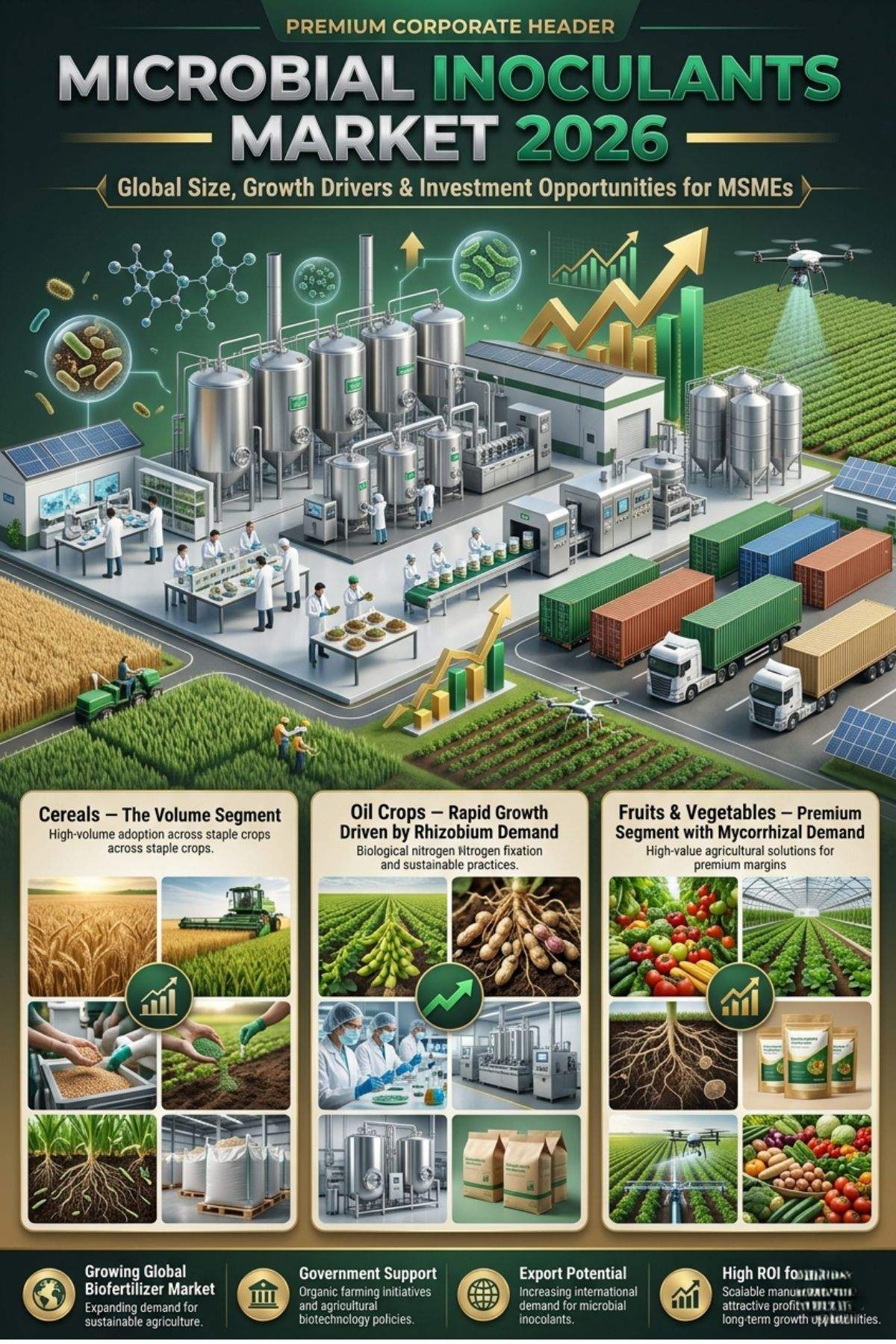
1 Cereals — The Volume Segment
The volume of application of cereals (wheat, rice, maize and sorghum) is the biggest. Even marginal use of microbial inoculants is a huge tonnage of marketable cereal. The workhorses here are the Azospirillum and Bacillus based inoculants which stimulate nitrogen fixation, phosphate solubilisation, and the production of growth hormones which are measurable and result in increased yields. The cereal segment is an obvious area of growth for the Indian producers, given the high potential states of Punjab, Haryana, Uttar Pradesh, Madhya Pradesh and Maharashtra.
2 Oil Crops — Rapid Growth Driven by Rhizobium Demand
Soybean, groundnut, sunflower and rapeseed are important crops that can be inoculated with bacterial agents, especially Rhizobium spp. which can fix atmospheric nitrogen in leguminous root nodules. These facts on yield increase of 15–25% soybean crop under effective Rhizobium inoculation are documented by ICAR and really call for the attention of farmers as well as the input retailers. With the demand for home-grown edible oil in India being put in place, the demand for oil crop specific inoculants will grow in tandem.
3 Fruits & Vegetables — Premium Segment with Mycorrhizal Demand
Fruits and vegetables are premium products and making up the highest value growth. In high-value horticulture, mycorrhizal fungal inoculants, especially arbuscular mycorrhizal fungi (AMF), are being widely studied for their ability to improve fruit quality, water use efficiency and P uptake. The growing export market of horticulture crops such as grapes (Maharashtra), mango, tomato and pomegranate, increasingly relies on biological inputs to fulfil the requirements of Global GAP and other markets for certification.
Get Detailed Insights from This Book: Handbook on Fruits, Vegetables & Food Processing with Canning & Preservation
Table 2: Microbial Inoculants Application Segment Analysis
| Application | Key Microbes Used | Primary Benefit | Market Share (Value) | Growth Rate (Est.) |
| Cereals | Azospirillum, Bacillus | Nitrogen fixation, yield boost | ~35% | Moderate-High |
| Oil Crops | Rhizobium, PSB | BNF, P-solubilisation | ~28% | High |
| Fruits & Vegetables | AMF, Trichoderma | Root health, quality | ~22% | Very High |
| Others (Pulses, Legumes) | Mixed | Multi-functional | ~15% | High |
Note: Market share estimates based on production value analysis from global industry research, 2026.
Demand–Supply Gap: The Most Critical Market Signal for Investors
One of the most structurally-sound investment cues in the agri-input space today is the demand–supply gap of microbial inoculants in India and emerging Asian markets. On the demand side, policy requirements, awareness campaigns, certification requirements, and growing competitiveness in synthetic fertiliser prices are all contributing to adoption. On the demand side, the manufacturing industry in most developing countries is still not sufficiently large or of a quality to meet the scale of potential demand, and is still very fragmented.
About 150–200 biofertilizer manufacturing units are registered in India and most of them are small-scale units promoted by State Government’s that have outdated fermentation technology and are not equipped with cold-chain facilities. Historically, quality control issues such as poor cell counts, and shelf life have created a quality-driven import dependency for premium inoculant formulations, especially the fungal and composite types.
Data compiled by the Department for Promotion of Industry and Internal Trade (DPIIT) under the Ministry of Commerce and Industry shows that India still continues to import its bioagricultural inputs, including the advanced liquid and wettable powder formulations from North America, Europe and Israel. The import dependence in the product category which India has significant domestic microbial biodiversity to support is structurally avoidable and can be filled by well capitalised domestic manufacturers.
Get Detailed Project Report (DPR): Liquid Biofertilizer Manufacturing Industry
DEMAND–SUPPLY GAP INSIGHT
Only 15% of the land under cultivation in India uses microbial inoculants, whereas the Government of India has set a target of 30%+ by 2030 for the use of microbial inoculants. Although the number of fungal products produced domestically is increasing, it is still not sufficient to meet the demand, especially in the production of high-quality fungal inoculants and multi-strain composite products. The gap can be filled at present with imports; therefore, an opportunity may be available for the domestic manufacturers who can produce to quality and shelf-life requirements.
Market Growth Forecasts: Production Value, Capacity, and Pricing Outlook
The microbial inoculants market is expected to grow at a robust compound rate till 2032 across the globe. Production value estimates over the 2021 to 2032 period account for not only volume growth, but also an average increase in selling price due to price premiums for new formulations (powder to liquid and encapsulated formats) and rising costs of regulatory compliance which weed out low quality producers.
Table 3: Global Microbial Inoculants Market — Indicative Growth Trajectory (2021–2032)
| Metric | Base Year (2021) | Mid-Period (2025) | Forecast (2028) | Target (2032) |
| Production Value (USD Bn) | ~1.8 | ~2.9 | ~4.2 | ~6.8 |
| Production Volume (‘000 MT) | ~180 | ~295 | ~430 | ~720 |
| Average Price (USD/Kg) | ~10.0 | ~9.8 | ~9.7 | ~9.4 |
| No. of Active Manufacturers | ~420 | ~510 | ~590 | ~720 |
Note: Values are indicative based on industry analysis. Average price decline reflects efficiency gains partially offsetting premium product mix. Source: Industry research synthesis, 2026.
Average price trends indicate slight price declines over the forecast period, reflecting a typical trend of maturing biologicals products where lower per-unit production costs due to economies of scale and fermentation technology improvements continue. The general trend of premium pricing will likely be mitigated by premium fungal and composite formulations featuring proprietary strain differentiation, however, for innovative producers. The organised biologicals market in India is expected to expand at a higher rate than the market due to policy convergence between the central and state agricultural departments, according to the FICCI Agriculture Committee.
Major Indian Players and the Organised Manufacturing Landscape
Large organised manufacturers and a base of small state-supported ones make up India’s microbial inoculants manufacturing industry. Companies that have invested in scalable fermentation infrastructure and quality control systems, along with field demonstration networks are leading the way in the organised sector.
The Government of India owned National Fertilizers Limited (NFL) has been promoting and supporting the production of biofertilisers. Rashtriya Chemicals & Fertilizers (RCF) has been working with research institutions on developing and commercialising products of the bio-fertiliser. In the private sector, Biostadt India, Kan Biosys (Gujarat), Agriland Biosciences, and T.Stanes & Company (Tamil Nadu) are known service providers with ample reach across various states. Some State Agricultural Universities are also a part of commercial production units but the quality consistency in these units is a problem.
Table 4: Key Indian Microbial Inoculant Manufacturers — Organised Sector
| Company | Headquarters | Primary Products | Market Focus |
| T.Stanes & Company | Coimbatore, TN | Rhizobium, PSB, KSB, AMF | South India, Export |
| Kan Biosys Pvt. Ltd. | Vadodara, GJ | Liquid inoculants, Trichoderma | Pan-India |
| Biostadt India Ltd. | Mumbai, MH | Composite inoculants, biocontrol | Pan-India, Export |
| Agriland Biosciences | Hyderabad, TS | AMF, bacterial inoculants | South & West India |
| National Fertilizers Ltd. (NFL) | Noida, UP | Biofertiliser blends | Government scheme supply |
Source: Company disclosures, State Agriculture Department records, Industry research, 2026.
Startup and MSME Investment Opportunity: Why This Sector Merits Serious Attention
The use of microbial inoculants has a high degree of import substitution logic and an impressive policy tailwind, high-margin product potential, and relatively low capital intensity compared to chemical fertiliser plants, making it an exciting opportunity for first generation entrepreneurs and MSMEs considering production facilities in agri-inputs. The Ministry of MSME categorises the production of agri-biologicals as a priority sector for manufacturing support under the MSME Development Act and several state governments provide capital subsidy and power tariff concessions on biofertiliser units.
Establishment of a green field microbial inoculant manufacturing unit of around 200-500 MT finished product (both bacterial and fungal lines) would cost about ₹2-6 crore, depending on the land requirement, fermentation capacity and quality control facility set-up. With established distribution channels and a brand positioning based on quality certification (BIS, ISO or organic equivalent) the project can reach EBITDA margins of 25-35% at this scale.
The angle of import substitution is very interesting. Currently India imports microbial inoculant formulations of high quality such as liquid shelf stable formulations, encapsulated inoculants of fungal spores from manufacturers in Denmark (Novozymes), USA and Israel. There is a huge opportunity for domestic manufacturers to gain market share from imports as they can produce similar parameters at competitive price points and with the introduction of Make in India policy, the preference for procurement of domestically manufactured agri-inputs is increasing in government-sponsored scheme supply chains.
Your investment deserves the right opportunity
STARTUP OPPORTUNITY INSIGHT
- Capital efficient entry: Greenfield microbial inoculant unit at ₹2-6 Cr with potential payback period of 3-4 years
- Import substitution: Use of premium fungal and composite inoculants in the organized retail and Government supply chain is to be substituted by alternative sources.
- Policy support: inputs and outputs markets accessed through subsidised schemes (PKVY, NMSA, state biofertilizer promotion schemes)
- Scalability: Start off with bacterial inoculants, and introduce fungal/composite lines as knowledge increases
- Export opportunity: There is global demand for organic certified inoculants, which opens an export opportunity, particularly to Southeast Asia, Africa and MENA.
Market Insight Summary
The global microbial inoculants market is undergoing a major shift from a phase of pilot to a phase of mainstream agronomic implementation. A unique conjunction of mandates on sustainability, fertilizer subsidy rationale and soil health legislation in major agricultural economies is creating demand conditions never seen before-not even five years ago. The key insight for industrial investors is to view quality differentiated manufacturing (rather than low-cost, commodity-type manufacturing) as the value creation path.
Frequently Asked Questions (FAQs)
Q1. What are microbial inoculants and how they differ from chemical fertilisers?
Microbial inoculants are products which contains live beneficial micro-organisms, such as bacteria or fungi. They improve the plants nutrient availability and soil productivity via biological processes such as nitrogen fixation, phosphate solubilisation, etc. Chemical fertilisers, on the other hand, directly supply the nutrients but it cannot contribute to improving soil health. A microbial inoculant formulation could substitute the use of chemical fertilizers to some extent, by reducing the requirement of fertilizers by 20-40% if used regularly.
Q2. What is the minimum scale for establishing a microbial inoculant manufacturing unit in India for viability?
A manufacturing unit could be economically feasible when its annual output of finished product would be between 100-200 MT/year, otherwise its fixed costs, due to investments in fermentation machinery, Quality Control lab, NABL accreditation, are not justify by sales volume. Most of feasibility analyses studies recommend a plant size for the bacterial inoculant production would range from 200-400 MT/year and for fungal (AMF) inoculants would range from 50-100 MT/year given the complexity of its production.
Q3. Which regulatory approvals would a manufacturer need to establish the production and sale of microbial inoculants in India?
Manufacturing, sale and distribution would require manufacturers to strictly adhere to provisions stated under the Fertiliser Control Order (FCO), specifying strains specifications, cell numbers in formulation, and shelf-life standards of product. The registration for newly identified microbial strains requires a special approval from Central Insecticides Board & Registration Committee (CIB&RC) for biofertilizers. The state agriculture departments registration of biological fertilizers would also be necessary for marketing the product in some states. For export of organic-certified biological inputs to foreign countries APEDA (Agricultural and Processed Food Products Export Development Authority) could also advise on regulatory standards of products.
Q4. How long is the typical shelf life of microbial inoculant products and how that impacts distribution?
The shelf-life varies for bacterial inoculant products to be generally of 6 months when formulation is peat based (lignite/peat). For liquid formulation of microbial inoculants, product with properly formulated matrix would survive for more than 12-18 months in ambient temperature, where for fungal inoculants (AMF), product in granulated form could have a shelf life of more than 24 months, with reduced necessity for cold chain storage facility of product and packaging. With advancements in encapsulation technology cold chain demand will continuously be reduce that is critical in supply chain of product in hinterland agricultural region of India.
Q5. What kind of Government support are available for MSMEs to set up microbial inoculant manufacturing unit?
Support for establishing microbila inoculant unit is available for MSMEs under schemes like National Bank for Agriculture and Rural Development (NABARD) refinance scheme for agri-processing industries and SIDBI MSME loan products, state agro industrial parks scheme and ICAR through its various biotechnology laboratories network for technology development. For bio-fertilizer units the state Governments like Karnataka, Andhra Pradesh, Maharashtra offer capital subsidy ranging from 25-33% of fixed capital based on its agricultural biotechnology policy promoting development of new biofertilizer units.
About Niir Project Consultancy Services (NPCS)
Niir Project Consultancy Services (NPCS) provides market survey cum detailed Techno-Economic Feasibility Reports (DPRs) which provides you the micro level information that an investor, entrepreneur has to analyze about the technical and financial viability to set up a microbial inoculants manufacturing unit.
NPCS’s reports on microbial inoculants and biofertiliser manufacturing typically cover:
- Detailed manufacturing process: fermentation technology, downstream processing, carrier preparation, quality control protocols
- Market research and demand analysis: crop-wise consumption data, state-level market assessment, import–export trend analysis
- Process Flow Diagrams (PFD/BFD): complete production flowcharts for bacterial, fungal, and composite inoculant lines
- Product mix and capacity planning: optimal scale selection, multi-product facility configuration
- Machinery and raw material specifications: equipment sourcing (domestic and imported), fermentation vessel sizing, QC laboratory setup
- Import–export dependency analysis: trade data on current import volumes, value, and origin countries
- Project financials and profitability evaluation: capital cost estimate, operating cost analysis, IRR, NPV, payback period, break-even analysis
NPCS aim is to help the entrepreneur assess the technical feasibility, financial viability, market, and scalability of the proposed new agri-biological manufacturing project. NPCS have more than three decades of experience, supported by hundreds of industries, enabling investors from feasibility to commissioning stages. For more details on our available reports and bespoke consultancy services, please log on to our website www.niir.org.
Key References and Data Sources
This article draws on the following authoritative sources:
- Food and Agriculture Organization (FAO) — Soil Biodiversity Portal
- Indian Council of Agricultural Research (ICAR) — Official Portal
- Department for Promotion of Industry and Internal Trade (DPIIT)
- 6. Agricultural and Processed Food Products Export Development Authority (APEDA)