
BHAVYA Rasayan Scheme
Ten first-time promoters will say: What does it take to manufacture chemicals? Nine will say: What does it take to manufacture chemicals? How many dollars does it cost? That’s a good question, but it’s masking a better one. The question is what is the interest earned on each rupee and what is the time period. This article has both answers. It classifies practical business ideas based on the amount you can invest; so that you will not waste your time on the projects that you can’t afford.
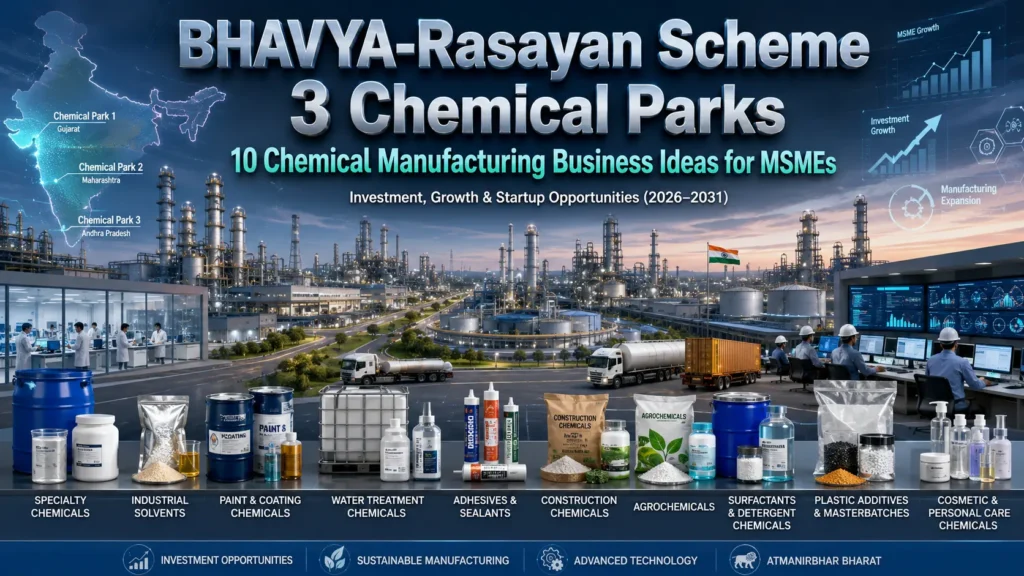
The timing is also a factor. Three dedicated chemical parks are a part of the BHAVYA-Rasayan scheme and the Union Cabinet has approved funding of ₹3030 crore for the same. Concentrated utilities within those parks will reduce the capital cost for all units within those parks. As a result, a number of projects that were considered to be too expensive just a year ago are now at the reach of a mid-size promoter.
Why Founders Ask the Wrong Question First
Capital Is Rarely the Real Constraint
Good chemical projects are bank financed. They have been doing so for decades. The money is the least thing that prevents most promoters from succeeding. Far more projects fail due to weak product selection, missing approvals, and unrealistic demand estimates than due to tight budgets. Thus, capital is a result of good planning and not the beginning.
What Actually Decides Your Return
The profitability of this sector is determined by three factors. The first is the level of narrowness and defensibility of your product. Second, the efficiency with which you are using utilities like steam, power, water etc. Thirdly, your rate of filling capacity. The plant is not the same at 40 per cent as it is at 80 per cent. In most years, in fact, utilisation is more than the price.
Margins Rise as Products Get Harder to Copy
Simple blending businesses have regular, but modest margins. Product with the need of process know-how, catalysts or tight product purity fetches much more. They also require improved chemists and extended customer approval processes, though. So it does not actually make any sense to say it is a choice of ladders anymore. Select the rung that suits your team, not your bank account.
How to Read a Chemical Project Cost Sheet
The Five Blocks Every Project Contains
When you’re judging a project, divide it up into 5 parts:
- Land and site development, which is eliminated by a park location.
- This is typically 15 to 20 per cent of the building or civil work cost.
- Plant, machinery and instrumentation (usually the largest block).
- Utilities and pollution control, typically 20 – 30 per cent, in standalone units.
- Working capital in the form of preliminary expenses, contingency and margin money.
Be aware of the significant contribution of utilities and pollution control to the total. This one sentence is the answer as to why shared park infrastructure is such an important issue to smaller promoters.
Related Article: 15 Profitable Chemical Business Ideas in India (Low Investment Manufacturing Guide)
The Working Capital Trap
This is where new founders are most likely to get hurt. Raw material must be paid for within a short period of time, and customer payment takes 60 to 90 days. Export buyers pull it even more. In the meantime, there is never an idle hour for salaries or power bills. Thus, even if a profitable plant is developed, it may still be cash-flowed in the first year. For at least 3-4 months operating cost, budget the operating cost as working capital; arrange the limit before commissioning; don’t wait after commissioning to arrange the operating cost limit.
Business Ideas Under ₹2 Crore
Don’t let small capital fool you, this is a big opportunity. The ideas below require small investments since they do not demand a lot of synthesis and pollution load.
Chemical Testing and Calibration Laboratory
All chemical units are required to test raw materials, finished products, effluent and emissions. Small units don’t have the resources for their own full analytical lab; therefore, they outsource. Thus, there is a demand for a NABL accredited third party laboratory from its first year. Services smoothly widen into instrument calibration, safety data sheet preparation and export support. Investment is in the instruments and qualified analysts, not land and reactors. Margins remain high because the key factor is skill. Fortunately, tougher environmental standards continue to grow the market without needing to be pushed. This still stands as one of the best opportunities for a technically savvy entrepreneur with little money to invest, anywhere in the industry.
Drum Reconditioning and Chemical Packaging
Chemicals are transported in drums, carboys, IBCs and each and every one of these requires cleaning, testing and certification before reusing. A reconditioning unit removes the used containers, conditions them to be standard and puts them back into circulation. The demand gradually increases with the increasing capacity of chemicals, which is close to the demand. Discipline in the areas of safety and traceability is more important for the business than extensive knowledge of deep chemistry.
Therefore, it is appropriate for promoters coming from an engineering or logistics background looking for a presence in the sector without taking on process risk. The cash cycles are short, as buyers are not distant distributors but some industrial units. Subsequent operators go on to expand into bulk liquid transport, using the same customers.
Institutional Cleaning and Sanitation Chemicals
Consumables such as floor cleaners, disinfectants, degreasers and hand hygiene products are purchased on a regular basis by hospitals, hotels, food plants, and large offices. These are blending operations, not synthesis, which means that capital remains low and approvals remain easy. The real business is in the quality of the formulations and institutional selling. The majority of volume is generated by tenders and annual rate contracts which means income is predictable after empanellation.
Another thing that you should know about contract manufacturing for bigger brands is that you will get your cash flow early and will be able to construct your own brand. The founders who learn the tender process in one state typically repeat it in adjacent states within a couple years of learning it.
Business Ideas Between ₹2 Crore and ₹10 Crore
This band is meant for promoters who can come up with approximately ₹1 crore to ₹3 crore of their own money and the rest on the term loan.
Water Treatment Chemicals
Poly aluminium chloride, Ferric chloride, Anti-sealants and boiler chemicals are sold to municipal bodies, textile mills, power plants, industrial estates. Demand is unrelated to economic cycles; all factories have to deal with their effluent. This is a very steady revenue. Process technology is simple and most machines are home-made, so that capital is low. Within a chemical park, CETP becomes a big captive customer. The primary risk is freight as they have a low value per tonne. Thus, it is advisable to locate the plant near its purchasers, and not to seek early distant markets.
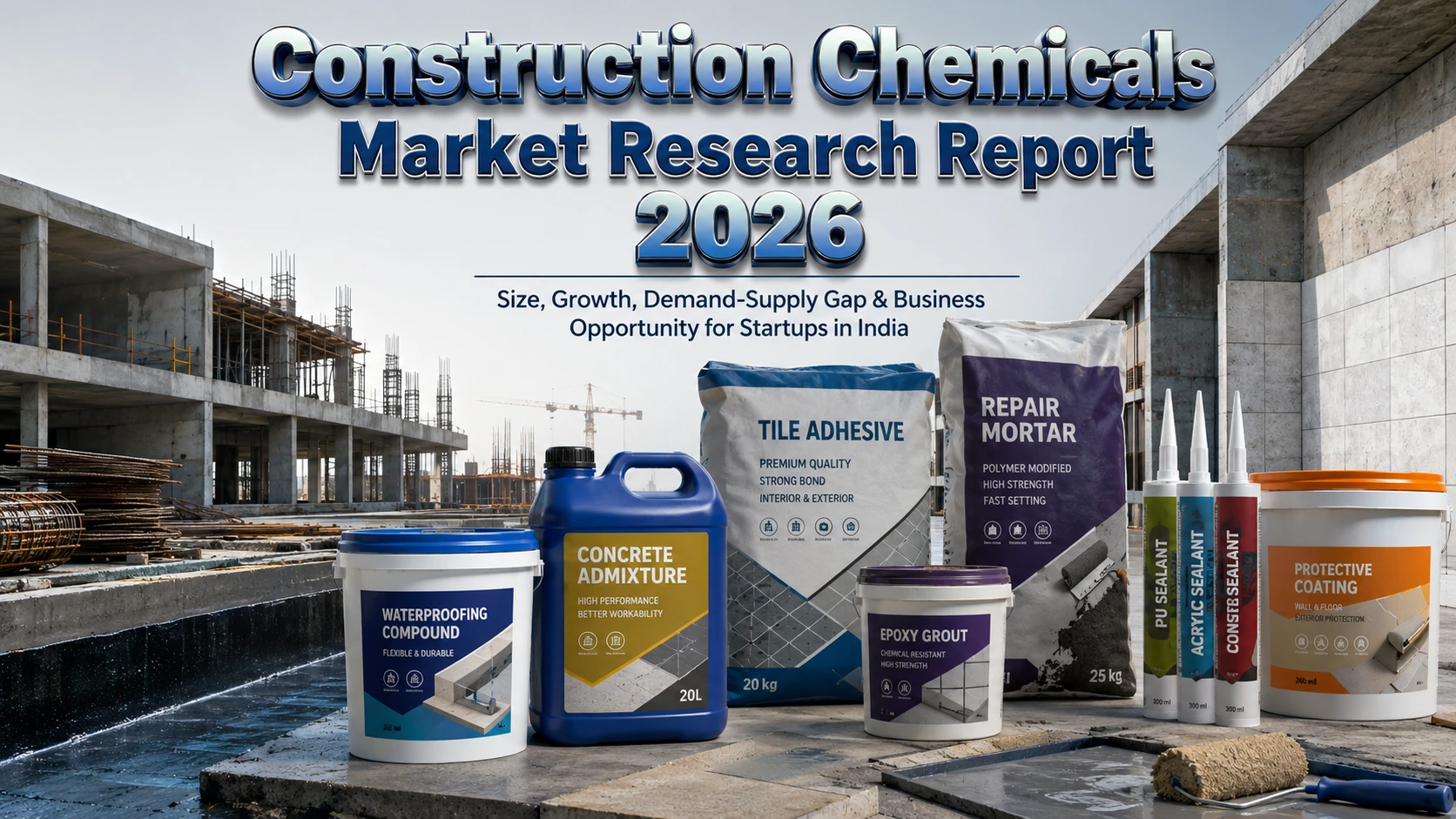
Construction Chemicals and Adhesives
Waterproofing compounds, tile adhesives, concrete admixtures and sealants are now standard in Indian projects, where they were previously optional. For this industry, the segment is unique in allowing a founder to create a brand instead of being some nameless supplier. Price is no factor in driving sales, and the dealer network and applicator training/site demonstrations are much more effective. Capital remains moderate because most of the products are dispersion and mixing products and not synthesis products. But Credit is the key expectation of the dealers and the discipline of working capital makes the difference in survival.
The contractors who gain trust to promote in one district, and then move from district to district will usually be the successful promoters; while those who try to go national first before establishing their quality will be unsuccessful.
Solvent Recovery and Reprocessing
The model is a money spinner on both sides. Units such as pharma, paint and agrochemicals are required to dispose of spent solvent at a cost. A recovery unit captures that stream, recovers the solvent and re-enters the same industrial belt as purified solvent. So, the operator receives a payment for the input and another for the output. There has been a steady improvement in the amount of feedstock available due to environmental rules being tightened. Capital is mostly in distillation columns, storage and safety systems. Approval is strict and it must be. However, very few models within an industrial complex have this combination of low-cost raw materials and back-to-back demand.
Agrochemical Formulation Unit
Formulation can be done on a small scale, assuming technical grade molecules can be made on a large scale. In a formulation unit, technical material is purchased and formulated into emulsifiable concentrates or suspension concentrates or granules. Agrochemicals are exported in bulk quantities in India and hence there is a scope for contract formulation for the units with appropriate registrations. Approval under the Insecticides Act requires patience and i guess that’s why those who complete it are protected.
In the meantime, biopesticides and bio-stimulants are emerging rapidly with the demand of residue free produce from buyers. This is a model that can be scaled in a steady pace with little capital by a promoter with rural distribution strength or an overseas tie-up.
Get Detailed Insights from This Book: Agrochemicals Manufacturing Technology Book
Business Ideas Above ₹10 Crore
These are high-dollar, high-tech projects. They, in turn, provide the highest margins and longest-lasting customer relationships.
Pharma Intermediates and Key Starting Materials
India still relies heavily on imports of its starting materials and policy is in full swing to change this. Building the order book with domestic API manufacturers is possible even if two or three intermediates are produced well in a unit. The buyer pays premium prices here, but requires impurity profiles, documentation and audit readiness from the first shipment. So plan properly for quality control lab and expert chemists, not just reactors. There are long approval cycles and so is the need of maintaining adequate working capital to tide over the same. In this area, founders with technical backgrounds do very well or those who work with an experienced process chemist.
Specialty Surfactants and Oleochemical Derivatives
Surfactants are essential for all types of detergent, shampoos and cleaners and are not influenced by industrial cycles but rather by household income. Revenue remains very consistent in the event of a downturn. Ethoxylates, sulphonated acids, amine oxides and betaines are suitable for both multinational buyers and fast-growing regional brands. That’s where a park with a common steam network makes the cost equation better, because these types of processes use heavy steam. Contract manufacturing provides a less risky way to enter. Some surfactant units started as job-work units, gained knowledge of the quality discipline required by big customers, and subsequently introduced their own range in institutions with much better profit margins.
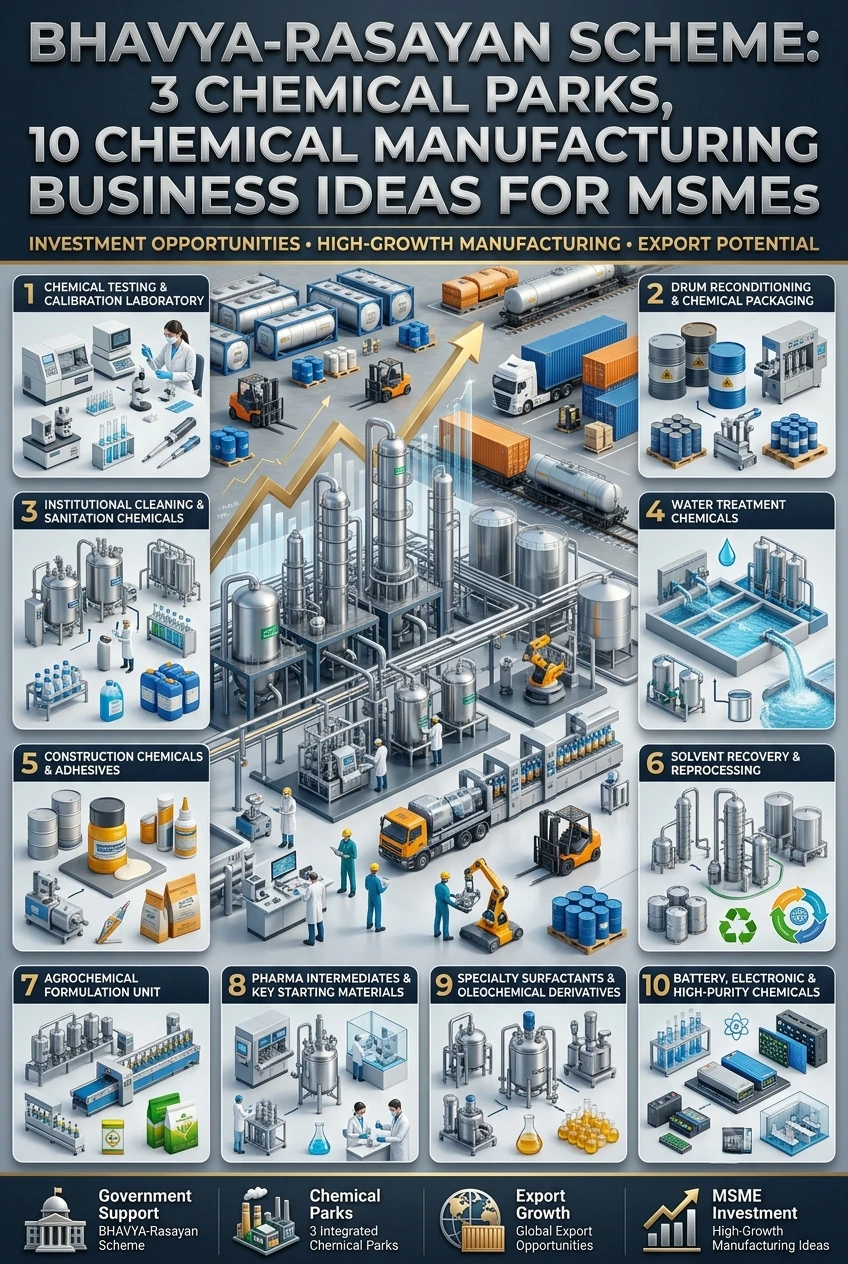
Battery, Electronic and High-Purity Chemicals
Demand for electric vehicles and electronics assembly is growing, and only just begun. The use of high purity solvents, electrolyte salts, binders and cleaning chemicals is still largely imported. This concept is appropriate to promoters who want to invest in purification technology and in serious analytical instruments. Specifications are hard to please and rejection is painful. But there is not much choice of suppliers available and incentive schemes actively seeking customers. To sum up, it’s a longer game that’s more lucrative. Assess and reserve for an extended qualification period.
Get Detailed Project Report (DPR): Complete Battery Manufacturing Guide
How the ₹3,030 Crore Parks Scheme Improves Your Returns
The BHAVYA-Rasayan scheme provides ₹3,000 crore for common infrastructure and basic utilities within three dedicated chemical parks. The Centre will provide up to ₹1,000 crore to each park, with a minimum of ₹500 crore to be contributed by the state. States bid for these projects, using a challenge process, and, for each park, the minimum acreage required is 2,000 acres of contingencies-free land.
Read that as a return calculation not a policy note. Effluent-treatment, steam generation, water distribution, solvent recovery, pipelines and warehousing are all shared services. Normally each one remains within the capital budget of its promoter. Place them in a usage charge, and the total cost of a project is usually reduced by 1/5 or more.
A lower capital has two effects on your return. It reduces interest cost, and shortens payback. Additionally, there is accelerated clearance of clearances within a planned park saving months of idle interest while under construction. Those months are never recorded in project reports, but they make all the difference in the world as to whether a first project is successful.
Funding the Project: Where the Money Actually Comes From
The Standard Structure
The promoter’s funding in the majority of chemical projects is approximately 30 per cent, and the remainder comes from a term loan. A working capital limit is also given to banks on stock and receivables. Sanction them together, for a completed plant with no working means a non-functional plant.
Collateral-Free Routes
Thus, first register on Udyam because the majority of advantages are linked to Udyam. Credit programmes, cluster and technology programmes are worth checking from the Ministry of MSME. Specifically, CGTMSE offers bank loans without collateral up to a limit of ₹10 crore with guarantee cover. PMEGP provides margin money subsidy for small enterprises and ZED certification as well as the RAMP programme for improvement to quality and productivity.
Subsidies That Cut Your Effective Cost
State industrial policies often provide stamp duty waiver, power tariff relief, SGST reimbursement, interest subvention and capital subsidy. In total, these can represent 15 to 25 per cent of the project costs. There are more product linked schemes like PLI for bulk drugs, key starting materials and PLI for Advanced Chemistry Cell batteries. Advices on sectors can be provided by Invest India and Department of Chemicals and Petrochemicals.
Export Earnings Change the Return Profile
India is in the league of approximately 14th amongst countries exporting chemicals and near eighth in the list of importing countries. That is a market map for all persons who are going to make plans for import substitution. According to the IBEF, the domestic chemical industry is comfortably over US$ 250 billion and expanding well in the specialty areas. In the duty credit category, RoDTEP refunds embedded taxes, Advance Authorisation allows duty-free import of input goods for export production and EPCG provides EO duty-free machinery. These are kept at the Directorate General of Foreign Trade and CHEMEXCIL handles buyer meets and registration of member exporters.
Founders Who Built Strong Returns from Small Beginnings
Clean Science and Technology — Ashok Boob and Siddharth Sikchi
After 30 years working in the chemical industry, Ashok Boob began his own business in his mid-fifties. He started his work with his nephew Siddharth Sikchi in a small laboratory at Vapi with the aim of devising cleaner catalytic processes. The two deliberately selected products on which they designed their own catalysts and their own plants. That decision gave a competitive edge that was hard for others to emulate and it gave margins. The bulk of the company’s sales are now directed to the international market. There is a straightforward lesson. Scale is not what saves specialty chemistry returns, it is process know-how.
Tatva Chintan Pharma Chem — Chintan Shah and Ajay Patel
Tatva Chintan was conceived in Vadodara with a very focused approach. The promoters focused on structure directing agents and phase transfer catalysts, both products where there are only a handful of suppliers worldwide. Chintan Shah did the business development and Ajay Patel, a chemical engineer, did project engineering. The division of skills was as important as the product selection. They were a small Indian company, catering to demanding international customers in a specialised area. The lesson to take from this for founders is that a niche on a global level is more likely to work than a niche at a national level.
Neogen Chemicals — Haridas Kanani
A chemical engineer from IIT Bombay, Haridas Kanani, founded Neogen on the backdrop of bromine and lithium chemistry, which was well ahead of the trend at that time. The company launched in humble manner in Navi Mumbai and later went ahead with setting up plants in Gujarat. Instead, the promoter concentrated on two chemistries and added to the product line within each of these chemistries. This focus enabled the business to be placed in the right circumstances when the demand for battery materials arrived. So, investing in a specific chemistry proved to be more fruitful than diversification early on.
What the Numbers Teach
No one of these founders had huge capital. Everyone chose a defensible chemistry, put in some process knowledge and put the proceeds back in to capacity. Moreover, all three developed technical depth prior to scale. That pattern can be repeated and that is the best way to describe their return profile than any market trend.
Test the Numbers Before You Commit Capital
Of all chemical projects, most fail on arithmetic not chemistry. If they underestimate utility loads, misjudice an effluent volume, or presume that a market will absorb a volume of output that it cannot. A well-planned techno-economic analysis uncovers these gaps and helps rectify them without incurring high costs.
At Niir Project Consultancy Services (NPCS) we offer professional consultancy services for preparation of Market Survey cum Detailed Techno-Economic Feasibility Reports for new Industries and businesses. We have reports of manufacturing process, market research and market demand analysis, process flow diagrams, product mix and capacity planning, details of machinery and raw materials etc., and complete financials of the project with profitability analysis. The intent is simple. We assist entrepreneurs in assessing viability, viability and scalability before investing.
These reports are closely read by banks and state agencies. Thus, a prepared report will insure the promoter against a bad deal and can ease the funding discussion.
Explore 10,000+ Business Ideas Aligned with Your Investment Goals
Business Ideas by Budget: Investment and Return Snapshot
The table below compares entry options across budget bands. Treat the figures as planning ranges used in early feasibility work.
| Business Idea | Investment Band | Gross Margin | Payback | Risk Level |
| Testing and calibration laboratory | ₹1 – 4 crore | 35% – 50% | 2 – 3 years | Low |
| Drum reconditioning and packaging | ₹1 – 6 crore | 18% – 28% | 3 – 4 years | Low |
| Institutional cleaning chemicals | ₹0.5 – 2 crore | 25% – 35% | 2 – 3 years | Low |
| Water treatment chemicals | ₹1 – 5 crore | 20% – 28% | 3 – 4 years | Low |
| Construction chemicals | ₹1.5 – 6 crore | 30% – 40% | 3 – 4 years | Medium |
| Solvent recovery | ₹3 – 15 crore | 30% – 45% | 3 – 4 years | Medium |
| Agrochemical formulation | ₹3 – 12 crore | 22% – 32% | 3 – 5 years | Medium |
| Pharma intermediates and KSM | ₹15 – 60 crore | 25% – 38% | 4 – 6 years | High |
| Specialty surfactants | ₹5 – 20 crore | 20% – 30% | 4 – 5 years | Medium |
| Battery and high-purity chemicals | ₹20 – 80 crore | 28% – 40% | 5 – 7 years | High |
Means of Finance for a Sample ₹10 Crore Project
| Source | Indicative Share | Practical Note |
| Promoter equity | ₹3 crore | Banks normally expect 30% from the promoter |
| Term loan | ₹7 crore | Typically 7 to 9 year tenure with moratorium |
| Working capital limit | ₹2 – 2.5 crore | Sanction alongside the term loan, never after |
| State capital subsidy | ₹1 – 2 crore | Claimed after commissioning, so do not treat as upfront funding |
| CGTMSE guarantee cover | Up to ₹10 crore | Reduces or removes the collateral requirement |
How Payback Moves With Capacity Utilisation
| Capacity Utilisation | Revenue Level | Operating Margin | Payback Period |
| 40% | Below break-even | Negative to 5% | Not achieved |
| 55% | Break-even zone | 8% – 12% | 6 – 7 years |
| 70% | Comfortable | 16% – 20% | 4 – 5 years |
| 85% | Strong | 22% – 26% | 3 – 4 years |
Notice how sharply returns improve with utilisation. This is why demand validation matters more than shaving a few lakhs off machinery cost.
Frequently Asked Questions
What is the minimum realistic investment of a chemical business?
If you adopt a blending or service-based model, you can expect to pay in the range of ₹50 lakh to ₹1 crore. Most institutional cleaning chemicals, small packaging and testing laboratories fall into that range. Cost of synthesis-based plants realistically begin at ₹3 crore. Anything under ₹50 lakh is more of a trade than a manufacturing.
What fraction of the project expenses will a bank provide the funds for?
The term loan would normally be 65% to 70% of the project and the promoter would contribute the remaining amount. The working capital requirement is also considered as a distinct requirement by the banks. When project reports are solid, there is good approval and firm interest in the project, the amount of the sanction is increased and the interest rate offered is increased.
What is the cost-effective budget?
The price range of ₹2 cr to ₹10 cr generally is ideal. Projects are sizable enough to generate actual margins but small enough to fill capacity rapidly. There’s a ceiling on your upside with very small projects. These are more difficult to approve and have higher interest rates on them during construction, if they are very large.
How many days does it take for the business to break even?
Make plans for 2-3 years. Construction and commissioning take about one year. The process of customer approval and trial supply takes several months more, especially for export customers. The normal well planned unit crosses break even utilisation in the second or third year of operation.
Will the subsidy lower my upfront costs for me?
Usually not. The majority of state capital subsidies are recoverable, typically in stages, following the commissioning. So, first, plan for full funding; then, secondary, plan for subsidy. The founders who plan for subsidy as a lump sum usually end up short of funds during construction.
Is it safer to buy an existing unit instead of building one?
Sometimes, yes. An operating unit comes with approvals, trained staff and existing customers, which saves considerable time. However, check pollution compliance history, pending liabilities and machinery condition very carefully. Have an independent engineer value the plant before you agree on a price.
Final Word: Match the Project to Your Pocket
The most common mistake in this sector is choosing a project that is slightly too big. Ambition is not the problem. Under-funded ambition is. A ₹4 crore plant running at 80 per cent will always beat a ₹12 crore plant running at 35 per cent.
So work backwards. Decide what you can genuinely fund, including working capital and a cushion for delays. Then pick from the ideas that fit that number comfortably. Study the incentive package in two or three states. Finally, build an honest feasibility model before you order a single reactor.
Founders who follow that order rarely regret entering chemicals. Those who reverse it usually learn the same lesson at a much higher price.