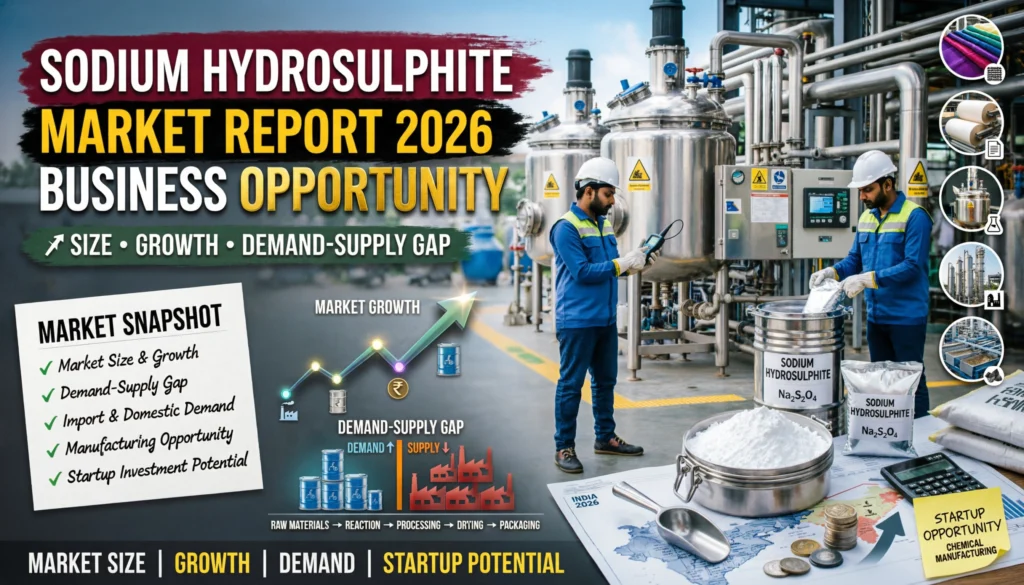

Sodium Hydrosulphite Manufacturing Business
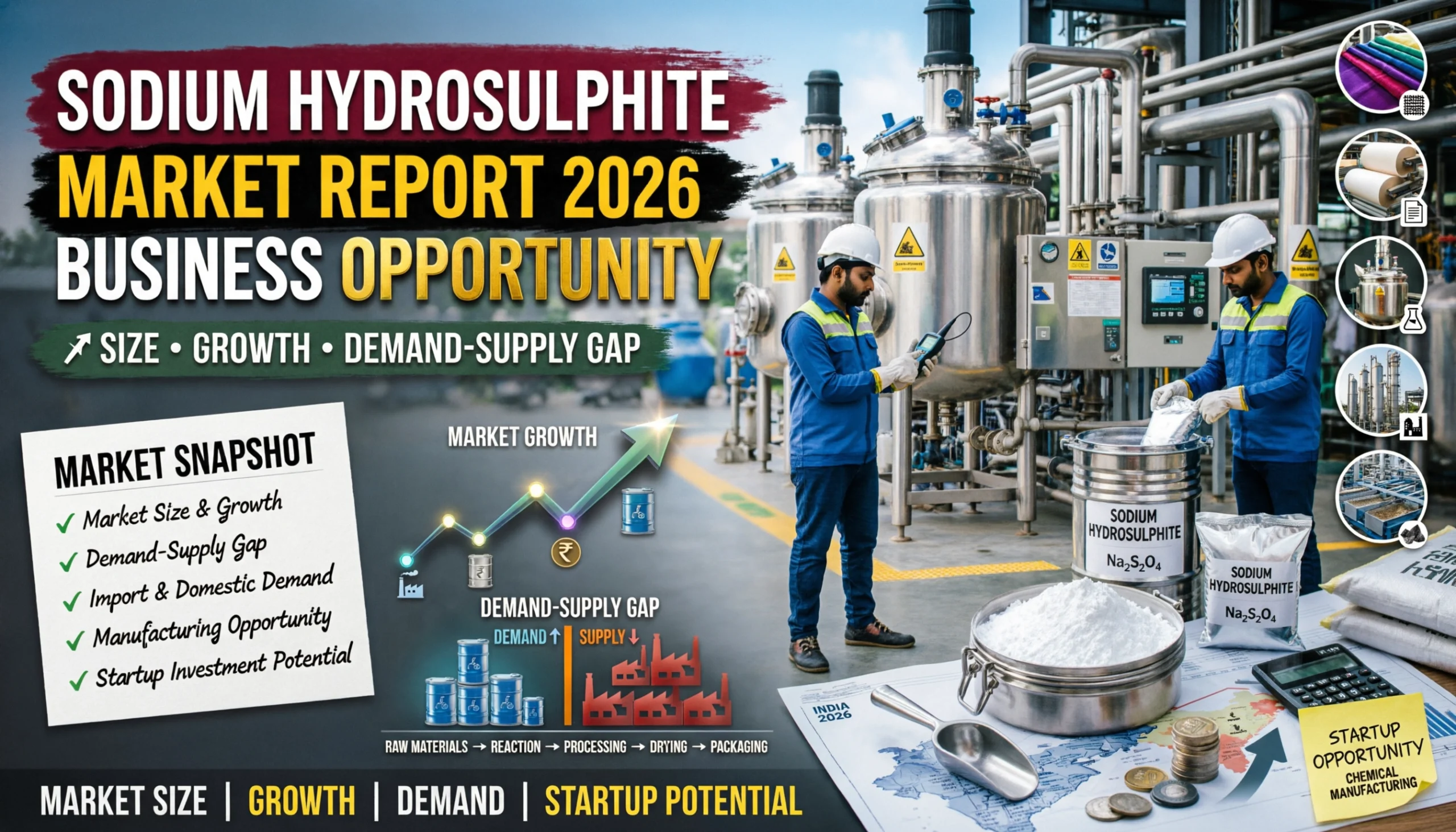
The vast textile and apparel manufacturing infrastructure in India is the largest in the world, and almost every metre of cotton, viscose or denim fabric that comes off the mill floor in India has been treated with sodium hydrosulphite, at some point in its life. It’s a non-glamorous reducing agent, but it’s also a chemical India still imports the majority of its requirements to meet: a simple opportunity with no seasonality, and the demand is assured.
What Is Sodium Hydrosulphite?
Sodium hydrosulphite is a white crystalline powder, and one of the strongest commercially available reducing agents, commonly called sodium dithionite or “hydros” in industry. It is produced by three major industrial processes:
- Zinc dust process – an older and more proven production method.
- Amalgam (sodium/mercury) process – a traditional pathway now less often used because of the handling of mercury and environmental issues
- Sodium formate process – This is the modern and preferred process which produces a purer product – free from traces of zinc, iron and mercury with lower environmental compliance costs.
However, its essential characteristic, strong reducing power which easily breaks down in acidic or hot aqueous conditions, makes it indispensable in several industries:
- Textile dyeing and bleaching – the major application (around 45% of global demand) which has applications such as Vat Dyeing, Indigo/Denim Dye Stripping, Reduction Clearing and Cotton, Wool and synthetic fibres bleaching
- Pulp and paper – bleaching mechanical and chemical pulp, and de-inking/brightening recycled paper
- Mineral processing – kaolin clay bleaching, mineral ore flotation/reduction
- Treatment of water for removal of dichlorination and heavy metals from industrial effluent.
- The permitted use of food processing is as a preservative/antioxidant in certain applications.
- The ability to provide high purity electroless plating chemicals and premium grade reducing agents for PCB assembly processes is a new application of electronics manufacturing.
Get Detailed Project Report (DPR): Sodium Hydrosulphite Manufacturing Project Report
Global and India Sodium Hydrosulphite Market Size and Growth
Global market-size estimates for sodium hydrosulphite (sodium dithionite) in the most recent of the estimated base years (2022–2025) span from about USD 1.0 billion to USD 1.6 billion, and forecasts range from USD 1.46 billion to USD 1.7 billion by 2030–2034, at CAGRs that tend to cluster between 2.2% and 5.2% depending on study, a moderate, mature-market growth profile due to steady demand and emerging substitution threat from alternative reducing chemistries.
The domestic market is projected to grow at a significantly higher CAGR of around 5.0% with rising demand in various applications, such as textile dyeing, paper bleaching and water treatment during 2020-2024, and forecast to reach a size of 200 MT by 2035 with the growth of environmentally friendly and high efficiency hydrosulphite products.
Note on figures: Sodium hydrosulphite is also known by various names in market studies (sodium dithionite, “hydros” or hydrosulfite) and the amount in some studies may be stated as part of the liquid/stabilised formulations, as reported in the powder column. NPCS can provide an investor-grade TEFS that can be customized for your selected process route (sodium formate vs zinc dust) and application segment.
India’s Import Dependence
Industry sources say India’s domestic sodium hydrosulphite market is import-dependent with the product not just a niche specialty chemical but a base industrial input for the huge Indian textile industry, and that domestic capacity has not matched the demand. This translates into an “immediate opportunity for domestic manufacturers” – that is, demand that is not seasonal, not dependent on a single industry’s cycle and that is already partly being satisfied by imports.
Policy Tailwinds
- Textile sector growth and export orientation: India’s textile and apparel export ambitions, supported by schemes like the Production Linked Incentive (PLI) for textiles, directly drive underlying demand for dyeing and bleaching chemicals including sodium hydrosulphite.
- Environmental compliance shift toward the sodium formate process: As environmental regulation tightens around zinc and mercury-based production routes, the more compliant sodium formate process — already adopted by leading Indian producers — represents both a compliance requirement and a differentiation opportunity for new entrants.
- MSME and textile cluster incentives: Sodium hydrosulphite manufacturing units located near India’s major textile clusters (Gujarat, Maharashtra, Tamil Nadu) can access MSME capital subsidy schemes and state industrial incentives tied to textile value-chain support.
- Make in India import substitution focus: Broader manufacturing self-reliance initiatives support domestic capacity building for industrial chemicals like sodium hydrosulphite that currently carry import dependence.
Read the Complete Book Here: Modern Technology of Industrial Chemicals
India Demand-Supply Gap: Sodium Hydrosulphite
| Parameter | Current Position |
| Demand base | Broad and non-seasonal — spread across textile dyeing/bleaching (largest), paper bleaching, water treatment, mineral processing, and food preservation |
| Domestic production base | Limited number of established producers, most notably TCP Limited (the only Indian plant using the sodium formate process, one of only five such plants worldwide) and Gulshan Chemical Ltd. |
| Import dependence | Documented by industry sources as an ongoing structural gap — India imports a share of its sodium hydrosulphite requirement despite having a substantial textile-driven demand base that could support more domestic capacity |
| Textile sector linkage | India’s textile industry is one of the largest in the world by volume; as polyester and blended fabric usage grows alongside cotton and viscose, reducing-agent demand grows correspondingly |
| Nature of the gap | An import-substitution opportunity tied directly to India’s textile manufacturing scale — demand growth is assured by the underlying textile sector; the gap is in domestic reducing-agent production capacity, particularly using the cleaner, more compliant sodium formate process |
| Opportunity for new entrants | Strong for regional manufacturers positioned near textile clusters (Gujarat, Maharashtra, Tamil Nadu), particularly those adopting the sodium formate process for lower environmental compliance cost |
Reading the gap: This is a straightforward, demand-secure opportunity: India makes more textiles than almost anywhere else in the world, and sodium hydrosulphite is a non-substitutable input for a large share of that dyeing and bleaching process. The gap isn’t about proving demand exists — it’s about India’s current domestic manufacturing base (concentrated in a small number of established players) not yet matching the country’s textile-sector scale, leaving room for regional capacity closer to specific textile clusters.
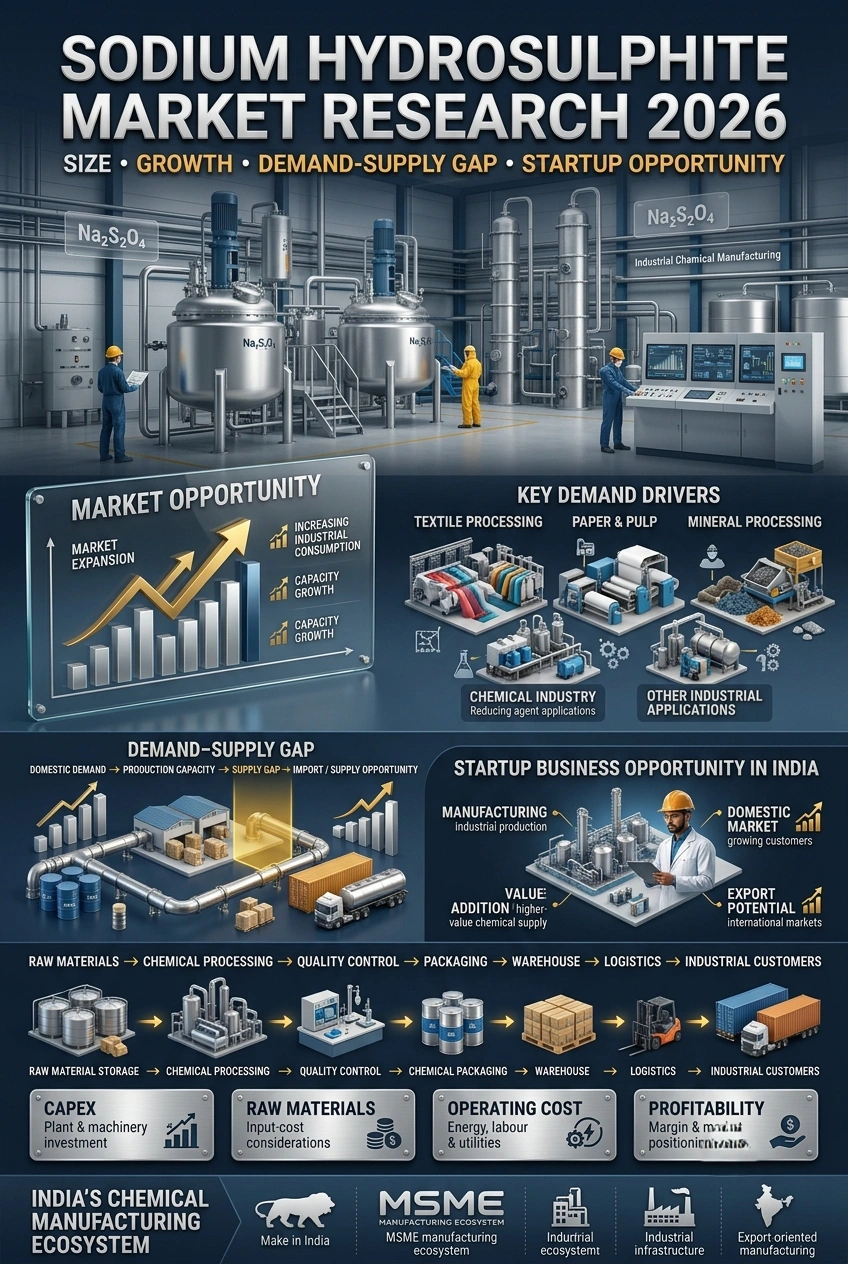
Major Indian Sodium Hydrosulphite Manufacturers
| Company | Base/Region | Process | Notes |
| TCP Limited | India (with Mitsubishi Corporation, Japan technology collaboration) | Sodium formate process | India’s only plant using this cleaner process — one of only five such plants in the world; produces “Hydros” free of zinc, iron, or mercury traces |
| Gulshan Chemical Ltd. | Bhiwadi, Rajasthan | Established process | Recognised registered synthesizer supplying premium-grade sodium hydrosulphite to the textile trade across Mumbai and other markets |
| Veeraj Chemtech Pvt. Ltd. | India | Established manufacturer | Recognised Indian sodium hydrosulphite producer |
| S.D. Dyes & Chemicals | India | Established manufacturer | Recognised regional producer serving textile dyeing and paper industry customers |
| Regional Gujarat/Rajasthan-based manufacturers (Ahmedabad, Vapi, Bhiwadi clusters) | Gujarat, Rajasthan | Various | The MSME-scale entry tier — smaller regional producers serving local textile mill demand |
Major International Sodium Hydrosulphite Players
| Company | Country | Notes |
| BASF (BASF Canada) | Germany/Canada | Major global chemicals company among the top players by market share in the sodium hydrosulphite/dithionite market |
| Guangdong Zhongcheng (Zhongcheng Chemical) | China | Major Chinese producer; China holds an estimated 60% share of global sodium hydrosulphite production, driven by its massive textile manufacturing sector |
| Yantai Jinhe | China | Recognised major Chinese sodium dithionite manufacturer |
| Hubei Yihua | China | Recognised major Chinese chemicals producer with sodium dithionite capacity |
| Huidelong | China | Recognised Chinese sodium dithionite manufacturer |
| Transpek-Silox (India-linked international operations) | India/international | Cited among the top global players in some market studies, reflecting India’s growing manufacturing relevance in this category |
Market Segmentation
By Process
- Sodium formate process — cleaner, lower environmental compliance cost, increasingly preferred
- Zinc dust process — traditional, established route
- Amalgam process — traditional, declining due to mercury handling concerns
By Form
- Powder (granular) — dominant form, roughly 62% market share, preferred for ease of handling and transport
- Liquid/stabilised solution — used in specific industrial applications requiring consistent reduction potential
By Application
- Textile dyeing and bleaching (vat dyeing, indigo/denim reduction clearing) — largest segment, ~45% of global demand
- Pulp and paper bleaching/de-inking
- Water treatment (dechlorination, heavy metal removal)
- Mineral processing (kaolin bleaching, ore flotation)
- Food and beverage (preservative/antioxidant)
- Electronics manufacturing (emerging, high-purity grades for PCB and semiconductor processes)
By End-Use Industry
- Textile and apparel manufacturing
- Pulp and paper
- Water and wastewater treatment
- Mining and mineral processing
- Food processing
Key Growth Drivers
1. The size of India as a global textile producer. India has one of the largest textile industry bases in the world and the production of polyester and mixed fabrics continues to rise, so the base demand for reducing agents, such as sodium hydrosulphite continues to grow in India.
2. Move towards sodium formate production process. Environmental compliance costs are increasing for zinc- and mercury-based production processes, and those using the cleaner sodium formate process benefit from a regulatory and market positioning.
3. An increase in the production of denim and indigo dyed fabric. In the production of denim, a particular high-volume use that is closely associated with the huge denim manufacturing industry in India, sodium hydrosulphite (as sodium dithionite) plays an important role in the reduction process of indigo dye to a washable form.
4. Tightening of water treatment regulations. A fast-growing application of sodium hydrosulphite is dechlorination and removal of heavy metals in industrial effluent, resulting from increased regulation of industrial effluent.
5. Emerging electronics/semiconductor demand. As the electronics manufacturing base grows in India, high purity sodium dithionite grades are emerging in the electroless plating and PCB assembly processes, creating a more niche, but still higher margin market segment.
Related Article: Sodium Hydrosulphite Business Plan
Challenges and Restraints
- Moisture and air sensitive. Sodium hydrosulphite is a reactive material that needs to be handled and kept carefully, making logistics and inventory management a more complex challenge.
- Replacement hazard by other agents of reduction. These glucose-based systems and electrochemical reduction technologies are being used as environmentally friendly alternatives in textile and paper applications, and are a long-term competitor.
- Regulations on the traditional production pathways. Maggical treatments of zinc dust and amalgam are being increasingly investigated and the industry is moving towards the more capital intensive but compliant sodium formate process.
- Structural overcapacity in standard grades globally. Global overcapacity in commodity-grade sodium hydrosulphite has compressed producer margins in some markets, making differentiation (via process technology or purity grade) important for new entrants.
- China’s dominant production scale. With roughly 60% of global production concentrated in China, Indian manufacturers compete against well-established, large-scale Chinese producers on price for standard-grade product.
Competitive Landscape
The sodium hydrosulphite industry in India is dominated by a few large established players, including the sole process plant using sodium formate technology in India and limited in the world, jointly developed by the Indian firm Mitsubishi and TCP Limited, and also by a larger group of companies located in chemical hubs in Gujarat and Rajasthan. China leads the production scale (around 60%), followed by BASF and some large Chinese chemical groups, such as Zhongcheng, Yantai Jinhe and Hubei Yihua. As already noted, India’s textile industry is massive but the competition is in favour of new domestic capacity which can supply the textile clusters more efficiently on cost and lead time than imported products.
Sodium Hydrosulphite Manufacturing: Business Opportunity for Startups and MSMEs
1. Manufacturing unit where the main products are related to textile cluster. The most direct and highest volume entry point is a plant that supplies the local fabric mills and the yarn processors in Gujarat, Maharashtra and Tamilnadu, which are the main textile processing hubs in India, directly, after the standard grade (85–88% purity level) vat dyeing/bleaching market.
2. Premium positioning by adopting the sodium formate process. The sodium formate route offers environmental compliance benefits and purity that could enable a new player to enter the market without a disadvantage and stand out based on quality and futureproofing the new technology in case environmental regulation tightens.
3. Water treatment-grade production. Dechlorinating and/or removing heavy metals are appropriate product differentiators that can provide diversification from the textile-cycle business.
4. Electronics Grade – high purity. The manufacture of premium purity sodium dithionite for electroless plating and PCB assembly is a specialty opportunity with a smaller volume but high margin segment in India, where electronics and semiconductors are growing as manufacturing hubs.
5. Textile exporters: import-substitution positioning. As India’s textile export and with domestic hydrosulphite being an unreliable and inconsistent option, the idea of being a reliable and quality assured alternative can attract direct interest from the export-oriented textile mills.
The figures for investment and margin for sodium hydrosulphite production are based on the assumption that the hydrosulphite will be produced by the sodium formate method and the margin is dependent on the grade of purity required as well as the method of production used (sodium formate is more complex production technology than using zinc dust). NPCS drafts comprehensive Project Reports along with the list of process specific machines, raw material sourcing plan, and textile-cluster market analysis based on your desired capacity and process route, all of which are bankable.
How NPCS Supports Entrepreneurs Entering This Space
The first step for any entrepreneur considering a sodium hydrosulphite manufacturing business is to draw a Detailed Project Report (DPR), which includes aspects of plant capacity, process route selection (sodium formate vs. zinc dust), raw material sourcing, manpower planning, project cost and financial viability based on the specific application and targeted textile/industrial cluster.
Start with clarity—choose the best business idea
About NPCS (Niir Project Consultancy Services)
Founded in 1994, NPCS is a New Delhi based industrial consultancy, and is ISO 9001:2015 certified organisation with more than 30 years of experience in techno-economic and project consultancy. In the past 30 years, NPCS has provided over 150,000 project reports and profiles in 85 countries covering almost all process & manufacturing industries, including industrial reducing agents, dyeing and bleaching auxiliaries, and textile chemicals.
NPCS is available on three synchronized platforms:
- niir.org — the primary repository of industry-specific Detailed Project Reports, business plans, and techno-economic feasibility studies
- entrepreneurindia.co — market research, project profiles, and manufacturing business opportunity content aimed at entrepreneurs and MSMEs
- npcsblog.com — industry insight, trend analysis, and manufacturing sector commentary
The following are the primary outputs from NPCS that are relevant to a sodium hydrosulphite business:
- Detailed Project Reports (DPRs) with plant capacity, machinery specifications, and layout
- Process route comparison and environmental compliance guidance (techno-economic feasibility study)
- Financial modelling: project cost, profitability analysis, ROI and break-even calculations
- Raw material evaluation and market evaluation specific to textile clusters and export markets in India
- Support documentation for the applications of MSME loans, subsidy schemes and bank funding requirements.
Entrepreneurs evaluating this sector can access relevant sodium hydrosulphite manufacturing profiles directly on niir.org and entrepreneurindia.co, or request a custom feasibility study scoped to a specific process route and region.
Government and Institutional Reference Links
- Ministry of Micro, Small and Medium Enterprises (MSME)
- Development Commissioner, MSME (DCMSME)
- Central Pollution Control Board (CPCB)
- Bureau of Indian Standards (BIS)
- Press Information Bureau (PIB), Government of India
- Startup India
- Invest India (National Investment Promotion and Facilitation Agency)
Entrepreneurs are advised to verify the latest textile PLI scheme guidelines, environmental compliance requirements for chemical production routes, and MSME subsidy norms directly on these portals, as regulatory provisions are periodically revised.
Conclusion
Sodium hydrosulphite is an industrial chemical, which has a huge base of production across India, and is a demand secure chemical, which is not seasonal so that the domestic production has not been able to meet the domestic demand and that gives an opportunity to the other players to come in with actual import substitution. The greater regulatory scrutiny of the cleaner sodium formate method compared to the older zinc dust and amalgam methods makes an entrepreneur with the right technology a strong contender to provide services directly to textile clusters and be able to differentiate on quality and environmental standards.
In the eyes of the entrepreneurs and MSMEs interested in investing in the textile chemical industry, sodium hydrosulphite represents a simple investment with a wide range of demands backed by one of the biggest and most enduring industries in India.