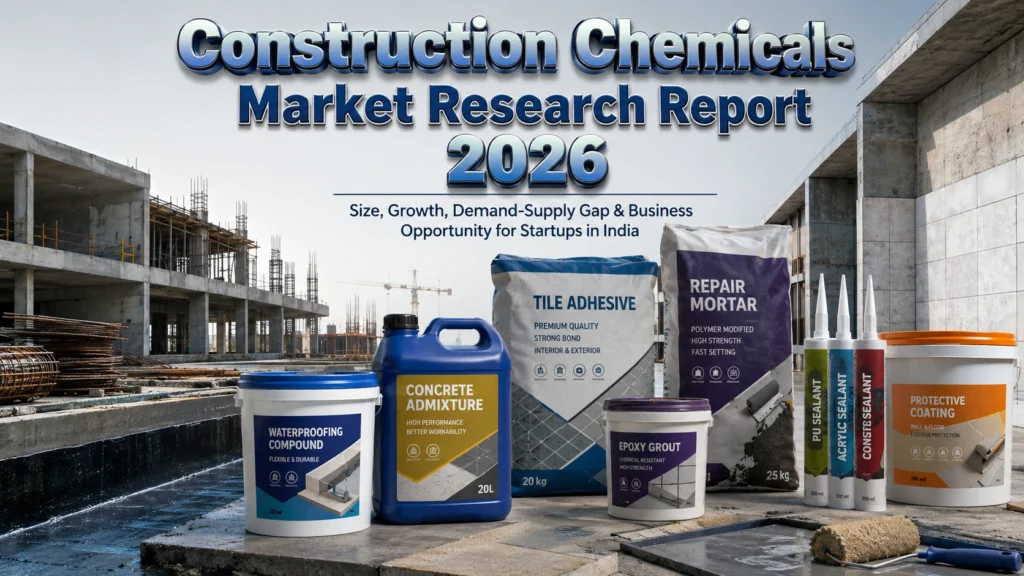

Construction Chemicals Market in India
India’s construction industry is in the midst of its biggest capital expenditure cycle in decades – metros, highways, smart cities and a housing boom in Tier-2 and Tier-3 cities. Each of those projects requires the use of construction chemicals: admixtures to create workable and durable concrete; waterproofing systems; tile adhesives, grouts, sealants and repair compounds. But it’s a category that’s expanding even faster than the construction industry, as the intensity of the use of chemicals relative to square feet is increasing even as construction volume is increasing. The entrepreneurs find that sweet soup of volume growth and growing penetration a rare double whammy.
What Are Construction Chemicals?
- Construction chemicals are specialty chemical products added to the cement, concrete and other building materials to enhance their strength, durability, workability or performance, or to safeguard them against water, chemical or environmental attack. The category spans:
- Aggregates – natural, crushed, broken, or ground rock used in concrete to provide strength, texture, and other specific properties; can be natural or artificial, including pervious concrete
- Membrane, Coating, and Integral Waterproofing Systems – Waterproofing chemicals for roofs, basements, bathrooms and below grade structures.
- Electrical and electronic components – connectors, transformers, wires, and components for electronics and electrical devices
- Industrial and commercial flooring compounds – epoxy and polyurethane and self-levelling floor systems.
- Split Level Concrete – split level concrete for tiling and structural anchoring applications
- Chemicals for repair and rehabilitation: concrete repair mortars, corrosion inhibitors and structural strengthening systems
- Coatings for Protection of Concrete and Steel structures – anti-corrosive, fire-retardant and decorative protective coatings for concrete and steel structures
Construction chemicals are sold on performance specification, as opposed to commodity pricing, are generally higher-margin, technically differentiated products, in contrast to bulk construction materials (cement, steel, aggregates).
View Full Project Details: Construction Chemicals Projects
India Construction Chemicals Market Size and Growth
Market sizes published by different research firms have significant variations both due to the extent of the product scope (some include paints and coatings while others exclude these) and the base year methodology (some use a different base year than others) but all major studies indicate double-digit growth in India. The India market is estimated to be between USD 2.25 billion to USD 4.64 billion in 2025-26, and is expected to grow at a CAGR of around 10% to 14% in the near future, significantly higher than the global market, which is expected to grow at an average CAGR of ~3.5% over the same period.
Note on figures: The wide range is because there is a genuine variation in scope of product activity between different research agencies (including paints, coatings and adhesives which are not used in non-construction applications). Consider the numbers above as directional. NPCS can put together a personalized techno-economic feasibility study tailored to your particular product line (admixtures, waterproofing, tile adhesives etc.) for investors grade numbers.
What’s Driving the Faster-Than-Construction Growth
The reason for this is that the construction chemicals market is expanding at a meaningful rate faster than the construction market – the number of square metres of ready-mix concrete (which relies heavily on admixtures) has increased, the number of buildings being constructed using advanced waterproofing, instead of traditional, has increased, and the number of developers using tile adhesives and epoxy grouts, as opposed to sand-cement mortar, has increased. The double-digit growth rates come from this progression from “no chemical” to “basic chemical” and then “advanced chemical”” specification, added to the increased construction volumes.
Policy Tailwinds
1. National Infrastructure Pipeline (NIP): An investment plan for roads, railways, urban infrastructure and housing, with the total planned capital investment of approximately INR 111 lakh crore (₹11.1 trillion+).
2. Smart Cities Mission and metro rail expansion: This requires high-performance construction chemicals for tunnels, bridges, elevated structures, which are higher than the specification for residential building.
3. Pradhan Mantri Awas Yojana (PMAY) and affordable housing push: Mass housing construction drives volume demand for tile adhesives, waterproofing, and basic admixtures even in cost-sensitive segments.
4. BIS standards for construction materials: Increasing enforcement of Bureau of Indian Standards specifications for concrete and building materials is pushing informal/unorganised segments of the market toward branded, tested construction chemical products.
5. MSME and Make in India manufacturing incentives: Domestic manufacturing of construction chemicals — as opposed to imported formulations — is supported by manufacturing-linked incentive frameworks and MSME capital subsidy schemes.
Check Out This Recommended Book: The Complete Book on Construction Materials
India Demand-Supply Gap: Construction Chemicals
| Parameter | Current Position |
| Market structure | Fragmented — the top five companies together hold only an estimated ~19% of the India construction chemicals market by some industry analyses |
| Organized vs. unorganized share | Several sub-segments (sealants, grouting) see meaningful unorganised/local competition; segments requiring stricter quality compliance (protective coatings, repair chemicals) are more organized-player dominated |
| Domestic manufacturing base | A mix of large MNC-linked players (Sika India, BASF/MBCC, Fosroc, Mapei, Saint-Gobain Weber) and strong domestic majors (Pidilite, Asian Paints, STP Ltd., Chembond Chemicals) manufacturing within India |
| Nature of the gap | Primarily a regional and category-specific capacity gap rather than an import-dependency gap — India largely manufactures domestically, but Tier-2/Tier-3 city demand and specific sub-categories (advanced repair systems, specialty flooring) remain underserved by regional-scale manufacturing |
| Opportunity for new entrants | Regional manufacturing closer to Tier-2/3 construction clusters, MSME-scale entry into specific product categories (tile adhesives, waterproofing coatings, admixtures), and contract manufacturing for established brands |
Reading the gap: Unlike categories where India depends heavily on imports, construction chemicals in India are largely manufactured domestically — the gap here is about market fragmentation and regional reach rather than a supply shortfall. With the top players collectively holding under a fifth of the market, and demand growing fastest in Tier-2/Tier-3 cities where large national brands often have thinner distribution, there is genuine room for a well-positioned regional manufacturer to build a defensible niche.
Major Indian Construction Chemicals Manufacturers
| Company | Base | Focus Area | Notes |
| Pidilite Industries Ltd. | Mumbai, Maharashtra | Adhesives, waterproofing, sealants, tile fix systems | India’s largest adhesives and construction chemicals company; brands include Dr. Fixit and Roff; revenue of ~₹13,094 crore (2025) |
| Asian Paints Ltd. | Mumbai, Maharashtra | Waterproofing, protective coatings | India’s largest paint company, with an expanding construction chemicals and waterproofing portfolio |
| STP Limited | Kolkata, West Bengal | Protective coatings, waterproofing, repair chemicals | Long-established Indian construction chemicals manufacturer (STP Berger) |
| Chembond Chemicals Ltd. | Mumbai, Maharashtra | Protective coatings, admixtures, industrial flooring | Established Indian specialty chemicals manufacturer with a construction chemicals division |
| Bigbloc Construction Ltd. | Gujarat | Adhesives, putty, waterproofing (new entrant) | Diversified into construction chemicals in 2024–26 under the Nxtfix/Nxtplast/Nxtgrip brands; representative of new domestic entrants |
| Sunanda Specialty Coatings Pvt. Ltd. | India | Flooring, protective coatings | Recognised Indian specialty coatings and flooring systems manufacturer |
| Ramco Cements (Hard Worker brand) | Chennai, Tamil Nadu | Construction chemicals (new brand, 2025) | Major cement company’s new construction chemicals brand, targeting ₹2,000 crore revenue within 4–5 years |
| Sakshi Chem Sciences | India | Waterproofing agents, concrete admixtures, polymer additives | R&D-focused domestic manufacturer |
| Cera Chemicals / Cera-Chem Pvt. Ltd. | India | Waterproofing, admixtures | Established regional Indian manufacturer |
Major International/MNC Construction Chemicals Players in India
| Company | Country of Origin | India Presence | Notes |
| Sika AG | Switzerland | Sika India Pvt. Ltd. | Global concrete admixtures, waterproofing, and sealants leader; recently completed NCLT-approved amalgamation following its MBCC integration |
| Saint-Gobain (Fosroc, Weber, Chryso, GCP) | France | Saint-Gobain Weber India, Fosroc International | Acquired Fosroc (2024–25, ~USD 1.025 billion), consolidating its position as a leading global and Indian construction chemicals group |
| BASF SE (Master Builders Solutions/MBCC) | Germany | BASF India Ltd. | Major global admixtures and waterproofing supplier for complex structures including metro tunnels and bridges; announced a new India production site in 2025 |
| Mapei S.p.A. | Italy | Mapei Construction Products India Pvt. Ltd. | Global tile adhesives, grouts, and waterproofing systems manufacturer |
| MYK Laticrete India Pvt. Ltd. | United States (Laticrete) | MYK Laticrete India | Joint venture bringing global tile-fixing and waterproofing technology to the Indian market |
| Ardex Group (Ardex Endura) | Germany | Ardex Endura (India) Pvt. Ltd. | Global flooring, tile adhesive, and waterproofing systems manufacturer |
| Dow Inc. | United States | Dow Chemical International Pvt. Ltd. | Global materials science company supplying construction chemical raw materials and formulated products |
| W.R. Grace & Co. (GCP Applied Technologies) | United States | Part of Saint-Gobain group in India | Global concrete admixtures and specialty construction chemicals technology |
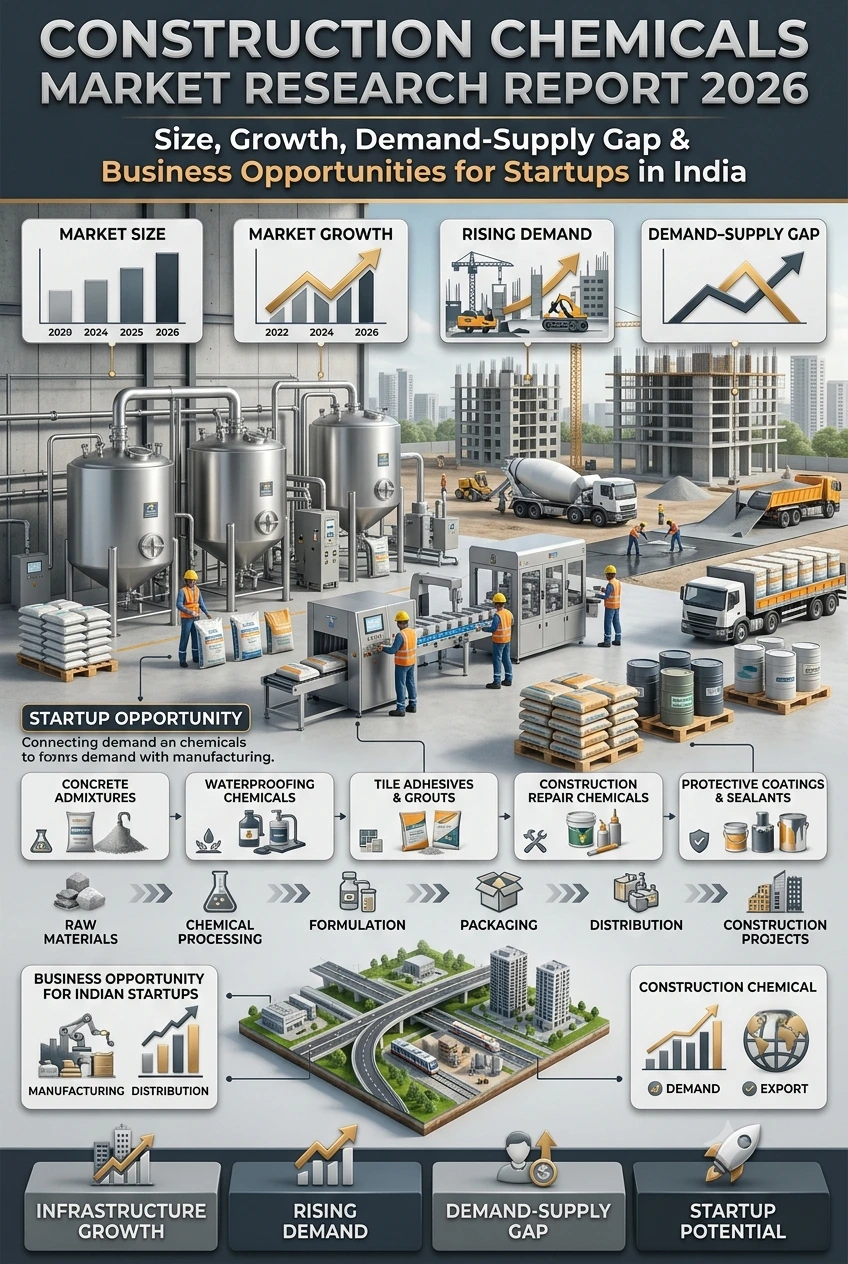
Market Segmentation
By Product Type
- Concrete admixtures (plasticizers, superplasticizers, accelerators, retarders)
- Waterproofing chemicals (membranes, coatings, integral systems)
- Adhesives and sealants (tile adhesives, structural adhesives, joint sealants)
- Repair and rehabilitation chemicals
- Flooring compounds (epoxy, polyurethane, self-levelling)
- Grouts (cementitious and epoxy)
- Protective and decorative coatings
By Application
- Residential construction
- Commercial construction (offices, retail, hospitality)
- Industrial construction (factories, warehouses)
- Infrastructure (roads, bridges, metros, tunnels, dams)
- Repair and rehabilitation of existing structures
By End User
- Real estate developers
- Infrastructure EPC contractors
- Government construction/PWD projects
- Individual homeowners (retail/DIY segment, dominated by Pidilite’s Dr. Fixit brand)
Key Growth Drivers
1. Continuing investment in infrastructure. Multi-year demand visibility for high performance admixtures, waterproofing, and repair chemicals exists with the National Infrastructure Pipeline, along with investment in metro, highway and railway infrastructure.
2. Ready-mix concrete (RMC) penetration beyond Tier-1 cities. As RMC adoption spreads to Tier-2 and Tier-3 cities, it creates sustained demand for admixtures and dosing technologies that were previously used mainly in metro construction.
3. Increase of chemical use intensity per square foot. As the number of developments continues to grow, developers have begun to place requirements for tile adhesives, epoxy grouts, and advanced waterproofing techniques, in addition to growth in the number of developments.
4. Construction trends towards green & sustainable construction. There are new sub-categories in premium construction materials like low- VOC, nano-enhanced waterproofing, self-healing concrete additives that are developing high margin products.
5. Commercial real estate and Grade A office growth. High specification floor, coating and waterproofing systems are expected to see significant growth in the Grade A office market in top cities in India through 2030 driven by the growth of the demand.
6. Category consolidation and awareness through M&A. The significant acquisitions made by bigger companies (Saint-Gobain/Fosroc, UltraTech/Wonder WallCare, Thermax/Buildtech) are helping the brandisation of the category and indirect enlargement of the addressable market for the smaller regional players.
Related Article: How Building Materials Suppliers Are Shaping the Future of Sustainable Construction
Challenges and Restraints
- Raw material price volatility. Many construction chemicals rely on petrochemical-derived polymers and resins, exposing manufacturers to crude oil and specialty chemical price swings.
- Competition from unorganised/local players. Whereas in other segments, such as basic sealants and grouting, there is a lot of competition from unorganised local manufacturers and they are beating branded entities on price.
- Application know-how dependency. Correct application is needed to get construction chemicals to work and manufacturers need to spend on training contractors and technical support, which increases go to market costs.
- Quality perception and BIS compliance. Building trust among a new brand takes time and investment and requires to demonstrate the quality of a product consistently, and even more so, with BIS certification.
- Logistics and shelf-life sensitivity: The storage and shelf-life requirements of certain product categories (particularly the two-component and cementitious systems) can be a distribution economic constraint for smaller regional manufacturers.
Competitive Landscape
While major global brands dominate the India construction chemicals market, the overall market is truly a fragmented one, as the top 5 companies are expected to account for less than 20 per cent of the market share in some industry estimates. Pidilite continues to be the leading Indian-origin product in the waterproofing and adhesives market, especially in the retail/DIY market, under its Dr. Fixit and Roff brands, with the global majors (Sika, Saint-Gobain/Fosroc, BASF/MBCC, Mapei) primarily competing in the higher-specification infrastructure/commercial market.
Recent activity in the M&A market (Saint-Gobain acquired Fosroc, UltraTech acquired Wonder WallCare, Ramco Cements new “Hard Worker” brand, Thermax acquired Buildtech) reinforces the idea that even old boy establishment companies outside of construction chemicals have an interest in this category, and a great validation to it for new entrants with a good pedigree and capital.
Construction Chemicals Manufacturing: Business Opportunity for Startups and MSMEs
1. Regional waterproofing and tile adhesive production facility. A niche shop that targets a particular region or state and has to offer a better price and service compared to the national thinly spread brands – this is the format that was followed by a number of successful regional Indian producers.
2. Production of concrete admixture in RMC plants. With the increasing penetration of ready mixed concrete in Tier 2/3 cities, the suppliers of admixture, who are close to the RMC plant clusters, can access this market, which is not easily captured by national suppliers due to logistics costs.
3. Manufacturing under other companies’ brand names. Some national and international manufacturers use others to formulate and package certain product lines – a way to dip your toes into a lower risk area of brand.
4. Specialty/niche product manufacturing. Products such as epoxy flooring, structural repair mortars, and corrosion inhibitors have technical differentiation and high margins, and are appropriate for an entrepreneur with chemical engineering background who is willing to invest in R&D and technical service capacity.
5. Retail/DIY-focused product lines. Smaller-pack retail construction chemical products such as waterproofing compounds, adhesives, sealants are another different, less EPC-contractor dependent, go-to-market approach, following Pidilite’s lead.
Assumption flag: The margin/ investment levels for construction chemicals manufacturing are widely different depending on the product category: For example, the margin and investment levels for the manufacture of construction chemicals for protective coatings are generally higher than those used in the manufacture of construction chemicals for admixtures or epoxy flooring systems. NPCS prepares detailed and bankable Project Reports in your target product category and region with category specific lists of machinery, raw material sourcing plans and location specific financial projections.
Your investment deserves the right opportunity
How NPCS Supports Entrepreneurs Entering This Space
For any businessman who is considering an endeavor in the manufacturing of construction chemicals, the first step is to have a properly prepared Detailed Project Report (DPR) that covers the plant capacity, formulation, selection of machinery, raw material procurement, manpower planning, project cost and financial feasibility of the specific product category and market.
About NPCS (Niir Project Consultancy Services)
Founded in 1994, NPCS is a New Delhi based industrial consultancy and an ISO 9001:2015 certified organisation with more than 30 years of experience in techno-economic and project consultancy. In the past 30 years, NPCS has published over 150,000 project reports and profiles in 85 countries in virtually every manufacturing and process industry, including construction chemicals, building materials and specialty polymer formulations.
NPCS works across three seamlessly integrated platforms:
- niir.org — the primary repository of industry-specific Detailed Project Reports, business plans, and techno-economic feasibility studies
- entrepreneurindia.co — market research, project profiles, and manufacturing business opportunity content aimed at entrepreneurs and MSMEs
- npcsblog.com — industry insight, trend analysis, and manufacturing sector commentary
NPCS’ primary contributions to a construction chemicals business are:
- Detailed Project Reports (DPRs) including plant capacity and machine specifications and Layouts
- Techno-economic feasibility studies including BIS compliance and certification guidance
- The financial modelling includes the project cost, profitability analysis, ROI, and break-even analysis.
- Raw material and market evaluation specific to Indian Regional markets and exportability
- Support documents in respect of MSME loan application, subsidy scheme and bank funding requirements etc.
A feasibility study of this industry is available for download on niir.org and entrepreneurindia.co and is available in different categories and regions for customisation, as well.
Government and Institutional Reference Links
- Ministry of Housing & Urban Affairs
- Ministry of Micro, Small and Medium Enterprises (MSME)
- Development Commissioner, MSME (DCMSME)
- Bureau of Indian Standards (BIS)
- National Infrastructure Pipeline / Department of Economic Affairs
- Department for Promotion of Industry and Internal Trade (DPIIT)
- Press Information Bureau (PIB), Government of India
- Startup India
- Invest India (National Investment Promotion and Facilitation Agency)
- Make in India
Entrepreneurs are advised to verify the latest BIS specifications, PMAY and infrastructure scheme guidelines, and MSME subsidy norms directly on these portals, as standards and provisions are periodically revised.
Conclusion
Construction chemicals sit at an unparalleled place in the Indian manufacturing industry: a rapidly expanding, fragmented, and largely untapped market, sitting on a massive infrastructure investment cycle in the nation’s history. There is no single player with a significant market share and the demand growth is highest in Tier-2/Tier-3 cities where national brands have not penetrated the market well – thus the opportunity for a well-positioned regional/ category player is real and not theoretical.
Construction chemicals are a unique category with supercharged growth, high fragmentation and a long-term demand from an infrastructure and urbanisation cycle that is continuing in India, and for entrepreneurs and MSMEs considering investments in the specialty chemical manufacturing business.