
A feasibility-led look at where e-commerce demand meets sustainability in Indian packaging.
Any online order, product on a shelf, and shipment requires packaging, making paper and packaging business ideas always in demand. As e-commerce grows and plastic faces pressure, demand for paper-based and sustainable packaging is on the rise. For a first-time founder, that shift is a rare combination of rising volume and regulatory preference.
The article will explore the sector through the lens of a project consultant, weighing demand drivers, viable schemes, and 5 possible manufacturing routes, and trade-opening opportunities and successful Indian success stories.
Why Paper and Packaging Demand Keeps Rising
E-Commerce and Retail Fuel Growth
Packaging demand follows economic activity, and with retail and online sales growing, orders occur constantly, making for a steady, recurring revenue source for a well-run unit rather than a one-time sale.
The push against single-use plastic also drives demand for paper-based packaging. A founder who can supply sustainable packaging benefits from both the e-commerce boom and the green shift.
Sustainability Opens Premium Niches
Buyers are increasingly seeking recyclable and biodegradable packaging, creating room for value-added products. Consequently, a producer of eco-friendly packaging enjoys better margins and loyal buyers. Sector guidance through the Ministry of MSME and Central Pollution Control Board can help align with the changing norms.
Government Policies and Incentives
Support is primarily through MSME and cluster schemes. The Ministry of MSME backs small manufacturers by encouraging credit and cluster development, and Make in India promotes domestic manufacturing, lowering barriers for new units.
Founders should register on Udyam for collateral-free credit and preferential lending. Plastic-waste regulations from the Central Pollution Control Board benefit paper alternatives, supporting demand. State support also aids; for example, Uttar Pradesh’s MSME and export promotion portal aids small manufacturers with facilitation and incentives.
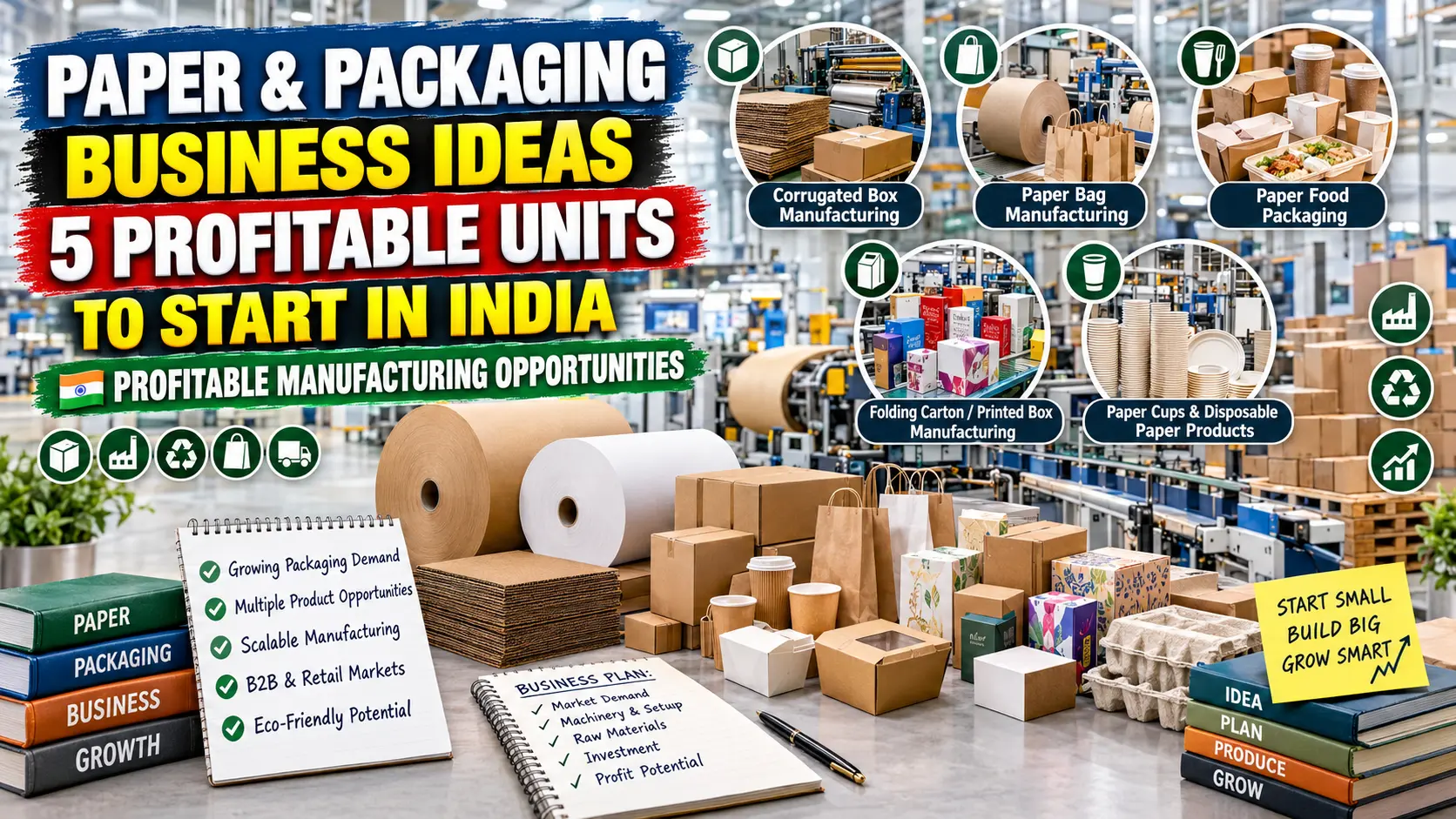
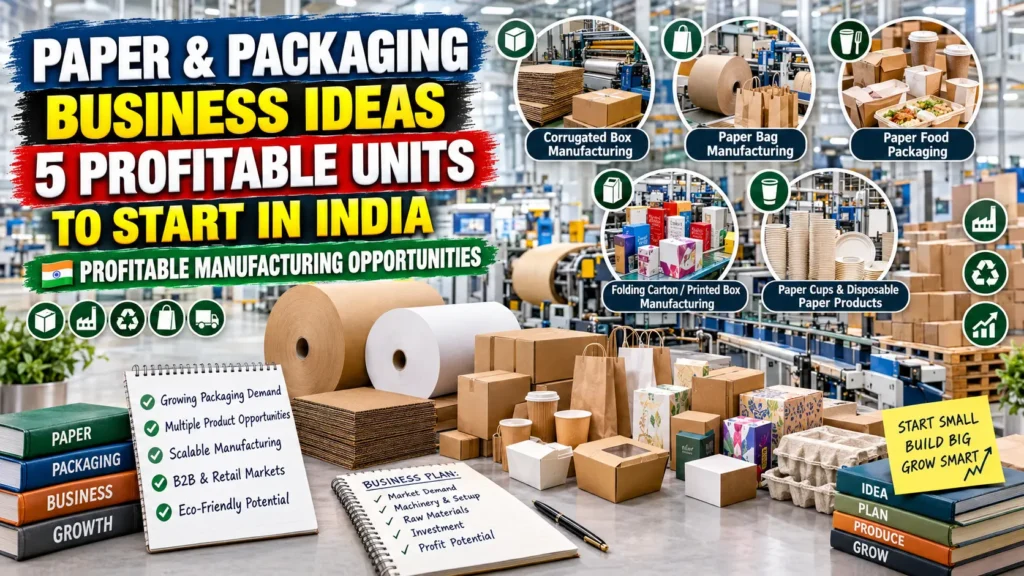
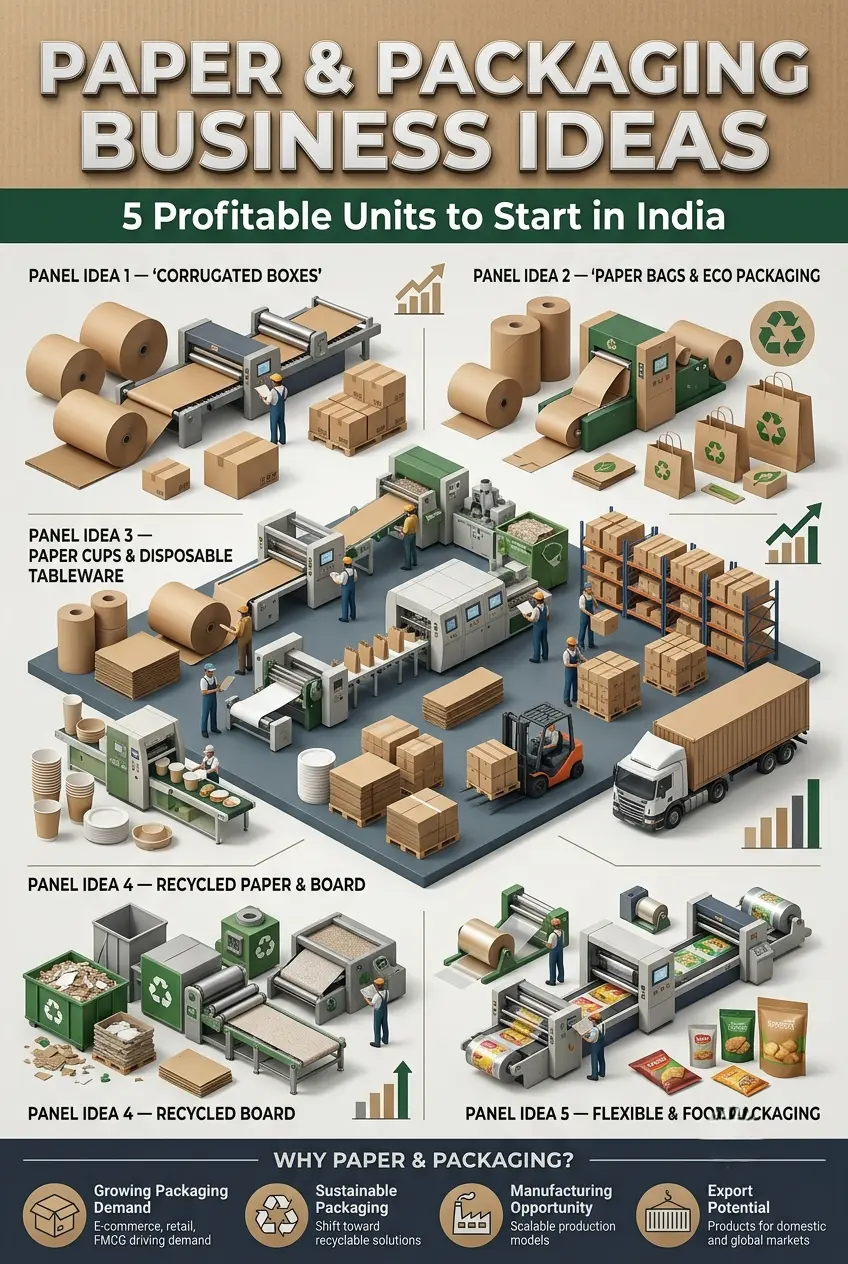
5 Paper and Packaging Business Ideas for Startups
Idea 1 — Corrugated Boxes Unit
Corrugated boxes form the backbone of shipping, with demand rising with each e-commerce order. This unit benefits from the constant reordering by manufacturers and online sellers. A founder can begin with standard sizes and add custom printing. Consistent strength and dimensions help secure buyer trust, so quality control is crucial. Local supply reduces delivery and freight costs, giving a new unit an edge. Furthermore, branded and printed boxes command higher margins. A corrugated box unit that provides reliable strength and printing capability can grow steadily alongside the expanding retail and online economy.
Idea 2 — Paper Bags and Eco-Friendly Packaging
Paper bags and biodegradable packaging enjoy rising demand as more places ban plastic. This trend benefits the founder who can supply quality paper bags. Starting with common sizes builds volume, while custom-printed bags add margin. Additionally, food-grade and premium packaging can access higher-value markets. Local manufacturing competes on cost and delivery. A unit that can offer strength, design, and eco-credentials can build strong demand across retail, food, and branded segments.
Idea 3 — Paper Cups and Disposable Tableware
Paper cups, plates, and disposable tableware cater to a vast food and hospitality market. As restrictions on plastic disposables grow, paper alternatives see strong, policy-driven demand. A founder who can manufacture these products benefits from constant reordering from caterers, cafes, and events. Food-safe quality and consistent supply win contracts. Starting with standard products builds volume, while custom branding adds margin. Furthermore, institutional and event demand provides steady bulk orders. Local manufacturing shortens delivery and lowers cost. A disposable tableware unit that maintains food-safe standards and reliable supply can grow steadily across the expanding food-service sector.
Idea 4 — Recycled Paper and Board
Recycling waste into board and packaging material benefits manufacturers seeking greener inputs. With abundant and cost-effective raw material, margins are stable. Policy pushes for recycled content boost demand. A founder can benefit from both cost advantage and green positioning. The output feeds box, carton, and packaging makers, providing a wide customer base. Additionally, institutional buyers increasingly require recycled feedstock, opening steady contracts. A recycled paper and board unit turns an abundant waste stream into a profitable, purpose-driven business that aligns with the sector’s sustainable future.
Idea 5 — Flexible and Food Packaging
Food and consumer brands need attractive, safe packaging for pouches, wraps, and cartons. With constant new brands and products launching, demand grows. A founder should focus on print quality and food-safe standards, as these win contracts. Starting with a defined segment builds volume, while custom and premium packaging adds margin. Additionally, sustainable and recyclable materials attract premium buyers. Local supply competes on cost and delivery time. A packaging unit that combines quality, food safety, and responsible materials can grow steadily alongside the fast-expanding retail and food economy, building durable brand relationships.
Import–Export Opportunity Analysis
Trade patterns favor capable manufacturers. India imports certain specialty packaging materials, so a reliable local producer can substitute that supply. At the same time, Indian packaging products find buyers abroad, giving founders a two-way opportunity.
Export readiness depends on consistent quality and compliance and guidance from DGFT helps founders align early. Consequently, a unit designed for both substitution and export builds resilience. When domestic demand dips, overseas orders help fill the gap, steadying cash flow through the cycle.
Indian MSME Success Stories Worth Studying
Many regional corrugated box makers grew into substantial suppliers by serving e-commerce and FMCG clients reliably. Their steady, quality-led growth shows how recurring demand compounds. The lesson is that dependable supply builds durable businesses.
Several eco-packaging MSMEs scaled quickly by reading the plastic-ban shift early and offering compliant alternatives. Similarly, recycled-board units built strong positions by combining cost advantage with sustainability. For new founders, the shared message is clear: align with policy trends, deliver consistent quality, and grow distribution patiently.
About NPCS
We at Niir Project Consultancy Services (NPCS) provide professional consulting for the preparation of Market Survey cum Detailed Techno-Economic Feasibility Reports (DPRs) for setting up new industries or businesses. Our reports include detailed manufacturing processes, market research and demand analysis, process flow diagrams, product mix and capacity planning, machinery and raw material details, and complete project financials with profitability analysis. Our objective is to help entrepreneurs evaluate feasibility, profitability, and long-term scalability before investing.
NPCS has published a comprehensive printed reference book on paper and packaging, covering technology, market analysis, investment parameters, and manufacturing processes in depth — the printed book: The Complete Technology Book on Pulp & Paper Industries
For a detailed techno-economic Project Report on setting up a manufacturing business in this sector — including plant economics, machinery lists, financial projections, and applicable government incentives — the NPCS Project Report: Explore the Paper & Paper Products Guide
Conclusion
Paper and packaging reward founders who ride both e-commerce growth and the shift toward sustainability. Demand is broad and recurring, policy favours paper alternatives, and exports add stability. Therefore, the winners are those who pick a focused product, master quality, and build distribution steadily. A detailed feasibility report turns that plan into a fundable, bankable reality.
Your Investment Deserves the Right Opportunity
Every serious investment begins with choosing the right sector and the right business model. With hundreds of industrial opportunities available across India’s manufacturing and clean-energy landscape, making the most informed choice is critical. NPCS Startup Selector tool helps entrepreneurs, MSMEs, and investors identify the most suitable business opportunities based on their investment capacity, location, and interests — so your capital is directed toward a venture with the strongest fit and potential. Explore your best-fit business opportunity today.