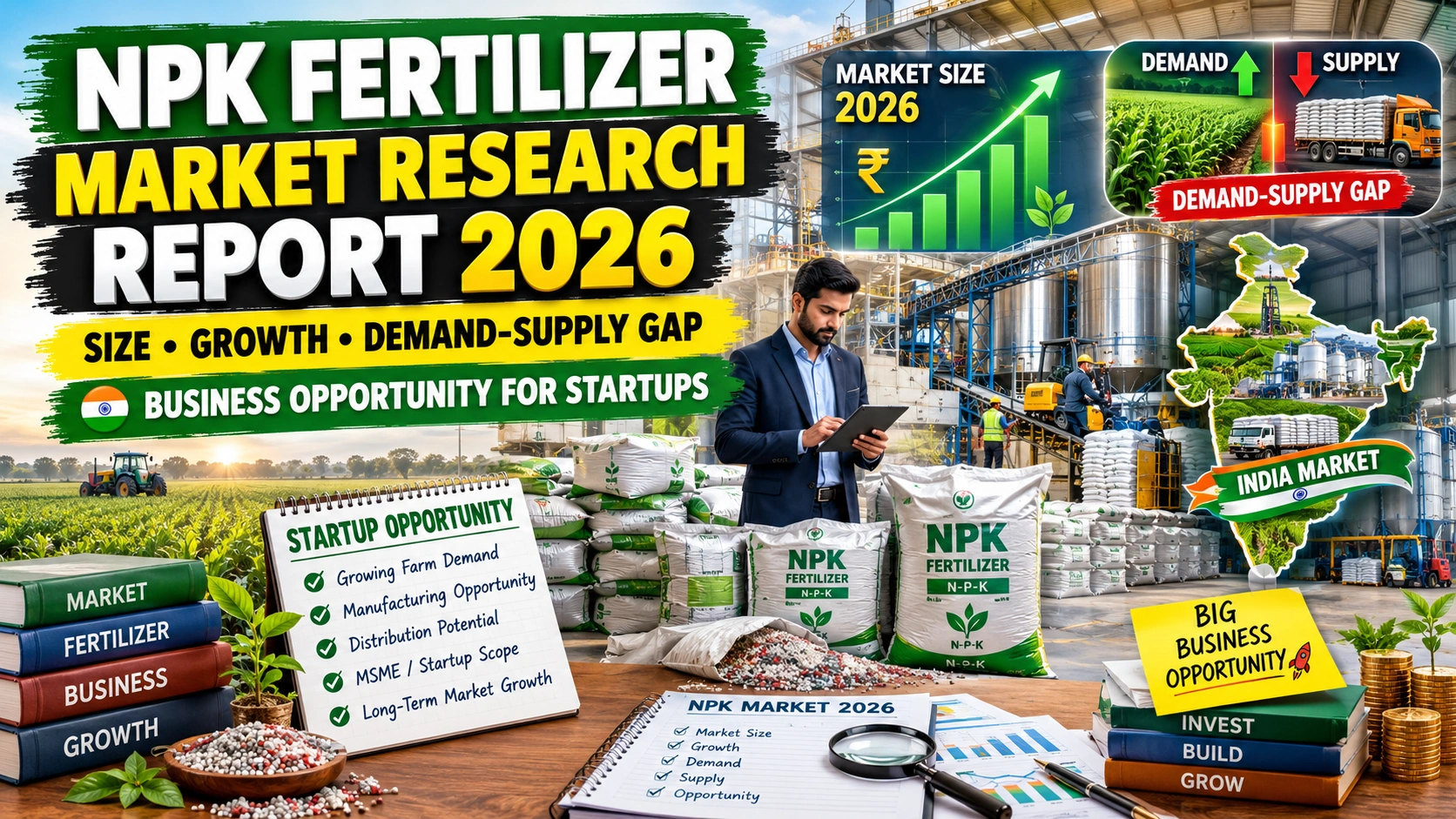

NPK Fertilizer Manufacturing Business in India
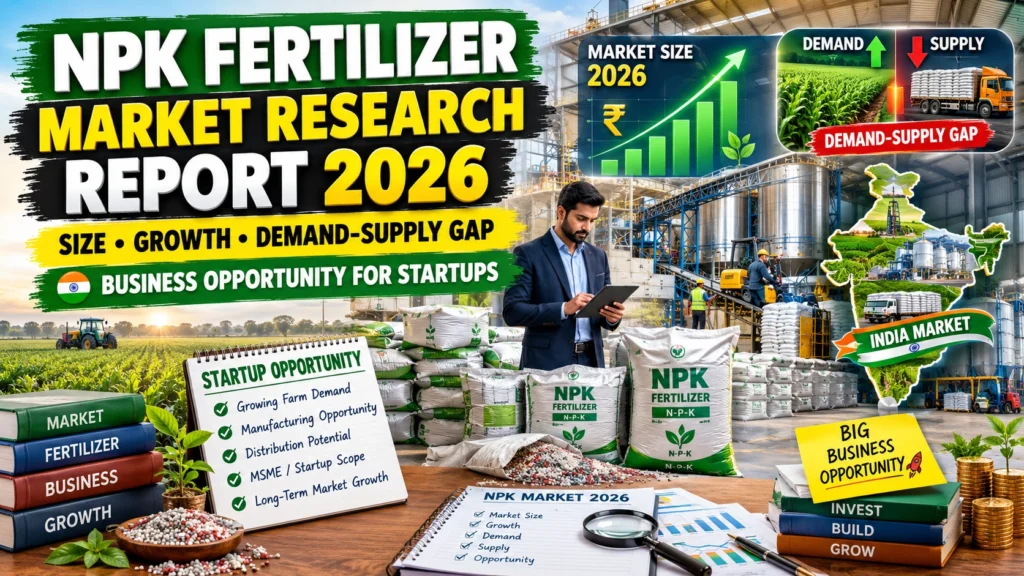
Government data, certain of which is India-specific, is clear: NPK fertilizer production rose from 165.15 lakh tonnes in 2014-15 to 220.69 lakh tonnes in 2024-25, while consumption increased even more, from 255.76 lakh tonnes to 329.28 lakh tonnes over the same period. It’s a growing, growing India-made to India-farmers gap that’s being filled by imports of finished fertilizer and even more importantly, imports of raw material such as phosphoric acid, phosphate rock, and potash. For an entrepreneur, it is as near as manufacturing can get to guaranteed, policy supported demand.
What Is NPK Fertilizer?
NPK is a complex or compound fertilizer that includes the three primary plant nutrients—nitrogen (N), phosphorus (P), and potassium (K)—in one granulated product, which is usually assigned a ratio (such as 10-26-26, 12-32-16, 20-20-0) that shows the percentage of each nutrient by weight. NPK complex fertilizers contain all three nutrients together which provides balanced nutrition and reduces the wastage of nutrients compared to separately applying the single nutrient fertilizers, making them more convenient to use than straight fertilizers (urea for nitrogen alone, DAP for nitrogen-phosphorus, MOP for potassium alone).
There are two major ways in which NPK fertilizers are produced:
- Granulation/complex fertilizer production – mixing the raw materials (ammonia, phosphoric acid, potash and intermediates) into a compound fertilizer by chemical reaction and granulation and forming a uniform compound fertilizer product.
- Bulk blending – a lower capital intensity production process that involves no chemical reaction, but physically blends granular fertilizers like urea, DAP, MOP in the required proportions.
India’s fertilizer policy is also increasingly moving towards customised and specialty NPK grades such as water-soluble fertilizers for fertigation/drip irrigation, micronutrient fortified formulations and controlled release fertilizers, which are in line with precision agriculture nutritional programing.
View Full Project Details: NPK Fertilizers Manufacturing Project Report
India NPK Fertilizer Market Size and Growth
The India fertilizer market is estimated to be valued at USD 11.35–25.30 billion (2025-26) with most estimates falling in the range of USD 14.9 billion to USD 34.3 billion by 2031-2035 at average CAGRs of 3.8% to 6.6%. Chemical fertilizers, as a group, make up about 83% of the total product demand in India up to 2025 in India, with NPK/complex fertilizers being the major part of the market, followed by urea and DAP.
Note on figures: India’s fertilizer market is generally reported as the aggregate or in total, encompassing urea, DAP, MOP, NPK complexes and specialty grades, rather than as an NPK-only number and as such can differ significantly between sources. NPCS can provide a customized techno-economic feasibility study based on the specific NPK grade (complex/granulated, bulk-blended, water-soluble) and capacity (investor-grade numbers) required.
India’s Structural Production-Consumption Gap
The National NPK fertilizer production increased from 165.15 lakh tonnes in 2014-15 to 220.69 lakh tonnes in 2024-25, while the consumption increased to 329.28 lakh tonnes during the same period — a higher rate of growth over the years which has actually increased the absolute gap. This deficit is filled by importing finished NPK product, and near complete reliance on imported potash (India has almost no commercial potash reserves) and a high reliance on imported phosphate rock and phosphoric acid for the production of phosphatic fertilizers.
Policy Tailwinds
1. Nutrient Based Subsidy (NBS) framework reform: The NBS framework was reformed in 2024 with a nutrient-centric approach to calculating subsidy, explains the increase by 23% in complex fertilizer sales in 2024 kharif season due to higher prices for the NPK blends, which prompted the farmers to switch from urea and straight N.
2. Increase in NBS budgetary outlay: The Nutrient Based Subsidy window budget rose from ₹79,500 crore (2023-24) to ₹87,500 crore (2024-25) with the Department of Fertilizers getting an estimated allotment of ₹1.71 lakh crore in FY2026-27, which has made it easier for fertiliser manufacturers such as IFFCO and Coromandel to increase blending capacity by 35%.
3. New specifications under the Fertilizer Control Order (FCO): Better quality specifications for the micronutrient levels in NPK grades are compelling manufacturers to produce high-end, micronutrient fortified fertilizers and encouraging foreign companies to come up with specialty products.
4. Pradhan Mantri Krishi Sinchayee Yojana (PMKSY) fertigation support: Government outlays exceeding ₹21,900 crore have expanded micro-irrigation coverage to over 95 lakh hectares, directly driving demand for water-soluble NPK grades compatible with drip and sprinkler systems.
5. Indigenous water-soluble fertilizer technology: This is a significant step towards reducing the dependency on specialty fertilizers, where India is still importing, and could make the country a net exporter of the technology, after all the technology was completed by the Ministry of Mines in August 2025 with indigenous raw materials.
Get Detailed Insights from This Book: Get Detailed Insights from This Book
India Demand-Supply Gap: NPK Fertilizer
| Parameter | Current Position (2024-25, per Economic Survey 2025-26) |
| Domestic NPK production | 220.69 lakh tonnes (up from 165.15 lakh tonnes in 2014-15) |
| Domestic NPK consumption | 329.28 lakh tonnes (up from 255.76 lakh tonnes in 2014-15) |
| Production-consumption gap | Roughly 108.6 lakh tonnes — met through finished-product imports and imported raw material for domestic granulation |
| Raw material import dependence | Near-total dependence on imported potash (India has minimal domestic reserves); significant dependence on imported phosphate rock and phosphoric acid |
| Current stock buffer | As of March 2026, India held approximately 48.38 LMT of NPKS stock alongside 53.08 LMT urea, 21.80 LMT DAP, and 7.98 LMT MOP — reflecting active government management of the supply gap through strategic stocking |
| Nature of the gap | A structural, widening production-consumption gap, driven both by finished-product shortfall and by India’s fundamental lack of domestic potash reserves and limited phosphate rock resources |
| Opportunity for new entrants | Concentrated in granulation/blending capacity expansion (converting imported raw materials into finished NPK product domestically), and in the specialty/water-soluble segment where India is actively reducing import dependence |
Reading the gap: Unlike categories where the constraint is manufacturing know-how or capacity, NPK fertilizer in India faces a genuine raw material resource constraint — the country simply doesn’t have significant domestic potash reserves, and its phosphate rock resources are limited. That means the most realistic opportunity for new entrants isn’t primary raw material extraction, but capacity in granulation, blending, and specialty formulation — converting imported intermediates into finished, subsidy-eligible, farmer-ready product, and increasingly into higher-value specialty and water-soluble grades where India is building genuine import-substitution capability.
Major Indian NPK Fertilizer Manufacturers
| Company | Base/Region | Notes |
| Indian Farmers Fertiliser Cooperative Ltd. (IFFCO) | Multiple locations (world’s largest fertilizer cooperative) | Owned by 36,000+ member cooperatives; produces urea, DAP, NPK, and SSP; pioneering nano-fertilizer technology (Nano Urea, Nano DAP) with 47% YoY nano-fertilizer sales growth in 2024-25 |
| Coromandel International Ltd. (Murugappa Group) | Kakinada, Andhra Pradesh (and other locations) | India’s second-largest phosphatic fertilizer company; ~40% share in unique-grade fertiliser sales; expanded NPK granulation capacity by 7.5 lakh tonnes per annum (₹800 crore investment) to a total of 30 lakh tonnes at Kakinada |
| Chambal Fertilisers and Chemicals Ltd. (KK Birla Group) | Rajasthan (and other locations) | Among India’s largest fertilizer producers, primarily known for urea but with a diversified complex fertilizer portfolio |
| Gujarat Narmada Valley Fertilizers and Chemicals Ltd. (GNFC) | Gujarat | Government of Gujarat-promoted fertilizer and chemicals major |
| Gujarat State Fertilizers & Chemicals Ltd. (GSFC) | Gujarat | Major public sector fertilizer and chemicals producer with NPK/complex fertilizer capacity |
| Rashtriya Chemicals and Fertilizers Ltd. (RCFL) | Maharashtra | Government of India public sector fertilizer producer |
| National Fertilizers Ltd. (NFL) | Multiple locations | Public sector undertaking under the Ministry of Chemicals and Fertilizers |
| Deepak Fertilizers and Petrochemicals Corporation Ltd. (DFPCL) | Maharashtra | Known for water-soluble and customised specialty fertilizer blends |
| Paradeep Phosphates Ltd. (Zuari-Maroc Phosphates) | Odisha | Major Indian phosphatic and NPK fertilizer producer, recently listed |
| The Fertilisers and Chemicals Travancore Ltd. (FACT) | Kerala | Government-owned fertilizer and petrochemicals company, mainly serving South India |
Major International NPK Fertilizer Players
| Company | Country | Notes |
| Yara International ASA | Norway | Major global fertilizer company, among the top 5 global players by collective market share; investing in low-carbon fertilizer production technologies |
| ICL Group Ltd. | Israel | Major global specialty fertilizer and phosphate/potash company; building local India blending plants for water-soluble NPK grades |
| EuroChem Group | Switzerland | Major global fertilizer producer with integrated nitrogen, phosphate, and potash operations |
| Borealis AG | Austria | Major European fertilizer and chemicals producer, among the top global NPK players by market share |
| PhosAgro PJSC | Russia | Major global phosphate-based fertilizer producer |
| The Mosaic Company | United States | Major global phosphate and potash fertilizer producer |
| Nutrien Ltd. | Canada | World’s largest fertilizer company by production capacity, spanning nitrogen, phosphate, and potash |
| CF Industries Holdings, Inc. | United States | Major global nitrogen fertilizer producer |
| Haifa Negev Technologies Ltd. | Israel | Specialty and water-soluble fertilizer producer, building localised India blending operations |
| Sociedad Química y Minera de Chile (SQM) | Chile | Major global specialty plant nutrition and potassium nitrate producer |
Market Segmentation
By Nutrient Ratio/Grade
- Common bulk NPK grades (e.g., 10-26-26, 12-32-16, 20-20-0-13)
- Customised/fortified specialty grades (micronutrient-enhanced, per updated FCO norms)
- Water-soluble NPK (fertigation-compatible)
- Controlled-release/slow-release NPK (emerging, premium segment)
By Production Method
- Granulated complex fertilizer (chemical reaction-based)
- Bulk blended fertilizer (physical mixing of straight fertilizers)
By Application
- Field crops (cereals, pulses, oilseeds) — largest volume segment
- Horticulture and high-value crops (increasingly specialty/water-soluble grade)
- Plantation crops
By Distribution Channel
- Government/cooperative subsidy channel (majority of volume, NBS-linked)
- Private retail/agri-input dealer network
- Direct-to-farmer digital/precision agriculture platforms (emerging)
Key Growth Drivers
1. Nutrient-Based Subsidy reform correcting historical price distortion. The 2024 shift to nutrient-centric subsidy calculation has already driven a documented 23% jump in complex fertilizer purchases, directly benefiting NPK manufacturers over straight urea producers.
2. An increase in government allocation of fertilizer. Sustained financial support to the Department of Fertilizers has helped in providing a stable offtake for NPK and other subsidised categories of fertilizers during the estimated budget of ₹1.71 lakh crore for the FY2026-27.
3. Growth of micro-irrigation and fertigation. The water-soluble NPK grades are directly increasing the demand due to the investment in PMKSY, which is fit for use in drip and sprinkler irrigation systems.
4. Improved quality and micronutrient fortification standards. The revised Fertilizer Control Order regulations are driving up the market towards higher pricey and fortified NPK grades that will offer a better margin for manufacturers who can produce them.
5. Nano-fertilizer technology adoption. The IFFCO’s Nano Fertilizer Platform is transforming the economics and logistics of products, as shown by a 47% growth in sales from the previous year in 2024-25, indicating a true change in farmer adoption momentum.
6. Development of local special fertiliser technology. The Ministry of Mines successfully indigenous development of water-soluble fertilizer technology till 2025 is a definite step towards making India an exporter in the specialty segment and also reduce import dependency.
Related Article: How to Start a Gel-NPK Fertilizer Manufacturing Business in India
Challenges and Restraints
- Structural raw material import dependence. India’s near-total lack of domestic potash reserves and limited phosphate rock resources mean NPK manufacturers remain exposed to global potash and phosphate price volatility and supply chain disruption.
- Subsidy administration and working capital stress. Payment delays for fertilizer subsidy may generate huge working capital stress and result in higher cost of capital for smaller players as compared to the cash-rich, integrated players.
- Environmental norms compliance cost. The costs to be incurred by CPCs are pushing the smaller manufacturers towards attrition, providing an opportunity for the bigger manufacturers to acquire them.
- Regional adoption unevenness. Although the states with a double-digit adoption rate, such as Maharashtra and Gujarat, are using balanced/complex fertilizers, the belts which have more urea are adopting at a slower pace, causing regional variation in demand.
- Volatility of global fertilizer prices. Compared to other margin commodities, the prices of nitrogen, phosphate and potash are all tied to commodity and energy markets both nationally and internationally, and result in margin uncertainty for manufacturers.
Competitive Landscape
The NPK fertilizer industry in India is dominated by large private conglomerates (Coromandel International/Murugappa Group, Chambal Fertilisers/KK Birla Group, Deepak Fertilizers), a number of major cooperatives (IFFCO) and PSUs (NFL, RCFL, GSFC, GNFC, FACT), while specialty companies from abroad such as ICL Group, Yara, Haifa Negev are also becoming more active in India for blending operations to cater to the fertigation and water-soluble segment. With the updated FCO norms highlighting the move towards specialty/fortified grades, there is real potential for new players to emerge as blending capacity and specialty formulation in the region, as opposed to bidding for bulk commodity grade NPK to integrated players.
NPK Fertilizer Manufacturing: Business Opportunity for Startups and MSMEs
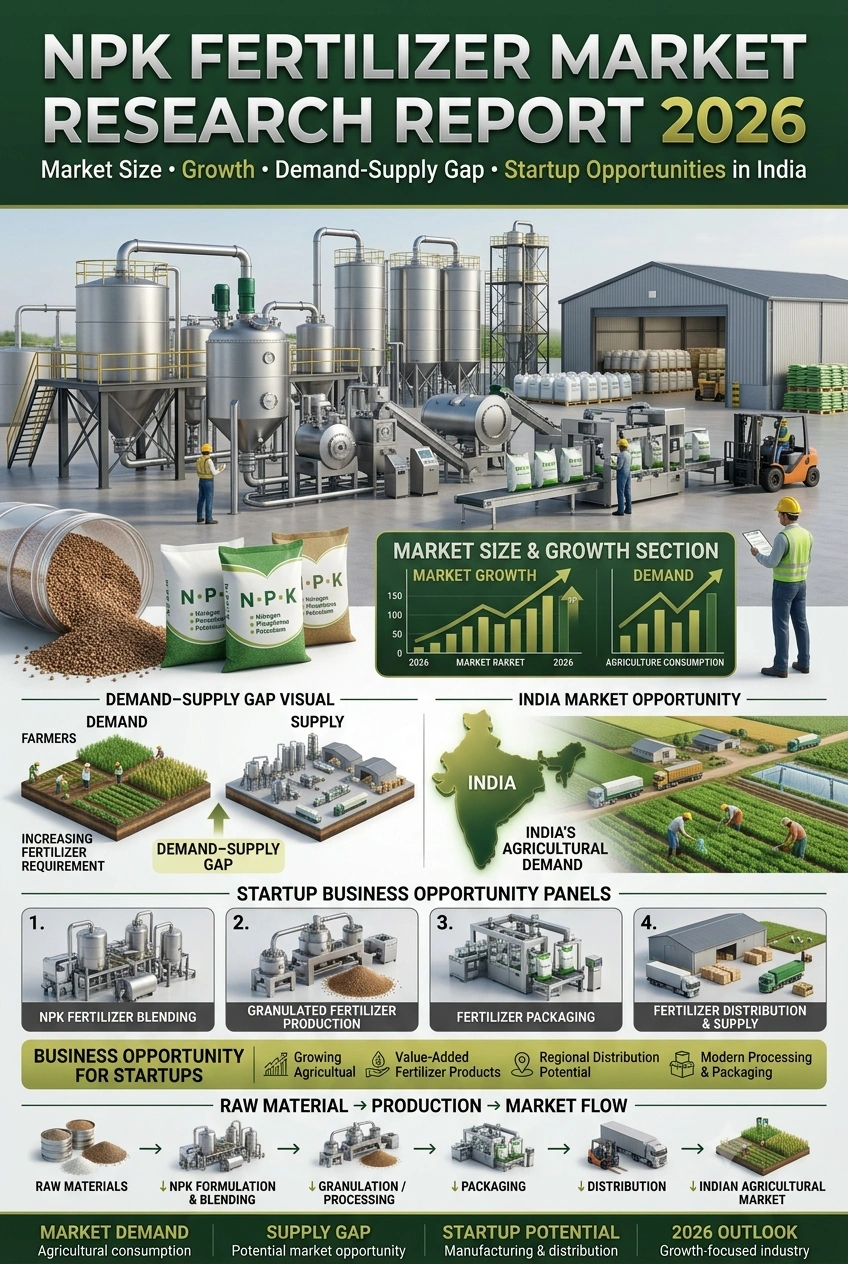
1. Regional bulk-blending unit. Lower capital intensity compared to full granulation, mixing of imported/domestically produced straight fertilizers (urea, DAP, MOP) into a region and crop specific NPK ratio for a local agricultural cluster.
2. Water soluble and fertigation friendly NPK production. In addition to the high value specialty segments, fertigation is one of the most technically challenging and rewarding segments for a new technically competent player with the proven savings of 30-40% nutrients and 20-25% yield.
3. Micronutrient-fortified NPK grades. The new quality requirements in the amended Fertilizer Control Order places a manufacturer in a position to offer higher quality retail products and also to be eligible for the subsidy as more stringent regulatory requirements begin to come into effect.
4. Customised/regional-crop-specific blends. Therefore, by conceptualizing NPK grades suitable to the soil and crop type of the region, rather than national averages, premium positioning can be achieved with forward-thinking farmers and agri-input dealers.
5. Contract granulation/toll manufacturing. When the entrepreneurs have technology to produce granules but have little or no brand, selling the contract manufacturing to the existing fertilizer brands which are facing capacity shortage will be a low market risk entry point to the business.
Note Assumption: Investment and margin for NPK fertilizer production will differ widely depending on manufacturing method (bulk blending versus full granulation) and product grade (commodity versus specialty/water soluble). NPCS prepares detailed Project Reports with the list of machines required in the project, with sourcing strategy for raw materials, and guidance on the eligibility for NB subsidisation based on the target capacity and grade of the project.
Stop guessing—choose the right business with confidence
How NPCS Supports Entrepreneurs Entering This Space
The first step for any entrepreneur looking at an NPK fertilizer manufacturing business is to create a detailed project report (DPR) that covers various aspects of the business such as plant capacity, selection of production process (blending or granulation), raw material sourcing, compliance to NBS/FCO regulations, manpower planning, project cost, and financial viability based on the selected grade and target market.
About NPCS (Niir Project Consultancy Services)
Founded in 1994, NPCS is an ISO 9001:2015 certified organization, based in New Delhi with more than 30 years of experience in techno-economic and project consultancy. In the last three decades, NPCS has disseminated over 150,000 project reports and profiles in 85 countries and across almost every manufacturing and process industry including manufacturing of fertilizers, agro-chemicals, agriculture input manufacturing etc.
NPCS has three integrated platforms.
- niir.org — the primary repository of industry-specific Detailed Project Reports, business plans, and techno-economic feasibility studies
- entrepreneurindia.co — market research, project profiles, and manufacturing business opportunity content aimed at entrepreneurs and MSMEs
- npcsblog.com — industry insight, trend analysis, and manufacturing sector commentary
NPCS key contributions to an NPK fertilizer venture are:
- In-depth Project Reports (DPRs) that include the plant capacity, machinery specifications and plant layout.
- Techno-economic Feasibility Studies, including NBS subsidy eligibility and FCO compliance guidance
- Financial modelling, project cost and profitability analysis, ROI and break-even calculations.
- Assessment of the raw material and the markets in agro-climatic zones of India
- Support documentation required for MSME loan applications, subsidy schemes, funding requirements of banks etc.
Entrepreneurs evaluating this sector can access relevant NPK fertilizer manufacturing profiles directly on niir.org and entrepreneurindia.co, or request a custom feasibility study scoped to a specific grade and region.
Government and Institutional Reference Links
- Ministry of Agriculture & Farmers Welfare
- Ministry of Jal Shakti — PMKSY
- Ministry of Micro, Small and Medium Enterprises (MSME)
- Development Commissioner, MSME (DCMSME)
- Central Pollution Control Board (CPCB)
- Press Information Bureau (PIB), Government of India
- Startup India
- Invest India (National Investment Promotion and Facilitation Agency)
Entrepreneurs are advised to verify the latest Nutrient-Based Subsidy rates, Fertilizer Control Order quality specifications, and MSME scheme guidelines directly on these portals, as regulatory provisions are periodically revised.
Conclusion
NPK fertilizer sits at the centre of one of India’s most policy-protected and demand-secure agricultural input categories — anchored to a documented, government-verified production-consumption gap of over 100 lakh tonnes, a recently reformed subsidy structure that directly favours balanced fertilizer adoption, and a growing specialty segment tied to India’s expanding micro-irrigation infrastructure. For entrepreneurs willing to work within the sector’s regulatory framework, this is a manufacturing category with genuine, quantified, and government-supported demand visibility.
For entrepreneurs and MSMEs evaluating agri-input manufacturing investments, NPK fertilizer production — particularly in regional blending and specialty/water-soluble formulation — offers a rare combination of guaranteed underlying demand and active government policy support.