
NPK Fertilizer Market Research Report 2026: Size, Growth, Demand-Supply Gap and Business Opportunity for Startups in India
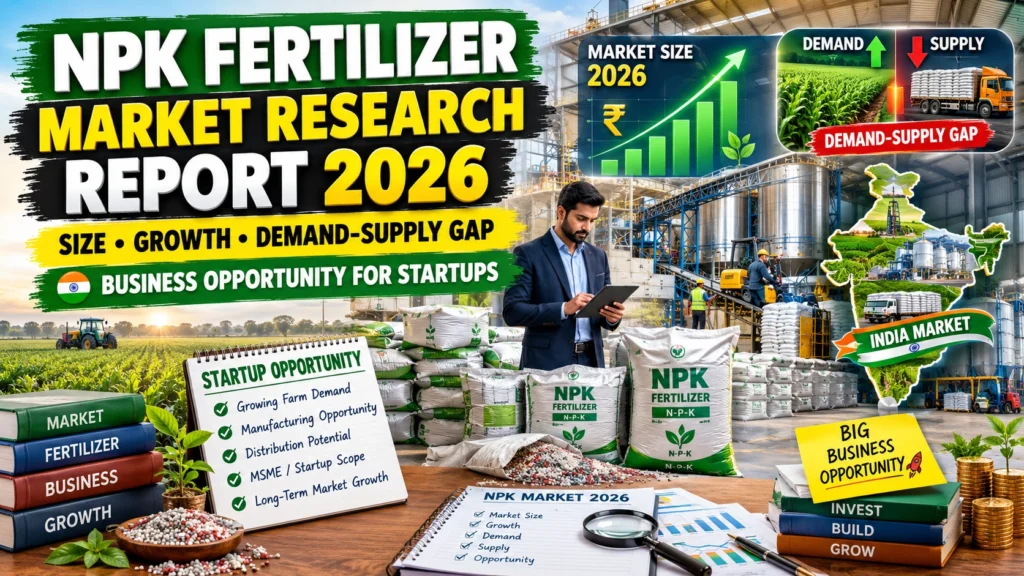
NPK Fertilizer Manufacturing Business in India Government data, certain of which is India-specific, is clear: NPK fertilizer production rose from 165.15 lakh tonnes in 2014-15 to 220.69 lakh tonnes in 2024-25, while consumption increased even more, from 255.76 lakh tonnes to 329.28 lakh tonnes over the same period. It’s a growing, growing India-made to India-farmers gap that’s being filled by imports of finished fertilizer and even more importantly, imports of raw material such as phosphoric acid, phosphate rock, and potash. For an entrepreneur, it is as near as manufacturing can get to guaranteed, policy supported demand. What Is NPK Fertilizer? NPK is a complex or compound fertilizer that includes the three primary plant nutrients—nitrogen (N), phosphorus (P), and potassium (K)—in one granulated product, which is usually assigned a ratio (such as 10-26-26, 12-32-16, 20-20-0) that shows the percentage of each nutrient by weight. NPK complex fertilizers contain all three nutrients together which provides balanced nutrition and reduces the wastage of nutrients compared to separately applying the single nutrient fertilizers, making them more convenient to use than straight fertilizers (urea for nitrogen alone, DAP for nitrogen-phosphorus, MOP for potassium alone). There are two major ways in which NPK fertilizers are produced: India’s fertilizer policy is also increasingly moving towards customised and specialty NPK grades such as water-soluble fertilizers for fertigation/drip irrigation, micronutrient fortified formulations and controlled release fertilizers, which are in line with precision agriculture nutritional programing. View Full Project Details: NPK Fertilizers Manufacturing Project Report India NPK Fertilizer Market Size and Growth The India fertilizer market is estimated to be valued at USD 11.35–25.30 billion (2025-26) with most estimates falling in the range of USD 14.9 billion to USD 34.3 billion by 2031-2035 at average CAGRs of 3.8% to 6.6%. Chemical fertilizers, as a group, make up about 83% of the total product demand in India up to 2025 in India, with NPK/complex fertilizers being the major part of the market, followed by urea and DAP. Note on figures: India’s fertilizer market is generally reported as the aggregate or in total, encompassing urea, DAP, MOP, NPK complexes and specialty grades, rather than as an NPK-only number and as such can differ significantly between sources. NPCS can provide a customized techno-economic feasibility study based on the specific NPK grade (complex/granulated, bulk-blended, water-soluble) and capacity (investor-grade numbers) required. India’s Structural Production-Consumption Gap The National NPK fertilizer production increased from 165.15 lakh tonnes in 2014-15 to 220.69 lakh tonnes in 2024-25, while the consumption increased to 329.28 lakh tonnes during the same period — a higher rate of growth over the years which has actually increased the absolute gap. This deficit is filled by importing finished NPK product, and near complete reliance on imported potash (India has almost no commercial potash reserves) and a high reliance on imported phosphate rock and phosphoric acid for the production of phosphatic fertilizers. Policy Tailwinds 1. Nutrient Based Subsidy (NBS) framework reform: The NBS framework was reformed in 2024 with a nutrient-centric approach to calculating subsidy, explains the increase by 23% in complex fertilizer sales in 2024 kharif season due to higher prices for the NPK blends, which prompted the farmers to switch from urea and straight N. 2. Increase in NBS budgetary outlay: The Nutrient Based Subsidy window budget rose from ₹79,500 crore (2023-24) to ₹87,500 crore (2024-25) with the Department of Fertilizers getting an estimated allotment of ₹1.71 lakh crore in FY2026-27, which has made it easier for fertiliser manufacturers such as IFFCO and Coromandel to increase blending capacity by 35%. 3. New specifications under the Fertilizer Control Order (FCO): Better quality specifications for the micronutrient levels in NPK grades are compelling manufacturers to produce high-end, micronutrient fortified fertilizers and encouraging foreign companies to come up with specialty products. 4. Pradhan Mantri Krishi Sinchayee Yojana (PMKSY) fertigation support: Government outlays exceeding ₹21,900 crore have expanded micro-irrigation coverage to over 95 lakh hectares, directly driving demand for water-soluble NPK grades compatible with drip and sprinkler systems. 5. Indigenous water-soluble fertilizer technology: This is a significant step towards reducing the dependency on specialty fertilizers, where India is still importing, and could make the country a net exporter of the technology, after all the technology was completed by the Ministry of Mines in August 2025 with indigenous raw materials. Get Detailed Insights from This Book: Get Detailed Insights from This Book India Demand-Supply Gap: NPK Fertilizer Parameter Current Position (2024-25, per Economic Survey 2025-26) Domestic NPK production 220.69 lakh tonnes (up from 165.15 lakh tonnes in 2014-15) Domestic NPK consumption 329.28 lakh tonnes (up from 255.76 lakh tonnes in 2014-15) Production-consumption gap Roughly 108.6 lakh tonnes — met through finished-product imports and imported raw material for domestic granulation Raw material import dependence Near-total dependence on imported potash (India has minimal domestic reserves); significant dependence on imported phosphate rock and phosphoric acid Current stock buffer As of March 2026, India held approximately 48.38 LMT of NPKS stock alongside 53.08 LMT urea, 21.80 LMT DAP, and 7.98 LMT MOP — reflecting active government management of the supply gap through strategic stocking Nature of the gap A structural, widening production-consumption gap, driven both by finished-product shortfall and by India’s fundamental lack of domestic potash reserves and limited phosphate rock resources Opportunity for new entrants Concentrated in granulation/blending capacity expansion (converting imported raw materials into finished NPK product domestically), and in the specialty/water-soluble segment where India is actively reducing import dependence Reading the gap: Unlike categories where the constraint is manufacturing know-how or capacity, NPK fertilizer in India faces a genuine raw material resource constraint — the country simply doesn’t have significant domestic potash reserves, and its phosphate rock resources are limited. That means the most realistic opportunity for new entrants isn’t primary raw material extraction, but capacity in granulation, blending, and specialty formulation — converting imported intermediates into finished, subsidy-eligible, farmer-ready product, and increasingly into higher-value specialty and water-soluble grades where India is building genuine import-substitution capability. Major Indian NPK Fertilizer Manufacturers Company Base/Region Notes Indian Farmers Fertiliser Cooperative Ltd. (IFFCO)