
Agri Warehouse Business in India
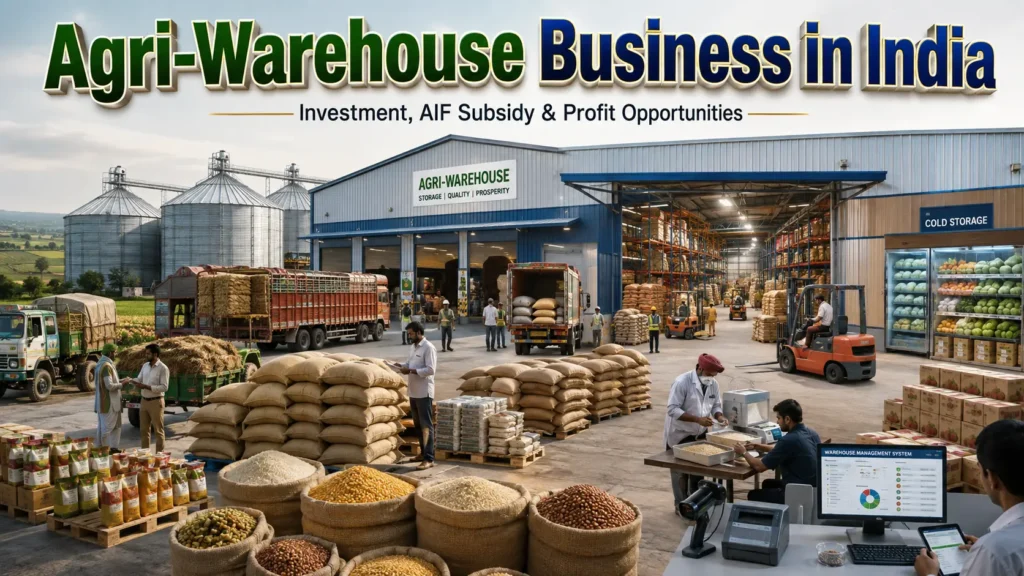
India wastes nearly 16% of its agricultural produce every year due to poor storage infrastructure. This gap is a huge business opportunity for entrepreneurs considering having high impact business ideas in the agri-sector. It is not only a logistics project, but a platform to integrate farmers, traders, processors & exporters in the Central India Agri-Warehouse and Commodity Trading Hub on a single ecosystem with Rs.50 Crore investment. The interesting rate on loans for qualified agri-infrastructure projects is paid by the Agriculture Infrastructure Fund (AIF) at 3%. The Warehouse Development and Regulatory Authority (WDRA) allows registered warehouses to issue a powerful financial tool called Negotiable Warehouse Receipts (NWRs), which can generate additional income for the hub operators.
Get Detailed Project Report (DPR): Cold Storage & Cold Chain Technology Guide
Why Central India Is the Right Location for This Business
Soybean and wheat, pulses and cotton are vast in number produced in Madhya Pradesh, Vidarbha region in Maharashtra and Chhattisgarh. However, infrastructure for local storage and trading is still very poorly developed. The Agmarknet portal offers district-wise available commodity data which reflects good volume of throughput but lack in storage capacity to match in these districts. A modern warehousing infrastructure created in advance will give the entrepreneur the first-mover advantage in an area where demand is outpacing supply.
Government Policies and Incentives Supporting Agri-Warehousing
Agriculture Infrastructure Fund (AIF): It is a fund that has been established with an interest subvention of 3% on loans upto Rs.2 Crore for eligible projects, backed by credit guarantee from CGTMSE. Pradhan Mantri Kisan Sampada Yojana (PMKSY) provides capital subsidy for the cold chain and storage projects ranging from 35% to 50% in general areas and SC/ST and NE areas respectively. The NABARD has long-term refinance for warehouse construction through its Rural Infrastructure Development Fund (RIDF).
The warehouse may also be registered as a warehouse under the WDRA, which would allow it to issue Negotiable Warehouse Receipts (NWRs) which would give the farmers a second source of income as they may pledge the stored commodities as collateral for loans.
Turn your budget into a successful business plan
Top Business Ideas Within the Agri-Warehouse and Trading Hub Model
Commodity Storage and Negotiable Warehouse Receipt (NWR) Services
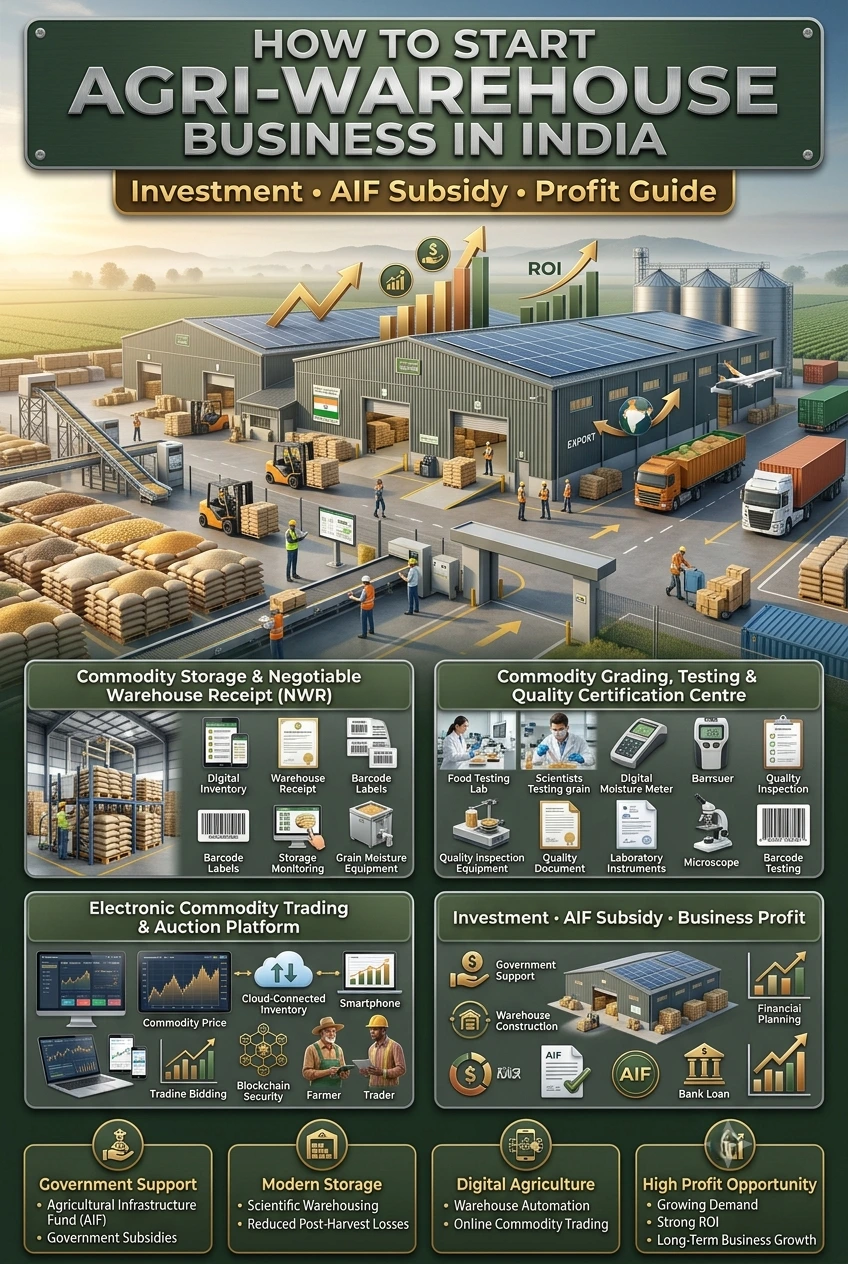
This business’s core is the large-scale commodity storage registered by the WDRA. NWR system allows the warehouse to issue receipts for the commodities stored in the warehouse. These receipts are accepted by the banks, and the farmers borrow against them, instead of selling the produce at distress prices after harvest. The warehouse charges the storage fee on a per quintal, per month basis, handling charges and quality certification charges. Commodity backed financing and price discovery is provided on the NCDEX (National Commodity and Derivatives Exchange) platform which can be directly accessed by the WDRA registered warehouses.
Commodity Grading, Testing, and Quality Certification Centre
An FSSAI approved testing laboratory and grading facility in the hub warehouse enables a business to take a charge for moisture testing, aflatoxin testing, protein content testing and separation of foreign material. Soybean meal exporters, rice millers and pulses traders will all need certified quality reports before they can move on to large transactions. The APEDA mandates certification of agri-products exports, and a set-up having its own NABL certified testing facility makes the service offering more attractive for export processors.
Electronic Commodity Trading and Auction Platform
The third option of high-value business ideas in the hub is registering as a sub-broker/affiliate with NCDEX or setting up an electronic auction platform for trading at the mandi level. Traditional mandis are still in existence in central India, where many farmers sell their produce at lesser prices. The hub can fill this gap by organizing electronic auctions where registered buyers will bid for lots stored in the warehouse. The platform charges a transaction fee, which is usually between 0.5% – 1% of the transaction amount. Monitor real time commodity prices, highlight the price discovery value to the farmers through the Agmarknet.
Related Article: Cold Storage, Cold Chain & Warehouse
Import-Export Opportunity Analysis
Some commodities are identified in Central India which have high export potential. The soybean meal is sold overseas in animal feed in Southeast Asian and European countries. Wheat and flour is exported to neighbouring countries, West Asia and Africa. APEDA helps to export agri-commodities and offers support for phytosanitary certificates. As an export consolidation service, a hub operator with APEDA registration will be able to bring together small lots from smallholder farmers into export ready shipments. Check for export documentation/IEC code from DGFT.
Indian MSME Success Stories in Agri-Warehousing
Arya.ag — Building India’s Agri-Finance Backbone
Chattanathan Devarajan and Prasanna Rao of Arya.ag, were able to address one of the most significant agri-problems in India, which is post-harvest financing, by leveraging Technology and Warehousing. The company developed an asset-light warehousing network in the rural areas of India, established digital NWRs, and linked the farmers to the institutional credit market at affordable rates. Arya.ag proved that agri-warehouse infrastructure coupled with fintech is a high return and scalable business. A key part of their business model was the integration with WDRA’s NWR framework.
Star Agri warehousing and Collateral Management Ltd
Initially, Star Agriwarehousing started with one warehouse in the state of Rajasthan and has now emerged as one of the largest collateral management companies in India. The company’s approach, which involved managing storage on the field at a client’s owned or rented warehouse, enabled it to grow without a significant capital expenditure. Today it has stocking of millions of metric tonnes in various states and is serving banks, NBFCs, traders, agri-processors etc. The lesson for new business owners: You may require third-party storage infrastructure, but not self-owned infrastructure, to achieve this reduces capital requirements.
Get Detailed Insights from This Book: The Complete Book on Cold Storage, Cold Chain & Warehouse (with Controlled Atmosphere Storage & Rural Godowns)
How NPCS Can Help You Build This Project
The Niir Project Consultancy Services (NPCS) aims to provide professional consulting for the preparation of Market Survey cum Detailed Techno-Economic Feasibility Reports (DPRs) for setting up of new industry/business. Our reports cover the detailed manufacturing process, market overview and demand study, process flow diagram, product mix and capacity planning, machinery details and raw material information, detailed financials of the project and profitability analysis. For detailed project report of agri-warehouse and commodity trading hub please visit www.niir.org.
Conclusion
The proposed Agri-Warehouse and Commodity Trading Hub in Central India is not just a Rs.50 Crore endeavour, it is a much-needed gap in the infrastructure and has been supported by substantial government funding, including AIF and PMKSY. The proposal of building Agri-Warehouse and Commodity Trading Hub in Central India is a Rs.50 Crore project, not only because of its need for funding, but it is also a huge gap in the infrastructure and generates revenue from multiple complementary streams of the business, which is due to the generous government support in the form of AIF and PMKSY.
Build an agri-logistics platform of its own by registering with WDRA and collaborating with NCDEX for commodity trading, and with APEDA for export facilitation.
Rs.50 Crore Agriculture Project — Key Parameters
| Parameter | Details |
| Total Project Investment | Rs.45–55 Crore |
| Storage Capacity (Target) | 50,000–1,00,000 Metric Tonnes |
| Key Government Scheme | Agriculture Infrastructure Fund (AIF), PMKSY |
| Interest Subvention Available | 3% under AIF on eligible loans |
| Capital Subsidy | 25–50% under PMKSY for cold chain/storage |
| Revenue Streams | Storage fees, NWR services, grading, trading platform, export facilitation |
| Expected Payback Period | 5–7 years |
| WDRA Registration Required | Yes — mandatory for NWR issuance |
Key References and Government Resources
- Agriculture Infrastructure Fund (AIF) — 3% interest subvention on agri-infrastructure loans, CGTMSE guarantee
- WDRA — Warehouse Development and Regulatory Authority — NWR issuance, warehouse registration, collateral management standards
- NCDEX — National Commodity and Derivatives Exchange — Commodity price discovery, futures trading, exchange-grade warehouse standards
- Agmarknet — Agricultural Marketing Information Network — Real-time mandi prices, commodity arrival data, district-level market intelligence
- MoFPI — Ministry of Food Processing Industries — PMKSY capital subsidy 35% for storage and cold chain infrastructure
- APEDA — Agri-commodity export facilitation, phytosanitary certificates, buyer connect
Frequently Asked Questions (FAQ)
What is a Negotiable Warehouse Receipt and why does it matter?
A Negotiable Warehouse Receipt (NWR) is a document issued by a WDRA-registered warehouse against stored commodities. Banks and NBFCs accept NWRs as collateral for short-term loans. This prevents farmer distress selling post-harvest. The WDRA portal manages NWR registration and provides the regulatory framework for issuance.
How does the Agriculture Infrastructure Fund (AIF) work?
Under AIF, eligible entities including agri-entrepreneurs and private companies can access loans with 3% interest subvention for up to 7 years. Credit guarantee is provided through CGTMSE, reducing collateral requirements. Apply through participating scheduled commercial banks — the AIF portal lists all participating banks.
How do I connect with NCDEX for commodity trading?
Visit NCDEX’s website to register as a sub-broker or affiliated warehouse. NCDEX provides price discovery and futures trading for agricultural commodities. WDRA-registered warehouses can offer NCDEX-grade storage, enabling farmers to pledge commodities against NCDEX contracts — a premium service that significantly increases storage appeal.
What is the realistic annual revenue for a Rs.50 Crore hub?
A well-run hub with 75,000 MT average occupancy at Rs.8–12 per quintal per month can generate Rs.7–11 Crore annually from storage alone. Adding grading, NWR facilitation, and trading platform fees can push total annual revenue to Rs.15–20 Crore. Track commodity market movements on Agmarknet for real-time demand planning.
Which commodities are most suitable for Central India?
Madhya Pradesh and adjacent states produce large volumes of soybean, wheat, chana, toor dal, maize, and cotton. Soybean is particularly high-value given its export potential. Use Agmarknet’s district-level arrival data to identify the highest-volume commodities in your target location before finalising the warehouse’s commodity focus.
What PMKSY subsidy is available for agri-storage?
The Ministry of Food Processing Industries’ PMKSY provides capital subsidy of 35% in general areas and 50% in SC/ST and NE regions on eligible storage infrastructure investment. Combined with the 3% interest subvention under AIF, the effective government support can offset 40 to 50% of the total agri-warehouse project cost.