
How to Start Floriculture Export Business in India: Investment, APEDA Support & Export Opportunities

Floriculture Export Business Floriculture – the cultivation, export and marketing of cut flowers, potted plants, dried flowers and floral products is one of the most underdeveloped agriculture export business ideas in India. Cultivated globally, the cut flower industry generates over $50 billion per year, with the Netherlands, Colombia, Kenya and Ethiopia as the leading producers. India has a small share in this global market considering the range of tropical climates, skilled agriculture labour and existing farming tradition of flower cultivation in the country. APEDA’s floriculture export promotion mandate and support from the National Horticulture Board for modern greenhouse cultivation are paving the way to a new era for Indian Floriculture entrepreneurs to enter into the international markets. Floriculture export is a high value, land intensive land-based business with good commercials for the entrepreneurs who have access to land in suitable agro climatic zones like Karnataka, Tamil Nadu, Himachal Pradesh, West Bengal and J&K. Why Floriculture Export Is a Premium Agricultural Opportunity Cut flower export is one of the highest valued agricultural enterprises in terms of value per square metre as it generates a turnover of ₹500 – ₹2,000 per square metre of land in well managed polyhouse cultivation versus the most commonly grown vegetable crops which generate a turnover of ₹50 – ₹200 per square metre on the same area. Floriculture is particularly appealing to farmers having less agricultural area and seeking to utilize their farm for the maximum agricultural exportable value per area. Year-round consumption is the driving force behind global demand for cut flowers; floral gifting, wedding decoration, hotel amenity, and corporate event decoration are year-round markets. India’s tropical and sub-tropical climate variety allows flowers to be produced throughout the year; which is in stark contrast to the European countries who are very reliant on costly heated greenhouses during the winter months. This natural season advantage coupled with low labour cost provides a structural competitiveness to Indian floriculture exporters as compared to the established exporters from Europe and South America. Explore 10,000+ business ideas aligned with your investment goals APEDA and Government Support for Floriculture Exporters The floriculture and floriculture products (cut flowers, cut foliage, dried flowers and potted plants) are in the mandate of the Agricultural and Processed Food Products Export Development Authority (APEDA). APEDA offers loans for market development, pack house, pre-cooling, modern greenhouse (polyhouse) and financial assistance for refrigerated transport. APEDA also arranges participation of exporters from India in the largest Flower trading platform in the world, Flora Holland auction at Aalsmeer. The National Horticulture Board (NHB) offers subsidy and financial assistance for the construction of polyhouse and greenhouse where 50% of the total eligible capital cost is eligible up to the limit of the scheme. For new floriculture entrepreneurs, a considerable portion of the investment is taken up by the investment support provided by NHB for the protected cultivation infrastructure. The Ministry of Agriculture and Farmers Welfare has the National Horticulture Mission and the Horticulture Mission for North East and Himalayan States under its wings, which gives extra impetus to floriculture development in specific areas with climate conditions conducive to high value cultivation of flowers. An important logistics element for the export of perishables such as flowers is the air cargo capacity and cost. The government’s efforts towards developing air cargo infrastructure at key airports and APEDA’s push for dedicated air cold chain capacity for the flower exporters are gradually making the flower export logistics economics more attractive. Improvements to cold chain logistics from the farm to the airport are provided by APEDA’s financial support for pre-cooling and refrigerated transportation facilities. The logistics support of APEDA is explained in detail on the APEDA portal. Business Ideas in Floriculture Export 1. Cut Rose Export from Polyhouse Cultivation Roses are the most traded cut flower in the world, representing more than 30% of cut flower trade. So, the modern roses cultivated in polyhouse of Karnataka (Bengaluru district) and Himachal Pradesh are already exported to the markets of the Gulf, European and Japanese countries. A 1-hectare rose growing polyhouse can yield 1,500 to 2,500 flowers, which can be converted into 1.5 to 2.5 million stems for export, with investment ranging from ₹80 lakh to ₹1.5 crore, covering the construction of the polyhouse, irrigation, growing structures and post-harvest handling. The cost of the construction of the polyhouse is 50% subsidized by NHB. The main markets include export to Dutch flower markets and to the markets for flowers in the Gulf. With proper cultivation management, profits from 1-ha of polyhouse can be up to ₹30 lakh to ₹60 lakh annually. Get Detailed Project Report (DPR): Cut Rose Flower (Floriculture) Manufacturing Project Report 2. Tropical and Exotic Flower Export Tropical flowers (anthurium, heliconia, bird of paradise, ginger flower, and tropical foliage) are exported to Japanese, European and American florists, who are looking for unique non-European flower varieties for high-quality floral arrangements. These varieties have natural climatic conditions in the tropical southern part of India and North East India. One of the most valuable opportunities is to export to Japanese flower markets, where exotic tropical flowers have a high value. The investment on tropical flower cultivation & export unit varies from ₹30 lakh to ₹80 lakh based on plant species and scale of the project. The main logistics needs are air freight to Japan and EU. 3. Dried and Preserved Flower Export Dried flowers, potpourri, silica-dried roses, preserved eucalyptus and dried decorative botanicals are in high demand in the retail market in Europe and North America, especially on the home décor and gift market. India is blessed with a tremendous biodiversity, which offers a remarkable source of dried flower products. The investment in drying infrastructure, preservation chemical processing, sorting, and packaging is estimated to be between ₹10 lakh and ₹30 lakh for a dried flower processing unit. Dried products have the advantage of a shelf life of 12-24 months, which removes the time constraint of fresh cut flowers by air freight. Effective channels of export include the e-commerce platforms and
How to Start Agri-Warehouse Business in India: Investment, AIF Subsidy & Profit Guide
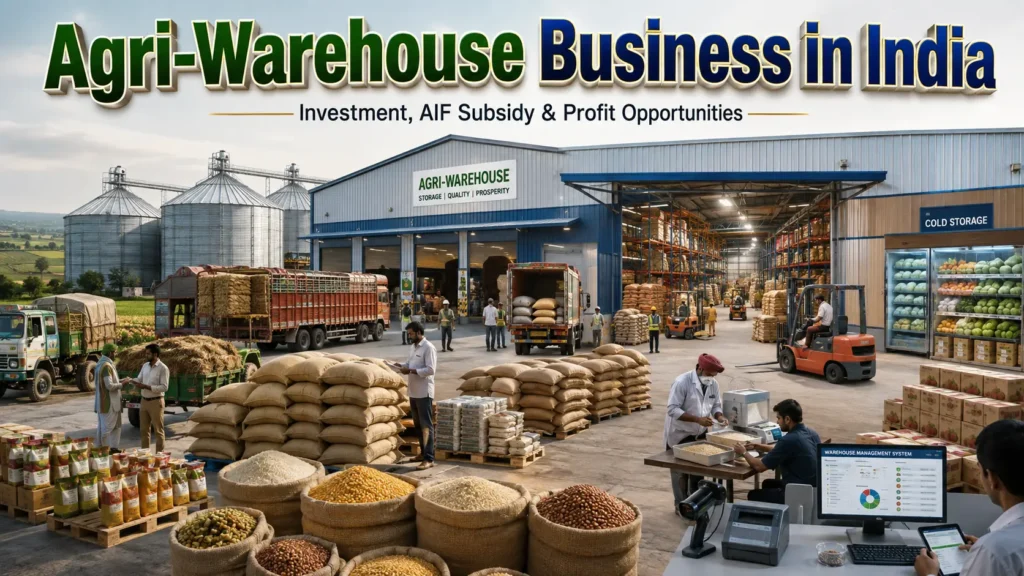
Agri Warehouse Business in India India wastes nearly 16% of its agricultural produce every year due to poor storage infrastructure. This gap is a huge business opportunity for entrepreneurs considering having high impact business ideas in the agri-sector. It is not only a logistics project, but a platform to integrate farmers, traders, processors & exporters in the Central India Agri-Warehouse and Commodity Trading Hub on a single ecosystem with Rs.50 Crore investment. The interesting rate on loans for qualified agri-infrastructure projects is paid by the Agriculture Infrastructure Fund (AIF) at 3%. The Warehouse Development and Regulatory Authority (WDRA) allows registered warehouses to issue a powerful financial tool called Negotiable Warehouse Receipts (NWRs), which can generate additional income for the hub operators. Get Detailed Project Report (DPR): Cold Storage & Cold Chain Technology Guide Why Central India Is the Right Location for This Business Soybean and wheat, pulses and cotton are vast in number produced in Madhya Pradesh, Vidarbha region in Maharashtra and Chhattisgarh. However, infrastructure for local storage and trading is still very poorly developed. The Agmarknet portal offers district-wise available commodity data which reflects good volume of throughput but lack in storage capacity to match in these districts. A modern warehousing infrastructure created in advance will give the entrepreneur the first-mover advantage in an area where demand is outpacing supply. Government Policies and Incentives Supporting Agri-Warehousing Agriculture Infrastructure Fund (AIF): It is a fund that has been established with an interest subvention of 3% on loans upto Rs.2 Crore for eligible projects, backed by credit guarantee from CGTMSE. Pradhan Mantri Kisan Sampada Yojana (PMKSY) provides capital subsidy for the cold chain and storage projects ranging from 35% to 50% in general areas and SC/ST and NE areas respectively. The NABARD has long-term refinance for warehouse construction through its Rural Infrastructure Development Fund (RIDF). The warehouse may also be registered as a warehouse under the WDRA, which would allow it to issue Negotiable Warehouse Receipts (NWRs) which would give the farmers a second source of income as they may pledge the stored commodities as collateral for loans. Turn your budget into a successful business plan Top Business Ideas Within the Agri-Warehouse and Trading Hub Model Commodity Storage and Negotiable Warehouse Receipt (NWR) Services This business’s core is the large-scale commodity storage registered by the WDRA. NWR system allows the warehouse to issue receipts for the commodities stored in the warehouse. These receipts are accepted by the banks, and the farmers borrow against them, instead of selling the produce at distress prices after harvest. The warehouse charges the storage fee on a per quintal, per month basis, handling charges and quality certification charges. Commodity backed financing and price discovery is provided on the NCDEX (National Commodity and Derivatives Exchange) platform which can be directly accessed by the WDRA registered warehouses. Commodity Grading, Testing, and Quality Certification Centre An FSSAI approved testing laboratory and grading facility in the hub warehouse enables a business to take a charge for moisture testing, aflatoxin testing, protein content testing and separation of foreign material. Soybean meal exporters, rice millers and pulses traders will all need certified quality reports before they can move on to large transactions. The APEDA mandates certification of agri-products exports, and a set-up having its own NABL certified testing facility makes the service offering more attractive for export processors. Electronic Commodity Trading and Auction Platform The third option of high-value business ideas in the hub is registering as a sub-broker/affiliate with NCDEX or setting up an electronic auction platform for trading at the mandi level. Traditional mandis are still in existence in central India, where many farmers sell their produce at lesser prices. The hub can fill this gap by organizing electronic auctions where registered buyers will bid for lots stored in the warehouse. The platform charges a transaction fee, which is usually between 0.5% – 1% of the transaction amount. Monitor real time commodity prices, highlight the price discovery value to the farmers through the Agmarknet. Related Article: Cold Storage, Cold Chain & Warehouse Import-Export Opportunity Analysis Some commodities are identified in Central India which have high export potential. The soybean meal is sold overseas in animal feed in Southeast Asian and European countries. Wheat and flour is exported to neighbouring countries, West Asia and Africa. APEDA helps to export agri-commodities and offers support for phytosanitary certificates. As an export consolidation service, a hub operator with APEDA registration will be able to bring together small lots from smallholder farmers into export ready shipments. Check for export documentation/IEC code from DGFT. Indian MSME Success Stories in Agri-Warehousing Arya.ag — Building India’s Agri-Finance Backbone Chattanathan Devarajan and Prasanna Rao of Arya.ag, were able to address one of the most significant agri-problems in India, which is post-harvest financing, by leveraging Technology and Warehousing. The company developed an asset-light warehousing network in the rural areas of India, established digital NWRs, and linked the farmers to the institutional credit market at affordable rates. Arya.ag proved that agri-warehouse infrastructure coupled with fintech is a high return and scalable business. A key part of their business model was the integration with WDRA’s NWR framework. Star Agri warehousing and Collateral Management Ltd Initially, Star Agriwarehousing started with one warehouse in the state of Rajasthan and has now emerged as one of the largest collateral management companies in India. The company’s approach, which involved managing storage on the field at a client’s owned or rented warehouse, enabled it to grow without a significant capital expenditure. Today it has stocking of millions of metric tonnes in various states and is serving banks, NBFCs, traders, agri-processors etc. The lesson for new business owners: You may require third-party storage infrastructure, but not self-owned infrastructure, to achieve this reduces capital requirements. Get Detailed Insights from This Book: The Complete Book on Cold Storage, Cold Chain & Warehouse (with Controlled Atmosphere Storage & Rural Godowns) How NPCS Can Help You Build This Project The Niir Project Consultancy Services (NPCS) aims to provide professional consulting for