
Floriculture Export Business
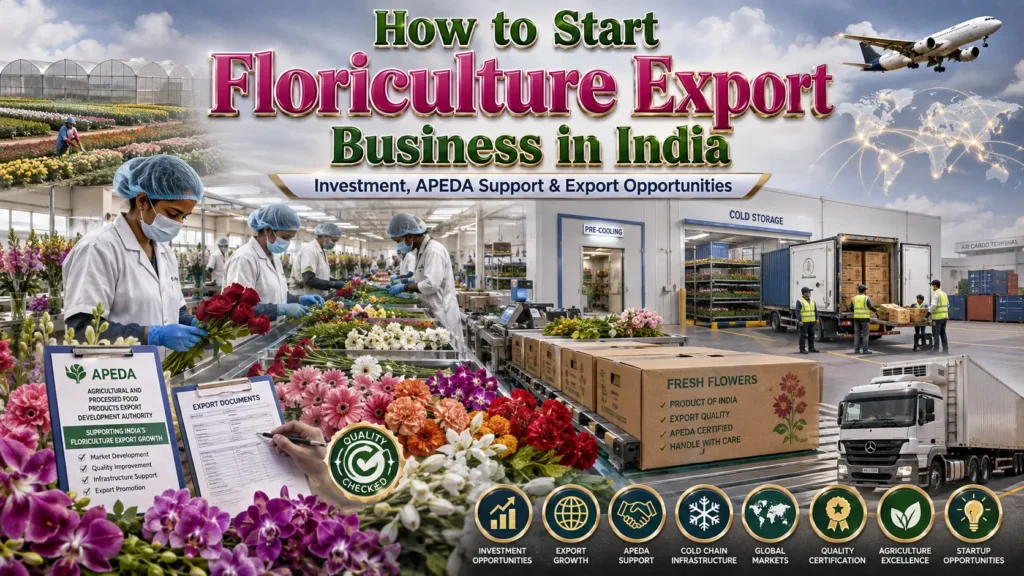
Floriculture – the cultivation, export and marketing of cut flowers, potted plants, dried flowers and floral products is one of the most underdeveloped agriculture export business ideas in India. Cultivated globally, the cut flower industry generates over $50 billion per year, with the Netherlands, Colombia, Kenya and Ethiopia as the leading producers. India has a small share in this global market considering the range of tropical climates, skilled agriculture labour and existing farming tradition of flower cultivation in the country. APEDA’s floriculture export promotion mandate and support from the National Horticulture Board for modern greenhouse cultivation are paving the way to a new era for Indian Floriculture entrepreneurs to enter into the international markets.
Floriculture export is a high value, land intensive land-based business with good commercials for the entrepreneurs who have access to land in suitable agro climatic zones like Karnataka, Tamil Nadu, Himachal Pradesh, West Bengal and J&K.
Why Floriculture Export Is a Premium Agricultural Opportunity
Cut flower export is one of the highest valued agricultural enterprises in terms of value per square metre as it generates a turnover of ₹500 – ₹2,000 per square metre of land in well managed polyhouse cultivation versus the most commonly grown vegetable crops which generate a turnover of ₹50 – ₹200 per square metre on the same area. Floriculture is particularly appealing to farmers having less agricultural area and seeking to utilize their farm for the maximum agricultural exportable value per area.
Year-round consumption is the driving force behind global demand for cut flowers; floral gifting, wedding decoration, hotel amenity, and corporate event decoration are year-round markets. India’s tropical and sub-tropical climate variety allows flowers to be produced throughout the year; which is in stark contrast to the European countries who are very reliant on costly heated greenhouses during the winter months. This natural season advantage coupled with low labour cost provides a structural competitiveness to Indian floriculture exporters as compared to the established exporters from Europe and South America.
Explore 10,000+ business ideas aligned with your investment goals
APEDA and Government Support for Floriculture Exporters
The floriculture and floriculture products (cut flowers, cut foliage, dried flowers and potted plants) are in the mandate of the Agricultural and Processed Food Products Export Development Authority (APEDA). APEDA offers loans for market development, pack house, pre-cooling, modern greenhouse (polyhouse) and financial assistance for refrigerated transport. APEDA also arranges participation of exporters from India in the largest Flower trading platform in the world, Flora Holland auction at Aalsmeer.
The National Horticulture Board (NHB) offers subsidy and financial assistance for the construction of polyhouse and greenhouse where 50% of the total eligible capital cost is eligible up to the limit of the scheme. For new floriculture entrepreneurs, a considerable portion of the investment is taken up by the investment support provided by NHB for the protected cultivation infrastructure.
The Ministry of Agriculture and Farmers Welfare has the National Horticulture Mission and the Horticulture Mission for North East and Himalayan States under its wings, which gives extra impetus to floriculture development in specific areas with climate conditions conducive to high value cultivation of flowers.
An important logistics element for the export of perishables such as flowers is the air cargo capacity and cost. The government’s efforts towards developing air cargo infrastructure at key airports and APEDA’s push for dedicated air cold chain capacity for the flower exporters are gradually making the flower export logistics economics more attractive. Improvements to cold chain logistics from the farm to the airport are provided by APEDA’s financial support for pre-cooling and refrigerated transportation facilities. The logistics support of APEDA is explained in detail on the APEDA portal.
Business Ideas in Floriculture Export
1. Cut Rose Export from Polyhouse Cultivation
Roses are the most traded cut flower in the world, representing more than 30% of cut flower trade. So, the modern roses cultivated in polyhouse of Karnataka (Bengaluru district) and Himachal Pradesh are already exported to the markets of the Gulf, European and Japanese countries. A 1-hectare rose growing polyhouse can yield 1,500 to 2,500 flowers, which can be converted into 1.5 to 2.5 million stems for export, with investment ranging from ₹80 lakh to ₹1.5 crore, covering the construction of the polyhouse, irrigation, growing structures and post-harvest handling.
The cost of the construction of the polyhouse is 50% subsidized by NHB. The main markets include export to Dutch flower markets and to the markets for flowers in the Gulf. With proper cultivation management, profits from 1-ha of polyhouse can be up to ₹30 lakh to ₹60 lakh annually.
Get Detailed Project Report (DPR): Cut Rose Flower (Floriculture) Manufacturing Project Report
2. Tropical and Exotic Flower Export
Tropical flowers (anthurium, heliconia, bird of paradise, ginger flower, and tropical foliage) are exported to Japanese, European and American florists, who are looking for unique non-European flower varieties for high-quality floral arrangements. These varieties have natural climatic conditions in the tropical southern part of India and North East India. One of the most valuable opportunities is to export to Japanese flower markets, where exotic tropical flowers have a high value. The investment on tropical flower cultivation & export unit varies from ₹30 lakh to ₹80 lakh based on plant species and scale of the project. The main logistics needs are air freight to Japan and EU.
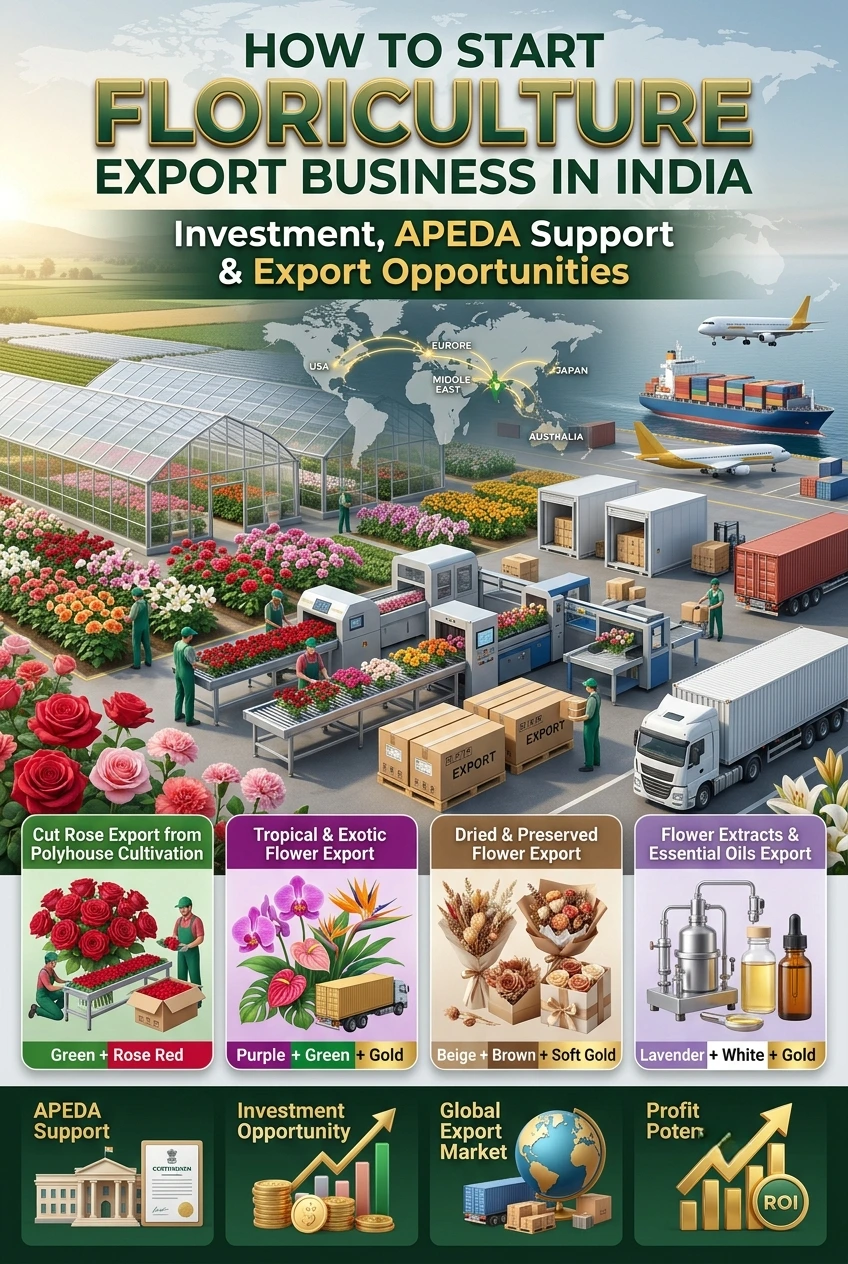
3. Dried and Preserved Flower Export
Dried flowers, potpourri, silica-dried roses, preserved eucalyptus and dried decorative botanicals are in high demand in the retail market in Europe and North America, especially on the home décor and gift market. India is blessed with a tremendous biodiversity, which offers a remarkable source of dried flower products. The investment in drying infrastructure, preservation chemical processing, sorting, and packaging is estimated to be between ₹10 lakh and ₹30 lakh for a dried flower processing unit. Dried products have the advantage of a shelf life of 12-24 months, which removes the time constraint of fresh cut flowers by air freight. Effective channels of export include the e-commerce platforms and floral wholesale distributors in EU and US.
4. Flower Extracts and Essential Oils Export
Other rare floral essential oils made from Indian flowers such as Rose absolute, jasmine absolute, tuberose absolute etc. are among the costlier naturally derived perfumery, cosmetics as well as aromatherapy ingredients. Indian jasmine absolute and rose absolute are traditionally used by perfume houses in Grasse (France) for a signature perfume. Flower absolute extraction (small scale) using solvent extraction or enfleurage requires investment of ₹20 lakh to ₹60 lakh. The trade in authentic natural absolutes is small and extremely profitable, and in some categories of absolutes, the price of the gram is on par with that of the precious metals. Specialty aroma chemical brokers and direct connections to perfume houses in France, the UK and US.
Related Article: Cultivation of Fruits & Flowers
Import-Export Opportunity Analysis
India’s floriculture export performance has significant room to grow relative to established exporters like Netherlands, Kenya, and Colombia. The APEDA AgriExchange floriculture data shows growing export values in cut flowers and floriculture products. The Netherlands, UK, UAE, and Japan are the primary export destinations.
The Dutch flower auction system — FloraHolland at Aalsmeer — is the global pricing reference for cut flowers. Indian exporters registered with FloraHolland can sell through the daily auction to European buyers, accessing the world’s largest flower trading infrastructure. APEDA facilitates Indian flower exporter access to FloraHolland and provides guidance on meeting Dutch auction quality grading standards.
Indian MSME Success Stories in Floriculture
Karuturi Global was the world’s biggest rose producer and proved that Indian floriculture can go international; rose cultivation was established in Karnataka and Ethiopia to provide Dutch flower auctions. Their Ethiopia operation was beset with difficulties, but their Karnataka operation proved the commercial feasibility of the export of roses on a large-scale basis to the Dutch auction market in India.
The entrepreneurs have formed small-scale export enterprises in the form of small polyhouses with a size of 0.5–2 ha around Bengaluru, Karnataka, and have successfully established small-scale export business in Karnataka, supplying directly to the flower wholesale markets in the Gulf through cargo agents which shows the viability of small-scale export business of Indian floriculture entrepreneurs, especially MSMEs.
The floriculture industry of Northeast India, especially the organically cultivated flowers of Sikkim and anthurium production of Assam is now becoming a strong player in exports to Southeast Asian and Japanese markets, which are enabled by the logistics enhancement, supported by APEDA, of Northeast flowers for export.
Read the Complete Book Here: Tropical, Subtropical Fruits & Flowers Cultivation
How NPCS Supports Floriculture Business Planning
At Niir Project Consultancy Services (NPCS) we are professionals in preparing Market Survey cum Detailed Techno-Economic Feasibility Report (DPRs) in connection with setting up of new businesses in the floriculture sector, which includes export-oriented floriculture businesses. Our reports cover design of the polyhouse, agronomy planning, specification of post-harvest infrastructure, compliance guidelines as per APEDA, market and logistic analysis and detailed financial projections that include profitability.
Floriculture Export Business: Key Data Overview
| Floriculture Category | Investment Range | Key Certification | Target Markets | Revenue Potential |
| Polyhouse Rose Cultivation (1 ha) | ₹80L – ₹1.5 Cr (incl. NHB subsidy) | APEDA + GlobalGAP | Netherlands, UAE, Japan | ₹30–60L/ha/yr |
| Tropical Exotic Flowers | ₹30L – ₹80L | APEDA | Japan, EU, US | ₹20–45L/unit/yr |
| Dried and Preserved Flowers | ₹10L – ₹30L | FSSAI + APEDA | EU, US, Australia | ₹15–35L/yr |
| Floral Absolutes/Essential Oils | ₹20L – ₹60L | ISO 9001 + APEDA | France, UK, US | ₹20–80L/yr |
| Cut Foliage and Greenery | ₹15L – ₹40L | APEDA | EU, Japan, Gulf | ₹15–30L/yr |
Frequently Asked Questions (FAQ)
1. What is the subsidy given by NHB for poly house floriculture?
Capital subsidy of ₹935 per square metre for naturally ventilated polyhouses and ₹1,465 per square metre for fan and pad polyhouses provided by National Horticulture Board with area and scheme cap limits. Use state horticulture departments through NHB’s development programmes.
2. What is the process for air freight destined for cut flower exports?
To assure quality, it takes 24 to 72 hours for cut flowers to reach export destinations after being cut. The most important part of pre-cooling is right after harvest at the farm pack house. Transport of flowers to airport cold storage centers with little handling time and direct loading to air cargo maintain flower quality. The majority of the exporters of flowers from India rely on special agents who are proficient with perishables flowers transport by air.
3. What is FloraHolland and how can the Indian exporters avail of it?
Royal FloraHolland (formerly FloraHolland) is the world’s biggest flower auction cooperative located in the town of Aalsmeer, Netherlands. Indian exporters can enter into the auction clock system with the help of registering as suppliers and ship flowers on consignment to the distribution centre of FloraHolland. APEDA helps Indian floriculture exporters register. The auction price is determined by the market daily and the exporter is paid the auction price less the handling and commission.
4. The flower should be GlobalGAP certified for exports to EU?
GlobalGAP FLOWERS & ORNAMENTALS certifies the safe agricultural methods, the welfare of the workers and the sustainable environment in flower production. GlobalGAP certification is becoming mandatory from flower suppliers for major Dutch buyers and many retailers in Europe. GlobalGAP certification costs are funded by NHB and APEDA.
5. Which flower varieties have the strongest international demand from India?
Roses (HT varieties) have the largest global market. Chrysanthemums, gerberas, and carnations have strong auction market demand. Tropical varieties (anthurium, heliconia, birds of paradise) have premium positioning in Japanese and specialty European markets. Seasonal demand patterns vary — Valentine’s Day, Mother’s Day, and Christmas represent peak demand periods where pre-planned production scheduling maximises export revenue.
6. Can small farmers participate in floriculture export without large investment?
Yes. Farmers’ groups and cooperatives — particularly in Karnataka — have collectively invested in shared pack houses, pre-cooling facilities, and export logistics, allowing individual small farmers with 0.1-to-0.5-hectare polyhouses to participate in export markets. APEDA’s financial assistance is accessible to farmer producer organisations as well as individual entrepreneurs.
Conclusion
With the global flower market being extremely huge; the natural climate, climate protection by NHB and market development infrastructure by APEDA, the export of floriculture is one of the highest returns per acre business ideas in India. With the proper investment in infrastructure, the main issues in the sector – air freight logistics and international quality grading compliance – are manageable. Floriculture is one of the most profitable businesses in the agricultural sector of India’s diversified agricultural export market for entrepreneurs who invest in technology for the cultivation of polyhouse, post-harvest cold chain and development of international flower auction or direct farmer buyer market.