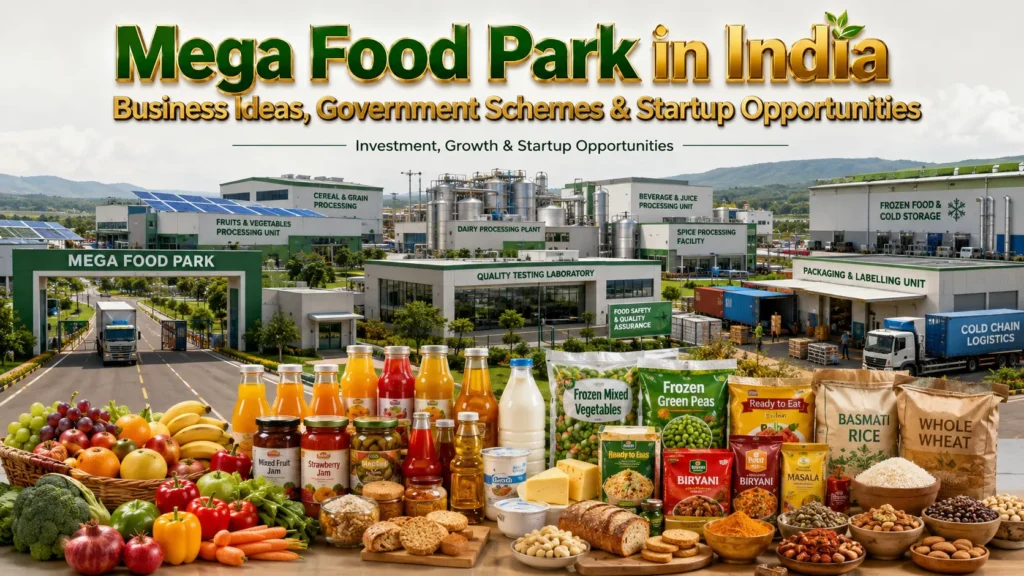

The fact that India wastes almost one-third of the food grown in its farms before it ends up on a plate is enough to make food entrepreneurs see potential in Mega Food Park business ideas. A Mega Food Park is not a factory. It is a collaborative industrial complex where cold storage, processing sheds, testing labs and logistics are available under the same roof and have been designed specifically for the ease of a small manufacturer. That’s a complete game change for a first-generation entrepreneur. A unit owner may lease an already developed plot within an existing unit and commence production within months, rather than spending crores building effluent treatment plants, power plants, and land.
In this article, he explains why food processing is one of the most promising businesses for new entrants in India these days, what kind of government schemes are currently used to support a new player and what would be the most suitable business lines.
Why Food Processing Is a Smart Sector to Enter Right Now
India generates huge production of fruits, vegetables, milk, grain and marine products. But much of that production does not go into higher value, longer shelf-life products. That’s the space where profit is hiding! Tomatoes are sold at the farm gate at a decent price, a tonne of raw tomatoes. Transform it to packaged puree, ketchup, or dehydrated flakes, and the value realisation increases several-fold as the buyer is now paying for shelf life, convenience, and brand trust, instead of paying for the raw crop.
The closed setting of Mega Food Parks allows the new player to leverage the infrastructure of other processors, such as processing units, cold chains and packaging plants, which would take years to construct on their own. A unit can simply be installed at operational parks with existing effluent treatment plants, weigh bridges, quality testing labs and warehousing facilities, which removes the need to invest large amounts of money into developing raw industrial land.
There’s also a chance to export. Gulf, Southeast Asia, the U.S. and the European Union are all areas that have become hot markets for processed food, spices, marine products and organic products from India. A unit that can access export documentation services, has access to a cold chain, and is located within a food park would thus have the best chance of capturing these markets when compared to a standalone rural unit operating in isolation.
Choose the right startup backed by real market demand
Government Policies and Incentives Supporting New Entrants
Here, a word of clarity is important before a founder’s business plan is created around it. The Ministry of Food Processing Industries has already withdrawn fresh sanctions under the original Mega Food Park Scheme, which means that there is no fresh sanction going down for any new park under the same window. Where there are already sanctioned parks, there will be no funding for unpaid liabilities. The real chance which a new entrepreneur has these days is two-fold—he can lease plots within the existing operational food processing parks formed under the scheme and he can look into the newer schemes which has replaced this scheme as the government’s staple food processing support measures.
Pradhan Mantri Kisan Sampada Yojana (PMKSY)
PMKSY continues to be the umbrella central sector scheme for food processing with infrastructure development, cold chain and agro-processing clusters. A new unit can join and plan its capital requirements in accordance with the components of infrastructure support under PMKSY within an existing food park ecosystem.
Production Linked Incentive Scheme for Food Processing Industry (PLISFPI)
This scheme offers incentives for eligible manufacturers based on the number of incremental sales of their processed food products, such as those in the branding and international marketing sectors. It is relevant to a food park-based manufacturing unit particularly because it is a focus on units that can increase the volume and create a brand that can compete in the export market.
PM Formalisation of Micro Food Processing Enterprises (PMFME)
PMFME can be a more appealing option for a truly small or new business owner. It provides credit linked capital subsidy, common infrastructure support, branding and skill training for micro and unorganized food processing units on a targeted basis to formalize and expand.
MSME and State-Level Support
In addition to the different schemes available in the different sectors, some food processing units are also classified as manufacturing MSMEs and can avail of the benefit of collateral-free credit guarantee cover, interest subvention on term loans and capital investment subsidy provided by a number of state industrial policies. Many state governments also exempt/reduce stamp duty for units established in notified food parks/in industrial estates.
Read as a package, these documents indicate that the road to funding for the Mega Food Park, as conceived, has been closed, but the government’s support of food processing, in general, has been more complex and more favorable to those who are careful about planning.
Multiple Business Ideas for Startups Inside a Mega Food Park
Establishment of business idea around a food park must match a product line with the infrastructure already provided by the food park. Some of the most viable options for a first-time investor entering the market as a founder.
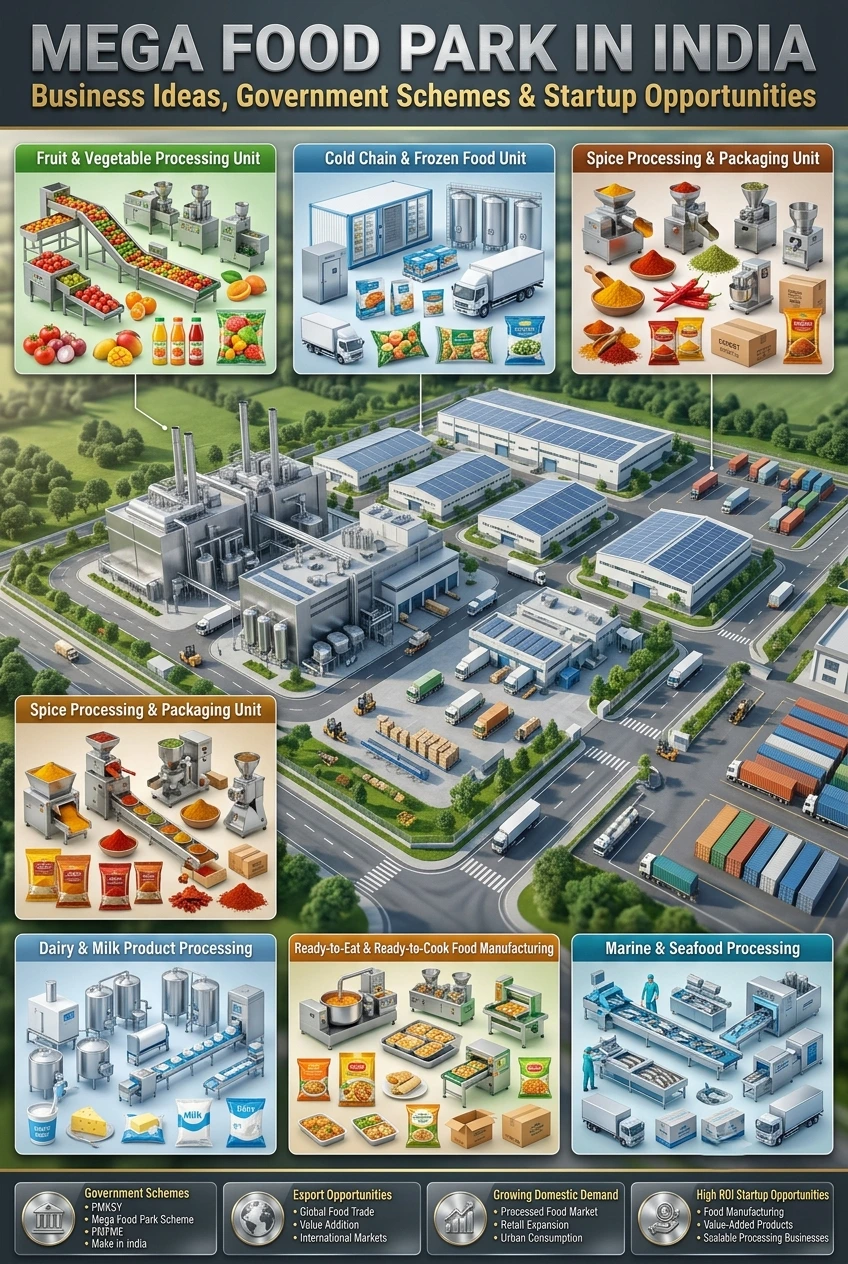
Fruit and Vegetable Processing Unit
One of the most natural places for a Mega Food Park is a fruit and vegetable processing line which converts local horticulture produce into pulp, puree, jam, pickle or dehydrated products, the cold storage and primary processing centres of a Mega Food Park are generally built around a particular agri-horticultural area. A founder can get raw material from the collection centers within the park, reducing losses during transportation and procurement expenses. Shelf-stable products such as jams, purees and ready-to-cook paste have healthy margins over fresh products and can be profitable within 2-3 years of fit-up even if only a few tonnes per day of capacity is installed, if quality and packaging is managed well from the beginning.
Get Detailed Insights from This Book: Handbook on Fruits, Vegetables & Food Processing with Canning & Preservation
Cold Chain and Frozen Food Unit
There has been good growth in frozen vegetables, ready to cook parathas, IQF (individually quick frozen) fruit and frozen snacks in urban areas, driven by the presence of more households using frozen and ready-to-eat foods. A unit within a food park may lease space directly adjacent to the common cold storage, thus greatly reducing the amount of capital investment required for a stand-alone blast-freezing center. For startups, this model is a great fit when the entrepreneurs have already established a distribution network with retailers in their region, quick-commerce delivery platforms or hotel, catering buyers as their partners, as the frozen food business relies heavily on a seamless cold chain from the factory to the shelf.
Spice Processing and Packaging Unit
India’s spice belt stretches across various States and a spice grinding, blending and packaging business is one of the businesses which can be started with lesser investment by a new entrepreneur. Housed in a food park, this unit helps ease the burden of having to share quality testing labs — and that is very important when export markets are known for their stringent test limits on pesticide residue, adulteration and microbial contamination. A founder that installs a robust traceable supply chain and implements food safety certification early will ascend from selling through the region to selling in branded packs, and ultimately export contracts, where margins are far higher.
Dairy and Milk Product Processing
In a favourable market area, where a Mega Food Park is located close to a strong milk producing belt, a business based on dairy products processing, like paneer, ghee, flavoured milk or value-added products like dairy snacks can be a good business. The common cold chain and packaging infrastructure already existing in an operational park provides a huge advantage for the dairy processing industry and the demand for branded hygienically packed dairy products is increasing in tier-2 and tier-3 towns with the growth of organised retail.
The quality of raw milk is extremely sensitive to time and the distance to cold storage, which is set up at the park, as well as the quality of the raw milk supplier network (local farmers or cooperatives).
Get Detailed Project Report (DPR): Dairy Products Manufacturing Guide
Ready-to-Eat and Ready-to-Cook Food Manufacturing
Urban households that are busy today are resorting to ready-to-eat curries, instant mixes and heat-and-eat meals, and these are now available in smaller towns as well. It is possible to develop a RTE unit within a food park based on a shared retort processing and packaging equipment to manufacture the pouches of shelf stable foods, thereby eliminating the need of investing extra in expensive retort equipment. This part is more about branding and consistency of taste, which is why if a founder has a good recipe, clean-label positioning and a partnership with a region or online grocery retailer, they can find a profitable niche in a rather short time.
Marine and Seafood Processing
Marine processing such as cleaning, grading, freezing and packing shrimp, seafood and fish for both the domestic and export markets is one of the highest export value business ideas that can be pursued in the coastal belt Mega Food Parks. A well-managed food park is essential for the proper implementation of cold chain integrity and HACCP requirements, which are key to seafood export. Since the customers globally are willing to pay a premium for traceable and certified marine products, if the founder invests his money early in the process of export documentation and quality certification, he will be able to earn much better margins than the domestic producers who compete only based on price.
Related Article: How to Start Fish Processing Business (Salted and Pickled Fish, Smoked Fish, Fish Fillet, Frozen Seafood)
Import–Export Opportunity Analysis for New Entrants
The export potential is the only advantage that a food park site can offer over an individual rural unit. Processed fruit pulp, frozen vegetables are already traded in high value markets like the Gulf Cooperation Council countries, the European Union, the United States and Southeast Asian countries and so are the spices and the marine products and organic foods from India. But, this relies mainly on the quality certification, cold chain integrity and documentation that a Mega Food Park is expected to deliver by its common testing lab and ‘export ready’ cold chain.
For new entrants following an import, it is also crucial to follow the machinery and packaging technology. The retorts are usually imported for high precision and IQF freezing lines and modern aseptic packaging equipment are also often imported. The entrepreneurs who are planning to install an export-oriented unit should also take customs duty, import lead time and availability of after sales service into consideration from the very beginning. The founder who has studied the two components — what India can export profitably and what technology it still needs to import itself to compete — is much better equipped to have a solid business plan than one that is based purely on India.
Indian MSME Success Stories in Food Processing
MTR Foods — Bengaluru
Under the stewardship of the Maiya family, what started as a small South Indian restaurant has bloomed into one of India’s most popular spice mixes and ready-to-eat brands, MTR Foods. The founders’ fundamental choice, to replace traditional recipes with packaged shelf-stable food before ‘convenience food’ had become a mass product, is precisely the type of innovation that today’s food-park entrepreneurs are urged to take with newer product categories such as frozen foods and ready-to-eat food.
Priya Foods — Hyderabad
Priya Foods began as a small pickle making business and grew into a big brand of pickles, spices and ready-to-eat products with its founder’s leadership and all built on a strong quality control system and uniformity of taste, regardless of the batch. The lesson for the new food park entrant is simple: Category leadership in food processing is not won by being the lowest priced, but by being the most consistent in quality, batch to batch, year to year.
Vadilal Industries — Ahmedabad
Vadilal expanded from its humble beginnings started from an ice cream parlour to one of the largest frozen dessert and frozen food companies in India with a long-standing export business that includes frozen vegetables and ready meals. The path that it traced demonstrates the ability to expand the frozen food business from one category into another with a single cold chain investment that has been the successful business model for many food park operators today.
About NPCS: Turning a Business Idea into a Bankable Project
We at Niir Project Consultancy Services (NPCS) provide professional consulting for the preparation of Market Survey cum Detailed Techno-Economic Feasibility Reports (DPRs) for setting up new industries or businesses, including food processing units planned around Mega Food Park locations. Our reports include detailed manufacturing processes, market research and demand analysis, process flow diagrams, product mix and capacity planning, machinery and raw material details, and complete project financials with profitability analysis. Our objective is to help entrepreneurs evaluate feasibility, profitability, and long-term scalability before investing, so that a good business idea is backed by numbers a bank, an investor, or the founder’s own conscience can trust.
Food Processing Business Snapshot: Indicative Data Table
| Business Line | Typical Small-Unit Investment Range | Key Demand Driver |
| Fruit & vegetable processing | ₹40 lakh – ₹1.5 crore | Organised retail, cold chain expansion |
| Frozen food / IQF unit | ₹75 lakh – ₹3 crore | Quick-commerce, HORECA demand |
| Spice processing & packaging | ₹25 lakh – ₹1 crore | Export markets, branded retail packs |
| Dairy processing (paneer/ghee) | ₹50 lakh – ₹2 crore | Tier-2/3 branded dairy demand |
| Ready-to-eat / RTC foods | ₹60 lakh – ₹2.5 crore | Urban convenience food consumption |
| Marine/seafood processing | ₹1 crore – ₹5 crore | Export demand, HACCP compliance |
Note: figures are indicative planning ranges only; actual project cost depends on capacity, location, machinery choice and civil work, and should be validated through a detailed feasibility study before investment.
FAQ: Mega Food Park Business Ideas
Can a new entrepreneur still get a plot inside a Mega Food Park?
Yes. The scheme the government put in place which initiated the creation of a number of Mega Food parks has come to an end but the existing, functional Mega Food Parks are continuing leasing industrial land & sheds to entrepreneurs looking to set up processing units.
Is the Mega Food Park Scheme still open for new applications?
No. The scheme has been discontinued for fresh sanctions, with funding now restricted to committed liabilities of already-approved projects. New entrants should instead look at PMKSY, PLISFPI and PMFME for scheme-based support.
What is the minimum investment needed to start a food processing unit in a food park?
They are widely different product to product; we have small capacity packaging units like roughly 25 lakhs; we have marine processing units of multiple crore rupees and huge marine/frozen food plants costing multiple of few crores; the exact cost can be decided upon after preparing the project report of the exact capacity.
Do units inside a food park get any tax or duty benefits?
The benefits differ from state to state and depend on the specific central scheme a unit falls under and may include MSME credit subsidies, PLI on incremental sales, state duty stamps etc which can be cross checked with relevant circulars.
How important is export documentation for a food park-based unit?
Very important for categories like spices, marine products and processed fruit, where global buyers demand certification, traceability and consistent quality. A food park’s shared testing infrastructure makes this compliance considerably easier to achieve.
How can I validate a business idea before investing?
A techno-economic feasibility study covering market demand, machinery, manpower, project cost and profitability is the standard first step before approaching a bank or investor, and is exactly what a professional DPR is built to deliver.
Conclusion
The Mega Food Park story in India has entered a new phase. The scheme that built the original parks has closed its doors to fresh sanctions, but the parks themselves, along with a wider and arguably stronger set of food processing schemes, remain very much open for business. For an entrepreneur willing to do the homework on location, product line and compliance, food processing continues to offer one of the more accessible and resilient manufacturing paths in India today — provided the business idea is backed by a properly costed feasibility study before the first machine is ordered.
Reference Sources
Ministry of Food Processing Industries – Mega Food Park
Press Information Bureau – PLI Scheme for Food Processing
Ministry of Food Processing Industries – PLISFPI
India Brand Equity Foundation – Food Processing Industry
Department for Promotion of Industry and Internal Trade – Make in India
Agricultural and Processed Food Products Export Development Authority