
Mega Food Park in India: Business Ideas, Government Schemes and Startup Opportunities
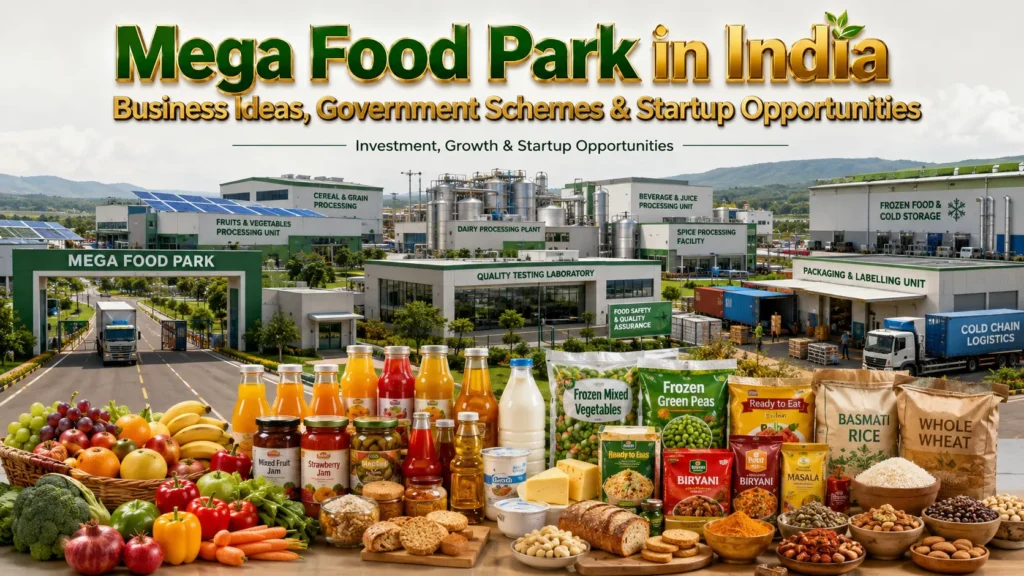
The fact that India wastes almost one-third of the food grown in its farms before it ends up on a plate is enough to make food entrepreneurs see potential in Mega Food Park business ideas. A Mega Food Park is not a factory. It is a collaborative industrial complex where cold storage, processing sheds, testing labs and logistics are available under the same roof and have been designed specifically for the ease of a small manufacturer. That’s a complete game change for a first-generation entrepreneur. A unit owner may lease an already developed plot within an existing unit and commence production within months, rather than spending crores building effluent treatment plants, power plants, and land. In this article, he explains why food processing is one of the most promising businesses for new entrants in India these days, what kind of government schemes are currently used to support a new player and what would be the most suitable business lines. Why Food Processing Is a Smart Sector to Enter Right Now India generates huge production of fruits, vegetables, milk, grain and marine products. But much of that production does not go into higher value, longer shelf-life products. That’s the space where profit is hiding! Tomatoes are sold at the farm gate at a decent price, a tonne of raw tomatoes. Transform it to packaged puree, ketchup, or dehydrated flakes, and the value realisation increases several-fold as the buyer is now paying for shelf life, convenience, and brand trust, instead of paying for the raw crop. The closed setting of Mega Food Parks allows the new player to leverage the infrastructure of other processors, such as processing units, cold chains and packaging plants, which would take years to construct on their own. A unit can simply be installed at operational parks with existing effluent treatment plants, weigh bridges, quality testing labs and warehousing facilities, which removes the need to invest large amounts of money into developing raw industrial land. There’s also a chance to export. Gulf, Southeast Asia, the U.S. and the European Union are all areas that have become hot markets for processed food, spices, marine products and organic products from India. A unit that can access export documentation services, has access to a cold chain, and is located within a food park would thus have the best chance of capturing these markets when compared to a standalone rural unit operating in isolation. Choose the right startup backed by real market demand Government Policies and Incentives Supporting New Entrants Here, a word of clarity is important before a founder’s business plan is created around it. The Ministry of Food Processing Industries has already withdrawn fresh sanctions under the original Mega Food Park Scheme, which means that there is no fresh sanction going down for any new park under the same window. Where there are already sanctioned parks, there will be no funding for unpaid liabilities. The real chance which a new entrepreneur has these days is two-fold—he can lease plots within the existing operational food processing parks formed under the scheme and he can look into the newer schemes which has replaced this scheme as the government’s staple food processing support measures. Pradhan Mantri Kisan Sampada Yojana (PMKSY) PMKSY continues to be the umbrella central sector scheme for food processing with infrastructure development, cold chain and agro-processing clusters. A new unit can join and plan its capital requirements in accordance with the components of infrastructure support under PMKSY within an existing food park ecosystem. Production Linked Incentive Scheme for Food Processing Industry (PLISFPI) This scheme offers incentives for eligible manufacturers based on the number of incremental sales of their processed food products, such as those in the branding and international marketing sectors. It is relevant to a food park-based manufacturing unit particularly because it is a focus on units that can increase the volume and create a brand that can compete in the export market. PM Formalisation of Micro Food Processing Enterprises (PMFME) PMFME can be a more appealing option for a truly small or new business owner. It provides credit linked capital subsidy, common infrastructure support, branding and skill training for micro and unorganized food processing units on a targeted basis to formalize and expand. MSME and State-Level Support In addition to the different schemes available in the different sectors, some food processing units are also classified as manufacturing MSMEs and can avail of the benefit of collateral-free credit guarantee cover, interest subvention on term loans and capital investment subsidy provided by a number of state industrial policies. Many state governments also exempt/reduce stamp duty for units established in notified food parks/in industrial estates. Read as a package, these documents indicate that the road to funding for the Mega Food Park, as conceived, has been closed, but the government’s support of food processing, in general, has been more complex and more favorable to those who are careful about planning. Multiple Business Ideas for Startups Inside a Mega Food Park Establishment of business idea around a food park must match a product line with the infrastructure already provided by the food park. Some of the most viable options for a first-time investor entering the market as a founder. Fruit and Vegetable Processing Unit One of the most natural places for a Mega Food Park is a fruit and vegetable processing line which converts local horticulture produce into pulp, puree, jam, pickle or dehydrated products, the cold storage and primary processing centres of a Mega Food Park are generally built around a particular agri-horticultural area. A founder can get raw material from the collection centers within the park, reducing losses during transportation and procurement expenses. Shelf-stable products such as jams, purees and ready-to-cook paste have healthy margins over fresh products and can be profitable within 2-3 years of fit-up even if only a few tonnes per day of capacity is installed, if quality and packaging is managed well from the beginning. Get Detailed Insights from This Book: Handbook on Fruits, Vegetables