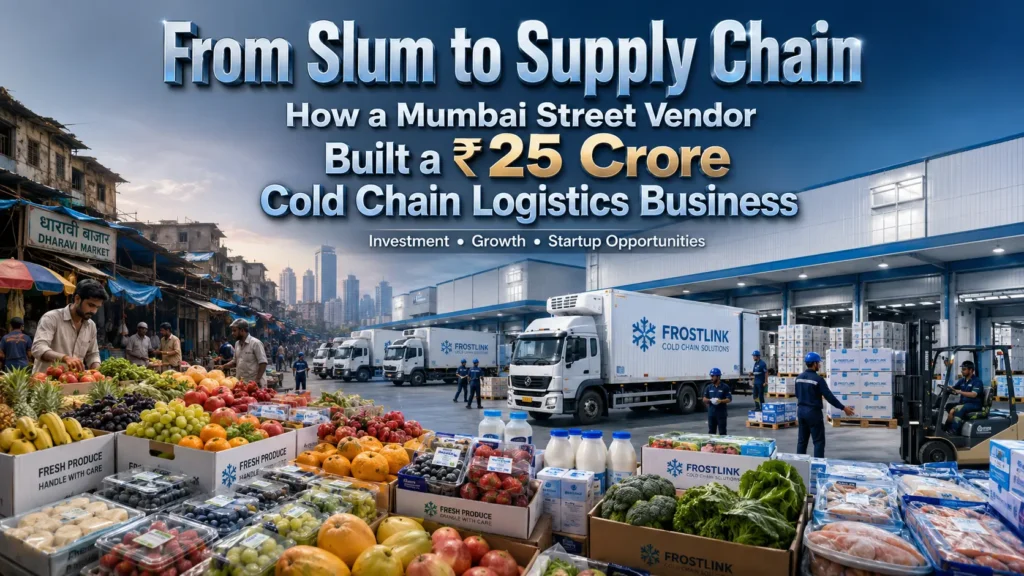

Cold Chain Logistics Business in India
The Gap That Makes Millionaires
Almost one third of the fruits and vegetables that are grown in India don’t reach the consumers. They decompose from the farm and up to the city market. Not due to its poor farming. This is not due to poor roads. The cold chain in India is where it lacks — at the last mile.
The National Horticulture Board (NHB) reports that the installed capacity of cold storages in India is about 37 million metric tonnes. Which is large until you realise that more than 70% of that is in five states: Uttar Pradesh, West Bengal, Punjab, Gujarat and Maharashtra, and virtually no portion is temperature-controlled transport. Cold rooms are present. The refrigerated trucks have been removed.
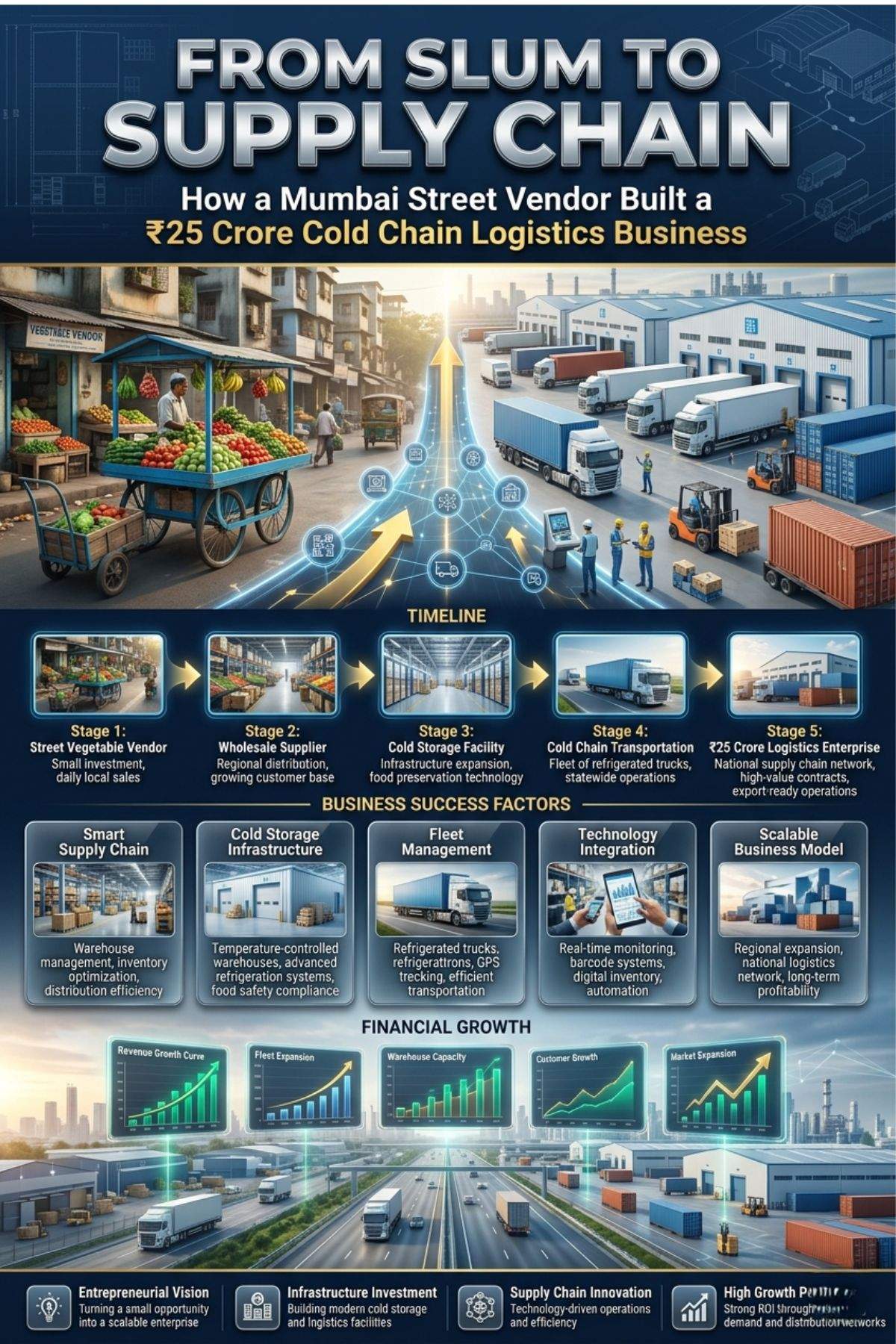
One man from Dharavi discovered his fortune in that space between warehousing and wheels. Ramesh Gaikwad started selling vegetables from a pushcart in Dadar in the late 1990s. He saw something that no logistics consultant had ever thought to write down: there were warm produce and no one owned a last-mile refrigerated van for small packs, in the hotel kitchens in South Mumbai.
He took a loan of ₹3 lakh from the chit fund and started hiring a small cold van, making a firm commitment to one hotel for the same-day delivery of chilled produce. After 12 years, Ramesh’s company owns 22 cars with refrigeration and has two cold storage units in Navi Mumbai and Bhiwandi with an annual turnover of ₹25 crore. The business doesn’t spend money on advertising. All of the clients were referred.
His is not a unique case. Repeatable — if you just know where to find it and how to make it.
Access Complete Business Plan: Cold Chain, Temperature Controlled Supply Chain Projects
India’s Cold Chain: Numbers That Should Embarrass Us
The Ministry of Agriculture & Farmers Welfare estimates that India produces more than 320 million tonnes of horticulture produce every year, which is the second largest in the world. The estimated losses in the post-harvest sector from 10 years of losses by the National Centre for Cold-chain Development (NCCD) are approximately worth ₹92,651 crore annually.
The nodal body on cold chain policy the NCCD estimates the demand of India at 61,000 reefer vehicles when less than 12,000 are available. This is a 80% deficit. The difference isn’t large in large cities. It’s in tier-2 towns, mandis and farm clusters in the states like Bihar, Madhya Pradesh, Assam, Odisha and Chhattisgarh.
The pharmaceuticals add to the issue. According to the Pharmaceuticals Export Promotion Council of India (Pharmexcil), India exports more than USD 25 billion worth of pharma products every year. This is increasing proportionately for vaccines, biologics and temperature-sensitive APIs, which must be handled under 2°C to 8°C conditions from the factory to the airport. But only about 15% of Indian airports have dedicated pharma cold zones leaving exporters to last mile, which is fragmented.
This was highlighted during the rollout of the COVID-19 vaccine where the government had to make do with blood banks, ice cream freezers, and improvised refrigeration at district health centres. The lesson has since led to serious investment by the government and private demand.
It is two sectors which are seeing the greatest need across the country: processed food (11% growth per year) and pharma cold chain (14% growth per year). The last mile delivery is problematic in both the sectors.
TABLE 1: State-Wise Cold Chain Demand, Infrastructure Gaps & Key Opportunity Clusters
| State | Hort. Produce (MT/yr) | Cold Storage Gap (%) | Reefer Van Deficit | Key Opportunity Clusters |
| Uttar Pradesh | 55 Million | 28% | ~9,000 vans | Agra, Lucknow, Varanasi — potato, mango, milk |
| Bihar | 18 Million | 67% | ~4,200 vans | Muzaffarpur, Patna — litchi, vegetables, pharma |
| Maharashtra | 22 Million | 31% | ~5,800 vans | Nashik, Pune, Mumbai — grapes, onion, hospitality |
| Madhya Pradesh | 14 Million | 54% | ~3,600 vans | Indore, Jabalpur — soybean, tomato, pulses |
| West Bengal | 19 Million | 22% | ~2,900 vans | Kolkata, Siliguri — fish, vegetables, flower exports |
| Assam | 8 Million | 72% | ~2,100 vans | Guwahati, Dibrugarh — tea, vegetables, fish |
| Rajasthan | 9 Million | 48% | ~2,400 vans | Jaipur, Jodhpur — dairy, vegetables, tourism supply |
Get Detailed Insights from This Book: Handbook on Fruits, Vegetables & Food Processing with Canning & Preservation
Why This Decade Belongs to Cold Chain Operators
The cold chain business is one of the most poised logistics segments in India at present, thanks to three factors.
The first one is the retail transformation. The app of quick commerce like Blinkit, Zepto, Swiggy Instamart have made it a consumer expectation to order food products in just 10 minutes. There is a need for a fresh produce delivery twice a day to every dark store in Tier-1 or Tier-2 cities from cold chain supplier. These platforms do not have the “last mile” themselves. They contract it out. The contracts are guaranteed to volume and multi-year.
Second, regulation tightening by the pharma industry. Strengthening of Schedule M requirements for storage and transport of pharmaceuticals by CDSCO (Central Drugs Standard Control Organisation). The UK healthcare sector has been impacted by the transition to non-controlled environments; those that have already done so will now have to meet the requirements of becoming a controlled environment or risk suspension of their licence. This means that there is legal demand for certified cold chain operators, not merely discretionary demand.
Third, government push. Under PM Kisan Sampada Yojana, the Indian government has pledged to establish an integrated cold chain network, budgeting a total of ₹2,000 crore for cold chain development initiatives nationwide. NABARD provides financing for the construction of cold storage through its development programme Rural Infrastructure Development Fund (RIDF) at subsidised interest rates. Under the Integrated Cold Chain and Value Addition Infrastructure scheme, 35% is the capital subsidy that is available from the Ministry of Food Processing Industries (MoFPI) — with the scheme, if you invest ₹1 crore, the government will write you a cheque of ₹35 lakh.
NABARD Cold Chain Subsidy Scheme: Provides subsidy of up to 35% of the capital expenditure for cold storage, pre cooling and refrigerated transportation infrastructure. Individual entrepreneurs, FPOs, cooperatives and private companies are eligible beneficiaries. Submit your application to the nearest NABARD Regional Office or through its website nabard.org.
Building Your Cold Chain Business: The Setup Playbook
Step 1: Define Your Service Model Before Buying Anything
The three possible scenarios for the first time operator are: (a) cold storage warehouse only, (b) refrigerated transport only and (c) integrated last-mile cold chain. The final model is the integrated model, which has the highest margins, but the highest capital cost. If you have a budget less than ₹50 lakh, then begin with transport. Once you have an anchor client include warehousing.
Step 2: Anchor One Large Client First
The best thing Ramesh Gaikwad did was to sign a three-year contract with one 5 star hotel before purchasing his second van. That contract paid for 60% of his fixed costs. Do the same. Address hotel chains, hospital kitchen units or big pharma distributors. Provide a free month for testing. Lock the contract prior to scaling.
Step 3: Capital Requirements
The cost of a basic refrigerated transport business with two reefer vans (3-5 tonne) is approximately ₹18-22 lakh per van, plus ₹5-8 lakh for GPS cold monitoring systems, ₹2-3 lakh for insurance and ₹4-6 lakh for working capital buffer. Approximate total setup cost: ₹50-60 lakh.
The cost of the civil work for a small cold storage hub (200-250 MT capacity) is around ₹80-120 lakh and the cost of refrigeration plant is around ₹40-60 lakh and the cost of electrical and monitoring equipment is around ₹10-15 lakh. Total: ₹1.3–2 crore. This is offset to a great extent by NABARD’s 35% subsidy.
Step 4: Infrastructure and Equipment
- Indian manufacturers and service networks in tier-2 cities, Refrigerated vans – Tata Ace Frost, Mahindra Supro Profit Truck.
- Cold room panels: GINDE, Star Cool, Daikin India are available and these panels are pre-fabricated and installed in 15-20 days.
- Temperature monitoring: companies such as Monnit India and Sensitech provide IoT-based loggers, which are all necessary for pharma clients
- Carrier India, Blue Star are both the refrigeration compressor and they have pan India service centres.
- Diesel genset required for backup power; consider grid-tied solar (low operating cost)
Step 5: Licences and Compliance
- Food Business Operator – FSSAI licence: For food cold chain – apply on foodlicensing.fssai.gov.in
- Pharma Cold chain certification: PCI (Pharmacy Cold Chain Inspection) – It is compulsory for Pharma Cold chain and it is governed by the CDSCO under schedule M.
- GST Registration: Threshold Based, Mandatory for above ₹20 lakh annual turnover
- To avail the government scheme for MSMEs, the Udyam Registration is mandatory and essential for obtaining MSME status.
- Pollution NOC: If a diesel refrigeration plant is operated more than 50 kW, then a pollution NOC is required, which can be obtained from the State Pollution Control Board.
- If you have 10 or more employees in a cold storage unit, then you will need a Factory Act Licence.
Realistic Timeline
- Paper registration and licences will take 30-45 days.
- The time required for procurement and installation of vehicles/cold room varies from 45 to 60 days.
- Gathered baseline data at the start of the pilot using anchor client: Month 3
- The break-even point is reached at 70% utilisation (M14-18)
Discover business ideas that actually make money
TABLE 2: Investment Breakdown for a Cold Chain Startup (₹50 Lakh – ₹2 Crore Scale)
| Component | Transport Model (₹) | Cold Storage Model (₹) | Integrated Model (₹) |
| Refrigerated vans (2 units) | 36,00,000–44,00,000 | — | 36,00,000–44,00,000 |
| Cold room construction (200 MT) | — | 80,00,000–1,20,00,000 | 80,00,000–1,00,00,000 |
| Refrigeration plant & equipment | — | 40,00,000–60,00,000 | 40,00,000–55,00,000 |
| IoT temperature monitoring | 5,00,000–8,00,000 | 6,00,000–10,00,000 | 10,00,000–14,00,000 |
| Electrical, genset, solar | 2,00,000–4,00,000 | 12,00,000–18,00,000 | 14,00,000–20,00,000 |
| Insurance & licensing fees | 2,00,000–3,00,000 | 3,00,000–5,00,000 | 4,00,000–6,00,000 |
| Working capital (3 months) | 5,00,000–7,00,000 | 10,00,000–15,00,000 | 14,00,000–20,00,000 |
| TOTAL ESTIMATED CAPEX | ₹50–66 Lakh | ₹1.51–2.28 Crore | ₹1.98–2.59 Crore |
Financial Snapshot: What the Numbers Actually Look Like
The transport-only model at 2 vehicles brings up ₹3.2-4.8 lakh of monthly income at 60% utilisation and ₹5.5-7.2 lakh at 100% utilisation. The monthly operating expenses vary from ₹1.8–2.6 lakh, which includes fuel, driver wages, maintenance, insurance amortisation, etc. This translates to a gross margin between 42-48%.
The cost for ambient agricultural products is ₹18-28 per box per month while the cost for pharma or processed food clients is ₹45-65 per carton with a 200 MT cold storage hub. With the occupancy at 60%, the monthly revenue is in the range of ₹2.8–4.2 lakh. The price at full load: ₹4.8–7 lakh. The operating costs per month are about ₹2.5–3.5 lakh for electricity (around ₹1.8–2.4 lakh), staff and maintenance costs.
The net margins of the established cold chain operators with multi-year contracts range from 18% to 26%. The integrated model (transport + storage) provides the highest margin as the storage profit is mostly passive after the clients are signed up.
Estimated value of the transport model: €150,000.Estimated cost of transport model: €150,000. Payback period: 18 to 24 months. For cold storage: 36–48 months. The NABARD subsidy effectively reduces the storage payback time by 12 – 15 months.
TABLE 3: Government Schemes for Cold Chain Entrepreneurs — Eligibility & Benefits
| Scheme | Administering Body | Benefit | Eligible Applicant | Apply At |
| Integrated Cold Chain & Value Addition Scheme | MoFPI | 35% capital subsidy (max ₹10 Cr) | Individual, FPO, Company, Co-op | mofpi.gov.in |
| RIDF (Rural Infrastructure Dev. Fund) | NABARD | Subsidised loans @ 5.5–7% | State Govts; piggyback via RRBs | nabard.org |
| PM Kisan Sampada Yojana | MoFPI | Grant + loan for agri-logistics | Entrepreneurs, Farmer Groups | sampada.mofpi.gov.in |
| PMEGP (PM Employment Generation Programme) | KVIC/Banks | 15–35% margin money subsidy | New micro-enterprises | kviconline.gov.in |
| MUDRA Tarun Loan | Mudra / Banks | Collateral-free loan up to ₹10 lakh | Small operators, first-time founders | mudra.org.in |
| CGTMSE Guarantee Scheme | SIDBI / Banks | Collateral-free guarantee up to ₹5 Cr | MSMEs without property to mortgage | cgtmse.in |
Need a Project Report Before You Commit Capital?
For entrepreneurs who are serious about venturing into the cold chain will have to run the numbers prior to investing in the venture. Niir Project Consultancy Services (NPCS) has been producing detailed project reports and techno-economic feasibility studies on cold chain projects in India, involving construction of cold stores, setting up refrigerated transport fleet and integrated agri-logistics parks. They also provide plant layout designs, specification of machinery, sourcing maps of raw material and NABARD/NHB subsidy mapping, which are useful for the first-time entrepreneurs when they show it to banks and investors. For the cold storage project report catalogue, visit niir.org and at entrepreneurindia.co, you can find business related information, sector guides, financial models and scheme explainers.
Related Article: Top 10 Export Products from India and How Entrepreneurs Can Join the Global Supply Chain
ENTREPRENEUR SPOTLIGHT
| Name | Ramesh Gaikwad (Representative Profile) |
| State | Maharashtra (Mumbai → Navi Mumbai → Bhiwandi) |
| Scale | ₹25 Crore Annual Revenue | 22 Reefer Vehicles | 2 Cold Hubs |
| Started With | ₹3 lakh chit fund borrowing | 1 rented cold van |
| Anchor Client | South Mumbai 5-star hotel chain (3-year supply contract) |
| Key Lesson | “Sign the contract before buying the vehicle. Revenue certainty changes everything — banks, vendors, and staff all respond differently when you have a signed client.” |
One Decision That Changes the Trajectory
The cold chain business is rewarding to the operator who is quicker to act than the infrastructure. The gap is not being narrowed quickly enough in India to ensure supply and demand match in the next few years. Each refrigerated van that you place in service today, and each cold room, is snatching up a market that will take years to develop.
The one move that makes an operator a scale-versus-stall is the anchor client. Get to know one big institutional buyer in town who uses temperature-controlled supply before you register a company, before you approach a bank and before you buy a van. A 5-star hotel, a hospital pharmacy, a large pharma distributor, and a chain of cloud kitchens. Talk to their buying manager. Provide a 30-day free trial. Get a letter of intent:
Now with this letter, the NABARD subsidy application becomes believable, the CGTMSE bank guarantee becomes available and the MUDRA Tarun loan becomes a formality. Then you’re only just another logistical idea on paper.
Start the conversation with one buyer this week. Everything else follows.
FAQs
Q1. What is the minimum investment needed to start a cold chain logistics business in India?
A transport only business involving two refrigerated vans can be established with a total investment (including vehicles, monitoring devices, insurance, and working capital) ranging from 50-66 lakhs. If you manage to receive the NABARD 35% subsidy on qualifying elements the required capital expenditure would significantly decrease. Establishing a cold store is an investment of 1.5-2.3 crore, varying by location and capacity.
Q2. What are the mandatory licenses before I commence business?
If your cold chain logistics is concerned with food products, FSSAI (Food Business Operator) license is non-negotiable; apply for the same at foodlicensing.fssai.gov.in. If concerned with pharmaceuticals cold chain, PCI (Pharmacy Cold Chain Inspection) certification from CDSCO under Schedule M is mandatory. Also, GST registration, Udyam MSME registration and Pollution NOC from your State Pollution Control Board is needed before you start operations.
Q3. Where to source refrigerated vehicles and cold room panels in India?
The refrigerated vehicles with warranty and Indian service are Tata Motors (Tata Ace Frost), Mahindra Logistics and vehicle conversion bodies at Coimbatore and Pune. The cold room panels with pan-India service are from GINDE, Star Cool and Daikin India. The refrigeration compressors can be procured from Carrier India and Blue Star. They offer a 24-hour service in tier-1 Indian cities.
Q4. What profit margins can I expect from such a business?
Established players offering multi-year institutional contracts usually achieve net profit of 18-26%. For the transport only module, gross margins vary between 42-48%, prior to all depreciation and EMIs for loan accounts. It’s widely considered that the most effective margins are gained through the fully integrated module (both transport and storage facilities), given the relatively passive income flow from the storage component after acquiring clients. Break even typically happens between 14-24 months depending on your rate of capacity utilisation.
Q5. How do I get the NABARD cold chain subsidy?
Submit application through Ministry of Food Processing Industries, Integrated Cold Chain and Value Addition Infrastructure Scheme at mofpi.gov.in or direct at the NABARD Regional Office under RIDF window. A Detailed Project Report (DPR), land/lease documents and estimation of costs are needed. NPCS provides DPR’s conforming to the standards of the NABARD & NHB subsidy scheme; contact them at niir.org.
Q6. Can I get help from NPCS for my project report for cold storage or cold chain business?
Yes, Niir Project Consultancy Services (NPCS) can provide you with a Detailed Project Report (DPR) for construction of cold store, refrigerated transport fleet or integrated agri-logistics infrastructure including allocation for NABARD & NHB subsidy scheme. These project reports are extensively utilized by entrepreneurs in their bank loan submissions, presentations to potential investors, government scheme applications etc. You can find their product catalogue on niir.org or contact NPCS at 106-E, Kamla Nagar, New Delhi.
KEY DATA SOURCES & REFERENCES
- National Centre for Cold-chain Development (NCCD): https://nccd.gov.in
- National Horticulture Board (NHB) — Cold Storage Data: https://nhb.gov.in
- Ministry of Food Processing Industries (MoFPI) — Integrated Cold Chain Scheme: https://mofpi.gov.in
- NABARD — Rural Infrastructure Development Fund & Cold Chain: https://www.nabard.org
- Pharmexcil — Pharma Export Data: https://www.pharmexcil.com