
Business Ideas Near Pachpadra Refinery
A Refinery That Changes the Map
One of the biggest industrial events in the remote memory of western India is the commissioning of HPCL (Rajasthan) Refinery at Pachpadra, Balotra-Barmer belt. A greenfield crude oil refinery of this magnitude isn’t just a manufacturing plant for fuel; it’s a whole new environment of entrepreneurial concepts that savvy business people can exploit today. The supply chains, workforce and infrastructure that a mega-refinery attracts benefits all of the above.
The Pachpadra corridor is undoubtedly the most enticing industrial opportunity in the country right now if you are a startup founder, MSME investor or first-generation entrepreneur seeking an opportune industrial entry into the nation. This article takes a detailed look at this opportunity – the sector logic, where the government support is available, some ideas for projects, trade dynamics and models of success to learn from.
Understanding the HPCL Pachpadra Refinery and Its Industrial Significance
The project for the HPCL Refinery Limited (HRRL) is a joint venture between Hindustan Petroleum Corporation Limited (HPCL) and the Government of Rajasthan at Pachpadra. It is meant to process locally available crude oil from Rajasthan, which is mainly from Barmer oil fields, with a capacity of 9 million metric tonnes per annum (MMTPA). Thus, it is one of the bigger greenfield refinery projects being undertaken during India’s recent industrial history.
But it is not just the refinery that is significant for entrepreneurs. It’s the industry that develops around the refinery, and what it makes. Modern crude oil refinery produces more than petrol and diesel. They include naptha, liquefied petroleum gas (LPG), aviation turbine fuel (ATF), sulphur, petroleum coke (pet coke), bitumen, propylene, and other hydrocarbon streams, which are generated as by-products or co-products. These are each a separate “downstream” manufacturing value chain.
Plus, because it’s such a large refinery, it requires massive amounts of support infrastructure: industrial gases and packaging materials, logistics, maintenance services, chemical intermediates, and so on. Thus, the business opportunity is direct (in the processing of the refinery outputs) and indirect (in provision of services and materials required by the refinery and its employees).
Information about the refinery project can be obtained from HPCL official corporate website.
Why the Petrochemical and Ancillary Manufacturing Sector Is a Strong Bet Right Now
The Indian Petrochemical industry is in structural growth mode. Demand of polymers, plastics, synthetic fibres and specialty chemicals have been on the ascent in the domestic market. This demand is sustained by rising activity in the construction, food and drinks packaging, automotive and agriculture industries. India is currently importing considerable quantity of petrochemical intermediates which presents an opportunity for domestic manufacturers to meet the demand through import substitution.
In addition, the state of Rajasthan is relatively underpenetrated industrially in terms of its resource base and size. The state government has made a conscious effort to make it an attractive industrial location through the Rajasthan Investment Promotion Scheme (RIPS) and dedicated industrial areas. The process of the Pachpadra refinery coming to life is also an anchor investment, which normally leads to an ancillary unit, workforce settlement and service industries coming into the area.
One of the biggest costs benefits a manufacturer can have is its proximity to the raw material source, from a profitability perspective. Companies set up near Pachpadra refinery will benefit from reduced logistics costs for feedstocks, quicker response of supply chain and possible preferential access to by-product streams. The benefits directly impact on operating margins.
The Ministry of Chemicals and Petrochemicals, Government of India is an authoritative source for industry level data and statistics for the petrochemical industry.
Export Potential from the Pachpadra Industrial Belt
The Indian petrochemical exports have been on the rise, and major markets in Southeast Asia, Africa and Middle East are actively looking for competitively priced petrochemical intermediates as well as finished products from India. The geo-location factor also proves to be advantageous for Rajasthan. The manufacturing sector has easy access to the sea through proximity of Mundra and Kandla ports located in Gujarat, which is essential for export-oriented industries. It is possible for an entrepreneur to start a petrochemical/ specialty chemical unit which can be export oriented from day one near Pachpadra, provided the product is in line with the global demand patterns such as agrochemicals, packaging polymers, industrial lubricants etc.
Government Policies and Incentives Supporting New Manufacturing Businesses
The policy landscape for new manufacturing enterprises that are located in the vicinity of an anchor industrial project, such as HRRL Pachpadra, is truly conducive at the moment. There are a few schemes at both central and state levels that offer capital subsidy, tax exemption, institutional support and thereby mitigate the financial risk for the first time investors.
Central Government Schemes
Production Linked Incentive (PLI) Scheme has been introduced by the Ministry of Chemicals and Petrochemicals for certain chemicals and petrochemicals. It provides incentives based on incremental production, which is especially appealing for manufacturers expanding production. The MSME Credit Guarantee Fund Trust (CGTMSE) scheme provides credit support of up to ₹2 crore to eligible MSMEs without the need for collateral.The MSME Credit Guarantee Fund Trust (CGTMSE) scheme is an important facilitator for the small manufacturing setups for providing credit support without collaterals to MSMEs.
Besides, the Ministry of MSME also operates PMEGP (Prime Minister’s Employment Generation Programme) that offers capital subsidy of up to 35% for manufacturing industries in rural and semi-urban areas. Pachpadra is considered as semi-urban area, which is very relevant for small manufacturing entrepreneurs for the implementation of PMEGP. Likewise, the Technology Upgradation Fund Scheme (TUFS) is applicable in the case of investment by business in modern and efficient manufacturing equipment.
Rajasthan State Incentives
Rajasthan Investment Promotion Scheme (RIPS) is the state’s key industrial incentive scheme. Provides subsidies on investments, exemption from electricity duty, rebate on conversion of land charges, and waiver of stamp duty for qualified industries. Typically, the sectors including units for Petrochemicals and Chemicals are considered as priority sectors for RIPS incentives. Further, the Rajasthan MSME Act provides for streamlined single window clearances, leading to a significant time reduction for the ease of operationalising a new plant. The Invest Rajasthan portal is the best place to look for the most recent incentive plans.
7 Specific Business Ideas for Entrepreneurs Near HPCL Pachpadra Refinery
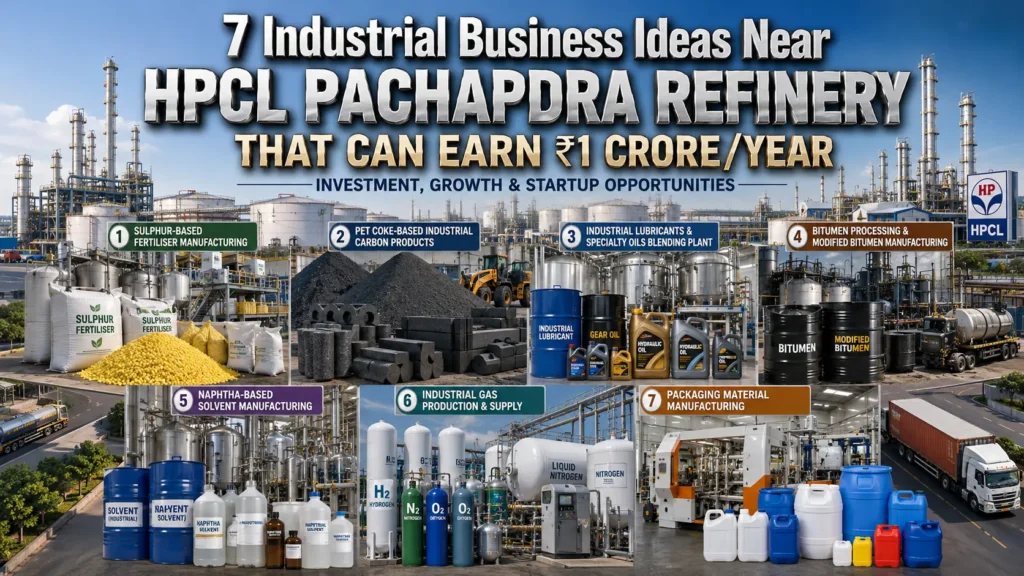
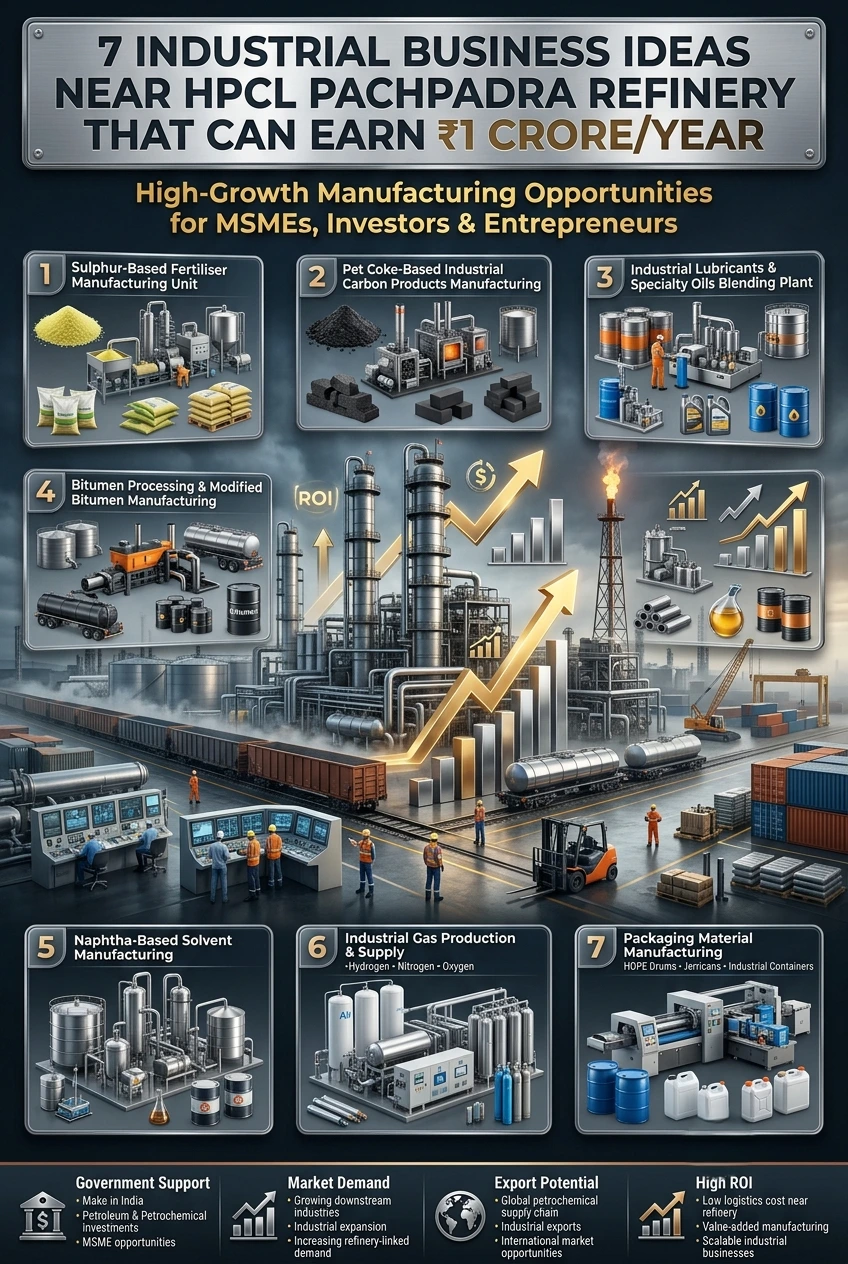
The following are the project ideas for manufacturing and industrial which is well suited to Pachpadra ecosystem. Each idea is based on the availability of feedstock, the logic of market demand, and practical considerations of setup. They are an array of investment sizes and technical levels, hence an entry point for different types of entrepreneurs.
1. Sulphur-Based Fertiliser Manufacturing Unit
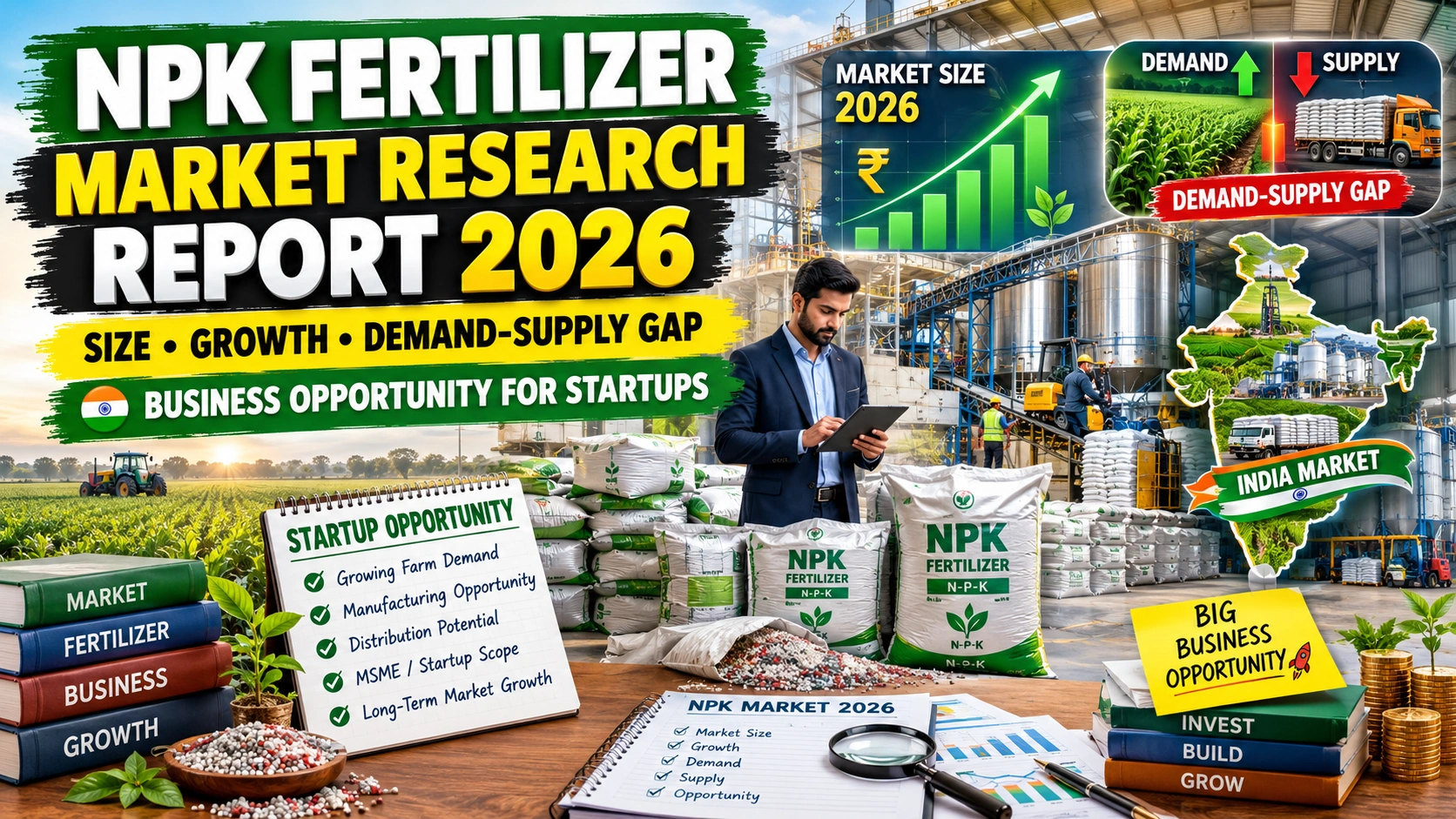
Elemental sulphur is a by-product of crude oil refineries in the desulphurisation process. The HRRL Pachpadra plant will produce huge quantities of sulphur, which is today being transported from Pachpadra to the manufacturers of fertilisers over a long distance. An entrepreneur, who establishes a sulphur-based fertiliser plant near Pachpadra, automatically has the advantage of logistics costs compared with the other plants located at great distances, being able to get sulphur feedstock directly from there. The agriculture industry in India is huge and there is a constant demand for sulphur-based fertilizers particularly in the states of Rajasthan, Punjab, Haryana and Madhya Pradesh.
The domestic demand of SSP is in millions of tonnes annually alone. Furthermore, the soil health mission by Indian Council of Agricultural Research (ICAR) has been actively encouraging sulphur application to nutrient deficient soils, which is a nonmarket driven demand that is policy-based. Hence, this business has a dependable supply chain and a reliable demand base.
Get Detailed Insights from This Book: Fertilizers Manufacturing Handbook
2. Pet Coke-Based Industrial Carbon Products Manufacturing
Another major by-product of the refinery is petroleum coke (pet coke) and its use in industry has grown greatly in recent years. Pet coke is used as feedstock for carbon anodes in aluminium smelting, in the cement kiln as fuel and for steel and titanium industry calcined coke. The commercial feasibility of setting up a unit for calcination of pet coke and carbon products is good near Pachpadra as there is no transportation cost of raw material for competition units. Indian aluminium industry, represented by major companies such as NALCO, Vedanta and Hindalco, is regular consumers of calcined pet coke.
A further buffer for the industry comes from the development of alternative fuels for the cement industry, which has grown its appetite. A moderate to high capital investment that has good B2B offtakes for industries. In addition, switching costs are high for industrial buyers of calcined coke, making long-term supply contracts prevalent in this industry.
3. Industrial Lubricants and Specialty Oils Blending Plant
The industrial lubricants are derived from base oil fractions obtained from the refineries. Establishment of a lubricant blending and formulation plant, in the vicinity of the refinery, can be a very profitable business particularly when concentrating on the rapidly expanding industrial and automotive aftermarket. Import of finished lubricants and specialty oils represents a huge import substitution opportunity for India. The capital investment required for setting up a medium scale lubricant blending unit is moderate and with proper product formulation and distribution strategy, entrepreneurs can cater to different industry firms like mining, manufacturing, transport and agriculture industry which are in and around Rajasthan.
With the correct formulation skill, the technical barrier is low and the branding and distribution become the main differentiators. Furthermore, the consumption of lubricant products is repetitive — not a single use — providing very strong recurring revenue characteristics for the right manufacturer.
Related Article: Petroleum Products: Refining and Distillation (Lubricants, Waxes and Petrochemicals) Manufacture of Crude Oil, Gasoline, Kerosene, Absorbent, Oils, and Fuels Oils, Petroleum Asphalts
4. Bitumen Processing and Modified Bitumen Manufacturing
Bitumen, which is one of the key components of crude oil refineries, is the primary material in the construction of roads, waterproofing and roofing. The HRRL Pachpadra refinery will be producing bitumen, and the area of northern and western India has an active road construction programme as part of schemes such as Pradhan Mantri Gram Sadak Yojana (PMGSY) and National Highway Development Programme. The ability to establish a modified bituminous factory in the vicinity of Pachpadra, directly supplying polymer modified bituminous (PMB) and bituminous emulsions to construction companies and road contractors, will have a significant impact on the region.
For the region, the establishment of a modified bituminous factory near Pachpadra will have a significant impact on the provision of polymer modified bituminous (PMB) and bituminous emulsions directly to the construction companies and road contractors in the region. The price of modified bitumen exceeds the price of plain bitumen, and its purchase volume is relatively stable. This too is a business with a natural anchor customer base – government infrastructure projects – that gives it visibility that a business with a pure market-facing is not always able to offer. Moreover, the segment business model develops a non-seasonal layer of private sector demand for the waterproofing and roofing application.
5. Naphtha-Based Solvent Manufacturing
Naphtha is an important product of the refinery that is a feedstock for various industrial solvents such as paints and coatings, adhesives, cleaning agents and pharmaceutical intermediates. The Indian solvent industry is competitive, and a considerable part of the demand is yet to be satisfied with local or imported supply sources. An entrepreneur who establishes a processing or blending unit for naphtha-based solvents at the site near Pachpadra is enjoying benefits of proximity of feedstock, minimized inventory carrying cost and quicker turnaround of customers.
Paint and coatings are a very strong end market, and is driven by growth in residential construction and increased auto production. Moreover, pharmaceutical manufacturing cluster in Rajasthan generates a local demand base for high purity solvents. Careful compliance planning is required for this type of business, but economics are good provided that it is operated well. Hence, it is not only a regulatory obligation to invest early in a robust effluent treatment system, but a business enabler as well.
6. Industrial Gas Production and Supply (Hydrogen, Nitrogen, Oxygen)
Industrial gases used in refineries include hydrogen for hydrotreatment and hydrocracking, nitrogen for blanketing, purging and other process applications and oxygen for various applications. Often, large refineries establish a captive industrial gas plant, but there is still large potential for dedicated third-party industrial gas suppliers to the wider industrial cluster developing around a refinery. The entrepreneur who establishes an air separation unit (ASU) or hydrogen production plant in the vicinity of Pachpadra can provide not only the refinery ecosystem but also other manufacturing plants in the area.
Industrial gas customers have steady and predictable demand; long-term supply contracts are the norm in this industry and switching industrial gas is expensive. This is a forward-looking business opportunity as the government’s National Hydrogen Mission further provides a long-term tailwind to hydrogen-related infrastructure investments.
7. Packaging Material Manufacturing (HDPE Drums, Jerricans, and Industrial Containers)
A significant amount of industrial packaging is required for every refinery and every chemical plant downstream, including large drums of HDPE, jerricans, IBCs (intermediate bulk containers) and special containers for hazardous chemicals. It is a manufacturing industry that is seldom considered by entrepreneurs tempted by the “glamour” of chemical processing but the economics are always good. The main raw material is HDPE that is sourced from petrochemical feedstocks available in the Pachpadra supply chain. Proximity to both raw material and customer leads to setting up blow moulding/ injection moulding plant for industrial packaging near Pachpadra.
All the refinery, the sulphur producers, the lubricant blenders, and the solvent manufacturers in the industrial cluster can be potential buyers. Moreover, the demand for HDPE packaging is increasing with its export potential in Africa and the Southeast Asian regions, which is a business opportunity with domestic as well as international upside. The capital needed is relatively low for a market opportunity and production technology is proven.
Get Detailed Project Report (DPR): Complete Packaging Industry Guide
Import–Export Opportunity Analysis for Startups Near Pachpadra
India is having a structural opportunity in petrochemicals and chemicals as it imports much more value in chemical products than it exports, though it has refinery and upstream capability to make significant production. Where smart entrepreneurs can build export-oriented manufacturing businesses is this gap.
India imports significant quantities of speciality chemicals and polymer additives, lubricant additives and modified bitumen from countries such as South Korea, China, Germany and the US on import. A domestic manufacturer near Pachpadra can aim to provide import substitution in every one of these categories – those who buy from foreign manufacturers. In many product categories, domestic supply may be more appealing than imports for a Pachpadra-based manufacturer, due to lower logistics costs of feedstocks.
On export side, India is with competitive edge in products such as sulphur fertilisers, bituminous emulsions, industrial lubricants and specialty solvents among various markets in South Asia, East Africa and the Gulf region. The nearby proximity of Pachpadra belt to Mundra and Kandla ports makes the export logistics manageable with ease as they are in approximately 400-450 km distance. Entrepreneurs who develop quality systems from the beginning that are export ready will have access to domestic and international income streams.
The Directorate General of Foreign Trade (DGFT) is an excellent source of information for this form of planing because it can offer latest trade policy, export incentive notifications and market access information.
Indian MSME Success Stories to Learn From
You’re not just inspired; you’ve got a plan — thanks to understanding how successful industrial entrepreneurs have developed their businesses around petrochemical clusters. These three are examples of concrete, replicable, decision logic.
Gujarat Fluorochemicals Limited (GFL) – Punit Lalbhai’s Downstream Positioning
The company, promoted by the Lalbhai Group, established its business by capitalising on a niche downstream chemical opportunity in fluorochemicals which needs specialised refinery linked feedstocks. The company’s move towards location of manufacturing near the petrochemical hub of Gujarat was not by chance. It not only lowered the company’s logistics costs for feedstocks, but also provided the company with access to suppliers of industrial gas and process chemicals early.
In the present times GFL is one of the prominent specialty chemical exporters in India. For new entrepreneurs, the salient point is one that is simple yet striking: Find a niche in the downstream of a current or future refinery output, develop technical expertise in that niche, and get early to it before you’re out-competed. The success of GFL also illustrates the power of niche with technical depth to provide pricing power for those who are not commodity oriented.
Apar Industries – Kushal Desai’s Multi-Sector Industrial Bet
Kushal Desai, the CEO of Apar Industries, accumulated a large fortune with its transformer oil and specialty oils business, taking advantage of its nearness to the refinery business in Gujarat. The company obtains base oil fractions and refines them into high-margin, automobile and transformer oils, which are both in domestic and export markets. Apar’s success comes from moving up the value chain – rather than buying and selling raw petrochemical materials, Apar is able to buy and sell finished industrial products where the value chain provides a degree of pricing power through branding and technical specifications.
To add, entrepreneurs close to Pachpadra are able to follow this at a smaller scale, without dealing in the trading of bulk commodities but by focusing on a specific category of the finished product. The lesson to take from here is that the refinery provides you the raw material advantage, but the real business value is downstream in the formulation and application of the raw material.
Vijay Agro Industries – A Rajasthan MSME That Built on Supply Chain Positioning
Rajasthan has also some MSME success stories in agro-chemical and fertiliser manufacturing by leveraging their presence on the raw material supply chains. The entrepreneurs of such enterprises always point to one key decision as the most crucial – location based on supply chain rationale, not convenience. Having a feedstock source within 50-100 km of the plant means that working capital requirements are lowered, delivery is more reliable and quality control is tighter. This might be the most repeatable and useful model for Pachpadra entrepreneurs.
The cost advantage should be a function of the supply chain and the business model should be created around it, all the while working towards a position of sustained competitive advantage that rivals who are further away will have a hard time closing the gap.
Find high-return business ideas based on your budget & ROI
How Professional Feasibility Planning Makes the Difference
All business concepts are great on paper. The key to a successful industrial project is a careful pre-investment feasibility study. This is the place where skilled consulting becomes truly useful, and where numerous entrepreneurs end up underinvesting at just the wrong time.
We at Niir Project Consultancy Services (NPCS) offer professional Consulting services for preparing Market Survey cum Detailed Techno-Economic Feasibility Reports (DPRs) for establishing new Industries and business. Our reports include detailed manufacturing processes, market research and demand analysis, process flow diagrams, product mix and capacity planning, details of machinery and raw material sourcing as well as project financials and profitability analysis. Our goal is quite simple: to assist entrepreneurs in assessing whether their venture is feasible, profitable, and scalable.
For a project near the Pachpadra refinery corridor, a professional DPR can identify the most viable feedstock sourcing arrangements, benchmark realistic capital and operating costs, model revenue projections under different demand scenarios, and help you present a bankable project to financial institutions. It can also identify regulatory requirements and environmental clearances specific to the petrochemical sector — which, if not addressed early, can significantly delay project commissioning and increase costs.
Indicative Investment and Market Overview: Key Business Opportunities Near Pachpadra
| Business Idea | Refinery Input Used | Est. Investment (₹ Cr) | Primary Market | Export Potential |
| Sulphur-Based Fertiliser | Elemental Sulphur | ₹2–5 Cr | Agriculture (N&W India) | Moderate |
| Pet Coke Carbon Products | Petroleum Coke | ₹5–15 Cr | Aluminium, Steel, Cement | High |
| Industrial Lubricants | Base Oil | ₹1–4 Cr | Automotive, Industrial | High |
| Modified Bitumen | Bitumen | ₹2–6 Cr | Road Construction | Low–Moderate |
| Naphtha Solvents | Naphtha | ₹3–8 Cr | Paints, Pharma, Adhesives | Moderate |
| Industrial Gases | Air / Natural Gas / H2 | ₹10–30 Cr | Refinery, Manufacturing | Low |
| HDPE Industrial Packaging | HDPE Polymer | ₹1.5–4 Cr | Chemical, Food, Export | High |
Source: NPCS Research Analysis. Investment estimates are indicative and depend on scale, technology choice, and location-specific factors.
Key Policy and Data References for Investors
Entrepreneurs planning projects in this corridor should build their feasibility plans on reliable policy and data sources. The following government and institutional references are particularly relevant:
- The Department for Promotion of Industry and Internal Trade (DPIIT) tracks FDI inflows, industrial licensing, and sector investment data across India.
- The Make in India portal provides sector-specific opportunity mapping and investment facilitation resources for new entrepreneurs.
- The Federation of Indian Chambers of Commerce and Industry (FICCI) publishes sector reports and industry outlook analyses for petrochemicals and chemicals.
Frequently Asked Questions (FAQs)
Q1. What is the minimum investment required to start a manufacturing business near the Pachpadra refinery?
The minimum investment will depend upon the business you want to start – for a basic lubricants blending and/or packaging plant, you can start with as low as 1-2 crore including Plant and Machinery – some large scale activities such as manufacturing of industrial gases or processing of pet coke will require 10 crore and above; however, thanks to capital subsidy in the form of PMEGP, CGTMSE loan without collateral, RIPS state subsidies etc – the entrepreneurial investment might be just a fraction of the project cost.
Q2. Is the HPCL Pachpadra refinery operational, and when can businesses start sourcing feedstock from it?
The HRRL Pachpadra project is in various stages of construction and commissioning. All intending entrepreneurs need to make current due diligence of actual progress based on notifications and press release by HPCL and government sources. For those directly dependent on refinery product output (as feedstock), approach should be made to the commercial team of the refinery, on an upfront basis to seek for formal feedstock supply arrangements and also use existing Gujarat refinery based alternative supply for the short-term bridge.
Q3. What are the environmental clearance requirements for setting up a chemical or petrochemical unit in Rajasthan?
These chemicals and petrochemical manufacturing industries generally falls under the Red Category of Industries which necessitates the grant of Environmental Impact Assessment (EIA) and Environmental Clearance (EC) from the Ministry of Environment, Forests and Climate Change (MoEFCC). The consents at the state level will be managed by Rajasthan Pollution Control Board (RPCB). The entrepreneurial should consider a time span of at least 12-18 months for environmental clearances in the overall project plan and employ a good environmental expert consultant right from the initiation stage.
Q4. Are there industrial plots available near the Pachpadra refinery for new manufacturers?
RIICO is also planning for industrial areas around this Barmer-Balotra axis because that refinery related growth. Applications for industrial plots in RIICO colonies, often provided with roads, electricity and water at the plotting stage are to be made through RIICO and the cost of land surrounding an anchor project increases rapidly hence acquiring a piece of land today also holds an economic argument.
Q5. Can a first-generation entrepreneur without a chemical engineering background enter this sector?
Yes, with a big dose of qualifications. Some industries such as industrial packaging, lubricants and asphalt processing require a significantly lower technical skill base than the synthesis chemical products are dependent on. A first-generation entrepreneur can successfully enter these segments by hiring experienced plant managers, working with technology licensors who offer turnkey plant setups, and commissioning a detailed techno-economic feasibility report to understand the operational requirements thoroughly before investing. The critical success factor is not personal technical knowledge — it is the ability to build the right team and make informed decisions based on quality analysis.
Q6. What is the expected payback period for a manufacturing investment near Pachpadra?
Payback periods vary by business type and scale. For well-planned manufacturing units in the lower-complexity segments like lubricant blending or packaging, a payback period of 4–6 years is achievable under realistic demand assumptions. More capital-intensive or technically complex projects may require 6–10 years. The feedstock cost advantage of being near the Pachpadra refinery, combined with government incentives, can accelerate payback timelines compared to equivalent businesses located farther from the supply chain.
Conclusion: The Window Is Open — But Not Forever
The HPCL Pachpadra refinery is not just another infrastructure project. It represents a fundamental shift in the industrial geography of western India. Historically, most downstream petrochemical manufacturing in India has been concentrated in Gujarat, Maharashtra, and Andhra Pradesh. Pachpadra creates a new centre of gravity — and the entrepreneurs who position themselves near it in the coming years will enjoy first-mover advantages in feedstock access, infrastructure connectivity, and market positioning that latecomers will struggle to replicate.
However, it is important to approach this opportunity with discipline. A business idea near a refinery is only as good as the feasibility analysis behind it. Understanding feedstock availability timelines, environmental clearance requirements, market demand realities, and capital cost benchmarks is not optional — it is the minimum standard for responsible investment planning.
The manufacturing and industrial project opportunities discussed in this article are real. The government policy support is substantial. The market demand is backed by structural drivers. What this opportunity requires from you is serious, informed preparation. Start with a solid feasibility study, engage with the right technical and regulatory advisors, and make your move before the industrial cluster around Pachpadra becomes क्राउडेड।